非平滑凸最適化に関する並列計算手法
Parallel
Computing
Method for Nonsmooth
Convex
optimization
明治大学理工学部情報科学科 菱沼和弘,飯塚秀明
Kazuhiro HISHINUMA and Hideaki IIDUKA
Department ofComputer Science, School of Science and Technology,
Meiji University
ABSTRACT. Inthis paper, weconsider the problem of minimizing thesum of
nondifferen-tiable, convex functionsover aclosed convex set in a real Hilbert space, which is simple in
thesensethat the projectiononto it canbe easilycalculated. We presentaparallel subgra-dient methodfor solving it and the two convergence analyses of the method. One analysis shows that the parallel method withasmall constant step size approximates asolution to
theproblem. The other analysis indicates that the parallel method withadiminishing step
size convergestoasolution tothe problem in thesense of the weak topology of the Hilbert space. Finally, we numerically compare our method with the existing method and state future workonparallelsubgradient methods.
1. INTRODUCTION
This paper considers the following standard nonsmooth convex minimizationproblem.
Problem 1.1. Let $f_{i}(i=1,2, \ldots, K)$ be convex, continuous functionals on a real Hilbert
space $H$ and let $C$ be a nonempty, closed convexsubset of $H$. Then,
minimize $\sum_{i=1}^{K}f_{i}(x)$ subject to$x\in C.$
A useful algorithm for solving Problem 1.1 is the incremental subgradient method [9, 12], and it is defined as follows: for defining $P_{C}$ as the projection onto $C$ and $\partial f_{i}(x)$ as the
subdifferential of$f_{i}$ at $x\in H$ $(i=1,2, \ldots , K)$, an iteration $(n+1)$ of the algorithm is
(1.1) $\{\begin{array}{l}\psi_{0,n}:=x_{n},\psi_{i,n}:=P_{C}(\psi_{i-1,n}-\lambda_{n}g_{i,n}) , g_{i,n}\in\partial f_{i}(\psi_{i-1,n})(i=1,2, \ldots, K) ,x_{n+1}:=\psi_{K,n}.\end{array}$
Algorithm (1.1) requires us to use $P_{C}$ each iteration. Hence, we assume that $C$ is simple in
thesensethat $P_{C}$ can beeasily calculatedwithin afinitenumber ofarithmetic operations [1,
p.406], [2, Subchapter 28.3]. Some incremental methods that can be applied when $C$ is not
always simple werepresented in [4, 6, 7].
Meanwhile, parallel proximal algorithms [2, Proposition 27.8], [3, Algorithm 10.27], [10] are
convex $f_{i}$ which maps every $x\in H$ to the uniqueminimizer of$f_{i}+(1/2)\Vert x-\cdot\Vert^{2}$, where $\Vert\cdot\Vert$
stands for the norm of $H$. The parallel gradient algorithms presented in [6, 7] work only
when $f_{i}$ is differentiable and convex, and $C$ is not always simple.
This paper presents
a
parallel subgradient method for solving Problem 1.1. The proposed method doesnot useany proximityoperators, in contrast to the algorithms in [2, Proposition27.8], [3, Algorithm 10.27], [10]. Next, we present convergence analyses for the two step-size
rules: a constant step-size rule and a diminishing step-size rule. We show that the proposed method withasmallconstantstepsizeapproximatesasolution to Problem 1.1. We also show that the algorithm with a diminishing step size weakly converges to a solution to Problem 1.1.
This paper is organized
as
follows. Section 2givesthemathematicalpreliminaries. Section3presents theparallel algorithm for minimizingthesumofconvexfunctionals over a simple,
convex closed constraint set and studies its convergence properties for a constant step size andadiminishing step size. Section4 providesnumericalexamples of the algorithm. Section 5 concludes the paper and mentions future work on parallel subgradient methods.
2. PRELIMINARIES
Let $H$ be areal Hilbert space with inner product and its induced norm $\Vert$ . Let $\mathbb{N}$
denote the set of all positive integers includingzero.
2.1. Subdifferentiability and projection. The
subdifferential
[2, Definition 16.1], [11,Section 23], [13, p.132] of $f:Harrow \mathbb{R}$ is the set-valued operator,
$\partial f:Harrow 2^{H}:x\mapsto\{u\in H:f(y)\geq f(x)+\langle y-x, u\rangle(y\in H)\}.$
Suppose that $f:Harrow \mathbb{R}$iscontinuous andconvexwith$dom(f)$ $:=\{x\in H:f(x)<\infty\}=H.$
Then, $\partial f(x)\neq\emptyset(x\in H)$ [$2_{\}}$ Proposition 16.14(ii)]:
Proposition 2.1. [2, Proposition 16.17] Let $f:Harrow \mathbb{R}$ be continuous and convex with
$dom(f)=H$. Then, thefollowing are equivalent:
(i) $f$ is bounded
on every
bounded subsetof
$H.$(ii) $f$ is Lipschitz continuous relative to every bounded subset
of
$H.$(iii) $dom(\partial f)$ $:=\{x\in H:\partial f(x)\neq\emptyset\}=H$ and $\partial f$ maps every bounded subset
of
$H$ to abounded set.
The metric projection [2, Subchapter 4.2, Chapter 28] onto a nonempty, closed convex set
$C(\subset H)$ is denoted by $P_{C}$. It is defined by $P_{C}(x)\in C$ and $\Vert x-P_{C}(x)\Vert=\inf_{y\in C}\Vert x-y\Vert$
$(x\in H)$
.
$P_{C}$ is (firmly) nonexpansive with Fix$(P_{C}):=\{x\in H:P_{C}(x)=x\}=C[2,$Proposition 4.8, (4.8)].
2.2. Main problem. This paper deals witha networked system with $K$users. Throughout
this paper, we assume the following.
Assumption 2.2.
(A2) $f_{i}:Harrow \mathbb{R}(i=1,2, \ldots, K)$ iscontinuous and convexwith$dom(f_{i})=dom(\partial f_{i})=H,$
and $\cup\{\partial f_{i}(x):x\in B\}$ is bounded for a bounded set $B(\subset H)$;
(A3) User $i(i=1,2, \ldots, K)$ can
use
$P_{C}$ and $\partial f_{i}$;(A4) User $i(i=1,2, \ldots, K)$ can communicate with all users.
The main objective ofthis paper is to solve the following problem.
Problem 2.3. Under Assumption 2.2, find a minimizer of $\sum_{x’=1}^{K}f_{i}$ over $C.$
3. PARALLEL ALGORITHM
We present a parallel algorithm for solving Problem 2.3.
Algorithm 3.1.
Step O. All users set $x_{0}\in H$ arbitrarily and $\{\lambda_{n}\}\subset(0, \infty)$.
Step 1. User $i(i=1,2, \ldots, K)$ computes $y_{i,n}\in H$ as follows:
$\{\begin{array}{l}g_{i,n}\in\partial f_{i}(x_{n}) ,y_{i,n}:=P_{C}(x_{n}-\lambda_{n}g_{i,n}) .\end{array}$
Step 2. User$i(i=1,2, \ldots, K)$ shares$y_{i,n}$ in Step 1 with all users andcalculates $x_{n+1}\in H$
as follows:
$x_{n+1}:= \frac{1}{K}\sum_{i=1}^{K}y_{i,n}.$
Step 3. Put $n:=n+1$ , and go to Step 1.
Assumption (A2)
ensures
that $\partial f_{i}(x_{n})\neq\emptyset(i=1,2, \ldots, K, n\in \mathbb{N})[2$, Proposition16.14(ii)]. Assumption (A3) impliesthatuser$i(i=1,2, \ldots, K)$ can compute $y_{i,n}$. Moreover,
(A4) guarantees that all users can calculate $x_{n}$ in Step 2.
Theconvergence analyses of Algorithm 3.1 depend
on
the following assumption. Assumption 3.2. For $i=1$,2,... ,$K$, there exists $M_{i}\in \mathbb{R}$ such that$\sup\{\Vert g\Vert:g\in\partial f_{i}(x_{n}), n\in \mathbb{N}\}<M_{i}.$
Suppose that $C$ is bounded $(e.g., C is a$ closed ball). From $\{y_{i,n}\}\subset C(i=1,2, \ldots, K)$,
$\{y_{i,n}\}(i=1,2, \ldots, K)$ is bounded. Accordingly, $\{x_{n}\}$ is bounded. Hence, (A2) (see
Proposi-tion 2.1 for the equivalent propertiesof (A2)) ensures that Assumption3.2 holds. Moreover,
since (A1) and (A2) implythat $C\cap dom(f)=C\neq\emptyset$ and$C$is bounded, (A2) (thecontinuity
and convexity off) guarantees that Problem 2.3 has a solution [2, Proposition 11.14].
This paper uses thenotation,
$M := \max\{M_{i}:i=1, 2, . . . , K\},$
The following is the convergence analysis of Algorithm 3.1 when the step size is
some
constant.Theorem 3.3. Suppose that Assumption 3.2 holds. Let $\lambda$ be a positive
real number and let
$\{x_{n}\}\subset H$ be the sequence generated by Algorithm 3.1. When $\lambda_{n}$ $:=\lambda$
for
all $n\in \mathbb{N}$, thefollowing holds.
$\lim_{narrow}\inf_{\infty}f(x_{n})\leq\inf_{x\in C}f(x)+\frac{1}{2}\lambda KM^{2}.$
Proof.
See [5]. ロThe following theorem indicates the weak convergence of Algorithm3.1with adiminishing
step-size sequence.
Theorem 3.4. Suppose that Assumption 3.2 holds and $\{x_{n}\}\subset H$ is the sequence generated
by Algorithm 3.1, with $\{\lambda_{n}\}$ satisfying
$\sum_{n=0}^{\infty}\lambda_{n}=\infty$ and $\sum_{n=0}^{\infty}\lambda_{n}^{2}<\infty.$
Then,
if
$X$ is nonempty, $\{x_{n}\}$ converges weakly to some point in $X.$Proof.
See [5]. ロ4. NUMERICAL EXAMPLES
We applied the incremental subgradient method (1.1) and Algorithm 3.1 to the following
$N$-dimensional constrained nonsmooth
convex
optimization problem (Problem 1.1 when$H=$$\mathbb{R}^{N}$
and $K=N$).
Problem 4.1. Let $f_{i}:\mathbb{R}^{N}arrow \mathbb{R}(i=1,2, \ldots, N)$ be convexand let $C$bea nonempty, closed
convex
subset of$\mathbb{R}^{N}$. Then,
minimize $\sum_{i=1}^{N}f_{i}(x)$ subject to $x\in C.$
In the experiment, we used the PC-Cluster composed of 48 Fujitsu PRIMERGY RX350
$S7$ computers at the Ikuta campus of Meiji University. One of those computers has two
Xeon E5-2690 $(2.9GHz, 8$ cores) CPUs and $32GB$ memory. We used 64 CPU
cores
of thiscluster; i.e., there were 64 users in the experiment environment that satisfied (A3) and (A4)
of the Assumption 2.2. In the implementation of Step 2 in Algorithm 3.1, we used the
MPI-Allreduce function, which is categorized as an All-To-All collective operation in [8,
Chapter 5], to compute and share the sum of $y_{i,n}$ with all users. This means that all users
contributed to computing$x_{n+1}$ in Algorithm3.1. ThisoperationdoesnotviolateAssumption
2.2. The experimental programs were written in $C$ and compiled by
$gcc$ version
4.4.7
withIntel$(R)MPI$ Library
4.1.
We used GNUScientific
Library 1.16 to express and computeWe set $N:=64$ and $C:=\{x\in \mathbb{R}^{N} : \Vert x\Vert\leq 1\}$ in Problem 4.1. For all $i=1$, 2, . . . ,$N$, we
prepared random numbers$a_{i}\in(0,1)$ and$b_{i}\in(-1,1)$ and gave$a_{i}$ and$b_{i}$ touser$i$ inadvance.
The objective function of user $i$ was defined for all$x\in \mathbb{R}^{N}$ by
$f_{i}(x)$ $:=|a_{i}\langle x,$$e_{i}\rangle+b_{i}|$, where
$e_{i}(i=1,2, \ldots, N)$ stands for the naturalbase of$\mathbb{R}^{N}.$
In the experiment, we set $\lambda_{n}:=1$ for the constant step-size rule and $\lambda_{n}$ $:=1/(n+1)$ for
thediminishing step-size rule. Weperformed 100 samplings, each starting fromthe different
random initial points in $[0, 1)^{N}.$
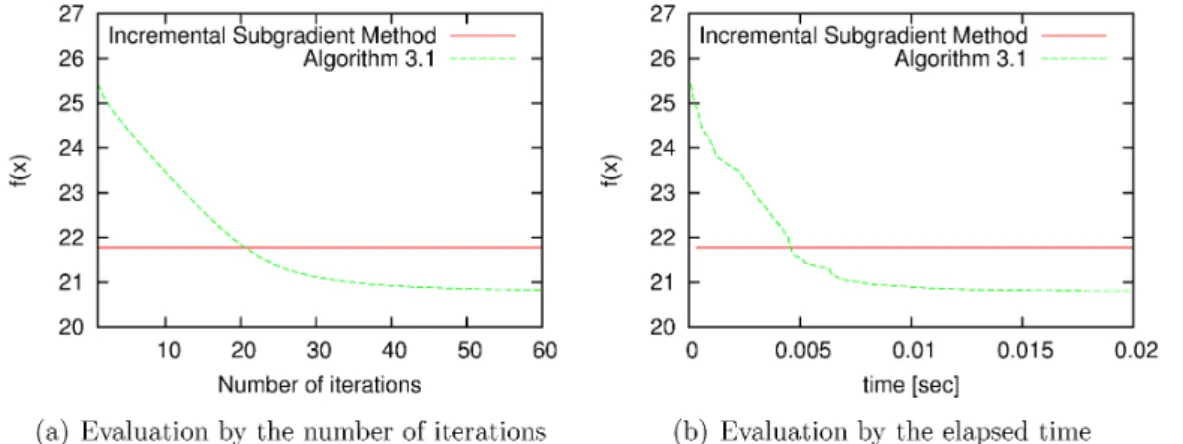
Figure 1 shows the behaviors of$f(x)$ $:= \sum_{i=1}^{N}f_{i}(x)$for the incremental subgradient method
(1.1) and Algorithm 3.1 with a constant step size. The $y$-axis in Figures $1(a)$ and $1(b)$
represent the value of $f(x)$. The $x$-axis in Figure $1(a)$ represents the number of iterations
and the $x$-axis in Figure 1(b) represents the elapsed time. Theresults show that Algorithm
3.1 minimizes the value of $f(x)$ more than the incremental subgradient method does (1.1).
Numberofiterations time$[\sec]$
(a) Evaluation by the number of iterations (b) Evaluation by the elapsed time
FIGURE 1. Behavior of $f(x)$ for the incremental subgradient method and
Al-gorithm 3.1 with constant step size
Figure 2 shows the behaviors of $f(x)$ for the incremental subgradient method (1.1) and
Algorithm 3.1 withthe diminishing step size. The $y$-axis in Figures 2(a) and 2(b) represent
thevalue of$f(x)$. The$x$-axisinFigure 2(a) representsthenumber of iterations, and the$x$-axis
in Figure 2(b) represents the elapsed time. The results show that Algorithm 3.1 converges slower than the incrementalsubgradientmethod. However, it shows that Algorithm3.1 with
aconstant stepsize behaves roughly to thesame as the incremental subgradientmethodwith
the diminishing step size. This implies that, if it is difficult to share the diminishing step
size with all users, Algorithm 3.1 can be usedas an effective approximation algorithm of the
incremental subgradient method.
5. CONCLUSION AND FUTURE WORK
This paperdiscussed the problemof minimizingthe sumofnondifferentiable, convex func-tionsover a simple convexclosed constraint set ofareal Hilbert space. It presentedaparallel
$\hat{arrow\vee X}$
Number ofiterations time$[\sec]$
(a) Evaluation bythenumber ofiterations (b) Evaluation by the elapsed time
FIGURE 2. Behavior of$f(x)$ with diminishing step size
algorithm for solving theproblem. We studied its convergence properties for aconstant step
size and
a
diminishing step size. We showed that the algorithm with a constant step size approximates a solution to the problem, while the algorithm witha
diminishing step size weakly converges to a solution to the problem. Finally, we numerically compared theal-gorithm with the existing algorithm and showed that, when the step size is constant, the
algorithm performs betterthan the existing algorithm.
The numerical comparisons also indicated that, when the step size is diminishing, the
existing algorithmconverges toasolutionfaster thanour algorithm. Therefore, in thefuture,
we should consider developing parallel optimization algorithms which perform better than
the existing algorithm evenwhen the step sizes are diminishing. ACKNOWLEDGMENTS
Theauthors would liketo thank ProfessorWataru Takahashi for givingus achance to
dis-cuss
Problem 2.3in The International Workshop onNonlinear Analysis and ConvexAnalysis held at the Research Institute for Mathematical Sciences, Kyoto University on the 19th of August in 2014.The authors wouldlike to congratulate Professor Wataru Takahashi on his70th birthday. REFERENCES
[1] Bauschke,H.H.,Borwein, J.M.: On projection algorithms for solvingconvexfeasibility problems. SIAM
Review 38(3), 367-426 (1996)
[2] Bauschke, H.H., Combettes, P.L.: Convex Analysis and Monotone Operator Theory in Hilbert Spaces.
Springer (2011)
[3] Combettes, P.L., Pesquet, J.C.: Proximal splitting methods in signal processing. In: H.H. Bauschke,
R.S. Burachik, P.L. Combettes, V. Elser, D.R. Luke, H. Wolkowicz (eds.) Fixed-Point Algorithms for
[4] Helou Neto, E.S., De Pierro, A.R.: Incremental subgradients for constrained convex optimization: $A$
unified frameworkandnewmethods. SIAM Journalon optimization 20, 1547-1572 (2009)
[5] Hishinuma, K., Iiduka, H.: Parallel subgradient method for nonsmooth convex optimization with a
simple constraint. (submitted)
[6] Iiduka, H.: Fixed point optimization algorithms for distributed optimization in networked systems. SIAMJournalon optimization 23, 1-26 (2013)
[7] Iiduka,H.,Hishinuma, K.: Accelerationmethod combining broadcast and incremental distributed
opti-mization algorithms. SIAM Journalon optimization24(4), 1840-1863 (2014)
[8] Message Passing Interface Forum: MPI: A Message-PassingInterface Standard, Version3.0. High
Per-formance Computing Center Stuttgart (2012)
[9] Nedi\v{c}, A., Bertsekas, D.P.: Incremental sugradient methods for nondifferentiable optimization. SIAM
Journalonoptimization 12, 109-138 (2001)
[10] Pesquet, J.C., Pustelnik, N.: Aparallelinertial proximal optimizationmethod. Pacific Journal of Opti-mization8, 273-306 (2012)
[11] Rockafellar, R.T.: Convex Analysis. Princeton University Press (1970)
[12] Solodov, M.V.,Zavriev, S.K.: Error stabilitypropertiesofgeneralizedgradient-type algorithms. Journal of optimization Theory and Applications 98, 663-680 (1998)
[13] Takahashi, W.: Nonlinear Functional Analysis. Yokohama Publishers (2000)
(K.Hishinuma, H.Iiduka)DEPARTMENTOFCOMPUTERSCIENCE, MEIJI UNIVERSITY, 1-1-1 HIGASHIMITA, TAMA-KU, KAWASAK1-SHI, KANAGAWA 214-8571, JAPAN
$E$-mail address, K. Hishinuma:
[email protected]$i$.ac.jp