HIGHER-ORDER ALEXANDER INVARIANTS FOR HOMOLOGICALLY FIBERED KNOTS
HIROSHI GODA AND TAKUYA SAKASAI
1. INTRODUCTION
Thisnoteisadaptedfrom the talk atthe 2010Intelligenceof Low-dimensional Topology
at Research Institutefor Mathematical Sciences, Kyoto University. For the detail,
see
theoriginal papers [12], [13].
Let $\Sigma_{g,n}$ be a compact oriented surface of genus $g$ with $n\geq 1$ boundary components,
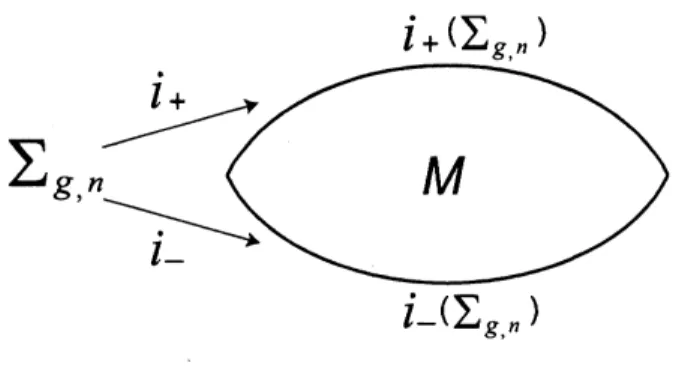
and the triple $(M, i_{+}, i_{-})$ be an oriented homology cobordism between $\Sigma_{g,n}$ and $\Sigma_{g,n}$ with
two markings of$\partial M$ : $i_{+},$$i_{-}:\Sigma_{g,1}\mapsto\partial M$
.
We call $(M, i_{+}, i_{-})$a
homology cylinderover
$\Sigma_{g,n}$
.
This objectwas
introduced by Goussarov [14] and Habiro [16] since it is suitablefor applying the theory of clovers and claspers, and then has been studied together with finite type invariants of 3-manifolds. The following have been known
as
methods for constructing homology cylinders:$\bullet$ connected
sums
of the trivial cobordism with homology 3-spheres; $\bullet$ Levine’s method [19] using string links in the 3-ball;$\bullet$ Habegger $s$ method [15] giving homology cylinders
as
results of surgeries alongstring links in homology 3-balls; and
$\bullet$ clasper surgeries (see [14] and [16]).
In [12], the authors gave anexplicit construction of homology cylinders, i.e.
we
introduceda
notion ofa
homologicallyfibered
knot and constructa
homology cylinder using it. The family of the homologically fibered knots include that of the fibered knots. So, roughly speaking, the following relationships exist:Pure$\cap Braid$ $rightarrow$
$Mapping\cap$cylinder $Fibered\cap$ knot
Pure String link $\underline{Levin}e$
Homology cylinder Homologically fibered knot
(Habegger-Lin) (Goussarov, Habiro)
In [18], Kirk-Livingston-Wang introduced a Reidemeister torsion for string links, then
the second author studied the corresponding Reidemeister torsion for homologycylinders
in [23]. Note that this torsion may be regarded
as
aspecialcase
ofa
decatogorification of sutured Floer homology [8]. In thisnote, we study the Reidemeistertorsion forhomologi-callyfibered knots and show afactorization formula. Further, wegive a MATHEMATICA
program for explicit calculations of the invariants for homologically fibered knots.
2000 Mathematics Subject Classification. Primary$57M27$, Secondary$57M25$.
The authors are partially supported by Grant-in-Aid for Scientific Research, (No. 21540071 and No. 21740044), MinistryofEducation, Science, Sports and Technology, Japan.
2. HOMOLOGICALLY FIBERED KNOTS
In this section,
we
introduce two main objects in this note: homology cylinders and sutured manifolds. First, we define homology cylindersover
surfaces, which have their originin Goussarov [14], Habiro [16], Garoufalidis-Levine [11] and Levine [19]. Let $\Sigma_{g,n}$ bea
compact connected oriented surface ofgenus $g\geq 0$ with $n\geq 1$ boundary components.Definition 2.1. A homology cylinder $(M, i_{+}, i_{-})$
over
$\Sigma_{g,n}$ consists ofa
compactoriented3-manifold $M$ with two embeddings $i_{+},$$i_{-}:\Sigma_{g,n}\mapsto\partial M$ such that:
(i) $i_{+}$ is orientation-preserving and $i_{-}$ is orientation-reversing;
(ii) $\partial M=i_{+}(\Sigma_{g,n})\cup i_{-}(\Sigma_{g,n})$ and $i_{+}(\Sigma_{g,n})\cap i_{-}(\Sigma_{g,n})=i_{\dagger}(\partial\Sigma_{g,n})=i_{-}(\partial\Sigma_{g,n})$;
(iii) $i_{+}|_{\partial\Sigma_{g,n}}=i_{-}|_{\partial\Sigma_{g,n}}$; and
(iv) $i_{+},$$i_{-}:H_{*}(\Sigma_{g,n};\mathbb{Z})arrow H_{*}(M;\mathbb{Z})$
are
isomorphisms.If
we
replace (iv) with the condition that $i_{+},$$i_{-}:H_{*}(\Sigma_{g,n};\mathbb{Q})arrow H_{*}(M;\mathbb{Q})$are
isomor-phisms, then $(M, i_{+}, i_{-})$ is called a rational homology cylinder.
$i_{+}( \sum_{g,n})$
$i_{-}( \sum_{g,n})$
FIGURE 1. Homology cylinder
We often write
a
(rational) homology cylinder $(M, i_{+}, i_{-})$ briefly by $M$.
Note thatour
definition is the
same
as that in [11] and [19] except that we may consider homology cylindersover
surfaces with multiple boundaries.Two (rational) homology cylinders $(M, i_{+}, i_{-})$ and $(N, j+, j_{-})$ over $\Sigma_{g,n}$ are said to be
isomorphicif there exists
an
orientation-preserving diffeomorphism $f$ : $Marrow N\underline{\simeq}$satisfying$j+=foi_{+}$ and$j_{-}=foi_{-}$. Wedenote the set of isomorphism classesofhomology cylinders
(resp. rational homology cylinders) over $\Sigma_{g,n}$ by $C_{g,n}$ (resp. $C_{g,n}^{\mathbb{Q}}$).
Example 2.2 (Mapping cylinder). For each diffeomorphism $\varphi$ of $\Sigma_{g,n}$ which fixes $\partial\Sigma_{g,n}$
pointwise (hence, $\varphi$ preserves the orientation of$\Sigma_{g,n}$), we can construct ahomology
cylin-der by setting
$(\Sigma_{g,n}\cross[0,1], id\cross 1, \varphi\cross 0)$,
where collars of $i_{+}(\Sigma_{g,n})$ and $i_{-}(\Sigma_{g,n})$
are
stretched half-way along $(\partial\Sigma_{g,n})\cross[0,1]$. It is easily checked that the isomorphism class of $(\Sigma_{g,n}\cross[0,1], id\cross 1, \varphi\cross 0)$ depends onlyon
the (boundary fixing) isotopy class of $\varphi$. Therefore, this construction gives a map from
Next, we recall the definition of sutured manifolds given by Gabai [10]. We here
use a
special
case
of them.A sutured
manifold
$(M, \gamma)$ isa
compact oriented 3-manifold $M$ together witha
subset$\gamma\subset\partial M$ which is
a
union offinitely many mutually disjoint annuli. For each componentof$\gamma$,
an
orientedcore
circle calleda
suture is fixed, andwe
denote the set of sutures by$s(\gamma)$. Every component of$R(\gamma)=\partial M$-Int$\gamma$ is oriented
so
that the orientationson
$R(\gamma)$are
coherent with respect to $s(\gamma)$, that is, the orientation of each component of $\partial R(\gamma)$induced from that of $R(\gamma)$ is parallel to the orientation of the corresponding component
of$s(\gamma)$. We denote by $R_{+}(\gamma)$ (resp. $R_{-}(\gamma)$) the union of those components of$R(\gamma)$ whose normal vectors point out of (resp. into) $M$.
Example 2.3. For
a
knot $K$ in $S^{3}$ anda
Seifert surface $\overline{R}$ of$K$,we
set $R:=\overline{R}\cap E(K)$,called also
a
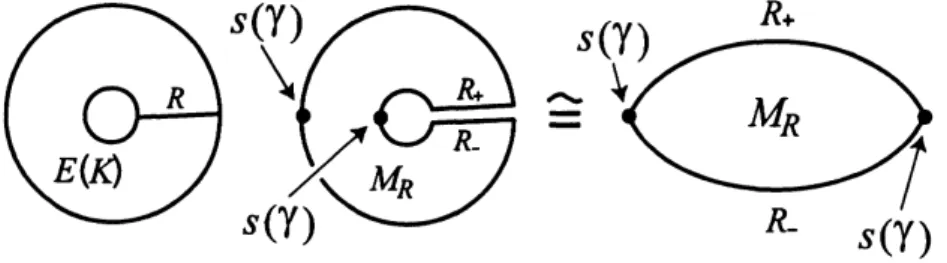
Seifert surface, where $E(K)=\overline{S^{3}-N(K)}$ is the complement of a regularneighborhood $N(K)$ of$K$. Then $(M_{R}, \gamma)$ $:=(\overline{E(K)-N(R)}, \overline{\partial E(K)-N(\partial R)})$ defines
a
sutured manifold. We call it the complementary suturedmanifold
for $R$.
In this paper,we simply call it the sutured manifold for $R$
.
FIGURE 2. Complementary sutured manifold
Let $L$ be an oriented link in the 3-sphere $S^{3}$, and $\triangle_{L}(t)$ the normalized (one variable)
Alexander polynomial of$L$, i.e. the lowest degree of$\Delta_{L}(t)$ is $0$
.
Definition 2.4. An n-component link $L$ in $S^{3}$ is said to be homologically
fibered
if $L$satisfies the following two conditions:
(i) The degree of $\Delta_{L}(t)$ is $2g+n-1$, where $g$ is the genus of
a
connected Seifertsurface of$L$; and
(ii) $\Delta_{L}(0)=\pm 1$
.
If
an
n-component link$L$ satisfies (i), then $L$ is said to be rationally homologicallyfibered.
The Alexander polynomial that satisfies the condition (ii) is said to be monic in this paper.
Remark 2.5. In general, if $L$ bounds a connected Seifert surface ofgenus $g$, then
$2g+n-1\geq$ (the degree of$\triangle_{L}(t)$).
It is known ([5], [21]) that if $L$ has
an
alternating diagram that gives, by the Seifertalgorithm, a connected Seifert surface ofgenus $g$, then the degree of $\Delta_{L}(t)$ is equal to $2g+n-1$
.
Remark 2.6. Suppose $L$ is an alternating link. Then, $L$ isfibered if and only if$\triangle_{L}(t)$ is
monic, by Murasugi [22] (see also 13.26 (c) in [1]). Therefore, if a homologically fibered
link $L$ is not fibered, then $L$ is non-alternating.
Let $L$ be
an
n-component link and $\Sigma_{g,n}$ the compact oriented surface that isdiffeo-morphic to
a
Seifert surface $R$ of $L$.
We fixa
diffeomorphism $\theta$ : $\Sigma_{g,n}arrow\underline{\simeq}R$ and denoteby $(M_{R}, \gamma)$ the complementary sutured manifold for $R$. Then we may see that there
are an orientation-preserving embedding $i+:\Sigma_{g,n}arrow M_{R}$ and an orientation-reversing
embedding $i_{-}:\Sigma_{g,n}arrow M_{R}$ with $i_{+}(\Sigma_{g,n})=R_{+}(\gamma)$ and $i_{-}(\Sigma_{g,n})=R_{-}(\gamma)$, where two
embeddings $i\pm$
are
the composite mappings of$\theta$ and embeddings $\iota\pm:R\mapsto M_{R}$ such that$i_{\pm}=\iota_{\pm}0\theta:\Sigma_{g,n}arrow R_{\pm}(\gamma)\subset M_{R}$:
$\Sigma_{g,n}arrow^{\theta}R$
$\backslash _{i\pm}\downarrow\iota\pm$
$M_{R}$
If$i_{+},$ $i_{-}:H_{1}(\Sigma_{g,n})arrow H_{1}(M_{R})$
are
isomorphisms,we
mayregard $(M_{R}, \gamma)$as a
homology cylinder. The next proposition was essentially mentioned in [6]. A proof is given in [12]. Proposition 2.7. Let $R$ be aSeifert
surface of
a link L.If
the complementary suturedmanifold for
$R$ is a homology cylinder, then $L$ is homologicallyfibered.
Conversely,if
$L$is homologically fibered, then the complementary sutured
manifold for
each minimalgenusSeifert surface of
$L$ is a homology cylinder.It is known that all homologicallyfibered knots are fibered among prime knots with at
most 11 crossings. On the other hand, Friedl-Kim [9] (see also [2]) showed that there are
13 non-fibered homologically fibered knots with 12-crossings. See Figure 7.
3. FACTORIZATION FORMULAS OF ALEXANDER lNVARlANTS
Let $R$be aminimalgenus Seifert surfaceofarationally homologically fibered knot $K$ in
$S^{3}$, and $M_{R}$be the sutured manifold for$R\cong\Sigma_{g,1}$. We fixabasis of$H_{1}(R;\mathbb{Q})$, which yields
anisomorphism$H_{1}(R;\mathbb{Q})\cong \mathbb{Q}^{2g}$. Thenwe canrewrite the definition $\triangle_{K}(t)=\det(S-tS^{T})$
of the Alexander polynomial of$K$ by using theinvertibility (over $\mathbb{Q}$) ofthe Seifert matrix
$S$, and obtain a factorization
(3.1) $\triangle_{K}(t)=\det(S)\det(I_{2g}-t\sigma(M_{R}))$
of$\triangle_{K}(t)$
.
Note that $\sigma(M_{R})$ $:=S^{-1}S^{T}$ represents the composite ofisomorphisms$\mathbb{Q}^{2g}\cong H_{1}(R;\mathbb{Q})arrow H_{1}(M_{R};\mathbb{Q})i-\underline{\simeq}\vec{i_{+}^{-1}}\underline{\simeq}H_{1}(R;\mathbb{Q})\cong \mathbb{Q}^{2g}$
.
The matrix $\sigma(M_{R})$ can be interpreted as a monodromy of $M_{R}$ from a view point of the
rational homology. Regarding the formula (3.1)
as a
basic case,we
constructed in [12] its generalization under the framework of higher-order Alexander invariantsdue to Cochran[3], Harvey [17] and Friedl [7]. In this procedure, the Seifert matrix $S$, the monodromy
matrix $r_{\rho}(M_{R})$ and
some
higher-order (non-commutative) Reidemeister torsion $\tau_{\rho}(E(K))$associated with
a
representation $\rho$ of the fundamental group of$M_{R}$.
Here, we review higher-order Alexander invariants quickly. Fora matrix $A$ with entries
in a group ring $\mathbb{Z}G$ (or its quotient field) for a group $G$, we denote by $\overline{A}$ the matrix
obtained from $A$ by applying the involution induced from $(x\mapsto x^{-1}, x\in G)$ to each
entry. For
a
module $M$,we
write $M^{n}$ for the module of column vectors with $n$ entries.For
a
finite cell complex $X$,we
denote by $\tilde{X}$its universal covering. We take
a
base point$p$ of $X$ and a lift $\tilde{p}$ of
$p$
as a
base point of$\tilde{X}$
.
$\pi$ $:=\pi_{1}(X,p)$ acts
on
$\tilde{X}$
from the right through its deck transformation group,
so
that the lift ofa
loop $l\in\pi$ starting from $\tilde{p}$reaches $\tilde{p}l^{-1}$. Then the cellular chain complex $C_{*}(\tilde{X})$ of$\tilde{X}$ becomes
a
right $\mathbb{Z}\pi$-module.For each left $\mathbb{Z}\pi$-algebra $\mathcal{R}$, the twisted chain complex $C_{*}(X;\mathcal{R})$ is given by the tensor
product ofthe right $\mathbb{Z}\pi$-module
C.
$(\tilde{X})$ and the left $\mathbb{Z}\pi$-module $\mathcal{R}$,so
that $C_{*}(X;\mathcal{R})$ and$H.(X;\mathcal{R})$ are right $\mathcal{R}$-modules.
In the definition of higher-order Alexander invariants, PTFA groups play important
roles, where
a
group $\Gamma$ is said to be poly-torsion-free abelian (PTFA) if it has a sequence$\Gamma=\Gamma_{0}\triangleright\Gamma_{1}\triangleright\cdots\triangleright\Gamma_{n}=\{1\}$
whose successive quotients $\Gamma_{i}/\Gamma_{i+1}(i\geq 0)$ are all torsion-free abelian. An advantage of
usingPTFA groups is that the group ring $\mathbb{Z}\Gamma$ $($or $\mathbb{Q}\Gamma)$ of$\Gamma$ is known to be an Ore domain
so that it can be embed into the field (skew field in general)
$\mathcal{K}_{\Gamma}:=\mathbb{Z}\Gamma(\mathbb{Z}\Gamma-\{0\})^{-1}=\mathbb{Q}\Gamma(\mathbb{Q}\Gamma-\{0\})^{-1}$
called the right
field
of fractions.
A typical example ofPTFA groups is $\mathbb{Z}^{n}$, where $\mathcal{K}_{\mathbb{Z}^{n}}$ isisomorphic to the field ofrational functions with $n$ variables.
For a rationally homologically fibered knot $K$, we take a homomorphism $\rho$ : $G(K)$ $:=$
$\pi_{1}(E(K))arrow\Gamma$ whose target $\Gamma$ is PTFA. We suppose that
$\rho$ is non-trivial. We regard $\mathcal{K}_{\Gamma}$
as a
local coefficient systemon
$E(K)$ through $\rho$.Lemma3.1 (Cochran [3,Lemma 3.9]). For any non-trivial homomorphism$\rho:G(K)arrow\Gamma$
to a PTFA group $\Gamma$,
we
have $H_{*}(E(K);\mathcal{K}_{\Gamma})=0$.
By this lemma, we can define the Reidemeister torsion
$\tau_{\rho}(E(K))$ $:=\tau(C_{*}(E(K);\mathcal{K}_{\Gamma}))\in K_{1}(\mathcal{K}_{\Gamma})/\pm\rho(G(K))$
for the acyclic complex$C_{*}(E(K);\mathcal{K}_{\Gamma})$. We refer to Milnor [20] for generalities oftorsions.
By higher-order Alexander invariants for $K$, we here mean this torsion $\tau_{\rho}(E(K))$.
We now describe afactorization of$\tau_{\rho}(E(K))$ generalizing (3.1). Let $(M_{R}, i_{+}, i_{-})\in C_{g,1}^{\mathbb{Q}}$
be the rational homology cylinder obtained as the sutured manifold for a minimal genus
Seifert surface $R$ of$K$
.
Weuse
thesame
notation $\rho$ : $\pi_{1}(M_{R})arrow\Gamma$ for the composition$\pi_{1}(M_{R})arrow G(K)arrow^{\rho}\Gamma$
.
Applying Cochran-Orr-Teichner [4, Proposition 2.10], we havethe following:
Lemma 3.2. $i_{+},$$i_{-}:H_{*}(\Sigma_{g,1},p;i_{\pm}^{*}\mathcal{K}_{\Gamma})arrow H_{*}(M_{R},p;\mathcal{K}_{\Gamma})$ are isomorphisms as right $\mathcal{K}_{\Gamma^{-}}$
This lemma provides the followingtwo kinds of invariants for $M_{R}$.
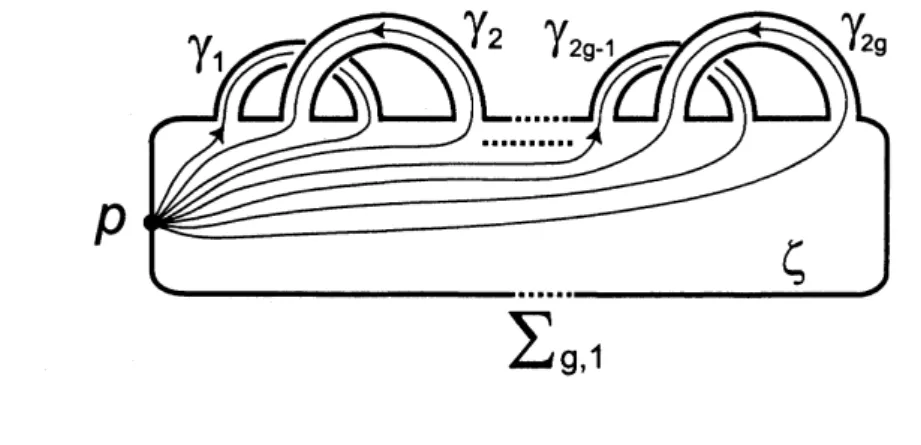
The Magnus matrix Let $X\subset\Sigma_{g,1}$ be the bouquet of$2g$circles $\gamma_{1},$
$\ldots,$$\gamma_{2g}$ tied at$p$ (see
Figure 3). $X$ is
a
deformation retract of $\Sigma_{g,1}$ relative to$p$.
Therefore, for $\pm\in\{+, -\}$,we
have
$H_{1}(\Sigma_{g,1},p;i_{\pm}^{*}\mathcal{K}_{\Gamma})\cong H_{1}(X,p;i_{\pm}^{*}\mathcal{K}_{\Gamma})=C_{1}(\tilde{X})\otimes_{\pi 1(\Sigma_{g,1})}i_{\pm}^{*}\mathcal{K}_{\Gamma}\cong \mathcal{K}_{\Gamma}^{2g}$
with a basis
$\{\tilde{\gamma}_{1}\otimes 1, \ldots, \tilde{\gamma}_{2g}\otimes 1\}\subset C_{1}(\tilde{X})\otimes_{\pi_{1(\Sigma_{g,1})}}i_{\pm}^{*}\mathcal{K}_{\Gamma}$
as a right $\mathcal{K}_{\Gamma}$-vector space. Here we fix a lift $\tilde{p}$of
$p$ as a base point of
$\tilde{X}$, and
denote by
$\tilde{\gamma}_{i}$ the lift ofthe oriented loop
$\gamma_{i}$ starting from $\tilde{p}$
.
Definition 3.3. For $M_{R}=(M_{R}, i_{+}, i_{-})\in C_{g,1}^{\mathbb{Q}}$, the Magnus matrix $r_{\rho}(M_{R})\in GL(2g, \mathcal{K}_{\Gamma})$
of$M_{R}$ is defined
as
the representation matrix of the right $\mathcal{K}_{\Gamma}$-isomorphism$\mathcal{K}_{\Gamma}^{2g}\cong H_{1}(\Sigma_{g,1,p)}\cdot \mathcal{K}_{\Gamma})arrow H_{1}(M_{R},p;\mathcal{K}_{\Gamma})i_{-}\underline{\simeq}\vec{i_{+}^{-1}}\underline{\simeq}H_{1}(\Sigma_{g,1},p;\mathcal{K}_{\Gamma})\cong \mathcal{K}_{\Gamma}^{2g}$,
where the first and the last isomorphisms use the bases mentioned above.
The matrix $r_{\rho}(M_{R})$
can
be interpretedas
a monodromy of $M_{R}$ from a view point of thetwisted homology with coefficients in $\mathcal{K}_{\Gamma}$
.
$\sum_{g,1}$
FIGURE 3. Cell decomposition of $\Sigma_{g,1}$
$\Gamma$-torsion Since the relative complex $C_{*}(M_{R}, i_{+}(\Sigma_{g,1});\mathcal{K}_{\Gamma})$ obtained from any cell
de-composition of $(M_{R}, i_{+}(\Sigma_{g,1}))$ is acyclic by Lemma 3.2,
we can
define the following:Definition 3.4. For $M_{R}=(M_{R}, i_{+}, i_{-})\in C_{g,1}^{\mathbb{Q}}$, the $\Gamma$-torsion
$\tau_{\rho}^{+}(M_{R})$ of$M_{R}$ is definedby
$\tau_{\rho}^{+}(M_{R}):=\tau(C_{*}(M_{R}, i_{+}(\Sigma_{g,1});\mathcal{K}_{\Gamma}))\in K_{1}(\mathcal{K}_{\Gamma})/\pm\rho(\pi_{1}(M_{R}))$.
A method for computing $r_{\rho}(M_{R})$ and $\tau_{\rho}^{+}(M_{R})$ isgiven in [12, Section 4], which is based
on Kirk-Livingston-Wang’s method [18] for invariants of string links, and we now recall it briefly. An admissible presentation of$\pi_{1}(M_{R})$ is defined to be the
one
of the form(3.2) $\langle i_{-}(\gamma_{1}),$
$\ldots,$$i_{-}(\gamma_{2g}),$$z_{1},$$\ldots,$$z_{l},$$i_{+}(\gamma_{1}),$
for
some
integer $l$.
That is, it is a finite presentation with deficiency $2g$ whose generatingset contains $i_{-}(\gamma_{1}),$
$\ldots,$$i_{-}(\gamma_{2g}),$$i_{+}(\gamma_{1}),$$\ldots,$$i_{+}(\gamma_{2g})$ and is ordered
as
above. Such apre-sentation always exists. For
any
admissiblepresentation, define $2g\cross(2g+l),$ $l\cross(2g+l)$and $2g\cross(2g+l)$ matrices $A,$$B,$$C$
over
$\mathbb{Z}\Gamma$ by$A=\overline{\rho(\frac{\partial r_{j}}{\partial i_{-}(\gamma_{i})})}_{1\leq j\leq 2g+l}1\leq i\leq 2g$
’ $B=\overline{\rho(\frac{\partial r_{j}}{\partial z_{i}})}_{1\leq j\leq 2g+l}1\leq i\leq\downarrow$
’ $C=\overline{\rho(\frac{\partial r_{j}}{\partial i_{+}(\gamma_{i})})}_{1\leq j\leq 2g+l}1\leq i\leq 2g$
Proposition 3.5 ([12, Propositions 4.5, 4.6]). As matrices with entries in $\mathcal{K}_{\Gamma}$, we have:
(1) The square matrix $(\begin{array}{l}AB\end{array})$ is invertible and $\tau_{\rho}^{+}(M_{R})=(\begin{array}{l}AB\end{array})$
:
and (2) $r_{\rho}(M_{R})=-C(\begin{array}{l}AB\end{array})(\begin{array}{l}I_{2g}o_{(l,2g)}\end{array})$Using the above invariants, the
factorization
formula for $\tau_{\rho}(E(K))$ is givenas
follows:Theorem 3.6. Let $K$ be a mtionally homologically
fibered
knotof
genus $g$. For any non-trivial homomorphism $\rho$ : $G(K)arrow\Gamma$ to a PTFA group$\Gamma$, a loop
$\mu$ representing the
meridian
of
$K$satisfies
$\rho(\mu)\neq 1\in\Gamma\subset \mathcal{K}_{\Gamma}$ and we have afactorization
(3.3) $\tau_{\rho}(E(K))=\frac{\tau_{\rho}^{+}(M_{R})\cdot(I_{2g}-\rho(\mu)r_{\rho}(M_{R}))}{1-\rho(\mu)}$ $\in K_{1}(\mathcal{K}_{\Gamma})/\pm\rho(G(K))$of
the torsion $\tau_{\rho}(E(K))$.
To compare (3.3) with (3.1), recall Milnor’s formula [20] that $\frac{\triangle_{K}(t)}{1-t}$ represents the
Reidemeister torsion associated with the abelianization map $\rho_{1}$ : $G(K)arrow\langle t\rangle\subset \mathbb{Q}(t)$
.
Taking $\rho_{1}$
as
$\rho$,we
recover
the formula (3.1).4. COMPUTATIONS
Although all the ingredients in the formula (3.3)
are
theoretically determined by infor-mation on fundamental groups, it is difficult to compute them explicitly because of the non-commutativity of$\mathcal{K}_{\Gamma}$ except insome
specialcases
including the following.Let $K$ be a homologically fibered knot with a minimal genus Seifert surface $R$ and let
$M_{R}$ be the sutured manifold for $R$
.
Consider the group extension(4.1) $1arrow G(K)’/G(K)”arrow D_{2}(K)arrow G(K)/G(K)’=H_{1}(E(K))\cong \mathbb{Z}arrow 1$
relating to the metabelian quotient $D_{2}(K)$ $:=G(K)/G(K)”$ of $G(K)$
.
We have$G(K)’/G(K)”\cong H_{1}(R)\cong H_{1}(M_{R})$
since it coincides with the first homology of the infinite cyclic covering of $E(K)$, which
can
be seen as the product of infinitely manycopies of$M_{R}$.
In particular, we may regard$H_{1}(M_{R})$
as
a natural (namely, independent of choices of minimal genus Seifert surfaces)subgroup of$D_{2}(K)$. We take $\rho$ to be the natural projection
It is known that $D_{2}(K)$ is PTFA,
so
that $\mathcal{K}_{D_{2}(K)}$ is defined. Then, Proposition 3.5 showsthat $\tau_{\rho_{2}}^{+}(M_{R})$ and $r_{\rho_{2}}(M_{R})$
can
be computed by calculations on a commutative subfield$\mathcal{K}_{H_{1}(M_{R})}$ of $\mathcal{K}_{D_{2}(K)}$
.
Let
us
see an example of calculations of our invariants. Let $K$ be the knot as theboundary of the Seifert surface $R$ illustrated in Figure 4. This is the knot 0057 in Figure
7. We
can
easily compute that $\triangle_{K}(t)=1-2t+3t^{2}-2t^{3}+t^{4}$ and the genus of $R$ is2. Hence $K$ is a homologically fibered knot and $R$ is of minimal genus. The graph $G$
in the right hand side of Figure 4 is obtained from $R$ by a deformation retract. Thus
$\pi_{1}(M_{R})\cong\pi_{1}(S^{3}-\mathring{N}(G))$
.
Then $\pi_{1}(M_{R})$ has a presentation:$\langle z_{1},$$z_{2},$$\ldots,$$z_{10}|z_{1}z_{5}z_{6}^{-1},$ $z_{2}z_{3}z_{4}z_{1},$ $z_{3}z_{9}^{-1}z_{5}^{-1},$ $z_{7}z_{4}z_{8}^{-1},$ $z_{8}z_{10}z_{6},$ $z_{2}z_{5}z_{7}^{-1}z_{5}^{-1},$ $z_{9}z_{4}z_{10}^{-1}z_{4}^{-1}\rangle$
.
The first 5 relationscome
from the vertices of $G$ and the last 2 relationscome
from thecrossings of $G$
.
Wecan
drop the last relation $z_{9}z_{4}z_{10}^{-1}z_{4}^{-1}$ because it is derived from the others.FIGURE 4
We take a spine of $R$ as in Figure 5, by which we can fix an identification of $\Sigma_{g,1}$ and
$R$
.
A direct computation shows thatFIGURE 5
$i_{-}(\gamma_{1})=z_{5}z_{1}$ $i_{-}(\gamma_{2})=z_{2}^{-1}$ $i_{-}(\gamma_{3})=z_{5}z_{7}^{-1}z_{8}^{-1}z_{4}^{-1}$ $i_{-}(\gamma_{4})=z_{4}^{-1}$
$i_{+}(\gamma_{1})=z_{5}$ $i_{+}(\gamma_{2})=z_{6}z_{9}$ $i_{+}(\gamma_{3})=z_{6}z_{5}^{-1}z_{3}z_{5}z_{7}^{-1}z_{4}^{-1}z_{6}^{-1}$ $i_{+}(\gamma_{4})=z_{6}z_{7}z_{6}^{-1}$.
Here the darker color in $R$ is the $+$-side. Then, we obtain an admissible presentation of
Generators $i_{-}(\gamma_{1}),$
$\ldots,$$i_{-}(\gamma_{4}),$ $z_{1},$$\ldots,$$z_{10},$ $i_{+}(\gamma_{1}),$$\ldots,$$i_{+}(\gamma_{4})$ Relations
$z_{15695825}zz^{-1},$
$z_{2}z_{3}z_{4}z_{1},$ $z_{3}z^{-1}z^{-1},$ $z_{7}z_{4}z^{-1},$ $z_{8}z_{10}z_{6},$ $zzz_{7}^{-1}z_{5}^{-1}$,$i_{-}(\gamma_{1})z_{1}^{-1}z_{5}^{-1},$ $i_{-}(\gamma_{2})z_{2},$ $i_{-}(\gamma_{3})z_{4}z_{8}z_{7}z_{5}^{-1},$ $i_{-}(\gamma_{4})z_{4}$,
$i_{+}(\gamma_{1})z_{5}^{-1},$ $i_{+}(\gamma_{2})z_{9}^{-1}z_{6}^{-1},$ $i_{+}(\gamma_{3})z_{6}z_{4}z_{7}z_{5}^{-1}z_{3}^{-1}z_{5}z_{6}^{-1},$ $i_{+}(\gamma_{4})z_{6}z_{7}^{-1}z_{6}^{-1}$
If
we
havean
admissible presentation, wecan use
the program shown in Section 5. However, we here demonstratea
calculation by hand.By sliding the edges$v_{1}$ and$v_{2}$ of$G$
as
in Figure 6,we
obtaina
graph whose complementis clearly a genus 4 handlebody. This
means
that the complement of $G$ (and hence $M_{R}$)is homeomorphic to a genus 4 handlebody. Let $D_{1},$
$\ldots,$$D_{4}$ be the meridian disks of the handlebody
as
illustrated in the figure.FIGURE 6
Then, $H_{1}(M_{R})$ is the free abelian group generated by $t_{i}(i=1, \ldots, 4)$ where $t_{t}$
corre-sponding to
an
oriented loop which intersects $D_{i}$ transversely inone
point from the aboveto the down side in Figure 6 and is disjoint from $D_{j}(i\neq j)$
.
We have the natural homomorphism $\pi_{1}(M_{R})arrow H_{1}(M_{R})$ which maps
$z_{1}\mapsto t_{1}^{-1}$ $z_{2}\mapsto t_{2}t_{3}^{-1}$ $z_{3}\mapsto t_{1}t_{2}^{-1}t_{3}t_{4}^{-1}$ $z_{4}\mapsto t_{4}$ $z_{5}\mapsto t_{1}t_{2}^{-1}$ $z_{6}\mapsto t_{2}^{-1}$ $z_{7}\mapsto t_{2}t_{3}^{-1}$ $z_{8}\mapsto t_{2}t_{3}^{-1}t_{4}$ $z_{9}\mapsto t_{3}t_{4}^{-1}$ $z_{10}\mapsto t_{3}t_{4}^{-1}$
$i_{-}(\gamma_{1})\mapsto t_{2}^{-1}$ $i_{-}(\gamma_{2})\mapsto t_{2}^{-1}t_{3}$ $i_{-}(\gamma_{3})\mapsto t_{1}t_{2}^{-3}t_{3}^{2}t_{4}^{-2}$ $i_{-}(\gamma_{4})\mapsto t_{4}^{-1}$
$i_{+}(\gamma_{1})\mapsto t_{1}t_{2}^{-1}$ $i_{+}(\gamma_{2})\mapsto t_{2}^{-1}t_{3}t_{4}^{-1}$ $i_{+}(\gamma_{3})\mapsto t_{1}t_{2}^{-2}t_{3}^{2}t_{4}^{-2}$ $i_{+}(\gamma_{4})\mapsto t_{2}t_{3}^{-1}$
Under the bases $\langle[\gamma_{1}],$ $[\gamma_{2}],$ $[\gamma_{3}],$$[\gamma_{4}]\rangle$ of $H_{1}(\Sigma_{2,1})$ and $\langle t_{1},$$t_{2},$$t_{3},$$t_{4}\rangle$ of $H_{1}(M_{R})$, the induced
maps $i_{-},$$i+$ are represented by
$S_{-=}(\begin{array}{llll}0 0 1 0-1-1-3 020 1 0-20 0 -1\end{array})$ , $S_{+}=(\begin{array}{llll}1 0 1 0-1 -1 -2 10 1 2 -10 -1 -2 0\end{array})$
respectively. Note that $\det(I-t(S_{+}^{-1}S_{-}))=1-2t+3t^{2}-2t^{3}+t^{4}$ is the Alexander
polynomial of$K$.
Since $M_{R}$ is homeomorphic to
a
handlebody, we have the following admissiblepresen-tation of $\pi_{1}(M_{R})$ by setting $x_{1}$ $:=z_{1}^{-1},$$x_{2}=z_{6}^{-1},$$x_{3};=(z_{6}z_{7})^{-1}$ and $x_{4}:=z_{4}$, which
are
mapped to $t_{1},$ $t_{2},$ $t_{3}$ and $t_{4}$ by the homomorphism $\pi_{1}(M_{R})arrow H_{1}(M_{R})$.
Generators $i_{-}(\gamma_{1}),$$\ldots,i_{-}(\gamma_{4}),$ $x_{1},x_{2},x_{3},x_{4},$$i_{+}(\gamma_{1}),$$\ldots,i_{+}(\gamma_{4})$
Relations $i_{-}(\gamma_{1})x_{1}x_{2}x_{1}^{-1},$ $i_{-}(\gamma_{2})x_{1}x_{3}^{-1}x_{2}x_{1}^{-1},$ $i_{-}(\gamma_{3})_{X4}x_{2}x_{3}^{-1}x_{4}x_{2}x_{3}^{-1}x_{2}x_{1}^{-1},$ $i_{-}(\gamma_{4})x_{4}$, $i_{+}(\gamma_{1})x_{2}x_{1}^{-1},$ $i_{+}(\gamma_{2})x_{4}x_{3}^{-1}x_{2},$ $i_{+}(\gamma_{3})x_{2}^{-1}x_{4}x_{2}x_{3}^{-1}x_{2}x_{1}^{-1}x_{4}x_{3}^{-1}x_{2},$$i_{+}(\gamma_{4})x_{2}^{-1}x_{3}$
We write $r_{1},$
$\ldots,$$r_{8}$ for these relations in order. Note that $\mathcal{K}_{H_{1}(M_{R})}$ is isomorphic to the
field ofrational functions with variables $x_{1},$
$\ldots,$$x_{4}$. Then we have:
$r_{1}$ $r_{2}$ $r_{3}$ $r_{4}$ $r_{5}$ $r_{6}$ $r_{7}$ $r_{8}$
(2)
$=x_{2}xx_{3}1$$i_{-}(\gamma_{2})i_{-}(\gamma 1)i_{-}(\gamma_{4})i_{-}(\gamma_{3})x_{4}i_{+}(\gamma 1)i_{+}(\gamma_{2})i_{+}(\gamma_{3})i_{+}(\gamma_{4})[g11g_{21}g_{41}g_{31}00010000$ $g12g_{32}g_{22}g_{42}00010000$ $g_{23}g13g_{43}g_{33}00001000$ $gg_{24}g_{44}g_{34}000_{14}10000$ $gg_{25}g_{45}g_{35}0000_{15}0001$ $g_{26}g16g_{36}g_{46}00000001$ $g17g_{27}g_{1}g_{47}0000_{37}000$ $g_{28}g18g_{38}g_{48}o_{1}000000$ $]$,
where $g_{ij}=\overline{\frac{\partial r_{j}}{\partial x_{i}}}$. Thus $\tau_{\rho_{2}}^{+}(M_{R})=(\begin{array}{l}AB\end{array})=[_{g}g_{21}0gg_{41}^{31}00_{11}1$ $gg_{22}g_{32}g_{42}00_{12}01$ $g13g_{23}g_{33}g_{43}0001$ $g14g_{24}g_{44}g_{34}0001$ $g15g_{25}g_{35}g_{45}0000$ $gg_{26}g_{36}g_{46}000_{16}0$ $g_{27}g17g_{37}g_{47}0000$ $gg_{28}g_{38}g_{48}0000_{18}]$ . As
a torsion, it is equivalent to $(\begin{array}{llll}g_{15} g_{16} g_{17} g_{18}g_{25} g_{26} g_{27} g_{28}g_{35} g_{36} g_{37} g_{38}g_{45} g_{46} g_{47} g_{48}\end{array})$ , where
$g_{15}=-1$, $g_{16}=0$, $g_{18}=0$, $g_{25}=x_{1}^{-1_{X_{2}}}$, $g_{26}=x_{2}$, $g_{28}=-x_{3}$, $g_{35}=0$, $g_{36}=-x_{2}$, $g_{38}=x_{3}$, $g_{45}=0$, $g_{46}=x_{2}x_{3}^{-1}x_{4}$, $g_{48}=0$, $g_{17}=-x_{2}x_{3}^{-1}x_{4}$, $g_{27}=x_{2}+x_{1}^{-1}x_{2}^{2}x_{3}^{-1}x_{4}+x_{1}^{-1}x_{2}^{3}x_{3}^{-2}x_{4}-x_{1}^{-1}x_{2}^{3}x_{3}^{-2}x_{4}^{2}$ , $g_{37}=-x_{2}-x_{1}^{-1}x_{2}^{2}x_{3}^{-1}x_{4}$, $g_{47}=x_{2}x_{3}^{-1}x_{4}+x_{1}^{-1}x_{2}^{3}x_{3}^{-2}x_{4}^{2}$. Then
we
have:The Magnus matrix $r_{\rho_{2}}(M_{R})$
can
be computed by the formula in Proposition 3.5 (2). Howeverwe
omit here.Remark 4.1. Ifwe change bases of$H_{1}(\Sigma_{2,1})\cong H_{1}(M_{R})$ by
$x_{1}=\gamma_{2}^{-2}\gamma_{3}$, $x_{2}=\gamma_{1}^{-1}\gamma_{2}^{-2}\gamma_{3}$, $x_{3}=\gamma_{1}^{-1}\gamma_{2}^{-2}\gamma_{3}\gamma_{4}^{-1}$, $x_{4}=\gamma_{2}^{-1}\gamma_{4}^{-1}$,
where $\gamma_{j}$ denotes $i_{+}(\gamma_{j})$, we have $\det(\tau_{\rho_{2}}^{+}(M_{R}))=\frac{\gamma_{3}}{\gamma_{1}^{2}\gamma_{2}^{5}\gamma_{4}}(1+\gamma_{2}-\gamma_{2}\gamma_{4})$
.
This expressionis used in the program in Section 5.
5.
MATHEMATICA
PROGRAMThe followingis
a
MATHEMATICAprogram
which calculates the invariants discussedin the previous section.
hlClass $\underline{-}$ $\{\}$; hlMonodromy $\underline{-}$ $\{\}$: torsionMatrix $\underline{-}$ $\{\}$; magnusMatrix $=$ $\{\}$;
invariants[$g_{-},$ $z_{-}$, RELATIONS-] :–
Module[{reindexedRel, hlMatrix, $i$, alex}, GENUS $\Leftrightarrow gj$
Ztotal $\underline{-}z$;
reindexedRel $=$ Map [reindexing, RELATIONS, {2}];
hlMatrix $\underline{-}-Map$[$Take[\gamma$
.
$-2$ GENUS] $l$.
homologyComputation[reindexedRel]];hlClass
-Join[Map [monomialExpression, hlMatrixl,
Table$[ToExpression[ToString[SequenceForm[”\backslash [Gama]$ ”, $i]]]$
.
$\{i,$ $2$ GENUS$\}]]$;Print[’Homology classes of generators $s||$
.
hlClass //DisplayForm];hlMonodromy– Transpose[Take[hlMatrix, 2 GENUS]]$j$
Print[”Homological monodromy $\underline{-}1\dagger$, hlMonodromy //MatrixForm];
alex $=$ Transpose[makeAlexanderMatrix[reindexedRel]];
torsionNatrix $=$ Take[alex, 2 GENUS $+$ Ztotall;
Print[’torsion matrix $=tt$
.
torsionMatrix //MatrixForm];Print$[^{||}\det$(torsion) $\underline{-}$
Il. Expand[$Det$[torsionMatrix]]$]$;
magnusMatrix $=$ Simplify[Transpose[
Take[Transpose[-Drop[alex, 2 GENUS $+$ Ztotal]. Inverse[
torsionMatrix]$]$, 2 GENUSI]$]$;
Print$[^{t1}Magnus$ matrix $\underline{-}1\mathfrak{l}$
.
magnusMatrix //MatrixForm]
$]$;
reindexing[num-] $:\underline{-}$
Module[{numString, sg},
If[NumberQ[num], num $+2$ GENUS$*$Sign$[num]$
.
numString $=$ ToString[nm];
sg $\underline{-}$ If[StringTake [numString, 11 $.\underline{-}t-",$ 1, $0$];
If[StringTake [nmString, {1 $+sg\}$] $\epsilon z$ “$m$“,
$((-1)^{\wedge}$sg$)*$ToExpression[StringDrop [numString, 1 $+sg]$].
$]$;
homologyComputation[rel-] :–
Module$[\{i, j\}$
.
RowReduce[Table [Count [rel$[[i]],$ $j$] $-$ Count$[$rel $[[i]]$
.
$-j]$ ,{$i$
.
$1.2$ GENUS $+$ Ztotal}, {$j$.
$1,4$ GENUS $+$ Ztotal}$]]]_{j}$monomialExpression[list-] $:\underline{-}$
Nodule$[${$i$, prod $=1$},
For$[i=1$, $i$ く$=$ $2$ GENUS, $i++$,
prod – $prod*$$(ToExpression$[ToString [SequenceForm$[”\backslash [Gamma]$“, $i]]]^{\wedge}1$ist$[[i]])]$;
prod] ;
makeAlexanderNatrix[rel-] $:=$
Module$[\{i. j\}$,
Table[$foxDer[rel[[i]],$ $j],$ $\{i,$ $1$, Length$[rel]\},$ $\{j,$ $1,4$ GENUS $+$ Ztotal$\}$]$]$;
foxDer[word-, var-] $:\underline{-}$
Module$[\{entry=0, i\}$
.
For$[i–1$
.
$i$ く$=$ Length[word], $i++$,Which[word$[[i]]\underline{-}=$ var,
entry – entry $+$ (makeMonomial [Take[word, $i-1]]^{\wedge}(-1)$),
word $[[i]]$ $==$ -var,
entry – entry - (makeNonomial [Take[word, $i]]^{\wedge}(-1)$)$]]$ ;
entry] ;
makeMonomial[list-] $:=$
Nodule$[\{prod=1\}$,
For$[i\underline{-}1,$ $i$ く$=$ Length[list], $i++$
.
prod – prod$*$(hlClass$[[Abs$[list$[[i]]]]]^{\wedge}$Sign[list$[[i]]]$)$]$;
prod] ;
A computation by this program goes
as
follows. Let $(M, i_{+}, i_{-})\in C_{g,1}$ with anadmis-sible presentation
$\langle i_{-}(\gamma_{1}),$
$\ldots,$$i_{-}(\gamma_{2g}),$$z_{1},$ $\ldots,$$z_{l},$$i_{+}(\gamma_{1}),$
$\ldots,$$i_{+}(\gamma_{2g})|r_{1},$ $\ldots,$$r_{2g+l}\rangle$
of $\pi_{1}(M)$. The main function in the program is invariants having three slots
as
theinput. These slots correspond to the genus $g$, the number $l$ of z-generators and the list of relations. For each word in the relations, we make a list by replacing $i_{-}(\gamma_{j})^{\pm 1},$ $z_{j}^{\pm 1}$ and
$i_{+}(\gamma_{j})^{\pm 1}$ by $\pm mj,$ $\pm j$ and $\pm pj$. By lining up them, we obtain the list of relations.
For example, the knot 0815 in Figure 7 has a minimal genus Seifert surface giving a
sutured manifold whose fundamental group has the following admissible presentation:
Generators $i_{-}(\gamma_{1}),$
$\ldots,$$i_{-}(\gamma_{4}),$ $z_{1},$$\ldots,$$z_{11},$ $i_{+}(\gamma_{1}),$
$\ldots,$
$i_{+}(\gamma_{4})$
Relations $z_{1}z_{9}z_{6},$ $z_{1}z_{2}^{-1}z_{4}^{-1},$ $z_{4}z_{11}^{-1}z_{5},$ $z_{10}^{-1}z_{5}^{-1}z_{6}z_{7}z_{8},$ $z_{8}^{-1}z_{6}^{-1}z_{9^{Z}6}$,
$-1-1$ $-1-1$
$Z_{7}$ $Z_{6}$ $Z_{3}Z_{6},$ $Z_{4}Z_{3}$ $Z_{4}$ $Z_{10}$,
$i_{-}(\gamma_{1})z_{4}z_{3}^{-1}z_{4}^{-1},$ $i_{-}(\gamma_{2})z_{4}z_{11},$ $i_{-}(\gamma_{3})z_{9},$ $i_{-}(\gamma_{4})z_{2}^{-1}z_{9}^{-1}$, $i_{+}(\gamma_{1})z_{2}^{-1}z_{3}^{-1}z_{4}^{-1},$ $i_{+}(\gamma_{2})z_{11}z_{1},$ $i_{+}(\gamma_{3})z_{9}z_{3}^{-1}z_{1},$ $i_{+}(\gamma_{4})z_{9}z_{2}^{-1}z_{9}^{-1}$
Then, the input is:
invariant$s[2,11,$ $\{\{1,9,6\},$ $\{1, -2, -4\},$ $\{4, -11,5\}$,
$\{4, -3, -4,10\}$, $\{ml, 4, -3, -4\},$ $\{m2,4,11\}$,
$\{m3.9\},$ $\{m4, -2, -9\}$, $\{pl, -2, -3, -4\},$ $\{p2,11,1\}$, $\{p3,9, -3,1\},$ $\{p4,9, -2, -9\}\}]$
Then the function returns homology classes of generators in terms of $\gamma j$ $:=i_{+}(\gamma_{j})\in$
$H_{1}(M_{R})$, the homological monodromy matrix $\sigma(M_{R})$, the torsion matrix $\tau_{\rho_{2}}^{+}(M_{R})$ and
the Magnus matrix $r_{\rho_{2}}(M_{R})$
.
These datacan
be referredas
the variables $hlC1$ass,hlMonodromy, torsionMatrix and magnusMatrix.
Using this program, we
can
easily check the calculations presented in [13] for 13non-fibered homologically non-fibered knots with 12-crossings (Figure 7).
REFERENCES
[1] G. Burde, H. Zieschang, Knots, de Gruyter Studies in Mathematics, 5. Walter de Gruyter & Co.,
Berlin, 2003.
[2] J. Cha, C. Livingston, Table of Knot Invariants, http://www.indiana.edu/knotinfo/.
[3] T. Cochran, Noncommutative knot theory, Algebr. Geom. Topol. 4 (2004), 347-398.
[4] T. Cochran, K. Orr, P. Teichner, Knot concordance, Whitney towers and $L^{2}$-signatures, Ann. of
Math. 157 (2003), 433-519.
[5] R. Crowell, Genus ofaltemating link types, Ann. of Math. (2) 69 (1959), 258-275. [6] R. Crowell, H. Trotter, A class ofpretzel knots, Duke Math. J. 30 (1963), 373-377.
[7] S. Friedl, Reidemeister torsion, the Thurston norm and Harvey’s invareants, Pacific J. Math. 230
(2007), 271-296.
[8] S.Friedl,A.Juh\’asz,J. Rasmussen, The decategonfication
of
sutured Floer homology, preprint (2009),arXiv:0903.5287.
[9] S. Friedl, T. Kim, The Thurston norm, fibered manifolds and twistedAlexanderpolynomials, Topol-ogy 45 (2006),929-953.
[10] D. Gabai, Foliations and the topology of3-manifolds, J. Differential Geom. 18 (1983), 445-503. [11] S.Garoufalidis, J.Levine, Tree-level invare ants ofthree-manifolds, Massey products and the Johnson
homomorphism, Graphs and patterns in mathematics and theorical physics, Proc. Sympos. Pure Math. 73 (2005), 173-205.
[12] H. Goda, T. Sakasai, Homology cylinders in knot theory, preprint (2008), arXiv:0807.4034.
[13] H. Goda,T. Sakasai, Factorezation
formulas
and computationsof
higher-order Alexanderinvare antsforhomologicallyfibered knots,preprint (2010), arXiv:1004.3326.
[14] M. Goussarov,Finite type invareants and n-equivalence of3-manifolds, C. R. Math. Acad.Sci. Paris 329 (1999), 517-522.
[15] N. Habegger, Milnor, Johnson, and tree level perturbative invanants, preprint. [16] K. Habiro, Claspers and
finite
type invare antsof
links, Geom. Topol. 4 (2000), 1-83.[17] S. Harvey, Monotonicity ofdegrees ofgeneralized Alexander polynomials ofgroups and 3-manifolds, Math. Proc. Cambridge Philos. Soc. 140 (2006), 431-450.
[18] P. Kirk, C. Livingston, Z. Wang, The Gassner representationfor streng links, Commun. Contemp.
Math. 3 (2001),87-136.
[19] J. Levine, Homology cylinders: an enlargement
of
the mapping classgroup, Algebr. Geom. Topol. 1 (2001), 243-270.[20] J. Milnor, Whitehead torsion, Bull. Amer. Math. Soc. 72 (1966), 358-426.
[21] K. Murasugi, On the genus ofthe altemating knot, I, II, J. Math. Soc. Japan 10 (1958), 94-105, 235-248.
[22] K. Murasugi, On a certain subgroup of the group of an altemating link, Amer. J. Math. 85 (1963),
[23] T. Sakasai, The Magnus representation and higher-order Alexander invariantsfor homology cobor-disms
of
surfaces, Algebr. Geom. Topol. 8 (2008), 803-848.DEPARTMENT OF MATHEMATICS, TOKYO UNIVERSITY OF AGRICULTURE AND TECHNOLOGY,
2-24-16 NAKA-CHO, KOGANEI, TOKYO 184-8588, JAPAN E-mail address: godaQcc. tuat.ac.jp
DEPARTMENT OF MATHEMATICAL, TOKYO INSTITUTE OF TECHNOLOGY, 2-12-1 OH-OKAYAMA, MEGURO-KU, TOKYO 152-8552, JAPAN