Knotted 3-Valent
Graphs,
Branched
Braids,
and Multiplication-Conjugation Relations in
a
Group
Victoria
Lebed
Osaka City University Advanced Mathematical Institute
This
survey
is devotedtoa
new
algebraicstructurecalled qualgebra. Our topologicalmo-tivation isthestudyofknotted 3-valentgraphsandcloselyrelated branched braidsvia
com-binatorially defined coloringinvariants. From
an
algebraicviewpoint,our
structurea
part ofan
alternativeaxiomatization ofgroups, describingthe properties ofconjugationoperationanditsinteractionswiththe
group
multiplication. Qualgebrascan
thusbe metaphoricallyseen as a
widening ofthe bridge between algebra andtopologyformed by the quandlestruc-ture,popular
among
knottheorists;see
Table 1 tobetter understand how this bridge works. Onlya
brief and rather informal exposition ofdifferent facetsofqualgebrasis givenhere.For
more
details,comments,and proofs,see
[20, 15]. However, Sections2.1,2.3, 2.4, and3. 1 containsome
recentunpublishedresults,which will be thoroughly treated elsewhere.1
How
aknot theorist would invent qualgebras
1.1 Quandlesas
an
algebraizationofknotsDiagram coloring techniquescount amongthemostpowerful combinatorial tools in Knot Theory. Afamous exampleis given byFoxcolorings,which
are
a
particularcase
of quandle colorings. Inthissectionwe
brieflyrecall the latter.Take
a
set$S$ anda
binaryoperation $\triangleleft on$it. An$(S, \triangleleft)$-coloringofa
knot diagram$D$isan
assignment ofan element of$S$toeach
arc
$ofD$in suchaway
that the conditionon
Figure$1\circ A$(motivatedbelow) issatisfied around each crossing. Unoriented
arcs
inour
diagramsmean
that the diagrams should be considered for all coherent orientations of such
arcs.
$\swarrow_{\grave{a\triangleleft}b}^{\backslash }OAab$
${}_{\theta_{a}1^{>^{p}oB}}C^{1}\alpha$ $a_{C}bY_{c^{\pm 1}b^{\pm 1}a^{\pm 1}=1}^{\copyright}$ $a_{Y_{b}^{b},a*}$
Figure1: Coloringrules and their topologicalmotivations
Now, wewantcoloringstosaysomething about theknot$K_{D}$representedby$D$, indepen-dently of the diagram chosen. Therefore,
we
wantReidemeistermoves
(Figure 2) toinduce only local coloring changes, keeping fixed all the colors outside the smallball where themove
is realized. This happens if and only if operation$\triangleleft$satisfies the following properties:
RIII $arrow$一 self-distributivity $(a\triangleleft b)\triangleleft c=(a\triangleleft c)\triangleleft(b\triangleleft c)$, $(Q_{SD})$
RII – invertibility $\forall b,$ $a\mapsto a\triangleleft b$isinvertible, $(Q_{In\nu})$
$p^{1}$ $\underline{RI}$ $)_{\backslash }^{/}($ $\underline{RII})’($
Figure2: Reidemeistermovesfor knot diagrams
Data$(S, \triangleleft)$ satisfying
$(Q_{SD})-(Q_{Idem})$is called
a
quandle. This structure hasbeenactivelystudiedsincethe pioneer 1982
papers
ofD. JoyceandS.V Matveev[14, 23]. Theargumentaboveimplies that the number of colorings of
a
knot diagram bya
quandleis stable byRei-demeistermoves,and thus defines
an
invariantof the underlying knot:Suchquandleinvariantsturn out tobe extremely efficient in practice.
The central example ofquandleisgiven by
a
group
$G$and operation$g\triangleleft h=h^{-1}gh$on
it; it is the conjugationquandleof$G$, denoted by Conj(G).
Nowfixa
diagram$D$ ofa
knot$K_{D}.$Recall Wirtingerpresentation of the knot
group
$\pi_{1}(\mathbb{R}^{3}\backslash K_{D})$, withone
generator$\theta_{\alpha}$ for each
arc
$\alpha$of$D$,as
shownon
Figure1OB
(point$p$is chosen in front ofthediagram).Around eachcrossing,
compare
the relationsimposedon
the $\theta_{\alpha}$with thecoloringrule from Figure1OA.
One readily identifies Conj(G)-coloringsof$D$with representations of the knot
group
in$G$:
Quandleinvariantsthusgeneralizethe classical study of knot
groups.
1.2 Extendingquandlecoloringsto3-graphs
Knotted3-valentgraphs(simplycalled 3-graphs in whatfollows;cf. Figures 5 and 6 for typical examples) have recently attracted
a
lot ofattention,among
others due to applicationstohandle-body classification and to foams (a particular type of surfaces appearing in
some
categorificationconstructionsandin3-manifoldstudies).Accordingto [19,26,27],the study of such graphs
up
toisotopyis equivalenttothe study of theirdiagramsuptoReidemeistermoves
I-VI (Figures2 and3), opening theway
to combinatorialinvariants.$\underline{RV})_{\backslash }\lambda$ $\underline{RVI}$
Figure3;Additional Reidemeistermovesfor knotted 3-valent graph diagrams
Ageneralization of the (very powerful)quandle coloringstographsis
a
possiblesource
ofsuchcombinatorial invariants. Themain challenge istocomplete the coloring rule around
crossings (Figure $1\circ A$) with
a
rule around trivalentvertices. Wirtinger presentation of thegraph
group
suggestsa
solution when colorscome
froma
conjugation quandle; itis givento
more
general quandles in [22, 11, 24, 12, 13]. In [20]we
proposedan
alternativesolution,whichconsistsin enriching thenotionof quandle in
a
particularway.Ourmethod works for well-oriented 3-graphs–thatis,having only zip and unzip vertices
(Figure 4). Since every3-graphiswell-orientable,
our
method also allows tocompare
twounoriented3-graphs by considering all their well-oriented versions.
$Y$
zipA
unzipFigure 4: Zipandunzipvertices for3-graphs
Now,
suppose
our
quandle $(S, \triangleleft)$ tobe endowed witha
secondbinaryoperation$*$, anduse
itto definea
coloringrulearoundtrivalent verticesas
shownon
Figure 1$OD$.
Asusual,one
checks if this rule forces Reidemeistermoves
toinduceonly local changes in diagrams’colorings. Ithappens ifandonly if operations$\triangleleft and*are$compatiblein the following
sense:
RIV – translationcomposability $a\triangleleft(b*c)=(a\triangleleft b)\triangleleft c,$ $(QA_{Comp})$
RVI –
distributivitr
$(a*b)\triangleleft c=(a\triangleleft c)*(b\triangleleft c)$, $(QA_{D})$RV – semi-commutativity. $a*b=b*(a\triangleleft b)$
.
$(QA_{Comm})$Data $(S, \triangleleft, *)$ satisfying $(Q_{SD})-(Q_{Idem})$ and $(QA_{Comp})-(QA_{Comm})$ is called
a
qualgebra.This termconsistsof words“quandle” and“algebra” zipped together, which underlines the
presence
and the importance oftwodifferent operations in the story Notethataxiom$(Q_{SD})$can
be omitted since it follows from $(QA_{Comp})$ and $(QA_{Comm})$.
Ourchoice ofaxiomsguar-anteesthat the number of colorings of
a
graph diagram$D$bya
qualgebrais stable byReide-meistermoves, and thus defines
an
invariantof the underlying well-oriented 3-graph$\Gamma_{D}$:
The central example of qualgebra is given,
once
again, bya group
$G$,withconjugation andmultiplicationoperations: $g\triangleleft h=h^{-1}gh,$$g*h=gh$
.
It is thegroup
qualgebraof$G$,denotedby$QA(G)$
.
Thecoloring rule from Figure1
recovers
in thiscase
theone
from Figure1\copyright ,
prescribed by Wirtingerpresentation ofthe graph
group.
Onethat getsWe finish this sectionwith
a
computation example. Here instead of counting all colo-rings ofa
diagram bya
qualgebra$S$,we
restrict ourselvesto isosceles colorings. Thismeans
that both incoming (oroutcoming) edges ofanyzip (respectively,unzip) vertexarecolored
bythe
same
element of$S$; inotherwords,one
imposes$a=b$inFigure $1OD$.
Reidemeistermoves
do not change the property of beingisosceles, hence the number of isosceles colo-rings $\# Cot_{S}^{iso}(D)$ isa
graph invariant. The 3-graphswe are
interested inare
standard andKinoshita-Terasaka$\Theta$-curves,with diagrams given
on
Figure 5. An isosceles coloring of$\Theta_{st}$is entirelydeterminedby the choice of$x\in S$,
so
$\# Cot_{S}^{iso}(\Theta_{st})=\# S$.
Any other well-orientation of$\Theta_{st}$ leadstothesame
result. For$\Theta_{KT}$, the choice of$x,y\in S$ determines everything,but$(\star)\{\begin{array}{l}a = x\triangleleft(y*y)=y\triangleleft x,b = X\triangleleft\triangleleft\sim_{y=y^{\sim}(x*x)},c = ()\triangleleft X=(X*X)^{\sim}.\end{array}$
Here
we
use
notion$x\triangleleft y\sim$,classicalinQuandleTheory: it standsfortheunique$z\in S$satisfying
$z\triangleleft y.=x$ (cf. axiom $(Q_{Inv}.)$). Now, for
any
$x$, the choice $y=x$providesa
solutionto ($\star$),so
$\# Cot_{s}^{\iota so}(\Theta_{KT})\geq\# S=\# Cot_{s}^{lSO}(\Theta_{st})$
.
To separatethese quantities (andthusto distinguishthetwo $\Theta$
-curves), take
as
$S$thegroup
qualgebra of the symmetricgroup
$S_{4}$
.
One checks that$x=(123)$ and$y=(432)\neq x$satisfy($\star$),giving
$\# Cot_{QA(S_{4})}^{iso}(\Theta_{KT})>\# QA(S_{4})=\# Cot_{QA(S_{4})}^{iso}(\Theta_{st})$
.
$\Theta_{KT}$
Figure5: Isosceles colorings for diagrams of standard and Kinoshita-Terasaka$\Theta$-curves
2
How
an
algebraist would invent qualgebras
2.1 Anabstraction ofthe conjugation-multiplcation interaction in
agroup
Let
us
return to quandlesonce
again. Besides Knot Theory, theyappear
in another setting, completely algebraic thistime. Wesaw
abovethatconjugation operation definesa
quandle structureon a
group,
and thus satisfiesaxioms $(Q_{SD})-(Q_{Idem})$.
Infact,one can
say
more:
ifa
propertyinvolvingonly conjugation holdstrueinevery
group, thenitisa
consequence
of thesethreeaxioms. Thereason
lies in thestructureofthe freequandleon
a
set$X$,whichcan
be
seen
inside the freegroupon
$X$.
Quandlethusprovidean
axiomatizationofconjugation.In
a
similarway, conjugationandmultiplication operations definea
qualgebrastructureon a
group, andthussatisfy all qualgebraaxioms. Moreover, axioms $(QA_{Comp})-(QA_{Comm})$captureall essential relations between conjugation and multiplication (cf. Table 1).
How-ever,formalizingthisidea isnot
so easy
Forinstance,relation$(b\triangleleft a)*(a\triangleleft b)=((a\triangleleft b)\sim\triangleleft a)*b$
holds in
any group
qualgebra(bothsides equal$a^{-1}bab^{-1}$ab),butfails in the free qualgebraon
twoelements–andthus doesnotfollow from qualgebraaxioms.The remainder of this section is devoted to various examples of qualgebras. Algebraic
properties of
some
of themare
very
different from those ofgroups.
This confirms that theinterest ofqualgebras
goes
beyond the realm ofgroups.
Onemore
conclusion is thatcon-jugation and multiplication operations do not suffice for
an
alternativeaxiomatizationof
groups;
themissingingredients will bedetermined inSection2.3.$\bullet$ The
first exampleisstill closeto
groups.
Considersub-qualgebrasofa
group
qualge-bra $QA(G)$ – thatis, subsets stable by conjugationandmultiplication. If$G$is finite,one
getsonly subgroups of$G$.
For infinite $G$new
examplesappear:
forinstance, thesub-qualgebra$\mathbb{N}$of$QA(\mathbb{Z}, +)$ contains
no
inverses,and thusisnota
group
qualgebra.$\bullet$
Now,considerqualgebras$(S, \triangleleft, *)$with$a\triangleleft b=a$,called trivialqualgebras.Inthis case,
the onlycondition imposed$on*by$axioms$(QA_{Comp})-(QA_{Comm})$is the commutativity.
Colorings by trivial qualgebras donotdistinguish over-crossings from under-crossings, and thus donot capturetheknottedness of 3-graphs. Such qualgebras thus yield only abstractgraphinvariants.
$\bullet$
A
more
sophisticated examplecan
be constructedas
follows. Takea
set $X$ equippedwith
a
commutative operation $\star$ anda
distinguishedzero
element$0$ (thismeans
that$0\star x=x\star 0=0$for all$x$). Fix
an
$n\in \mathbb{N}$.
Extend operation$\star$to$X^{xn}$coordinate-wise, anddenote by$\cdot$the
usual right action of thesymmetric
group
$S_{n}$on
$X^{xn}$.
Now,theset$Q_{X,n}=${$((x_{1},\ldots,x_{n}),g)\in X^{xn}xS_{n}|x_{i}=x_{j}=0$whenever$g(i)=j$with$i\neq j$}
can
be endowed with the following qualgebra structure:$\ulcorner x,g)\triangleleft(\overline{y}, h)=(\overline{x}\cdot h, h^{-1}gh)$, $(\overline{x},g)*(\overline{y}, h)=(\overline{x}\star\overline{y},gh)$
.
Consider the simplest example$X_{2}=\{0, a\}$
.
Then$Q_{X_{2},2}=\{ ((x_{1\prime}x_{2}), Id) |x_{1},x_{2}\in X_{2}\}\coprod\{((0,0),\tau)\}$
(where$\tau$isthenon-trivial element of$S_{2}$) consistsof five elements. $7Wo$operations $\star_{1}$
and$\star_{2}$
can
be fedintoour
machine:$0$isa zero
element forboth,andwe
have$a\star_{1}a=0$and$a\star_{2}a=a$
.
Thetworesultingqualgebrasare
non-isomorphic. Their operations$*i$are
commutative, associative,butnon-cancellative:$((0,0),\tau)*\iota((0, a),Id)=((0,0),\tau)*i((a,0),Id)=((0,0),\tau) , i=1,2.$
2.2 Towards
a
classification of qualgebras: the 4-elementcase
Up tosize3, all qualgebras
are
trivial. Thingschangein size 4. In [20]we
classified allnon-trivia14-e1ementqualgebrasup to qualgebra isomorphism. Here
we
describe all the 9iso-morphismclasses. Ontheset$Q=\{p, q, r,s\}$,consider the involutionexchanging$p$and$q$
:
$\overline{p}=q,\overline{q}=p,\overline{r}=r,\overline{s}=s.$Put$x\triangleleft r=X$, and$x\triangleleft y=x$for other$y$
.
Asfor the second operation,take the commutative$\bullet$
$\overline{x}*\overline{y}=\overline{x*y}$for$aJ1x,y\in Q$;
$\bullet$
$r$enjoys theabsorptionproperty:
$r*x=r$for all$x\neq r$;
$\bullet$
one
has$r*r=s*s=p*q=s$
;$\bullet$
$q*q$and$q*s$
are
any
elements chosen in$\{p,$ $q,$$sI.$Thealternatives inthelast point leadto$3\cross 3=9$pairwisenon-isomorphicstructures.
The absorptionpropertyfor$r$preventsthese qualgebras from being cancellative with
re-spect to$*$ and,
a
fortiori,fromembeddingintoa group.
Further,outofthese ninestructures,
preciselytwo
are
associative. Theyare
in fact the sub-qualgebras of$Q_{X_{2},2}$ from Section2. 1obtained byomittingthe element$((a, a)$,Id$)$;thetwopossible operations
$\star_{1}$ and$\star_{2}$give
non-isomorphicstructures. Lastly, three qualgebras out of thenine haveneutralelements, and
none
are
unitalassociative. Thuseven
in this smallsizequalgebrascan
exhibita
widerange
of algebraicbehavior,confirmingtheinterestofthis structure.
To illustrate topological applicationsof 4-element qualgebras, consider the diagrams of
standardand Hopf cuff graphs depicted
on
Figure 6, Analyzing the colors around trivalentvertices,
one
getsforany
qualgebra$S$thefollowingbijections:$Co(_{S}(C_{st})\{(a,b,c)\in S^{x3}|b*a=a, b*c=c\}\underline{bij},$
$C\circ t_{S}(C_{H})\{(a, b, c)\in S^{x3}|b*a=(a^{\sim}\triangleleft c)\triangleleft a\underline{bij}, b*c=c\triangleleft a\}.$
For
a
trivial qualgebra$S$, these sets coincide. However,for the
non-trivia14-e1ement
qual-gebra $Q$ above with $q*q=s$ and$q*s=q$,
one
gets$\# Cot_{Q}(C_{st})=18$ (and thesame
valuefor anywell-orientation of$C_{st}$, due to the commutativity$of*$), and
$\# Cot_{Q}(C_{H})=14$
.
Thisdistinguishesthe two cuffgraphs.
$a’=((a\triangleleft c)\triangleleft a\sim$
$c’=c\triangleleft a$
$C_{H}$
Figure6:Qualgebracoloringsfor diagrams of standard and Hopf cuff graphs 2.3 Getting closerto
groups:
symmetric qualgebrasWe
now
turn to distinctionsbetween the notions ofgroup
and qualgebra. Abovewere
given examples of qualgebras whichare
not associative and/ornot cancellative. Here thesetwoproperties willbe showntobe essentially theonly
ones
needed fora
qualgebratobea group.
The notionof symmetric quandle,introduced in 1996by S. Kamada([17]), shouldfirstbe
recalled. Itis
a
quandle $(S, \triangleleft)$ endowed withan
involution$\rho:Sarrow S$ (called
a
goodinvolu-tion), compatible with operation$\triangleleft in$thefollowing
sense:
$\rho(a)\triangleleft b=\rho(a\triangleleft b)$, (1)
The
topological
roleof
a
good
involutionis
to render quandleinvariants independent
oforientations. Concretely, if $(S, \triangleleft,\rho)$ is
a
symmetric quandle, thena
bijection $Cot_{S}(D)rightarrow$$Cot_{S}(-D)$, where diagrams $D$ and $-D$ differ by the orientation only,
can
be given by therule $a\downarrow-\uparrow\rho(a)$ Now,
we
want thesame
kind of ruleto inducea
bijection between the$(S, \triangleleft, *)$-coloringsetsof3-graph diagrams which differ by the orientation of
some
edges only($aJ1$thegraphs involved
are
supposedwell-oriented). Forthistohold,$\rho$should be
a
goodin-volution for the quandle$(S, \triangleleft)$, compatiblewith $*$ in thefollowing
sense:
$(a*b)*\rho(b)=\rho(b)*(b*a)=a$
.
(3)The resulting structure$(S, \triangleleft, *,\rho)$ iscalled
a
symmetric qualgebra.As
one
would expect, the central example is given bygroup
qualgebras, for which theinversion$\rho(g)=g^{-1}$ defines
a
goodinvolution.Table 1can now
be continuedwithTable2.Table 2: Different viewpointsonsymmetric qualgebras
In
a
symmetricqualgebra,maps
$a\mapsto a*b$and$a\mapsto b*a$are
bijectionsforall$b$,accordingtoaxiom(3). Consequently,
$\bullet$
forany$b$,property(3) defines$\rho(b)$uniquely; good involutions
can
thus be safelyomit-ted from thedescription of
a
symmetric qualgebra;$\bullet$ the multiplication table for $*$ is
a
Latinsquare(i.e.,every
elementoccurs
exactlyonce
in each column and in eachrow).
Usingtheseobservations, symmetric trivial qualgebras
are
particularlyeasy
todescribe.They correspondtoLatinsquareswhich
1.
are
symmetric withrespect tothe maindiagonal, and2. together with
a row
correspondingtoa
permutation$\sigma$necessarily containa row
corre-spondingto$\sigma^{-1}$
(thetwo
rows
can
coincide).Let
us now
turn toexamples.$\bullet$ Among3-e1ement
qualgebras (which
are
necessarilytrivial), thereare
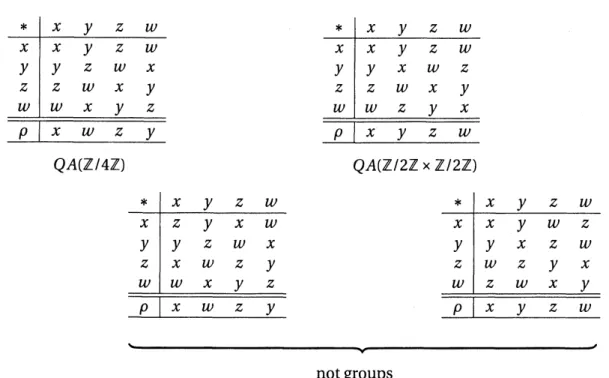
precisely3sym-metricones,
as
usualuptosymmetricqualgebra isomorphism:$QA(\mathbb{Z}/3\mathbb{Z})$
–
notgroups
$\bullet$ Among
$QA( \mathbb{Z}\int 4\mathbb{Z})$ $QA( \mathbb{Z}\int 2\mathbb{Z}\cross \mathbb{Z}/2\mathbb{Z})$
not
groups
$\bullet$
Non-trivia14-e1ementqualgebras
are
notcancellative and thusnotsymmetric.Even though good involutions bring the structure of qualgebra closer to that ofgroup,
the examples above show that symmetric qualgebra stay
more
general thangroups.
Themissingproperty turns out to betheassociativity:
group
qualgebrasare
preciselysymmetricqualgebraswhichareassociative(i.e., theiroperation $*$ isassociative);seeFigure 7.
Figure 7: Qualgebrasversus groups
In particular, this allows to deduce the non-associativity of two 3-element and two
4-element symmetric qualgebras above from the absence of neutral 4-elements for their
opera-tions $*$ (andthus theirfailuretobe
group
qualgebras),which is mucheasiertocheck.2.4 Fromquandlestoqualgebras
Above
we
analyzed how far the notion of qualgebraisfromthat ofgroup.
Acomparison of thenotions of qualgebra and quandle will be given here.Let
us
first discuss whena
quandle $(S, \triangleleft)$ isqualgebraizable -that is, admitsa
secondoperation $*$ turning itinto
a
qualgebra. For this, considerright translations $T_{b}:a\mapsto a\triangleleft b,$writtenhere
on
the right of their arguments. Axioms $(Q_{SD})-(Q_{Idem})$ imply that2’. the
map
$T:b\mapsto T_{b}$ isa
quandle morphism from $(S, \triangleleft)$ to Conj$(Aut(S))$ –thatis,one
has $T_{b\triangleleft c}=T_{c}^{-1}T_{b}T_{c}$;
3’. theimage of$T$is
a
sub-quandleof Conj$(Aut(S))$.
Now, if$(S, \triangleleft, *)$is
a
qualgebra, thenin addition1.
maps
$T_{b}$are
automorphisms of the qualgebra$(S, \triangleleft, *)$;2. the
map
$T:b\mapsto T_{b}$isa
qualgebra morphism from$(S, \triangleleft, *)$ to$QA(Aut(S))$–thatis,one
has $T_{b*c}=T_{b}T_{\mathcal{C}/}.$
3. $T(S)$ is
a
sub-qualgebra of$QA(Aut(S))$,andisin particular stable under composition;4. therestrictionof$T_{b}$tothe sub-qualgebra of$S$generatedby$b$istheidentity
map.
Property3 is
an
importantnecessary
qualgebraizability condition, which is unfortunatelynot sufficient (a counter-exampleis given below). Neither does it give estimations for the
number of qualgebraizations of
a
given quandle: the relatedproperty 2 determines $b*c$only modulo $Ker(T)$, which
can
beverylarge. Asfor now,no
satisfying qualgebraizabilitycriterionis knowntothe author.
We
now
givesome
exampleswhere qualgebraizationsare
unique,are
numerous,or
donotexistatall.
$\bullet$
As shown above, the qualgebraizationsof
a
trivial quandleare
given by commutative $n(n+1)$operations $*$
.
Forthe trivial quandle with $n$ elements, thisgives $n\overline{2}$qualgebraiza-tions.However,countingthese qualgebraizations
up
toqualgebraisomorphismismuchmore
difficult. Forinstance, for$n=2$ these8 structuresfallinto4 equivalenceclasses,and for$n=3$the729structuresform 129 classes.
$\bullet$
Consider
an
Alexanderquandle$(M, a\triangleleft b=\alpha a+(1-\alpha)b)$,where$M$isa
moduleover a
ring$R$, and$\alpha$isa
fixed invertible element from$R$.
Onecalculates($a$)$T_{b}T_{c}=(a\triangleleft b)\triangleleft c=a^{2}a+\alpha(1-\alpha)b+(1-\alpha)c.$
Our quandle is qualgebraizable only if $T_{b}T_{c}$ equals $T_{d}$
:
$a\mapsto\alpha a+(1-a)d$ forsome
$d\in M$
.
Butthis would imply that the value ofa
$a-\alpha a$doesnotdependon
$a$.
Since$a$isinvertible, the value of$\alpha a-a$isalso
a
constant, and thus$a\triangleleft b=\alpha a+b-ab=a$.
Oneconcludes that
among
Alexander quandles, only the trivialones are
qualgebraizable.$\bullet$
There
are
3 quandlesofsize 3:-Thetrivial
one was
showntoadmit 4 qualgebraizations.-The Alexander quandle $(\mathbb{Z}/3\mathbb{Z}, a\triangleleft b=2b-a)$(thecolorings bywhich
are
preciselythefamousFoxcolorings)
was
provednot tobequalgebraizable.-Thesub-quandle$Q’=\{p, q, r\}$ofthequandle$Q$fromSection2.2 satisfies
necessary
algebraizability condition 3above,since $T(Q’)$is
a
2-element subgroup(hencesub-qualgebra) of$Aut(Q’)$
.
However, $Q’$ isnot qualgebraizable. Indeed, according to property4 above, element $r*r$ should befixed by$T_{\Gamma/}$ implying$r*r=r$ ; butthis contradictsproperty2,whichgives $T_{r*r}=T_{r}T_{r}=Id\neq T_{r}.$
$\bullet$
Thequandle$Q$from Section2.2admits9 qualgebraizations
(upto isomorphism).Note
that above
we
showed itssub-quandle$tp,$$q,$$r$} not tobe qualgebraizable.$\bullet$
The
group
qualgebra$QA(S_{n})$isa
qualgebraization oftheconjugationquandleConj$(S_{n})$
.
This qualgebraization isuniquefor$n\geq 3$, sincein this
case
themap
$T$is injective.3
Variations
ofqualgebra
ideas
3.1 Towards qualgebracohomology
Fix
a
qualgebra $(S,\triangleleft, *)$.
InSection 1.2,we
$sa\mathcal{W}$ that
any
Reidemeister
move
induces
a
bi-jection betweenthe sets$Cot_{S}(D)$ and$Cot_{S}(D’)$ of$(S, \triangleleft, *)$-coloringsof the two
well-oriented
3-graphdiagrams involved.Theconclusion
was
that thecardinality$\# Cot_{S}(D)$of sucha
setisa
3-graphinvariant. However,a
lot ofinformationis lost when passing from the coloringsettoits cardinality.Here
we
show how toretrievesome
ofit,imitatingwhatwas
done forquan-dle coloringsof knots by
Carter-Jelsovsky-Kamada-Langford-Saito
in 1999 (cf. the originalpapers
[1, 2],a
verypedagogicsurvey
[16], andnumerous
relatedpublications).Thebasicidea istoassociate to
every
$S$-coloring$\mathscr{C}$ofa
diagram $D$
a
quantity invariantunderReidemeister
moves.
Developingthe approach of[1],we
look forsuantities
ofa
par-ticular form. Taie two
maps
$\chi,\lambda:SxSarrow \mathbb{Z}$, evaluate themon
all the crossings and trivalent
verticesof$D$colored accordingto$\mathscr{C}$,
as
shown
on
Figure8,andsum
up
the valuesobtained.The result is called the$(\chi,\lambda)$-weight of$\mathscr{C}$,
denotedby$\omega_{\chi,\lambda}(\mathscr{C})$
.
a
$b$ $b$ $a\triangleleft b$$a*b$
$\swarrow_{a\triangleleft}^{\backslash _{\searrow}}\mapsto\chi(a, b)b a\searrow^{\mapsto-\chi(a,b)} aA\mapsto\lambda(a, b) a_{Y_{b}^{b}\mapsto-\lambda(a,b) ,a*}$
Figure 8: Qualgebra 2-cocycle $\sim$ weight
The
invariance
oftheweight$\omega_{\chi,\lambda}(\mathscr{C})$ underReidemeistermoves
is equivalenttothe
fol-lowing relationsfor$\chi$and$\lambda$
:
RIV – $\chi(a, b*c)=\chi(a, b)+\chi(a\triangleleft b,c)$,
(4)
RVI
$-$
$\chi(a*b,c)+\lambda(a\triangleleft c, b\triangleleft c)=\chi(a,c)+\chi(b, c)+\lambda(a, b)$, (5)RV
$-$
$\chi(a, b)+\lambda(a, b)=\lambda(b, a\triangleleft b)$.
(6)Therelationsfor theremaining
moves
follow fromthepresentedones
andare
omitted.Apair of
maps
$\chi,\lambda:S\cross Sarrow \mathbb{Z}satisfi^{r}ing(4)-(6)$ iscalleda
qualgebra 2-cocycle for S. As
shown above,for such
a
pair themulti-set ofweights $\{\omega_{\chi,\lambda}(^{\zeta}\mathscr{E})|\mathscr{C}\in Cot_{S}(D)\}$ definesan
in-variant of theunderlying well-oriented3-graph$\Gamma_{D}$:
The
same
qualgebrathusgivesrisetoa
wholefamily ofso-called cocycle invariants.Inpartic-ular,
one recovers
the qualgebrainvariantsfrom Section 1.2 when takingzero
maps
$\chi$and $\lambda.$
Theterm qualgebra 2-cocycle”
was
chosento stresstheanalogy with quandle 2-cocyclesfrom [1], which
are
indeed 2-cocycles for the celebratedquandle cohomologytheory. Asfornow,
no
qualgebra cohomologytheoryis known. Topological arguments suggest what itshould look like in small degrees, but its continuation tohigher degrees remains
mysteri-ous.
Thegeneral braidedcohomologytheory from[21] yieldsa
cohomology theory for rigidqualgebras (withaxiom $(QA_{Comm})$ omitted from thedefinition); topologically, these
corre-spondtorigid 3-graphs(forwhich graph vertices
are
viewedas
disks,notas
points, excluding Reidemeistermove
V). However, this approach doesnotwork for general qualgebras.Let
us
describesome
properties of 2-cocycles forour
qualgebra$S$.
Theyforman
Abeliangroup
$Z^{2}(S)$ under point-wise coordinate-wise addition. A subgroup $B^{2}(S)$ is formed byqualgebra2 $coboundaries-$thatis,2-cocycles builtoutof
maps
$\psi:Sarrow \mathbb{Z}$as
follows:$\chi(a, b)=\phi(a\triangleleft b)-\phi(a)$,
$\lambda(a, b)=\phi(a)+\phi(bI-\phi(a*b)$
.
Such 2-cocycles
are
useless for distinguishinggraphs,givingzero
weights only The quotient$H^{2}(S)=Z^{2}(S)lB^{2}(S)$is
a
natural candidate for the title degree 2 cohomology of$S.$Inordertoshow that the definitions from thissection
are
not empty,we
presentcompu-tations for the 4-elementqualgebrasfrom Section2.2. All the9 qualgebras describedthere
exhibit the
same
homological behavior. Namely, they satisfy$Z^{2}(Q)\cong \mathbb{Z}^{8}, B^{2}(Q)\cong \mathbb{Z}^{4}, H^{2}(Q)\cong \mathbb{Z}/2\mathbb{Z}\oplus \mathbb{Z}^{4}.$ The torsionappearing in the quotient is particularly interesting.
We finish with two directionscontinuingthe color-and-weight”ideas.
1. Together with diagramarcs,
one
can
color diagram regions with elements ofour
qualge-bra(orofa
more
generalqualgebramodule). The philosophy of weights then naturally leadstoa
notion of qualgebra3-cocycles,andtoa
generalizations of shadowcocyclein-$\iota/$ariants,constructed in the
case
of quandles in[17, 3].2. The evaluation rules for trivalentverticesfrom Figure 8
are
the simplestones
making things work. Onecan
adda
thirdmap
V: $SxSarrow \mathbb{Z}$tothe initialdata,use
it forevalu-ations
on
zipvertices, andwrite down the compatibility conditions forV, $\lambda$ and$\chi$
im-posed by Reidemeister
moves.
This could leadtoa
richer family of3-graph invariants.3.2 Weak qualgebras and branched braids
Manycombinatorial knot invariants directly generalizetolinks, braids,tangles and other
1-dimensional topological objects. In the
case
ofbraidsone can
often obtaineven
strongerresults,since
some
flexibility is gained byexcludingReidemeistermove
Ifrom the story. Forexample, when extending quandleinvariantstobraids,
one
gets twoenhancements for free:1.
a
weakerstructurecalled rack$(=$data($S, \triangleleft)$satisfying$(Q_{SD})-(Q_{Inv})$ only)can serve as a
coloringset;
2. the $S$-colors of the $n$
upper
arcs
ofa
braid $\beta$with $n$ strands uniquely determine thecolors of all remainingarcs, in particular of the $n$ lower arcs; this defines
a
map $B_{\beta}$:
In the oppositedirection,Alexanderand Markovtheoremspresentknots
as
certain equiva-lenceclassesofbraids,viatheclosureoperation. Hencebraid invariantsprovidea
potentialsource
of knotinvariants. Inthis sectionwe
introducea
topological notionwhichplays for 3-graphs thesame
roleas
braidsplay forknots, and presenta
weak version of qualgebrassufficientforproducing invariantsof these
new
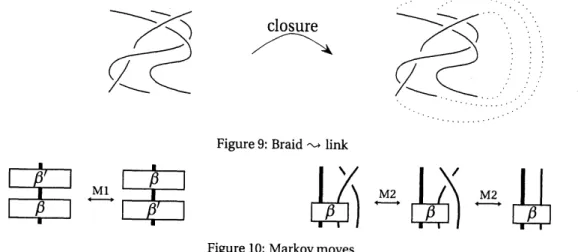
objects.The closure
map
for braids is recalledon
Figure 9. Alexander theoremassertsitssurjecti-vityby presenting
every
linkas
the closure ofsome
braid. Markov theorem describes itskernel byshowing that
any
twobraids with isotopicclosuresare
connected bya
finitese-quence of Reidemeister
moves
II-III and Markovmoves
1-2 (see Figure 10; thick lines herereplace
an
arbitrary number ofstrands).Figure9:Braid$\sim$ link
Figure 10:Markovmoves
When studying 3-graphs, braids should be replaced with branched braids. These
are
knotted graphs in$\mathbb{R}^{2}\cross[0$
,1$]$with$n$univalentvertices
on
thetop, $m$univalentvertices
on
thebottom,
some
trivalentverticesin between, andno
cups or caps
(with respect to the thirdcoordinate projection$\mathbb{R}^{2}\cross[0, 1]arrow[0$,1 The closure operation is still
definedforbranched
braids with$n=m$,
as
shownon
Figure11.Figure11: Branched braid$\sim 3$-graph
K. Kanno and K. Taniyama ([18]) proved that a113-graphs
are
obtained this way, givingan
Alexander-type theoremforbranchedbraids;see
also [25] fora
related result fortheta-curves.
AMarkov-type theoremforbranchedbraidswas
established byS.Kamada and the author([15]):we
showedany
twobranchedbraids withisotopicclosurestobe connected bya
finitesequence
ofReidemeistermoves
II-VI and Markovmoves
1-2. This resultgeneralizesTable3: Alexander-and Markov-typetheorems in differentsettings
Onthe level ofinvariants, the twotheoremsimplythat
a
branched braid invariantstable under Markovmoves
automatically gives risetoa
3-graphinvariant.In the opposite direction, qualgebra colorings work well for branched braids. Among
thetwoenhancements mentioned above for quandle colorings ofbraids, only the first
one
adapts to this setting. Indeed,a
weak qualgebra $(=$ data ($S, \triangleleft, *)$ satisfying $(Q_{SD})-(Q_{Inv})$and$(QA_{Comp})-(QA_{Comm})$ only)
can
serve as
a
coloringsetfor branchedbraid diagrams:However, contrarytothe
case
of usualbraids,hereupper
colors donotdetermine lower colors$*$because of unzipvertices: the knowledge of$a*b$does not give
you
$a$and$b$.
Henceone
hasto contentoneselfwith counting(weak) qualgebra colorings, possibly with weights.3.3 Qualgebras in SetTheory
Besidesthetopological and algebraic settingsdescribedabove,axioms$(QA_{Comp})-(QA_{Comm})$
also
emerge
ina
completelydifferent set-theoretical context. Namely, together with the as-sociativity of $*$ and the existence ofa
neutral element 1 $for*satisfi^{r}ing$moreover
$1\triangleleft a=1$and$a\triangleleft 1=a$forall $a$, they define$a(right-)$distributivemonoid(or,in othersources, RD
al-gebra). Examplesincludeelementaryembeddings,Lavertables,and extended braids. Allof
them admitrich distributivemonoidstructures, motivating
an
extensive study of thecon-cept (see forinstance [4, 9, 10, 5],
or
Chapter XI of[6] fora
comprehensive exposition). $A$weaker augmented (right-)distributive system structure ofP Dehornoy obeys only axioms $(Q_{SD})$, $(QA_{Comp})$,and$(QA_{D})$
.
Themajor example here is that of parenthesized braids([7,8Ourqualgebras
are
particularcases
of augmented distributive systems.Acknowledgements
Theauthor is gratefultoSeiichiKamada,Patrick Dehornoy and Atsushi Ishii for stimulating
discussions,andtothe researchers andsecretariesof OCAMI andRIMSfortheir hospitality The author
was
supported bya
ISPS
Postdoctral FellowshipForForeign Researchers and byJSPS
KAKENHIGrant$25\cdot 03315.$References
[1]
J.
ScottCarter,Daniel Jelsovsky, SeiichiKamada, LaurelLangford, and Masahico Saito.State-sum invariantsofknotted
curves
and surfaces from quandle cohomology.[2] I. ScottCarter, DanielJelsovsky, SeiichiKamada, Laurel Langford, and Masahico Saito. Quandle
cohomology
and state-suminvariants ofknottedcurves
andsurfaces. Trans. Amer. Math. Soc.,$355(10):3947-3989$,2003.[3] Wesley Changand Sam Nelson. Rackshadowsandtheirinvariants.
J.
KnotTheoryRam-ifications, $20(9):1259-1269$,2011.
[4] PatrickDehornoy Infiniteproducts in monoids. SemigroupForum, $34(1):21-68$, 1986.
[5] Patrick Dehornoy. Transfinite braids and left distributive operations. Math. Z.,
$228(3):405-433$, 1998.
[6] PatrickDehornoy Braids and
self-distributivity,
volume 192 ofProgress in Mathematics.Birkh\"auserVerlag,Basel,2000.
[7] PatrickDehornoy. The
group
ofparenthesized braids. Adv.Math.,205(2):354-409,2006. [8] PatrickDehornoy Freeaugmented LD-systems.J.
AlgebraAppl., 6(1):173-187, 2007.[9] AlegDr\’apal. Onthesemigroupstructure of cyclic leftdistributivealgebras.
Semigroup
Forum, $51(1):23-30$, 1995.
[10] Ale\v{s} Dr\’apal. Finite leftdistributive algebras with
one
generator. J. PureAppl. Algebra, $121(3):233-251$ ,1997.[11] Thomas Flemingand Blake Mellor. Virtual spatial graphs.
KobeJ.
Math., $24(2):67-85,$ 2007.[12] A. Ishii, M. Iwakiri, Y Jang, and K. Oshiro. A$G$-family ofquandles and
handlebody-knots. To
appear
inIllinoisJ.
Math.,May2012.[13] Atsushi Ishii. A multiple conjugation quandle and handlebody-knots. Preprint at
http..llwww. math. tsukuba. ac.jpl aishiilpapers.htm,2013.
[14] David Joyce. Aclassifying invariant ofknots, the knot quandle. J. PureAppl. Algebra,
$23(1):37-65$, 1982.
[15] S.Kamada andyLebed. Alexanderand Markov theorems for graph-braids. In
progress,
2014.
[16] Seiichi Kamada. Knot invariants derived from quandles and racks. In Invariants
of
knotsand
3-manifolds
(Kyoto, 2001),volume4 ofGeom. Topol. Monogr.,pages
103-117(electronic).Geom. Topol.Publ.,Coventry,2002.
[17] Seiichi Kamada.Quandleswith goodinvolutions,their homologies and knotinvariants.
In Intelligence
of
low dimensional topology2006, volume 40 of Ser Knots Everything,pages 101-108.World Sci.Publ., Hackensack, NI, 2007.
[18] Ken Kanno and Kouki Taniyama. Braidpresentationofspatialgraphs. TokyoJ.Math.,
33(2):509-522,2010.
[19] Louis H. Kauffman. Invariants of graphs in three-space. Trans. Amer Math. Soc.,
[20] V Lebed. Qualgebrasandknotted3-va1entgraphs. ArXive-prints, February2014. [21] VictoriaLebed. Homologies of algebraicstructuresviabraidingsandquantumshuffles.
J.Algebra, 391:152-192,2013.
[22] Charles Livingston. Knottedsymmetricgraphs. Proc. Amer.Math. Soc., 123(3):963-967, 1995.
[23] S. V Matveev. Distributivegroupoidsin knot theory. Mat. Sb. (N.S.), $119(161)(1):78-88,$
160, 1982.
[24] Maciej Niebrzydowski. Coloringinvariantsofspatialgraphs.
J.
KnotTheoryRamifica-tions, $19(6):829-841$,2010.
[25] Tomoko Shinnoki and Takashi Takamuki. On the braid index of$\theta_{m}$
-curve
in 3-space.Math. Nachr, 260:84-92,2003.
[26] ShujiYamada. Aninvariantofspatial graphs.
J.
GraphTheory, $13(5):537-551$, 1989.[27] DavidN.Yetter. Categorytheoreticrepresentationsofknotted graphsin$S^{3}.$
Adv.Math.,
$77(2):137-155$ , 1989.
Osaka City UniversityAdvancedMathematical Institute Osaka City University
Osaka558-8585