Monotone
Bartlett-type
correction
for
some
test
statistics
under
nonnormality
筑波大学・数学系 青嶋 誠 (Makoto Aoshima)
Institute of Mathematics
University of Tsukuba
筑波大学大学院・数理物質科学研究科 榎 広之 (Hiroyuki Enoki)
Graduate School of Pure and Applied Sciences
University of Tsukuba
筑波大学大学院・数理物質科学研究科 伊藤 修 (Osamu Ito)
Graduate School ofPure and Applied Sciences
University of Tsukuba
Suppose that anonnegativestatistic $T$ is asymptotically distributed as achi-squared
distri-bution with $f$ degrees of ffeedom, $\chi_{f}^{2}$, as apositive number $n$ tends to infinity. We consider
monotone transformations to improve chi-squared approximations under nonnormality. The
transformations proposed here preserve monotonicity and give transformed statistics whose
firstthree moments arecoincident with the onesof$\chi_{f}^{2}$up to $O(n^{-1})$. It may be noted that the
proposed transformations can be applied to awide class ofstatistics whether an asymptotic
expansion of $T$ is available or not. Several examples for applications are presented to
demon-strate that the proposed transformations give asignificant improvement to the chi-squared
approximation when compared to competitors.
Key Words and Phrases: Asymptotic expansion, Bartlett-type correction, chi-squared
approx-imation, monotonicity, nonnormality.
1.
INTRODUCTION
Suppose that anonnegative statistic $T$ is asymptotically distributed as achi-squared
distribution $\chi_{f}^{2}$ with $f$ degrees of freedom,
as
apositive number $n$ tends to infinity. TheBartlett correction was originally proposed
so
that itsmean
is coincident with theone
of$\chi_{f}^{2}11\mathrm{p}$ to the order $O(n^{-1})$
.
Recently,$\mathrm{F}_{11}\mathrm{j}\mathrm{i}\mathrm{k}\mathrm{o}\mathrm{s}\mathrm{h}\mathrm{i}$ (2000) gave different transformations
such that the first two moments oftransformed statistics
are
coincident with theones
of$\chi_{f}^{2}11\mathrm{p}$to $O(n^{-1})$. The latter fact can be stated
more
concretely as follows: Suppose thatthe first two moments of$T$
can
be expandedas
$E(T)=f\{1+n^{-1}c_{1}+O(n^{-2})\}$, (1.1) $E(T^{2})=f(f+2)\{1+n^{-1}c_{2}+O(n^{-2})\}$. (1.2) 数理解析研究所講究録 1308 巻 2003 年 39-52
Then, for the case $\tilde{c_{2}}\equiv c_{2}-2c_{1}\neq 0$, Fujikoshi (2000) gave the following three
transfor-mations:
(i) For $\alpha_{0}>0$ and $n\alpha_{0}+\beta_{0}>0$,
$Y=(n \alpha_{0}+\beta_{0})\log(1+\frac{1}{n\alpha_{0}}T)$ ; (1.3)
(ii) For $\alpha_{0}<0$ and$n\alpha_{0}+\beta_{0}<0$,
$Y=T+ \frac{1}{n}(\frac{\beta_{0}}{\alpha_{0}}T-\frac{1}{2\alpha_{0}}T^{2})$ ; (1.4)
(iii) For any $\mathrm{a}\mathrm{O}$, $n$ and $\beta_{0}$,
$Y=(n \alpha_{0}+\beta_{0})\{1-\exp(-\frac{1}{n\alpha_{0}}T)\}$ ; (1.5)
with
$\alpha_{0}=2/\tilde{c_{2}}$, $\beta_{0}=\frac{1}{2}\{(f+2)c_{2}-2(f+4)c_{1}\}/\tilde{c_{2}}$
.
(1.6)Then, it holds that $Y’ \mathrm{s}$ are monotone functions of $T$
under each parameter restriction
and
$E(Y)=f+O(n^{-2})$, $E(Y^{2})=f(f+2)+O(n^{-2})$
.
(1.7)Further, if$T$
can
beexpandedas
$P(T \leq x)=G_{f}(x)+\frac{1}{n}\sum_{j=0}^{k}a_{j}G_{f+2j}(x)+O(n^{-2})$ (1.8)
where $k$ is apositive integer and $G_{f+2j}(\cdot)$ is the distribution function
of$\chi_{f+2j}^{2}$, $Y$ has the
asymptotic expansion given by
$P(Y\leq x)=G_{f}(x)+O(n^{-2})$ (1.9)
when $k=2$
.
(See also Cordeiro and Ferrari (1998).) However, there existsome
teststatistics such that the transformations given by (1.3), (1.4) and (1.5) with (1.6) do not
work in the
sense
of (1.9), especially under nonnormality.It may be noted that Bartlett-type correction, studied by Cordeiro and Ferrari (1991),
Kakizawa (1996), Fujikoshi (1997) andFujisawa (1997), forastatisticwith (1.8) depends
on
the knowledge about $k$ and the coefficients$a_{j}’ \mathrm{s}$, and in
some cases
$k$ is unknown and$a_{j}’ \mathrm{s}$ mustbe estimated inapractical
use.
Further,we
often encounter the situations whereit is difficult to obtain the coefficients $a_{j}’ \mathrm{s}$ in (1.8),
even
though its existence is assured.These situations appear in treating the distributionsofmultivariate test statistics under
nonnormality.
In order to
overcome
these difficulties, Cordeiro and Ferrari (1998) supposed to obtainthe third moment of$T$as in
an
expanded form,$E(T^{3})=f(f+2)(f+4)\{1+n^{-1}c_{3}+O(n^{-2})\}$ (1.10)
41
adding to (1.1)-(1.2) and they proposed a(2.3)-type transformation beyond the Bartlett
correction, depending on the coefficients ci, $c_{2}$ and $c_{3}$. So, such atransformation is
expected to give an improvement to the chi-squared approximation than dothe
transfor-mations givenby (1.3), (1.4) and (1.5). In general, the problemofderiving (1.1)-(1.2) and
(1.10) is moretractable than the one ofderiving (1.8). Similarly, the problemof
estimat-ing the coefficientsci, $c_{2}$ and $c_{3}$ is simplerthan theone ofestimatingthe coefficients $a_{j}’ \mathrm{s}$.
However, unfortunatelly, the transformation proposed by Cordeiro and Ferrari (1998) is
not always monotone.
In this paper, we shall consider new transformations given by adifferent approach
from others under the assumptions (1.1)-(1.2) and (1.10). It may be observed that new
transformations, proposed in this paper, successfully preserve monotonicity and give
a
significant improvement to chi-squared approximation as expected. It would lead abroad
application with awide class of statistics, especially under nonnormality, where their
asymptotic expansions are quite difficult to
access.
This paper is organized as in the following way. In Section 2, we propose monotone
transformations beyond the Bartlett correction, which
are
different from (1.3), (1.4) and(1.5). InSection 3,wegive
some
distributional properties of theproposedtransformationswhen $T$ has an asymptotic expansion (1.8). In Section 4, numerical examples of some
test statistics are demonstrated to observe an improvement brought by the proposed
transformations beyond the competitors.
2. NEW
TRANSFORMATIONS
For anonnegative statistic $T$ whose asymptotic distribution is $\chi_{f}^{2}$, we assume that the
first three moments
are
expandedas
in (1.1)-(1.2) and (1.10), respectively. Then, for thetransformations $Y’ \mathrm{s}$ given by (1.3), (1.4) and (1.5) with (1.6), it holds that
$E(Y^{3})=f(f+2)(f+4)\{1+n^{-1}\tilde{c_{3}}+O(n^{-2})\}$, (2.1)
where
$\tilde{c_{3}}=3(c_{1}-c_{2})+c_{3}$
.
Therefore, if $\mathrm{c}2\neq 0$ and $\tilde{c_{3}}=0$, we have that the differences among the first three
momentsof$Y$’s and $\chi_{f}^{2}$ are $O(n^{-2})$
.
However, if $\mathrm{c}2\neq 0$ and $\tilde{c_{3}}\neq 0$, in order to keep suchan optimum property, we need to consider
some
other transformations beyond Bartlettcorrection.
Now we consider the
cases
$\mathrm{c}2\neq 0$ and $\tilde{c}_{3}\neq 0$.
Let us consider the followingtransfor-mations which
were
originally given for astatistic with (1.8) when $k=3$:(i) For $\alpha>0$, $n\alpha+\beta>0$ and $\gamma>0$,
$\tilde{T}_{1}=(n\alpha+\beta)\log\{1+\frac{1}{n\alpha}(T+\frac{\gamma}{n\alpha}T^{3})\}$ (Fujikoshi (1997)); (2.2)
(ii) For $\alpha<0$, $not+\beta<0$ and $\gamma<0$,
$\tilde{T}_{2}=T+\frac{1}{n}(\frac{\beta}{\alpha}T-\frac{1}{2\alpha}T^{2}+\frac{\gamma}{\alpha}T^{3})$ (Cordeiro and Ferrari (1991)). (2.3)
Note that $\tilde{T}_{1}$ and $\tilde{T}_{2}$ are monotone increasing
functions when the parameters $\alpha$, $\beta$ and $\gamma$
satisfy the parameter restrictions of (i) and (ii), respectively. However, those parameter
ristrictions, in which $\alpha\gamma>0$, are very severe. So, let 11S propose the following new
transformations:
(2.4)
(iii) For any $\alpha$, $\beta$, $\gamma$ and $n$,
$\tilde{T}_{3}=(n\alpha+\beta)\{1-\exp(-\frac{1}{n\alpha}T-\frac{\gamma}{n^{2}\alpha^{2}}T^{3}-\frac{9\gamma^{2}}{20n^{3}\alpha^{3}}T^{5})\}$ ;
(2.5) (iv) For any $\alpha$, $\beta$,
$\gamma$ and $n$,
$\tilde{T}_{4}=(n\alpha+\beta)(1-\frac{\beta^{2}-\beta+\gamma-1}{n^{2}\alpha^{2}})$
$\{1-\exp(-\frac{1}{n\alpha}T-\frac{\gamma}{n^{2}\alpha^{2}}T^{3}-\frac{9\gamma^{2}}{20n^{3}\alpha^{3}}T^{5})\}$
.
(2.7) Note that $\tilde{T}_{4}=\{1-(\beta^{2}-\beta+\gamma-1)/(n^{2}\alpha^{2})\}\tilde{T}_{3}$, and $\tilde{T}_{3}$ and $\tilde{T}_{4}$ preserve monotonicity
without parameter restrictions. Further, note that asymptotic expansions of four $\tilde{T}_{i}’ \mathrm{s}$
described in $(\mathrm{i})-(\mathrm{i}\mathrm{v})$
are
thesame
up to $O(n^{-1})$ and they are given by$\tilde{T}=T+\frac{1}{n}(\frac{\beta}{\alpha}T-\frac{1}{2\alpha}T^{2}+\frac{\gamma}{\alpha}T^{3})+O_{p}(n^{-2})$
.
(2.6)Originally, $\tilde{T}_{3}$ is
motivated to reduce the amount of the terms of $O_{p}(n^{-2})$ in (2.6),
con-sidering the fact that
$\exp(-x)=1-x+\frac{1}{2!}x^{2}-\frac{1}{3!}x^{3}+\frac{1}{4!}x^{4}-\frac{1}{5!}x^{5}+\cdots$
.
The$\mathrm{e}\mathrm{x}\mathrm{p}\mathrm{a}\mathrm{n}\mathrm{d}\mathrm{e}\mathrm{d}+-+-\cdots$ terms could beeffectiveto reduce extra terms if$x>0$. From
(2.6), we have $E( \tilde{T})=f\{1+\frac{1}{n}(c_{1}+\frac{\beta}{\alpha}-\frac{f+2}{2\alpha}+\frac{(f+2)(f+4)\gamma}{\alpha})+O(n^{-2})\}$ , $E( \tilde{T}^{2})=f(f+2)\{1+\frac{1}{n}(c_{2}+\frac{2\beta}{\alpha}-\frac{f+4}{\alpha}+\frac{2(f+4)(f+6)\gamma}{\alpha})+O(n^{-2})\}(2.8)$ and $E( \tilde{T}^{3})=f(f+2)(f+4)\{1+\frac{1}{n}(c_{3}+\frac{3\beta}{\alpha}-\frac{3(f+6)}{2\alpha}+\frac{3(f+6)(f+8)\gamma}{\alpha})$ $+O(n^{-2})\}$. (2.9)
The coefficient $\{1-(\beta^{2}-\beta+\gamma-1)/(n^{2}\alpha^{2})\}$ appeared in $\tilde{T}_{4}$
is motivated to reduce the
amount of the terms of$O(n^{-2})$ in (2.7)-(2.9). It might be considered to add some extra
term to the inside of$\exp(\cdot)$ so that it works to cancel the terms of$O(n^{-2})$ in (2.7)-(2.9).
However, there seems to be difficult to preserve monotonicity. The idea of multiplyin$\mathrm{g}$
43
the coefficient $\{1-(\beta^{2}-\beta+\gamma-1)/(n^{2}\alpha^{2})\}$ in$\overline{T}_{4}$ aimstoreduce the amount of the terms
of $o(n^{-2})$ simultaneously. In fact, the effect of coefficient $\{1-(\beta^{2}-\beta+\gamma-1)/(n^{2}\alpha^{2})\}$
can be seen in Section 4numerically.
Now, in order to make the terms oforder $n^{-1}$ in (2.7)-(2.9) vanish, we need to choose
$\alpha$, $\beta$ and $\gamma$ as
$\alpha=\frac{6}{3\tilde{c_{2}}-(f+4)\tilde{c_{3}}}$,
$\beta=\frac{12(c_{2}-4c_{1})+6f\tilde{c_{2}}-(f+2)(f+4)\tilde{c_{3}}}{4\{3c_{2}^{-}-(f+4)\tilde{c_{3}}\}}$, (2.10)
$\gamma=\frac{-\tilde{c_{3}}}{4\{3\tilde{c_{2}}-(f+4)\tilde{c_{3}}\}}$,
provided that $3\mathrm{c}2-(f+4)\mathrm{c}\mathrm{Y}\neq 0$. These results
can
be summarized as follows:THEOREM 1. Suppose that
a
nonnegative random variate$T$ hasan
asymptoticchi-squared distribution with $f$ degrees
of
freedom, and itsfirst
threemoments are
expandedas in (1.1)-(1.2) and (1.10). For the
cases
that $\tilde{c_{2}}\neq 0,\tilde{c_{3}}\neq 0$ and$3\tilde{c_{2}}-(f+4)\tilde{c_{3}}\neq 0$, let$\tilde{T}$
’s be the
transformations
(2.2)-(2.5) with $a$, $\beta$ and$\gamma$defined
by (2.10). Then, it holdsthat $\tilde{T}$
’s
are
monotonefunctions of
$T$ and$E(\tilde{T})=f+O(n^{-2})$,
$E(\tilde{T}^{2})=f(f+2)+O(n^{-2})$, (2.11)
$E(\tilde{T}^{3})=f(f+2)(f+4)+O(n^{-2})$.
It is easy to see that the transformation $\tilde{T}_{2}$ with
$\alpha$, $\beta$ and
7defined
by (2.10) isequivalent to the transformation given by Cordeiro and Ferarri (1998).
Let $t(u)$ be afunction of$u$ defined by arelation
$P(T\leq t(u))=P(\chi_{f}^{2}\leq u)$. (2.12)
Note that $P(T\leq t(u))=P(\tilde{T}(T)\leq\tilde{T}(t(u)))$ and the distribution of$\tilde{T}(T)$ is close to a
chi-squared distribution $\chi_{f}^{2}$ in the sense of (2.11). This suggests that
an
approximation$\tilde{t}(u)$ may be proposed by $\tilde{T}(\tilde{t}(u))=u$
.
Since $\tilde{t}(u)$ isan
inverse function of $\tilde{T}$,
we can
express
an
approximation for (2.2) and (2.3), respectively, as follows: (i) For $\alpha>0$, $n\alpha+\beta>0$ and$\gamma>0$,$\tilde{t}_{1}(u)=(\frac{n^{2}\alpha^{2}}{2\gamma^{2}})^{1/3}\{$$(-d_{1}\gamma+\sqrt{d_{1}^{2}\gamma^{2}+\frac{4\gamma}{27n\alpha}})^{1/3}+(-d_{1}\gamma-\sqrt{d_{1}^{2}\gamma^{2}+\frac{4\gamma}{27n\alpha}})^{1/3}\}$
(2.13) where $d_{1}=1- \exp(\frac{u}{n\alpha+\beta})$;
(ii) For $\alpha<0$, $n\alpha+\beta<0$ and $\gamma<0$,
$\overline{t}_{2}(u)=\frac{1}{6\gamma}[1+\{$$1-18(n\alpha+\beta)\gamma+108n\alpha\gamma^{2}u+108\gamma\sqrt{d_{2}}\}^{1/3}$
$+\{1-18(n\alpha+\beta)\gamma+108n\alpha\gamma^{2}u-108\gamma\sqrt{d_{2}}\}^{1/3}]$ (2.14)
where $d_{2}=n^{2} \alpha^{2}\gamma^{2}u^{2}+\frac{n\alpha\gamma}{3}(\frac{1}{18\gamma}-(n\alpha+\beta))u+\frac{(na+\beta)^{2}}{108}(16(n\alpha+\beta)\gamma-1)$ . We note that
the asymptotic expansionsof$\tilde{t}(u)$ given by (2.13)-(2.14)are same uptothe order$O(n^{-1})$
,
and they
are
given by$\tilde{t}(u)=u-\frac{1}{n}(\frac{\beta}{\alpha}u-\frac{1}{2\alpha}u^{2}+\frac{\gamma}{\alpha}u^{3})+O(n^{-2})$. (2.15)
Unfortunately, we cannot describe $\tilde{t}(u)$ explicitly for (2.4) and (2.5). However, those
approximate values
are
available by conducting anumerical computation. It would beenough for apractical
use.
The accuracy of the approximations to the true percentagepoint $t(u)$ of$T$
can
be evaluated by using$P(T\leq t(u))=P(\tilde{T}(T)\leq\tilde{T}(t(u)))=P(\tilde{T}\leq u)$
.
(2.16)3. FURTHER
PROPERTIES
In this section, we study
some
distributional properties of the transformed statistics$\tilde{T}=\tilde{T}(T)$ when astatistic $T$
can
be expanded as in (1.8), in addition to the assumptionsof Theorem 1. Especially, we examine how much the distributions of $\tilde{T}$
are
simplified and close to the distribution of $\chi_{f}^{2}$
.
Beforewe
treat the distributions of $\tilde{T}$, we give the
expressionsof$\alpha$, $\beta$and
$\gamma$ in (2.10) in terms of thecoefficients $a_{j}’ \mathrm{s}$. Note that $\sum_{j=0}^{k}a_{j}=0$
to get from (1.8) that
$c_{1}= \frac{2}{f}\sum_{j=1}^{k}ja_{j}$,
$c_{2}= \frac{4}{f(f+2)}\sum_{j=1}^{k}j(j+f+1)a_{j}$, (3.1)
$c_{3}= \frac{8}{f(f+2)(f+4)}\sum_{j=1}^{k}j^{2}(j+f+1)a_{j}$
$+ \frac{4}{f(f+2)}\sum_{j=1}^{k}j(j+f+1)a_{j}+\frac{2}{f+4}\sum_{j=1}^{k}ja_{j}$
.
For the case $k=2$, we have $\tilde{c_{3}}=0$, and hence the transformations $Y$’s due to Fujikoshi
(2000) yield an improvement on approximation of the third moment as well as the first
two moments of$\chi_{f}^{2}$
.
Further, we can get (1.9). So, we consider thecase
$k\geq 3$.
First, wenote that
$\tilde{c_{2}}=\frac{4}{f(f+2)}\sum_{j=2}^{k}j(j-1)a_{j}$,
$\tilde{c_{3}}=\frac{8}{f(f+2)(f+4)}\sum_{j=3}^{k}j(j-1)(j-2)a_{j}$ (3.2)
45
(3.5)
and hence the expressions of$\alpha$, $\beta$ and
$\gamma$ in (2.10) are obtained as $\alpha=\frac{-3f(f+2)}{2\sum_{j=2}^{k}j(j-1)(2j-7)a_{j}}$,
$\beta=\frac{(f+2)\sum_{j_{-}^{-}1}^{k}j(j^{2}-6j+11)a_{j}}{2\sum_{j=2}^{k}j(j-1)(2j-7)a_{j}}$ , (3.3)
$\gamma=\frac{\sum_{j=3}^{k}j(j-1)(j-2)a_{j}}{2(f+4)\sum_{j=2}^{k}j(j-1)(2j-7)a_{j}}$ ,
provided that $3\mathrm{c}2-(f+4)\tilde{c_{3}}\neq 0$
.
Especially when $k=3$, (3.3) becomes that$\alpha=\frac{1}{4}f(f+2)/(a_{2}+a_{3})$, $\beta=\frac{1}{2}(f+2)a_{0}/(a_{2}+a_{3})$,
$\gamma=-\frac{1}{2}a_{3}/\{(f+4)(a_{2}+a_{3})\}$
.
(3.4)Under the assumption that the distribution of astatistic $T$ can be expanded as in (1.8),
Kakizawa (1996) proposed amethod for finding amonotone transformation of$T$. When
$k=3$, his method gives the following transformation with (3.4):
$T_{K}=T+ \frac{1}{n}(\frac{\beta}{\alpha}T-\frac{1}{2\alpha}T^{2}+\frac{\gamma}{\alpha}T^{3})$
$+ \frac{1}{4n^{2}}\{\frac{\beta^{2}}{\alpha^{2}}T-\frac{\beta}{\alpha^{2}}T^{2}+(\frac{2\beta\gamma}{\alpha^{2}}+\frac{1}{3\alpha^{2}})T^{3}-\frac{3\gamma}{2\alpha^{2}}T^{4}+\frac{9\gamma^{2}}{5\alpha^{2}}T^{5}\}$ .
Notethat the expansion (3.5) is
same
as in (2.6) up to $O(n^{-1})$.Now, we consider asymptotic expansions ofthe distributions of$\overline{T}’ \mathrm{s}$
with
an error
termof $O(n^{-2})$. For the purpose, from (2.6) we may deal with
$\tilde{T}=T+\frac{1}{n}(\frac{\beta}{\alpha}T-\frac{1}{2\alpha}T^{2}+\frac{\gamma}{\alpha}T^{3})$
.
(3.6)The characteristic function of$\tilde{T}$
can
be expanded as$C(t)=E(e^{it\tilde{T}})$ $=E \{e^{itT}(1+\frac{it}{n}(\frac{\beta}{\alpha}T-\frac{1}{2\alpha}T^{2}+\frac{\gamma}{\alpha}T^{3}))\}+O(n^{-2})$ $=(1-2it)^{-f/2} \{1+\frac{1}{n}\sum_{j=0}^{k}a_{j}(1-2it)^{-j}\}$ $+ \frac{it}{n}E\{e^{itT}(\frac{\beta}{\alpha}T-\frac{1}{2\alpha}T^{2}+\frac{\gamma}{\alpha}T^{3})\}+O(n^{-2})$
.
Note that $E(Te^{itT})=f(1-2it)^{-f/2-1}+O(n^{-1})$, $E(T^{2}e^{itT})=f(f+2)(1-2it)^{-f/2-2}+O(n^{-1})$, $E(T^{3}e^{\dot{\iota}tT})=f(f+2)(f+4)(1-2it)^{-f/2-3}+O(n^{-1})$.
45
Using these results, we have
$C(t)=(1-2it)^{-f/2} \{1+\frac{1}{n}\sum_{j=0}^{k}\overline{a}_{j}(1-2it)^{-j}+O(n^{-2})\}$ , (3.7)
where
$\tilde{a}_{0}=a_{0}-\frac{\beta}{2\alpha}f,\tilde{a}_{1}=a_{1}$$ $\frac{1}{4\alpha}(2\beta+f+2)f$,
$\tilde{a}_{2}=a_{2}-\frac{1}{4\alpha}(1+2\gamma f+8\gamma)f(f+2)$, $\tilde{a}_{3}=a_{3}+\frac{\gamma}{2\alpha}f(f+2)(f+4)$, (3.8)
$\tilde{a}_{j}=a_{j}(j\geq 4)$
.
Inverting (3.7), we
can
obtain the followingtheorem.THEOREM 2. Suppose that
a
nonnegative random variate $T$ hasan
asymptoticexpansion (1.8), and its
first
three momentscan
be expandedas
in (1.1)-(1.2) and (1.10).Assume that$k\geq 3$ and$\sum_{j=2}^{k}j(j-1)(2j-7)a_{j}\neq 0$
.
Then, neglecting the termsof
$o(n^{-2})$,$\tilde{T}$
’s have the
same
asymptotic expansion given by$P( \tilde{T}\leq x)=G_{f}(x)+\frac{1}{n}\sum_{j=0}^{k}\tilde{a}_{j}G_{f+2j}(x)+O(n^{-2})$, (3.9)
where the
coefficients
$\tilde{a}_{j}$’sare
given by (3.8).Theorem 2shows that the diiferences between the asymptotic expansions for $T$ and $\tilde{T}$
appear in only the first four coefficients $a_{j},$ $dj,j=0,1,2,3$. Further, we can see that the
asymptotic expansions for $\tilde{T}$
in the cases $k=3$ and 4are considerably simple, and are
close to the distribution of$\chi_{f}^{2}$
.
In fact,(i) The case $k=3;\tilde{a}_{j}=0,j=0,1,2,3$ and
$P(\overline{T}\leq x)=G_{f}(x)+O(n^{-2})$
.
(3.10)(ii) The
case
$k=4$;note that$\alpha=\frac{1}{4}f(f+2)/(a_{2}+a_{3}-2a_{4})$, $\beta=\frac{1}{2}(f+2)(a_{0}-a_{4})/(a_{2}+a_{3}-2a_{4})$, $\gamma=-\frac{1}{2}(a_{3}+4a_{4})/\{(f+4)(a_{2}+a_{3}-2a_{4})\}$.
Hence, we have that $\tilde{a}_{0}=a_{4},\tilde{a}_{1}=-4a_{4},\tilde{a}_{2}=6a_{4},\tilde{a}_{3}=-4a_{4},\tilde{a}_{4}=a_{4}$ , and
$P( \tilde{T}\leq x)=Gf(x)+\frac{a_{4}}{n}\{G_{f}(x)-4G_{f+2}(x)+6G_{f+4}(x)$
$-4G_{f+6}(x)+G_{f+8}\}+O(n^{-2})$ (3.11)
$=G_{f}(x)+ \frac{2a_{4}}{nf}g_{f}(x)\{x-\frac{3}{f+2}x^{2}+\frac{3}{(f+2)(f+4)}x^{3}$
$- \frac{1}{(f+2)(f+4)(f+6)}x^{4}+O(n^{-2})\}$,
47
where $g_{f}(x)$ is the probability density function of$\chi_{f}^{2}$.
It may be noted that the transformations $\tilde{T}’ \mathrm{s}$
in (2.2)-(2.5) and $T_{K}$ in (3.5) have
removedthe terms of$O(n^{-1})$ in the asymptotic expansion(1.8) with $k=3$. One may refer
to Cordeiro and Ferarri (1998) as well. For$k=4$, wehave asimpleasymptotic expansion for the distribution of$\tilde{T}$
, which becomes more close to the chi-squared distribution $\mathrm{a}_{\mathrm{L}}\mathrm{s}a_{4}$
becomes close to zero. In many instances, the null distributions of test statistics under
nonnormality are expanded in the form (1.8) with $k=3$.
4. SOME
APPLICATIONS
EXAMPLE 1. Let $T=(n-q)s_{h}^{2}/s_{e}^{2}$ be atest statistic for testing the equality of
means
of$q$ nonnormal populations $\Pi_{i}$ $(i=1, \ldots, q)$ withcommon
variance. Here,$s_{h}^{2}$ and
$s_{\mathrm{e}}^{2}$
are
thesums
of squares dlle to the hypothesis and the error, respectively, basedon
the sample of the size $n_{i}$ from $\Pi_{i}$
.
Let $\rho_{t}=\sqrt{n_{i}/n}$, where $n$ is the total sample size.Assume that $\rho_{i}=O(1)$ as $n_{j}’ \mathrm{s}$tend to infinity. Let $\kappa_{3}$ and $\kappa_{4}$ be the third and the fourth
cumulants ofthe standardized variate. Then, under ageneral condition, an asymptotic
expansion for the null distribution of$T$ was given by Fujikoshi, Ohmae and Yanagihara
(1999) in the form (1.8) with $k=3$,
$f=q-1$
and the coefficients given by$a_{0}= \frac{1}{4}(q-1)(q-3)-d_{1}\kappa_{3}^{2}+d_{2}\kappa_{4}$,
$a_{1}=- \frac{1}{2}(q-1)^{2}+3d_{1}\kappa_{3}^{2}-2d_{2}\kappa_{4}$,
$a_{2}= \frac{1}{4}(q^{2}-1)-3d_{1}\kappa_{3}^{2}+d_{2}\kappa_{4}$,
a3 $=d_{1}\kappa_{3}^{2}$,
where
$d1$ $=$ $\frac{5}{24}$
(
$\sum_{j=1}^{q}$$\frac{n}{n_{j}}$– $q\mathrm{z}$
)
$+$ $\frac{1}{12}$$(q$ – $1$$)$$(q$–$2$$)$,$d_{2}= \frac{1}{8}(\sum_{j=1}^{q}\frac{n}{n_{j}}-q^{2})-\frac{1}{4}(q-1)$.
We examined performance of
our new
transfomations under the following threenon-nomal models:
(1) $\chi^{2}$ distribution with 4degrees of freedom;
(2) Gamma distribution with shape parameter 3and scale parameter 1/3;
(3) Exponential distribution with scale parameter 1.
TABLE Igives the true percentage point $t(u)$ and the approximate percentage points
$t_{B}(u)$, $t_{E}(u)$, $t_{1\cdot 2}(u)$, $t_{3}(u),\tilde{t}_{1\cdot 2}(u),\tilde{t}_{3}(u),\tilde{t}_{4}(u)$ and $t_{K}(u)$ for the case $q=3$
.
Here, $u$denotes the upper 5% point of $\chi_{2}^{2}$, $t_{B}(u)$ and $t_{E}(u)$ are computed on
the basis of the
Bartlett corection and the Cornish-Fisherexpansion $11\mathrm{p}$ to the order $O(n^{-1})$ respectively,
and $t_{3}(u),\tilde{t}_{3}(u),\tilde{t}_{4}(u)$ and$t_{K}(u)$ arecomputedon thebasis of (1.5), (2.4), (2.5) and (3.5)
respectively. Note that when $k=3$, the Cornish-Fisher expansion yields the percentage
point$t(u\mathrm{J}$of$T$inthesameformas in (2.15) with (3.4). Itmeans thatthetransformations
$T_{K}$ and $T$ aim to find an improvement ofapproximations to $t(u)$ in the terms of$O(n^{-2})$
.
On the other hand,
$t_{1\cdot 2}(u)=\{$
$t_{1}(u)$ if $\alpha_{0}>0$ and $n\alpha_{0}+\beta_{0}>0$,
$t_{2}(u)$ if $\alpha_{0}<0$ and $n\alpha_{0}+\beta_{0}<0$,
where$t_{1}(u)$ and$t_{2}(u)$
are
computedon
the basis of(1.3) and (1.4) respectively. Similarly,$\tilde{t}_{1\cdot 2}(u)=\{$
$\tilde{t}_{1}(u)$ if $\alpha>0$, $n\alpha+\beta>0$ and $\gamma>0$, $\tilde{t}_{2}(u)$ if $\alpha<0$, $n\alpha+\beta<0$ and $\gamma<0$,
where $\tilde{t}_{1}(u)$ and $\tilde{t}_{2}(u)$ are defined by (2.13) and (2.14) respectively.
TABLEI
Thepercentage points in the case$q=3$
49
TABLE II
The actualtest sizes in the case$q=3$
TABLE II gives the actual test sizesdenoted by
$\alpha_{1}=P(T>u)$, $\alpha_{2}=P(T>t_{B}(u))$, $\alpha_{3}=P(T>t_{E}(u))$,
$\alpha_{4}=P(T>t_{1\cdot 2}(u))$, $\alpha_{5}=P(T>t_{3}(u))$, $\alpha_{6}=P(T>\tilde{t}_{1\cdot 2}(u))$,
$\alpha_{7}=P(T>\tilde{t}_{3}(u))$, $\alpha_{8}=P(T>\tilde{t}_{4}(u))$, $\alpha_{9}=P(T>t_{K}(u))$,
for the case $q=3$.
In this example, $\tilde{T}_{1}$ and $\tilde{T}_{2}$ are not applicable because of $\alpha\gamma<0$
.
The reason whythere are several $\alpha_{4}$ and 05 values very close to the target (5%) would be caused by
the closeness of $\tilde{c_{3}}$ to 0. In the case when $\tilde{c_{3}}$ is close to 0, the advantage of using the
transformations expanded as (2.6) is seriously influenced by the amount of the terms of
$O(n^{-2})$ in (2.11). In fact,
we can see
from TABLE II that areduction of the amount ofthe terms of$O(n^{-2})$ brought by $\tilde{t}_{4}(u)$ is visible
as an
improvementof the approximation,especially when $n$ is small
EXAMPLE 2. We consider chi-squared approximations for the distribution of the
score statistic Sr. An asymptotic expansion for the null distribution of$S_{R}$ was given by
Harris (1985) in the form (1.8) with k $=3$ and the coefficients given by
$a_{0}= \frac{A_{2}-A_{1}-A_{3}}{24}$, $a_{1}= \frac{3A_{3}-2A_{2}+A_{1}}{24}$, $a_{2}= \frac{A_{2}-3A_{3}}{24}$, $a_{3}= \frac{A_{3}}{24}$.
The quantities $A_{1}$,
A2
and $A_{3}$ are usually functions of unknown parameters. Ferrari,Uribe-Opazo and Cordeiro (2002) gave simple formulae of $A_{1}$, $A_{2}$ and
A3
fortw0-parameter exponential family models.
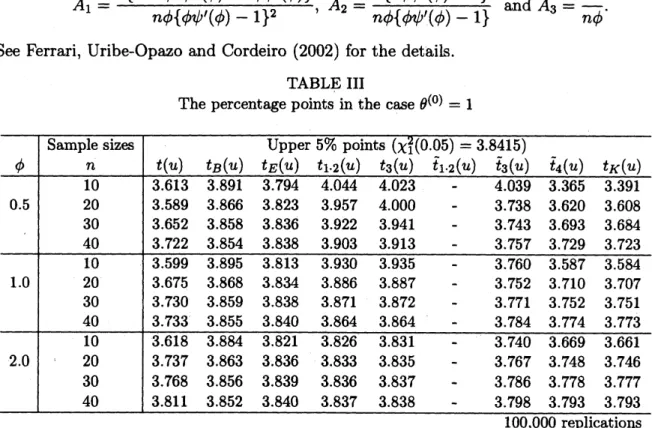
Let us consider thegamma distribution with
mean
$\theta>0$ and shape parameter $\phi$ $>0$$(y>0)$. In the experiment, our interest is in testing $H_{0}$ : $\theta=\theta^{(0)}$ against $H_{1}$ : $\theta\neq\theta^{(0)}$,
assuming that the shape parameter $\phi$ is unknown. The Monte Carlo simulation with
100,000 replications was conducted by setting $\theta^{(0\rangle}=1$, $\phi=0.5,1.0$ and 2.0 and the
number of observations was set as $n=10,20,30$ and 40. For each sample, the score
statistic were computed as $S_{R}=n\overline{\phi}(\overline{y} - 1)^{2}$, where $\tilde{\phi}$
, the MLE of $\phi$ under $H_{0}$, is
obtained as asolution to the nonlinear equation
$\log\tilde{\phi}-\psi(\tilde{\phi})=\log(\frac{\theta^{(0)}}{\overline{y}_{g}})+(\frac{\overline{y}-\theta^{(0)}}{\theta^{(0)}})$
with $\psi(\phi)=d\log$$\Gamma(\phi)/d\phi$ the digammafunctoin, and $\overline{y}$ and
$\overline{y}_{g}$
are
the samplemean
andgeometric
mean
of $y_{1}$, $\ldots$,$y_{n}$.
Then, an asymptotic expansion for the null distributionof $S_{R}$ is the chi-squared distribution with 1degree of freedom followed by the terms of
order$n^{-1}$ with the quantites
$A_{1}= \frac{6\{1-\phi^{2}\psi’(\phi)-2\phi\psi’(\phi)\}}{n\phi\{\phi\psi(\phi)-1\}^{2}},$, $A_{2}= \frac{9\{2\phi\psi’(\phi)-3\}}{n\phi\{\phi\psi(\phi)-1\}}$
,and
$A_{3}= \frac{20}{n\phi}$.See Ferrari, Uribe-Opazo and Cordeiro (2002) for the details.
TABLE III
Thepercentage points in thecase $\theta^{(0)}=1$
51
Similarly to EXAMPLE 1TABLE III gives the true percentage point and the
approx-imate percentage points for the case $\theta^{(0)}=1$ and TABLE IV gives the corresponding
actual test sizes.
In this example as well, $\tilde{T}_{1}$ and $\tilde{T}_{2}$ are not applicable because of $\alpha\gamma<0$. From these
tables, we can see the advantage of using the transformations (2.4)-(2.5) and (3.5). In
fact, $\tilde{c_{3}}$ is not close to 0. Note that ay $<0$ and $\alpha<0$. In the case when ay $<0$ and
$\alpha<0$, the inside of$\exp(\cdot)$ in (2.4) is always positive, so that the using of$\exp(\cdot)$ in (2.4)
would cause to increase the amount of the terms of $O_{p}(n^{-2})$ in (2.6). We can see that
the transformation (2.5) with the coefficient $\{1-(\beta^{2}-\beta+\gamma-1)/(n^{2}\alpha^{2})\}$ produces
an
improvement successfully in that
sense.
TABLE IV
The actual test sizes inthe case $\theta^{(0)}=1$
Nominal 5% test $\frac{\alpha_{4}\alpha_{5}\alpha_{6}\alpha_{7}\alpha_{8}\alpha_{9}}{4.1743.895-4.1875.6125.555}$ 0.063 0.061 0.063 0.073 0.072 3.989 3.905 4.461 4.757 4.790 0.062 0.061 0.065 0.067 0.068 4.265 4.217 4.711 4.877 4.893 0.064 0.064 0.067 0.068 0.068 4.502 4.466 4.899 4.985 4.997 $\frac{0.0660.065-0.0680.0690.069}{4.0884.074- 4.5315.0335.044}$ 0.063 0.063 0.066 0.069 0.069 4.377 4.374 4.755 4.896 4.903 0.065 0.065 0.067 0.068 0.068 4.590 4.589 4.884 4.934 4.940 0.066 0.066 0.068 0.068 0.069 4.618 4.618 4.856 4.877 4.879 $\frac{0.0660.066- 0.0680.0680.068}{4.3104.297- 4.6044.8354.867}$ 0.064 0.064 0.066 0.068 0.068 4.692 4.688 4.910 4.957 4.961 0.067 0.067 0.068 0.069 0.069 4.796 4.794 4.947 4.978 4.979 0.068 0.068 0.069 0.069 0.069 4.914 4.913 5.045 5.061 5.065 $\frac{0.0680.068- 0.0690.0690.069}{100,000\mathrm{r}\mathrm{e}\mathrm{p}1\mathrm{i}\mathrm{c}\mathrm{a}\mathrm{t}\mathrm{i}\mathrm{o}\mathrm{n}\mathrm{s}}$
Through EXAMPLEs 1and 2, we have
seen
how much the distributions of thetrans-formed statistics $\tilde{T}_{i}$ are close to the one of $\chi_{f}^{2}$ -variate, or how much the approximate
percentage points $\tilde{t}_{i}(u)$ are close to the true percentage point $t(u)$ of $T$. It is shown
that the proposed transformations of these statistics give alarger improvement to the
chi-squared approximation than dotheother transformations. Unfortunately, we cannot
recommend
our
transformations in the followingcase
$\mathrm{s}$(i) In the case $\alpha>0,\tilde{T}_{3}$ has the upper limit
$not+\beta$
.
Therefore, when $u$ is close to$n\alpha+\beta$, theapproximatepercentagepoint $\tilde{t}_{3}(u)$ cannot hold accuracy seenin EXAMPLEs
1and 2. Further, when $u$ is over$n\alpha+\beta$, the approximate percentage point $\tilde{t}_{3}(u)$ cannot
be used.
(ii) In the casecry $<0,\tilde{T}_{3}$has anextreme value at$T=\sqrt{-2n\alpha/(3\gamma)}$.
Therefore, when
$u$ is close to that value, the approximate percentage point $\tilde{t}_{3}(u)$ cannot hold accuracy
seen in EXAMPLEs 1and 2.
As for $(\mathrm{i})-(\mathrm{i}\mathrm{i})$ described above, $\tilde{T}_{4}$
has similar natures to $\tilde{T}_{3}$
.
Toovercome
these
diffi-culties $(\mathrm{i})-(\mathrm{i}\mathrm{i})$ simultaneously, the following transformation
could be
one
of the options:$\tilde{T}=(n^{2}+\frac{\beta}{\alpha}n)\log(1+\frac{1}{n^{2}}T-\frac{1}{2n^{3}\alpha}T^{2}+\frac{\gamma}{n^{3}\alpha}T^{3}$
$+ \frac{1}{2n^{4}}T^{2}+\frac{1}{12n^{4}\alpha^{2}}T^{3}-\frac{3\gamma}{8n^{4}\alpha^{2}}T^{4}$%
$\frac{9\gamma^{2}}{20n^{4}\alpha^{2}}T^{5})$
for any $\alpha$, $\beta$, $\gamma$ and $n$
.
Its asymptotic expansion form issame
as in (2.6) up to $O(n^{-1})$.Theefficiency of this transformation and its modifications are under investigation.
REFERENCES
[1] G. M. Cordeiro and S. L. de P. Ferrari, Amodified scoretest statistic having chi-squared
distribution toorder $n^{-1}$, Bi0metrika, 78 (1991), 573-582.
[2] G. M. Cordeiro and S. L. P. Ferrari, Anote on Bartlett-type correction for the first few
moments of test statistics, J. Statist. Plan. Inference, 71 (1998), 261-269.
[3] S. L. P. Ferrari, M. A. UribeOpazo, and G. M. Cordeiro, Bartlett-type correctionsfor two
parameter exponential family models, Commun. Statist -Theory Meth., 31 (2002), 901-924.
[4] Y. Fujikoshi, Amethodfor improvingthe large-sample chi-squared approximations tosome
multivariate test statistics, Amer. J. Math. Management Sci., 17 (1997), 15-29.
[5] Y. Fujikoshi, Transformations with improved chi-squared approximations, J. Multivariate
Analysis, 72 (2000) 249-263
[6] Y. Fujikoshi, M. Ohmae, and H. Yanagihara, Asymptotic approximations of the null
dis-tribution of one-way ANOVA test statistic under nonnormality, J. Japan Statist., 29 (1999),
147-161.
[7] H. Fujisawa, Improvement on chi-squared approximation by monotone transformation, /.
Multivariate Anal 60 (1997), 84-89.
[8] P. Harris, An asymptotic expansion for the null distribution of the efficient score statistic,
Biometrika, 72 (1985), 653-659.
[9] Y. Kakizawa, Higher order monotone Bartlett-type ajustment for some multivariate test
statistics, Biornetrika, 83 (1996), 923-927