{st
g]
Journa]
ofSt[uctu[aL
andConstruction
Engineerlng
Htsefi7ftMfiXtaNvafipt
uDc:sso.
347
,
(Traosactions
oiAIJ)
Ne.
396,
Feb[uary,
1989
ng3g6e
・1gsg4
2A
A
SEMI-EMPIRICAL
METHOD
TO
SYNTHESIZE
'
'
EARTHQUAKE
GROUND
MOTIONS
BASED
ON
'
APPROXIMATE
FAR-FIELD
SHEAR-WAVE
DISPLACEMENT
by
KAZUO
DAN',
TAKAHIDE
WATANABE"
and
TEIJI
TANAKA**',
Members
of
A.
I.
J.
1.
Introduction
Estimation
of
strong
ground
motionsis
animportant
subjectfoi
earthquake resistantdesign
of
structures.Since
Hartzell's
work(lg78)",
a semi-empirical methodto
simulateground
motions of alarge
earthquake
by
utilizing
small-event
recordsas
Green'$
functions
has
been
applied
by
many'researchers.
Kanamori
{1979)'2
pfoposed'a
rnethod
to
simulateLove-wave
displacements
by
consideringthe
difference
ofthe
seismic mornentbetween
the
small
and
th'e
large
events.Imagawa
&
Mikumo
(1982)'3
andIrikura
(1983)'`
simulateddisplacement
and velocity motions, respectively,based
onthe
similarity ielations of earthquakesthat
the
rupturedfault
,length,
width andaverage
distocation
areproportional
to
each other,Tanaka
etaL(1982)'5
simulated
accelerogramsby
considering
only
the
difference
ofthe
fault
areabetween
the
two
eventsin
orderto
avoidthe
ghost
peak
correspondingto
the
rise'time
ofthe
smallevent.
For
the
synthesis
ofthe
ground
displacement
or velocity motions,the
number of superposition ofthe
small-event recordsis
basically
the
ratio ofthe
seismic momentbetween
the
small andthe
large
events.
This
may correspondto
the
fact
that
the
seismic momentis
determined
from
the
arnplitude, ofthe
motions whgsefrequency
is
generally
lower
than
O.1Hz.
On
the
otherhand,
for
the
synthesis ofthe
acceLeratiQn, more attention mustbe
paid
to
the
efficiency ofgeneration
ofhigh-frequency
rnotionsthat
does
fiot
directly
correspondto
the
seismic
mornent.
The
authors(1987)'`
modifiedTanaka
et al,'smethod consistently with
the
co-square modelprop'Qsed
by
Aki
(lg67)"
and showedthe
applicability
ofthe
methodto
the
epicentral
regionof
the
197g
Imperial
Valley
earthquake,Their
method,however,
has
someproblems
that
the
Fourier
amplitudebecomes
zero at somefrequencies
because
of a ramp slipfunction
andthat
the
boundary
frequency
between
low
andhigh
frequencies
is
determined
by
mathematicalconvenience,
In
this
paper,
a newsynthesis
methodis
proposed
in
ordei
to
give
some
physical
aspects
to
the
modificationof
small-event records asGreen's
functions.
The
methodis
basecl
en
the
assumptionthat
the
source
spectraof
the
two
events couldbe
modeledby
an
approximatesource
spectrum
for
far-field
shear
waye
proposed
by
Brune
(1970)*B,
whichis
ene
of
the
to-squaremodel.
The
difference
of
the
low-frequency
motionsbetween
the
two
eventsis
taken
into
accountby
considering
the
difference
of
the
seismic moment, andthat
ofthe
high-frequency
motionsby
consideringthe
difference
ofthe
eff6ctive stress andthe
fault
area.The
methodis
appliedto
the
velocityand
acceteration
motionsfrom
the
fore
shock
(M
4,
9)
and
the
mainshock
(M
6.
7)
of
the
1980
Izu;Hanto-Toho-Oki
earthquake.The
predominant
frequencies
ofthe
velocity motions are aboutO.
1
Hz
andthose
ofthe
accelegation motions arefrom
1
to
10Hz.
2.
Synthesjs
Method
The
approximate
far-field
shear-wave
displacement
proposed
by
Brune
can
be
described
6y
Note
:Some
partsof thispaper were presented attheannual meetl"g ofthe Architectu[at [nstituteefJapan
in19S7,
thesemi-annual meetlng ofthgSelsmo]egical
Soclety
ofJapan
{n
1987, andInternationat
Symposium
onEarthquake
Countermeasures
ifi
lgs8,Beijing,
China.
*
Ohsaki
Research
Institute,
Shirnizu
Corporation,
M.
Eng.
**
Ohsaki
Research
Institute,
Shimizu
Co[po[ation,
Dr.
Eng.
・
#*
Ohsaki
Research
lnstitute,
Shimizu
Co[po[ation,
Df,
Sc.
,
(Manuscript
receivedAugust
31,
1988)
.{t)-Fs(-i:)(-::')p(t-g)exp[-to.(t-g)].
o)
Here
FS
is
the
radiationpattern
of
shear wave,X
is
the
source
size,
r
is
the
hypocentral
distance,
a.is
the
effective stress,"
is
the
rigidity ofthe
medium,B
is
the
shear-wave velocity and a),is
the
corner circularfrequent:y,
The
Fourier
transform
pair
is
obtained
by
9(to)=FS(J")(f')(.,.fli.)t・
(2)
where
j
is
A
andthe
time-lag
term
ofexp[-jafifr]
is
neglected.On
the
otherhand,
accordingto
the
theoretical
solution ef a shear-wavedisplacement
(Aki
&
Richards,
].980)'9,
g(O)
is
given
by
the
following
equation:9(O)=
FS
4
.wh/fi,r .(
3)
Here
Mh
is
the
seisrnic moment andp
is
the
density
ofthe
medium.From
equationsC
2
)
and(
3
),,
the
cerner
circular
frequency
canbe
writtenby
wc:=2B nAaelMo.
・
(4)
When
the
rupturedfault
length
L,
width
W
and
average
dislocation
D
are
proportional
to
each other(Kanamori
&
Anderson,
1975)'iO,
the
seismic
momentMh
is
proportional
to
A3
anclthen
the
corner circularfrequend:y
w,is
proportional
to
11A
because
A=ViJU773F
and
M,=-tLVV[D.
In
orderto
representthe
spectrurnof
an
actually
recordeddisplacement,
we shall considerthe
effect ofthe
quality
factor
Q
ofthe
medium andthe
receiver
characteristics
H(w).
The
modeled spectrum canbe
described
by
9(to)
'=F`4
ntssr
(1+J'
.W.)Mt
(1'
2Qrr
)W'1`""H(.).
(s)
We
as$umethat
the
ratios ofthe
rupturedfault
length,
width, averagedislocation
and effective stress ofthe
large
eventto
those
ofthe
small
event
are
a,b,
cand
d.
Then
the
expected spectrumgeneTated
by
the
{p,
q)
element
whose size
ls
equal
to
that
of
the
small
eventis
obtainedby
.
gdial==(rr.s)d(tu..tN'+Jte+jw)'(1.2Qrr)W`'m-'sVMptggw).
{6)
Here
FS,
p,
S,
Q
and
H(w}
for
the
large
eventare
all assumedto
be
the
same asthose
foT
the
small event.The
subscripts
pq
and
s
indicate
the
valuesfor
the
(p,
q)
element
and
the
small
event,
respectively,The
expectedspectrum
generated
by
the
(p,
q)
element
converges
into
the
following
formulas
(7)
and(8)
for
ts・< to,, andfor
to>to,., whenthe
hypocentral
distance
of
the
small
event
is
the
sarne
asthat
of
the
(p,
a)
element.
9pq(w)==C9s(w)
co<wcs(7)
9pq{to)=d9s{tu)
to>wcs(8)
Consequently,
the
expected
motionfrom
the
large
earthquake canbe
writtenby
abuKt)=
£
Z
u.ditny
t..),
<9)
p]tgml
where u..{t)
is
the
inverse
Fourier
transform
ef
equation
(
6
)
and
t..
is
the
traveling
time-lag
for
the
ruptureprocess
andthe
wavepropagation
for
each(p,
q)
element,
Note
here
that,
whenthe
effectivestress
ofthe
small eventis
equalto
that
ofthe
large
event, our synthesis methodis
equivalentto
those
by
Imagawa
&
Mikumo
(19s2)
''3
andIrikura
<1983)'`
for
the
low-frequency
motions andto
that
by
Tanaka
et aL(lg82>'5
for
the
high-frequency
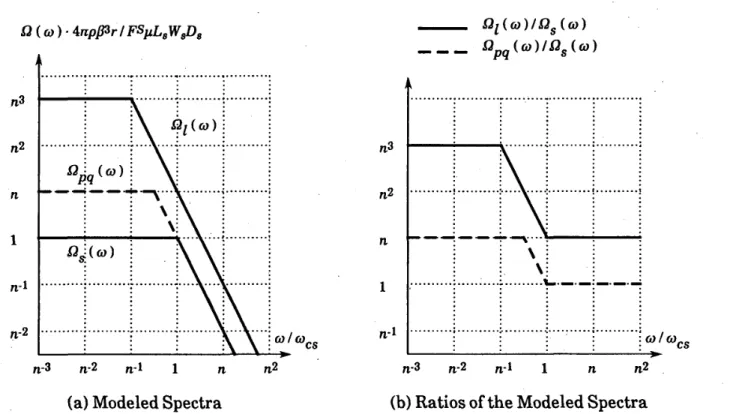
motions.Figure
1(a)
shows a scheme ofthe
spectrafor
a small event as aGreen's
function,
fora
large
eart.hquaketo
be
simulated
andfor
the
(p,
q)
eLement
on
the
1arge
earthquake
fault.
Figure
1(b>
shows
their
ratios.Here
the
ratiosa,
b
andc
are all assumedto
be
equalto
n
andd
equalto
1.
3.
Discussion
on
the
Synthesis
Method
Under
some assumptions,the
theoretical
representation of ashear-wave
displacement
(Aki
&
Richards,
1980)#9
is
written
by
"(t)=4.FneSs."fA,b[t-S-T(e)]dS(e)・
(lo)
-28-9(a})・4appar/IFSpL,vrP,
n3
n2
'n
1
n-1
n-2
bl
cs
n3
n2
n
1
n-1
n-3 n-2 n-11
n n2(a)
Modeled
Spectra
Fig.
1
Scherne
of the spectra and their raties usedin
this
paper/
Green's
function,
alarge
earthquake tobe
simulated and the(p,
.
where
S(g)
is
the
fault
plane,
D(t)
is
the
differential
o rapture at apoint
of,e onthe
fault
plane.
The
Fourier
9("')=4
.FneSs.
ptb(w)
flL,
exp
[-i
whereb(tu)
is
the
Fourier
transform
pair
ofb(t).
with a
decay
time
of11ca.
(Brune,
1970)'S:
ae(t)=aeeXP(-wDt)
Since
the
slipfunc,tion
is
writtenby
'-2ae
fl
.
pt
toD
a,.
in
equation
(12)
andb(w.).in
equation
(11)
are'
・
2age
tuD-
itD
tb(.)=
D
.
1+j-W
toDSubsequently,
equation(6).can
be
rewrittepby
9pq{
a))=(rr.S,
)d
.,.ISSI+cJ+'
WJ・.(1
-
2Qn
'
The
characterist.ics ofthis
formula
is
similarto
formula
(
6
),
'
also maintained.
not exPlain
high-frequgncy
motions very well(Aki,
1967>".
of equation(5)
in
this
paper.
4.
Applicatjon
to
the
1980
lzu-Hanto-Toho-Oki
Earthquake
Figure
2
showsthe
location
ofthe
fault
plane
for
the
mainthe
fore
shock{M
4.
9)
used as aGreen"s
station
OThaezaki
(34,
60eN,
138,
21"E)
andthe
acceleration
-
91{a,)19s(a))
----Slpq(w)ia,{w)
n-3n-2n-11n
w
csn2
(b)
Ratios
of
the
Modeled
Spectra
Thesubscripts
s,l
andpq
indicate
the
yaluesferasmall
event asaq)
element6n
thelarge
earthquakefattlt,
respectively.f
the
slipfunction
ofthe
source, andT(e)
is
a
starting
time
oftransform
pair
of equation(10)
is
obtainedby
tu[ii-+T{e)lldS(e),
'
We
assume
here
that
the
effective stressdecreases
exponentially
'
t->O.
(12)
[1-exp(-wDt)],
represented
by
thefollowing
equations:
(13)
(14)
(15)
)"tr7-tev4nng.(w).
.
・
{l6)
and
the
relationships of equations("7')
and(8)
areAlthough
an exact solution canbe
obtainedfrom
equation(10)
under somehssumptions
(Haskell,
1964)'ii,
it
does
Therefore
we will adoptthe
approximate representationshock
(M
6.
7)
projected
onthe
surface,the
epicenter offunction
andthe
recording stations.The
velocity motions were recorded atmotions at stations
Takada
{35.280N,
139.
19eE)
and-29-Table1
Source
pafarneters
fer
the1980Izu-Hanto-Toho-Okiearthquake.
Origintirne
Latitude
!.ongitude
Focaldepth
Magnitude
Faultlength
Faultwidth
Source
sizeDislocation
Seismiemoment
Effective
stress
Cornerfrequency
Distance
(
Omaezaki
)
Distance
(
Takada
)
Distance
(
Kawana
)
MgidityShear
wave velocityDensityQualityfactor
MLWxDMooewc12nrrr
[km]
[km][km][kml[m][dyne-cm]
[bar][Hz][km][km][km]
Common
parameters
P
[dyneicm2]
P
[kmtsec]
P
[gfcm3]
Q
Fore
shock
June
28,
12:05
34.9220N
139,2300E
11.64.92.7(16t6)
1.3
(816)
1.06O.17
(ll6)
2.4
×1023
30O,79100.742.e15.1
4,OxlOll
3.82,8250
Mainshock
June
29,,
16:120
34.8920N
139,228'E
10.56.71686.415.1
×lolZ5
30O.1399.245.015.3
Kawana
{34.95eN,
139.130E).
The
velocity
metions were recordedby
VS-100
(Velocity-Type
Strong-Motion
Seismograph),
whose reliable ampSitude rangeis
5
×10-`
to
100kine
over afrequency
rangeof
O,02
to
20Hz
<Muramatu
&
Ohnuma,
1988)"Z.
The
acceleration
motions
of
stations
Takada
andKawana
were recordedby
DSA-1
(Digital
Strong
Motion
Accelerograph),
whose
reliable
frequency
range
is
DC
to
50
Hz
and
by
SMAC-B
(Strong
Motion
Accelerograph,
Type
B),
whose Teliablefrequency
rangeis
aboutO.1-O.
5
to
10
Hz
(Tanaka
etat. ,1980
and
Iai
&
Kurata,
1978)'i3・'i4,
respectively.The
seurceparameters
used
for
the
simulation
aresummarized
in
Table
1.
The
locations
aretaken
after
Matsu'ura
(1983)'i5
andthe
ruptu:edfault
length
and width correspondto
the
distribution
ofthe
fore
shocks and afteTshocks.Since
the
ratio ofthe
Fourier
spectrais
roughly20o
<
=63) atfrequency
of aboutO.
1
Hz
as shownin
Figure
4,
whichdirectly
corresponclsto
the
ratio ofthe
seismic moment,the
ratiosa,
b
andc
are all assumedto
be
equalto
6
andd
equalto
1,
based
enthe
similarity relations of earthquakesproposed
by
Kanamori
&
Anderson
(lg7s)t'e.
Here
we
assume
that
both
of
the
fore
shock
andthe
rnain shockare
strike
sliptype
events
andthe
effective
stress
can
be
approximatedby
stressdrop
whichis
representedby
the
formula
of(2
stD)1(rrW).
The
receiver characteristicsH{to)
is
assurned
to
be
2.
0ther
parameters
are
obtainedto
fit
the
spectrashown
in
Figures3-8
by
the
trial
and errorapproach
in
referencete
the
resultsof
other
researchers.Figure
3
showsthe
observed and modeledFourier
spectra ofthe
velocity motions of stationOmaezaki.
Figure
4
showsthe
ratios ofthe
spectiashown
in
Figure
3.
Figures5-8
showthe
Fouriei
spectra
and
the
ratiosof
the
acceleration rnetions of stations
Takada
and
Kawana.
The
acceleTation
motions ofstation
Kawana
were
band-passed
with a cosine
type
function
f[om
O.
1
to
O.
2
Hz
andfrom
10
to
20
Hz
(Tanaka
etal.,lg8o)+i3.
The
medeled spectra representthe
observed onespretty
weli, andthe
modeled ratios, which afemore
important
for
the
simulationby
a semi-empiricalmethod,
agree
withthe
observed
ones
in
sufficient
accuracy.
The
fault
modelfinally
adopted
for
the
synthesis
is
shownin
FiguTe
9.
Figure
10
is
the
resultof
stationOrnaezaki
for
(a)
the
fore-shock
velocity metion{M
4.
9),
(b)
the
synthesized-30-main-shock motion and
(c)
the
observed main-shockilelocity
motion(M
6.
7).
We
can simulate wellthe
waveform,
especially
the
amplitude andthe
phase
ofthe
first
several waves,Figures
ll
and12
arethe
results of stationsTakada
andKawana.
The
acceleration motionsof
station
Kawana
arelow-cut
with acosinetype
function
from
O.
25
to
O.
s
Hz
because
ofthe
characteristics ofthe
Fourier
spectrafor
the
fore-shock
motionshown
in
Figure
7.
Altheugh
the
agreement
of
the
waveformsis
not sogood
asthe
result of stationOmaezaki,
the
levei
andthe
duration
time
ofthe
36,ON 3S,DN
Omaezeki
34.0N
13e.O'E 139.0E L4e,DE
Fig.2
Location
ofthe
198e
Izu・Hanto-Toho-Oki
earthquake.The
starindicates
the
epicgnter of thefore
shockfor
a
Green's
function.
Velocity
motions were recorded atstation
Omaezaki
and acceleratien motions at stationsTakada
andKawana
GRLxSEC
100.0
10.0
1.0
O.1
O.Ol
O.2'
D.5
1.0
2.8
・5.0
10,020.0
HZ
Fig.5
Observed
and modeledFourier
spectra ofthe
accelerqtiQn motions of station
Takada
(EW
component).1OO.O
KINExSEO
10.0
1.0
O.1
O.Ol
O.OOI
o.oso.l
o.2
o.s
r.o
2.o
s.olo
Fig.3
Observed
and mocleledFouriei
spectra ofvelocity motions ef station
Omaezaki
(EW
cornponent).100.0
10.0
1.0
O.050.1
O,2
O.5
1.
Fig4
Ratios
ofthe
spectTaGALxSEC
looe.o
100.0
10.0
LO
o.i
0.2
O.5
1.0
2.a・
Fig.7
Observed
and modeted acceleration mot{ons ef(EW
component).100.0
0
2.0
shown5ln.O
HZthe
.OIO.O
HZ
Figure
3.
s.oFeurierstatlon
10,020.
spectra ofKawana
O
HZthe
ID.O
1.0
O.1
O.2
Fig.6
t-
=--"lnl
'
-M6.71M4.9
iiii,Iig,fikl'i,!,'s,X!-
T-1 1Il)'10.0
1.0
Ol
,--M
6.7
tM
4.9
11H IIieqi'igiei
Oh5
1,O
2.0
5.0
10.020.0
HZ
Ratios
of the spectra shown mFiguTe5.
itil
k"..
:-vg
O.2Fig.B
O.5
l.O
2.0
5.D
Ratios
of the spectra shown10in.O20.0HZ
SS,ON
34.eN
34.8N
(a)
Projection
on
the
surfaee
N15.W
S150E
fiMm.st
fiMo
fipapt
¢
8krn:
8km
1616kme
16
kmv=3,3km/sec
fi:"di
z
HMco
6RL
15
e
-15GRL
7e
o
-70
GfiL
70
o
--70
fo)
Division
of
the
fault
plane
Fig.9
Fault
modelfor
the synthesis.(a)
Fore-shock
motion
(
M
4.9
)
fo)
Synthesized
main-shoek
motion
v'
(SEC]
O
2
4
6
8
10
12
14
16
tB
2e
22
24
(c)
Observed
main-shock
rnotion
(
M
6.7
)
Fig.11
Comparison
ofthe
ebserved and synthesizedacceleration motions of statien
Takada
{EW
component).-32-KINE
D.05
D,OO
--o.os
KrNE
!nO
0・0
-1.0
KINE
1.0
O.o
-1.0
pmww
(a)
Fere-sbock
motion(
M
4.9
)
Awt
ib)
Synthesized
main-sheck
mi)tiein
o
Fig.10
10
20
30
O
SO
60
70
BO
(c)
Observed
main-sheck
rnotion
(
M
6.7
)
CompaTjson
of the obshrved and synthesized velocity motions of stationOmaezaki
(EW
component>.GRL
100
O
wwNe"
-100
(a)
Fore-shock
motion
(
M
4.9
)
figts
o
Vwtfttwmfl
-400
GAL
(b)
Synthesined
rnain-shock
motion
40D
o
esww
--4OO
CSEC}
O123456789
10
(c)
Observed
main-shock/
motion
(
M
6.7
)
Fig
12
Comparison
of the obsented and synthesizedacceleratien motions of station
Kawana
KINE100.0
10.0
1.0
O.1
O.Ol
Mainshock
(M6.7)
rn:{-:-:---:--l
"
---l--.1----:i-:.h;:l:'N'.Synthesized
r
--
-:-Foreshock
(M4.9)
.Nrt.::
h=O.05-O.1
1.0
SEC
Fjg.13
Comparison
of the velocity respense spectrafor
the
acceleratien motionsin
Figure
ll.
KINE
ISO.O
10.0
1.0
Oe1
Mainshock
(M6.7)
'-l--,s..---"---T
:..tbX'sL-TrSynthesized
.
Foreshock
(M4.9)'
-i
h=O.05
0.1
1.0
SEC
Fig.
14
Comparison
ofthe
velocity respense spectrafor
the
acceleration rnotionsin
Figure12.
strong-motion
parts
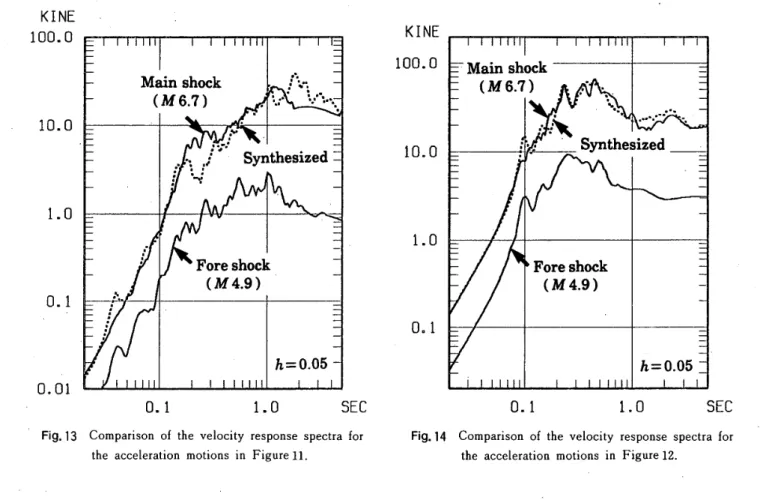
are silnulated well.Figures
13
and14
arethe
comparison ofthe
velocity response spectra with adamping
factor
h
ofO.
05
for
the
acceleration motions shownin
Figures
11
and12,
respgctively.They
representthe
'seismic-wave
energy
to
be
appliedto
a structure,The
solidlines
.are
for
the
observed motions andthe
dotted
lines
arefor
the
synthesized
ipotions.It
is
apparentthat
the
spectrum chaJacteristics ofthe
motions show agood
agreementin
the
natural-period rangeof
O.
02
to
5
seconds.
5.
Concluding
Remarks
A
new semi-ernpirical methodis
presented
based
on approximatesource
spectrum
for
far-field
shear
waveproposed
by
Brune,
whichis
ene ofthe.
w-sqilare models,It
can simulate wellthe
velocity and acceleration motionsebserved
during
the
main shock(M
6.
7>
ofthe
1980
Izu-Hante-Toho-Oki
earthquakeby
usingthe
recods ofits
fore
shock(M
4.
9)
asGreen's
functions.
The
predominant
frequencies
ofthe
velocity motions are aboutO.
1
Hz
andthose
ofthe
acceleration motions are
from
]
to
10
Hz.
This
new methodis
verypowerful
whenthe
source spectra ofthe
large
andthe
small e"ents, or especiallytheit
ratio, couldbe
representedby
the
ahsquare model.Meanwhile,
in
the
actual computationfor
the
1980
Izu-Hanto-Toho-Oki
earthquake,
we adoptedthe
similarity
relationsof
eafthquakes
that
the
ruptured
fault
length,
width and averagedislocation
areproportional
to
each other andthat
the
stressdrop
is
constantTherefore,
whenthis
methodis
appliedto
other earthquakes which would not maintainthe
similarity relations, more careful attention shouldbe
paid
to
the
sourceparameters,
Furthermore,
in
orderto
applythis
new semi-empirical methodto
estimation of stronggreund
motiensfor
earthquake
resistant
design
of
structures,
following
two
problEms
mustbe
resolved:
1)
applicabilityto
large
earthquakes
withmagnitude
of
abottt
8
and
2)
evaluation
of
the
variation ofestimated
valuesfor
different
small-event motions asGreen's
functions.
The
authors wishto
expresstheir
appreciationto
emeritusProf,
I.
Muramatu
ofGifu
University,
'Prof,
K,
Irikura
of
Kyoto
University
andDr.
K.
Kudo,
Ms.
S.
Yoshizawa
and other staffs ofEarthquake
Research
Institute,
University
ofTokyo,
for
their
permission
ofthe
usage afthe
records,Their
appreciationis
extended
to
Mr.
Q,
Luo
of
Institute
ofEngineering
Mechanics.,
State
Seismological
Bureau,
China,
andDr.
T.
Sato
ofOhsaki
Research
Institute,
Shimizu
Corporation,
for
their
fruitful
discussiOn.
-33-Reterences
1)
Hartzell,
S,
0978}
:
Earthquake
aftershocks asG[een's
functions,
Geophysical
Research
Letters,
Vol.5,
)lo.1,
pp,1-4,
2)
Kanamori,
H.
(1979)
:
A
semi-empirical approachte
prediction
oflong-peried
ground
motionsfrom
great
earthquakes,Bulletin
of theSei$mological
Society
ofAmerica,
Vo).69,
No.6,
pp.1645-167e.
3)
Imagawa,
K.
andT.
Mikumo
(1982)
:
Near-field
seismic wayeformsfrom
[najor eaithquakes and a consideration onthe
rupture
process
onthe
fattlt,
Zisin,
Bulletin
ofthe
Seismological
Society
ofJapan,
Vol.
35,
No.2,
pp.
575-590
(in
Japanese),
4)
Irikttra,
K.
(1983)
:
Semi-empirical
estimation of strengground
rnotion$tluring
Iarge
earthquakes,Bulletin
efthe
Disaster
Prevention
Research
Institute,
Kyoto
University,
Vol.33,
Part
2,
No.298,
pp.63-104.
5)
Tanaka,
T.
,S.
Yoshizawa,
M.
Sakaue
andY.
Osawa
(1982)
:
Estimation
ef acceleration characteiistics of strongground
motien
by
synthesis of accelerogram obtainedduring
a small earthquake,Bulletin
of theEarthquake
Research
Institute,
Vol.57,
pp.561-579
(in
Japanese).
6>
Dan,
K.
,T.
Tanaka
andT.
Watanabe
(1987)
:
Simulation
andprediction
of stronggrotancl
motionin
epicentTal reglon ofthe
1979
Imperial
Valley
earthquakeby
semi-empirical method,Journal
efStructuial
andConstruction
Engineering
CTransactions
of
AIJ),
No.373,
pp.50-62.
7}
Aki,
K.
"967}:Scaling
raw
of seismic spectrum,Journal
efGeophysicaL
Research,
Vol.72,
No.4,
pp.1217-1231.
8}
Brune,
J.
(1970)
:
Tectonic
stress andthe
spectraof seismic shear wavesfrom
earthquakes,Journal
ofGeophys,ical
lResearch,
Vol.75,
No.26,
pp.4997-5009.
9}
Aki,
K.
andP.
Richard$
(1980}
:
Quantitative
Seismology,
W.
H.
Freeman
andCompany,
San
Francisce,
Sections4.
3
and14.1.
10)
Kanameri,
H.
andD.
Anderson
{1975)1Theoretical
basis
of seme empi[ical ielationsin
seismology,Bulletin
of theSeismological
Seciety
ofAmerica,
Vol.65.
No.5,
pp.1073-1095.
Il)
Haskell,
N.
(]g64)
:
Total
energy and energy spectraldensity
of elastic wave radiationfrom
propagating
faul.ts,
Bulletin
ofthe
Seismological
Society
ofAmerica,
Vol.54,
No.6,
pp.1811-1841.
12}
Muramatu,
I.
andH.
Ohnuma
(19gg)
:
Synthesis
of strong motiensby
using an aftershock record asthe
Green's
fttnctlon,
Tectonophysics,
149,
pp.275-288.
13)
Tanaka,
T,
,M,
Sakaue,
Y,
Osawaand
S,
Yeshizawa(19SO}
:
Streng-motion
accelerograms and maximum acceterationdata
of