The Japanese Psychonomic Society
NII-Electronic Library Service
The JapanesePsychonomic Society
Thelapanese
.fournal
ofl-]ychonomic Science2005,Vol,24,No.1,131-132
Summary
ofAwardedPresentation2P45
Searching
for
luminance-defined
objectsthrough
moving
apertures
Takahiro
KAwABE
andKayo
MiuRA
K],ushu
[inivet:sity*
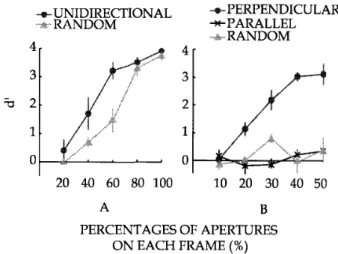
InExperiment
1
theobservers searched fora bright,static square arnong threedark
squares,The
search display consisted of tenframes and was covered withdynamic
grayscale noise whichhad a random or unidircctional motion.
The
aperture was present during differentpercentages ofnoises. By measuring
d',
it
was revealed thatdetection
was more sensitive inunidirectional, ratherthan randorn, noise,
This
result suggested that temporal luminance summation played a rninerrole
in
detection.In Experiment 2 thc observers searched forabright,
vertical baramong threcdark
vertical bars inthepresence of dynamic noisc which was perpendicular, para]leLor random,to the bar orientation.
Detection
was most sensitive when the movement ofthe
noise wasperpendicular. The result suggested thatsuccessive visual transientswhich were visible through
the apertures, and which were unrelated to rnovement of the noise, were critical for target
detection,
Key
words: aperture vision, visual transients,surface segregation
Introduetion
When
a moving object isvisible through only athinaperture, we often perceiveitsentire appearancc
even though a complete image of the object
is
notpresented simultaneously. This
kind
ofperception,
called `aperture
viewingL has been an interesting
topic
for
vision research. Although the underlyingmechanism of typical aperture viewing
has
been
studied extensively,
how
the visual system detectsthe appearance of static objects through moving apertures isunclear.
The aim of thepresent study was toexamine what
visual
information
is
necessary fordynamic apeTture viewing,in
other words, forthedetection
ofinforma-tion concerning
the
luminance of static objectswhich are viewed through moving apertures. In
Experiment
1,
we observed a minor involvement ofluminance summation. InExperirnent
2
we observedthat
detection
performance wasdependent
on thesegregation of spatiotemporal patterns of visual
transients from the occluder. More specifical]y,
when the spatiotemporal patternsofthe visual
.sients
were more salient, the performance insearch
tasks
washigher.
The role of occlusion perception driven
by
spatio-* User Science Institute,
Kyushu
University,6-19-1
Hakozaki,
Higashi-ku,
Fukueka
812-8581
temporal integrationof visual transients indynarnic
aperture viewing, isalso
discussed.
Method
Observers Four people incLudingtheauthor
(TK)
participatedinthe firstand second experiment,
re-spectively.
They
had
cerrect or corrected-to-normalvisual acuities. Apart from the firstauthor
(TKL
al]observers were unaware ofthepttrposeof the
experi-ments,
Apparatus
Apersonalcomputer{SonyVAIO,Ja-pan) controlled the presentation of stimuli and
cor-rection of data. The stimuli were presented on a
gamma-corrected,
19-inch
CRT display(Nanao
Flex-Scan
T761,
Japan)
with a resolution of1024
×768pixelsand a refresh rate Qf
75
Hz,
Stimuli
A
motion sequence consisting of10
frames
was presented tothe observers ineach triaLEach frame included a
20
×20
grayscale pattern ofrandom-dot$,
Each
sequence contained a searchdis-play which was covered with dynamic noise. The
dots
in
thedynamic noise were categorizedinto
ei-ther
`noise
dots'which occluded search displays,or`aperture
dots'
which passed over them, The search
display
in
"present"trialsconsisted of one bright,
square target,and threedark,square
distracters.
In L`absent"trials
the
search
display
consisted offour
dark,
squaredistracters.
Inthe firstexperiment, twoThe Japanese Psychonomic Society
NII-Electronic Library Service
The JapanesePsychonomic Society
132
The
Japanese
Journal
ef PsvchonornicScience
Vol.
24,
No.
1
-e-UNIDIRECI'IONAL
・Hm.RANDOM
4 4..t.t.ng
3 ,s' 3
,.,g
2 is 2 ltt ft" 1 .・ 1tt.
・'
o om,F?ERPENDICULAR
-x-PARALLEL
.dits.RANDOM
ytf'dettt'ttt..t./
2o 4o 6o so loo lo 2o 3o 4b so A B PERCENTAGES OF APERTURES
ON
EACH
FRAME
<%)
Figure
1.
Panels
A
andB
show the results ofthe
first
and second experiments,respective-ly.Error bars denote standard errors ef the
mean
{IV="4).
types of dynamic noise
(uni-d{rectional
and randomnoise) were superimposed on thc
first
frame
(Frame
1)
of thesearchdisplay.
The
number of aperture dots was selected randomly to bc either 20,40,60,
80,
or1OO% ofa totalof
400
dots.
The
luminance
values oft.henoise
dots
were randoml}, selected from 128equ-allystepped luminance values ranging from 25to
75
cdfm2. In the unidirectional noisc, a mExing of thetwo motion directic)nsprevented motion aftereffects.
Each
frame
was presentedfor
13,3ms(1
verticalretrace interval}and thus one sequence was
pre-sented for133 ms. The speed of themoving
dots
was14
degrees
per second.In
the second expcrimentthrectypes ef dynamic noise were used:
perpcndicu-lar,parallc], and random noise.
Procedure The ubservers were asked to
judge
whethcr, or not the search
display
contained abright,
square targetamong three dark,squarcdis-tracters.Each experimental condition was repeated
40
timcs
(20
trialsfor
the"target-present"condition
and
20
for
"target-absent").
Results
Experiment
1
A
two-way repeated measuresANOVA
with the type of dynam[c noise<2)
×aper-ture probability
{5)
as factorsrevealed that a maineffect of thetype of noise was marginally significant
(F{1,
3}=9,417, p<O.1) and the main effect ofaper-turepercentage was definitelysignificant
(F(4,
12)=
60.132,
p<O.001}.
The
interaction
between
the twofactorswas also significant
(F(4,
12)=4.430,p<O.05).A
post-hoc analysis of the interactionindicatedthatd'
was significantlydifferent
between
thetwo typesof dynarnic noise when the aperture percentage was
40%
and60%
(F(1,
15)=7.451 and 22.677;P<O.05,
and O.OOI,respectively).
Experiment
2
A
two-way repeated measuresANOVA
with the type of dynamic noise(3)
×aper-ture probability
(5)
as factorsrevealed that a maineffect ef the type of
dynamic
noise was signjficant(F(2,6>=31.231,
p<O,OOOI).
Multiple
comparisontests
(Ryan's
method)indicated
that the d'inthe
perpendicu]ar motion condition was significant]y
differentfrom that intheother two conditions
ip<
O.OOI),
The
main effect of the aperture percentagcwas significant
(F(4,
12)-:30,778,
P<O.OOOI),
andin-teraction between thc
two
factors was alsosig-nificant
(F(8,
24)=9.879,P<O.OOO1),
Discussion
This study examined how
the
visual systemde-tectstheluminance of static objects which are
view-cd through moving apertures inthe presence of
dy-namic luminance noise
(dynamic
aperture viewing).Inthe firstexperiment, we observed that
luminance
surnrnation was only a marginal factorin dynamic
aperture viewing because
the
performance wasbet-terwhen the nojse was uni-directional, rather than
random, when the percentage aperture was 40 or
60%.
In
thesecond experiment theresults indicatedthatdetcctionof theluminance of static objects was
moTe successfu[ when the nperture moved
perpen-dicular tothe search
items
rather than para]lel tothem. The signals of spatiotemporal integrationof
themovement thereforehindered detectionof a
tar-get with the same orientation as the path of the
movement. The results
indicate
that thespatiotem-poral