Effects of Positive Bodily Experience on the Change of Depressive States in Undergraduates: Using Self-Rating
Depression Scale and YG Personality Inventory
Yoshitaka KONNO
*, Nobuyo YOSHIKAWA
**[Abstract]
Positive bodily experience induced by Dohsa-method relaxation could enhance positive affective/cogni- tive attitudes toward oneself, others, and the external world. These attitudes might contribute to the change of depressive states. Thirty-six undergraduates participated in this study. They were assigned to either Experimental group receiving positive bodily experience or Control group without undergoing any treat- ment. Tokeau-taiken (“Touch with the Melting Experience”), one of the relaxation techniques of Dohsa- method, was administered to the shoulders, the head, the neck, the back, and the arches of the feet. About two weeks before receiving Tokeau-taiken, the Experimental group underwent Self-rating Depression Scale (SDS) and YG Personality Inventory (YG) as a pre-test, and immediately after Tokeau-taiken they answered these tests again as a post-test. During the same interval, the Control group was administered these tests twice. The preliminary studies revealed three clusters for SDS (Cluster 1: “fatigue, anxiety and irritability;” Cluster 2: “dissatisfaction about oneself and despair about one’s own future;” Cluster 3:
“unwell mind-body condition”), and three factors for Depression subscale in YG (YG-D)(Factor 1:
“decline in mental and physical energy;” Factor 2: “decline in self-esteem;” Factor 3: “melancholy and anxiety” ). Main results were as follows. Comparisons of pre-post ratios of SDS cluster scores between the Experimental and the Control groups revealed statistically significant differences for “fatigue, anxiety and irritability” and “unwell mind-body condition.” Comparisons of pre-post ratios of YG-D between the Experimental and the Control groups showed significant differences for “decline in mental and physical energy” and “decline in self-esteem.” These results suggest that the positive bodily experience may enhance positive state in mind and body, then alleviate depressive states.
Purpose
Dohsa-method relaxation was originally developed to improve motor control in people with cerebral palsy. Nowadays, it has been applied to enhance a harmonious and well-functioning mind-body relation, and establish a self-control of emotional and behavioral responses in those people who are suffering from autism, attention deficits hyperactive disorders (ADHD), anxiety disorder, or depression. Konno (1995,
────────────────────
* Faculty of Human Sciences, Bunkyo University
**Graduate School of Human Sciences, Bunkyo University
1997, 1998) has indicated that Dohsa-method relaxation training could enhance positive mind-body experiences while alleviating negative mind-body experience, and bring about positive affective/cogni- tive attitudes towards oneself, others, and the external world.
Konno, Yanagisawa, & Yoshikawa (2000) and Konno & Yoshikawa (2002) examined the effects of Dohsa-method relaxation on alleviating depressive states in undergraduate students using Zung’s Self- rating Depression Scale (SDS) and Yatabe-Guilford Personality Inventory (YG). These studies revealed the decrease in SDS total score and in Depression subscale score of YG (YG-D), indicating the alleviation of depressive states.
The previous studies (Rickels, Downing, Lipman, Fisher, and Randall, 1973; Bolon and Barling, 1980; Erstlander, Takala, and Erkasalo, 1995) suggested that depressive state consisted of physical and cognitive components: Physical depression and Cognitive depression. In this study, the authors attempted to examine the effect of positive mind-body experience induced by Dohsa-method relaxation on the changes of Physical and Cognitive depression scores using SDS and YG-D in undergraduate students.
Method
1. Participants
Thirty-six undergraduates (mean age = 19.5 years; range = 18.4 to 23.1 years), with a written informed consent, participated in this study. They were assigned to either Experimental group (n=22) receiving relaxation training, or Control group (n=14) without undergoing any treatment.
2. Procedure of Relaxation (1) Tokeau-taiken
Tokeau-taiken (“Touch with the Melting Experience”), one of Dohsa-method relaxation procedures (Konno, 1997 a), was administered to the shoulders, the head, the neck, the back, and the arches of the feet. Tokeau-taiken was carried out individually by the experimenter (one of the present authors). The experimenter softly touched the participant’s body and gently pressed the body, then released the pres- sure slowly while keeping the palm in contact with the participant’s body. While releasing the pressure, both the experimenter and the participant could experience good sensations such as a sense of warmth, a sense of stretching, and a sense of moving, and could share these good sensations with each other.
(2) The Criteria for Relaxation
According to Konno (1997 b), the criteria for relaxation through Tokeau-taiken were as follows: (a) feel warmth, (b) feel stretching and becoming lighter, (c) feel the back moving smoothly without inade- quate body tension in other parts of the body, (d) feel stretching at the ankle and the thigh, (e) feel the sense of standing firmly on the ground. Participants in the Experimental group underwent the relax- ation training until they achieved these criteria, which took about 30 minutes.
3. Measurements (1) SDS
Zung’s Self-rating Depression Scale, 20-item Japanese version (Fukuda and Kobayashi, 1983) was used. Preliminary cluster analysis for 20 items using Ward method revealed three clusters. Cluster 1 included 7 items: depressed affect, Crying spells, weight loss, tachycardia, fatigue, psychomotor agita-
tion, representing “Fatigue, anxiety, and irritability.” Cluster 2 comprised 7 items: decreased libido, hope- lessness, indecisiveness, personal devaluation, emptiness, suicidal rumination, and dissatisfaction, indicat- ing “Dissatisfaction about oneself and despair about one’s own future.” Cluster 3 included 6 items: “diur- nal variation, sleep disturbance, decreased appetite, confusion, psychomotor retardation. This cluster was named “Unwell mind-body condition.”
(2) Yatabe-Guilford Personality Inventory (YG)
Yatabe-Guilford Personality Inventory (YG) (Tsujioka, Yatabe, and Sonohara, 1982) comprises twelve sub-scales: ①Depression, ②Cyclic Tendency, ③Inferiority Feelings, ④Nervousness, ⑤Lack of Objectivity, ⑥Lack of Cooperativeness, ⑦Lack of Agreeableness, ⑧General Activity, ⑨Rhathymia,
⑩Thinking Extroversion, ⑪Ascendance, ⑫Social Extroversion. Each scale consisted of 10 items, and evaluated on a three-point rating scale in which 0 indicates “no,” 1 “not certain,” and 2 “yes,” respec- tively. In this study, Depression sub-scale was used. Preliminary factor analysis with varimax rotation revealed three factors. Factor 1 comprised 4 items: losing interesting, fatigue, depression, and lose vigor.
This factor was named “Decline in mental and physical energy.” Factor 2 included three items: personal devaluation, sink down in thought, and brood on past failure. This factor was named “Decline in self- esteem.” Factor 3 was consisted of three items: feel lonely, anxious, and rumination, representing
“Melancholy and anxiety.”
4. Procedure of Experiment
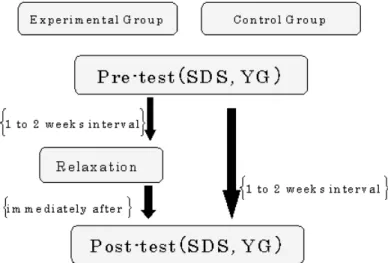
As depicted in Figure1, about one to two weeks before Tokeau-taiken, the participants in the Experimental group was administered a pre SDS and YG, and immediately after receiving Tokeau-taiken answered a post SDS and YG. During the same interval, the participants in the Control group were administered the SDS and YG twice; pre and post tests.
Results
1. Comparison of Pre-post SDS Ratio (%) between Experimental and Control groups
Figure 2 and Figure 3 depict the comparison of pre-post ratio of SDS sub-items between Experimental Figure 1 Proceadure of the experiment for Experimental and Control groups.
group and Control group. As shown in Figure 4, in the Experimental group, SDS pre-post-ratio scores, under the score of 100 (%) means alleviation of depressed states, were 71% for Cluster 1 (“Fatigue, anxiety, and irritability”), 86 % for Cluster 2 (“Dissatisfaction about oneself and despair about one’s own future”), and 75% for Cluster 3 (“Unwell mind-body condition”), respectively. In the Control group, respective scores were 98% for Cluster 1, 98% for Cluster 2, and 104% for Cluster 3. Comparison of these scores between the Experimental group and the Control group revealed statistically significant differences for Cluster 1(t (35)=5.527, p<.001), Cluster 2(t (35)=2.581, p<.05)), and Cluster 3(t (35)=6.346, p<.001). These results indicated that the alleviation of depressed states could be found in the Experimental group, whereas no par- ticular changes were found in the Control group.
Figure 3 Comparison of SDS sub items pre-post ratio scores between Experimental and Control groups.
Figure 2 Comparison of SDS sub items pre-post ratio scores between Experimental and Control groups.
2. Comparison of Pre-post YG-D Ratio (%) between Experimental and Control groups
In the Experimental group, as depicted in Figure5, YG-D pre-post ratio scores were 84% for Factor 1 (“Decline in mental and physical energy”), 85% for Factor 2 (“Decline in self-esteem”), and 93% for Factor 3 (“Melancholy and anxiety”), respectively. In the Control group, pre-post ratio scores were 105% for Factor 1, 106% for Factor 2, and 96% for Factor 3. Comparisons of these scores between the Experimental group and the Control group revealed statistically significant differences for Factor 1 (t (35)2.513=p<.05) and Factor 2(t (35)=2.75, p<.05), while no difference was found for Factor 3.
3. Multiple Regression Analyses
Multiple regression analyses were conducted for SDS and YG-D. In the multiple regression analysis of 0
20 40 60 80 100 120
Cluster 1 Cluster 2 Cluster 3
Ratio of Pre-post Test Scores (%)
Experimental Control
Figure 4 Comparison of Ratio of Pre-post test scores for SDS between Experimental and Control groups.
0 20 40 60 80 100 120
Factor 1 Factor 2 Factor 3
Ratio of Pre-post Test Scores(%)
Experimental Control
Figure 5 Comparison of ratio of Pre-post test scores for YG-D between Experimental and Control groups.
SDS, a dependent variable was Total SDS score and independent variables were three clusters(Cluster 1:“Fatigue, anxiety, and irritability,” Cluster 2 :“Dissatisfaction about oneself and despair about one’s own future,” Cluster 3 :“Unwell mind-body condition”). Coefficient of multiple determination (R2) = .975, and standardized partial regression coefficients were .417 for Cluster 1, .517 for Cluster 2, and .416 for Cluster 3, respectively.
In the multiple regression analysis of YG-D, a dependent variable was Total YG-D score, and independent variables were three factors (Factor 1:“Decline in mental and physical energy,” Factor 2: “Decline in self- esteem,” and Factor 3: “Melancholy and anxiety”). Coefficient of multiple determination (R2) = .956, and respective standardized partial regression coefficients were .469 for Factor 1, .435 for Factor 2, and .406 for Factor 3.
Discussion
The present authors found that depressive states measured by SDS or YG-D could be alleviated through positive bodily experience induced by Tokeau-taiken, one of the Dohsa-method relaxation. The previous studies using factor analysis indicated that SDS consisted of several subcategories. Rickkels, Downing, Lipman, Fisher, and Randall (1973) found four factors in depressed patients: “Retarded depression” (feel uselessness, life empty, hard to make decision, etc.), “Anxiety depression” (irritable, feel down-hearted, crying spells, restless, etc.), “Appetite disturbance”(losing weight, eat less), and “Performance difficulty”
(don’t enjoy sex, conspirated, morning feel worst). Bolon (1980) obtained three factors in normal popula- tion: “Ideational Depression,” “Physiological Depression,” and “Behavioral depression.” Erstlander, Takala, and Erkasalo (1995) found three factors in three groups of subjects (no pain group, low pain group, and high pain group): “Psychic energy,” “Irritability,” and “Sleep problem.”
In the preliminary study, the authors found three clusters for SDS (Cluster 1: “fatigue, anxiety and irri- tability,” Cluster 2: “dissatisfaction about oneself and despair about one’s own future,” Cluster 3: “unwell mind-body condition”), and three factors for YG-D (Factor 1: “decline in mental and physical energy;
”Factor 2: “decline in self-esteem;” Factor 3: “melancholy and anxiety” ). Comparisons of pre-post ratio scores between the Experimental and the Control groups revealed that the Experimental group differed sig- nificantly from the Control group on all three SDS clusters scores, and on two factor scores on YG-D (Factor 1 and Factor 2).
According to the multidimensional studies, depressed states could be categorized into two subcategories:
“Physical depression” and “Cognitive depression.” In this study, Physical depression might contain
“fatigue, anxiety and irritability,” “unwell mind-body condition,” and “decline in mental and physical energy,” while Cognitive depression correspond to “dissatisfaction about self and despair about future,”
“decline in self-esteem,” and “melancholy and anxiety.” Results indicated the positive bodily experience induced by Tokeau-taiken exerts a beneficial effect on the alleviation of both Physical and Cognitive depressive states. Furthermore, as shown in Figure 6, these results suggest the path relation between the alleviation of Physical and Cognitive depression.
This study confirms the beneficial effects of Dohsa-method relaxation on reducing depressive tendency as indicated in the previous study (Konno and Yoshikawa, 2002), and may also provide a rationale of the bod- ily approach to the Cognitive therapy (Beck, 1976) for depression. That is, the positive bodily experience may reorganize a “depressogenic schemata,” which is considered to be the underlying cognitive process of depression. Then this reorganization may alleviate “logical thinking errors” and “negative automatic
thoughts,” which lead to depressive symptoms.
[References]
Beck, A.T. (1976) Cognitive therapy and emotional disorders. New York: International University Press.
Bolon, K., & Barling, J. (1980): The measurement of self-rated depression: A multidimensional approach.
The Journal of Genetic Psychology, 137, 309-310.
Erstlander, A.M., Takala, E.P., & Erkasalo, M. (1995): Assessment in chronic musculoskeltal pain patients.
The Clinical Journal of Pain, 11, 194-200.
Fukuda, K., & Kobayashi, S. (1983): Japanese version of Self-rating Depression Scale. Sankyobo, Kyoto.
Konno, Y. (1995) The experience of bodily tension-relaxation and perception of other person: using Questionnaires and personal space. Japanese Journal of Behavior Therapy,21 (1), 6-14.
Konno, Y. (1997 a) Body Work for Healing. Gakuenshya, Tokyo.
Konno, Y. (1997 b) The effects of relaxation and postural training on external perception:
Improvement of visual acuity, visual field, and hearing acuity. Japanese Psychological Research, 39, 2, 119-123.
Konno, Y. (1998) Improvement of anxiety and phobic response through Tokeai-desensitization method (Desensitization with melting experience): Case study of anxiety neurosis and conversion response.
Japanese Journal of behavior Therapy, 24 (1), 15-26.
Konno, Y. (1999): Lateral effects of muscular relaxation on visual and auditory responses. Japanese Psychological Research,41, 193-202.
Konno, Y., Yanagisawa, M., & Yoshikawa, N. (2000) The effects of Dohsa-method based relaxation train- ing on the reduction of depressive states in undergraduate students. 27th International Conference of Psychology, Stockholm, Sweden.
Konno, Y., & Yoshikawa, N. (2002): Effects of relaxation training on the change of Y-G Personality Figure 6 Shematic illustration of Multi Regression Analysis of SDS and YG-D scores.
Inventory scores in undergraduates. 25th International Congress of Applied Psychology, Singapore.
Rickels, K., Downing. R.W., Lipman, R.S., Fisher, E., & Randall, A.M. (1973): The Self-rating Depression Scale (SDS) as a measure of psychotropic response. Disease of Nervous System, 34, 98-104.
Tsujioka, M., Yatabe, T., & Sonohara, T. (1982) Y-G Personality Inventory. Takei-Kiki Inc. Tokyo.