LETTER
Special Section on Signal Design and Its Applications in CommunicationsNew Construction of Even-Length Binary Z-Complementary Pairs with Low PAPR ∗
Zhi GU†,††a),Nonmember, Yong WANG†,††b),Member,andYang YANG†,††c),Nonmember
SUMMARY This paper is focused on constructing even-length binary Z-complementary pairs (EB-ZCPs) with new length. Inspired by a recent work of Adhikary et al., we give a construction of EB-ZCPs with length 8N+4 (whereN=2α10β26γandα, β, γare nonnegative integers) and zero correlation zone (ZCZ) width 5N+2. The maximum aperiodic autocorre- lation sums (AACS) magnitude of the proposed sequences outside the ZCZ region is 8. It turns out that the generated sequences have low PAPR.
key words: aperiodic correlation, Golay complementary pair, Z- complementary pairs, PAPR
1. Introduction
A pair of sequences is called a Golay complementary pair (GCP), if their aperiodic autocorrelation sums (AACSs) are zero everywhere, except at the zero shift[1],[2]. GCPs first introduced by Golay in 1961 in the context of an optical problem in multislit spectrometry, have been used exten- sively in communication engineering. For instance, a well- known application of GCPs is peak-to-average power ratio (PAPR) control in orthogonal frequency-division multiplex- ing (OFDM) system[3]–[5]. Besides, GCPs were used for intersymbol interference (ISI) channel estimation[6],[7], and radar waveform design[8]–[11]. Recently, Liu et al.
proposed a training waveforms with autocorrelation side- lobes close to zero for continuous phase modulation based on GCPs[12].
The main drawback of the GCPs is their limited avail- ability for various lengths. It is widely believed that binary GCPs can only be found for sequence lengths with form 2α10β26γ, whereα, β, γare non-negative integers. This has been verified for binary GCPs of length up to 100[13]. This motivates the notion of binary Z-complementary pair (ZCP) which was proposed by Fan et al.[14]. It turns out in[14]
Manuscript received March 6, 2020.
Manuscript revised July 9, 2020.
†The authors are with Southwest Jiaotong University, Chengdu 610031, China.
††The authors are with the State Key Laboratory of Cryptology, Beijing 100878, China.
∗This paper was presented in part at the 9th International Work- shop on Signal Design and its Applications in Communications (IWSDA’19), October 20–24, 2019, Dongguan, China. This work was supported by the National Science Foundation of China under Grant 61771016. The work of Yang Yang is partly supported by the Research Council of Norway (No. 311646).
a) E-mail: [email protected]
b) E-mail: [email protected] (Corresponding au- thor)
c) E-mail: yang [email protected] DOI: 10.1587/transfun.2020SDL0002
and [15] that binary ZCPs exist for much more sequence length. It was further conjectured by Fan, Yuan and Tu[14]
that “For EB-ZCPs, given that the lengths N , 2a10b26c, the ZCZ is upper bounded by N−2.” Since then, the study of ZCPs has received a lot attention.
In[16], Liu et al. confirmed the above conjecture and gave a systematic construction of the EB-ZCPs based on the head-end (or the tail-end) quarter-sequence-truncation of certain binary Golay-Davis-Jedwab complementary pairs [4]of length 2α. Each EB-ZCP in[16]has length 2α+1+2α and zero correlation zone (ZCZ) width of 2α+1. In [17], Chen also gave a systematic construction of the EB-ZCPs through the generalized Boolean functions, each having length of 2m−1 +2v, and ZCZ width of 2m−2 +2v, where v≤m−2, v∈Z+∪ {0}. In[18], Pai et al. proposed a novel construction of ZCPs based on Boolean functions with flex- ible length 2m−1 +Pm−1
α=k+1aα2α−1 +2v, and ZCZ width of 2k−1+2v, wherev <k <m. Recently, Xie et al. proposed a systematic construction of EB-ZCPs[19]with length 28N and ZCZ width of 24N, whereN = 2α10β26γ andα, β, γ are nonnegative integers. Insertion element method is a use- ful method for constructing ZCPs proposed by Adhikary et al. in[20]. By the method, Adhikary et al. inserted tow el- ements in a GCP, and then constructed a ZCP with length 4N+2 and ZCZ width 3N+1. Very recently, Adhikary et al.
combined insertion element method and Boolean functions to construct ZCPs[21]. Inspired this work of Adhikary, we further consider the construction of ZCPs by inserting more elements in GCPs.
In this paper, we present a systematic construction of EB-ZCPs, each having length 8N +4, and ZCZ width of 5N+2, i.e., asymptotic ZCZ ratio of 5/8. Interestingly, each of the constructed EB-ZCPs has identical AACS magnitude of 8 at each time-shift outside the ZCZ (except at the last quarter time-shift, at which the AACS magnitude is zero).
The key of the proposed construction is to use some newly intrinsic properties of binary GCPs found in[22]. Table 1 lists the parameters of EB-ZCPs mentioned above.
The rest of the paper is organized as follows. In Sect. 2, we introduce EB-ZCPs and complementary mates.
In Sect. 3, we propose asystematic construction of EB-ZCPs of length 8N+4, each having ZCZ width 5N+2. We show that outside the ZCZ, the AACS has identical value of 8 ex- cept at the last quarter time-shift position. Finally, we con- clude this work in Sect. 4.
Copyright c2021 The Institute of Electronics, Information and Communication Engineers
Table 1 The parameters of EB-ZCPs.
Length ZCZ width Parameter Rerference
2α+1+2α 2α+1 α∈Z+ Liu et al.[16]
2m−1+2v 2m−2+2v m≥2, v≤m−2,m, v∈Z+ Chen[17]
2m−1+Pm−1
α=k+1aα2α−1+2v 2k−1+2v v <k<k Pai et al.[18]
28N 24N N=2α10β26γ Xie et al.[19]
24N 20N N=2α10β26γ Xie et al.[19]
2m+3+2m+2+2m+1 2m+3 m∈Z+ Xie et al.[19]
4N+2 3N+1 N=2α10β26γ Adhikary et al.[20]
8N+4 5N+2 N=2α10β26γ This paper
2. Preliminaries
Throughout this paper, a binary sequence is a vector over signal setU ={+1,−1}. Let “[a,b]” denote the horizontal concatenation of sequencesaandb. Also, the reverse ofa is denoted by←−
a, 1 and−1 are denoted by+and−, respec- tively.
Definition 1. For two length-N binary sequencesa andb overU, their aperiodic cross-correlation function is defined as
ρa,b(τ)=
N−1−τ
X
k=0
akbk+τ, 0≤τ≤N−1.
When a = b, ρa,b(τ) is called aperiodic autocorrelation function (AACF) of a and is denoted asρa(τ).
Definition 2. A pair of sequences(a,b), each of length N, is said to be a Golay complementary pair (GCP), if and only if
ρa(τ)+ρb(τ)=0, for all1≤τ≤N−1.
Definition 3. A pair of sequences(a,b), each of length N, is said to be a Z-complementary pair (ZCP) with zero cor- relation zone (ZCZ) width Z, if and only if
ρa(τ)+ρb(τ)=0, for all1≤τ≤Z−1.
WhenNis even, the ZCP is called an EB-ZCP. IfZ = N, this pair (a,b) is a GCP.
Definition 4. A GCP(c,d)is called a complementary mate of a GCP(a,b), if
ρa,c(τ)+ρb,d(τ)=0,for all0≤τ≤N−1.
A useful lemma in[22]is given below.
Lemma 1. Let(a,b) be a GCP, then(c,d) = (←− b,−←−
a)is complementary mate of GCP(a,b).
3. New Construction of Even-Length Binary Z- Complementary Pairs
In this section, we give a systematic construction of EB- ZCPs.
Fig. 1 Divide the sequencese,f.
3.1 Systematic Construction
Construction 1. Step 1: Let(x,y)be a GCP of length N = 2α10β26γ. Construct
a=[x,y,x,−y], b=[x,y,−x,y].
Step 2: Set(c,d)=(←− b,−←−
a), ande=[a,c],f=[b,d].
Step 3: Sequences e,f are divided into 4 parts e1,e2,e3,e4andf1,f2,f3,f4on average, as shown in Fig. 1.
Step 4: Construct two sequencespandq p=[x1,e1,x2,e2,e3,x3,e4,x4],
q=y1,f1, y2,f2,f3, y3,f4, y4, where
x1 x2 x3 x4
y1 y2 y3 y4
!
= −1 1 1 1
−1 −1 1 −1
!
. (1)
The construction of sequencesp,qis illustrated in Fig. 2.
As the Step 1 in Construction 1, it is easy to verify the following property.
Property 1. Suppose that(a,b)is a GCP generated by Step 1 in Construction 1. Writea =(a0,a1, . . . ,a4N−1)andb = (b0,b1, . . . ,b4N−1), then we have
ak=bk, when k∈ {0,1,· · · ,2N−1};
ak=−bk, when k∈ {2N,2N+1,· · ·,4N−1};
ak=ak+2N, when k∈ {0,1,· · ·,N−1};
ak=−ak+2N, when k∈ {N,N+1,· · ·,2N−1}.
(2)
The following result follows directly from the proper- ties of GCPs.
Lemma 2. Let sequencese1,e2,e3,e4,f1,f2,f3,f4be gener- ated by Step 3 of Construction 1. Then we have
1. Both (ei,ei+1)(i = 1,3) and (ei,ei+2)(i = 1,2) are
Fig. 2 Construction of sequencep,q.
Fig. 3 AACF sum magnitudes of EB-ZCP.
GCPs;
2. (e1,e2)is a Golay mate of(e3,e4);
(f1,f2)is a Golay mate of(f3,f4);
(e1,e3)is a Golay mate of(e2,e4);
(f1,f3)is a Golay mate of(f2,f4).
Our main result is the following.
Theorem 1. For the sequence pair(p,q)generated by Con- struction 1, it is an EB-ZCP of length8N+4with ZCZ width Z=5N+2. Furthermore,
ρp(τ)+ρq(τ)=
2(8N+4), τ=0;
0, 0< τ <Z;
±8, Z≤τ≤6N+1;
0, otherwise.
Proof. See Appendix.
Remark 1. In[20], Adhikary et al. constructed ZCPs with the asymptotic ZCZ ratio 3/4 by inserting two points to a Golay mate. Besides, by using the Kronecker product method[14]and the ZCPs from[20], ZCPs of length8N+4 and with ZCZ width6N+2can be obtained. While in this paper, inspired by the work in[20], by inserting four points to a Golay mate, the above theorem gives new ZCPs with 5/8ZCZ ratio asymptotically.
3.2 PAPR of the Proposed ZCPs
Like GCPs, one application of ZCPs is the reduction of peak-to-mean envelop power ratio of multicarrier signals [4],[19]. In this section, we discuss the PAPR of the pro- posed ZCPs.
Leta =(a0,a1, . . . ,aL−1) be the corresponding BPSK modulated sequence over U. The time-domain baseband OFDM signal can be written as
Sa(t)=
L−1
X
i=0
aiej2πit, 0≤t≤1, (3)
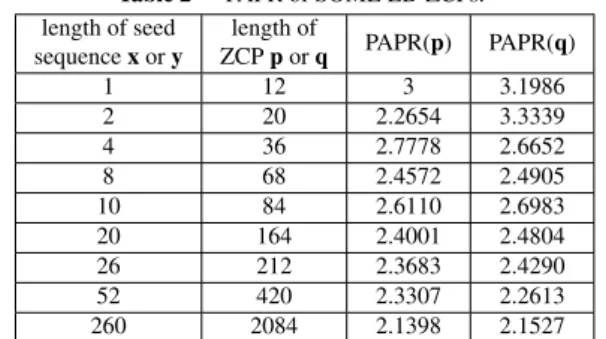
Table 2 PAPR of SOME EB-ZCPs.
length of seed sequencexory
length of
ZCPporq PAPR(p) PAPR(q)
1 12 3 3.1986
2 20 2.2654 3.3339
4 36 2.7778 2.6652
8 68 2.4572 2.4905
10 84 2.6110 2.6983
20 164 2.4001 2.4804
26 212 2.3683 2.4290
52 420 2.3307 2.2613
260 2084 2.1398 2.1527
The data in above table comes from part of the sequence, not all of it.
where the number of subcarriers is equal to length of se- quence a. Denote Pa(t) = |Sa(t)|2 as the instantaneous power and Pav as the average power. For a BPSK modu- lated sequence, we havePavisLand hence the PAPR of a sequenceais given by
PAPR(a)=max
0≤t≤1
Pa(t) Pav =max
0≤t≤1
Pa(t) L . By (3), we have
Pa(t)=ρa(0)+2<e
L−1
X
τ=1
ρa(τ)e−τj2πt
.
Let (a,b) be two binary sequences of lengthL, then we have
PAPR(a)≤2+2 L
L−1
X
τ=1
|ρa(τ)+ρb(τ)|. (4)
The following result follows directly from (4).
Theorem 2. Suppose that(p,q)is a ZCP generated by Con- struction 1. Then sequenceporqhas a PAPR less than 4.
Table 2 lists the PAPR of some ZCPs generated by Construction 1. It can be seen that the actual PAPR of these sequences are smaller than 3 when the length of sequence
pair is larger than 4. It might be possible to derive a better bound for the PAPR of the proposed sequences.
3.3 An Example
The following example will illustrate the proposed construc- tion step by step.
Step 1: Letx=[+ + +−], y=[+−++], then (a,b) is a GCP of length 16. The first 24−1 =8 columns of (a,b) has entries with identical signs in each column.
a b
!
= + + +−+−+ + + + +− −+−−
+ + +−+−+ +− − −+ +−++
! . Step 2: Construct (c,d) as a Golay mate of (a,b),
c d
!
= + +−+ +− − −+ +−+−+ ++
+ +−+ +− − − − −+−+− −−
! .
And definee=[a,c],f=[b,d].
Step 3: Divide sequencee,finto 4 parts on average, e=(+ + +−+−+++ + +− −+−−
+ +−+ +− −−+ +−+−+ ++);
f=(+ + +−+−++− − −+ +−++
+ +−+ +− −−− −+−+− −−);
Step 4: Insert four elements ine,f, p=(−+ + +−+−+ +++ + +− −+− −
+ +−+ +− − −++ +−+−+ + ++);
q=(−+ + +−+−+ +−− − −+ +−+ + + +−+ +− − −+− −+−+− − −−);
Then (p,q) is a length-36 EB-ZCP with a ZCZ width of 22 because
ρp(τ)+ρq(τ)35
τ=0=(72,021,84,010).
The AACP sum magnitudes of (p,q) are shown in Fig. 3.
Furthermore, the PAPR of sequences p,q are 2.9018, 2.9415, respectively.
4. Conclusion
In this paper, a construction of EB-ZCPs was proposed. The key of the proposed construction is to use some interesting intrinsic structure properties of binary GCPs. The proposed EB-ZCPs have lengths 2α+310β26γ +4 and ZCZ widths 5· 2α10β26γ +2. The PAPR of the proposed sequences was proved to upper bounded by 4.
References
[1] M.J.E. Golay, “Static multislit spectrometry and its application to
the panoramic display of infrared spectra,” J. Opt. Soc. Am., vol.41, no.7, pp.468–472, July 1951.
[2] M. Golay, “Complementary series,” IRE Trans. Inf. Theory, vol.7, no.2, pp.82–87, April 1961.
[3] R.D. Van Nee, “OFDM codes for peak-to-average power reduction and error correction,” IEEE Globecomm, London, U.K., pp.740–
744, 1996.
[4] J.A. Davis and J. Jedwab, “Peak-to-mean power control in OFDM, Golay complementary sequences, and Reed-Muller codes,” IEEE Trans. Inf. Theory, vol.45, no.7, pp.2397–2417, Nov. 1999.
[5] K.G. Paterson, “Generalized Reed-Muller codes and power con- trol in OFDM modulation,” IEEE Trans. Inf. Theory, vol.46, no.1, pp.104–120, Jan. 2000.
[6] P. Spasojevic and C.N. Georghiades, “Complementary sequences for ISI channel estimation,” IEEE Trans. Inf. Theory, vol.47, no.3, pp.1145–1152, 2001.
[7] S. Wang and A. Abdi, “MIMO ISI channel estimation using uncor- related golay complementary sets of polyphase sequences,” IEEE Trans. Veh. Technol., vol.56, no.5, pp.3024–3039, 2007.
[8] G. Welti, “Quaternary codes for pulsed radar,” IRE Trans. Inf. The- ory, vol.6, no.3, pp.400–408, 1960.
[9] R. Turyn, “Ambiguity functions of complementary sequences (Cor- resp.),” IEEE Trans. Inf. Theory, vol.9, no.1, pp.46–47, 1963.
[10] S. Budiˇsin, “Efficient pulse compressor for Golay complementary sequences,” Electron. Lett., vol.27, no.3, pp.219–220, 1991.
[11] A. Pezeshki, A.R. Calderbank, W. Moran, and S.D. Howard,
“Doppler resilient Golay complementary waveforms,” IEEE Trans.
Inf. Theory, vol.54, no.9, pp.4254–4266, 2008.
[12] Z. Liu, Y.L. Guan, and C.-C. Chui, “CPM training waveforms with autocorrelation sidelobes close to zero,” IEEE Trans. Veh. Technol., vol.67, no.11, pp.11269–11273, 2018.
[13] M.G. Parker, K.G. Paterson, and C. Tellambura, “Golay complemen- tary sequences,” Wiley Encyclopedia of Telecommunications, Wiley Online Library, New York, 2003.
[14] P. Fan, W. Yuan, and Y. Tu, “Z-complementary binary sequences,”
IEEE Signal Process. Lett., vol.14, no.8, pp.509–512, 2007.
[15] X. Li, P. Fan, X. Tang, and Y. Tu, “Existence of binary z- complementary pairs,” IEEE Signal Process. Lett., vol.18, no.1, pp.63–66, 2010.
[16] Z. Liu, U. Parampalli, and Y.L. Guan, “On even-period binary Z- complementary pairs with large ZCZs,” IEEE Signal Process. Lett., vol.21, no.3, pp.284–287, 2014.
[17] C.-Y. Chen, “A novel construction of Z-complementary pairs based on generalized Boolean functions,” IEEE Signal Process. Lett., vol.24, no.7, pp.987–990, 2017.
[18] C. Pai, S. Wu, and C. Chen, “Z-complementary pairs with flexible lengths from generalized Boolean functions,” IEEE Commun. Lett., vol.24, no.6, pp.1183–1187, 2020.
[19] C. Xie and Y. Sun, “Constructions of even-period binary Z- complementary pairs with large ZCZs,” IEEE Signal Process. Lett., vol.25, no.8, pp.1141–1145, 2018.
[20] A.R. Adhikary, S. Majhi, Z. Liu, and Y.L. Guan, “New sets of even- length binary Z-complementary pairs with asymptotic ZCZ ratio of 3/4,” IEEE Signal Process. Lett., vol.25, no.7, pp.970–973, 2018.
[21] A.R. Adhikary, P. Sarkar, and S. Majhi, “A direct construction ofq- ary even length Z-complementary pairs using generalized Boolean functions,” IEEE Signal Process. Lett., vol.27, pp.146–150, 2020.
[22] P. Fan and M. Darnell, “Complementary sequences,” Sequence De- sign for Communications Applications, ch. 13, Wiley, New York, 1996.
Appendix: Proof of Theorem 1
We distinguish among the following eight cases to calculate the aperiodic autocorrelation sums.
Case 1. 1≤τ≤2N. We have
ρp(τ)=x1aτ−1+ρe1(τ)+x2a2N−τ+x2a2N+τ−1+ρe2(τ) +ρe2e3(τ)+ρe3(τ)+x3c2N−τ+x3c2N+τ−1 +ρe4(τ)+x4c4−τ
=x1aτ−1+x2(a2N−τ+a2N+τ−1) +x4c4N−τ+x3(c2N−τ+c2N+τ−1)
+ρe1(τ)+ρe2(τ)+ρe3(τ)+ρe4(τ)+ρe2e3(τ).
ρq(τ)=y1bτ−1+ρf1(τ)+y2b2N−τ+y2b2N+τ−1+ρf2(τ) +ρf2f3(τ)+ρf3(τ)+y3d2N−τ+y3d2N+τ−1
+ρf4(τ)+y4d4N−τ
=y1bτ−1+y2(b2N−τ+b2N+τ−1) +y4d4N−τ+y3(d2N−τ+d2N+τ−1)
+ρf1(τ)+ρf2(τ)+ρf3(τ)+ρf4(τ)+ρf2f3(τ).
Hence, we have
ρp(τ)+ρq(τ)=x1aτ−1
+x2(a2N−τ+a2N+τ−1)+x3(c2N−τ+c2N+τ−1) +x4c4N−τ+y1bτ−1+y2(b2N−τ+b2N+τ−1) +y3(d2N−τ+d2N+τ−1)+y4d4N−τ+ρe1(τ)+ρe2(τ) +ρe3(τ)+ρe4(τ)+ρf1(τ)+ρf2(τ)+ρf3(τ)+ρf4(τ).
By Lemma 2,ρe1(τ)+ρe2(τ)=0,ρe3(τ)+ρe4(τ)=0,ρf1(τ)+ ρf2(τ)=0,ρf3(τ)+ρf4(τ)=0. Besides, it is easy to see that e2 =−f2ande3=f3. Hence, we haveρe2e3(τ)+ρf2f3(τ)=0.
It then follows that ρp(τ)+ρq(τ)=x1aτ−1
+x2(a2N−τ+a2N+τ−1)+x3(c2N−τ+c2N+τ−1) +x4c4N−τ+y1bτ−1+y2(b2N−τ+b2N+τ−1) +y3(d2N−τ+d2N+τ−1)+y4d4N−τ. According to Property 1 and Eq. (1), we have
ρp(τ)+ρq(τ)=−2aτ−1+2a2N+τ−1+2c2N−τ+2c4N
=−2aτ−1+2a2N+τ−1+2b2N+τ−1+2bτ−1
=0.
Case 2.τ=2N+1. We have
ρp(τ)=x1x2+ρe1e2(0)+x2c0+ρe2e3(1) +x3a4N−1+ρe3e4(0)+x3x4
=x1x2+x3x4+x2c0+x3aN−1
+ρe1e2(0)+ρe3e4(0)+ρe2e3(1).
By Lemma 2, we have ρe1e2(0)=ρe3e4(0)=0.
Hence,
ρp(τ)=x1x2+x3x4+x2c0+x3a4N−1+ρe2e3(1).
Similarly,
ρq(τ)=y1y2+y3y4+y2d0+y3b4N−1+ρf2f3(1).
It follows from Lemma 2 and (1) that
ρp(τ)+ρq(τ)=x2c0+x3a4N−1+y2d0+y3b4N−1
=(x3−x2)a4N−1+(y2+y3)b4N−1
=0.
Similarly, we have the AACFs are zero following cases:
• Case 3. 2N+2≤τ≤4N;
• Case 4.τ=4N+1;
• Case 6.τ=6N+2;
• Case 7. 6N+3≤τ≤8N+2;
• Case 8.τ=8N+3.
Besides, we should discuss Case 5 separately.
Case 5. 4N+2≤τ≤6N+1. We have ρp(τ)=x1cτ−4N−2
+ρe1e3(τ−4N−1)+ρe2e4(τ−4N−1) +x3a6N+1−τ+x2cτ−2N−2+x4a8N+1−τ, ρq(τ)=y1dτ−4N−2
+ρf1f3(τ−4N−1)+ρf2f4(τ−4N−1) +y3b6N+1−τ+y2dτ−2N−2+y4b8N+1−τ. According to Lemma 2 and (1), we have
ρP(τ)+ρq(τ)=4a6N+1−τ+4a8N+1−τ
−cτ−4N−2+cτ−2N−2+a6N+1−τ+a8N+1−τ
−dτ−4N−2−dτ−2N−2+b6N+1−τ−b8N+1−τ
=4a6N+1−τ+4a8N+1−τ. Using Property 1, we have
ρp(τ)+ρq(τ)=4a6N+1−τ+4a8N+1−τ
=( 0, 4N+2≤τ≤5N+1;
±8, 5N+2≤τ≤6N+1.
Summarizing the eight cases above completes the proof of this theorem.