SURVEY PAPER
A Survey on Mining Software Repositories
Woosung JUNG†∗,Student Member, Eunjoo LEE††a),andChisu WU†††,Nonmembers
SUMMARY This paper presents fundamental concepts, overall pro- cess and recent research issues of Mining Software Repositories. The data sources such as source control systems, bug tracking systems or archived communications, data types and techniques used for general MSR prob- lems are also presented. Finally, evaluation approaches, opportunities and challenge issues are given.
key words: mining, software, repository, extraction, change, evolution, analysis
1. Introduction
The size of the data related to software projects is increas- ing, and thus overwhelming developers and maintainers.
Recently, researchers have started to mine software repos- itories to get a better comprehension of their continuously changing artifacts that are related to long term projects.
Thomas Zimmermann said that “Learning from past suc- cesses and failures helps us create better software”, which best describes one of the ultimate goals of the MSR (Mining Software Repositories) [1]. However, learning from history is not a simple process because software evolves and there are various kinds of data sources.
Most of the cost of the software projects comes from reusing components or maintaining legacy software sys- tems, and not from new developments. Thus, knowledge or patterns from the project history are very useful for soft- ware evolution. General activities such as adding or mod- ifying user requirements, changing system environments and correcting software for bug-fixes keep software evolv- ing. However, these works on software evolutions are time- consuming and error-prone even though they could be sup- ported by the previous patterns in the project history.
The MSR field becomes critical to support mainte- nance, improve the quality of software process and empiri- cally validate various research ideas or techniques. The ma- jor goals of the MSR are manifold:
- Supporting software maintenance Manuscript received July 8, 2011.
Manuscript revised December 16, 2011.
†The author was with Software Capability Development Cen- ter, LG Electronics, Seoul, 137–130 Korea.
††The author is with Kyungpook National University, Buk-gu, Daegu, 702–701, South Korea. (Corresponding author)
†††The author is with Seoul National University, Gwanak-gu, Seoul, 151–742, South Korea.
∗Presently, with Chungbuk National University, Heungdeok- gu, Cheongju Chungbuk, 361–763, South Korea.
a) E-mail: [email protected]
DOI: 10.1587/transinf.E95.D.1384
- Software process improvement
- Empirical validation of new ideas in software engineer- ing fields
- Predicting defects or detecting inconsistencies These goals can be accomplished by achieving deep insights about software development and software evolution with the help of the MSR. The goals are very closely re- lated to the analysis methods of the MSR. More explana- tions about the issues are represented in Sect. 5.
Meanwhile, the first international workshop on MSR was held at the International Conference on Software En- gineering (ICSE) in 2004. After four years, MSR became a Working Conference in 2008. The research issues vary from predicting bug patterns to visualizing software evolu- tion. Most MSR analysis techniques for MSR are based on machine learning algorithms and statistics. However, soft- ware engineering knowledge is also required to deal with the data or analysis such as code patterns or dependency analy- sis.
In this paper, we investigated the existing MSR litera- tures in view of the MSR process. Most of the MSR data are not just from one snapshot of a source code but are from a series or set of codes and documents that have complex relations to each other. As MSR starts with the extraction of the concerned data from various large repositories such as source control systems, bug tracking systems or archives of communications, and so on. The starting point of the MSR becomes to analyze and understand the data sources to extract MSR data. After extracting, the data is trans- formed into various formats such as text, tree, graph, and vector. Appropriate mining algorithm is selected to process the transformed data and to execute their tasks. In this work, the published literatures before June 2011 have been sur- veyed. The concrete review questions are as follows:
- Data extraction: From where was the raw data ex- tracted?
- Processing: What type of data were handled in the MSR process?
- Analysis: How are the data analyzed? (algorithms and concrete tasks)
- Evaluation: How are the MSR results evaluated?
That is, we divided the MSR process into data extrac- tion, processing the data, and analyzing with the mining al- gorithms and explained several issues for each phase. We also categorized existing studies according to the types of Copyright c2012 The Institute of Electronics, Information and Communication Engineers
their tasks and presented concrete tasks and evaluation tech- niques.
To our knowledge, there are a few survey papers of MSR, though several literatures exist which describe a part of the various MSR issues. Kagdi et al.’s work [121] is the most referred paper for MSR survey. Kagdi et al. pro- vides an overall survey and substantial taxonomy of MSR, with four dimension of the type of repository (what), pur- pose (why), the methodology (how), and evaluation (qual- ity) [121]. The taxonomy is expressive and the survey re- sults are well structured. In this paper, the process of MSR is a basis of description, which helps readers understand the MSR issues according to the MSR process, while ‘what, why, how, and quality’ were the perspectives of [121]. In this work, the information source is described more detailed and the recent trends are reflected. The type of processing data and various mining algorithms have been well classi- fied, which is not the point of [121]. As the surveyed liter- ature in [121] has been published before August 2006, the necessity of new survey paper increases that reflects the re- cent trend in MSR, due to the growth in the MSR area.
This paper is organized as follows. Section 2 shows the basic concepts and the overall process of the MSR. The processes and the related issues for extraction, processing, analysis and evaluation are represented in Sect. 3 through 6. Opportunities and challenges in MSR are presented in Sect. 7. Finally, the conclusions are drawn in Sect. 8.
2. Overview
2.1 Background and Scope
The Mining Software Repositories is described as “a field which analyzes the rich data available in software reposito- ries to uncover interesting and actionable information about software systems and projects [5]”. The definition of MSR is similar to that of data mining, which is defined as “the pro- cess of automatically discovering useful information in large data repositories [6]”. Actually, data mining is a more gen- eral field than MSR. Most analysis of data mining is based on numeric, nominal or text data which are related to busi- ness concepts. However, the information of software engi- neering area is not limited to such types. MSR requires soft- ware domain knowledge for the analysis because its sources mostly come from code files, bug reports, design documents or other special kinds of development archives. Extracting and processing these data are not easy without software en- gineering domain knowledge and cannot be understood just with statistics. There are lots of specialized techniques or tools for parsing, extracting software data. For example, ANTLR[50], JDT[51] is used to parse Java source codes.
UMLDiff[78] provides change facts of object-oriented de- sign model between the two releases, andSoftChange[92]
extracts software trails like version releases, mailing lists, and version control logs.Rationalizer[128] extracts history data and visualizes them in various views. Those extractors have been introduced in Sect. 5.2. MSR is more than just a
kind of data mining whose sources come from software.
The definition of reverse engineering in ISO/IEC 24765:2009 is “a software engineering approach that de- rives a system’s design or requirements from its code [7]”.
In the sense of analyzing and extracting meaningful struc- tures or patterns, the MSR approaches are similar to those of reverse engineering. Reverse engineering supports devel- opers in finding defects or comprehending complex systems by generating or recovering models and architectures. Usu- ally, a snapshot of source code is analyzed and abstracted in reverse engineering. However, MSR considers series of data changes from the history of projects, not just a single snapshot. Additionally, the sources of MSR are more vari- ous than reverse engineering because not only the code files but also developers’ social networks, design documents, bug reports are used for the analysis. Therefore, the MSR data is generally much larger and complex than that of reverse engineering.
We mainly surveyed the literature presented at the representative workshop in MSR, IEEE/ACM International Workshop on the Mining Software Repositories, from 2004 to 2011. Especially, we studied in detail the papers from 2007 to 2011 which were not surveyed in [121]. Besides them, this paper incorporates the works presented in the main venue of software engineering, such as, ACM/IEEE International Conference on Software Engineering (ICSE) and Automated Software Engineering (ASE), IEEE Interna- tional Conference on Software Maintenance (ICSM), ACM International Symposium on the Foundations of Software Engineering (FSE), and some papers related to MSR topic which have been published in several SE journals like IEEE Transaction of Software Engineering, Journal of Software Maintenance and Evolution: Research and Practice, and so on. As we intend to investigate influential literatures about software evolution, the scope of this work includes litera- tures which have been conducted on software systems that have multiple snapshots, like [121]. However, a few studies have been included though the target systems in them have a single snapshot. For example, using specific dataset [68], validating existing tool for bug detection [108], a tool to sup- port developers which record editing operations [106], are the cases. They did not process historical data of target sys- tems, but they also supported MSR activities and multiple snapshots were not required to them.
2.2 MSR Process
The general process of the MSR is composed of the follow- ing steps, as is shown in the Fig. 1. The process is very similar to data mining. The objects and processes are rep- resented in angulated and rounded rectangles, respectively.
MSR researcher can be an actor in Fig. 1.
Table 1 shows the outline of issues which are described in this work.CVSandSVNare based on centralized system andGitis distributed system where offline work is enabled and the execution speed is fast. MSR approaches of meta- repository such as, FLOSSMole [180], [182] and FLOSS-
Fig. 1 The general process of mining software repositories.
Table 1 Issues in the general MSR process in Fig. 1.
phase input(source) output(target)
issue Extraction repository
raw data
Type of repository
-version control system: CVS, SVN, Git (CVS, SVN: centralized, Git: distributed) -bug tracking system: BugZilla, Jira, Trac
-archives of communications: emails, mailing lists, messenger, forum -integrated environment: Mylyn, IBM Jazz
-code repository: Google code, Source- Forge
-other sources: design documents, de- ployment log, crash report
Processing raw data processed data
Types of handling data -source code: text, tree
-natural language: comment, bug re- ports, mailing list, etc.
-graph: source code, relations among de- velopers, etc.
-vector: attributes representation Analysis processed data
helpful knowl- edge
Data mining algorithms
- classification, regression, association, clustering
Concrete tasks
- bug, change, team-activity, validation, source code com-prehension, understand- ing development or evolution
Metrics [179], [181], which try to extract various data from many different VCS (version control system), the differ- ences between the repositories should be considered. How- ever, in view of the general MSR researchers, the physi- cal difference is less important. In other words, they usu- ally focus on high level functionalities like obtaining source codes in specific revision, update, and commit. A vari- ety of communication data including chat log, messenger, emails, and forums, can give meaningful information about projects. IBM Jazz andMylyn recently arose in the MSR study. Strictly speaking,Mylynis not an integrated environ- ment but a plug-in of Eclipse, however, we classified it into
‘integrated environment’ because we regarded it as a com- ponent of the environment. Additionally, design artifacts and runtime artifacts including deployment log and crash reports can be used as data sources. For more detailed ex- planation, refer to Sect. 3.
Software-related data such as source codes, bug re- ports, communication messages, editing events or work
items can be extracted from those repositories. Some of them provide commands, APIs or tools for the extraction.
After the extraction, they are properly processed to effec- tively find patterns or rules. For example, some of the text-based data requires tokenization, removal of stop-words and stemming before they are used for analysis. Some- times, source codes need to be abstracted with heuristics be- cause of the cost caused by the high complexity of extracted data such as abstract syntax trees. Once they are processed and optimized for analysis, various techniques such as as- sociation, clustering or visualization can be conducted for obtaining patterns, rules or knowledge. These results are used to support developers or maintainers in planning future projects.
3. Extraction
MSR begins with data extraction, and the extracted data can be classified based on the types of repositories. Data could be collected from one or more various data sources such as source control system, bug tracking system, design docu- ments or archives of communications. However, the ma- jority of research focuses on source codes or bug reports that can be extracted from version control systems and bug tracking systems, respectively. About 80% of the published works in the proceedings of MSR from 2004 to 2011 focus on the source code and bug related repositories. For more detailed information, refer [184]. Other examples of data sources used for MSR are design document, stack traces, mailing list, messages,IBM Jazz,Mylyn, byte code, project description notes and so on.
3.1 Source Control System
Managing versions of source code is becoming more and more important as the size of project increases. Addition- ally, most projects are not done by one developer but a team or group of people. Thus, tracking the changes of source code or authors and resolving conflicts in software evolution are necessary for achieving successful collabora- tion. Source control systems provide such features to de- velopers. Examples of major source control systems in- cludeCVS(Concurrent Version System) [9],SVN(Subver- sion) [10] andGit[11]. From the view point of MSR, code files and histories are obtained from those systems.
CVSandSVN are centralized version control systems which use the client-server repository model; however,Git is a distributed version control system that uses a distributed model like Mercurial [12], Bazaar [13] or Darcs [14]. Thus, internal structures or methods of storing and managing source codes are different. Table 2 shows a brief compar- ison of these source control systems.Gitstores snapshot of each changed file based on diff, without creating new ver- sion. The execution speed ofGitis fast because the products in the servers are replicated and used in the local sites, which enables offline work [138]. Furthermore, as Git manages files with three states, such as, committed, modified, and
Table 2 A brief comparison ofCVS,SVN, andGit.
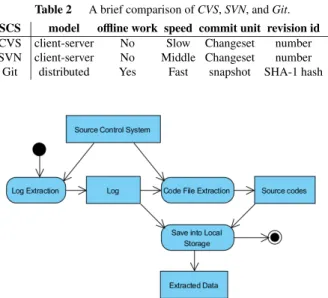
SCS model offline work speed commit unit revision id CVS client-server No Slow Changeset number SVN client-server No Middle Changeset number Git distributed Yes Fast snapshot SHA-1 hash
Fig. 2 The general process of data extraction from source control sys- tems.
staged, working directory, staging area, andGitrepository exists separately. However, general MSR researchers usu- ally focus on high level functionalities like obtaining source codes in specific revision, update, and commit. They share reasonably similar commands for source code management such ascommit,add,checkout (orclone),update(orpull).
The commands in the parentheses indicate they areGitcom- mands. That is,checkout,update, andsvnsyncinSVNcor- respond toclone,pull,cloneinGit, respectively.
Figure 2 shows a general approach to extracting data.
In order to extract data from source control systems, the log file should be first obtained by using provided commands or APIs of the system. However, creating a local clone repository is recommended before extracting logs for per- formance reasons.svnsync(orclone) command can be used for creating a local clone repository. Detail data such as list of changed files, author, date and comments can be ob- tained for each commit in the log history. By using those data, commands for requesting related source codes can be built and executed on the local repository, which returns a set of changed files. These data are finally inserted into a local database which already has related tables to store the records.
A log from source control system generally includes the following data.
- Unique id: Commit order or branch structure can be represented by using these unique identifiers.CVSand SVN use revision numbers, but they do not provide structural information about branches. However, Git effectively represents tree structures or parent commits with its hash values.
- Date: CVSandSVN have only the committing date.
However, Git provides not only committing date but also authoring date.
- Author/Committer:CVSandSVNprovide only com- mitter information. However, Git provides not only
committers but also authors. Analysis of developers re- quires identifying authors from logs. Emails and names can be combined and practically used as a key to iden- tify users [137].
- Comment: Each commit usually has a comment.
Some projects have a rule for comments by using spe- cial keywords such as “refactor” or “bug fix”. Some- times, bug id numbers are included in the comment in order to create relations with the bug reports.
- List of changed files: One or more than one file could be changed for each commit. Based on these data, the file types or sizes are also easily obtained. A unique file id should be the composition of commit id and path id because files which have the same path do not always have the same identities due to the different modified date and time.
There are lots of related works using source control systems such as bug prediction, impact analysis, visualizing change traces and detecting clones, refactoring cases or de- sign patterns. This kind of research can support the software process by providing developers insights into the software evolution.
3.2 Bug Tracking System
Today, the size and complexity of software projects are increasing. Thus, a lot of reported bugs should be man- aged systemically. Bug-related information such as priority, severity, location, how to reproduce bugs, who found the bugs or the status of bugs are stored in bug tracking systems such asBugzilla[19],Trac[20] orZIRA[21]. Basically, a bug tracking system manages bug reports which contain de- tailed descriptions of software failures. However, the struc- ture of the reports is mostly not formal and it is difficult to extract semantics from the original text based reports. Thus, the expected data schema needs to be confirmed before the extraction.
Most bug tracking systems provide web interfaces for managing bug reports and use database management sys- tems such asMySQL[22],PostgreSQL[23] orOracle[24].
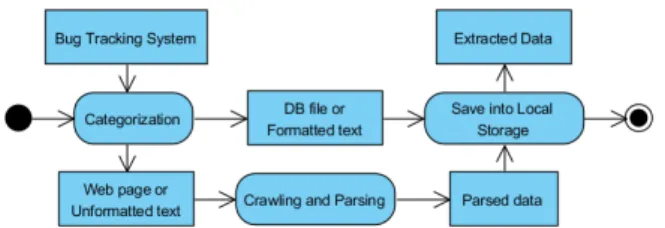
Therefore, necessary records could be extracted directly and stored in separated local databases by accessing the tables of the original databases as long as they are available. A sim- ilar approach could be applied in the case that csv or xml files are provided by the bug tracking systems. However, they are mostly unavailable and the data should be crawled and parsed through the web interfaces. Even if they are ex- tracted, some of them are difficult to be identified except some trivial fields such as status, priority or severity. At- tached files also should be downloaded and given identifiers to have relations with bug reports. Figure 3 shows the gen- eral process for extracting data from bug tracking systems.
During the categorization step in Fig. 3, data is classified into two cases: the possible case to expert data in formatted text or database files, or not. When files or data cannot be obtained, crawler or parser is required to get data.
Fig. 3 The general process of data extraction from bug tracking systems.
General data that can be extracted from bug tracking systems are listed below.
- Bug id: Unique identifier of each bug
- Dependency: Information which can show relations between bug reports or developers such as “assigned to”, “duplicated”, “other bugs depending on the bug”
- Version: The version of software which has the bug - Environment: Operating system or hardware specifi-
cation
- Status: The information which show the status of bug’s lifecycle. Generally, it has one status of “un- confirmed”, “new”, “assigned”, “resolved”, “verified”,
“closed”, and “reopened”.
- Resolution: The result of handling the bug report.
Generally, it has one status of “fixed”, “invalid”, “won’t fix”, “later”, “remind”, “duplicate”, and “works for me”.
- Priority: Generally, it has one of five levels from “very low” to “very high”.
- Severity: The impact of the bug. The highest severity is called “blocker” where you cannot even test a prob- lem. “critical” is the next highest case that can break a program and cause data loss. The lowest severity is
“trivial” which is related to requirements enhancement.
- Patches: Information for fixing the bugs. Most of them are attached files that have uniform diffformats, which can be applied for automatic fixes. Sometimes, descrip- tions of how to fix the source codes are included.
- Stack traces: Execution information which is consid- ered as one of the most important factors for debugging by developers. It can give direct hints for finding causes of defects in the case of software crash. It includes not only exceptions or error messages but also other detail execution information such as call dependencies. Each data can be parsed and extracted by using regular ex- pressions.
- Source code: Example codes which are helpful to find the problem or to fix the bug.
- Descriptions: Causes or symptoms about the bug, re- producing procedures or solutions to the problem; usu- ally written in natural languages.
According to a survey to find out features of a good bug report [25], most developers considered that reproduc- ing steps, stack traces and test cases are most helpful for debugging. However, users thought they were difficult to provide. These results could be used not only to support de-
velopers for designing better bug tracking systems but also to automatically distinguish the good bug reports from bad ones.
In general, the extraction cost or complexity of a bug tracking system is higher than those of a source control system because the structure of a bug report is difficult to be predicted, compared to the change log or source code.
Bettenburg et al. effectively generated a common structure of bug reports by using a tool namedInfoZilla[26] in order to support the mining process of bug reports. They also fig- ured out that the quality of the bug report is improved by merging the duplicate bug reports, not just by eliminating them [27].
For conducting MSR tasks such as change analysis, de- fect prediction and setting expertise for bug reports, it is important to link bug reports and source repository [132].
Gyimothy et al. presented a technique to link bugs from BugZilladatabase to source code classes [130]. At first, they filtered overall bug database to remove unnecessary data, and then, they allocated the bugs to an area in the codes by analyzing the patch files. As the patch files contain several information like, changed file name, the number of removed lines, and so on, it is possible to determine the change in- terval in each file. Bugs are matched onto the releases from the date of bug reporting to bug modifying. For each bug, they searched the class in the specified releases, of which interval the bug overlapped. Finally, on-the-fly classes were removed because they had no bugs. SZZ algorithm [58] has also been commonly used. SZZ algorithm is composed of syntactic and semantic level. In syntactic analysis, they in- ferred links between transactions and bug reports. To do this, syntactic confidence,syn(0-2), is assigned to log mes- sage by token analysis. Highsynindicates that the log mes- sage is highly possible to be buggy. After that, the link is validated using bug report data, which is the semantic anal- ysis. The semantic confidence,sem(0-4) is assigned to the links.synandsemis computed in the heuristic way. For ex- ample,synincreases by one when there are predefined key- words likebug, andsemincreases by one when the author in transaction is allocated to the corresponding bug. Kim et al.
proposed the extended SZZ algorithm [131]. They pointed out that the built-in annotated feature of the SCM (software configuration management) on which SZZ depends is insuf- ficient, and the modifications do not always get fixed. Kim et al. built annotation graph where nodes and edges denote code lines and evolving from nodes, respectively, to supple- ment the insufficiency of annotation in SZZ. And then, they excluded the changes in format or comment, and addition or removal of blanks to reduce false positives. Furthermore, they eliminate an outlier, excessively modified file at a revi- sion, because the modifications are less likely to fix bugs.
3.3 Other Sources
Even though most MSR research focuses on source control systems or bug tracking systems, the mining sources are not limited only to them. Archives of communications, UML
diagrams are also interesting data sources for MSR. Espe- cially,IBM Jazz, which provides collaborative environments for a whole lifecycle of software development, manages not only team organizations but also work items including his- tory of changes and event logs. On the other hand,Mylyn can provide developer low-level interactions such as select- ing menus or editing methods.
Archives of Communications
A lot of data related to communications are generated via email, messenger or off-line meeting, which are very use- ful for identifying the structure or efficiency of teams.
Archives of communications not only affect the quality of software [34], but also can support the prediction of fail- ure [35].
Communication data based on text is important though speech is the most principal communication data, due to the availability of text data. In the case of email, the sender, receiver, subject, content, date, time, priority, and attached files are available for data extraction. These can be directly obtained from the mail box files if they are accessible. Oth- erwise, crawlers should be applied for web mail clients.
Thus, the general process for extracting data is similar to that of the bug tracking system. However, the approaches for archived communications are more dependent on text mining based on natural language processing.
Network graph generated from the communication data often supports “Conway’s law [36]”. Thus, local interaction history is often analyzed in order to improve the quality of software process based on the structure of developers’ or- ganization [37]. Especially, the structure of developers is relatively dynamic in the case of open source project be- cause the participations are free [149]. The mailing lists in open source projects play an important role for communica- tion [145], and they provide helpful information for develop- ers or projects [139]. Yu et al. analyzed the associated social networks of developers based on their interactions extracted from two open source projects,LinuxandKDE[38]. They considered the channel directions of messages or threads, and assumed that one-way is a service relationship and two- way is a collaboration or coordination. They also defined evolution models and predicted the dynamics of social net- works by using bandwidths and interaction degrees based on the size of messages.
Recently,IRCmeeting is increasing in software devel- opment projects. Thus, analyzing the messages in the con- versations of developers is a new challenge. The first study of MSR on the open source project was conducted by Shihab et al. by extracting the message volumes, the size of partici- pants and their activities fromGNOME GTK+project [39], [40].
Design documents
MSR data are not limited to source code or text data. Soft- ware artifacts such as UML diagrams, which include ab- stract models of packages, classes, components, sequences or activities, are also interesting data sources for MSR anal-
ysis. In order to extract information from the UML dia- grams, usingXMI[41] is one of the easiest ways because most majorUMLmodeling tools likeVisual-paradigm[42], Enterprise Architect[43], IBM-tau[44] can export the di- agrams as XMI format. The extracted data of elements and relations from the exported files can be stored into the database tables that have been defined based on the XMI schema.
Based on the extracted data fromUMLdiagrams, vari- ous analyses such as prediction or association are possible.
Nugroho showed that the quality of Java class can be effec- tively predicted based on metrics such as the detail levels of messages and import coupling, which are obtained from sequence diagrams and class diagrams, respectively [45].
IBM Jazz
MSR research aims at extracting data and knowledge from separate source codes, code changes, bug reports, emails or communication messages. However, their relations are missing and it is difficult for researchers to organize or com- bine their separate data sources. IBM Jazz[3] is a collab- orative software engineering environment that provides full traceability among all the artifacts of software development.
Thus, important mining sources such as codes, bug reports, work assignments, changes and tests are formally related to each other. This feature enables researchers to analyze data or predict defects with clear relationships without using the mapping heuristics among data sources. Recently, funda- mental studies to extract data from Jazz repositories have been conducted [46], [47].
There are four major extraction approaches for Jazz repositories and they have trade-offs among their strategies.
Direct access to the database ofJazzprovides the most au- thority for the repositories. However, it also requires the highest cost for understanding the complex schema of the database, which may result in generating errors or faults while handling the repositories. Contrary to this, extract- ing data from only automatically generated reports provides the safest way with low cost. It could be intuitively under- stood, but the extracted data will be restrictively available.
Client API or Server API could be used to extract data from Jazzmore safely with lower cost than directly accessing the database but more effectively than using reports. Table 3 shows a summary of the extraction methods of IBM Jazz repository. In directly accessing database, the cost is high due to the need of understanding database schema, including the types and meanings of table and field, and their relations.
Reports require little cost, because they provide final data whose meanings are clear. In case of Server API or Client API which is located between the database and the reports
Table 3 Extraction methods ofIBM Jazzrepository.
Method Cost Accessibility Safety Database Very High Very High Low
Server API High High Middle
Client API High Middle High
Reports Low Low Very High
in the layer structure, the cost is lower than the database but higher than the reports, as it is not required to understand the schema. As it is possible to directly access the table and field in using database, the accessibility of the database is very high. With the opposite reason of database case, the accessibility of the reports is very low. It is possible to vio- late integrity of database and to extract wrong data or miss- ing data on account of misunderstanding schema, in directly accessing database. However, using the reports reduce this risk because they are normally extracted via internal logic of Jazz. For server API and client API, accessibility and safety are affected by the order in the layer where the bot- tom layer is database, the top is reports, and server API and client API are located between them in order. For example, the accessibility of server API is a little higher than that of client API.
Mylyn
Mylyn[4], an Eclipse plug-in, collects information about programmer’s activities such as editing files, methods and selecting menus with time stamps or identifiers for each event. It can manage eight kinds of interaction events such as selection, edit, command, preference, prediction, prop- agation, manipulation and attention. Method level interac- tions are also available for the data extraction. Thus, the data extracted fromMylynare very useful for analyzing the relations between the tasks of developers and the resources, which include not only classes or files but also methods. It also provides degree-of-interest (DOI) values representing how frequently and recently the elements in the tasks have been accessed. Thus, the elements with negativeDOIvalue can be ignored for the analysis [48], unless the target of anal- ysis is to find the elements which have not been frequently used. Mylar[49], the origin of task context for the Eclipse development environment, has changed its name toMylyn since 2007.
Miscellaneous
Most of the MSR studies are focused on source control sys- tems and bug tracking systems. However, the data sources for MSR are not limited to them, neither are they exclusive to each other. Thus, other data sources such as program execution information [30], crash reports [133], [185], and test cases [134] can also be introduced for MSR research.
Execution information enables to reflect abnormal behavior which had not been detected by the bug report and it is little influenced by the variation of natural language [30]. Crash reports can be used for bug fixing or crash triage, because they have stack traces and run time information about when the crash happened [133], [185]. Deployment logs contain execution information of one or multiple sites and they are increasingly used in MSR [136]. Furthermore, code reposi- tory site such asSourceforge.net[186] orGoogle code[187]
is a data source where massive software projects are pro- vided [136].SourceForgeis a code repository which is web based, and it hosts many projects which are in high level compared toCVS,SVN, andGit.SourceForgenaturally uti-
lizes several version control systems like CVS, SVN,Git, and so on, to control multiple versions. Thus, it may be helpful for analyzing multiple open source software to use code repository. Google code is useful for studying pat- terns of code, because it is possible to search codes using several conditions like package, language, class, function, and licenses and to identify codes of files for the various projects. These deployment logs or source codes from mul- tiple source code repositories could be analyzed together with other data sources such as bug tracking systems at the same time [135].
4. Processing
4.1 Source Codes
Source codes can be regarded as a set of text strings. How- ever, they have tree structures based on syntax. Thus, an ab- stract syntax tree is often used when token-level analysis is required. Table 4 shows the differences between text based source code and abstract syntax tree. In processing text, the data type is string. However, the data structure of tree and operations of them are complex because tokens and edges are dealt with in the case of tree processing. Tree enables to analyze data dependency and control dependency using the tokens and edges which denote relations, but it is hard to analyze them in text. For these reasons, accurate analysis, such as size, complexity, and dependency, is possible in tree but they are difficult in text.
Text
The cost of processing text-based source code is much lower than that of tree-based source code. However, dependency analysis or structural matching is not applicable for raw text- based data. Even if they are possible, precision is very low compared to the tree-based data. In spite of their lack of applicability and accuracy, text-based source code is often used for structural matching with a technique of replacing specific substrings with special characters such as “*” or
“?” [15]. After abstracting text-based source code, regular expressions are used for structural analysis.
In order to analyze the code change patterns, changed pairs of files should be produced from the history logs. And then, the differences of codes between adjacent revisions can be calculated for each pair via text-difftools.
In general repository systems, line-based code differ- ences can be generated for each change if proper log options are applied. The results show the locations of added, re- moved positions of the changed files by attaching “+” or “−”
character in front of the changed code lines. However, addi- tional processes are required in order to get added, removed or modified code hunks because the result is composed of
Table 4 A comparison between text and tree data of source code.
Type Unit Complexity Dependency Precision
Text line low no low
Tree token, edge high yes high
text strings which have multiple sets of such changes. The code hunks can be extracted by checking the sequence of
“+” or “−”. For example, if continuously changed parts have a pattern of “−” or “+”, then the “−” part can be con- sidered to be modified to “+” part. Eventually, each change has multiple code hunks.
Tree
Tree-based code requires a much higher cost of handling than the text-based one. However, it enables detailed ap- proaches such as dependency analysis or structural compar- ison on the token level. Tree-baseddiff is used for detect- ing detail changes which are mostly based on heuristic algo- rithms in order to reduce calculation cost [2]. The tree-based difftools are closely related to similarity or distance metrics and could be used for detecting clones. The differences be- tween trees are not just text strings, but the set of changed pairs of tokens and edges. Thus, it is much more complex and difficult to calculate their differences compared to the list of added or removed text lines. Generally, if move oper- ations are considered, calculating an edit distance between two different trees is NP-Hard [2]. Thus, it could require too much time to calculate the differences between every changed file because the data size for the MSR is usually very large. As a result, it creates the scalability problem.
Therefore, this kind of detail analysis should be done only in the area of concern, not for the whole source codes.
Source control systems basically do not support tree- diff operations. Thus, text-based source codes should be transformed to abstract syntax trees before being analyzed.
ANTLR[50],JDT[51] can be used for parsing Java source codes or java2xml[52] can be used for transforming the source code into an xml file, which has tree representations for the codes. Further, efficient xml difftools [53], [54] can be applied for calculating the differences between two xml files. However, xml differences are difficult to represent in intuitive formats because most of xml difftools use paths or pointers to represent the changed sub trees. As a result, calculating the differences directly from two abstract syntax trees and storing them in neat format for long time project history is challenging. Therefore, heuristic approaches such as comparing token counts or abstracted text strings, which are generated from the trees are sometimes more effective.
They can be used for code analysis if detail level analysis such as dependency analysis is not required. However, tree- based code is necessary in order to increase precision, espe- cially for structural methods such as finding dominant usage patterns or code examples from the historical data. These patterns or examples can be used to detect suspicious code usage or to guide the developers to make better codes from the learned knowledge.
4.2 Natural Languages
Most of the major data extracted from comments, bug re- ports or archives of communications are text-based format in natural languages. The types of bugs can be classified
with the words extracted from bug reports in a heuristic way [140]. The types of changes can be determined with commit messages [144]. The characteristics of projects are derived from work descriptions [143] or mailing list based on word count [139]. General processing steps for such data include the following.
- Tokenization: The original large text strings are di- vided into a set of tokens. Parsed tokens or simply sep- arated tokens can be obtained.
- Removal of stop-words: Meaningless tokens such as
“a”, “an”, “the”, “in”, “of”, “this”, “that” and etc. are eliminated, which leaves only meaningful tokens that have semantics.
- Stemming: The tokens with the same meaning but dif- ferent expressions are transformed into a unified token.
For example, “looked”, “looks”, “looking” are changed to “look”.
- Generating a bag of words: Unordered set of words in each file are transformed to a set of tuples. Each tuples has a token and the token count. Sometimes, the count is replaced with a weight value based on term frequency and inverse document frequency.
The natural language is eventually transformed to dynamic vectors whose attributes are tokens. And then, they are used for further analysis such as classification, prediction or clus- tering.
4.3 Graphs
Source code elements can have relations such as call, use, dependency and assignment, which can compose a net- work between tokens [141]. The developers also have re- lations and a social network could be created among them.
These networks are represented in graphs [176]. Table 5 shows some examples of basic relations which compose those graphs. However, there is lack of detail information in the graphs such as modified date, size, and impacted code hunks. For example,Fix(Jack,foo1.java) which means that Jack fixed the foo1.java file, does not tell such specific in- formation. In brief, a graph can only show the relations be- tween entities and further information should be managed somewhere else. That is, it is possible to store additional information like relating table with foreign key in RDBMS.
Of course, nodes and edges can apparently store these infor- mation with their attributes.
Table 5 Examples of 3-tuple for graphs.
Entity 1 relations entity 2 examples
developer communicate developer Email(Dave, Jack), Message(Jack, Bob)
developer use ‘software artifact’
Fix(Jack, MyClass.java), Remove(Dave, Yours.xml)
‘software artifact’ include ‘code element’
Include(Spec.doc, requirement1)
‘code element’ dependency ‘code element’
Call(foo1, foo2), Include(MyClass, foo3), Assign(var1, var2)
Those data for graphs can be generalized to “Rela- tion(Entity1,Entity2)” which means that “Entity1” and “En- tity2” have an order. Relational databases can easily imple- ment this kind of fundamental types. However, sometimes further processing is required for reasons related to perfor- mance by transforming a sub-graph into a text string or defining new complex types that are optimized for specific domains. For example, you can create class, method, field or parameter tables for easier source code analysis. Separate tables of statistics also could be defined for special purposes such as visualization.
4.4 Vectors
Specific data such as source code, natural language, and graph, usually have attributes, which could be one of nu- meric, nominal or text data types. They are often calculated from metrics or values among the predefined categories.
The patterns of attributes are important for prediction, clus- tering or association analysis. The number of attribute is also critical because too large size of attributes could reduce precision. Thus, selecting key attributes is necessary not only for achieving better analysis results but also for simpler models. In addition, some attributes that depend on other at- tributes should be eliminated for better analysis. When there are dependencies between the attributes, it is not needed to use both of it; by enduring the high computational cost due to large vector size. In addition to cost problem, co-related attributes which has not been reduced may be the cause of biased results. For better processing, it is enough to use one representative of co-related attributes.
Some specific machine learning algorithms are not ap- plicable for numeric type attributes. Therefore, those at- tributes should be transformed into nominal types by defin- ing some limited ranges and grouping similar numeric val- ues into one category. Normalizations of attribute values are also required to compare data which have different ranges of values. For example, (v-min)/(max-min) can be used for linear normalization where v is the attribute value before normalization, min and max is the minimum value and max- imum of the attribute, respectively. The changes of software can be represented with vector [142], entropy can be used as a key attribute to characterize the author contributions per file [55] or to calculate the complexity of changes for pre- dicting error-prone codes [56].
4.5 Discussion
“Garbage in, garbage out” is a phrase emphasizing the im- portance of input data in order to get high-quality output.
Actually, data extraction and processing are very important steps for making analysis easier and improving the quality of the result. Most MSR time is spent for data extraction and processing.
Sometimes, further processing may be required in or- der to be adapted for tools or environments. For example, the final data should be table styles forExcelor DBMS, and
arff format is required forWEKA. Thus, proper data types such as nominal, ordinal or numeric should be defined based on the metrics or probabilities calculated from the software engineering domain knowledge.
While processing fundamental data, outliers could be detected in the data. However, they are not always removed because they could give more interesting results for anomaly analysis. Most of data mining algorithms are robust to noise, but some of them are not. Recently, there has been a re- search to reduce noise from raw analysis data [57].
5. Analysis
5.1 Data Mining Algorithms
Data mining algorithms are often used in the MSR analysis for source codes, bug reports or software artifacts. For ex- ample, classifications or regressions in MSR can be consid- ered as supervised learning problems. Classifying priority, severity, security bug reports or good reports, and predict- ing defects based on the bug/fix memories belong to these problems.
Bayesiannetwork, rule-basedZeroR, tree-basedId3or J48 are mainly used for the classification problems. How- ever, in order to useId3algorithm with numeric data, proper transformation should be conducted for the numeric at- tributes because only nominal values can be applied for it. Support Vector Machine (SVM) is also known to be more general and achieves high performance of classifica- tion. Neural networks are mainly used for regression prob- lems. Regression is very similar to classification but the only difference is that the output has quantitative values, not nom- inal values. Association is finding related attributes such as the change coupling issue in MSR. Actually, using histori- cal data is a very effective way for this issue because it could find co-change relations even if there are no traditional de- pendencies such as data or control flows.Aprioriis a major association algorithm, which is also only applicable for the attributes of nominal data types. Clustering is a typical un- supervised learning problem, and the major methods are hi- erarchical clustering,K-means,SOM(self organizing map) andEM(expectation maximization). In the case of using K-meansorSOM, the number of clusters should be known and the cost is higher than hierarchical approach. However, they are known to have better quality of results thanEM. As clustering is an unsupervised problem, historical data is not always necessary. Examples of related problems are clone detection and grouping components.
Table 6 shows major data mining algorithms for MSR and their related issues. It has been referred from Halkidi et al.’s work [146]. These algorithms are effectively applied to vectors that include numeric or nominal types such as sta- tistical data or metrics. For example, the nearest neighbor algorithm has been used to predict the effort of issue reports in [163]. Decision tree has been used to predict develop- ers’ contribution in [145]. In [65], SVM has been applied for the bug triage and in [147], association rule mining has
Table 6 Major data mining algorithms and MSR issues.
Category Classification Regression Association Clustering
Supervised Yes Yes Yes No
Input don’t care quantitative don’t care don’t care Output discrete quantitative associated
attributes
homogeneous clus- ters
MSR Issues
priority, severity, SBRs/NSBRs for bug re- ports, etc.
change rate,
# of bug, quality, complexity cost, etc.
change cou- pling, impact anal- ysis, etc.
clone, code pat- tern, etc.
Algorithms SVM, Near- est Neighbor, Decision trees
Neural net- work
Apriori K-means, hierarchical clus- tering,
SOM, EM
Table 7 Detailed category of purposes.
keyword existing approaches bug bug fix [58]–[61], [155]
duplicate bug detection [28]–[30]
prediction [15], [18], [31]–[33], [62]–[64]
bug resolvers [65], [66]
using information retrieval [68]
change prediction [69]–[71]
refactoring [72], [73]
API-change [74], [75], [77], [80], [81]
change patterns [83]–[88], [90], [160]
team-activity developer’s contribution [55], [91], [93], [94], [154]
experties of developers [96], [97], [149]
tool support [98], [99], [128], [151]
helpful information [100]
comprehension visualization [101], [102], [156]
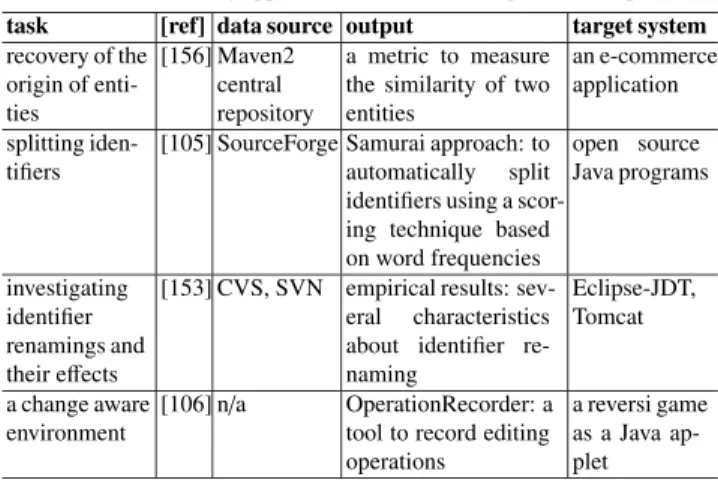
identifiers [104], [105], [153]
recording operations [106]
validation metrics [45], [107], [157]
tool [108]
clones [109]–[112], [150], [159]
bug [113], [114]
development&
evolution
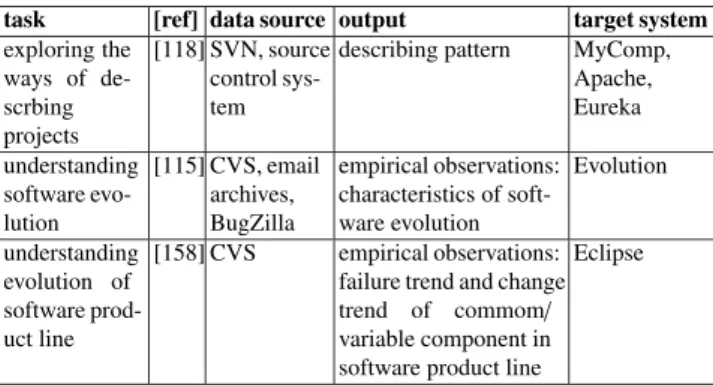
development [118]–[120]
evolution [115]–[117], [152], [158]
been applied for the defect data analysis. Hierarchical clus- tering algorithm has been used to understand the developer’s role in [148], and defect priority has been determined based on neural networks [32]. However, other specific algorithms should be implemented when directly applied to the domain oriented types such as source code.
There are more issues such as sequential pattern or out- lier discovery. Sequential pattern analysis focuses on find- ing relations in ordinal data and it is related to automated code completion or change prediction. Outlier discovery is related to detecting anomalies in the source code or devel- opment process.
5.2 Purpose of MSR Analysis
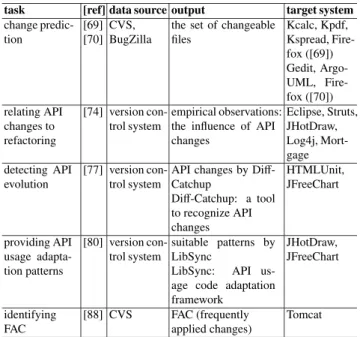
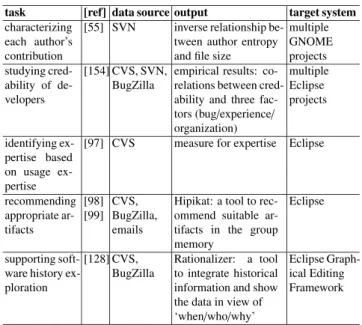
Table 7 presents the detailed category of MSR purposes, their detailed task types, and existing approaches. Table 8–
13 for each purpose summarize the existing approaches in view of task, data sources, output, and target systems. Due to space restriction, only a part of it is presented. For entire tables, please refer [161].
Table 8 Existing approaches to support bug-related activities (part).
task [ref] data source output target system bug-fix anal-
ysis
[155] Git, CVS development charac- teristics
Linux Kernel, PostgresSQL detecting du-
plicated bugs
[30] CVS, bug repository
duplicated defect re- ports
Eclipse, Fire- fox revealing use-
less phase in defect predic- tion
[63] CVS, Bugzilla
empirical observations:
the influence of con- cept drift
Eclipse, OpenOffice, Netbeans, Mozilla predicting the
severity of bugs
[31] BugZilla severe bugs and non- severe bugs
Mozilla, Eclipse, GNOME identifying se-
curity bug re- ports
[129] Cisco’s bug tracking system
security bug reports four Cisco soft- ware systems bug triage [65] CVS,
BugZilla
expertise to fix the re- ported bugs
Eclipse, Fire- fox
To support Bug-related activity
There have been several studies on bug-fix: empirical study on the patterns for bug-fix [58], [155], automatic bug- fix [59], [60], understanding the bug-fix patterns of hard- ware project [61]. Sliwerski et al. conducted the empiri- cal analysis about fix-inducing change based onCVS log andBugZilla[58]. For example, they investigated whether or not some change properties such as specific day or spe- cific working group are actually correlated with problems.
The experimental results showed that fix-inducing changes mostly happened on Friday and Saturday in case ofMozilla andEclipse, respectively. The number of fix-inducing trans- actions is about three times that of non-fix inducing trans- actions. Eyolfson et al. studied the co-relationship between the patterns of commits and the bugginess for those com- mits [155]. They explored the Linux Kernel and Postgres- SQL and found several observations: The commits from midnight to 4 A.M were highly possible to be buggy and the commits of everyday committers were less buggy. They also argued that the influence of day-of-week on commits was variable for each project. Williams and Hollingworth suggested a technique to automatically find and fix bugs by mining bug-fix information in source code repository, espe- cially on the bugs of function-return-value check [59], [60].
Sudhakrishnan et al. studied the bug-fix patterns of hard- ware projects [61]. As most of hardware projects utilize CM (Configuration Management) repositories, they mined bug- fix history on four Verilog projects and manually defined 25 bug-fix patterns.
There was a text-based analysis approach for detecting duplicate bugs [28], [29]. However, Wang et al. increased the recall of duplicate bug detection by combining the meth- ods from natural language and execution information [30].
Their approach showed 67%–93% recall in Firefox reposi- tory, which had been 43%–72% for natural language only.
Prediction is the main subject of mining software repository and predicting bugs has been also widely studied.
By extracting bug/fix code patterns from the history, simi- lar code patterns in the future are considered to have high chances of introducing similar bugs. Based on the bug/fix
patterns that had been learned from the change history of source codes, BugMem[15] tried to predict the project- specific bugs. The approach is different from others such asJLint[16],FindBugs[17] which use the static analysis of a snapshot of source codes. BugMemis more effective for detecting project-specific bugs, but it has limits in finding some trivial bugs such as missing null checks. It also re- quires enough change history to use the approach. There was a similar research using change couplings. Four kinds of bug localities such as change entity, new entity, temporal, and spatial localities had been checked whenever the source codes were modified. Further, the locations which are only related to bugs and fixes were stored into a cache [18]. If a similar code in the cache is detected, the developers are alerted for possible bugs. The accuracy was 73–95% in the file, 46–72% in the method level. Nagappan et al. suggested an approach to combine complexity metrics and post-release defect history as to construct the prediction model of post- release failures [62]. They also validated four hypotheses that present the correlation between complexity and post- release defects, by five MS products. The hypotheses and the validation results are as follows:
- H1: The complexity metrics correlate with post-release defects (Supported).
- H2: There exist a single set of metrics which predict defects in all projects (Rejected).
- H3: There exist combined metrics to predict the post- release defects within a project (Supported).
- H4: The combined metrics in H3 can predict defects in other projects (Partially confirmed).
In case of H4, they asserted that the predictors from a project are only useful to similar projects, and not every project.
Lamkanfi proposed a technique to predict the severity of bugs via text mining algorithms, which had been manu- ally predicted [31]. The technique has been applied to three open sources,Mozilla,Eclipse, andGNOME. The results showed that a sufficient size training set makes it possible to predict with reasonable accuracy. There have been studies of predicting the priority of bug reports based on neural net- works [32]. Similarly, classifying security bug reports from non-security related reports was conducted based on the text mining approach [33]. Ekanayake et. al revealed that useless phase exists in defect prediction using the notion of concept drift, which invalidates a learned prediction model [63]. As history data is a good predictor of future bugs in the sta- ble phase, however, in unstable phase, it is not the case, re- sulting in reducing the effectiveness of future effort and re- source allocation. They built the defect prediction model for Eclipse,OpenOffice,Netbeans, andMozilla, and they then visualized the prediction quality. The results represent that software systems usually have significant concept drifts in history, and particularly the number of authors editing files and the number of defects fixed by the authors contribute the concept drift and degenerate the quality of prediction. Giger et al. showed that fine-grained source code changes (SCC) is better than the existing line modified (LM) for bug pre-
diction [64]. SCC incorporates semantic of changes, which are not provided by LM. They established three hypothe- ses: First, SCC is strongly correlated with the number of bugs. Second, SCC is more effective than LM to classify the source files into bug-prone and none bug-prone. Third, SCC outperforms to predict the number of bugs compared to LM. These hypotheses are validated through an experiment on theEclipsesystem.
There are researches on recommending bug re- solvers [65], [66]. Anvik et al. recommended the list of po- tential developers who can resolve BRs by supervised learn- ing [65]. The past reports ofBugZillaare applied as classi- fiers, and they are then trained with project-specific heuris- tics, not with the direct usage of ‘assigned-to’ fields in BR.
Matter et al. suggested an approach to automatically assign BRs to relevant developers using vocabulary [66]. The ex- pertise of each developer has been modeled by comparing the vocabulary of source codes contributed by the devel- oper and the vocabulary of BRs. The evaluation has been conducted based on a comparison between recommended developers and actual developers. The empirical results in- corporate 33.6% top-1 precision and 71.0% of top-10 recall based on investigating theEclipsefor 8 years.
Information retrieval is applied to bug localization.
Rao and Kak compared five text models, VSM (Vector Space Model), LSA (Latent Semantic Analysis Model), UM (Unigram Model), LDA (Latent Dirichlet Allocation Model), and CBDM (Cluster-Based Document Model), to retrieve relevant files from libraries using benchmarked dataset iBugs [67], [68]. MAP (Mean Average Precision) and ‘Rank of Retrieved Files’ are used as evaluation mea- sures. In conclusion, a simple model, such as VSM or Un- igram shows better performance than complex models like LDA, LSA, and CBDM.
Table 9 Existing approaches to support change-related activities (part).
task [ref] data source output target system change predic-
tion
[69]
[70]
CVS, BugZilla
the set of changeable files
Kcalc, Kpdf, Kspread, Fire- fox ([69]) Gedit, Argo- UML, Fire- fox ([70]) relating API
changes to refactoring
[74] version con- trol system
empirical observations:
the influence of API changes
Eclipse, Struts, JHotDraw, Log4j, Mort- gage detecting API
evolution
[77] version con- trol system
API changes by Diff- Catchup
Diff-Catchup: a tool to recognize API changes
HTMLUnit, JFreeChart
providing API usage adapta- tion patterns
[80] version con- trol system
suitable patterns by LibSync
LibSync: API us- age code adaptation framework
JHotDraw, JFreeChart
identifying FAC
[88] CVS FAC (frequently applied changes)
Tomcat