Gender and Socioeconomic Differences in Adolescents’
Perceived Information and Communication Technology
(ICT) Competencies
Ke y w o r d s :
Perceived ICT competence, gender, socioeconomic status, second-level digital divide, PISA
Shuji TOBISHIMA,
Gunma UniversityAbstract
Based on tenth-grade students’ perceived ICT (information and communication technology) competencies, this study investigates the gender and socioeconomic differences in adolescents’ digital skills in Japan. This study used data from the Programme for International Student Assessment (PISA), which was conducted in 2015 by the Organisation for Economic Co-operation and Development (OECD). The multiple regression analysis results demonstrated that gender and family socioeconomic status (SES) had statistically significant effects on adolescents’ perceived ICT competencies. Specifically, the surveyed girls exhibited lower perceived ICT competence levels than boys, and family SES had a positive effect on adolescents’ perceived ICT competencies. The results also indicated that ICT availability at home partially mediated the effect of family SES on adolescents’ perceived ICT competence levels. In contrast, internet usage time suppressed the effect of SES on adolescents’ perceived ICT competence levels. Moreover, the (positive) effects of ICT availability at home and internet usage time on adolescents’ perceived ICT competencies were weaker for girls than for boys. It is presumed that girls are more likely to use ICTs for communicational purposes than boys, which may not improve their digital skills.
1. Introduction
The term “digital divide” originally referred to gaps in physical access to information and communication technologies (ICTs) such as computers and the internet. The digital divide received worldwide attention from the late 1990s to the early 2000s. Although it was a serious problem at the time, this type of digital divide was expected to disappear as ICTs became more popular and easier to access.
However, the diffusion of internet use has not eliminated the digital divide, as evidenced by two important facts. First, gaps in physical access to ICTs are still an important issue, even in developed countries (Campos-Castillo 2015). Second, the widespread use of the internet has led to the development of a new type of digital divide. With internet usage rates reaching high levels, the focus of research on the digital divide has shifted from gaps in physical access to ICTs to gaps in ICT usage and digital skills. The former is referred to as the “first-level digital divide,” whereas the latter is referred to as the “second-level digital divide” (Attewell 2001, Hargittai 2002) or the “digital inequality” (DiMaggio et al. 2004).
By analyzing data from a survey of youth in the Netherlands, Peter and Valkenburg (2006) showed that the “emerging digital differentiation hypothesis,” rather than the “disappearing digital divide hypothesis,” is supported. That is, the widespread use of the internet has not necessarily eliminated any socioeconomic disparities related to ICT usage. Rather, a new form of differentiation has occurred in terms of how people use ICTs. Another study showed that physical access gaps are gradually decreasing, whereas digital skill gaps tend to increase (Van Dijk 2006).
Furthermore, digital skill inequalities may exacerbate existing social inequalities (Van Dijk 2005, Witte & Mannon 2010). For example, Falck et al. (2016) analyzed data from the Programme for the International Assessment of Adult Competencies (PIAAC) conducted by the Organisation for Economic Co-operation and Development (OECD) to find that ICT skills are substantially rewarded in the labor market. Thus, the unequal distribution of digital skills among different social groups can lead to income inequality among them.
Few studies have empirically investigated the second-level digital divide in Japan, which is the aim of this study. Instead, there are several cross-national studies on the (first- and second-level) digital divide among adolescents using data from the OECD’s Programme for International Student Assessment (PISA), in which Japan has participated since the first survey conducted in 2000. These studies demonstrated that there are gender and socioeconomic differences in adolescents’ ICT use and digital skills.
For example, Notten et al. (2009) investigated the influence of gender and socioeconomic status (SES) on adolescents’ access to and use of ICTs in 30 of the countries that participated in PISA 2003. They found that girls have lower odds of informational and game use of ICTs, whereas there is no gender difference regarding communicational use. Furthermore, parental education level and occupational status have positive effects on informational and communicational use, but have negative effects on game use. Other studies using PISA data also demonstrated that 15-years-old students’ self-reported digital skills (Zhong 2011) and internet literacy levels (Ma et al. 2019) differ by gender and SES.
cross-national studies provided rich information on not only the student-level but also the school- and country-level factors that affect student ICT usage and digital skills. However, Ma et al. (2015) analyzed PISA 2009 data to elucidate that a second-level digital divide’s magnitude is dependent on several country-level factors such as GDP per capita, research and development (R&D) investments, and expenditures on secondary education. Therefore, it is necessary to more fully investigate each country’s second-level digital divide to provide a more complete picture as to what causes these divides.
In Japan, internet use has increased rapidly since the late 1990s. According to the results of the Communications Usage Trend Survey conducted by the Ministry of Internal Affairs and Communications, the internet usage rate was only 9% in 1997 but steadily increased to 37% in 2000, 70.8% in 2005, 78.2% in 2010, and 83.0% in 2015. Although several studies investigated the first-level digital divide (Kimura 2001, Tarohmaru 2004, Higuchi 2013), few studies have explored the second-level digital divide in Japan. Ono and Zavodny (2007) is one of the few exceptions; however, their research is based on surveys that were conducted in the 1990s. Apart from the findings of the cross-national studies using PISA data, little is known about the second-level digital divide in Japan.
A rationale for focusing on Japan is that Japanese schools would not have contributed to narrowing the digital skill gap between students. According to the results of PISA 2018, Japan had the lowest percentage of students using ICTs in language, math, and science classes at school (National Institute for Educational Policy Research 2019: 242-244). For example, only 14.0% of tenth-grade students used ICTs in language
classes in Japan (the OECD average was 45.0%). Therefore, Japan is an important research target when studying the second-level digital divide. Moreover, the use of portable internet devices such as smartphones has rapidly spread since the early 2010s in Japan. According to the results of the Survey on the Internet Use Environment of Youths conducted by the Cabinet Office, high school students’ smartphone ownership and usage rates, which was only 6.8% in 2011, reached 54.8% in 2012 and exceeded 90% in 2014. It is expected that the spread of smartphones and other devices has changed the way people use ICTs. Therefore, it is not appropriate to apply the findings from the existing research that has relied on early- and mid-2000s PISA data to the current Japanese society.
2. Research Question and Hypothesis The purpose of this study is to contribute to a better understanding of the second-level digital divide in Japan. Using a representative sample obtained by PISA 2015, this study specifically investigates the gender and socioeconomic differences in adolescents’ digital skills in Japan. The research questions addressed in this study are as follows:
RQ1: Do adolescents’ digital skills differ by
gender?
RQ2: Do adolescents’ digital skills differ by SES? As mentioned above, previous studies using PISA data have demonstrated that 15-years-old students’ access to and usage of the internet (Notten et al. 2009), self-reported digital skills (Zhong 2011), and internet literacy levels (Ma et al. 2019) differ by gender and SES. For example,
Zhong (2011) analyzed data from PISA 2003 and 2006 to find that boys tend to show higher self-reported digital skills than girls. Moreover, family SES had a positive effect on adolescents’ self-reported digital skills. It would be reasonable to suppose that Japan is no exception. Therefore, hypotheses 1 and 2 for this study are as follows: H1: Girls exhibit a lower level of digital skills
than boys.
H2: As SES increases, adolescents exhibit a
higher level of digital skills.
In addition to verifying these two hypotheses, this study includes a more detailed analysis that focuses on the roles of ICT availability at home and the amount of time spent using the internet regarding the effects of gender and SES on adolescents’ digital skills.
RQ3: How are ICT availability at home and
time spent using the internet related to the gender and socioeconomic differences in adolescents’ digital skills?
Digital skills are expected to improve as the home ICT environment is better prepared, and ICTs are more frequently used. Therefore, we can predict that ICT availability at home and internet usage time would have positive effects on adolescents’ digital skills. Further, if ICT availability at home and time spent using the internet are related to gender and SES, then these factors may mediate the effects of gender and SES on adolescents’ digital skills.
H3: The effects of gender and SES on adolescents’
digital skills are (partially) mediated by ICT availability at home and time spent using the
internet.
As discussed above, ICT availability at home and the amount of time spent using the internet are expected to correlate with adolescents’ digital skills. However, even if the home ICT environment is fulfilling, it is unclear how adolescents actually use ICTs at home. Similarly, the impact of internet usage time on adolescents’ digital skills could depend on how they use the internet. This study therefore examines whether and how the effects of at-home ICT availability and internet usage time on adolescents’ digital skills differ by gender and SES in Japan.
Previous studies have exhibited gender and socioeconomic differences in young people’s ICT usage. Tsai and Tsai (2010) found that boys are more exploration-oriented internet users, whereas girls are more communication-oriented internet users in Taiwan. A communicational use of ICTs tends to be routine, thus may not improve digital skills. In fact, young people’s digital skills do not predict frequency of Facebook use in Chile (Correa 2016). Moreover, young adults with higher levels of education use the internet for more “capital enhancing” activities in the United States (Hargittai & Hinnant 2008). Therefore, this study examines the following hypotheses.
H4: The effects of ICT availability at home and
time spent using the internet on digital skills are larger for boys than for girls.
H5: As SES increases, ICT availability at home
and time spent using the internet have larger effects on adolescents’ digital skills.
3. Method 3.1. Data
This study relies on data collected from the OECD’s PISA 2015 survey1. Since 2000, PISA
surveys have been conducted every three years, to assess 15-years-old students’ reading, mathematical, and scientific literacy levels. Approximately 540,000 students from 72 countries and regions participated in the 2015 survey, and students from 46 countries and regions, including Japan, also responded to the optional ICT familiarity questionnaire. This study uses Japan’s PISA 2015 dataset. 6,647 tenth-grade (the first year of high school) students from 198 schools in Japan participated in PISA 2015 (National Institute for Educational Policy Research 2016: 61). In PISA 2015, a two-stage stratified random sampling procedure was employed to extract the sample (OECD 2016: 293). First, schools were randomly selected from all parts of each country. Second, about 35 students were randomly drawn from each selected school. Since some extracted schools and students did not participate in the survey, sampling weights were used in the statistical analysis to compensate for the bias due to the school- and student-level non-participation. The response rates for schools and students in Japan were 99% and 97%, respectively (OECD 2016: 295).
The PISA 2015 data, due to the two-stage stratified sampling design, have a multilevel structure wherein students are nested in schools. In a clustered sample such as this, the error terms may be correlated within each school, which can lead to biased standard errors. However, the intra-class correlation coefficient (defined as the ratio of between-group variance to the total variance) for this study’s dependent variable (i.e., adolescents’ perceived ICT
competence) is 0.019 (1.9%), which is below 0.05 (5%). This means that the degree of student homogeneity within schools is negligible and thus not for concern in this study (Heck et al. 2013). Therefore, OLS regression analysis, rather than multilevel modeling, was conducted in this study.
3.2. Dependent Variables
This study’s dependent variable is adolescents’ perceived ICT competencies, which is a proxy of their digital skills. This study used the PISA index of perceived ICT competence (COMPICT), which is based on IRT (item response theory) scaling (OECD 2017: 330-331). Concerning their perceived ICT competence levels, students were asked, “Thinking about your experience with digital media and digital devices: to what extent do you disagree or agree with the following statements?” In PISA 2015, the adolescents’ perceived ICT competencies were assessed using the five variables listed below (OECD 2017: 331).
1) I feel comfortable using digital devices that I
am less familiar with.
2) If my friends and relatives want to buy new
digital devices or applications, I can give them advice.
3) I feel comfortable using my digital devices at
home
4) When I come across problems with digital
devices, I think I can solve them.
5) If my friends and relatives have a problem
with digital devices, I can help them.
The students responded to all questions with a four-point Likert scale, ranging from 1 (strongly disagree) to 4 (strongly agree). The scale
reliability (Cronbach’s Alpha) for Japan was 0.875 (OECD 2017: 329).
3.3. Independent Variables
This study’s independent variables are described in this section.
Gender
This study measured students’ gender with a dummy variable (1: girls, 0: boys).
Socioeconomic status (SES)
Regarding adolescents’ SES, this study used the PISA index of economic, social and cultural status (ESCS). The ESCS is a composite score obtained by a principal component analysis using parents’ education levels (PARED), highest parental occupation (HISEI), and home possessions (HOMEPOS) including books in the home. As a result of the principal component analysis, factor loadings of PARED, HISEI, and HOMEPOS for Japan were 0.76, 0.74, and 0.68, respectively (OECD 2017: 340).
This study uses this unidimensional SES measure to simplify the interpretation of interaction effects2. Moreover, using the same
variable as many existing studies using PISA data (e.g., Zhong 2011, Ma et al. 2019) ensures the international comparability of the results.
ICT availability at home
The original PISA index of ICT availability at home (ICTHOME) was measured by the sum of the availability of the following 11 items at home (1: yes, 2: no): desktop computer, portable laptop or notebook, tablet computer (e.g., iPad®),
internet connection, video game console (e.g., Sony® PlayStation®), cell phone (without internet
access), cell phone (with internet access),
portable music player (Mp3/Mp4 player, iPod,®
or similar), printer, USB (memory) stick, and ebook reader (e.g., Amazon® KindleTM).
Instead of using this simply summed variable, this study performed a multiple correspondence analysis (MCA), which is equivalent to a principal component analysis for categorical data, using the 11 items listed above. A rationale for using all 11 items is that Van Deursen and Van Dijk (2019) found that diversity in access to devices and peripherals affects inequalities in internet skills and uses.
The result of MCA demonstrated that the first dimension accounts for 91.65% of the total variance, indicating the unidimensionality of ICT availability at home. This study uses the row score of the first dimension as an index of ICT availability at home. As the coordinates of each variable categories (yes/no) described in Table 1 indicate, a large value of the constructed variable means the high ICT availability at home. Table 1 also shows that the absence of the internet connection, a printer, and a USB (memory) stick at home contributed greatly to the definition of the first dimension.
Time spent using the internet outside of school
This study measured adolescents’ time spent using the internet outside of school weekly. For both weekdays and holidays, the respondents could choose from the following categories: “no time” (coded as 0), “1 to 30 minutes per day” (0.25h), “31 to 60 minutes per day” (0.75h), “between 1 hour and 2 hours” (1.5h), “between 2 hour and 4 hours” (3h), “between 4 hour and 6 hours” (5h), and “more than 6 hours per day” (7h)3. To reflect the weekly internet usage time
weekdays and holidays were multiplied by 5 days and 2 days, respectively.
Table 2 shows the descriptive statistics of variables used for the regression analyses. The sample size after listwise deletion is N = 5,945. 4. Results
Regarding the first-level digital divide, this study examined the gender and socioeconomic differences in ICT availability at home, which is the index concerning access to various devices and peripherals. Due to the large sample size, we consider the effect sizes rather than the p-value here. ICT availability at home is moderately
correlated with SES (the correlation coefficient = 0.342) but weakly related with gender (Hedges’s
g = 0.085). This result indicates that the first-level
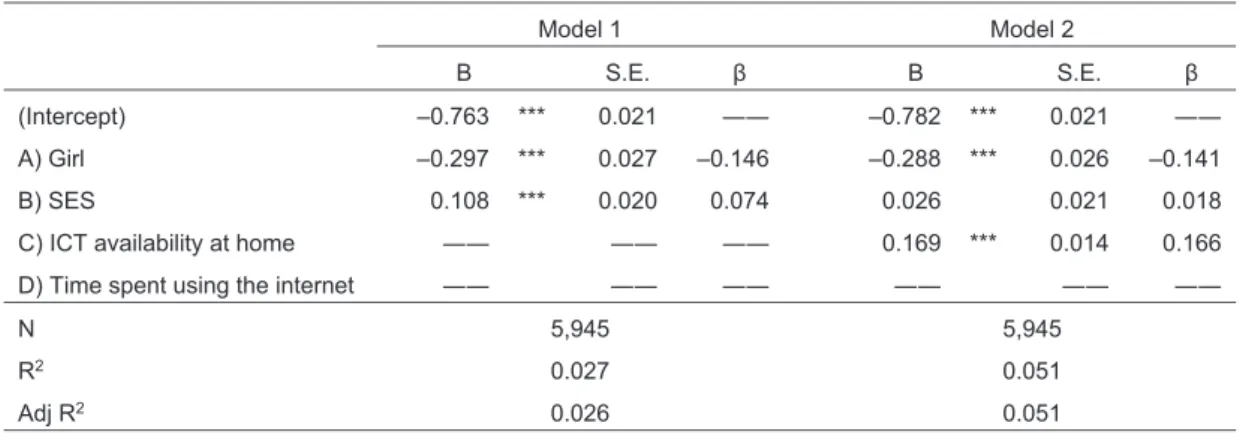
digital divide by SES still remains in Japan. Next, we investigate the second-level digital divide in Japan. Tables 3 and 4 display the estimation results of the multiple regression analyses of adolescents’ perceived ICT competencies. This study examines mediation effects by hierarchical regression procedures4. The estimation result of
Model 1 demonstrates that girls have lower perceived ICT competencies than boys. Also, a positive regression coefficient of SES indicates that adolescents with higher SES backgrounds have higher perceived ICT competencies.
In Model 2, ICT availability at home was included as an additional independent variable, and the estimation results indicate that ICT availability at home has a positive effect on adolescents’ perceived ICT competence levels. Moreover, the SES regression coefficient (0.026) was smaller than that in Model 1 (0.108), and the effect of SES was not statistically significant (p>0.05) in Model 2. This result indicates that ICT availability at home mediated the effect of SES on adolescents’ perceived ICT competence levels5.
The amount of time one spends using the internet was added as an independent variable in Model 3, and the estimation results demonstrate that time spent using the internet has a positive effect on adolescents’ perceived ICT competencies. The SES regression coefficient was 0.087, which was statistically significant (p<0.001) and larger than that in Model 2 (0.026). In contrast to ICT availability at home, time spent using the internet suppresses the effect of SES on adolescents’ perceived ICT competence levels6. In other words, SES has a positive direct
Table 2. Descriptive Statistics
Table 3. Multiple Regression Analysis Results (Models 1 and 2)
effect and a negative indirect effect through time spent using the internet on perceived ICT competencies. This is due to a negative correlation between one’s time spent using the internet and SES (the correlation coefficient is –0.105) despite the fact that both variables have positive effects on adolescents’ perceived ICT competencies7.
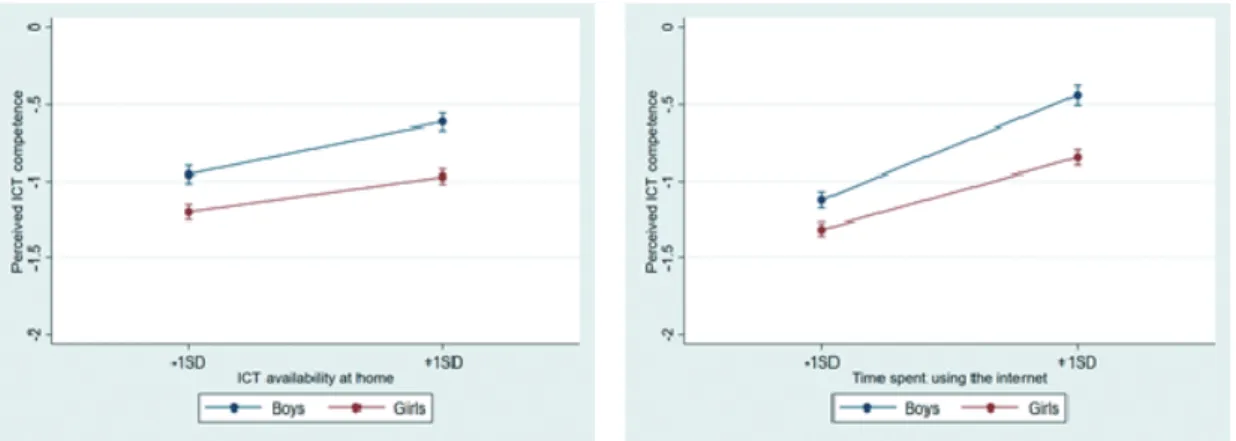
Next, this study examined whether and how the effects of ICT availability at home and time spent using the internet differ between girls and boys. The estimation result of Model 4 demonstrates that the interaction effect between gender and ICT availability at home (p<0.05), as well as the interaction effect between gender and internet usage time (p<0.001), were both negative. These results indicate that the positive effects of both ICT availability at home and time spent using the internet are smaller for girls. Specifically, the regression coefficient for ICT availability at home was 0.177 for boys but 0.122 (=0.177–0.055) for girls. Similarly, the regression coefficient for time spent using the internet was 0.026 for boys but only 0.018 (=0.026–0.008) for girls. Figure 1 graphically represents the interaction effects.
Model 4 also examined whether and how the
effects of ICT availability at home and time spent using the internet differ by SES. However, neither the interaction effect between SES and ICT availability at home nor the interaction effect between SES and time spent using the internet was statistically significant (p>0.05). These results indicate that the (positive) effects of ICT availability at home and time spent using the internet do not differ for adolescents with different SES levels.
5. Discussion
Using PISA 2015 data, this study investigated the gender and socioeconomic differences in adolescents’ perceived ICT competencies in Japan. The results of the regression analyses demonstrated that girls exhibited lower perceived ICT competencies than did boys. Thus, the results offer support for Hypothesis 1. The results also showed that SES had a positive effect on adolescents’ perceived ICT competence levels, indicating that Hypothesis 2 was supported. These findings indicate that the spread of ICTs has not eliminated the digital divide. Rather, as this study demonstrates, the second-level digital divide does exist in Japan. Figure 1. Predictive Margins with 95% CIs
However, it should also be noted that adolescents’ perceived ICT competence levels are largely unexplained by gender and SES, as indicated by low R2 value in regression analysis.
As expected, both ICT availability at home and the amount of time spent using the internet had positive effects on adolescents’ perceived ICT competence levels. However, these two variables played different roles with the effect of SES on perceived ICT competencies, and the results of testing Hypothesis 3 were mixed. That is, ICT availability at home mediated the effect of SES on adolescents’ perceived ICT competencies, whereas one’s time spent using the internet suppressed the effect of SES on perceived ICT competencies. This is because SES is positively correlated with ICT availability at home but negatively correlated with time spent using the internet.
Moreover, the effects of ICT availability at home and time spent using the internet on perceived ICT competence levels differed between girls and boys. That is, the positive effects of ICT availability at home and internet usage time on adolescents’ perceived ICT competencies were weaker for girls than for boys. The result offers support for Hypothesis 4. It could be assumed that these results are due to the gender differences in ICT usage (Notten et al. 2009, Tsai & Tsai 2010). That is, it is presumed that girls tend to use ICTs for communicational purposes, which may not improve their digital skills. Future research should empirically investigate the relationship between such gender differences in ICT usage and skills.
On the other hand, the magnitudes of the effects of ICT availability at home and internet usage time on adolescents’ perceived ICT competencies did not depend on SES. Therefore,
Hypothesis 5 was not supported. Previous studies have suggested that young people’s ICT usage varies depending on SES (Peter & Valkenburg 2006, Hargittai & Hinnant 2008, Notten et al. 2009). However, the present study’s results indicate that it might not necessarily be the case that adolescents with higher SES tend to use ICTs more effectively to improve their digital skills.
A limitation of this study relates to how digital skills were measured (Litt 2013). Due to data limitations, this study used adolescents’ perceived ICT competence levels in the statistical analyses rather than adolescents’ objectively measured digital skills. However, it is possible that one’s perceived and actual ICT competencies are different (Hargittai & Shafer 2006). Due to the use of subjective indicators, this study’s findings may depend on the measurement of digital skills (Merritt et al. 2005). It is necessary to verify the robustness of the results in future research. Regarding this issue, special attention should be paid to gender differences, as women may underestimate their digital skills compared to men (Sieverding & Koch 2009). Therefore, the gender difference in adolescents’ perceived ICT competencies observed in this study can be attributed to the gender bias regarding self-evaluations of digital skills. In fact, while boys outperformed girls in computer literacy, girls outperformed boys in information literacy in the International Computer and Information Literacy Study (ICILS) 2013 (Punter et al. 2017).
Furthermore, due to data limitations, this study did not account for some possible confounders such as parental attitudes toward ICTs. Therefore, future research is needed to estimate more precisely the effects of ICT availability at home and internet usage time on
adolescents’ perceived ICT competence levels. Finally, it must be noted that the importance of the digital skill gap (at least partially) depends on how the existing digital skill inequalities relate to other types of social inequalities. In order to elucidate how the digital skill gap among adolescents exacerbates the existing social inequalities, further research should be conducted on the role of digital skills in the Japanese education system and labor market.
Note
1. PISA data are available on the official web site (URL: https://www.oecd.org/pisa/). The data file name of the student dataset (SPSS format) is “CY6_MS_CMB_STU_QQQ.sav”.
2. Although the Cronbach’s alpha for Japan was not high at 0.54 (OECD 2017: 340), this is due in part to the small number of items
3. In empirical research using survey data, this type of value assignment is often made when using a discretely measured time variable as a quantitative one (e.g., Matsuoka 2017).
4. An indirect effect can be calculated by multiplying the unstandardized regression coefficient of the independent variable on the mediator variable and that of the mediator variable on the dependent variable (Baron & Kenny 1986).
5. The indirect effect of SES on perceived ICT competencies through ICT availability at home was statistically significant (z = 9.135, p<0.001) by the Sobel test (Sobel 1982).
6. The indirect (negative) effect of SES on perceived ICT competencies through time spent using the internet was also statistically significant (z = –7.481, p<0.001).
7. Given the method of calculating an indirect effect, multiplying a positive coefficient by a negative one result in a negative indirect effect.
References
Attewell, P. (2001). The first and second digital divides. Sociology of Education, 74(3), pp. 252-259. Baron, R.M, & Kenny, D.A. (1986). The moderator-mediator variable distinction in social psychological research: Conceptual, strategic, and statistical considerations. Journal of Personality and Social
Psychology, 51(6), pp. 1173-1182.
Campos-Castillo, C. (2015). Revisiting the first-level digital divide in the United States: Gender and race/ethnicity patterns, 2007-2012. Social Science
Computer Review, 33(4), pp. 423-439.
Correa, T. (2016). Digital skills and social media use: How Internet skills are related to different types of Facebook use among ‘digital natives’. Information,
Communication & Society, 19(8), pp. 1095-1107.
DiMaggio, P., Hargittai, E., Celeste, C., & Shafer, S. (2004). Digital inequality: From unequal access to differentiated use. In Neckerman K. M. ed. Social
inequality. Russell Sage, pp. 355-400.
Falck, O., Heimisch, A., & Wiederhold, S. (2016). Returns to ICT skills. OECD Education Working Papers No. 134.
Hargittai, E. (2002). Second-level digital divide: Differences in people’s online skills. First Monday, 7(4). Retrieved February 25, 2020, from https:// firstmonday.org/ojs/index.php/fm/ar ticle/ view/942/864
Hargittai, E., & Hinnant, A. (2008). Digital inequality: Differences in young adults’ use of the Internet.
Communication Research, 35(5), pp. 602-621.
Hargittai, E., & Shafer, S. (2006). Differences in actual and perceived online skills: The role of gender. Social Science Quarterly, 87(2), pp. 432-448.
Heck, R.H., Thomas, S.L., & Tabata, L.N. (2013).
Multilevel and longitudinal modeling with IBM SPSS (second edition). Routledge.
adoption: Changes in WWW adoption determinants in the diffusion process. Soshioroji, 57(3), pp. 39-55. (In Japanese)
Kimura, T. (2001). Dejitaru debaido towa nanika?
[What is the digital divide?]. Iwanami Shoten. (In
Japanese)
Litt, E. (2013). Measuring users’ Internet skills: A review of past assessments and a look toward the future. New Media & Society, 15(4), pp. 612-630. Ma, J. K.-H., Vachon, T.E., & Cheng, S. (2019).
National income, political freedom, and investments in R&D and education: A comparative analysis of the second digital dvide among 15-year-old students. Social Indicators Research, 144(1), pp. 133-166.
Matsuoka, R. (2017). Inequality of effort in an egalitarian education system. Asia Pacific
Education Review, 18(3), pp. 347-359.
Merritt, K., Smith, K.D., & Di Renzo, J.C. (2005). An investigation of self-reported computer literacy: Is it reliable? Issues in Information Systems, 6(1), pp. 289-295.
National Institute for Educational Policy Research (Ed.). (2016). Ikiru tame no chishiki to ginou 6:
OECD seito no gakusyu totatsudo chosa (PISA) (2015 nen chosa kokusai kekka hokokusyo) [Knowledge and skills for life 6: OECD Programme for International Student Assessment (PISA) (Report on international results of the survey in 2015)]. Akashi Shoten. (In Japanese)
National Institute for Educational Policy Research (Ed.). (2019). Ikiru tame no chishiki to ginou 7:
OECD seito no gakusyu totatsudo chosa (PISA) (2018 nen chosa kokusai kekka hokokusyo) [Knowledge and skills for life 7: OECD Programme for International Student Assessment (PISA) (Report on international results of the survey in 2018)]. Akashi Shoten. (In Japanese)
Notten, N., Peter, J., Kraaykamp, G., & Valkenburg, P.
M. (2009). Digital divide across borders: A cross-national study of adolescents’ use of digital technologies. European Sociological Review, 25(5), pp. 551-560.
OECD (2016). PISA 2015 results (Volume I):
Excellence and equity in education. OECD.
Retrieved February 25, 2020, from https://www. oecd.org/education/pisa-2015-results-volume-i-9789264266490-en.htm
OECD (2017). PISA 2015 technical report. OECD. Retrieved February 25, 2020, from https://www. oecd.org/pisa/sitedocument/PISA-2015-technical-report-final.pdf
Ono, H. & Zavodny, M. (2007). Digital inequality: A five country comparison using microdata. Social
Science Research, 36(3), pp. 1135-1155.
Peter, J., & Valkenburg, P.M. (2006). Adolescents’ Internet use: Testing the ‘‘disappearing digital divide’’ versus the ‘‘emerging digital differentiation’’ approach. Poetics, 34(4-5), pp. 293-305.
Punter, R.A., Meelissen, M.R.M, & Glas, C.A.W. (2017). Gender differences in computer and information literacy: An exploration of the performances of girls and boys in ICILS 2013.
European Educational Research Journal, 16(6), pp.
762-780.
Sieverding, M., & Koch, S.C. (2009). (Self-)Evaluation of computer competence: How gender matters.
Computers & Education, 52(3), pp. 696-701.
Sobel, M.E. (1982). Asymptotic confidence intervals for indirect effects in structural equations models.
Sociological Methodology, 13, pp. 290-312.
Tarohmaru, H. (2004). Social stratification and Internet use: Critique of digital divide studies.
Soshioroji, 48(3), pp. 53-66. (In Japanese)
Tsai, M.-J., & Tsai, C.-C. (2010). Junior high school students’ Internet usage and self-efficacy: A re-examination of the gender gap. Computers &
Van Deursen, A., & Van Dijk, J. (2019). The first-level digital divide shifts from inequalities in physical access to inequalities in material access. New
Media & Society, 21(2), pp. 354-375.
Van Dijk, J. (2005). The deepening divide: Inequality in
the information society. Sage.
Van Dijk, J. (2006). Digital divide research,
achievements and shortcomings. Poetics, 34(4-5), pp. 221-235.
Witte, S.E., & Mannon, J.C. (2010). The Internet and
social inequalities. Routledge.
Zhong, Z.-J. (2011). From access to usage: The divide of self-reported digital skills among adolescents.