CITATION
Sievert, S.M., and C. Vetriani. 2012. Chemoautotrophy at deep-sea vents: Past, present, and future. Oceanography 25(1):218–233, http://dx.doi.org/10.5670/oceanog.2012.21.
DOI
http://dx.doi.org/10.5670/oceanog.2012.21
COPYRIGHT
This article has been published in Oceanography, Volume 25, Number 1, a quarterly journal of The Oceanography Society. Copyright 2012 by The Oceanography Society. All rights reserved.
USAGE
Permission is granted to copy this article for use in teaching and research. Republication, systematic reproduction, or collective redistribution of any portion of this article by photocopy machine, reposting, or other means is permitted only with the approval of The Oceanography Society. Send all correspondence to: [email protected] or The Oceanography Society, PO Box 1931, Rockville, MD 20849-1931, USA.
O ceanography THE OffICIAl MAGAzINE Of THE OCEANOGRAPHY SOCIETY
DOwNlOADED fROM HTTP://www.TOS.ORG/OCEANOGRAPHY
Chemoautotrophy
at Deep-Sea Vents
Past, Present, and Future
B y S t e F a N M . S i e V e r t
a N D C o S ta N t i N o V e t r i a N i
o C e a N i C S P r e a D i N g C e N t e r P r o C e S S e S |
ridge 2000 P r o g r a M r e S e a r C h
Photo of a diffuse-flow vent site on the east Pacific rise called Crab Spa. it shows the submersible Alvin’s manipu- lator arm holding a sensor developed by Nadine Le Bris that measures temperature, ph, and sulfide in situ. This site is being used by the authors and colleagues as a model system to gain insights into chemosynthetic processes at deep-sea vents.
Photo courtesy of Stefan Sievert, WHOI
iNtroDuCtioN
The concept of chemolithoautotrophy (or chemosynthesis)—the production of organic matter from CO
2coupled to a redox reaction between inorganic chemicals to obtain energy—dates to the work of Russian microbiologist Sergei Winogradsky, who discovered this process toward the end of the nineteenth century while studying the metabo- lism of sulfur-oxidizing and nitrifying bacteria. However, it took the discovery of deep-sea hydrothermal vents in 1977 on the Galápagos Rift (Lonsdale, 1977; Corliss et al., 1979) to identify an ecosystem where chemosynthesis—as opposed to photosynthesis—is the predominant form of organic carbon production (Jannasch and Wirsen, 1979;
Jannasch and Mottl, 1985).
The discovery of deep-sea vents profoundly changed our view of life on Earth and made it abundantly clear that life could exist in the complete absence
of light as the main source of energy. It is quite remarkable that we were able to send people to the moon and explore other stars within the universe before ecosystems solely based on chemosyn- thesis were discovered on our planet.
However, the last 35 years or so have seen groundbreaking discoveries in deep-sea hydrothermal vent research, and the amount of knowledge obtained during this short amount of time is truly aston- ishing, especially considering the remote- ness of the sites and the relatively modest amount of funds available for research.
With the current Ridge 2000 Program coming to an end, it is timely to summa- rize our current knowledge in the area of deep-sea hydrothermal vent microbi- ology and biogeochemistry and to point a
way forward to bring our understanding of these systems to a new level.
In a seminal review, Karl (1995) stated that “[c]omprehensive studies of the in situ metabolic processes of the various hydrothermal vent microbial assem- blages have not been possible” and that
“the quantitative importance of various electron-donor and acceptor pathways remains open to speculation.” He goes so far as to say that in his view “the contro- versial chemolithoautotrophic hypoth- esis production has not been (rigorously) tested.” We argue that although we now have a much better understanding of the composition and diversity of the microbial communities at deep-sea hydrothermal vents, and groundbreaking discoveries have been made (see Holden et al., 2012, in this issue), we have not fundamentally advanced in terms of determining the relevant metabolic pathways and functions, defining micro- bial activity, or measuring the relevant metabolic processes in situ. With new cultivation-independent methodolo- gies, ranging from metagenomic and metaproteomic techniques to analyses at the single-cell level, it is now possible to address many of the unresolved questions, in particular, when they are applied simultaneously and in conjunc- tion with geochemical measurements and experimental approaches. For this review, we will mainly focus on diffuse- flow vent microbial communities and the associated subseafloor environment.
We now know that deep-sea hydro- thermal vents are located in a variety of aBStr aCt. Chemolithoautotrophic microorganisms are at the nexus of
hydrothermal systems by effectively transferring the energy from the geothermal source to the higher trophic levels. While the validity of this conceptual framework is well established at this point, there are still significant gaps in our understanding of the microbiology and biogeochemistry of deep-sea hydrothermal systems. Important questions in this regard are: (1) How much, at what rates, and where in the system is organic carbon being produced? (2) What are the dominant autotrophs, where do they reside, and what is the relative importance of free-swimming, biofilm-forming, and symbiotic microbes? (3) Which metabolic pathways are they using to conserve energy and to fix carbon? (4) How does community-wide gene expression in fluid and biofilm communities compare? and (5) How efficiently is the energy being utilized, transformed into biomass, and transferred to higher trophic levels? In particular, there is currently a notable lack of process-oriented studies that would allow an assessment of the larger role of these ecosystems in global biogeochemical cycles. By combining the presently available powerful “omic” and single-cell tools with thermodynamic modeling, experimental approaches, and new in situ instrumentation to measure rates and concentrations, it is now possible to bring our understanding of these truly fascinating ecosystems to a new level and to place them in a quantitative framework and thus a larger global context.
Stefan M. Sievert ([email protected]) is Associate Scientist, Biology Department, Woods
Hole Oceanographic Institution, Woods Hole, MA, USA. Costantino Vetriani is Associate
Professor, Department of Biochemistry and Microbiology and Institute of Marine and
Coastal Sciences, Rutgers University, New Brunswick, NJ, USA.
submarine environments that include mid-ocean ridge and back-arc spreading centers, hotspot volcanoes, seamounts, and off-axis locations. Each of these environments is characterized by distinct differences in the discharged hydro- thermal fluids and resulting biological communities (Reysenbach and Shock, 2002; Kelley et al., 2002; Schrenk et al., 2010). The hydrothermal fluids that form through high-temperature seawater- rock interactions are highly enriched in reduced chemical species such as H
2, H
2S, Fe
2+, or methane. The composition and concentration of these chemical species is strongly dependent on the geological setting, which again has a strong influence on the types of microbes inhabiting these systems (Kelley et al., 2002; Takai et al., 2006a; Amend et al., 2011). Mixing of these “geofuels” (Bach et al., 2006) with cold, oxygenated deep- sea water either above or below the seafloor creates chemical disequilibria
that can be harnessed by metabolically versatile chemolithoautotrophic microor- ganisms, producing organic matter that forms the base of the food chains in these highly productive ecosystems. Thus, microbes effectively transfer energy from the geothermal source to higher trophic levels (Jannasch, 1995; Jannasch and Mottl, 1985). Although the validity of this conceptual framework is well estab- lished, there are still significant gaps in our understanding of the microbiology and biogeochemistry of deep-sea hydro- thermal systems (Figure 1). These gaps include information describing the diver- sity of chemolithoautotrophic microor- ganisms that mediate critical reactions in different geothermal systems, the metabolic pathways used by microbes, rates of catalyzed reactions, amounts of organic carbon being produced, and the larger role of these ecosystems in global biogeochemical cycles.
Research over the last 30+ years
has shown that aerobic and anaerobic chemolithoautotrophic microorgan- isms are abundant in a variety of mid- ocean ridge hydrothermal systems, in particular, methanogenic archaea and sulfur-oxidizing bacteria (e.g., Sievert et al., 2007; Takai and Nakamura, 2011;
Table 1 shows some of the characteristics of chemoautotrophic organisms isolated as pure cultures from deep-sea hydro- thermal vents). While initially sulfur- oxidizing Gammaproteobacteria were seen as important chemolithoautotrophs in diffuse-flow environments—mainly based on cultivation-based studies—
recent research has brought bacteria belonging to the Epsilonproteobacteria and Aquificales to the forefront as important primary producers. They have been identified as significant members of the microbial communities at deep- sea hydrothermal vents, including free-living bacterial populations in vent fluids, on black smoker chimney walls, on surfaces exposed to hydrothermal fluids, and in the shallow subsurface (Reysenbach and Shock, 2002; Campbell et al., 2006; Nakagawa and Takai, 2008;
Hügler and Sievert, 2011). For example, the microbial communities inhabiting the subseafloor at deep-sea vents are phylogenetically highly diverse (Huber et al., 2007), yet the predominant members of these communities are only distantly related to presently cultivated organisms, indicating that we have only scratched the surface of the metabolic potential and the extent of physiological diversity of the microorganisms inhab- iting these environments. Following a volcanic eruption at Axial Volcano along the Juan de Fuca Ridge, it was further shown that the diversity among the Epsilonproteobacteria increased
Figure 1. Subjective view of gaps in our current understanding of deep-sea hydrothermal systems as a guide for formulating research objectives.
table 1. Characteristics of chemoautotrophic organisms isolated as pure cultures from deep-sea hydrothermal vents
Isolation site Optimum T
(°C) Electron donor(s) Electron acceptor(s)
End product of nitrate
respiration Carbon source Reference Epsilonproteobacteria
Sulfurovum
lithotrophicum Mot, iheya,
sediments 28–30 S2o3=, S0 No–3, o2 N2 Co2 inagaki et al.
(2004) Sulfurimonas
paralvinellae Mot, iheya,
Paralvinella 30 h2, S2o=3, S0 No–3, o2 N2 Co2 takai et al. (2006b)
Sulfurimonas
autotrophica Mot, hatoma
Knoll, sediments 25 S2o=3, S0, h2S o2 Co2 inagaki et al.
(2003) Thioreductor
micantisoli Mot, iheya,
sediments 32 h2 No3–, S0 Nh4+ Co2 Nakagawa et al.
(2005a) Nautilia
lithotrophica ePr, 13°N, Alvinella 53 h2, Formate S0 Co2, Formate Miroshnichenko
et al. (2002) Nautilia
nitratireducens ePr, 9°N, chimney 55 h2, Formate, acetate,
complex organic substrates No3–, S0,
S2o=3, Seo4= Nh4+ Co2, Formate Pérez-rodríguez et al. (2009) Nautilia
profundicola ePr, 9°N, Alvinella 40 h2, Formate S0 Co2, Formate Smith et al. (2008)
Nautili
abyssi ePr, 13°N, chimney 60 h2 S0 Co2, yeast extract,
Peptone alain et al. (2009) Hydrogenimonas
thermophila Cir, Kairei Field,
colonizer 55 h2 No3–, S0, o2 Nh4+ Co2 takai et al. (2004c)
Nitratiruptor
tergarcus Mot, iheya,
chimney 55 h2 No3–, S0, o2 N2 Co2 Nakagawa et al.
(2005b) Nitratifractor
salsuginis Mot, iheya,
chimney 37 h2 No3–, o2 N2 Co2 Nakagawa et al.
(2005) Caminibacter
profundus Mar, rainbow,
vent cap 55 h2 No3–, S0, o2 Nh4+ Co2 Miroshnichenko
et al. (2004) Caminibacter
mediatlanticus Mar, rainbow,
chimney 55 h2 No3–, S0 Nh4+ Co2 Voordeckers et al.
(2005) Caminibacter
hydrogeniphilus ePr, 13°N, Alvinella 60 h2 No3–, S0 Nh4+ Co2, complex
organic substrates alain et al. (2002) Lebetimonas
acidiphila Mariana arc,
colonizer 50 h2 S0 Co2 takai et al. (2005)
Aquificales Persephonella
marina ePr 73 h2, S2o=3, S0 No3–, S0, o2 N2 Co2 götz et al. (2002)
Persephonella
guaymasensis guaymas 70 h2, S2o=3, S0 No3–, o2 N2 Co2 götz et al. (2002)
Persephonella
hydrogeniphila izu-Bonin arc, Japan 70 h2 No3–, o2 N2 Co2 Nakagawa et al.
(2003) Desulfurobacterium
thermolithotrophum Mar, Snake Pit,
chimney 70 h2 S0, So3= Co2 L’haridon et al.
(1998) Desulfurobacterium
crinifex JdFr 60–65 h2 No3–, S0 Nh4+ Co2 alain et al. (2003)
Desulfurobacterium
pacificum ePr, 13°N, chimney 75 h2 No3–, S0,
S2o=3 Nh4+ Co2 L’haridon et al.
(2006) Desulfurobacterium
atlanticum Mar, 23°N,
chimney 70–75 h2 S2o=3 Nh4+ Co2 L’haridon et al.
(2006) Thermovibrio
ammonificans ePr 9°N, chimney 75 h2 No3–, S0 Nh4+ Co2 Vetriani et al.
(2004) Thermovibrio
guaymasensis guaymas, chimney 75–80 h2 No3–, S0 Nh4+ Co2 L’haridon et al.
(2006) Balnearium
lithotrophicum izu-Bonin arc, Japan 70–75 h2 S0 Co2 takai et al. (2003b)
Phorcysia thermohy-
drogeniphila ePr, 13°N, colonizer,
Alvinella tube 75 h2 No3–, S0 Nh4+ Co2 Pérez-rodríguez
et al. (in press) Hydrogenivirga
okinawensis Sot,
yonaguni Knoll iV 70–75 S2o3=, S0 No3–, o2 N2 Co2 Nunoura et al.
(2008a) Mot: Mid-okinawa trough; ePr: east Pacific rise; Cir: Central indian ridge; Mar: Mid-atlantic ridge; JdFr: Juan de Fuca ridge; Sot: Southern okinawa trough;
tag: trans-atlantic geotraverse Continued on next page…
table 1. Continued…
Isolation site Optimum T
(°C) Electron donor(s) Electron acceptor(s)
End product of nitrate
respiration Carbon source Reference Gammaproteobacteria
Thiomicrospira crunogena
ePr, 21°N, Vestimentiferan
tube 28–32 S2o3=, S0, h2S o2 Co2 Jannasch et al. (1985)
Thiomicrospira
thermophila Mariana arc,
diffuse flow 35–40 S2o3=, S0, h2S o2 Co2, complex
organic substrates takai et al. (2004a) Salinisphaera
hydrothermalis ePr, 9°N, diffuse
flow 30–35 S2o=3, complex organic
substrates o2 Co2, n-alkanes,
acetate, complex organic substrates
Crespo-Medina et al.
(2009b) Halothiobacillus
hydrothermalis Fiji Basin 35–40 S2o3=, S0, h2S o2 Co2, complex
organic substrates Durand et al. (1993) Thioprofundum
hispidum izu-Bonin arc, Japan 39 S2o3=, S0, S4o6= No–3, o2 ? Co2 Mori et al. (2011)
Thioprofundum
lithotrophicum Mar, tag 50 S2o3=, S0, S4o6=, So=3 No–3, o2 ? Co2 takai et al. (2009)
Deferribacterales Deferribacter
autotrophicus Mar, ashadze,
chimney 60 h2, complex organic
substrates
Fe(iii), Mn(iV),
No3–, S0 Nh4+ Co2, complex
organic substrates Slobodkina et al.
(2009) Deferribacter
abyssi Mar, rainbow,
chimney 60 h2, complex organic
substrates Fe(iii), No–3,
S0 No2– Co2, complex
organic substrates Miroshnichenko et al. (2003) Thermodesulfobacteriaceae and related taxa
Thermodesulfo- bacterium
hydrogeniphilum guaymas 75 h2 So4= Co2 Jeanthon et al. (2002)
Thermodesulfatator
indicus Cir, Kairei Field 70 h2 So4= Co2 Moussard et al.
(2004) Thermodesulfatator
atlanticus Mar, rainbow 65–70 h2 So4= Co2, complex
organic substrates alain et al., (2010) Thermosulfidibacter
takaii Sot,
yonaguni Knoll iV 70 h2 S0 Co2 Nunoura et al.
(2008b) Archaea
Ignicoccus pacificus ePr, 9°, Chimney 90 h2 S0 Co2 huber et al. (2000)
Geoglobus ahangari guaymas, chimney 88 h2, complex organic
substrates Fe(iii) Co2, complex
organic substrates Kashefi et al. (2002) Methano-
thermococcus
okinawanensis Mot, ilheya 60–65 h2, Formate Co2 Co2 takai et al. (2002)
Methano- caldococcus
indicus Cir 85 h2 Co2 Co2 L’haridon et al.
(2003) Methanotorris
formicicus Cir 85 h2, Formate Co2 Co2 takai et al. (2004b)
Methanopyrus
kandleri guaymas 100 h2 Co2 Co2 Kurr et al. (1991)
Methanopyrus kandleri strain 116
Cir, Kairei Field, colonizer on
chimney
100; 105 under 20
MPa h2 Co2 Co2 takai et al. (2008)
Pyrolobus fumarii Mar 105 h2 No–3, S0, o2 Nh4+ Co2 Blöchl et al. (1997)
“Geogemma
barossii” JdFr 105–107;
Max 121 h2 Fe(iii) Co2 Kashefi and Lovley
(2003) Archaeoglobus
veneficus Mar, chimney 75–80 h2, organic acids,
glucose, ethanol S0, So=3 Co2 huber et al. (1997)
Archaeoglobus sulfaticallidus
Flank of JdFr, steel surface of a seafloor borehole
observatory
75 h2, pyruvate, lactate So4=, S2o=3,
So=3 Co2 Steinsbu et al. (2010)
Mot: Mid-okinawa trough; ePr: east Pacific rise; Cir: Central indian ridge; Mar: Mid-atlantic ridge; JdFr: Juan de Fuca ridge; Sot: Southern okinawa trough;
tag: trans-atlantic geotraverse
as the temperature of the vent fluids decreased, suggesting a tight coupling between physicochemical conditions and microbial community composi- tion (Huber et al., 2003). On the other hand, it has been shown that microbial communities from different diffuse-flow sites, sometimes in close proximity, can be significantly different despite similar geochemical conditions (Opatkiewicz et al., 2009). At present, it is unknown whether the phylogenetic differences also have a functional counterpart.
A major breakthrough has been the cultivation of Epsilonproteobacteria and Aquificales from deep-sea hydrothermal vents subsequent to their detection by 16S rRNA-based surveys (Campbell et al., 2001; Götz et al., 2002; Takai et al., 2003a). Bringing them into culture has greatly aided elucidation of their ecological role and biogeochemical significance (Table 1). Based on these studies, Epsilonproteobacteria and Aquificales exhibit similar metabo- lisms—the oxidation of reduced sulfur compounds and/or hydrogen with both oxygen and nitrate, or the oxidation of hydrogen with elemental sulfur reduc- tion coupled to the fixation of inorganic carbon—and thus rely on similar resources, but in different temperature regimes (Epsilonproteobacteria: 20–60°C;
Aquificales: 60–80°C; Reysenbach and Shock, 2002; Campbell et al., 2006;
Nakagawa and Takai, 2008; Hügler and Sievert, 2011). The success of these microorganisms at deep-sea vents has frequently been attributed to their meta- bolic versatility and the ability to use alternative electron donors (e.g., sulfide, hydrogen) and/or electron acceptors
(e.g., oxygen, nitrate, sulfur), reflecting the dynamic environment in which they live (Campbell et al., 2006). However, little is known about the in situ activities of these organisms, the preferential or simultaneous use of alternative electron- donors/acceptors, and the conditions under which the corresponding enzymes are expressed. In particular, the high phylogenetic microdiversity revealed by 16S rRNA sequence analyses (e.g., Huber et al., 2007) poses the question: to what degree do the corresponding organisms share the same metabolism or perform different functions? Possibly, there is functional redundancy within the community, with different taxa carrying out similar functions using homologous pathways, but being optimally adapted to slightly different environmental condi- tions, like temperature. Overall, such strategy might impart robustness to the performance of the community and its response to the dynamic vent environ- ment that is characterized by steep thermal and redox gradients, as well as frequent disturbances.
Two eruptive cycles on the East Pacific Rise (EPR) at 9°N further emphasized the critical role of microbial biofilms in the initial colonization of post-eruptive diffuse-flow vents. Following the 1991 eruption at this site, Shank et al. (1998) reported that “white filamentous microbial mats, 10 cm thick, blanketed up to 50 m
2areas of fresh lava flows surrounding nascent venting areas.”
These observations were reinforced by more recent studies, which showed that chemosynthetic Epsilonproteobacteria dominated biofilm communities at various vent sites (Taylor et al., 1999;
López-García et al., 2003; Alain et al., 2004; recent work of authors Sievert and Vetriani). At present, the specific mecha- nisms of microbial biofilm formation at diffuse-flow deep-sea vents are unknown.
FuNCtioNaL aNaLySeS uSiNg “oMiC” aND SiNgLe- CeLL aPProaCheS
To address the questions posed above and to obtain a better understanding of the underlying processes and activi- ties requires the integration of a variety of complementary techniques that target the whole community (bulk rates, meta-“omics”
1)—including active community members—as well as single cells (e.g., Halogen In Situ Hybridization- Secondary Ion Mass Spectroscopy, or HISH-SIMS; Musat et al., 2008).
Metagenomic approaches make it possible to assess the gene content of the whole community without the need to grow and isolate the individual organisms in the laboratory (Gilbert and Dupont, 2011). The data obtained from these kinds of analyses provide an unprecedented view into the diversity, and, more importantly, the functional gene representation of the microbial communities being studied. With these data at hand, it is possible not only to determine which metabolic pathways are potentially present but also to assess their relative importance by analyzing frequencies of key genes indicative of these pathways. However, a major shortcoming of this approach is that the genes identified in the metagenome can only be linked to specific organisms by using bioinformatic approaches and not directly, as is possible with the genome
1 “omics” refer to fields of biological study ending in -omics, such as genomics or proteomics.
of an individual organism. However, it is now possible to obtain genomic information about single cells directly from the environment without the need to first cultivate them in the labora- tory (Stepanauskas and Sieracki, 2007;
Woyke et al., 2009). This method ideally complements the metagenomic approach described above, in which the genomic potential of the whole community, rather than individual cells, is investi- gated. In addition to the metagenome, one can look at the genes being tran- scribed in a microbial community (metatranscriptome) or directly at the expressed proteins (metaproteome): both approaches provide information on what kinds of organisms are actually active, and on the pathways being utilized at a particular point in time and under a particular set of conditions.
Applying these methods has already resulted in a number of breakthroughs that contributed critical information to better understand the role of marine microbes in biogeochemical cycling as well as their specific adaptations, in particular the photic zone (DeLong, 2009, and references therein; McCarren et al., 2010; Morris et al., 2010; Sowell et al., 2010), and, more recently, the deep sea (e.g., DeLong et al., 2006; Eloe et al., 2011; Swan et al., 2011). Functional approaches have already been applied with great success to studies of symbiotic bacteria of hydrothermal vent inverte- brates, a less-diverse and more tractable system as compared to the more diverse free-living communities (e.g., Markert et al., 2007; Gryzmski et al., 2008; Hügler et al., 2011). As an outstanding recent example, the use of hydrogen oxidation as an energy source by a hydrothermal vent symbiosis was demonstrated for the
first time by using an integrated approach involving metagenomic sequencing, single-gene fluorescent in situ hybridiza- tion (FISH), immunohistochemistry, shipboard incubations, and in situ mass spectroscopy (Petersen et al., 2011).
Recent work either comparing tubeworms of the same species at different sites or different species at the same sites (Gardebrecht et al., 2011;
Robidart et al., 2011) builds upon earlier metaproteomic analyses carried out to gain insights into the metabolism and physiology of the uncultivated endo- symbiont of the giant tube worm Riftia pachyptila (Markert et al., 2007, 2011).
New insights into the microorganisms involved in these communities and the pathways they use illustrates the power of using metagenomic approaches to study microbial communities associ- ated with hydrothermal vent chimneys (Brazelton and Baross, 2009, 2010; Xie et al., 2011). Interestingly, the metage- nome of a microbial community from a black smoker chimney from the Mothra hydrothermal vent field on the Juan de Fuca Ridge in the Northeast Pacific Ocean clustered most closely with one obtained from a carbonate chimney at the Lost City hydrothermal vent field on the Mid-Atlantic Ridge, two environ- ments with contrasting chemistry (Xie et al., 2011). Specific functions appear to be overrepresented in both communities, suggesting that growth as a biofilm in chimneys selects for certain traits irre- spective of the geochemical conditions.
We are currently pursuing meta- transcriptomic and metaproteomic studies of diffuse-flow vent microbial communities and associated biofilms, and first results clearly show the domi- nance of Epsilonproteobacteria as the
active community members. These data corroborate earlier studies of the genetic potential of hydrothermal vent communities and provide direct evidence that chemosynthesis is the dominant metabolism of these communities. Our work indicates that the reductive TCA (tricarboxylic acid) cycle for carbon fixation and the SOX (sulfur oxidation) pathway and sulfide-quinone reductase pathway for the oxidation of reduced sulfur compounds are the dominant chemosynthetic pathways, providing an opportunity for comparisons with biochemical analyses on relevant pure cultures (Yamamoto et al., 2010). These findings add to the notion that chemoau- totrophic production at deep-sea hydro- thermal vents occurs to a large extent via carbon fixation pathways other than the well-known Calvin cycle (Hügler and Sievert, 2011). Further, from the variety of bioavailable electron acceptors in low-temperature mixing hydrothermal habitats, the role of seawater NO
3–in supporting chemolithoautotrophic production has not been fully explored, despite the highly energetic nature of the microbial mediated nitrate reduction reactions (Jannasch and Mottl, 1985;
Amend and Shock, 2001). However,
recent data strongly suggest that nitrate
reduction either to N
2(denitrification)
or to NH
+4(dissimilatory reduction of
nitrate to ammonium, DNRA) might
be responsible for a significant fraction
of chemoautotrophic production. This
conclusion is based on (1) the frequent
isolation of chemolithoautotrophs that
have the potential to couple the oxida-
tion of reduced sulfur compounds and
hydrogen to the reduction of nitrate
(Table 1; Campbell et al., 2006; Nakagawa
and Takai, 2008), (2) the nonconservative
depletion of nitrate and accumulation of ammonia in diffuse-flow hydrothermal fluids (Butterfield et al., 2004), and (3) the presence of transcripts of the nitrate reductase genes and the strong expression of all enzymes involved in nitrate reduction to N
2in the meta- proteome of diffuse-flow hydrothermal vent communities obtained at 9°N EPR (recent work of the authors).
therMoDyNaMiC MoDeLS CouPLeD with FuNCtioNaL aNaLySeS A very productive path toward increasing understanding of deep-sea vent microbial communities is the cross-iteration of thermodynamic models and functional-based analyses of microbial communities (see also Holden et al., 2012, in this issue). Which of the possible metabolisms predicted by models are actually present or even expressed? Are there pathways that are expressed but not predicted by the models? These kinds of approaches have already been successfully applied and have resulted in new insights into the drivers of microbial community compo- sition and activity (Schmidt et al., 2008;
Houghton and Seyfried, 2010; Amend et al., 2011; Flores et al., 2011; Roussel et al., 2011; Takai and Nakamura, 2011).
In the future, the addition of “omic”
approaches should increase the power of such analyses by also assessing the kinds of pathways present and expressed in the respective communities.
Thermodynamic model data can also serve as an important screening tool for identifying which kind of organ- isms to target for cultivation and what processes to target for further inquiries.
For example, thermodynamic models
simulating the step-by-step dilution of end-member hydrothermal fluid with seawater often display a sharp boundary between oxic and anoxic conditions that is dependent on the assumption that chemical equilibrium is achieved between H
2(aq)and O
2(aq)(McCollom and Shock, 1997; Shock and Holland, 2004). However, experimental data demonstrating inhibition of the abiotic oxidation of hydrogen (Knallgas reac- tion) at temperatures < 100°C suggest that H
2(aq)and O
2(aq)may be available to aerobic hydrogen-oxidizing bacteria in low temperature vents (Foustoukos et al., 2011). Furthermore, anaerobic hydrogen-oxidizing bacteria may also be active at temperatures lower than 40°C due to the persistence of H
2(aq)in seawater/hydrothermal fluid mixtures (Foustoukos et al., 2011). Thus, under H
2-O
2disequilibrium, the anoxic/oxic boundaries along seawater/hydrothermal fluid mixing interfaces may not be as sharp as predicted by thermodynamic models, and microbially mediated H
2(aq)oxidation could provide one of the largest energy sources available at low-temperature diffuse-flow vent sites (Shock and Holland, 2004).
At present, however, the importance of hydrogen oxidation for chemo- autotrophic production is poorly constrained. The fact that it is used by symbioses suggests that it is probably also widespread among free-living microbes, which is supported by recent studies using a combination of approaches, including thermodynamic modeling in conjunction with microbial diversity assessments, geochemical flux measurements, and/or incubation studies (Perner et al., 2010; Takai and Nakamura, 2011; Wankel et al., 2011).
On the other hand, carefully designed experiments can also help to further constrain and refine thermodynamic models, for example, by determining growth parameters and growth efficien- cies of pure cultures, defined co-cultures, or natural communities (e.g., Houghton et al., 2007). For example, ATP synthesis in denitrification is generally far lower than expected from free energy changes (Strohm et al., 2007), emphasizing the need to perform actual growth experi- ments to verify predictions based on thermodynamic calculations. The possi- bility of novel energy-yielding metabo- lisms not predicted by thermodynamic models exists as well (e.g., Nakamura et al., 2010).
r ate MeaSureMeNtS
Since the early days of the discovery of
deep-sea hydrothermal vents, efforts
have been made to determine rates of
chemoautotrophic production, a key
parameter for estimating the produc-
tivity of these systems. In particular,
Holger Jannasch and colleagues carried
out a number of experiments (both
at the seafloor and aboard ship) to
measure chemoautotrophic production
(e.g., Tuttle et al., 1983; Wirsen et al.,
1986). These pioneering experiments
showed very low rates in the range of
0.05 nmol C L
–1hr
–1for incubations
conducted at an ambient deep-sea
temperature of 3°C either at the seafloor
or at atmospheric pressure. When
incubations were conducted at atmo-
spheric pressure and vent temperature
of 23°C, higher rates of approximately
21 nmol C L
–1hr
–1were measured,
suggesting that temperature, rather than
pressure, may be the main factor that
stimulated the activity of mesophilic
chemoautotrophs. In one experiment conducted at in situ pressure in an isobaric sampler that was brought to the ship and incubated at vent tempera- ture (23°C), higher rates of around 30 nmol C L
–1hr
–1were measured. These rates were as high as those measured for incubations at atmospheric pressure and 23°C to which 1 mM thiosulfate had been added.
These results point to the presence of pressure-adapted microbes, but equally important, if not more important, is the fact that, because they are likely to have a very strong effect on microbial activity, no outgassing of relevant chemical species (e.g., H
2, H
2S, CO
2) and no other changes in fluid geochemistry (e.g., pH) occurred during sample retrieval.
However, significant time elapsed between taking the sample and the addi- tion of the tracer onboard the ship, likely resulting in underestimation of the rates as available substrates in the chamber were being consumed, beginning at the time of sample collection. Also, these incubations were all carried out over relatively long time periods, often exceeding 24 hours. These long incuba- tion times introduce additional biases, as cell numbers increase and community changes are likely to occur during these periods, as recently demonstrated by Perner et al. (2010). All of these analyses indicate that, ideally, incubations need to be carried out at both in situ pressure and in situ vent temperature over reason- ably short time periods to obtain more realistic values that can be used to assess the productivity of these systems.
However, measuring rates of carbon fixation in situ at deep-sea hydrothermal vents represents a formidable task for a variety of reasons, ranging from the
difficulty of designing instruments to function at high pressure and in the presence of reducing chemicals, to the question of under which condition(s) carbon production should be measured.
In fact, in contrast to measuring primary production in the photic zone, deep- sea vents encompass a large range of environmental conditions (e.g., cold- hot, aerobic-anaerobic) that occur over relatively small spatial scales and that must be considered. In any case, devel- opments are underway to enable these kinds of measurements and to couple them with techniques that can address which organisms are actually performing the reactions and which genes and pathways are expressed. Particularly noteworthy in this regard are employing HISH-SIMS to identify active microbes and using functional gene arrays, like the GeoChip, to assess the pres- ence (Wang et al., 2009) and monitor expression of key genes. However, with
“omic” techniques becoming ever more sensitive and requiring less biomass, applying these techniques to small volume samples approaches the realm of possibility. A fascinating approach would be to detect actively metabolizing cells and to subsequently sort them and sequence their genomes.
CheMoautotroPhiC MiCroBiaL BioFiLMS
Early studies of the ecology of deep-sea hydrothermal vents included observa- tions of white microbial growth on the basalt in proximity to diffuse-flow vents, as well as descriptions of microbial attachment to animate and inanimate surfaces (Lonsdale, 1977; Jannasch and Wirsen, 1979, 1981; Jannasch and Taylor, 1984; Jannasch, 1985). More recently,
several studies addressed the importance of microbial attachment and biofilm formation at both focused- and diffuse- flow vents (reviewed in Schrenk et al., 2008). Yet, remarkably little information is currently available on the mechanisms underlying the establishment and devel- opment of microbial biofilms at deep-sea vents. Chemoautotrophic microorgan- isms are the first to attach to solid substrates (at and below the seafloor) at new vents where they form extensive biofilms that may play a critical role in “conditioning” the environment for metazoan settlement (Taylor et al., 1999;
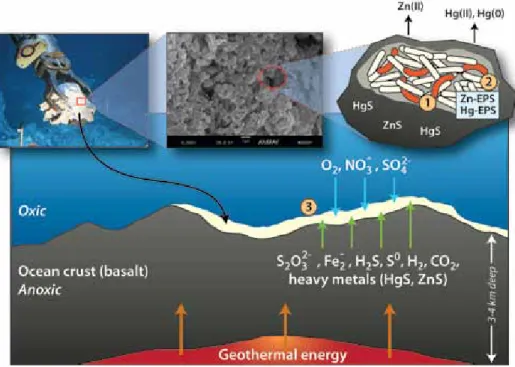
López-García et al., 2003; Alain et al., 2004). Based on current knowledge, the microorganisms that colonize deep-sea vents are expected to be able to adhere to solid substrates (to better access nutrients in these highly turbulent envi- ronments), to be metabolically versatile (to take advantage of the dynamic redox gradients typical of these environments) and, possibly, to use detoxification mech- anisms that allow them to survive in an environment where concentrations of many heavy metals (e.g., Cu, Zn, Fe, Cd, Pb, Hg) and other chemicals frequently exceed levels normally considered toxic to organisms (Figure 2).
However, the relevance of biofilm-
forming vs. free-swimming microbes has
not been investigated. It is reasonable to
hypothesize that attachment and forma-
tion of biofilms on native basalt in close
proximity to vent emissions provides
microorganisms with continuous access
to reduced compounds used in energy-
yielding processes (e.g., hydrogen sulfide
in hydrothermal fluids; McCollom
and Shock, 1997). In contrast, free-
swimming bacteria contained in the
fluids are advected into the surrounding
water column, and thus away from their energy sources. In mildly oxidizing hydrothermal fluids, sulfur compounds are known to bind heavy metals, in turn reducing their bioavailability and toxicity (Von Damm, 1990, 1995). However, heavy metals may be mobilized and/or detoxified by microbial activities medi- ated by genetically encoded functions (Vetriani et al., 2005) and, possibly, by biosorption to the biofilm matrix (with implications for biomineralization processes). Overall, such detoxifica- tion mechanisms are consistent with the elevated concentrations of heavy metals (e.g., Hg up to 88.7 ng L
–1at the Tica site on the EPR) and high relative abundances of mercury- resistant bacteria that we measured in diffuse flow fluids at 9°N on the EPR (Crespo-Medina et al., 2009a).
The recent availability of genome sequences from chemoautotrophic vent organisms is revealing interesting functions related to the establishment of biofilms. For instance, we know that several genes involved in the biosynthesis of exopolysaccharides and in quorum sensing mechanisms are encoded in the genomes of four sulfur metabolizing Epsilonproteobacteria known to colonize vent environments:
Caminibacter mediatlanticus (Govannelli et al., 2011), Nautilia profundicola (Campbell et al., 2009), Sulfurovum sp., and Nitratiruptor sp. (Nakagawa et al., 2007). Author Vetriani, Ileana Pérez- Rodriguez, and Jessica Ricci have obtained preliminary data demonstrating that pure cultures of C. mediatlanticus and Sulfurovum sp. express quorum- sensing-related genes during growth, and that these genes are also expressed in situ by the biofilm communities.
These findings are in line with a study that showed a link among biofilm forma- tion, exopolysaccharide synthesis, and quorum sensing in a hyperthermophilic bacterium (Johnson et al., 2005). We are currently applying transcriptomic and proteomic techniques in conjunc- tion with geochemical measurements, thermodynamic modeling, and carefully designed experiments in order to shed light on the hypothesized processes described above.
Future DireCtioN aND ChaLLeNgeS—
a Path ForwarD
To achieve a better understanding of the fluxes of energy and matter at deep-sea vents and to characterize the microbially catalyzed processes underlying these
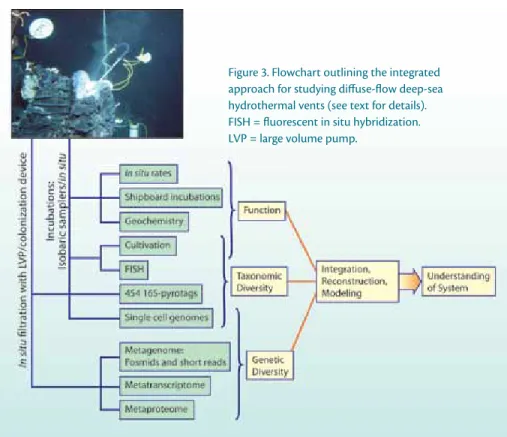
transformations requires an integrated approach that couples an assessment of taxonomic diversity using cultivation- dependent and -independent approaches with methodologies addressing genetic diversity, including (1) metagenomics (genetic potential and diversity of a community), (2) single-cell genomics (genetic potential and diversity of uncultured single cells), (3) metatran- scriptomics, and (4) metaproteomics (identification and function of active community members; realized poten- tial of the community). To assess the functional component, these approaches can be combined with (1) measure- ment of in situ rates of chemoauto- trophic productivity, (2) geochemical characterization of microbial habitats, and (3) shipboard incubations under
Figure 2. Diagram of a hypothetical basalt-colonizing microbial community at the oxic/anoxic inter- face of a diffuse flow vent. (1) a low-complexity community of chemosynthetic (straight, abundant) and heterotrophic (curved and red, sparse) bacteria attach to the basalt and establish a biofilm. when chemosynthetic bacteria oxidize sulfur species, they mobilize heavy metals, increasing their toxicity.
(2) Bacteria in biofilms produce ePSs (extracellular polymeric substances), which sequester heavy metals, reducing their toxicity. heterotrophic bacteria actively detoxify heavy metals. (3) Colonizing bacteria are metabolically versatile and can use multiple energy sources and terminal electron accep- tors. Figure not drawn to scale.
simulated in situ conditions (hypothesis testing under controlled conditions).
The integration of laboratory and field experiments in combination with a suite of cutting-edge analytical techniques, including analyses at the single-cell level, in a hypothesis-driven study of microbial processes will create unprecedented opportunities that will lead to a better understanding of the functioning of deep-sea vent microbial communities and the constraints regulating interac- tions between microbes and their abiotic and biotic environments (Figure 3).
A major challenge will be integrating and synthesizing the massive amount of generated data to reconstruct and simulate the metabolic network of the microbial communities contained in the vent fluids and to gather a compre- hensive understanding of the system.
However, methods have been developed for the integrated study of individual
genomes that can be adapted to the whole community (e.g., Covert et al., 2001, 2004; Stolyar et al., 2007; Zhang et al., 2009; Feist et al., 2009). In such an approach, the community-specific
“-omics” data can be linked to geochem- ical and physicochemical data to identify the pathways responsible for the adapta- tion of microbial communities to specific environmental conditions. In addition, metabolic simulation can be combined with environmental data to mimic the carbon and energy production of single cells, with the simulation possibly extending to the community level toward understanding and predicting carbon and energy transfers among different organisms. Flux balance analysis (Raman and Chandra, 2009) can be further adapted to simulate biomass genera- tion and reaction fluxes at the scale of community-level metabolic networks, and the simulation results can be
compared with experimental data to help identify knowledge gaps and improve our understanding of the key pathways in a number of processes, including biofilm formation.
It is an exciting time in this field because we are now in a position to connect the early days of deep-sea vent research, when there was greater focus on rate measurements, with the present focus on assessing microbial diversity.
Now is the time to combine the presently available powerful “omic” and single-cell tools with thermodynamic modeling, experimental approaches, and new in situ instrumentation to measure rates and concentrations. The overarching goal is to bring our understanding of these truly fascinating ecosystems to a new level and to place them in a quantitative frame- work and thus a larger global context.
aCKNowLeDgeMeNtS This review was written with support from NSF grants OCE-1136727,
OCE-1038131, and OCE-1131095 (SMS) and OCE-1136451 (CV). Research mentioned in the review that was carried out in the labs of CV and SMS was supported by NSF grants MCB-0843678 (CV) and OCE-0452333 (SMS). We would like to thank Nadine Le Bris, Dionysis Foustokous, Niculina Musat, Jeremy Rich, Thomas Schweder, Jeff Seewald, Ramunas Stepanauskas, Craig Taylor, Fengping Wang, and Ying Zhang with whom we are pursuing research outlined in this review and who generously shared their ideas. We also thank Carl Wirsen for his inspira- tion and for critically proofreading the manuscript, Jack Cook for help with preparing the figures, and Ellen Kappel and Vicky Cullen for editorial help.
Figure 3. Flowchart outlining the integrated approach for studying diffuse-flow deep-sea hydrothermal vents (see text for details).
FiSh = fluorescent in situ hybridization.
LVP = large volume pump.
reFereNCeS
Alain, K., N. Callac, M. Guegan, F. Lesongeur, P. Crassous, M.A. Cambon-Bonavita, J. Querellou, and D. Prieur. 2009. Nautilia abyssi sp. nov., a thermophilic, chemolithoau- totrophic, sulfur-reducing bacterium isolated from an East Pacific Rise hydrothermal vent. International Journal of Systematic and Evolutionary Microbiology 59:1,310–1,315, http://dx.doi.org/10.1099/ijs.0.005454-0.
Alain, K., A. Postec, E. Grinsard, F. Lesongeur, D. Prieur, and A. Godfroy. 2010.
Thermodesulfatator atlanticus sp. nov., a thermophilic, chemolithoautotrophic, sulfate-reducing bacterium isolated from a Mid-Atlantic Ridge hydrothermal vent.
International Journal of Systematic and Evolutionary Microbiology 60:33–38, http://
dx.doi.org/10.1099/ijs.0.009449-0.
Alain, K., J. Querellou, F. Lesongeur, P. Pignet, P. Crassous, G. Raguenes, V. Cueff, and M.A. Cambon-Bonavita. 2002. Caminibacter hydrogeniphilus gen. nov., sp nov., a novel thermophilic, hydrogen-oxidizing bacterium isolated from an East Pacific Rise hydrothermal vent. International Journal of Systematic and Evolutionary Microbiology 52:1,317–1,323, http://dx.doi.org/10.1099/ijs.0.02195-0.
Alain, K., S. Rolland, P. Crassous, F. Lesongeur, M. Zbinden, C. Le Gall, A. Godfroy, A. Page, S.K. Juniper, M.A. Cambon-Bonavita, and others. 2003. Desulfurobacterium crinifex sp.
nov., a novel thermophilic, pinkish-streamer forming, chemolithoautotrophic bacterium isolated from a Juan de Fuca Ridge hydro- thermal vent and amendment of the genus Desulfurobacterium. Extremophiles 7:361–370.
Alain, K., M. Zbinden, N. Le Bris, F. Lesongeur, J. Querellou, F. Gaill, and M.A. Cambon- Bonavita. 2004. Early steps in micro- bial colonization processes at deep-sea hydrothermal vents. Environmental Microbiology 6:227–241, http://
dx.doi.org/10.1111/j.1462-2920.2003.00557.x.
Amend, J.P., and E.L. Shock. 2001. Energetics of overall metabolic reactions of thermophilic and hyperthermophilic Archaea and bacteria.
FEMS Microbiology Review 25:175–243, http://
dx.doi.org/10.1111/j.1574-6976.2001.tb00576.x.
Amend, J.P., T.M. McCollom, M. Hentscher, and W. Bach. 2011. Catabolic and anabolic energy for chemolithoautotrophs in deep-sea hydrothermal systems hosted in different rock types. Geochimica et Cosmochimica Acta 75:5,736–5,748, http://
dx.doi.org/10.1016/j.gca.2011.07.041.
Bach, W., K.J. Edwards, J.M. Hayes, J.A. Huber, S.M. Sievert, and M.L. Sogin. 2006. Energy in the dark: Fuel for life in the deep ocean and beyond. Eos, Transactions, American Geophysical Union 87(7):73, http://dx.doi.
org/10.1029/2006EO070002.
Blöchl, E., R. Rachel, S. Burggraf, D. Hafenbradl, H.W. Jannasch, and K.O. Stetter. 1997.
Pyrolobus fumarii, gen. and sp. nov., repre- sents a novel group of archaea, extending the upper temperature limit for life to 113 degrees C. Extremophiles 1:14–21, http://
dx.doi.org/10.1007/s007920050010.
Brazelton, W.J., and J.A. Baross. 2009.
Abundant transposases encoded by the metagenome of a hydrothermal chimney biofilm. ISME Journal 3:1,420–1,424, http://
dx.doi.org/10.1038/ismej.2009.79.
Brazelton, W.J., and J.A. Baross. 2010. Metagenomic comparison of two Thiomicrospira lineages inhabiting contrasting deep-sea hydro- thermal environments. PLoS One 5:8, http://
dx.doi.org/10.1371/journal.pone.0013530.
Butterfield, D.A., K.K. Roe, M.D. Lilley, J.A. Huber, J.A. Baross, R.W. Embley, and G.J. Massoth.
2004. Mixing, reaction and microbial activity in the sub-seafloor revealed by temporal and spatial variation in diffuse flow vents at Axial Volcano. Pp. 269–289 in Subseafloor Biosphere at Mid-Oceanic Ridges. W.S.D. Wilcock, E.F. DeLong, D.S. Kelley, J.A. Baross, and S.C. Cary, eds, Geophysical Monograph Series, vol. 144, American Geophysical Union, Washington, DC.
Campbell, B.C., A.S. Engel, M.L. Porter, and K. Takai. 2006. The versatile ε−proteobacteria:
Key players in sulphidic habitats. Nature Reviews Microbiology 4:458–468, http://dx.doi.
org/10.1038/nrmicro1414.
Campbell, B.J., C. Jeanthon, J.E. Kostka, G.W. Luther III, and S.C. Cary. 2001.
Growth and phylogenetic properties of novel bacteria belonging to the epsilon subdivi- sion of the proteobacteria enriched from Alvinella pompejana and deep-sea hydro- thermal vents. Applied and Environmental Microbiology 67:4,566–4,572, http://
dx.doi.org/10.1128/AEM.67.10.4566-4572.2001.
Campbell, B.J., J.L. Smith, T.E. Hanson, M.G. Klotz, L.Y. Stein, C.K. Lee, D. Wu, J.M. Robinson, H.M. Khouri, J.A. Eisen, and S.C. Cary. 2009.
Adaptations to submarine hydrothermal environments exemplified by the genome of Nautilia profundicola. PLoS Genetics 5:e1000362, http://dx.doi.org/10.1371/journal.
pgen.1000362.
Corliss, J.B., J. Dymond, L.I. Gordon,
J.M. Edmond, R.P. von Herzen, R.D. Ballard, K. Green, D. Williams, A. Bainbridge, K. Crane, and T.H. von Andel. 1979.
Submarine thermal springs on the Galapagos Rift. Science 203:1,073–1,083, http://
dx.doi.org/10.1126/science.203.4385.1073.
Covert, M.W., E.M. Knight, J.L. Reed, M.J. Herrgard, and B.O. Palsson. 2004.
Integrating high-throughput and compu- tational data elucidates bacterial networks.
Nature 429:92–96, http://dx.doi.org/10.1038/
nature02456.
Covert, M.W., C.H. Schilling, I. Famili, J.S. Edwards, I.I. Goryanin, E. Selkov, and B.O. Palsson. 2001. Metabolic modeling of microbial strains in silico. Trends in Biochemical Sciences 26:179–186, http://dx.doi.org/10.1016/
S0968-0004(00)01754-0.
Crespo-Medina, M., A.D. Chatziefthimiou, N.S. Bloom, G.W. Luther, J.R. Reinfelder, C. Vetriani, and T. Barkay. 2009a. Adaptation of chemosynthetic microorganisms to elevated mercury concentrations in deep-sea hydrothermal vents. Limnology and Oceanography 54:41–49, http://
dx.doi.org/10.4319/lo.2009.54.1.0041.
Crespo-Medina, M., A. Chatziefthimiou, R. Cruz- Matos, I. Pérez-Rodriguez, T. Barkay, R.A. Lutz, V. Starovoytov, and C. Vetriani. 2009b.
Salinisphaera hydrothermalis sp. nov., a meso- philic, halotolerant, facultatively autotrophic, thiosulfate-oxidizing gammaproteobacterium from deep-sea hydrothermal vents, and emended description of the genus Salinisphaera.
International Journal of Systematic and Evolutionary Microbiology 59:1,497–1,503, http://dx.doi.org/10.1099/ijs.0.005058-0.
DeLong, E.F. 2009. The microbial ocean from genomes to biomes. Nature 459:200–206, http://
dx.doi.org/10.1038/nature08059.
DeLong, E.F., C.M. Preston, T. Mincer, V. Rich, S.J. Hallam, N.-U. Frigaard, A. Martinez, M.B. Sulivan, R. Edwards, B. Rodriguez Brito, and others. 2006. Community genomics among stratified microbial assemblages in the ocean’s interior. Science 311:496–503, http://
dx.doi.org/10.1126/science.1120250.
Durand, P., A.-L. Reysenbach, D. Prieur, and N.R. Pace. 1993. Isolation and characteriza- tion of Thiobacillus hydrothermalis sp. nov., a mesophilic obligately chemolithotrophic bacterium isolated from a deep-sea hydro- thermal vent in the Fiji Basin. Archives of Microbiology 159:39–44.
Eloe, E.A., D.W. Fadrosh, M. Novotny, L.Z. Allen, M. Kim, M.J. Lombardo, J. Yee-Greenbaum, S. Yooseph, E.E. Allen, R. Lasken, and others. 2011. Going deeper:
Metagenome of a hadopelagic microbial community. PLoS One 6(5):e20388, http://
dx.doi.org/10.1371/journal.pone.0020388.
Feist, A.M., M.J. Herrgard, I. Thiele, J.L. Reed, and B.O. Palsson. 2009. Reconstruction of biochemical networks in microorganisms.
Nature Reviews Microbiology 7:129–143, http://
dx.doi.org/10.1038/nrmicro1949.
Flores, G.E., J.H. Campbell, J.D. Kirshtein, J. Meneghin, M. Podar, J.I. Steinberg, J.S. Seewald, M.K. Tivey, M.A. Voytek, Z.K. Yang, and A.L. Reysenbach. Microbial community structure of hydrothermal deposits from geochemically different vent fields along the Mid-Atlantic Ridge. Environmental Microbiology 13:2,158–2,171, http://
dx.doi.org/10.1111/j.1462-2920.2011.02463.x.
Foustoukos, D.I., J.L. Houghton, W.E. Seyfried Jr., S.M. Sievert, and G.D. Cody. 2011. Kinetics of H2-O2-H2O redox equilibria and formation of metastable H2O2 under low temperature hydrothermal conditions. Geochemica et Cosmochimica Acta 75:1,594–1,607, http://
dx.doi.org/10.1016/j.gca.2010.12.020.
Gardebrecht, A., S. Markert, S.M. Sievert, H. Felbeck, A.Thürmer, D. Albrecht,
A. Wollherr, J. Kabisch, N. Le Bris, R. Lehmann, and others. 2011. Physiological homoge- neity among the endosymbionts of Riftia pachyptila and Tevnia jerichonana revealed by proteogenomics. The ISME Journal, http://
dx.doi.org/10.1038/ismej.2011.137.
Gilbert, J.A., and C.L. Dupont. 2011.
Microbial metagenomics: Beyond the genome. Annual Review in Marine Science 3:347–371, http://dx.doi.org/10.1146/
annurev-marine-120709-142811.
Giovannelli, D., S. Ferriera, J. Johnson, S. Kravitz, I. Pérez-Rodriguez, J. Ricci, C. O’Brien, J.W. Voordeckers, E. Bini, and C. Vetriani.
2011. Draft genome sequence of Caminibacter mediatlanticus strain TB-2T, an epsiloproteobac- terium isolated from a deep-sea hydrothermal vent. Standards in Genomic Science 5:135–143, http://dx.doi.org/10.4056/sigs.2094859.
Götz, D., A. Banta, T.J. Beveridge, A.I. Rushdi, B.R.T. Simoneit, and A. Reysenbach. 2002.
Persephonella marina gen. nov., sp nov. and Persephonella guaymasensis sp nov., two novel, thermophilic, hydrogen- oxidizing microaerophiles from deep-sea hydrothermal vents. International Journal of Systematic and Evolutionary Microbiology 52:1,349–1,359, http://dx.doi.org/10.1099/ijs.0.02126-0.
Grzymski, J.J., A.E. Murray, B.J. Campbell, M. Kaplarevic, G.R. Gao, C. Lee, R. Daniel, A. Ghadiri, R.A. Feldman, and S.C. Cary. 2008.
Metagenome analysis of an extreme microbial symbiosis reveals eurythermal adaptation and metabolic flexibility. Proceedings of the National Academy of Sciences of the United States of America 105:17,516–17,521, http://
dx.doi.org/10.1073/pnas.0802782105.
Holden, J.F., J.A. Breier, K.L. Rogers, M.D. Schulte, and B.M. Toner. 2012. Biogeochemical processes at hydrothermal vents: Microbes and minerals, bioenergetics, and carbon fluxes. Oceanography 25(1):196–208, http://
dx.doi.org/10.5670/oceanog.2012.18.
Houghton, J.L., and W.E. Seyfried Jr.
2010. An experimental and theoretical approach to determining linkages between geochemical variability and microbial biodiversity in seafloor hydrothermal chimneys. Geobiology 8:457–470, http://
dx.doi.org/10.1111/j.1472-4669.2010.00255.x.
Houghton, J.L., W.E. Seyfried Jr., A.B. Banta, and A.-L. Reysenbach. 2007. Continuous enrichment culturing of thermophiles under sulfate and nitrate-reducing
conditions and at deep-sea hydrostatic pres- sures. Extremophiles 11:371–382, http://
dx.doi.org/10.1007/s00792-006-0049-7.
Huber, H., S. Burggraf, T. Mayer, I. Wyschkony, R. Rachel, and K.O. Stetter. 2000. Ignicoccus gen. nov., a novel genus of hyperthermophilic, chemolithoautotrophic Archaea, represented by two new species, Ignicoccus islandicus sp nov and Ignicoccus pacificus sp nov. International Journal of Systematic and Evolutionary Microbiology 6:2,093–2,100.
Huber, J.A., D.A. Butterfield, and J.A. Baross. 2003.
Bacterial diversity in a subseafloor habitat following a deep-sea volcanic eruption. FEMS Microbiology Ecology 43:393–409, http://
dx.doi.org/10.1111/j.1574-6941.2003.tb01080.x.
Huber, H., H.W. Jannasch, R. Rachel, T. Fuchs, and K.O. Stetter. 1997. Archaeoglobus veneficus sp.
nov., a novel facultative chemolithoautotrophic hyperthermophilic sulfite reducer, isolated from abyssal black smokers. Systematic and Applied Microbiology 20:374–380, http://
dx.doi.org/10.1016/S0723-2020(97)80005-7.
Huber, J.A., D.B. Mark Welch, H.G. Morrison, S.M. Huse, P.R. Neal, D.A. Butterfield, and M.L. Sogin. 2007. Microbial population structures in the deep marine biosphere.
Science 318:97–100, http://dx.doi.org/10.1126/
science.1146689.
Hügler, M., and S.M. Sievert. 2011. Beyond the Calvin Cycle: Autotrophic carbon fixa- tion in the ocean. Annual Review of Marine Science 3:261–289, http://dx.doi.org/10.1146/
annurev-marine-120709-142712.
Hügler, M., J.M. Petersen, N. Dubilier, J.F. Imhoff, and S.M. Sievert. 2011. Pathways of carbon and energy metabolism of the epibiotic community associated with the deep- sea hydrothermal vent shrimp Rimicaris exoculata. PLoS One 6(1):e16018, http://
dx.doi.org/10.1371/journal.pone.0016018.
Inagaki, F., K. Takai, H. Kobayashi, K.H. Nealson, and K. Horikoshi. 2003. Sulfurimonas autotro- phica gen. nov., sp. nov., a novel sulfur-oxidizing epsilon-proteobacterium isolated from hydrothermal sediments in the Mid-Okinawa Trough. International Journal of Systematic and Evolutionary Microbiology 53:1,801–1,805, http://dx.doi.org/10.1099/ijs.0.02682-0.
Inagaki, F., K. Takai, K.H. Nealson, and K. Horikoshi. 2004. Sulfurovum lithotro- phicum gen. nov., sp. nov., a novel sulfur- oxidizing chemolithoautotroph within the ε-Proteobacteria isolated from Okinawa Trough hydrothermal sediments. International Journal of Systematic and Evolutionary Microbiology 54:1,477–1,482, http://
dx.doi.org/10.1099/ijs.0.03042-0.
Jannasch, H.W. 1985. The chemosynthetic support of life and the microbial diversity at deep-sea hydrothermal vents. Proceedings of the Royal Society of London B 225:277–297, http://
dx.doi.org/10.1098/rspb.1985.0062.
Jannasch, H.W. 1995. Microbial interactions with hydrothermal fluids. Pp. 273–296 in Seafloor Hydrothermal Systems. S.E. Humphris, R.A. Zierenberg, L.S. Mullineaux, and R.E. Thomson, eds, Geophysical Monograph Series, vol. 91, American Geophysical Union, Washington, DC.
Jannasch, H.W., and M.J. Mottl. 1985.
Geomicrobiology of deep-sea hydro- thermal vents. Science 229:717–725, http://
dx.doi.org/10.1126/science.229.4715.717.
Jannasch, H.W., and C.D. Taylor. 1984.
Deep-sea microbiology. Annual Review of Microbiology 38:487–514, http://dx.doi.org/10.1146/annurev.
mi.38.100184.002415.
Jannasch, H.W., and C.O. Wirsen. 1979.
Chemosynthetic primary production at East Pacific sea floor spreading centers.
Bioscience 29:592–598.
Jannasch, H.W., and C.O. Wirsen. 1981.
Morphological survey of microbial mats near deep-sea thermal vents. Applied and Environmental Microbiology 41:528–538.
Jannasch, H.W., C.O. Wirsen, D.C. Nelson, and L.A. Robertson. 1985. Thiomicrospira crunogena sp. nov., a colorless sulfur- oxidizing bacterium from a deep-sea hydrothermal vent. International Journal of Systematic Bacteriology 35:422–424, http://
dx.doi.org/10.1099/00207713-35-4-422.
Jeanthon, C., S. L’Haridon, V. Cueff, A. Banta, A.L. Reysenbach, and D. Prieur. 2002.
Thermodesulfobacterium hydrogeniphilum sp nov., a thermophilic, chemolithoau- totrophic, sulfate-reducing bacterium isolated from a deep-sea hydrothermal vent at Guaymas Basin, and emendation of the genus Thermodesulfobacterium.
International Journal of Systematic and Evolutionary Microbiology 52:765–772, http://
dx.doi.org/10.1099/ijs.0.02025-0.
Johnson, M.R., C.I. Montero, S.B. Conners, K.R. Shockley, S.L. Bridger, and R.M. Kelly.
2005. Population density-dependent regulation of exopolysaccharide formation in the hyper- thermophilic bacterium Thermotoga maritima.
Molecular Microbiology 55:664–674, http://
dx.doi.org/10.1111/j.1365-2958.2004.04419.x.
Karl, D.M. 1995. Ecology of free-living, hydro- thermal vent microbial communities.
Pp. 35–124 in Microbiology of Deep-Sea Hydrothermal Vents. D.M. Karl, ed., CRC Press, Boca Raton, FL.
Kashefi, K., and D.R. Lovley. 2003. Extending the upper temperature limit for life.
Science 301:934, http://dx.doi.org/10.1126/
science.1086823.
Kashefi, K., J.M. Tor, D.E. Holmes, C.V. Gaw Van Praagh, A.L. Reysenbach, and D.R. Lovley.
2002. Geoglobus ahangari gen. nov., sp.
nov., a novel hyperthermophilic archaeon capable of oxidizing organic acids and growing autotrophically on hydrogen with