• 検索結果がありません。

Foreign Direct Investment into Mongolia

N/A
N/A
Protected

Academic year: 2021

シェア "Foreign Direct Investment into Mongolia"

Copied!
11
0
0

読み込み中.... (全文を見る)

全文

(1)

Foreign Direct Investment into Mongolia

Christopher MacDougall*

Abstract

Awakened by the diminishing influence of the Soviet Union, Mongolia experienced its own revolution between 1990 and 1991. The following decade brought significant political, social, and economic change. Not the least of which was the introduction of foreign capital into the domestic economy. Targeted investment aimed at expanding Mongolia’s nascent mineral resources sector propelled the economy forward, making it one of the fastest growing in the world between 2009 and 2012.

This paper examines the impact of foreign investment on Mongolia’s economy and discusses the challenges of investing and doing business in a post-soviet nation. Comparing historic and modern influences, an assessment of external factors is also presented. Special attention has been given to Mongolia’s mineral resources sector, the influence of mineral resource demand in China, and the changing dynamics of domestic politics. While Mongolia’s future is dependent on a number of internal and external factors, these three offer the greatest opportunities and the greatest challenges for Mongolia as it strives to reach its full potential.

Keywords: Mongolia, foreign investment, natural resource investing, Mongolian investment Opportunities, and Northeast Asia

Introduction

Tightly bound between the region’s largest economic and political powers, Mongolia’s geographic position presents a variety of challenges and opportunities. With the economic and political relationship between Russia and China becoming ever closer, Mongolia stands to benefit from increased trade and interdependence. Likewise, proximity to the largest consumer of industrial commodities in the world is, in itself, a major catalyst for the attraction of foreign investment into Mongolia.

Weakening sentiment for commodities globally, in particular copper and coal, has burdened Mongolia’s growth trajectory. So to have, increasing concerns of China’s economic performance.

Mongolia’s economy is almost entirely dependent on the export of industrial commodities to China and is therefore easily swayed by shifting sentiment towards either. However, internal factors have also played a significant role in Mongolia’s ability to attract foreign direct investment to the country. In particular, poor legislative decisions in 2012 and 2013 have driven foreign investors away, fearing that new legislation would discriminate against foreigners.

Mongolia has since introduced a number of positive changes to mining and investment legislation. This has included a renewed investment law, a new mining law and policy, and new governing bodies aimed at attracting further foreign investment into the country. However, the continued slide in commodities globally and increasing concerns over China have undermined any positive developments by the Mongolian government. That said, the slightest change in investor sentiment towards either commodities and/or China’s economic growth could provide a significant catalyst for the attraction of foreign direct investment into Mongolia’s economy.

This article discusses Mongolia’s prospects as a destination for foreign investment and the

impact of both internal and external factors. In Chapter 1 an overview of Mongolia’s political and

(2)

economic developments are presented. Chapter 2 focuses on the current state of foreign direct investment into Mongolia, the role that legislative and macro issues have played in attracting foreign direct investment, and the future outlook for foreign direct investment. The potential for foreign direct investment into Mongolia is then discussed in the Conclusion.

1 The Current State of Mongolia’s Government and Economy and the Importance of Russia and China

1.1 The Current State of Mongolia’s Government and Economy 1.1.1 The Changing Face of Mongolian Politics

For nearly seventy years, Mongolia’s political leadership embraced the doctrine of the Soviet Union. This lasted until the final moments of 1989 when, now President, Elbegdorj Tsakhiahiin, announced the creation of the Mongolian Democratic Union during the first open political protest in Ulaanbaatar, Mongolia’s capital city. This marked the beginning of Mongolia’s Democratic Revolution, bringing about the first true reforms to the country. Changes to the constitution, the introduction of multi-party elections, and a reduced military presence by the USSR soon followed and contributed to a new constitution being adopted in 1992. This would lay the groundwork for Mongolia’s economic reform, the expansion of industry and the attraction of foreign investment.

Between 1992 and 2009, contrary to the rest of the former Soviet Union, Mongolia enjoyed free and open democratic elections. Legislation was introduced that supported the attraction of foreign investment and development of key sectors, which led to an inflow of foreign direct investment. During this period, a number of key political figures emerged, forming multiple political parties and special interest groups to represent the varied needs of the Mongolian public and the Mongolian business community.

Modern day Mongolia enjoys open and democratic elections. There are five political parties that make up the State Great Hural, Mongolia’s Parliamentary body. These include the Mongolian Peoples’ Revolutionary Party, the Mongolian Peoples’ Party, the Mongolian National Democratic Party, the Democratic Party of Mongolia, and the Civil Will-Green Party.

In the most recent Parliamentary elections, held in June 2012, the Democratic Party of Mongolia, under the leadership of Norovyn Altankhuyag, won 34 out of the available 76 seats in Parliament. The Democratic Party then formed a coalition government with the Mongolian Peoples’ Revolutionary Party. In 2014, Prime Minister Altankhuyag Norovyn lost a no- confidence vote and was replaced by Prime Minister Saikhanbileg Chimediin. Saikhanbileg remains the Prime Minister of Mongolia today but has faced numerous challenges to his leadership and control of Parliament. His major task as Prime Minister has been to reinvigorate foreign direct investment into Mongolia, a challenging task given the global macro environment and diminishing state of commodities prices globally. However, in his time as Prime Minister, he has secured the second phase of development for Oyu Tolgoi, the nation’s largest investment project and has helped to increase sentiment among foreign investors active in the country.

Most Mongolia observers believe that Saikhanbileg has performed well in his duties of

promoting Mongolia to foreign investors. However, there is a growing expectation that the

(3)

Democratic Party will not be able to maintain their position in Parliament in the upcoming 2016 Parliamentary elections. This is largely due to the worsening economic conditions the people of Mongolia have endured since the Democratic Party assumed leadership in 2012. This is concerning given the drastic change in policy experienced during the transition from the Mongolian Peoples’ Revolutionary Party government and the now Democratic Party government in 2012. Investors now expect that any change in government will likely result in a prolonged period of political and legislative uncertainty.

1.1.2 The Changing Tides of the Mongolian Economy

The Mongolian economy has transformed drastically over the last century. As recent as the early 1900’s, Mongolian economic activity was limited to a decentralized system of nomadic herders. The political, social, and economic changes introduced during the period of Soviet influence changed the foundation of economic activity in Mongolia. Across three key periods, Soviet-influenced Mongolian leaders introduced collectivization of livestock, cooperatives, and industrialization.

The first of these periods was known as the period of “General Transformation”, which lasted from 1921 to 1939. The following period, known as the period of the “Construction of Socialism” last from 1940 to 1960. Lastly, the period titled the “Completion of Construction of Material and Technical Basis of Socialism” lasted from 1961 up until the transition to a market economy in 1991.

During these three periods of Soviet influence, Mongolia’s economic activity transformed to include centralized production, agriculture planning and technology, the development of infrastructure and fixed abodes, and a significant expansion on mining, the processing of timber and the production of consumer goods. These changes provided the foundation from which the modern-day Mongolian economy has been built.

Today, in addition to being largely dictated by market activities Mongolia’s economy is far more diversified than it was during the period of Soviet influence. Still, the largest segment of the economy and the majority of foreign direct investment that is entering the country continue to revolve around Mongolia’s vast mineral resources. This is the reality for many developing nations, especially those with large endowments of mineral resources. For Mongolia, similar to other resource-rich nations, this dependence on mineral resources has made it difficult to achieve sustained growth. And, as has been demonstrated over the past two decades, has made the Mongolian economy especially vulnerable to boom-bust cycles.

The macro-economic pressures that exist outside of Mongolia’s control, such as commodities prices globally and demand factors also play a large role in the determination of the country’s success and likewise the attractiveness of Mongolia as a destination for foreign direct investment. Furthermore, mineral resource extraction requires significant upfront investment in order to achieve the financial gains that mineral wealth offers. This, in itself, can be an insurmountable challenge for a burgeoning economy with limited domestic capital to finance projects that aim to compete on a global scale.

Nevertheless, the Mongolian economy has expanded steadily as a result of increasing

investment into the domestic mineral resources sector. This expansion has not only been

contained to mineral resources but has also resulted in an expected spill-over effect to other

sectors. For example, the influx of foreign capital and the development of the domestic

(4)

mining sector has spurred the development of mining services sector, real estate and increased discretionary spending amongst the local population. This, in turn, has led to a more diversified and burgeoning consumer goods sector, increasing quality and availability of food and beverage services, and the introduction of a variety of luxury international brands.

The result of expanded service sector, combined with higher discretionary spending, is a growing consumer appetite and expanding economy. Between 2005 and 2013, the Mongolia’s Gross Domestic Product grew steadily by over US$10 billion, from US$2,523,471,602 in 2005 to US$12,545,217,934 in 2013. The table below shows the values that have been verified by the World Bank Group, detailing Mongolia’s Gross Domestic Product during the period described above. This illustrates the immense growth that Mongolia has experienced over the past decade and, when reviewed in conjunction with foreign direct investment figures, discussed below, provides a detailed illustration on the nation’s experience and challenges.

Figure 1: Gross Domestic Product (Current US$)

2 The Current State and Future Outlook for Foreign Direct Investment into Mongolia

2.1 The Current State of Foreign Direct Investment into Mongolia 2.1.1 Legislative and Free Market Missteps and Corrections

The current state of foreign direct investment into Mongolia has been dictated by both internal and external factors. Internally, Mongolia’s political leadership has made several crucial missteps resulting in a drastic decrease in foreign direct investment in the past three years. These have included the introduction and acceptance of several new or amended pieces of legislation that directly contradicted the interest of foreign investors and foreign companies.

One of the most publicly criticised pieces of legislation was the Strategic Entities Foreign Investment Law that was passed in 2012. This piece of legislation governed investment by foreign parties into sectors of the Mongolian economy deemed to be “strategic” by the Mongolian government. More specifically, the law required government approval before any

Source: World Bank Group, Data Bank -

2,000,000,000.00 4,000,000,000.00 6,000,000,000.00 8,000,000,000.00 10,000,000,000.00 12,000,000,000.00 14,000,000,000.00

2005 2006 2007 2008 2009 2010 2011 2012 2013 2014

(5)

foreign investment above 33% could be made into a domestic company that was active in a strategic sector. The sectors identified as strategic by the Mongolian government included telecommunications, banking, finance, and mining. Later in 2012, additional proposed changes to Mongolia’s mining law shocked foreign investors and disrupted several mining operations that had been steadily growing and expanding around the country. At the root of the proposed change was a proposal whereby foreign companies would be required to reduce their stakes in current projects to ensure 34% of mining projects were held and controlled by domestic companies.

This law was not passed and was heavily amended before being presented again. However, the proposal had already sent shockwaves through the foreign investment community, damaging investor sentiment and negatively impacting perceptions surrounding Mongolia’s mining sector and investment climate

Furthermore, there have been several engagements between the Mongolian government and foreign companies that have resulted in concerns among foreign investors and foreign companies over the willingness of the Mongolian government to provide fair and equal commercial terms to foreigners doing business in Mongolia. Examples include the highly publicised blockage by the Mongolian government of an attempt by Aluminium Corporation of China Ltd., a Chinese state owned enterprise, to acquire the publically listed Canadian company, SouthGobi Resources Ltd. In addition, the Mongolian government’s failure to comply with an international arbitration award to Canadian listed Khan Resources Inc. after the company had its uranium licenses revoked and handed to Russian uranium producer AtomRed MetZoloto Uranium Holding Co also gave rise to investor concerns.

The Mongolian government has also been criticised for their liberal use of travel bans on foreign citizens while failing to follow due process. The most high profile instance of such actions was the ban on three SouthGobi Resources Ltd. employees after the company was charged for tax evasion. The exit ban extended to the Chief Executive Officer of the company, a US citizen, who had not been formally charged. Following over two years of being unable to leave the country, the SouthGobi Resources Ltd.’s employees were sentenced to five years in prison. One month after their sentencing, the President of Mongolia pardoned the employees and they were allowed to leave the country. However, the damage that this and other highly publicised cases had caused on Mongolia’s international image had already been caused.

The resulting pressure from such internal missteps such as those described above, led to a sharp decline in the confidence in the Mongolian government by foreign investors. Coupled with restrictions on the availability of domestic capital, the mining sector quickly saw the impact of declining foreign direct investment into the economy.

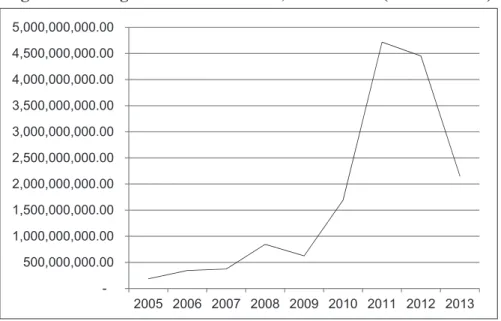
Overall, Mongolia has had varying success at attracting foreign direct investment in the past

decade. Between 2005 and 2011, the amount of foreign direct investment that entered Mongolia

increased steadily, from US$184,600,000 in 2005 to US$4,717,590,841 in 2011. Since 2011, as a

result of the issues described above, the amount of foreign direct investment entering the country

has been decreasing to US$4,451,761,799 in 2012 and US$2,150,897,062 in 2013. The table

below shows the values that have been verified by the World Bank Group, detailing Mongolia’s

success and failure at attracting foreign investment during the period described above.

(6)

Figure 2: Foreign Direct Investment, Net Inflows (Current US$)

Mongolia has since repealed and amended those pieces of negative legislation that were introduced in 2012. In its place, the Mongolian government has since introduced positive legislation that openly supports free competition between foreign and domestic companies while also allowing foreign investors to participate openly in the economy. This included abolishing the Strategic Entities Foreign Investment Law and replacing it with the new Investment Law of Mongolia. Additionally, the government introduced a new government agency, Invest Mongolia, which is responsible for promoting Mongolia as an investment destination for foreign capital. Mongolia also introduced a new Securities Market Law, which allowed for greater flexibility in capital markets activities. This included the ability for publicly listed companies from foreign nations to conduct a dual listing on the domestic stock exchange. Additionally, Mongolia introduced one other piece of legislation specifically targeting the development of the domestic capital markets and the attraction of foreign capital, the Investment Fund Law. The new Investment Fund Law provided a structure that had not yet existed whereby investment funds could be structured and governed within Mongolia. These three pieces of legislation provided the need foundation for the domestic capital markets and a more reasonable entry point for foreign direct investment to enter the country.

In addition to investment and capital markets related legislation the Mongolian government also introduced legislation that specifically targeted the mining sector. Given the importance of the sector to the overall health of the Mongolian economy, the government focused on delivering a legal foundation that would be acceptable to both foreign and domestic participants.

The amended Minerals Law and the accompanying Mining Policy saw limitations of state involvement in exploration and mining activities. Simultaneously, it also reduced the royalty charged on Gold by 50%, from 5% to 2.5%, for producers who sell to the Central Bank of Mongolia. This new legislation also resulted in the moratorium on exploration licenses being lifted, which saw the first auction of exploration licenses taking place in Mongolia in early 2015.

Mongolia has also resolved most of its outstanding issues with the corporate entities that it had engaged with in legal battles. As mentioned above, the President of Mongolia pardoned SouthGobi Resources Ltd.’s employees that had been detained and later sentenced. Outstanding

Source: World Bank Group, Data Bank -

500,000,000.00 1,000,000,000.00 1,500,000,000.00 2,000,000,000.00 2,500,000,000.00 3,000,000,000.00 3,500,000,000.00 4,000,000,000.00 4,500,000,000.00 5,000,000,000.00

2005 2006 2007 2008 2009 2010 2011 2012 2013

(7)

disputes over 106 licenses that had been revoked by the Mongolian government in January 2013.

However, questions over the future of SouthGobi Resources Ltd. and Khan Resources Inc. still persist, as due their disputes with the Mongolian government.

The impact of such internal missteps is not only damage to the Mongolian government’s reputation among international investors but also significant drops in foreign direct investment, as the chart presented above has illustrated. While there are still several legal engagements that remain unresolved, Mongolia’s change in course legislatively has proven to be an attractive step in the right direction compared to the path that appeared to be charted in 2012. Foreign investors seem content with the new legislative direction and appear to now be waiting for an indication of how impactful the 2016 Parliamentary elections could be to both the state of the economy and the direction of the country.

2.2 External Factors Impacting Foreign Direct Investment

Externally, Mongolia’s economy and potential for foreign direct investment has been hindered by the performance of commodities prices, the Chinese economy, and the global financial markets. Two of Mongolia’s main exports are coal and copper. Both commodities have suffered significant loses in their market value over the past 5 years. This has resulted in decreased revenues for coal and copper miners operating in Mongolia and as a result decreased taxes for the Mongolian government.

Copper is one of the most diversely applied metals globally. It is used across multiple disciplines, in the creation of power lines to hand held electronics. Copper futures, priced at US dollars per pound, are monitored as a key indicator of the demand for copper globally. As the chart below illustrates, demand for copper has been weakening since 2011. Unfortunately, this coincided with the damaging legislation that the Mongolia government introduced. The result of this timing was pressure being applied from both domestic and macro forces on foreign investors, both active and interested, in Mongolia’s mineral resources sector.

Figure 3: Copper Futures (US$/lb Six Month Intervals)

Source: Bloomberg Business, Commodities -

50.00 100.00 150.00 200.00 250.00 300.00 350.00 400.00 450.00 500.00

2011 2012 2013 2014 2015

(8)

Coal prices are also down significantly, 52% since 2011. The reason for this, similar to copper is a negative outlook for commodities consumption globally and Chinese consumption.

Pressures from the global financial markets have also assisted the fall in prices, in particular a strengthening US dollar. In 2015, global supply is expected to exceed demand by 30 million tons, compared to 9 million tons in 2014. This is following estimates that China and Europe will decrease coal consumption by 9% and 1% to 195 and 211 million tons respectively in 2015.

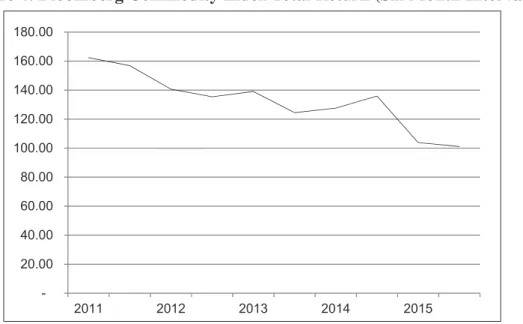
Ongoing concern from investors regarding the performance of the commodities markets globally is expected to continue to impact their view on Mongolian investments. This includes both mining and non-mining investment opportunities. As all aspects of the Mongolian economy are dependent on foreign direct investment into the mining sector, investors will be watching performance of commodities as an indication of appetite and activity from investors and companies entering Mongolia. The below chart illustrates the performance of the Bloomberg Commodity Index. This takes into consideration both supply and demand functions of the market and assesses performance of commodities globally on a weighted basis at both the commodity, sector and group level in order to manage diversification. The chart provided illustrates the difficulties in the commodities markets globally and the ongoing negative outlook given the 63%

drop in value from January 1, 2011 to June 30, 2015.

Figure 4: Bloomberg Commodity Index Total Return (Six Month Intervals)

Despite the challenging environment for coal and copper, as well as the wider commodities market, Mongolia is still in an advantageous position when it comes to competing with other producing nations. The same can be argued for coal production. This advantage is the result of a favourable geographic position with China in comparison to the largest copper and coal producing nations globally. Mongolian copper and coal are not subjected to the same high transport related expenses like many, more distant, commodity suppliers. As such, Mongolia is able to maintain a more competitive position at lower pricing.

Likewise, Mongolia’s production levels of both coal and copper do not rival the largest producers in either commodity. This suggests that the Mongolian economy will be able to sustain itself at lower levels of Chinese consumption and will not be as negatively impacted as other

Source: Bloomberg Business, Commodities -

20.00 40.00 60.00 80.00 100.00 120.00 140.00 160.00 180.00

2011 2012 2013 2014 2015

(9)

supplier nations, should Chinese demand continue to decrease. The following two tables illustrate the top ten producers of both copper and coal. This highlights the geographic challenge that each nation will face in reaching the Chinese market. Mongolian copper and coal, in comparison, are directly transported by road or rail to the Chinese border.

Figure 5: Top 10 Copper Producing Nations (2014)

Figure 6: Top 10 Coal Producing Nations (2013)

2.3 The Future Outlook for Foreign Direct Investment Into Mongolia

Mongolia’s attitude towards foreign investment has changed drastically over the past five years. This is likely a result of the economic realities that have inhibited the country’s ability to develop large-scale mining projects without the participation of foreign direct investment. As mentioned in the previous sections, the retreat of foreign investment has not solely been the fault of negative legislation but also the significant decrease in core commodities prices over the same period. These two factors, generally termed in this paper as internal and external, have together

Rank Country Production

(‘000 tons)

1 Chile 5,800

2 China 1,620

3 Peru 1,400

4 United States 1,370

5 D. R. Congo 1,100

6 Australia 1,000

7 Russia 850

8 Zambia 730

9 Canada 680

10 Mexico 520

Source: US Geological Society, Copper

Rank Country Production

(000‘000 tons)

1 China 3650

2 United States 922.1

3 India 605.8

4 Australia 431.2

5 Indonesia 386.0

6 Russia 354.8

7 South Africa 260.0

8 Germany 196.2

9 Poland 144.1

10 Kazakhstan 116.4

Source: US Energy Information Administration, International Energy Statistics

(10)

delivered an economic shock to foreign investors and Mongolian citizens alike.

The positive news for Mongolia is that the changes that have since been introduced to mining legislation and to support the formation of efficient capital markets. These are positive developments. These changes have provided a well-structured foundation for the economy that should garner support from international investors.

In addition to the changes already mentioned in this paper, the Mongolian government has also announced other initiatives targeted at attracting further foreign direct investment into Mongolia. One such program, introduced by President Elbegdorj in mid-2014, is a privatization program that will see state assets divested by the Mongolian government. A legislative framework that will result in the full or partial sale of state-owned enterprises will further support this initiative. An example of a state-owned enterprise that could be sold in full or part includes the 49% state-owned national flag carrier Mongolian International Airways. In addition, state- owned mining assets are a natural avenue for the Mongolian government to attract interest from large international mining companies and foreign investors alike. The prospect of having a stake in Mongolia’s most attractive mining assets has the potential to attract interest from international mining companies such as Glencore Xtrata, BHP Billiton, Rio Tinto, Vale, and Anglo American, all of which have previously participated in Mongolia’s mining sector within the past 10 years.

Given the boom-bust cycle of the Mongolian economy, similar to that of other resource- based markets, investors should expect a return to the growth cycle in conjunction with a strengthening outlook for commodities prices, particularly copper and coal. Likewise, a strengthening outlook for the Chinese economy will provide a welcomed boost to the Mongolian growth story as this would increase underlying demand for Mongolian exports. That said, Mongolia is not as severely impacted by commodity-driven price swings to the same extent like many other resource driven nations. Furthermore, the impact that changing conditions within the Chinese economy has on Mongolia’s commodity producers is far more acute than in other resource producing nations. Mongolia is therefore well positioned to benefit from positive developments in either the commodities markets or the Chinese economy. This is now especially true due to recent positive legislative developments that now govern the Mongolian economy and the participation of foreign investors.

Conclusion

Mongolia’s future prosperity will undoubtedly depend on the ability of the governing politicians to earn the interest and support of foreign investors. The Mongolian government has demonstrated over the past three years that this is their intent and that protecting the interest of foreign participation in Mongolia’s economy is a priority. Mongolia’s untapped resources, strengthening legislative and political environments, and increasing transparency are all contributing to the country’s potential. With a population of approximately 3 million, future prosperity will require continued positive developments and further foreign investment into the economy.

In June 2016, Mongolia will elect the next Parliament. As has been discussed, a change

in government may be on the horizon. Regardless of the outcome, the government will need to

ensure stability and limit legislative and political uncertainty in order to balance both foreign and

domestic interests.

(11)

* Managing Director, Mongolian Investment Banking Group SC LLC (MIBG)

1. Foreign direct investment refers to direct investment equity flows in the reporting economy. It is the sum of equity capital, reinvestment of earnings, and other capital. Direct investment is a category of cross-border investment associated with a resident in one economy having control or a significant degree of influence on the management of an enterprise that is resident in another economy. Ownership of 10% or more of the ordinary shares of voting stock is the criterion for determining the existence of a direct investment relationship. Data are in current U.S. dollars.

2. Bloomberg Commodity Index (BCOM) is calculated on an excess return basis and reflects commodity

futures price movements. The index rebalances annually weighted 2/3 by trading volume and 1/3 by world

production and weight-caps are applied at the commodity, sector and group level for diversification. Roll

period typically occurs from 6

th

–10

th

business day based on the roll schedule.

Figure 1: Gross Domestic Product (Current US$)
Figure 2: Foreign Direct Investment, Net Inflows (Current US$)
Figure 3: Copper Futures (US$/lb Six Month Intervals)
Figure 4: Bloomberg Commodity Index Total Return (Six Month Intervals)
+2

参照

関連したドキュメント

Laplacian on circle packing fractals invariant with respect to certain Kleinian groups (i.e., discrete groups of M¨ obius transformations on the Riemann sphere C b = C ∪ {∞}),

We show that a discrete fixed point theorem of Eilenberg is equivalent to the restriction of the contraction principle to the class of non-Archimedean bounded metric spaces.. We

Instead an elementary random occurrence will be denoted by the variable (though unpredictable) element x of the (now Cartesian) sample space, and a general random variable will

Applications of msets in Logic Programming languages is found to over- come “computational inefficiency” inherent in otherwise situation, especially in solving a sweep of

Shi, “The essential norm of a composition operator on the Bloch space in polydiscs,” Chinese Journal of Contemporary Mathematics, vol. Chen, “Weighted composition operators from Fp,

[2])) and will not be repeated here. As had been mentioned there, the only feasible way in which the problem of a system of charged particles and, in particular, of ionic solutions

Some examples include Gradstein’s 1925 direct extension of Sylvester’s 1888 lower bound of five on the number of distinct prime divisors of an OPN, as well as Dickson’s 1913

From Corollary 4.18, the algebras of the operad within any symmetric monoidal cat- egory admit a canonical description in terms of this new 2-monad, which in [31] enables