Bridging the Gap Between Prevention Research, Education and Practice:
Japan Egypt-Hydro Network (JE-HydroNet)
Sameh Ahmed Kantoush
Associate Professor, Civil Engineering Department, Faculty of Engineering and Material Science, The German University in Cairo – GUC, New Cairo City, Main Entrance of Al-Tagamoa Al-Khames, Cairo – Egypt
Mohamed Saber
Assistant professor, Geology Department, Faculty of Science, Assiut University, Assiut, 71516, Egypt
Tetsuya Sumi
Professor and Director of Water Resources Research Center, Disaster Prevention Research Institute, Kyoto University, Japan
Ibrahim Elshennawy
Professor and Director of Coastal Research Institute (CoRI), National Water Research Center (NWRC), Alexandria, Egypt
Medhat Aziz
Professor, Nile Research Institute (NRI), National Water Research Center (NWRC), Delta Barrage (El-Qanatir), 13621/5, Cairo, Egypt
Mahmoud Senousy
professor, Geology Department, Faculty of Science, Assiut University, Assiut, 71516, Egypt
Haithm Awad
Assistant professor, Faculty of Engineering, Civil Engineering Department, Alexandria University, Egypt
Ahmed Sefelnaser
Assistant professor, Geology Department, Faculty of Science, Assiut University, Assiut, 71516, Egypt
ABSTRACT:
This article outlines the development of a shared hydraulic and hydrology-based network that seeks to bridge the gap between research, education and practice. This network base was developed from the contextualised problems facing the Nile delta, Nile River system, and coastal managements in Egypt. Under the umbrella of GCOE-ARS project at Kyoto University, a joint project for research and education was established between Kyoto University and three institutional research units in Egypt.
Disaster Prevention Research Institute (DPRI), Kyoto University expert groups looked at problems of Nile Delta of Egypt related to their expertise and initiated Japan Egypt-Hydro Network (JE-HydroNet). In view of the challenges that Egypt is facing in the water resources and environmental issues, the project will help to mitigate the problems and its consequences. The exchange of qualitative and quantitative information between Japanese and Egyptian groups will contribute to the efforts of Egypt in development of innovative measures for water resources management.
Keywords: Joint project in science and technology, Nile River Basin, Delta of Egypt, Japan Egypt Hydro Network (JE-HydroNet)
1. INTRODUCTION 1.1. Context
The gap between education, research and practice in the hydraulics and hydrology field is recognized by many.
Bridging the gap can be achieved by involving the practitioners in education and training and more particularly in the life-long learning processes.
Hydro-Engineering projects are becoming more and
more complex projects and have to be carried out in close cooperation by several experts from different disciplines and locations. Under the umbrella of Global Center Of Excellence - Adaptation and Resilience in a Sustainable/Survivable Society to extreme weather and water conditions (GCOE-ARS) project at Kyoto University, a joint project for research and education was established between Kyoto University and three institutional research units in Egypt (Assiut and Alexandria Universities, and National Water Research
Center (NWRC), Ministry of Water Resources and Irrigation (MWRI)).
Japan Egypt-Hydro Network (JE-HydroNet) was initiated after the visit of DPRI research group on March 2009 to setup research projects concerning the Nile River and the Nile Delta of Egypt. On 26 October 2010 the first mini-symposium was organized at Uji campus, Kyoto University, Japan. The first symposium have served the exchange of information about the latest state of research of water resources problems facing Nile Delta and encouraged the discussion about joint research project activities and how to combine with consulting practitioners. Three main topics concerning to flash flood and water resources, groundwater, sediment and coastal managements in the Nile River of Egypt were discussed.
Finally we discussed the importance of climate change impacts on the Nile River Basin and the Delta of Egypt.
Vulnerability of the Nile River and Delta of Egypt
Upstream and in Nasser Lake Environmental
risks Sedimentation
Evaporation Aswan high dam (AHD) operation Impacts of dams upstream
of AHD Sediment management
techniques
Downstream of Aswan High Dam
Social behavior Water quality and
water pollution Global warming and
climate change Traditional irrigated
system Limited available water resources water-logging Rise in groundwater
levels Flash flood
Delta, Irrigation and Drainage Networks
Nile Delta flooding by sea Environmental
degradation Competing uses of
land Inefficient natural
resources management Salt water intrusion Negative impact of free crop pattern Degradation of agricultural soil
fertility Excessive pumping
Coastal
Potential impact of sea level rise
Coastal erosion
Sea level rise
Negative effects on fisheries Climate change
Energy Resources
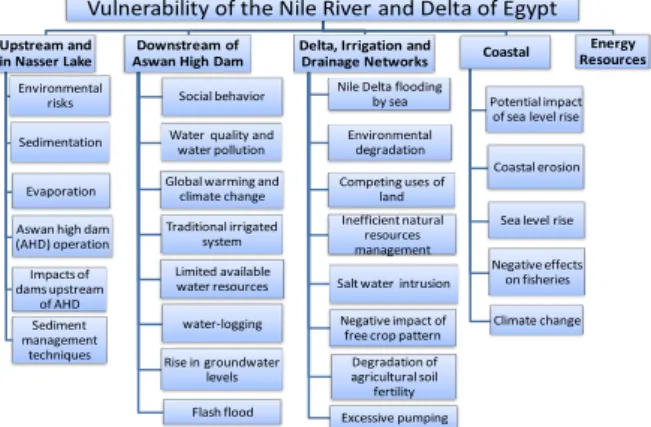
Figure 1. Problems facing Nile River and delta of Egypt.
Egypt’s Nile delta with its coastal front on the Mediterranean is considered vulnerable to the impacts of Aswan High Dam (AHD) operation and climate change (Figure 1). These factors also produce stressful effects on water and agricultural resources, and social. The Northern Egyptian Lakes, which constitute about 25% of the total Mediterranean Wetlands and produce about 60%
of the fish products, are also highly vulnerable to the impacts of climate change. Moreover, energy resources were ranked as least vulnerable because projections of higher temperatures in an arid climate are expected to boost energy demands, while any reduction in Nile waters would have a direct impact on hydroelectricity generation.
Until today, no proper protection from flash floods proposed for all Wadi basins in Egypt. Flash floods are the result of short period heavy storms and the velocity of floodwater depends mainly on topography of the Wadi (height, slope, capacity of drainage network), and soil characteristics. Flash floods are a major threat to human life and infrastructures. Unfortunately, there is often a lack of data on key hydrological processes in arid areas (Gheith & Sultan, 2002). This limits the ability to understand the flooding process and use this knowledge to minimize its threat to human health and well-being.
On the other hand, however, floodwater can be an important source of water replenishment in arid regions.
The wise use of floodwater in these areas is therefore important for the sustainable management of water resources. An overall aim of the research project is to develop and implement an integrated flash flood management strategy for the Wadi El-Arish, Sinai Peninsula, Egypt, based on stakeholder and practitioners participation.
Lake Nasser is causing flow and sediment flow regimes, and reservoir sedimentation is causing serious impacts on river morphology and scouring of delta and coastal region (Abdelsalam, 2008). Moreover, it is important to predict the response of Aswan High Dam (AHD) reservoir and the Nile Delta of Egypt to reservoir sedimentations in the newly constructed or planned dams on the upstream regions of the Nile basin. Moreover, how these dams will effect on the sediment management and operation of AHD. The worldwide sediment management techniques consist of three basin strategies:
sediment yield reduction, sediment routing, and sediment removal (Kantoush & Sumi, 2010).
The coastal area of the Nile delta is subjected to severe coastal erosion, even without accelerated sea level rise.
The World Bank (2005) highlights the present coastal erosion and retreat of the Delta, which are aggravated by human interventions such as reduced sediment input, groundwater extraction, and hard engineering work in coastal strip. In addition to the current trends, Egypt’s Mediterranean coast and the Nile Delta have been identified as highly vulnerable to climate change induced Sea Level Rise (SLR). Some parts along the Nile Delta coast have been protected by hard structures as well as artificial nourishment that have been applied at some sectors.
Accordingly, the main objective of the network is to assess the vulnerability of the Nile Delta coastal zone to climate change/sea level rise and to design an adaptation strategy based on adaptation policy framework. Climate Change Adaptation strategies will be vital for country as Egypt. Adaptation options for Egypt’s water resources meanwhile are closely intertwined with Egypt’s development choices and pathways.
2. CONCEPT OF THE NETWORK AND OBJECTIVES
2.1. History of the Network
Following Academic Exchange Agreements between Disaster Prevention Research Institute Kyoto University (Japan) and the Faculty of Science of Assiut University (Egypt), a sincere and friendly discussions with a view to strengthening the research and education, to promoting the cooperation on scientific exchange and the public understanding of science and technology, have been
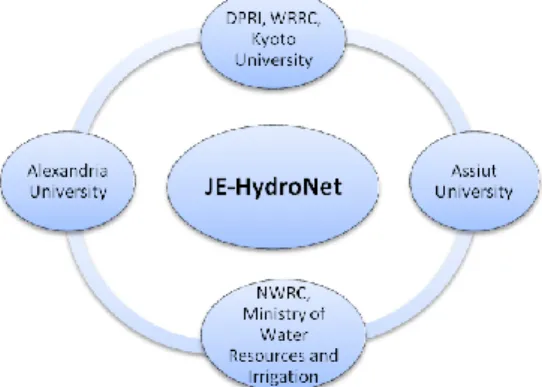
started between Kyoto University and two other institutional research in Egypt. The concept of the JE-HydroNet is illustrated in Fig. 2.
Figure 2. Concept of the seminar and partners.
A group of four researchers of Kyoto University made a preparatory field survey and meetings for establish of cooperative research project among institutes in JE-HydroNet, between 23rd to 30th of March 2010, in Aswan, Assiut, Alexandria, Rosetta, and Cairo in Egypt.
During the visit, the two counterparts agreed to hold the first symposium on 26 October 2010 at Uji campus, Kyoto University, Japan. DPRI has invited three Egyptian researchers representing each group and the symposium was successfully held in Japan. Through this symposium, 66 participants mainly from Japan and Egypt with various background and field of interest have attended. Next year another planned joint conference is proposed to be continuation of these past meetings.
This network is first of all unique in the sense that groups of international experts from a priori very distant scientific fields (hydraulics, Hydrology, flash flood and hazard map, dam operation, coastal management, sediment management in reservoirs, numerical and experimental modelling) initiated the JE-HydroNet, as well as the strong extensive knowledge and decision making responsibility of NWRC, Ministry of Water Resources and Irrigation (MWRI). Second, a group of researchers at DPRI, Kyoto University have simulated flash flood and ground water problems in the Delta and the hydrology of the whole Nile Basin, by using integrated hydrological model of Hydro-BEAM (Hydrological Basin Environmental Assessment Model) (Kojiri et al., 2002). The flash flooding Simulation has been performed at Wadi basins of Nile River and Wadi El-Arish using Global Satellite Mapping of Precipitation (GSMaP product). There is no available data for calibration and validation most of these results, only the GSMaP product was calibrated with Global Precipitation Climatology Centre (GPCC) monitored product to estimate the bias of the rainfall data at eleven arid sectors. Therefore, the network will make it possible for the data sharing and set-up new measurement instruments by the help of NWRC.
There is a need to set up an innovative system for rainfall forecasting and early warning for flash-floods in the pilot
area of one of Egyptian Wadis; for instance at Wadi El-Arish in Sinai peninsula. That aims at a sustainable management of water resources and wise use of floodwater in arid areas. Based on rainfall-runoff and hydrodynamic modelling, flood-risk maps will be created and best-storage options and suitable flood-protection measures will be identified. This project will help to install measurement station for validation. Moreover, to increase scientific and project based cooperation among the different institutional units of the network.
2.1. Detailed Objectives
Improvement of flexibility, availability, sustainability and environmental impacts of water resources in Nile Delta by developing advanced methodology for operation, monitoring, planning and management of the water resources problem by focusing on:
Set-up potential hazard map with a global flash flood warning system;
Assessment and evaluating of Wadi basins during the flash flood events;
Adaptation of climate change;
Sustainable integrated sediment management;
Coastal erosion;
Optimizing the dam operation;
Better Mobility of young researchers: To help the young researchers enhance their effectiveness as research group leaders, and to increase the results they achieve with modelling and measurements as well;
To allow participants to practice and sharpen their skills of interpersonal communication;
To analyse the problem of flash flood, climate changes, ground water modelling, sediment management and coastal problems.
Final discussion about the continuation of the project, research methodology and exchange data and experiences methods will be clarified.
Additional benefits through cooperation are:
Regular seminars to exchange experience;
Exchange research students (Master, PhD and postdoctoral levels);
International publications;
Solution of local problems in Egypt and share its experiences with Japanese researchers.
JE-HydroNet will be performed as the scientific network to exchange young researchers and information among related institutions towards a consistent standardized methodology for management, and propose mitigation projects.
3. DESCRIPTION OF THE ROAD MAP FOR FUTURE COOPERATION
There are five groups of researchers from both counterparts. The five groups agreed to study the following points under each group. Moreover, the closing
session of the symposium consisted of a brainstorming session during which participants expressed their views concerning the most important open questions that the network should address in the near future. The following is a summary of the main points made:
Impacts of climate changes on the Nile Basin and the Delta of Egypt;
Regional climate change and rainfall pattern;
Verification of Global Satellite Mapping of Precipitation (GSMaP) output;
Implementation on Nile Basin and Coastal zones in Egypt;
Social change.
Integrated water resources managements including irrigation and ground water;
Cooperation with Nile Basin countries;
Training courses for Nile Basin countries;
Water quality/quantity management;
Water requirements policies and laws;
Drought and wetting forecasting;
Surface/ground water interaction and recharge quantities;
Salt water intrusion.
Reservoir sustainability management;
Assessment of Aswan High Dam alternatives operation;
Impacts of upstream dams (constructed and proposed) in Ethiopia and Sudan on flow and sediment budget to Nasser Lake;
Applicability for new types of hydropower schemes (i.e pumping up storage);
Reservoir training;
Coastal management;
Hydrodynamic coastal erosion management;
Sea Level Rise (SLR);
Climate change impacts on waves and currents;
Soft measures by using wetlands and lakes as a barrier;
Compaction and subsidence of coastal sediments.
Flash flood disaster management;
Warning System and Public awareness (control, management, and forecasting)
Monitoring system and observational field stations (maintenance).
Finally there was widespread sentiment that we should built a data sharing website for exchange the data and starting a real cooperation between groups, before the next get-together conference on 2011. Some of the roadmaps for future steps are summarized as following:
Establishment of JE-HydroNet data sharing, and observational station for measurements;
Constructing a new website for data sharing information system;
HydroBeam development and providing to Egyptian researchers;
Establishing measurement stations in Egypt.
4. CONCLUSION
This paper has tried to weave together ideas drawn from research, education and from practice in supporting the development of international hydro network. Among several proposed topics a case study of flash flood management is presented. We need more focused research approach on collaboration and measurement development in areas of interest that are underpinned by complex relations to a variety of work-related practices. We need much more data and field measurement stations for validation and accurate simulations.
The JE-HydroNet was formed with the aim of bringing together the leading researchers from various disciplines and institutional units that are active in the area of water resources in Egypt, together with people from industry who are responsible for practical implementations from Japanese companies. The network helps us better understand problems facing Nile River System and Delta of Egypt and how these various groups of researcher connect to one another and how, together, they can contribute to the design and implementation of better improvement of flexibility, availability, sustainability and environmental impacts of water resources in Nile Delta by developing advanced methodology for operation, monitoring, planning and management of the water resources problem. This initiative represents an exciting opportunity to create an inclusive and dynamic research group of interest bridging the gap between guidance research and practice. It will enable us to examine the ways in which learning about guidance is created and shared (beliefs, concepts, ideas, theories, actions) as well as providing a potentially powerful engine to assist with the search for new understandings of effective guidance to benefit all groups.
REFERENCES
Abdelsalam, A.A. (2008): Sediment in the Nile River System.
UNESCO-IHP.
Gheith, H., and Sultan M. (2002): Construction of a hydrologic model for estimating Wadi runoff and groundwater recharge in the Eastern Desert. Egypt, J. of Hydrology. (263) 36–55.
Kantoush, S. A. and Sumi, T. (2010): River morphology and sediment management strategies for sustainable reservoir in Japan and European Alps. Annual report of Disas. Prev. Res.
Inst., Kyoto Univ., No. 53 B, pp.821-839.
Kojiri, T., Kinai, Y., and Park, J.H. (2002): Integrated river basin environment assessment on water quantity and quality by considering utilization processes. In: Proceedings of the International Conference on Water Resources and Environment Research, pp. 397-401.
Saber, M., Hamagutchi, T., Kojiri, T. and Tanaka, K. (2010):
Hydrological modeling of distributed runoff throughout comparative study between some Arabian Wadi basins.
Annual J. of Hydraulic Eng., JSCE, Vol.54, pp. 85-90.
Saber, M. (2010): Hydrological approaches of Wadi system considering flash floods in arid regions. Ph.D. thesis, Kyoto University.