Prepared by the PRESS
OOReview Group (affiliated to the IFLA Cataloguing Section):
Chair: Clément Oury (ISSN International Centre)
Members: Vincent Boulet (BnF), Gordon Dunsire (RDA Steering
Committee), Louise Howlett (BL/ISSN UK), Patrick Le Boeuf (BnF), Regina Reynolds (LC/ISSN US)
Edited by:
Patrick Le Bœuf
With contributions from:
Philippe Cantié (BnF/ISSN France), Pierre-Louis Drouhin (BnF), Pierre Godefroy (ISSN International Centre), Patrick Le Boeuf (BnF), Françoise Leresche (BnF), François-Xavier Pelegrin (ISSN International Centre)
Approved by CIDOC CRM-SIG (Special Interest Group for the Conceptual Reference Model of Comité international pour la
Documentation , affiliated to the International Council of Museums or ICOM)
Version 1.3 August 2016
Endorsed by the IFLA Professional Committee, March 2017.
PRESS
OOReview Group, affiliated to the IFLA Cataloguing Section 2017.
Definition of PRESS OO
A conceptual model for Bibliographic Information
Pertaining to Serials and Other Continuing Resources
© 2017 by PRESS
OOReview Group, affiliated to the IFLA Cataloguing Section 2017. This work is licensed under the Creative Commons Attribution 4.0 International (CC BY 4.0) license. To view a copy of this license, visit: http://creativecommons.org/licenses/by/4.0
IFLA
P.O. Box 95312 2509 CH Den Haag Netherlands
www.ifla.org
Table of Contents
Table of Contents ... 3
Foreword to version 1.3 ... 6
1 Introduction ... 7
2 Overview of PRESS
OO... 8
3 PRESS
OOclass hierarchy, aligned with portions from the FRBR
OOand the CIDOC CRM class hierarchies ... 21
4 PRESS
OOproperty hierarchy, aligned with portions from the FRBR
OOand the CIDOC CRM property hierarchies ... 24
5 PRESS
OOclasses ... 28
5.1 Z1 Serial Transformation ... 28
5.2 Z2 Absorption ... 28
5.3 Z3 Separation ... 29
5.4 Z4 Temporary Substitution ... 29
5.5 Z5 Issuing Rule Change ... 29
5.6 Z6 Starting of Publication ... 30
5.7 Z7 Ending of Publication ... 30
5.8 Z8 Metadata Management ... 30
5.9 Z9 Storage Unit ... 31
5.10 Z10 Sequencing Pattern ... 31
5.11 Z11 URL... 32
5.12 Z12 Issuing Rule... 32
5.13 Z13 Monograph ... 32
5.14 Z14 Storage Unit Creation ... 33
6 PRESS
OOproperties ... 34
6.1 Y1 provided a continuation to (was continued through) ... 34
6.2 Y2 initiated as continuation (was initiated as continuation through) ... 34
6.3 Y3 provided a replacement to (was replaced through) ... 34
6.4 Y4 initiated as replacement (was initiated as replacement through) ... 34
6.5 Y5 split (was split through) ... 35
6.6 Y6 initiated (resulted from split) ... 35
6.7 Y7 merged (was merged through) ... 35
6.8 Y8 merged into (resulted from merger) ... 36
6.9 Y9 absorbed (was absorbed through) ... 36
6.10 Y10 enhanced (was enhanced through) ... 36
6.11 Y11 separated (was separated through) ... 37
6.12 Y12 separated from (was diminished through) ... 37
6.13 Y13 provided surrogate to (had surrogate through) ... 37
6.14 Y14 substituted with (became surrogate through) ... 38
6.15 Y15 replaced (was replaced through) ... 38
6.16 Y16 replaced with (was introduced through) ... 38
6.17 Y17 launched (was launched through) ... 39
6.18 Y18 ended (was ended through) ... 39
6.19 Y19 concerned (was the concern of) ... 39
6.20 Y20 foresees type (is type foreseen in) ... 39
6.21 Y21 foresees use of language (is language foreseen in) ... 40
6.22 Y22 foresees sequencing pattern (is sequencing pattern foreseen in) ... 40
6.23 Y23 foresees dimension (is dimension foreseen in) ... 41
6.24 Y24 foresees use of title (is title foreseen in) ... 41
6.25 Y25 foresees association with (foresees to be associated with) ... 42
6.26 Y26 foresees other edition (foresees to be another edition of) ... 42
6.27 Y27 foresees translation in (foresees translation of) ... 43
6.28 Y28 foresees URL (is URL foreseen in) ... 43
6.29 Y29 evolved into (continues) ... 44
6.30 Y30 was partially continued by (was separated from) ... 44
6.31 Y31 was superseded by (superseded) ... 44
6.32 Y32 was split into (resulted from splitting) ... 44
6.33 Y33 was merged with ... 45
6.34 Y34 was merged to form (resulted from merging) ... 45
6.35 Y35 was absorbed in (was enhanced by absorbing) ... 45
6.36 Y36 had surrogate (was surrogate for) ... 46
6.37 Y37 has former or current issuing rule (is former or current issuing rule of) ... 46
6.38 Y38 has current issuing rule (is current issuing rule of) ... 46
6.39 Y39 is enhanced by monograph (enhances serial) ... 47
6.40 Y40 enhances monograph (is enhanced by serial)... 47
6.41 Y41 has former or current area of publication (is former or current area of publication of) 48 6.42 Y42 has current area of publication (is current area of publication of) ... 48
6.43 Y43 is indicative of (is exemplified by) ... 49
6.44 Y44 foresees topic (is topic foreseen in) ... 49
6.45 Y45 created (was created by) ... 49 6.46 Y46 aggregated in a single storage unit (was aggregated in a single storage unit through)
49
7 Mapping from the data elements listed in the ISSN Manual to PRESS
OO... 51
8 Referred to FRBR
OOClasses and Properties ... 58
8.1 List of Referred to FRBR
OOClasses ... 58
8.2 List of Referred to FRBR
OOProperties ... 59
8.3 Referred to FRBR
OOClasses ... 60
8.4 Referred to FRBR
OOProperties ... 73
9 Referred to CIDOC CRM Classes and Properties ... 78
9.1 List of Referred to CIDOC CRM Classes ... 78
9.2 List of Referred to CIDOC CRM Properties ... 80
9.3 Referred to CIDOC CRM Classes ... 81
9.4 Referred to CIDOC CRM Properties ... 105
Foreword to version 1.3
Continuing resources present modelling challenges, especially as the high-level international model for bibliographic resources, FRBR (or “FRBR
ER”
1), does not fit well with their specific nature. These problems were notably stated during a harmonization meeting held between representatives of ISBD, RDA and ISSN
2in 2011
3. The three parties agreed that the hierarchical aspect of the Work/Expression/Manifestation relationships, in FRBR
ER, is conflicting with the dynamic character of continuing resources. For example, an “expression” of a specific serial work (e.g. a variant linguistic edition of a newspaper) may suddenly become a new “work” (if it starts publishing content that is not available in the edition in the original language). The same entity being successively an expression and a work is not conceivable in FRBR
ER; but it frequently happens to be true for continuing resources.
Application of FRBR to these kinds of resources needed therefore to be investigated again. It quickly appeared that FRBR
OO, the object-oriented version of FRBR, could provide a solution
4. FRBR
OO5, which was approved in June 2009, is an extension of the CIDOC Conceptual
Reference Model (CIDOC CRM
6). As an event-based model, it was better able to express the changing nature of serials and integrating resources. And as an object-oriented model, it offered a wealth of classes and properties for modelling seriality.
A working group was set up at the end of 2012, with representatives of the ISSN International Centre and the Bibliothèque nationale de France, with the support from experts of other national centres, to work on the extension of FRBR
OOto serials and integrating resources. The working Group started in January 2013 to draft PRESS
OO. The version 1.0, endorsed by the IFLA FRBR Review Group, was released in June 2014. It has been submitted to a world-wide review process in spring 2015 for an endorsement by the IFLA cataloguing section.
As a consequence of the positive outcome of the world-wide review, the Standing Committee of the IFLA Cataloguing Section decided on 19 August 2015 to form a working group dedicated to the maintenance and reviewing of the PRESS
OOconceptual model.
This PRESS
OOReview Group produced a subsequent version (1.2), which has been submitted to the IFLA Committee on Standards on June 2016.
The current version, 1.3, takes into account the comments of the IFLA Committee on Standards.
1 FRBRER or “FRBR Entity-relationships” is the original version of FRBR, as defined by the Functional Requirements for Bibliographic Records. Final report, published in 1998 and revised in 2009. See http://www.ifla.org/files/assets/cataloguing/frbr/frbr_2008.pdf.
2 The ISSN (International Standard Serial Number) is an access key and management tool for all serials and other ongoing resources, electronic and print, governed by the ISO 3297 standard. The ISSN International Centre is an intergovernmental organisation, the purpose of which is to manage the ISSN system and to coordinate the Network of National Centres assigning ISSN numbers in their own countries. It is also responsible for maintaining and publishing the ISSN International Register, an international database that lists all assigned ISSNs, along with metadata that follow the recommendations stated in the ISSN Manual.
3 See Joint Steering Committee for Development of RDA, IFLA ISBD Review Group, ISSN Network,
“JSC/ISBDRG/ISSN Outcomes”, 3-4 November 2011, Glasgow (UK):
http://www.ifla.org/files/assets/cataloguing/isbdrg/JSC_ISBD_ISSN_Outcomesfinal.pdf.
4 Le Bœuf, Patrick and Pelegrin, François-Xavier, “FRBR and serials: the PRESSOO model”. Paper presented at:
IFLA WLIC 2014 – Lyon – Libraries, Citizens, Societies: Confluence for Knowledge in Session 86 – Cataloguing with Bibliography, Classification & Indexing and UNIMARC Strategic Programme. In: IFLA WLIC 2014, 16-22 August 2014, Lyon, France: http://library.ifla.org/838/.
5 See the FRBR, object-oriented definition, version 2.2., March 2015:
http://www.ifla.org/files/assets/cataloguing/frbr/frbroo_v2.2.pdf.
6 On CIDOC CRM, see http://www.cidoc-crm.org/.
1 Introduction
This document is the definition of PRESS
OO, a formal ontology intended to capture and represent the underlying semantics of bibliographic information about continuing resources
7, and more specifically about serials (journals, newspapers, magazines, etc.). PRESS
OOis an
extension of FRBR
OO, which in turn is an extension of CIDOC CRM. FRBR
OOis an ontology of the underlying semantics of bibliographic information in general; it already deals with continuing resources, but at a very general level, and does not go into all the specific details required by the description of such resources.
Continuing resources pose particular modelling issues. As “living” resources, they may know many evolutions through time. Bibliographic information pertaining to them may change:
publisher, country of publication, publication frequency… Therefore, a bibliographic description of continuing resources (except for ceased ones) represents a statement about the past and assumptions about the future. Continuing resources present also complex relationships: they may originate from continuations, splits or mergers with other continuing resources; they may be (local, linguistic, special) editions of other publications – and these relationships themselves may evolve in the lifetime of the resources. Finally, continuing resources, especially serials, are a complex case of aggregations: serial titles are composed of discrete issues which are themselves aggregates of articles or other objects.
FRBR
OO, and subsequently PRESS
OO, are designed following the object-oriented formalism, where every information is expressed either as an instance of a class or as a property between classes. This formalism provides a very flexible way to finely describe continuing resources, and especially to take into account their dynamic nature. Besides, it is consistent with the RDF syntax, hence paving the way towards the publication of such description on the Semantic Web.
The purpose of PRESS
OOis to express the common, implicit conceptualization that underlies bibliographic description of continuing resources, and to formalize it as economically and adequately as possible as a set of triples.
It could be used several ways. First, it should be considered as a high-level standard, a model in the strongest sense of the term, against which more practical rules dealing with continuing resources (e.g. cataloguing rules) could be assessed.
Second, as PRESS
OOhas been built from the list of bibliographic information of the ISSN Manual, it provides a complete set of classes and properties that may be used in conjunction with other bibliographic ontologies to describe continuing resources. PRESS
OOis even very flexible, as it offers a choice between an object-centric and an event-centric modelling.
Finally, PRESS
OOmay be used, in conjunction with CIDOC-CRM and FRBR
OO, as the main ontology to publish a linked dataset. This kind of implementation provides all solutions to precisely express any kind of bibliographic information that is considered worthy of publication.
7 In the ISSN Manual, 2015 release (available from: <http://www.issn.org/understanding-the-issn/assignment-
rules/issn-manual/>, or <http://www.issn.org/wp-content/uploads/2013/09/ISSNManual_ENG2015_23-01- 2015.pdf>), a continuing resource is defined in section 0.1 as “a publication, in any medium, that is issued over time with no predetermined conclusion and made available to the public”. The ISSN Manual further specifies:
“Continuing resources include serials such as newspapers, periodicals, journals, magazines, etc., and ongoing integrating resources such as loose-leaf publications that are continually updated and Web sites that are continually updated”. In the same source, a serial is defined as “a continuing resource issued in a succession of discrete issues or parts, usually bearing numbering, that has no predetermined conclusion”, and an ongoing integrating resource as “a continuing resource that is added to or changed by means of updates that do not remain discrete and are integrated into the whole. Ongoing integrating resources have no predetermined conclusion”.
However, even in that case, there are several implementation choices; and shortcuts may sometimes be deemed necessary to simplify the model.
This document is therefore intended for data modelling and bibliographic standard experts, developers, and producers and consumers of linked data. It is not directly aimed to serials cataloguers – even though they may be interested in investigating the issues of modelling of continuing resources expressed in that document.
The name “PRESS
OO” itself does not correspond to an acronym. It is a reminder of the world of the press, historically the first form of ongoing resources – and still one of the most popular.
2 Overview of PRESS OO
Descriptions of continuing resources do not only reflect characteristics of existing products, but also, as long as the described resource still is being published, the expected characteristics of future behaviour. The main difference between cataloguing a monograph and cataloguing a serial could be expressed as follows: when you catalogue a monograph, you make statements about the past; when you catalogue a serial, you both make statements about the past and assumptions about the future. The CIDOC CRM model does not strive to model assumptions about the future; but it does declare a class that accounts for planned behaviours (no matter whether they were planned in the past or are still currently planned), E29 Design or Procedure. This class proved extremely useful, and even central, when developing the PRESS
OOmodel, as it was used as a superclass for Z12 Issuing Rule, which refers to elements of the policy established by the editor and/or publisher of a continuing resource. Bibliographic information about a continuing resource actually contains data about the various (and successive) instances of Z12 Issuing Rule that were followed in the course of the publication of a continuing resource. Most data elements found in a bibliographic record for a serial pertain to Z12 Issuing Rule rather than directly to the F18 Serial Work that was declared in FRBR
OO.
(Note: Multi-volume monographs, the volumes of which are not issued at once but over time, are very similar, in that regard, to continuing resources, although they are not defined as such in normative documents used in libraries. In a sense, PRESS
OOcan be said to cover multi-volume monographs as well, as long as the publication is not complete.)
ISBD defines continuing resources as resources that are ‘issued over time with no predetermined conclusion.’ As a logical consequence, FRBR
OOasserts that ‘there is in general no single
expression or manifestation representing a complete serial work, unless the serial work is ended.’
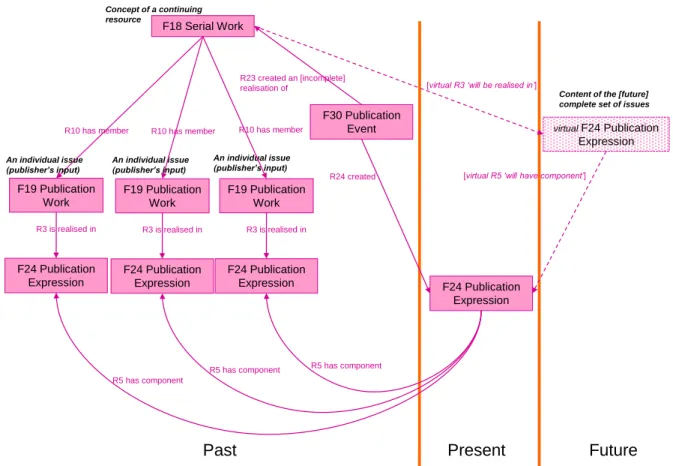
It is only possible to model the relationships between a serial work and its past issues. The sum,
at a given point in time (e.g., at the time the description is being made, or updated), of all the
expressions of all past issues published so far, does not represent the complete serial work, but
can be thought of as a ‘component’ of a virtual complete expression that does not exist yet. The
serial work is being partially realised through an instance of F30 Publication Event that is still
on-going as long as there is no ascertained knowledge that the continuing resource is ‘dead.’ This
state of affairs is represented in Figure 1, where dotted lines indicate ‘virtual’ instantiations of
classes and properties that are expected to exist at some point in the future but do not belong to
the present and cannot, therefore, be modelled in a strict sense.
virtual F24 Publication Expression F18 Serial Work
F19 Publication Work
F24 Publication Expression
Past Present Future
[virtual R3 ‘will be realised in’]
R3 is realised in R10 has member
R5 has component An individual issue
(publisher’s input)
Content of the [future]
complete set of issues Concept of a continuing
resource
F19 Publication Work
F24 Publication Expression
R3 is realised in
F19 Publication Work
F24 Publication Expression
R3 is realised in An individual issue
(publisher’s input)
An individual issue (publisher’s input) R10 has member R10 has member
F30 Publication Event
F24 Publication Expression
R5 has component R5 has component
[virtual R5 ‘will have component’]
R23 created an [incomplete]
realisation of
R24 created
Figure 1. A continuing resource that is still being published
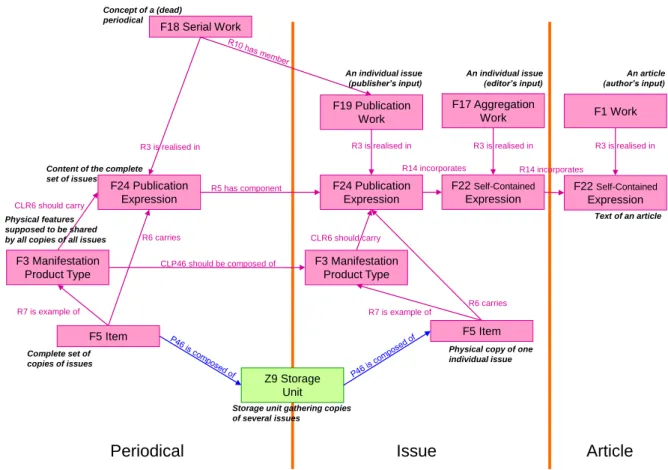
Once a continuing resource is ‘dead,’ it can be modelled in a strict sense as an object that exists
in its entirety. Figure 2 shows how ‘dead’ serials are modelled in PRESS
OO, in the context of
physical publishing (as opposed to online publishing).
F3 Manifestation Product Type
F5 Item
F24 Publication Expression
F18 Serial Work
F19 Publication Work
F24 Publication Expression
F3 Manifestation Product Type
F5 Item
F22 Self-Contained Expression
F1 Work
Z9 Storage Unit
Periodical Issue Article
R3 is realised in R3 is realised in R3 is realised in
CLR6 should carry
R7 is example of
R6 carries
CLP46 should be composed of
CLR6 should carry
R7 is example of R6 carries R14 incorporates R5 has component
Complete set of copies of issues
Storage unit gathering copies of several issues
Physical copy of one individual issue An individual issue
(publisher’s input)
Content of the complete set of issues
An article (author’s input)
Text of an article Concept of a (dead)
periodical
Physical features supposed to be shared by all copies of all issues
F17 Aggregation Work
F22 Self-Contained Expression
An individual issue (editor’s input)
R3 is realised in R14 incorporates
Figure 2. Serial, Issue, Article (physical publishing; assuming the serial is dead) This figure shows more particularly how the serial is connected with each of its individual issues, and how each individual issue is connected with individual articles. Of course, more complex cases occur in real life; e.g., a lengthy article can be ‘sliced’ and published over several issues.
Such a case can be easily modelled, using either the R5 has component or R15 has fragment FRBR
OOproperty.
PRESS
OOdeals with all kinds of serials, including online serials. FRBR
OOdistinguishes between
physical publishing and electronic (i.e., online) publishing. Physical publishing involves the
creation of an instance of F3 Manifestation Product Type, while electronic publishing ignores
that notion altogether.
F24 Publication Expression
F18 Serial Work
F19 Publication Work
F24 Publication Expression
F53 Material Copy
F22 Self-Contained Expression
Periodical Issue Article
R3 is realised in R3 is realised in R3 is realised in
R6 carries
R14 incorporates R5 has component
File(s) containing a complete issue, downloaded on a local computer
An individual issue (publisher’s input)
Content of the complete set of issues
An article (author’s input)
Text of an article Concept of a (dead)
periodical
F17 Aggregation Work
F22 Self-Contained Expression
An individual issue (editor’s input)
R3 is realised in R14 incorporates
F53 Material Copy
R6 carries
File(s) containing an individual article only, downloaded on a local computer
F53 Material Copy
R6 carries
File(s) containing the complete serial, downloaded on a local computer
F24 Publication Expression
Text of an article (+ layout etc.)
F1 Work
R14 incorporates
Figure 3. Serial, Issue, Article (electronic publishing;
assuming the serial is dead)
Figure 3 shows how online serials are modelled in PRESS
OO, i.e., without using the F3 Manifestation Product Type class, once they are dead. Instances of F53 Material Copy are downloaded files that carry either the publication expression of the complete serial, the
publication expressions of individual issues, or the publication expression of an individual article.
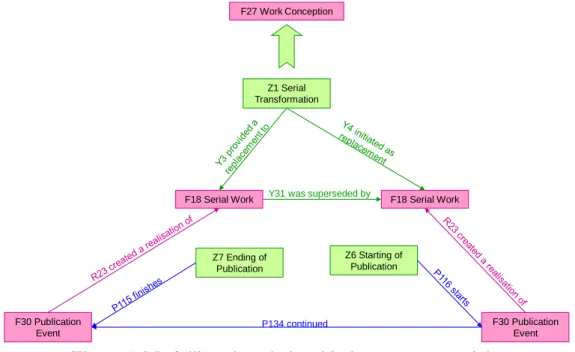
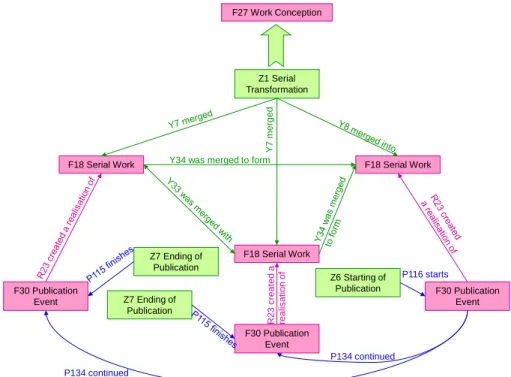
Figure 4 shows how cases of ‘continuation’ are modelled in PRESS
OO.
F18 Serial Work Y29 evolved into
Z1 Serial Transformation
F18 Serial Work
F27 Work Conception
F30 Publication Event
F30 Publication Event P134 continued
Z7 Ending of Publication
Z6 Starting of Publication
Figure 4. Modelling the relationship between two serials,
one of which is the ‘continuation’ of the other
The ISBD prescriptions include very specific rules as to when to regard a serial as the
‘continuation’ of another serial; it is essentially a matter of title change. Some title changes are deemed ‘minor,’ in which case there is no formal ‘continuation,’ but just a title change for the same serial, while other title changes are deemed ‘major’ and imply the creation of a new bibliographic record for a serial that is regarded as distinct from what it was prior to the title change – no matter whether the publisher actually intended to publish a ‘new’ serial or not.
Minor title changes are modelled through property Y24 foresees use of title (is title foreseen in) that relates a given title with a given instance of Z12 Issuing Rule, and the Z5 Issuing Rule Change class that allows for assigning chronological borders (if they are readily known) to the use of a specific title for one instance of F18 Serial Work. Major title changes are modelled through the notion of Z1 Serial Transformation which is introduced in PRESS
OOand does not exist in FRBR
OO.
Figure 5 shows the modelling of cases of ‘replacement.’
F18 Serial Work Y31 was superseded by
Z1 Serial Transformation
F18 Serial Work
F27 Work Conception
F30 Publication Event
F30 Publication Event P134 continued
Z7 Ending of Publication
Z6 Starting of Publication
Figure 5. Modelling the relationship between two serials, one of which ‘supersedes’ the other
The notion of replacement is very close to that of continuation, except that some circumstances are particular: while cases of continuation most often result from a deliberate decision on behalf of the publisher or editor of the serial, cases of replacement can be the consequence of external events, such as suppression by censorship. Also, a serial can supersede another without strictly
‘continuing’ it, because it carries out the same function as the serial that has ceased to be published.
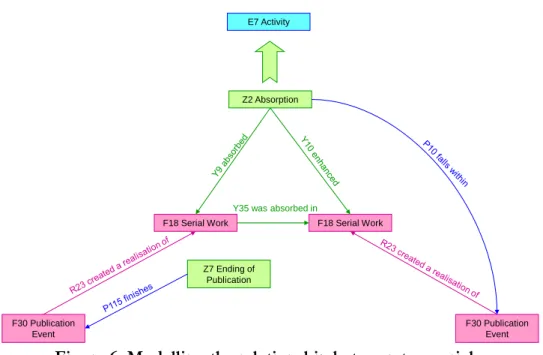
Figure 6 shows how cases of ‘absorption’ are modelled in PRESS
OO.
F18 Serial Work Y35 was absorbed in
Z2 Absorption
F18 Serial Work
F30 Publication Event
F30 Publication Event E7 Activity
Z7 Ending of Publication
Figure 6. Modelling the relationship between two serials, one of which is ‘absorbed’ by the other
The activity of absorption is an event that puts an end to the publication of the absorbed serial(s) while it does not bring another serial into being but just ‘falls within’ (P10 property from
CIDOC CRM) the publication process of the absorbing serial. A given serial can be absorbed by more than one serial. In some cases, a serial that was absorbed can be ‘revived’.
Figure 7 shows how cases of ‘separation’ are modelled in PRESS
OO.
F18 Serial Work Y30 was partially continued by
Z3 Separation
F18 Serial Work
F30 Publication Event
F30 Publication Event F27 Work Conception
Z6 Starting of Publication
Figure 7. Modelling the relationship between two serials, one of which ‘separated’ itself from the other
The activity of separation is an event that initiates the publication of one (or more than one) serial that continues in part another serial which does not cease to be published. Such an event just ‘falls within’ the publication process of the original serial. In some cases, a serial that
separated itself from another serial can be absorbed back by the serial of which it originally was a part.
Figure 8 shows how mergers are modelled in PRESS
OO.
F18 Serial Work Y34 was merged to form
Z1 Serial Transformation
F18 Serial Work
F30 Publication Event
F30 Publication Event
P134 continued F18 Serial Work
F30 Publication Event
R23 created a realisation ofY7 merged
P134 continued
F27 Work Conception
Z7 Ending of Publication
Z6 Starting of Publication
P116 starts
Z7 Ending of Publication
Figure 8. Modelling the relationships among three serials, two of which are ‘merged’ to create the third one
A merger is a particular case of Z1 Serial Transformation that simultaneously brings a new serial work into being, and puts an end to the publication of at least two serials.
Figure 9 shows how splits are modelled in PRESS
OO.
F18 Serial Work Y32 was split into
Z1 Serial Transformation
F18 Serial Work
F30 Publication Event
F30 Publication Event
P134 continued
F18 Serial Work
F30 Publication Event R23 created a realisation of
Y6 initiated
P134 continued F27 Work Conception
Z7 Ending of Publication
Z6 Starting of Publication Z6 Starting of
Publication
Figure 9. Modelling the relationships among three serials, one of which is ‘split’ to create the other two
A split is a particular case of Z1 Serial Transformation that simultaneously brings at least two
new serial works into being, and puts an end to the publication of one serial.
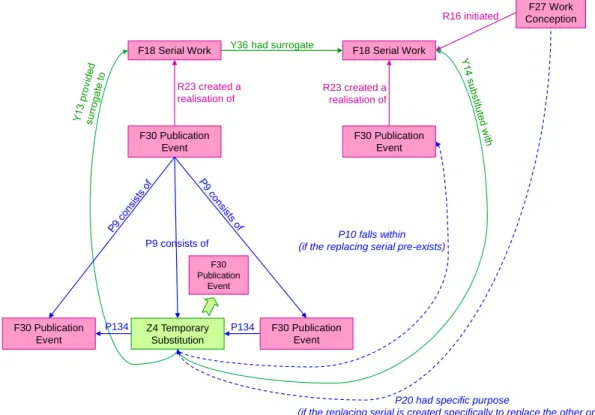
Figure 10 shows how a case of temporary replacement of a serial with another serial (whether that other serial pre-existed the replacement or was created specifically on that occasion) is modelled in PRESS
OO.
F18 Serial Work
Z4 Temporary Substitution F18 Serial Work
F30 Publication Event
F30 Publication Event F30 Publication
Event
R23 created a realisation of
Y36 had surrogate
F27 Work Conception
F30 Publication Event
F30 Publication
Event
R23 created a realisation of
R16 initiated
P9 consists of
P134 P134
P10 falls within (if the replacing serial pre-exists)
P20 had specific purpose
(if the replacing serial is created specifically to replace the other one)
Figure 10. Modelling the temporary replacement of a serial with another serial The replacement does not put an end to the event of publication of the serial, but is regarded as a component of the overall activity that consists of publishing the serial (Z4 Temporary
Substitution is declared as a subclass of F30 Publication Event, which makes a clear distinction between a (temporary) replacement and a continuation, since the notion of continuation is understood as a specific case of Z1 Serial Transformation, which is subclass of F27 Work Conception). If the replacing serial pre-exists the replacement and continues to be published after the replacement period is over, then the replacement just P10 falls within the publication event that creates a realisation of the replacing serial. If the replacing serial is created specifically for the purpose of replacing the earlier serial (and ceases to be published after the replacement period is over), then it is possible to assert that the instance of F27 Work Conception that initiated the replacing serial P20 has specific purpose the instance of Z4 Temporary Substitution.
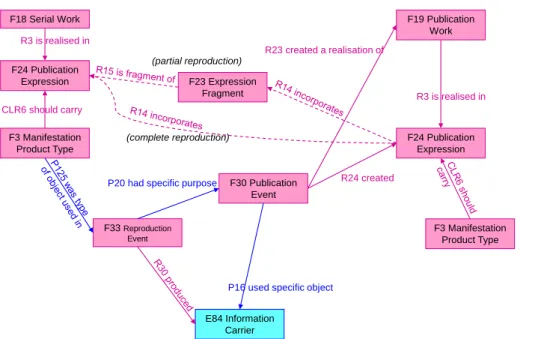
Figure 11 shows how the facsimile reprint of a (dead) serial as a monograph is modelled in
FRBR
OO(there was no need to introduce any new class or property in PRESS
OOas everything
that was required was already present in FRBR
OO).
F33 Reproduction Event F3 Manifestation
Product Type F24 Publication
Expression F18 Serial Work
R3 is realised in
CLR6 should carry
F19 Publication Work
F24 Publication Expression R3 is realised in
E84 Information Carrier
F3 Manifestation Product Type F30 Publication
Event
R23 created a realisation of
R24 created
P16 used specific object P20 had specific purpose
F23 Expression Fragment
(complete reproduction) (partial reproduction)
Figure 11. Modelling the relationship between a (dead) serial and its facsimile reprint as a monograph
The reprint is not necessarily a serial by its own nature; but end-users will usually expect to retrieve it even if they restrict their query parameters in a library catalogue to serials only. The R14 incorporates property between the two instances of F24 Publication Expression, in addition to the path from F18 Serial Work to F19 Publication work (the reprint) through F33 Reproduction Event, makes it possible to bypass this restriction and to include the reprint in the hit list without having to qualify wrongly the reprint as a serial.
Figure 12 shows how the digitization of a (dead) serial, and the subsequent publication of the resulting digital file on the Web, are modelled in FRBR
OO, with the adjunction of the
corresponding classes in CRMdig (an extension of the CIDOC CRM model that deals specifically with digitization processes and digital preservation).
F33 Reproduction Event F3 Manifestation
Product Type F24 Publication
Expression F18 Serial Work
R3 is realised in
CLR6 should carry
F19 Publication Work
F24 Publication Expression R3 is realised in
E84 Information Carrier
F30 Publication Event
R23 created a realisation of
R24 created
P16 used specific object P20 had specific purpose
F23 Expression Fragment
(complete reproduction) (partial reproduction)
F53 Material Copy R6 carries
File(s) downloaded on a local computer
= D2 Digitization Process
= D1 Digital Object
= D13 Digital Information Carrier
Figure 12. Modelling the relationship between a (dead) serial
and its digitization made available online
The resulting digital files are not necessarily published in the form of a serial: they can also be published as monographs. Once again, the R14 incorporates property makes it possible to retrieve the digitization as a match to a query restricted on serials without having to qualify wrongly the digitization as a serial if it has been released as a monograph.
A cumulative issue that repeats the content of several previously released issues of a serial can be modelled as a publication that incorporates a fragment of the overall expression of a serial work (see Figure 13).
F23 Expression Fragment F24 Publication
Expression F18 Serial Work
R3 is realised in
R15 has fragment
F19 Publication Work
F24 Publication Expression R3 is realised in
R14 incorporates
Figure 13. Modelling the relationship between a serial and a cumulative issue
Naming conventions
The following naming conventions have been applied throughout PRESS
OO:
- Classes borrowed from CIDOC CRM are identified by numbers preceded by the letter ‘E’, and are named using noun phrases. For example: E7 Activity.
- Classes borrowed from FRBR
OOare identified by numbers preceded by the letter ‘F’, and are named using noun phrases. For example: F1 Work.
- Classes declared for the first time in PRESS
OOare identified by numbers preceded by the letter ‘Z’ (which was chosen just because it is the last letter in the alphabet, and has no other meaning here), and are named using noun phrases. For example: Z1 Serial Transformation.
- Properties borrowed from CIDOC CRM are identified by numbers preceded by the letter
‘P’, and are named in both directions using verbal phrases. For example: P1 identifies (is identified by).
- Properties borrowed from FRBR
OOare identified by numbers preceded by the letter ‘R’, the letters ‘CLP’ or the letters ‘CLR’, and are named in both directions using verbal phrases. For example: R3 is realised in (realises); CLP2 should have type (should be type of); CLR6 should carry (should be carried by).
- Properties declared for the first time in PRESS
OOare identified by numbers preceded by the letter ‘Y’ (which was chosen just because it is the next to last letter in the alphabet, and has no other meaning here), and are named in both directions using verbal phrases. For example: Y1 provided a continuation to (was continued through).
- Property names should be read in their non-parenthetical form for the domain-to-range direction, and in parenthetical form for the range-to-domain direction.
- Properties with a range that is a subclass of E59 Primitive Value have no parenthetical name form, because reading the property name in the range-to-domain direction is not regarded as meaningful.
- Properties that have identical domain and range are either symmetric or transitive.
Instantiating a symmetric property implies that the same relation holds for both the domain-to-range and the range-to-domain directions. For example: F18 Serial Work. Y33 was merged with: F18 Serial Work. The names of symmetric properties have no parenthetical form, because reading in the range-to-domain direction is the same as the domain-to-range reading. Transitive asymmetric properties have a parenthetical form that relates to the meaning of the inverse direction. For example: F18 Serial Work. Y34 was merged to form (resulted from merging): F18 Serial Work.
Property quantifiers
Quantifiers for properties are provided for the purpose of semantic clarification only, and should not be treated as implementation recommendations. Therefore the term ‘cardinality constraints’
is avoided here, as it typically pertains to implementations.
The following table lists all possible property quantifiers occurring in this document (for either properties declared specifically for the PRESS
OOmodel, or properties repeated from FRBR
OOand CIDOC CRM) by their notation, together with an explanation in plain words. In order to
provide optimal clarity, two widely accepted notations are used redundantly in this document, a
verbal and a numeric one. The verbal notation uses phrases such as ‘one to many,’ and the
numeric one, expressions such as ‘(0,n:0,1).’ While the terms ‘one,’ ‘many,’ and ‘necessary’ are
quite intuitive, the term ‘dependent’ denotes a situation where a range instance cannot exist
without an instance of the respective property. In other words, the property is ‘necessary’ for its
range.
many to many
(0,n:0,n) Unconstrained: An individual domain instance and range instance of this property can have zero, one or more instances of this property. In other words, this property is optional and repeatable for its domain and range.
one to one
(0,1:0,1) An individual domain instance and range instance of this property can have zero or one instance of this property. In other words, this property is optional for both its domain and range, and is not repeatable for either its domain or its range.
one to many (0,n:0,1)
An individual domain instance of this property can have zero, one or more instances of this property, but an individual range instance cannot be referenced by more than one instance of this property. In other words, this property is optional for its domain and range, but repeatable for its domain only. In some contexts this situation is called a “fan-out”.
many to one
(0,1:0,n) An individual domain instance of this property can have zero or one instance of this property, but an individual range instance can be referenced by zero, one or more instances of this property. In other words, this property is optional for its domain and range, but repeatable for its range only. In some contexts this situation is called a “fan-in”.
many to many, necessary (1,n:0,n)
An individual domain instance of this property can have one or more
instances of this property, but an individual range instance can have zero, one or more instances of this property. In other words, this property is necessary and repeatable for its domain, and optional and repeatable for its range.
one to many, necessary (1,n:0,1)
An individual domain instance of this property can have one or more instances of this property, but an individual range instance cannot be referenced by more than one instance of this property. In other words, this property is necessary and repeatable for its domain, and optional but not repeatable for its range. In some contexts this situation is called a “fan-out”.
one to one, necessary (1,1:0,1)
An individual domain instance of this property must have exactly one instance of this property, but an individual range instance cannot be referenced by more than one instance of this property. In other words, this property is necessary and not repeatable for its domain, and optional but not repeatable for its range.
many to one, necessary (1,1:0,n)
An individual domain instance of this property must have exactly one instance of this property, but an individual range instance can be referenced by zero, one or more instances of this property. In other words, this property is necessary and not repeatable for its domain, and optional and repeatable for its range. In some contexts this situation is called a “fan-in”.
one to many, necessary, dependent (1,n:1,1)
An individual domain instance of this property can have one or more
instances of this property, but an individual range instance must be referenced
by exactly one instance of this property. In other words, this property is
necessary and repeatable for its domain, and necessary but not repeatable for
its range. In some contexts this situation is called a “fan-out”.
many to one, necessary, dependent
(1,1:1,n)