九州大学学術情報リポジトリ
Kyushu University Institutional Repository
パルス中性子ビームを用いた118Sn の中性子誘起複 合核から放出されるガンマ線の角分布測定
古賀, 淳
http://hdl.handle.net/2324/4474934
出版情報:Kyushu University, 2020, 博士(理学), 課程博士 バージョン:
権利関係:Statement of depositing dissertation and fulltext file have not been submitted.
Doctoral Dissertation
Measurement of angular distribution of γ rays from neutron-induced compound states of
118Sn
with a pulsed neutron beam
Jun Koga
Department of Physics Graduate School of Science
KYUSHU UNIVERSITY
Supervisor: Tamaki Yoshioka
Februrary 2021
Abstract
The violation of charged conjugate and parity transformation symmetry (CP- violation) beyond the Standard Model is considered to be essential to explain the asymmetry between matter and antimatter in the current universe. Under the CPT theorem, CP-violation is equal to the violation of time-reversal symmetry (T-violation). Therefore, a number of experiments have been conducted to search for T-violation, and the current strongest limit has been obtained by searching for neutron electric dipole moment (nEDM).
Neutron-induced compound nuclei are expected to be sensitive to T-violation, and it is theoretically predicted that the sensitivity is proportional to a factorκ(J) which depends on the mixing angle ϕ of the 1/2 and 3/2 components of the total angular momentum of the neutron in a p-wave resonance. However, the ϕ has not yet been measured for most nuclei. It is predicted that the p-wave resonance shape depends on both the ϕ and the γ-ray emission angle (θγ) with respect to the direction of the incident neutron. Theϕ can be determined by measuring the angular dependence of the p-wave resonance shape.
This dissertation reports a measurement result of the angular dependence and an analysis result determining the ϕ and the κ(J) for 117Sn. The experiment was performed using a pulsed neutron beam and a germanium detector assembly at Japan Proton Accelerator Research Complex (J-PARC) with the time-of-flight method. The angular dependence of the 1.33 eV p-wave resonance was observed in the direct transition from the compound state of 118Sn to the ground state.
The asymmetry value ALH was defined to evaluate the angular dependence as ALH = (NL −NH)/(NL+NH), where NL(H) is the integrated values in the lower (higher) energy region of the resonance. The result was obtained to be ALH = (0.473±0.057) cosθγ+ (0.091±0.019). Two results obtained by the analysis based on the theoretical formalism are
ϕ = (10.3+6.4−7.2)◦ and |κ(J)|= 0.42+0.05−0.06 or
ϕ = (−80.8+7.1−6.4)◦ and |κ(J)|= 2.6+6.8−1.3.
T-violation in the compound nuclear reaction will be searched by irradiating a polarized neutron beam into a polarized target and measuring a T-odd term in the neutron forward scattering amplitude. Assuming that the polarization of the neutron beam and 117Sn target with a thickness of 5 cm is 85% and 20%, the measurement time to improve the current upper limit for T-violation by the nEDM search was estimated to be approximately 10 days in the case ofϕ =−80.8◦.
Acknowledgments
First of all, I would like to sincerely thank my supervisor, Professor Tamaki Yoshioka. He always gave great advice and comments for this study. Without his guidance and persistent help, this dissertation would not have been possible.
Moreover, his attitude as a scientist deeply influenced my life. It was one of the greatest fortunes in my life to spend my master’s and doctoral programs as his student.
I also wish to express my gratitude to Professor Kiyotomo Kawagoe. He keeps encouraging and guiding me since the time of my undergraduate school. I think that I was able to grow by being given the opportunities to go overseas for the experiment and the international school. If he had not established his laboratory, I could not have started this study.
I would like to thank all the collaborators of the NOPTREX experiment and Neutron Optics and Physics. I am deeply grateful to Professor Hirohiko M.
Shimizu, Professor Masaaki Kitaguchi, and Professor Katsuya Hirota. Their tech- nical advice and comments on the experiment and analysis helped me extensively.
I would like to express my appreciation to Dr. Takuya Okudaira, Dr. Tomoki Ya- mamoto, and Mr. Shusuke Takada. I really enjoyed the experiments in J-PARC and discussion with them. Especially, Mr. Shusuke Takada supported me from the beginning of this study, and we had a great deal of discussions on physics and we spent a lot of time together in and out the laboratory. I would like to offer my special thanks to Dr. Kenji Mishima. He supported me extensively and gave great advice on neutron experiments. Without his help, I would not have been able to publish my study on the neutron life measurement.
I owe a very important debt to the staffs of the MLF at J-PARC for providing the neutron beam and the experimental instruments. I am particularly grateful for the assistance given by Dr. Atsushi Kimura and Dr. Shoji Nakamura. They maintained the instruments at BL04, and their technical advice to analyze the measured data was crucial for my research.
Not just the collaborators, I would also like to thank the staffs of the laboratory, including Professor Junji Tojo, Dr. Hidetoshi Otono, Dr. Susumu Oda, Dr. Taikan Suehara, Dr. Dai Kobayashi, and Ms. Saori Shigematsu. I would also like to thank all those whose names I have not mentioned but who supported my study and tenure.
Last but not the least, I am deeply grateful to my family, who allowed me to study and provided financial support throughout my life.
Contents
1 Introduction 13
1.1 Overview of this dissertation . . . 13
1.2 Discrete symmetry violation . . . 13
1.3 CP-violation in the Standard Model . . . 14
1.4 Asymmetry between matter and antimatter . . . 15
1.5 CP-violation in low-energy scale . . . 16
2 Discrete symmetry violation in a compound nucleus 20 2.1 Parity violation . . . 20
2.1.1 P-violation in proton-proton scattering . . . 20
2.1.2 Enhancement of P-violation in a compound nucleus . . . 21
2.2 Enhancement of T-violation in a compound nucleus . . . 25
2.3 NOPTREX project . . . 27
2.3.1 Measurement principle of the T-violation search . . . 27
2.3.2 Candidate nuclei for the T-violation search . . . 30
2.3.3 Properties of117Sn . . . 31
3 Angular correlation in (n, γ) reaction 34 3.1 Formalism of cross section of (n, γ) reaction . . . 34
3.2 Angular correlation of cross section for unpolarized neutrons . . . . 38
3.3 Previous study for determining the ϕ value . . . 42
4 Experimental setup 45 4.1 J-PARC facility . . . 45
4.2 Beamline 04 ANNRI . . . 47
4.2.1 Beamline setup . . . 47
4.2.2 Energy resolution of the neutron beam . . . 48
4.3 Germanium detector assembly . . . 53
4.3.1 Geometry of germanium detector assembly . . . 53
4.3.2 Simulation of germanium detectors . . . 58
4.4 Data acquisition system . . . 59
5 Measurements 63 5.1 Experimental condition . . . 63
5.2 Nuclear targets . . . 64
5.2.1 Tin target with natural abundance . . . 64
5.2.2 117Sn-enriched tin target . . . 64
5.2.3 Boron carbide target . . . 64
5.3 Collected data . . . 65
5.3.1 Measurement of spectrum for 117Sn(n, γ) reactions . . . 65
5.3.2 Measurement of the beam intensity spectrum . . . 69
6 Analysis 71 6.1 Overview of analysis . . . 71
6.2 Definition of signal regions . . . 72
6.3 Spectrum correction and normalization . . . 74
6.3.1 Background subtraction . . . 75
6.3.2 Pile-up events correction . . . 76
6.3.3 Normalization of energy dependence of neutron beam intensity 77 6.4 Determination of resonance parameters . . . 79
6.4.1 Doppler broadening effect . . . 79
6.4.2 Convolution of neutron energy resolution . . . 80
6.4.3 Self-shielding effect . . . 81
6.4.4 Determination of resonance parameters . . . 84
6.5 Determination of relative transition ratios . . . 85
6.6 Angular dependence of p-wave resonance shape . . . 88
6.7 Estimation of systematic errors . . . 90
6.7.1 Range of signal region . . . 90
6.7.2 Neutron scattering effect inside the nuclear target . . . 90
6.7.3 Precision of the nuclear target position . . . 91
6.8 Determination of the mixing angle ϕ and theκ(J) . . . . 93
7 Discussion 95 7.1 Comparison with previous study . . . 95
7.2 Estimation of the sensitivity for the T-violation search . . . 96
7.2.1 Estimation of the upper limit ofWT/W . . . 96
7.2.2 Estimation of the measurement time using polarized neu- trons and polarized target . . . 96
7.3 Future prospects . . . 101
8 Conclusion 102
A Spin-dependent scattering length of nucleus 103 B Differential cross section in (n, γ) reaction 104
References 108
List of Figures
1.1 Schematic plot of the hierarchy of scales between the CP-odd sources
and three generic classes of observable EDMs . . . 17
1.2 Sensitivity of EDMs and LHC to supersymmetric baryogenesis in the minimal supersymmetric standard model . . . 18
1.3 History of the upper limit of nEDM . . . 18
1.4 Relationship between nEDM and compound state in parameter space 19 2.1 Longitudinal asymmetry in various nuclei . . . 22
2.2 Illustration of a p-wave resonance located at the tail of an s-wave resonance . . . 22
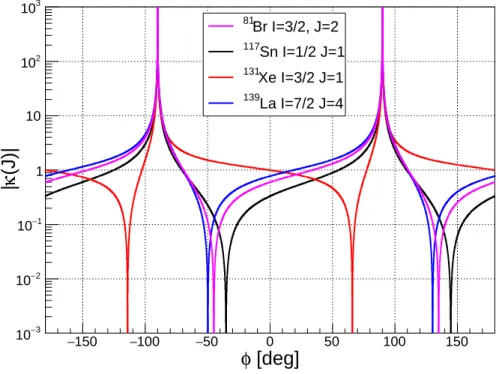
2.3 Comparison of the ϕ dependence of the absolute value of κ(J) for several nuclei . . . 27
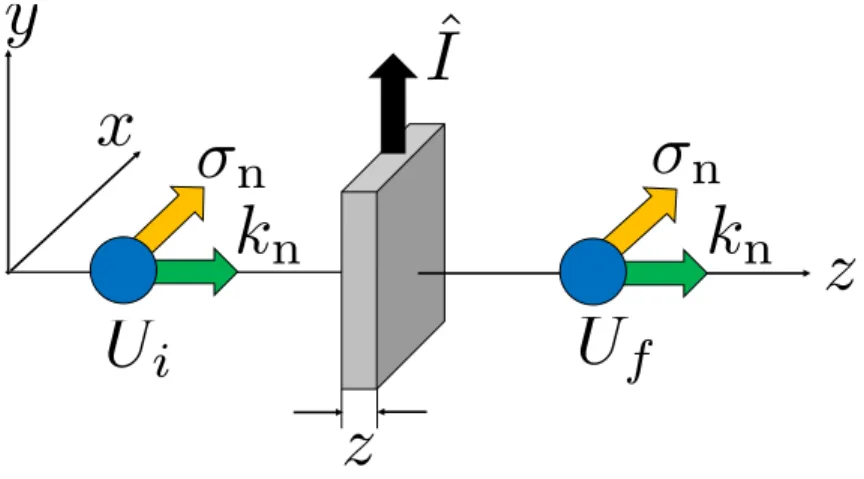
2.4 Measurement principle of D term with polarized neutrons and a polarized target . . . 29
2.5 Combinations of observables proportional to the D term . . . 30
2.6 Cross sections of 117Sn with neutron . . . 32
2.7 Transitions from 117Sn+n to 118Sn . . . 33
3.1 Feynman diagrams for amplitudes in (n,γ) reaction . . . 35
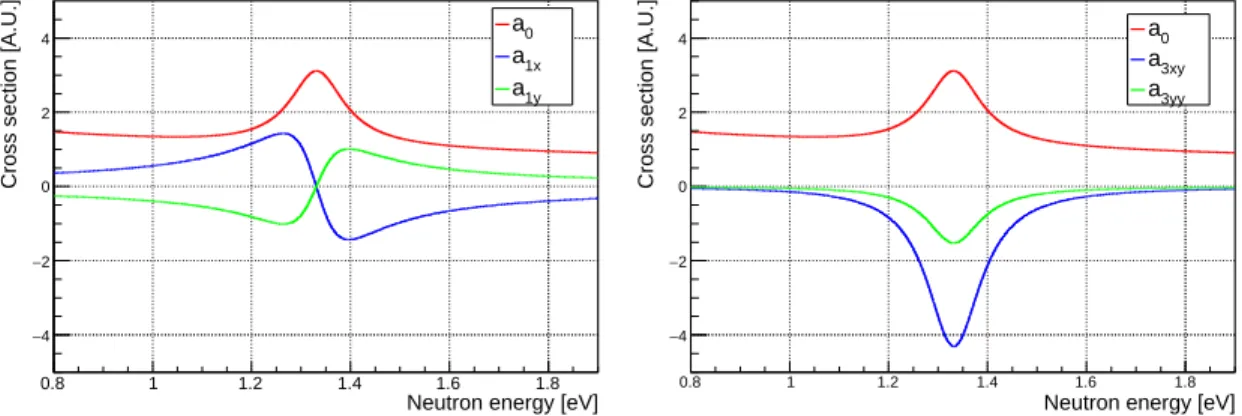
3.2 Neutron energy dependence of each term in (n,γ) reaction . . . 40
3.3 Variables ϕ and θγ dependencies of the p-wave resonance . . . 40
3.4 Angular dependence of differential cross section caused by a3 term . 42 3.5 Previous result by Alfimenkov et al. . . . 43
4.1 Bird’s eye view of J-PARC . . . 46
4.2 Beamlines in MLF . . . 46
4.3 Schematic view of ANNRI installed at the beamline 04 . . . 47
4.4 Examples of the simulated time structure of the neutron beam and fitting results . . . 50
4.5 Energy dependence of parameters in Ikeda-Carpenter function . . . 50
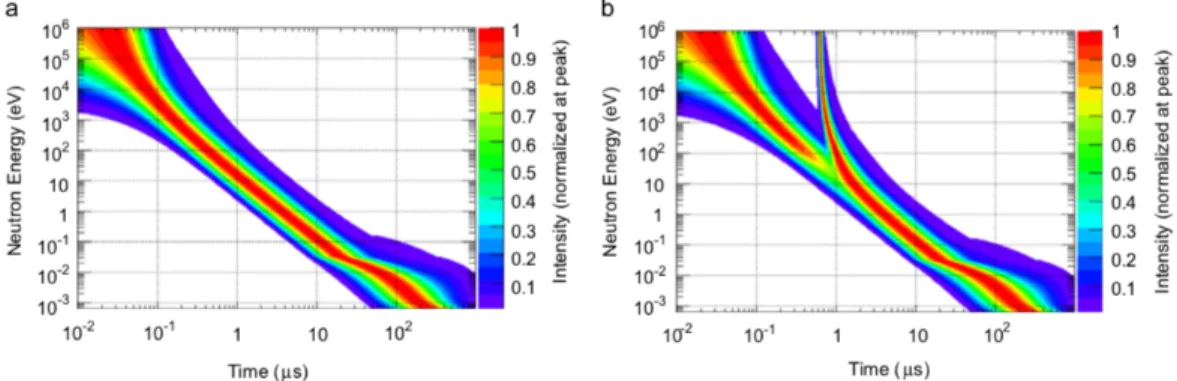
4.6 Two-dimensional plots of the time and energy of neutrons at the moderator surface . . . 51
4.7 Energy resolution of the neutron beam at ANNRI based on simulation 52 4.8 Comparison of energy resolution between simulation and measure- ments . . . 52
4.9 Configuration of the germanium detector assembly . . . 54
4.10 Crystal shapes of cluster-type and coaxial-type detector . . . 54
4.11 Cut view of the upper cluster-type detector unit . . . 55
4.12 Schematic view of the coaxial-type detector unit . . . 56
4.13 Schematic view of a coaxial detector . . . 56
4.14 Comparison ofγ-ray energy spectrum between simulation and mea- surement with a radioactive source 137Cs . . . 58
4.15 Comparison ofγ-ray energy spectrum between simulation and mea- surement with a melamine target . . . 59
4.16 Distribution of γ-ray detection angle . . . 59
4.17 Block diagram of V1724 module . . . 60
4.18 Simplified signal scheme on signal processing . . . 61
4.19 Effect of trapezoid overlapping in the four main cases . . . 62
5.1 Cross sections of 10B . . . 66
5.2 TOF spectrum of γ rays from the natSn(n, γ) reactions . . . 67
5.3 Spectrum of γ-ray energy from the natSn(n, γ) reactions . . . 67
5.4 TOF spectrum of γ rays from thenatSn(n, γ) reactions with the self filter . . . 68
5.5 TOF spectra measured with and without 117Sn-enriched target . . . 69
5.6 Spectrum of γ-ray energy with the boron carbide target . . . . 70
5.7 Energy dependence of the neutron beam intensity . . . 70
6.1 Analysis flow chart . . . 72
6.2 Definition of signal region for γ-ray peaks . . . . 73
6.3 Signal regions for γ-ray peaks in measurement data . . . . 74
6.4 Neutron-energy spectrum gated with the signal regions for all de- tectors . . . 74
6.5 Spectrum of γ-ray energy of each background component . . . . 75
6.6 Comparison of neutron-energy spectrum before and after subtraction 76 6.7 Correction ratio of pile-up events for neutron-energy spectrum . . . 77
6.8 Comparison of neutron-energy spectrum between before and after pile-up events correction . . . 78
6.9 Comparison of neutron-energy spectrum between before and after the beam intensity normalization . . . 78
6.10 Doppler broadening effect . . . 80
6.11 Breit-Wigner function convoluted the Doppler broadening effect and energy resolution . . . 81
6.12 Distribution of neutron flux inside the target . . . 82
6.13 Distribution of (n,γ) reactions inside the target . . . 82
6.14 Self-shielding effect for the s-wave resonance . . . 83
6.15 Cross-section dependence of self-shielding factor . . . 84
6.16 Fitting result of the p-wave resonance for determining resonance parameters . . . 85
6.17 Fitting result of the s-wave resonance for determining resonance parameters . . . 86
6.18 Fitting result for determining the relative transition ratios of nega- tive and p-wave resonances . . . 87
6.19 Fitting result for determining the relative transition ratio of s-wave
resonance . . . 87
6.20 Neutron-energy spectrum at the vicinity p-wave resonance of each angle . . . 88
6.21 Definition of the integral ranges for the asymmetry ALH . . . 89
6.22 Angular dependence of the ALH value . . . 90
6.23 Change of angular dependence for ranges of signal regions . . . 91
6.24 Neutron-energy dependence of backscattering ratio . . . 92
6.25 Side view of the target and holder . . . 93
6.26 Visualization of the ϕ on the xy-plane . . . . 94
6.27 The absolute value of κ(J) for117Sn . . . 94
7.1 Comparison of the value of ϕ with the previous study . . . 95
7.2 FOM of 3He spin filter at neutron energy of 1.33 eV . . . 99
7.3 Polarization, Transmission, and FOM of 3He spin filter . . . 99
7.4 Measurement time for polarization of 117Sn target . . . 100
7.5 Difference of a2 term between the values of ϕ . . . 101
List of Tables
2.1 Previous results on P-violation in p-p scattering . . . 21
2.2 Candidate nuclei for T-violation search . . . 31
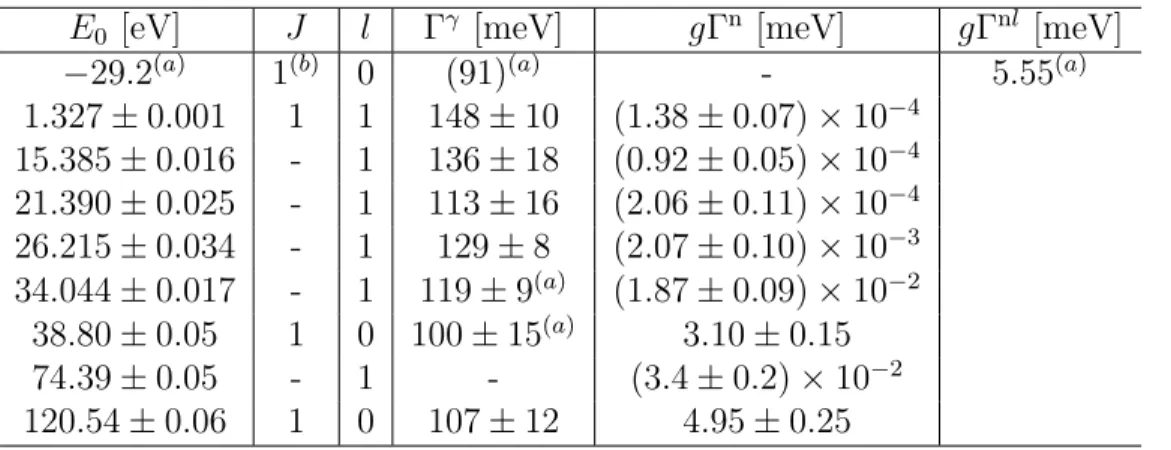
2.3 Resonance parameters of 117Sn . . . 32
3.1 Comparison with previous study . . . 44
4.1 Characteristics of moderators in MLF . . . 47
4.2 Setting angle of each germanium detector . . . 57
5.1 Summary of experimental condition . . . 63
5.2 Properties of tin isotopes . . . 64
5.3 Composition of 117Sn-enriched tin target . . . 65
6.1 Resonance parameters and relative transition ratios of 117Sn in this work. . . 88
6.2 Summary of errors for the slope of ALH . . . 92
Chapter 1 Introduction
1.1 Overview of this dissertation
It is theoretically predicted that neutron-induced compound states would be highly sensitive to the violation of time-reversal symmetry (T-violation) due to an en- hancement mechanism. The sensitivity to T-violation depends on a parameter ϕ. In order to determine the ϕ value precisely, the measurement was performed at Japan Proton Accelerator Research Complex (J-PARC). This dissertation de- scribes that the determination of the ϕ value and the possibility of a T-violation search experiment using the compound nuclear reaction of 117Sn.
In Chapter 1, the history of discrete symmetry violation and the current status of the T-violation search are described. Chapter 2 describes a theoretical predic- tion of the enhancement mechanism for T-violation in compound nuclear reactions.
The ϕ value can be determined by measuring the angular distribution of γ rays emitted from the neutron-induced compound states. In Chapter 3, the theoreti- cal formalism of the angular distribution and the differences between a previous study and this study are described. Chapter 4 describes the experimental setup, characteristics of a neutron beam and detectors, and a data acquisition system.
Measurement data and targets used in the measurements are described in Chap- ter 5. An analysis method is explained in Chapter 6 and theϕvalue is determined.
Chapter 7 compares this study with the previous study and discusses the exper- imental sensitivity of T-violation and future prospects. Chapter 8 concludes this dissertation.
1.2 Discrete symmetry violation
Before the 1950s, physical law was considered invariant to a particular direction or location. The invariance of physical systems with respect to transformation leads to a conservation law, which is known as Noether’s theorem. For example, invariances with respect to spatial translation and rotation give the conservation laws of linear momentum and angular momentum, respectively. In this case, linear momentum p and angular momentum L satisfy [p, H] = 0 and [L, H] = 0, where H is a Hamiltonian in the system. This idea can be applied to discrete transfor-
mations: parity (P) and time-reversal (T) transformations. Parity transformation indicates the flip in the sign of a spatial coordinate. Time-reversal transformation is the reversal of the direction of time. Invariance of the physics law to parity and time-reversal transformation also requires [P, H] = 0 and [T, H] = 0. In addition, charge conjugation (C) transformation is defined in particle physics as the change of a particle into its antiparticle. These discrete transformations were believed to have symmetries to the physical law.
In 1956, T. D. Lee and C. N. Yang proposed a possibility of P-violation in the weak interaction as a solution of the θ-τ puzzle [1]. In 1957 [2], C. S. Wu et al. experimented to verify this postulate by measuring the angular distribution of electrons from polarized 60Co via β decay. This experiment established that electrons are likely to emit in the direction opposite to the spin of 60Co. This asymmetric distribution to the spin direction is direct evidence of P-violation.
In 1964, CP-violation in the weak interaction was observed in the decay process of neutral kaon by J. H. Christenson et al. [3]. The two types of kaon K1 and K2 have different charge-conjugation and parity (CP) eigenstates. K1 decays to two pions (π0π0 and π+π−) and K2 decays to three pions (π0π0π0 and π0π+π−). Two more types of kaon KL and KS were also observed. They have different lifetimes:
τL = 5.2×10⁻⁸ s and τS = 8.9×10⁻¹¹ s. KL and KS were believed to be exactly K2 and K1, respectively. However, J. H. Christenson et al. discovered that KL decays to two pions with a branching ratio of 2.2×10⁻³. This means that KL and KS are the mixtures of two different CP eigenstates.
In addition, CP-violation was also observed in the decay process of B meson at Belle experiment [4] and BaBar experiment [5]. These experiments are known as the B-factories because the electrons collide with the positrons at the center- of-mass energy equal to the mass of Υ(4S) which decays toBB¯ pairs. In the Belle experiment, B and ¯B mesons can fly longer than the value of cτ, where c is the speed of light andτ is the average lifetime of the B meson. This is because their lifetimes in the observer’s rest frame are increased by the Lorentz boost factor, which is caused by the asymmetric energy collision. The difference in decay rates betweenB and ¯B mesons was observed by measuring the difference of the average flight lengths between them.
1.3 CP-violation in the Standard Model
The observed CP-violation can be explained by the Standard Model (SM) of par- ticle physics. In the SM, there are two possible sources of CP-violation. One is the complex phase of the Cabibbo-Kobayashi-Maskawa (CKM) matrix [6]. The charged current by theW boson exchange is described as
jµ= (¯u,c,¯ ¯t)γµ(1−γ5)
2 VCKM
d s b
, (1.1)
where γµ is the gamma matrix, γ5 = iγ0γ1γ2γ3. VCKM is a 3×3 unitary matrix which can be parameterized by three mixing angles and the CP-violating complex
phase and given as VCKM =
Vud Vus Vub Vcd Vcs Vcb Vtd Vts Vtb
=
1 0 0 0 c23 s23 0 −s23 c23
c13 0 s13e−iδ
0 1 0
s13eiδ 0 c13
c12 s12 0
−s12 c12 0
0 0 1
=
c12c13 s12c13 s13e−iδ
−s12c23−c12c23eiδ −c12c23−s12s23s13eiδ s23c13 s12c23−c12c23s13eiδ −c12c23−s12c23s13eiδ c23c13
, (1.2)
where sij = sinθij, cij = cosθij, and δ is the phase responsible for CP-violating phenomena in flavor-changing processes in the SM. The values of these parameters are s12 = 0.22650± 0.00048, s13 = 0.00361−+0.000110.00009, s23 = 0.04053+0.00083−0.00061, and δ= 1.196+0.045−0.043, respectively [7].
The other CP-violating source is the θ term in the Quantum Chromodynamics (QCD) which describes the strong interaction of colored quarks and gluons. The Lagrangian of QCD is given by
LQCD = ∑
q
ψ¯q,a(iγµ∂µδab−gsγµtCabACµ −mqδab)ψq,b
− 1
4FµνAFAµν + gs2θ
32π2FµνAF˜Aµν, (1.3) where the ψq,a are quark-field spinors for a quark flavor q with its mass mq, and an index a runs from a = 1 to Nc = 3 which indicates the three colors. The ACµ is the gluon field and an index C runs from 1 to Nc2−1 = 8 which indicates eight types of gluons. The tCab corresponds to eight 3×3 matrices which are defined as Gell-Mann matrices. The field tensorFµνA is given by
FµνA = ∂µAAν −∂νAAµ −gsfABCABµACµ (1.4) [tA, tB]
= ifABCtC (1.5)
F˜Aµν = 1
2ϵµνσρFAσρ, (1.6)
where the fABC are the structure constants of the SU(3) group and ϵµνσρ is the antisymmetric Levi-Civita symbol. The 3rd term of Eq. (1.3) corresponds to the CP-violating term in the QCD Lagrangian. However, the value of θ is limited to
|θ|≲10−10by experimental results. This indicates that CP-violation in the strong interaction is very small, and this is called the strong CP problem.
1.4 Asymmetry between matter and antimatter
In the early stages of the universe with a high-density and high-energy state, it
repeating pair productions and annihilations, and the number of particles was the same as that of antiparticles. However, the matter-antimatter asymmetry indicates an imbalance between baryonic and antibaryonic matter in the currently observed universe. The asymmetry between baryons and antibaryons is evaluated using the parameter η as
η≡ nB−nB¯
nB+nB¯
= nB−nB¯
nγ ∼10−9, (1.7)
where nB and nB¯ are number densities of baryons and antibaryons, respectively.
The nγ is the number density of photons. On the other hand, the theoretical estimation from the SM is done as follows [8];
nB−nB¯
nB+nB¯
∼10−18. (1.8)
This large discrepancy is one of the most important problems in particle physics and cosmology and implies that the SM cannot explain the current matter-dominant universe. In 1967, A. Sakharov proposed three conditions which are critical for the explanation of the matter-dominant universe. The three ”Sakharov conditions”
are [9]:
• Baryon number violation.
• C- and CP-violation.
• Interaction outside thermal equilibrium.
The 2nd condition suggests that there is a possibility of unknown CP-violation sources beyond the SM. This implies the existence of unknown T-violation sources under the CPT theorem [10, 11].
1.5 CP-violation in low-energy scale
Multiple experimental searches for T-violation have been conducted in the world.
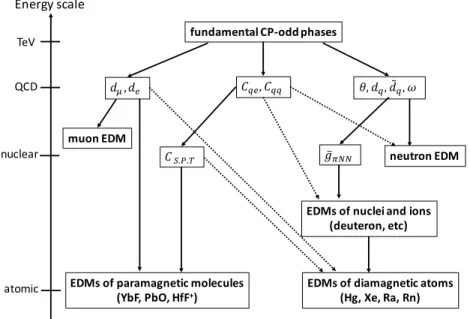
Figure 1.1 shows the hierarchy of scales between the CP-odd sources and three generic classes of observable electric dipole moments (EDMs). The fundamental CP-odd phase appears several EDMs through different paths in low-energy scale.
This idea is based on the effective field theory (EFT).
The reason why a non-zero value of the EDM indicates the existence of T- violation is explained as follows. The Hamiltonian of interactions between a par- ticle and an electromagnetic field can be written using a magnetic momentµ and an EDMd as
H =−µ·B−d·E, (1.9)
whereB and E are a magnetic field and an electric field, respectively. Under the T transformation, B, E, µ, and dare transformed as
B→ −B,E →E,µ→ −µ,d→ −d. (1.10)
Energy scale
fundamental CP-odd phases
𝜃, 𝑑$, 𝑑%$, 𝜔
𝑑', 𝑑( 𝐶$(, 𝐶$$
𝐶 +.-.. 𝑔̅122 neutron EDM
muon EDM
EDMs of paramagnetic molecules (YbF, PbO, HfF+)
EDMs of nuclei and ions (deuteron, etc)
EDMs of diamagnetic atoms (Hg, Xe, Ra, Rn) TeV
QCD
nuclear
atomic
Figure 1.1: Schematic plot of the hierarchy of scales between the CP-odd sources and three generic classes of observable EDMs. The dashed lines indicate generically weaker dependencies [12].
Therefore, the Hamiltonian is transformed in the T-transformed coordinate as
H =−µ·B+d·E. (1.11)
If the value ofd is non-zero, the Hamiltonian H will change by the T transforma- tion. This means that a non-zero EDM value of the particle implies the existence of T-violation.
The neutron EDM (nEDM) has been studied for a long time. Because it is a simpler system than massive atoms, it is relatively easy to compare the experimen- tal results with the theoretical calculations. In addition, nEDM search is expected to be sensitive to supersymmetric baryogenesis in the minimal supersymmetric standard model (MSSM). As an example, the nEDM search for O(10−27) e·cm can exclude MSSM more effectively than collider experiments as shown in Fig. 1.2.
However, it is hard to obtain sufficient statistics due to the short lifetime of neu- trons and the difficulty in generating neutrons. Figure 1.3 shows a historical plot of the upper limit of nEDM. The current upper limit was obtained by the experiment conducted at Paul Scherrer Institute (PSI) as
|dn|<1.8×10⁻²⁶ e·cm (90% C.L.). (1.12) The error of this experimental result is largely due to statistical errors. The de- velopment of technology to increase the number of neutrons is essential to further improve accuracy.
One of the different methods to search for T-violation employs a neutron-
Figure 1.2: Sensitivity of EDMs and LHC to supersymmetric baryogenesis in the minimal supersymmetric standard model [13]. The horizontal axis is the gaugino mass M1 and the vertical axis is the supersymmetric mass µ. The red region was excluded by the Large Electron-Positron Collider (LEP) experiment. The limit of electron EDM excludes the cyan region. The blue bands lead to the observed baryon asymmetry η. Large Hadron Collider (LHC) and nEDM searches will probe the region to the left of the green-dashed lines and the black-dashed lines, respectively.
1950 1960 1970 1980 1990 2000 2010 2020 2030
Publication year
−27
10
−26
10
−25
10
−24
10
−23
10
−22
10
−21
10
−20
10
−19
10
−18
10
Upper limit of nEDM [ecm]
Figure 1.3: History of the upper limit of nEDM [14–28].
in 1936 [29]. When a neutron irradiates into a target nucleus, the energy of the incident neutrons is distributed to each nucleon in the nucleus, and the nucleons repeatedly collide with each other. The energy exchanged between the nucleons is small, and it takes time of approximately 10−16seconds for the excess energy to be released. This time is much longer than that of approximately 10−22 seconds that a neutron with the energy of a few MeV takes to pass through a nucleus without interactions. Such long-excited states can be treated as a type of nucleus with a lifetime, which allows defining internal degrees of freedom such as spin.
The compound nuclear reaction is sensitive to the coupling constant of pion exchange interaction between nucleons. Therefore, experimental searches using the compound nuclear reaction are sensitive to the T-violating coupling constant
¯
gπN N shown in Fig. 1.1. The T-violating cross section in the compound nuclear reaction (∆σT) is theoretically estimated as follows [30];
∆σT 2σtot
= −0.185 b 2σtot ×(
¯
gπ(0)+ 0.26¯gπ(1))
. (1.13)
Here, ¯gπ(0) and ¯gπ(1) are isoscalar coupling constant and isovector coupling constant with T-violation, respectively. The variable σtot indicates the total cross section in the compound nuclear reaction. On the other hand, the value of nEDM is estimated using T-violating isotensor coupling constant ¯g(2)π as [31]
dn ≃0.14(
¯
gπ(0)−g¯π(2))
. (1.14)
This implies that the T-violation search using compound nuclear reactions can complementarily explore the parameter space of coupling constants using a differ- ent method than nEDM as shown in Fig. 1.4.
Figure 1.4: Relationship between nEDM and compound state in ¯gπ(0)-¯gπ(2) plane.
The red and blue bands are based on the limits obtained from experiments on nEDM and using the compound state, respectively
Chapter 2
Discrete symmetry violation in a compound nucleus
In this chapter, enhancement mechanisms of P-violation and T-violation in the compound nuclear reactions are explained. Moreover, an experimental approach to T-violating interaction is introduced.
2.1 Parity violation
2.1.1 P-violation in proton-proton scattering
The strong interaction is a dominant process in the nucleon-nucleon interactions.
The parity non-conserving (PNC) effect which is caused by the weak interaction is very small. The relative magnitude of the weak interaction to the strong interaction on the MeV scale is approximately estimated to beαw/αs ∼10−7, whereαwandαs are the strength parameters for the weak and the strong interactions, respectively.
Proton-proton scattering is a fundamental process in nucleon-nucleon interactions.
The PNC effect in the proton-proton scattering has been observed by measuring the helicity dependence of the total cross section using a polarized proton beam and an unpolarized proton target. The magnitude of the PNC effect is described as the longitudinal asymmetry AL,pp as
AL,pp = σ+pp−σpp−
σ+pp+σpp− , (2.1)
where σpp+ and σpp− are the total cross sections for positive- and negative-helicity protons on the target, respectively. The value of the longitudinal asymmetryAL,pp is the ratio of the PNC component to the parity-conserving (PC) component. It has been measured at several incident proton energies and the results are summarized in Table 2.1.
This P-violating effect is theoretically explained as follows. The total amplitude f consists of PC part (fPC) and PNC part (fPNC) as
f =fPC+fPNC. (2.2)
Table 2.1: Previous results of P-violation in p-p scattering.
Proton energy [MeV] AL,pp Reference
15 −(1.7±0.8)×10−7 [32]
45 −(2.3±0.89)×10−7 [33]
45 −(1.3±2.3)×10−7 [34]
221 (0.84±0.29±0.17)×10−7 [35]
800 (2.4±1.1±0.1)×10−7 [36]
2×10⁵ (5±17±20)×10−6 [37]
The absolute square off is to be observed in an experiment as
|f|2 = |fPC+fPNC|2
= |fPC|2 (
1 + fPCfPNC∗ +fPC∗ fPNC
|fPC|2 +|fPNC|2
|fPC|2 )
. (2.3)
The longitudinal asymmetry AL,pp corresponds to the second term in Eq. (2.3) and the size of fPNC to that of fPC is roughly given by the ratio of PC and PNC light-meson-exchange potentials (VPC and VPNC):
AL,pp ≈ fPCfPNC∗ +fPC∗ fPNC
|fPC|2 ≈ |fPNC|
|fPC|
∼ VPNC
VPC ∼GFm2π ∼2×10⁻⁷, (2.4) whereGF andmπ are the Fermi coupling constant and the pion mass, respectively.
This theoretical estimation is consistent with the experimental results measured on the MeV scale. However, the order ofAL,ppon the GeV scale is larger than that on the MeV scale, asαs is smaller due to the nature of running coupling. G. Nardulli et al. estimated that the order of AL,pp isO(10−6) on the GeV scale [38, 39].
2.1.2 Enhancement of P-violation in a compound nucleus
In several neutron-induced compound nuclei, P-violation has been observed by measuring the helicity dependence of the neutron-capture cross section using a polarized neutron beam and an unpolarized target. The P-violation was evaluated as a longitudinal asymmetryAL as
AL= σ+cap−σ−cap
σcap+ +σcap− , (2.5)
where σ+cap and σ−cap are the neutron-capture cross sections of the target nucleus for positive- and negative-helicity neutrons, respectively. Figure 2.1 shows the experimental results of the longitudinal asymmetry AL in various nuclei. These results imply that the P-violation in nucleon-nucleon interactions is enhanced by up to 106 times in neutron-induced compound nuclei. This large-enhanced P- violation has been observed only in p-wave resonances located at the tail of s-wave
1 10 10
210
3Resonance energy [eV]
−1
10 1 10
Longitudinal asymmetry [%]
139La
81Br
117Sn
131Xe
113Cd
115In
232Th
232Th
232Th
107Ag
133Cs
238U
238U
113Cd
232Th
108Pd
108Pd
109Ag
115In
127I
232Th
121Sb
232Th
232Th
127I
Figure 2.1: Longitudinal asymmetry in various nuclei [40].
Figure 2.2: Illustration of a p-wave resonance located at the tail of an s-wave resonance. The large enhanced P-violation has been observed at such p-wave resonances.
The enhancement phenomena can be theoretically explained by interference between amplitudes of the p-wave resonance and a neighboring s-wave resonance (s-p mixing) as follows. The angular momentum of the incident neutronj is given as
j =l+s, (2.6)
wherel is the orbital angular momentum of the incident neutrons andsis its spin.
The angular momentum in a p-wave resonance is either j = 1/2 or j = 3/2, while the angular momentum in an s-wave resonance is only allowed for j = 1/2. The neutron width of an s-wave resonance Γns and that of a p-wave resonance Γnp can be written as
Γns = Γns,j=1/2 and Γpn = Γnp,j=1/2+ Γnp,j=3/2, (2.7) where Γns,j=1/2 is the component of j = 1/2 in an s-wave resonance, and Γnp,j=1/2 and Γnp,j=3/2 are the components of j = 1/2 and j = 3/2in a p-wave resonance, respectively. When the total angular momentum of the compound state J is the same in an s-wave and a p-wave resonance, the two opposite parity states of the incident neutrons, the s-wave state and j = 1/2 part of the p-wave state, can interfere with each other via the weak interaction. Since nucleons in the compound states have a much longer time to interfere with each other than in a direct process, the interference effect between two opposite-parity states can be much larger in the compound states in a direct process.
In the s-p mixing model, the longitudinal asymmetry AL at the p-wave reso- nance can be described as
AL ≃ − 2xW Ep−Es
√ Γns
Γnp, (2.8)
where Es and Ep are the resonance energies of the s- and p-wave resonances, respectively. The individual matrix element of the weak P-violating interaction between the s- and p-wave states is denoted as W. Here, xis given as
x=
√Γnp,j=1/2
Γnp . (2.9)
On the other hand, the ratio of the j = 3/2 part to the neutron width of the p-wave resonance can be written asy =
√
Γnp,j=3/2/Γnp, and x and y satisfy
x2+y2 = 1, (2.10)
because of the relation of Γnp = Γnp,j=1/2 + Γnp,j=3/2. Then a mixing angle ϕ can be defined, andx and y can be written as
x= cosϕ and y= sinϕ. (2.11)
Two types of enhancement mechanisms which are considered to contribute to the large magnitude of AL. One of them is “dynamical enhancement” and the other is “structural enhancement”.
The “dynamical enhancement” originates from the statistical nature of the compound states. The wave functions of s- and p-wave states can be described as the sum of many single particle-hole states in the nuclear shell model calculated by the following equations:
|s⟩=
∑N i
ai|i⟩ and |p⟩=
∑N j
bj|j⟩, (2.12)
where |i⟩ and |j⟩ are the wave functions of the single particle-hole states. The magnitude of coefficients ai and bj are on the order of ∼ 1/√
N as a result of the normalization of the wave functions |s⟩ and |p⟩. The number of states N is estimated as
N ∼ ∆E
D , (2.13)
where ∆E is the energy required for one nucleus to excite from the ground state, and D is the average distance between compound states. The typical values of
∆E ∼106 eV and D∼10 eV make N to be the order of 105. Therefore, the size of the weak matrix element can be estimated as
|W| = |⟨s|HPNC|p⟩|
=
∑N i,j
aibj⟨i|HPNC|j⟩
∼ ⟨i|HPNC|j⟩
N ×√
N . (2.14)
Thus, the factor 2W/(Ep−Es) in Eq. (2.8) can be written as 2W
Ep−Es ∼ |W|
D ∼ ⟨i|HPNC|j⟩
∆E ×√
N , (2.15)
where ⟨i|HPNC|j⟩/∆E is the magnitude of the P-violating effect in the single- particle state and its order is∼10−7. Equation (2.15) shows that the P-violating effect in the compound states is enhanced compared to that in the single-particle state by√
N = 102 ∼103.
The other enhancement factor, “structural enhancement”, comes from the ratio of the neutron widths of two compound states. The neutron width is proportional to a factor of the centrifugal potential, so that the neutron widths of s- and p-wave resonances are described as
Γns ∝kR and Γnp ∝(kR)3, (2.16)
wherek is the neutron momentum, andR is the radius of the nucleus. Therefore, the “structural enhancement” is given as
√ Γns Γnp ∼ 1
kR. (2.17)
Typical values of k ∼ 2×10⁻⁴ fm and R ∼ 10 fm makes the value of 1/kR to be the order of 103. When x is the order of 1, the longitudinal asymmetry AL can become ∼ 10−1. However, x has not been experimentally determined yet for various nuclei.
2.2 Enhancement of T-violation in a compound nucleus
The enhancement mechanism of P-violation described in the previous section can be generalized to other discrete symmetry for the case that two states, having opposite polarities under the symmetry operation, are connected on the entrance channel into the compound states. V. P. Gudkov predicted that T-violation could be also enhanced through the similar mechanism as the enhancement of the P- violation in the compound states [41, 42]. The total angular momentum of the compound state denoted by J is given as
J =l+s+I, (2.18)
where I is the target nuclear spin. The wave function of the compound state is described as |lsI⟩ and is transformed by the P transformation as
Pˆ|lsI⟩ →(−1)l|lsI⟩. (2.19) Equation (2.19) indicates that the eigenvalue for the P transformation is deter- mined by the orbital angular momentum l. This indicates that the P-violating effect is caused by interference between the two states which have different orbital angular momentum. On the other hand, the wave function|lsI⟩is transformed by the time-reversal operation as
Tˆ|lsI⟩ →(−1)iπSyKˆ|lsI⟩, (2.20) where ˆKis the complex conjugate matrix, andSy is theycomponent of the channel spin S described as S =s+I 1. Equation (2.20) indicates the eigenvalue for the time-reversal transformation is determined by the channel spin. The T-violating effect in the compound states is caused by interference between two states which have different channel spins. Therefore, the enhancement of T-violation can be
1TheSy is the imaginary part of the channel spinS. This notation follows that of the Pauli
calculated by recombining angular momenta as
|J(l, S(sI))⟩ = ∑
j
⟨⟨J(j(ls), I)|J(l, S(sI))⟩|J(j(ls), I)⟩
= ∑
j
(−1)l+s+I+J√
(2j+ 1)(2S+ 1)
{I s l I S j
}
|J(j(ls), I)⟩. (2.21) Here, the partial widths of the channel spin are defined as
xS ≡
√
Γnp(S =I−1/2)
Γnp and yS ≡
√
Γnp(S=I+ 1/2)
Γnp , (2.22)
and they can be described as the result of the recombination as (xS
yS )
=
√ 1 3(2I+1)
(−√
2I −1 2√ I+ 1 2√
I+ 1 √ 2I−1
) ( x y
)
(J =I− 12)
√ 1 3(2I+1)
( −√
2I √
2I+ 3
√2I+ 3 2√ 2I
) ( x y
)
(J =I+12).
(2.23)
The large-enhanced P-violation at the p-wave resonance is proportional toxW, while the magnitude of T-violation is considered to be proportional to xSWT, where WT is the matrix element of the T-violating interactions. The size of the T-violating matrix element WT can be represented by converting the mixing of different channel spins into s-p mixing and the relative size of T-violating cross section ∆σT to the P-violating cross section ∆σP can be described as
∆σT
∆σP = ⟨Sy|HTRIV|Sy′⟩
⟨s|HPNC|p⟩
= κ(J)⟨s|HTRIV|p⟩
⟨s|HPNC|p⟩
= κ(J)WT
W , (2.24)
where HTRIV is a Hamiltonian of time-reversal invariance violating (TRIV) inter- actions, and κ(J) is a spin factor which can be given as a function of x and y as follows:
κ(J) =
(−1)2I
( 1 + 12
√2I−1 I+1
y x
)
(J =I−12) (−1)2I+1I+1I
(
1− 12√
2I+3 I
y x
)
(J =I+12).
(2.25) Here, κ(J) can be rewritten as a function of the mixing angleϕ using Eq. (2.11).
Equation (2.24) indicates that the sensitivity of the T-violating effect in the com- pound states strongly depends on the value ofϕ. Figure 2.3 shows theϕdependen- cies of the absolute values of κ(J) for 81Br, 117Sn, 131Xe, and 139La. The method to determine the value of ϕ is explained in Chapter 3.
−150 −100 −50 0 50 100 150
[deg]
φ
−3
10
−2
10
−1
10 1 10 102
103
(J)|κ|
Br I=3/2, J=2
81
Sn I=1/2 J=1
117
Xe I=3/2 J=1
131
La I=7/2 J=4
139
Figure 2.3: Comparison of the ϕ dependence of the absolute value of κ(J) for several nuclei.
2.3 NOPTREX project
Neutron Optics for Time Reversal Experiment (NOPTREX) collaboration aims to realize a sensitive search for T-violation using polarized neutrons and polarized nuclear targets which possess p-wave resonances. In this section, a measurement principle and candidate nuclei for T-violation search are explained.
2.3.1 Measurement principle of the T-violation search
A search for the T-violating effect obtained by measuring the neutron transmission has the advantage that T-odd effects in the final-state interaction are expected to be negligibly small. This is because neutron propagation does not change in the process of neutrons passing through the target.
When the polarization of the target nucleus is a pure vector polarization, the forward scattering amplitudef can be written as
f =A′+B′(σn·Iˆ) +C′(σn·kn) +D′(σn·(kn×I)),ˆ (2.26) where σn, kn, and ˆI denote the spin of incident neutrons, momentum of incident neutrons, and spin of the target nucleus, respectively. In the case of the nucleus withI = 1/2 andJ = 1, the neutron-energy-dependent coefficient of each term in
Eq. (2.26) is given as A′ =− 3
8k
( Γns
En−Es+iΓs/2 + Γnp
En−Ep+iΓp/2 )
+ 3
4as, (2.27a) B′ = M
4k (
− Γns
En−Es+iΓs/2 + 3 x2SΓnp En−Ep+iΓp/2
) +M
2 as, (2.27b) C′ =
√3 4k
√ΓnsW√ Γnp
(En−Ep+iΓp/2)(En−Es+iΓs/2)(xS−√
2yS), (2.27c) D′ =−
√3M 4k xS
√ΓnsWT
√Γnp
(En−Ep+iΓp/2)(En−Es+iΓs/2), (2.27d) where Γs and Γp are the resonance widths of s- and p-wave resonances, respec- tively [43]. The variable as is the potential scattering length2. The variable M is the spin projection, and it satisfies M = ±1/2. The P-odd correlation term C′ and the P-odd T-odd correlation termD′ can be related as
D′
C′ ∝κ(J)WT
W . (2.28)
Under the optical description for the behavior of the neutron spin in the po- larized target, the spinors of the initial and final states denoted byUi and Uf are related via a density matrixS as
Uf = SUi, S = ei(n−1)kz,
n = 1 + 2πρ
k2 f, (2.29)
wherez is the thickness of the target,ρis the number density of the material, and k is the neutron wave number [44]. Here, Sis described as
S=A+B(σn·Iˆ) +C(σn·kn) +D(σn·(kn×I)),ˆ (2.30) where the coefficients can be written as
A = eiZA′cosb, B = eiZA′sinb
b ZB′, C = eiZA′sinb
b ZC′, D = eiZA′sinb
b ZD′, Z = 2πρz
k , b = Z√
B′2+C′2+D′2. (2.31)
2The scattering length can be calculated using the cross sections of coherent scattering and incoherent scattering, which is described in Appendix A
![Figure 1.2: Sensitivity of EDMs and LHC to supersymmetric baryogenesis in the minimal supersymmetric standard model [13]](https://thumb-ap.123doks.com/thumbv2/123deta/9785621.1868908/19.918.233.657.138.557/figure-sensitivity-edms-supersymmetric-baryogenesis-minimal-supersymmetric-standard.webp)

![Table 4.1: Characteristics of moderators in MLF [55]. Moderator type Number of beam ports Time-integratedthermal neutron flux [n/s · cm 2 ] Peak neutron flux at 10 meV[n/eV·s·cm2] Pulse width inFWHM at10 meV [µs] Coupled 11 4.6 × 10 8 6.0 × 10 12 92 Decoup](https://thumb-ap.123doks.com/thumbv2/123deta/9785621.1868908/48.918.139.832.159.354/characteristics-moderators-moderator-number-integratedthermal-neutron-neutron-coupled.webp)
![Figure 4.4: Examples of the simulated time structure of the neutron beam and fitting results [62].](https://thumb-ap.123doks.com/thumbv2/123deta/9785621.1868908/51.918.173.724.131.505/figure-examples-simulated-time-structure-neutron-fitting-results.webp)