• 検索結果がありません。

強磁性金属薄膜における熱スピンダイナミクスに関 する研究

N/A
N/A
Protected

Academic year: 2021

シェア "強磁性金属薄膜における熱スピンダイナミクスに関 する研究"

Copied!
110
0
0

読み込み中.... (全文を見る)

全文

(1)

Kyushu University Institutional Repository

強磁性金属薄膜における熱スピンダイナミクスに関 する研究

山野井, 一人

https://doi.org/10.15017/1806812

出版情報:Kyushu University, 2016, 博士(理学), 課程博士 バージョン:

権利関係:Fulltext available.

(2)

Study on interplay between heat and spin dynamics

in ferromagnetic metal thin films

A thesis submitted for the degree of Doctor of Philosophy

at

Kyushu University

by

Kazuto Yamanoi

@: January, 2017

(3)
(4)

Abstract

Investigation of magnetization dynamics in patterned magnetic structures is indispens- able for deepening understanding of the fundamental spin-related physics as well as for controlling ultrafast magnetization processes. Moreover, the magnetization dynamics is found to produce a flow of spin angular momentum, namely spin current. This is known as the dynamical spin injection. This dynamical spin injection is attractive method for generating and controlling the spin current without using electrical method. So far, the mechanism of the dynamical spin injection is attributed to the spin pumping induced by the resonant precessional motion of the magnetization in the ferromagnetic material (FM) /non-magnetic material (NM) bilayer structure. In my PhD study, the heating effect during the resonant precessional motion of the magnetization in the ferromagnet is intensively investigated. When the temperature gradient exists at the FM/NM in- terface, the thermal spin injection occurs because of the spin-dependent Seebeck effect.

From this point of view, in this thesis, the magnetization dynamics with a large preces- sion angle and the interplay between the heat and magnetization dynamics have been investigated.

First, the magnetization dynamics under the radio-frequency (RF) magnetic field

i

(5)

with a strong intensity has been investigated by using the originally developed modulation- resistance measurement. The standing spin waves with various wave lengths stabilized in the ferromagnetic film were sensitively detected. A nonlinear relationship between the RF magnetic field intensity and the oscillation amplitude was also found, which can be explained by considering the heating effect on the ferromagnetic film. This finding indicates that the resonant precessional motion of the magnetization induces the heating effect on the ferromagnetic film because of the energy dissipation through the damping torque.

To understand the aforementioned heating effect more quantitatively, a new method for detecting the temperature of the ferromagnetic film during the ferromagnetic reso- nance (FMR) has been developed. The temperature due to the FMR is simply monitored by detecting the resistance of a Cu film in contact with the ferromagnetic film. As ex- pected, the temperature of the ferromagnetic film increases significantly with the FMR.

The temperature increase is found to be as high as 13 K under the strong RF magnetic field.

Based on these knowledge, the possibility for the thermal spin injection due to the

resonant magnetization motion in a FM/NM bilayer system, namely the dynamical

thermal spin injection, was investigated experimentally. Here, a dynamical spin injection

in a CoFe-based alloy/Pt bilayer was investigated by using the inverse spin Hall effect in

the Pt film. A clear and large spin Hall voltage was founded to be induced by exciting

the FMR. To distinguish the main mechanism of the induced voltage, the stacking-

order dependence and the microwave-frequency dependence have been investigated. The

obtained results strongly suggested that the mechanism of the dynamical spin injection

(6)

iii in this system is based on the thermal spin injection due to the FMR heating effect.

Thus, in this thesis, the heating effect due to the resonant magnetization motion was

found and was quantitatively evaluated. By extending the FMR heating effect to the

FM/NM bilayer film, the dynamical thermal spin injection was found to be induced in

addition to the spin pumping. I believe that this innovative and unique demonstration

provides consistent description for the problematic issues in dynamical spin injections,

and opens a new avenue for wireless spin devices and its application.

(7)
(8)

Contents

Abstract i

1 Introduction 1

1.1 Introduction and Motivation . . . . 1

1.2 Outline of the chapters . . . . 4

2 Theoretical Background 7 2.1 Magnetization dynamics . . . . 7

2.1.1 Landau-Lifshitz-Gilbert equation . . . . 8

2.1.2 Resonant precessional motion of magnetization . . . . 8

2.2 Anisotropic magnetoresistance effect . . . . 12

2.3 Dynamical spin injection (Spin pumping effect) . . . . 15

2.4 Thermal spin injection (Spin-dependent Seebeck effect) . . . . 18

3 Experimental method 21 3.1 Sample-preparation process . . . . 21

v

(9)

3.1.1 Magnetron sputtering system . . . . 21

3.1.2 Joule-heating evaporation system . . . . 23

3.1.3 Electron-beam lithography system . . . . 24

3.1.4 Scanning electron microscope . . . . 24

3.2 Measurement technique for magnetization dynamics . . . . 27

3.2.1 VNA-FMR measurement . . . . 27

3.2.2 Homodyne detection . . . . 27

4 Magnetization dynamics under strong RF magnetic field 29 4.1 Introduction . . . . 29

4.2 Sample structure and fabrication evaluation method . . . . 31

4.3 Measurement result and spectra analysis . . . . 32

4.4 dc current dependence of resonance characteristics . . . . 35

4.5 Power dependence of resonance characteristics . . . . 36

4.6 Summary . . . . 40

5 Heating effect due to resonant magnetization motion 41 5.1 Introduction . . . . 41

5.2 Sample structure and evaluation method . . . . 43

5.3 FMR property of the fabricated sample . . . . 45

5.4 Detection of FMR heating and its power dependence . . . . 47

5.5 Relationship between resonance frequency and FMR heating effect . . . . 50

5.6 Summary . . . . 54

(10)

CONTENTS vii 6 Dynamical spin injection based on FMR heating 55

6.1 Introduction . . . . 55 6.2 Sample structure and evaluation method . . . . 57 6.3 Demonstration of dynamical thermal spin injection . . . . 60 6.4 Structural dependence of dynamical thermal spin injection in the CoFeB/

Pt bilayer structure . . . . 61 6.5 Frequency dependence of dynamical thermal spin injection due to FMR

heating effect . . . . 63 6.6 Summary . . . . 67

7 Conclusion 69

Bibliography 73

Acknowledgement 89

Research Activities 91

(11)
(12)

List of Figures

1.1 Flow chart of chapters in this thesis. . . . . 6

2.1 Schematic diagram of the magnetization dynamics. . . . . 8 2.2 (a) Schematic illustration of the coherent magnetization dynamics around

the direction of the applied magnetic field in the ferromagnetic thin film.

(b) Demagnetization dependence of FMR frequency calculated from the Kittel equation. Here, the saturation magnetization is 1T. (c) Calculated real and imaginary parts of the magnetic susceptibilities as a function of the microwave frequency. . . . . 11 2.3 (a) Illustration of the measurement method for the typical anisotropic

magnetoresistance in the ferromagnetic metal. (b) Schematic image of the resistivity changes due to the s-d scattering. (c) Resistance of the NiFe thin film as a function of the external magnetic field. (d) Resistance of the NiFe narrow wire as a function of the magnetic filed under the microwave irradiation with the power of the 100 mW and the schematic image of the resistivity change at the resonance state. . . . . 14 2.4 Populations of up- and down-spin bands during magnetization dynamics. 15

ix

(13)

2.5 (a) Schematic illustration of the spin pumping effect in the ferromagnet/non- magnet bilayer structure. (b) Frequency dependence of the ferromagnetic resonance spectra using by the VNA measurement for the ferromagnetic CoFeB film and the ferromagnetic CoFeB/Pt bilayer structure, respec- tively. . . . 17 2.6 Schematic illustration of thermal spin injection in the ferromagnet/non-

magnet bilayer structure under the temperature gradient. . . . 19

3.1 Schematic process of sample fabrication method using positive and nega- tive resists, resistively. . . . . 22 3.2 A photograph of our sputtering system. . . . 23 3.3 A photograph of Joule-Heating Deposition System. . . . . 24 3.4 A photograph of ELIONIX ELS-7500 electron beam lithography system. 25

3.5 (a) A photograph of Scanning Electron Microscope(Hitachi : S-4800). (b) SEM image of the fabricated Cu coplanar wave guide. (c) SEM image of the fabricated NiFe narrow wire. . . . 26

3.6 A photograph of the RF transports measurement system using a vector network analyzer (E5071C) and a micro probe station which capable of applied in-plane static magnetic field. . . . . 28

4.1 Schematic illustration of the fabricated MSSW device together with the

circuit diagram for the spin-wave excitation and detection. . . . . 32

(14)

LIST OF FIGURES xi 4.2 (a) Field dependence of the voltage for NiFe film under the microwave

magnetic field with the magnitude of 10 mW. (b) Numerical curve repro- duced by superimposing several Lorentzian curves with different resonant magnetic fields. . . . . 33 4.3 (a) Theoretical dispersion relationship between the FMR and the MSSW

frequencies and the external magnetic field together with the experimen- tally obtained values (Solid circle). Here, we assume λ = 2L/n. (b) Schematic illustration of standing MSSWs with the different n stabilized by periodical Cu electrodes. . . . . 35 4.4 (a) Voltage spectra for various dc currents. (b) Resonant fields for FMR

and MSSWs as a function of the dc current. (c) Saturation magnetization estimated from the experimental results with Eq. 4.1 as a function of the bias current. . . . 37 4.5 (a) Resistance spectra for radio frequency (RF) currents with various

input power. (b) Resonant fields for the ferromagnetic resonance and the standing MSSW as a function of the input RF filed power and the dashed lines is the resonance fields estimated from the M S = 1T. . . . 39

5.1 (a) Circuit diagram for the resistance measurement under the microwave magnetic field application together with the conceptual image of the FMR heating. (b) Temperature dependence of the resistivity for our Cu film. . 44 5.2 Image plots for the FMR spectra for (a) FZ-Si substrate sample and (b)

glass substrate sample together with the representative spectra for various

magnetic fields. . . . . 46

(15)

5.3 Field dependences of the electrical resistances for the Cu strip lines on (a) FZ-Si substrate and (b) glass substrate. During the resistance measure- ments, the microwave signal with the power of 100 mW was superimposed. 48

5.4 Temperature change due to the FMR heating of the CoFeAl on the glass substrate as a function of the input microwave power. The inset shows the representative field dependence of the resistance with the definition of ∆R M . The scale bar of the inset is 0.1 Ω. . . . . 49

5.5 (a) Maximum resistance change ∆R M due to the FMR heating effect as a function of the resonance frequency ω 0 /2π. The inset shows the resistance spectra due to the FMR heating effects under various microwave frequen- cies. (b) Frequency dependences of the absorption power ratio defined by P ABS /P IN due to the FMR excitation estimated from the |∆S 11 | 2 . . . . . 53

6.1 Circuit diagram for the resistance measurement under RF current injec- tion together with schematic illustration of FMR heating effect. . . . . . 59

6.2 Representative result of the field dependence of the electrical voltage in-

duced by the inverse spin Hall voltage under microwave irradiation. The

inset shows the angular dependence of the overall signal change due to

the inverse spin Hall signal. . . . 60

(16)

LIST OF FIGURES xiii 6.3 (a) Field dependence of electric voltage induced in the CoFeB/Pt/FZ-Si

sub. sample under the microwave irradiation. (b) Separation of symmet- ric and anti-symmetric contributions to the induced electric voltage in the CoFeB/Pt/FZ-Si sub. sample. (c) Field dependence of electric voltage induced in Pt/CoFeB/FZ-Si sub. sample under the microwave irradia- tion, (d) Separation of symmetric and anti-symmetric contributions to the induced electric voltage in the Pt/CoFeB/FZ-Si sub. sample. . . . . 64 6.4 (a) Frequency dependence of the absorption power ratio defined by the

P ABS /P IN due to the FMR excitation estimated from the VNA measure- ment for the spin Hall device. (b) FMR line width ∆f in the spectra of the P ABS /ω as a function of the resonant frequency. (c) Field dependence of the inverse spin Hall spectra under the various microwave frequency.

(d) Overall change due to the inverse spin Hall effect as a function of the

resonance frequency. . . . 66

(17)
(18)

Chapter 1

Introduction

1.1 Introduction and Motivation

Recent developments in production technology of semiconductor-integrating circuits make it possible to fabricate nano–scale metallic multi–layer films without deteriorating material quality. This enabled us to provide ideal platform for the study on transport and magnetic properties in ferromagnetic/non-magnetic hybrid structures with keeping high qualities. Owing to these developments, various phenomena in nano–sized ferromagnetic multi–layered systems have been investigated intensively.

One of the most important discoveries in this research field is the giant magnetoresis- tance (GMR) effect in ferromagnetic/non-magnetic multi-layered structures by A. Fert et al.[1] and P. Grunberg et al.[2], who are the Nobel Prize winners in 2007[3]. After the discovery of the GMR effect, many scientists have studied magnetoresistance effect in various metallic multi-layered system in order to find the large resistance change[4, 5].

Especially, S. S. P. Parkin demonstrated reading head application in the hard disk drive

1

(19)

based on the GMR effect[6]. Therefore, the research on the metallic multi-layer film has been strongly developed[7, 8].

Independently of GMR effects, a tunnel magnetoresistance (TMR) effect was discov- ered in a multi-layer structure consisting of two ferromagnetic electrodes sandwiching a thin insulating layer[9]. Thus, the magnetoresistance effect is still actively investigated at the present[10–14]. Especially, S. Yuasa et al. carried out an innovative demonstration that the ratio of the resistance change exceeds 100 % at the room temperature by using a MgO barrier[14]. This innovative demonstration opens up high performance magnetic random access memory and highly sensitive magnetic field sensor.

Apart from the magnetoresistance effects, there is another important phenomenon

related to the spin current and/or spin dependent transports. When a spin current en-

ters a ferromagnet, a transfer of the spin angular momentum between the conduction

electrons and the magnetization of the ferromagnet occurs because of the conservation of

the spin angular momentum. This is known as a spin transfer effect. The concept of the

spin transfer effect in a magnetic domain wall is introduced by L. Berger[15]. J. C. Slon-

czewski predicted that the magnetization can be reversed by the spin transfer effect in

the magnetic multi-layered system[16]. This phenomenon has attracted much attention

for a novel manipulation technique of the magnetization especially after the first experi-

mental demonstration that the magnetization reversal due to the spin transfer effect has

been achieved by using a Co/Cu/Co sandwich structure[17]. This magnetization switch-

ing due to the spin transfer effect can be an attractive alternative to the conventional

field induced switching in nano–scaled magnetic devices. Moreover, with the develop-

ment of the high–frequency measurement techniques, the magnetization dynamics such

(20)

1.1. INTRODUCTION AND MOTIVATION 3 as the steady state precession is found to be controlled by the spin transfer effect[18, 19].

Thus, the spin transfer effect opens up a new paradigm for magneto–electronic device applications as well as for understanding the fundamental spin physics.

As an opposite effect of the steady state precession due to the spin transfer effect, the spin current is found to be produced by the steady state precession. This is known as the spin pumping effect[20–26]. Since the steady state precession can be induced by the microwave irradiation with an appropriate frequency, the spin current can be generated from the microwave irradiation via the spin pumping effect. The method for generating the spin current based on the spin pumping effect is known as the dynamical spin injection. One of the most important advantages of the dynamical spin injection is that the spin current can be generated without flowing an electric charge current.

Moreover, the microwave irradiation can be performed wirelessly. So, this technique is an innovative way for creating spin current and has great potential in wireless power transmission.

On the other hand, recent studies on the spin-related physics pointed out that the

heat can produce the spin current[27–30]. Especially, in the magnetic multi-layered

structure, if the temperature gradient exists at the ferromagnetic metal/non-magnetic

metal interface, the spin current can be injected due to the spin-dependent Seebeck

coefficients[28, 30]. This is known as the thermal spin injection. Of course, I know that

the magnetization dynamics produces the heat because of the dissipation during the

magnetization damping although this heat is believed to be negligibly small. However,

if the temperature gradient across the ferromagnetic metal/nonmagnetic metal interface

is induced by this heating effect, the spin current could be generated. As a result, the

(21)

phenomena based on the spin pumping should be reconsidered. From this point of view, in this thesis, I focus on the interplay between the magnetization dynamics and heat.

Then, I investigate the influence of the heat on the dynamical spin injection.

1.2 Outline of the chapters

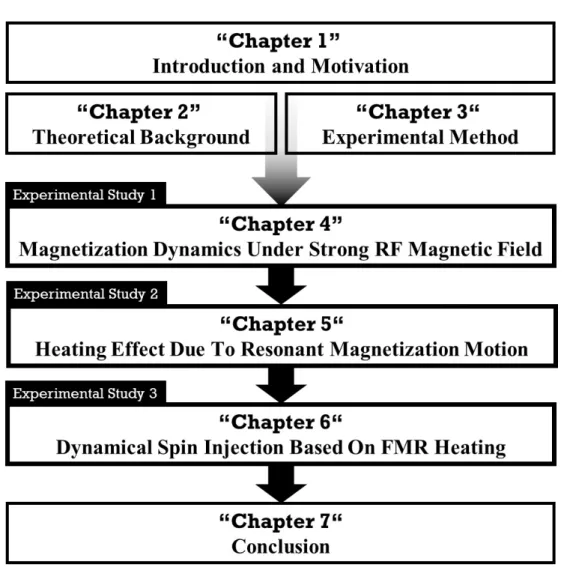
This thesis was carried out to clarity the influence of the heating effect during the magnetization dynamics and the dynamical spin injection. The experimental results consists of the chapters from 4 to 6 as shown in Fig. 1.1. A brief summary of each chapter is shown below,

• Chapter 1 presents an introduction and motivation of this thesis.

• Chapter 2 describes the theoretical background for this thesis.

• Chapter 3 provides the fabrication techniques and experimental methods for our samples.

• Chapter 4 show the excitation RF magnetic field intensity dependence of the res- onance properties during the ferromagnetic resonance (FMR) mode and the spin wave (SW) mode. As a result, I found that the magnetization precessional motion causes the warming of the ferromagnet. Moreover, the heat generation in the FMR mode was found to be larger than one in the SW mode.

• Chapter 5 proposes a quantitative evaluation method of the FMR heating effect

using the resistivity of the Cu electrode. The temperature increase ∆T due to the

FMR heating effect increases with increasing the FMR frequency because of the

(22)

1.2. OUTLINE OF THE CHAPTERS 5 suppression of the inhomogeneous broadening.

• Chapter 6 investigates the dynamical spin injection in the CoFeB/Pt bilayer struc- ture, in order to clarify the difference between the spin pumping effect and the thermal spin injection. From the analysis of the experimental results, I clarified that the thermal spin injection is dominant on the dynamical spin injection in our device.

• Chapter 7 gives conclusion in this thesis.

(23)

Figure 1.1: Flow chart of chapters in this thesis.

(24)

Chapter 2

Theoretical Background

2.1 Magnetization dynamics

By defining the magnetic moments in the ferromagnet as classical macro-spin vector M , namely magnetization, the time-dependence of the magnetization dynamics can be described by considering the torque T = M × H eff to the magnetization M caused by the effective magnetic field H eff , which could be written as following[31–33, 35–37]

dM

dt = γM × H eff . (2.1)

Here, γ =ge/2mc is the absolute value of the gyromagnetic ratio, g is the Lande g-factor. However, the magnetization dynamics attenuates in the finite time because of the damping torque. Therefore, the new equation was provided by adding the damping term to Eq. 2.1, the so-called a Landau-Lifshitz-Gilbert (LLG) equation[31–34]. A LLG equation is explained in the next section.

7

(25)

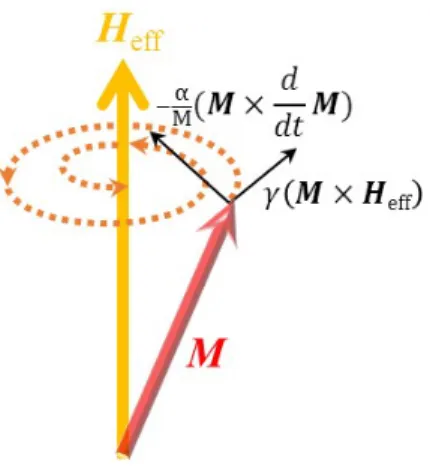
Figure 2.1: Schematic diagram of the magnetization dynamics.

2.1.1 Landau-Lifshitz-Gilbert equation

A phenomenological LLG equation could be described as following[31–34]

dM

dt = γ(M × H eff ) − α

M S (M × d

dt M ), (2.2)

where M S is the saturation magnetization and α is the dimensionless Gilbert damping constant, which depend on the ferromagnetic metal[40]. Equation 2.2 represents the relaxation process of the magnetization dynamics, where the first term and the second term are the precession term and the damping term for the attenuation process of the magnetization dynamics as shown in Fig. 2.1, respectively.

2.1.2 Resonant precessional motion of magnetization

A resonant precessional motion of the magnetization is one of the most well known

physical phenomena in the ferromagnetic metal. This phenomenon is called the co-

herent magnetization precession, namely ferromagnetic resonance (FMR) [33–37]. As

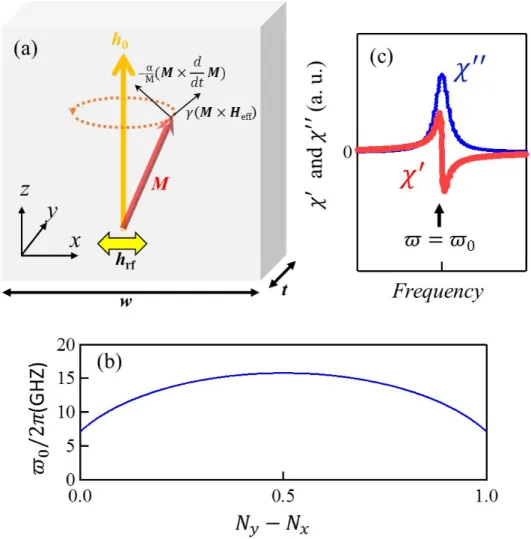
shown in Fig. 2.2, I consider the case of applying radio frequency (rf) magnetic field

(26)

2.1. MAGNETIZATION DYNAMICS 9 h rf with an angular frequency ω (ω = 2πf : f is the frequency of the rf magnetic field irradiation) to the perpendicular direction to a static magnetic field h 0 applied to fix the magnetization direction. Components of the effective magnetic field are H eff = (h rf − N x m x , −N y m y , h 0 − N z m z ). Here, N x , N y and N z are the demagnetization factors, which depend on the shape of the ferromagnetic thin film and N x +N y +N z = 1.

If the ferromagnetic shape is the thin film as shown in Fig. 2.2(a), the N z can be ne- glected, then N x can be approximated by the N x ≈ t/w. Here, t and w is the thickness and the width of the ferromagnetic thin film, respectively. In the case of the magneti- zation precessional motion with the small cone angle, I can describe the time derivative of the magnetization dynamics M(t) as M (t) = (m x (t), m y (t), M S ). Substituting that into Eq. 2.2, I obtain

 

 

 

 

−iωm x = γm y (h 0 + N y M S ) − iωαm y .

−iωm y = γ(−m x (h 0 + N x M S ) + M S h rf ) + iωαm x .

(2.3)

Here, Eq. 2.3 can be rewritten using matrices.

−iω γ(h 0 + N y M S ) − iωα

−γ(h 0 + N x M S ) + iωα −iω

 m x m y

= −γM S

 0 h rf

. (2.4)

Setting h rf = 0 and α = 0, namely coherent precessional motion, I can obtain the Kittel equations[35],

ω 0 2 = γ 2 (h 0 + N x M S )(h 0 + N y M S ). (2.5)

ω 2 0 = γ 2 (h 0 + (1 − N y )M S )(h 0 + N y M S ). (2.6)

These give the resonance angular frequency ω 0 during steady magnetization pre-

cessional motion, namely FMR. Here, I noticed that the FMR frequency f res can be

(27)

controlled by the shape of the ferromagnetic metal because of the demagnetizing field.

Figure 2.2(b) shows the theoretical result of the demagnetizing factor N dependence of the FMR frequency f res in the NiFe thin film. In addition, it has also been experimen- tally proved by several reports[41–43]. This means that the FMR frequency f res can be controlled without the applied external magnetic field.

From Eq. 2.6, I can obtain the magnetic susceptibility tensor χ defined by m = χh rf and χ = χ

0

+ iχ

00

. The real part χ

0

and the imaginary part χ

00

of the magnetic susceptibility can be calculated by the following equation, respectively[44, 45],

χ

0

= ω B ω M (ω 2 0 − ω 2 )

2 0 − ω 2 ) 2 + α 2 ω 2H + ω B ) 2 . (2.7) χ

00

= αωω MB 2 + 2ω 0 2 − ω 2 )

2 0 − ω 2 ) 2 + α 2 ω 2H + ω B ) 2 . (2.8) Here, α is the dimensionless damping constant. ω = 2πf , ω M = γµ 0 M S , ω H = γh 0 , ω B = ω HM and ω 0 = √

ω B ω M . At the resonant condition (ω = ω 0 ), when the magnetic field is much smaller than the saturation magnetization (ω M ω H ), χ 00 ≈ (2ω M )/(αω 0 ).

Figure 2.2(c) show the real and imaginary part of the magnetic susceptibilities as a

function of the microwave frequency.

(28)

2.1. MAGNETIZATION DYNAMICS 11

Figure 2.2: (a) Schematic illustration of the coherent magnetization dynamics around

the direction of the applied magnetic field in the ferromagnetic thin film. (b) Demagne-

tization dependence of FMR frequency calculated from the Kittel equation. Here, the

saturation magnetization is 1T. (c) Calculated real and imaginary parts of the magnetic

susceptibilities as a function of the microwave frequency.

(29)

2.2 Anisotropic magnetoresistance effect

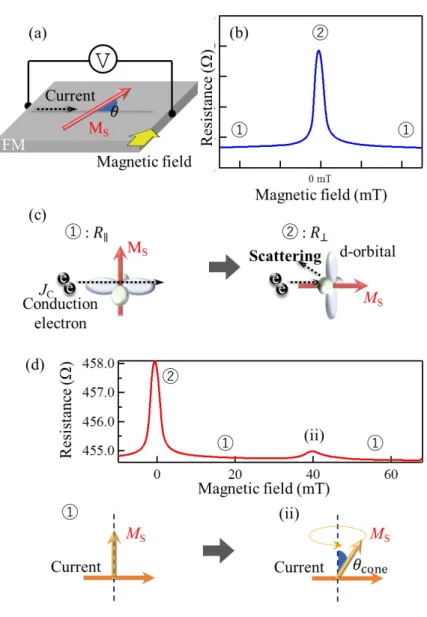
The band structures of the typical ferromagnetic metal, such as the Co or Fe, consist of the superposition of a degenerate 3d bands over a 4s band, and the density of states (DOS) at the Fermi level coexists with the 3d electrons and the sp-like electrons. The sp-like electrons, which are not polarized, are responsible for conduction around the Fermi level because of the small effective mass and the long mean free path. However, in the 3d band, since the up- and the down-spin bands are polarized, the DOS on the electrons are different. Therefore the conduction electrons are affected by the spin polar- ized 3d band. This is called the s-d scattering[46, 47]. The orbital of 3d-electron can be described by the wave function as shown in the Fig. 2.3(c). Moreover, it is changed with the magnetization direction of the ferromagnetic metal. As a result, the electrical resis- tance in the ferromagnetic metal changes with the magnetic field. This is a well-known effect called an anisotropic magnetoresistance (AMR) effect[48–51]. I demonstrated the conventional AMR measurement of NiFe thin film as shown in Figs. 2.3(a) and (b), re- spectively. Relative angle θ is defined as the angle between the magnetization M S and the conduction currents J C . I can clearly see the resistance increases around the zero field because the magnetization direction was changed from 1 state to 2 state as shown in Fig. 2.3(c). In addition, the magnetization dynamics can be easily detected using the AMR effect[52–56]. The resistance change due to the AMR effect of the ferromagnetic metal during the FMR is given by the following equation,

ρ(θ) = ρ k + ∆ρ cos 2 θ, (2.9)

where, ρ k is the resistivity of NiFe, when the conduction current is a parallel to the

(30)

2.2. ANISOTROPIC MAGNETORESISTANCE EFFECT 13 magnetization, and ρ ⊥ is the resistivity of a perpendicular state. The ∆ρ = ρ ⊥ − ρ k and the θ cone = π/2 − θ is the precessional cone angle of the magnetization dynamics.

As shown in Fig. 2.3(d), I demonstrated that ferromagnetic resonance can be detected

by measuring the external magnetic field dependence of electric resistance of the NiFe

narrow wire under the microwave irradiation. From the resistance change by FMR, the

precessional cone angle θ cone of FMR was estimated to be about 10 degrees.

(31)

Figure 2.3: (a) Illustration of the measurement method for the typical anisotropic mag-

netoresistance in the ferromagnetic metal. (b) Schematic image of the resistivity changes

due to the s-d scattering. (c) Resistance of the NiFe thin film as a function of the exter-

nal magnetic field. (d) Resistance of the NiFe narrow wire as a function of the magnetic

filed under the microwave irradiation with the power of the 100 mW and the schematic

image of the resistivity change at the resonance state.

(32)

2.3. DYNAMICAL SPIN INJECTION (SPIN PUMPING EFFECT) 15

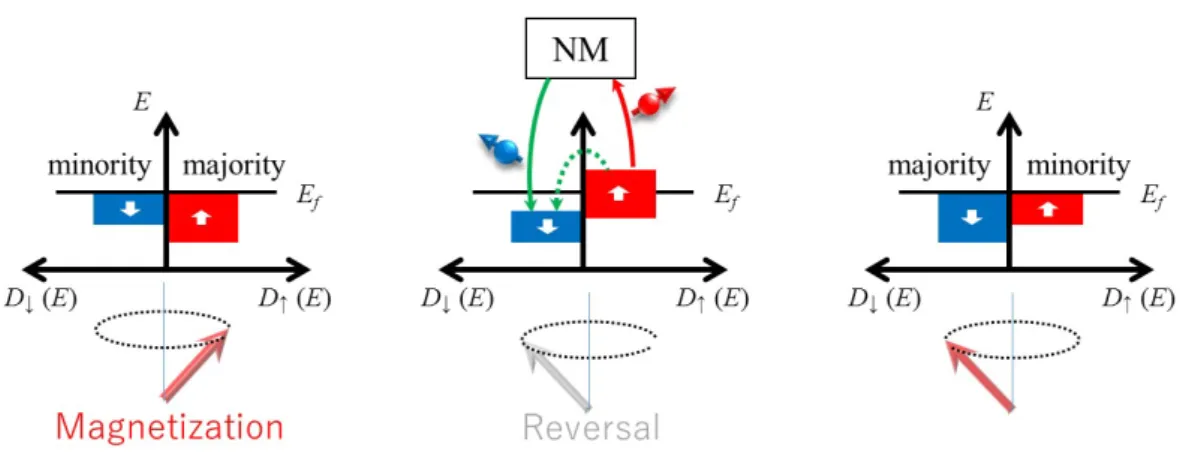
Figure 2.4: Populations of up- and down-spin bands during magnetization dynamics.

2.3 Dynamical spin injection (Spin pumping effect)

Recently, the spin pumping effect means the generation of the spin current by the mag-

netization dynamics from the ferromagnetic metal into the non-magnetic metal. This

effect described by J. C. Tserkovnyak et al.[24, 22]. Figure 2.4 schematically shows the

simple image of the mechanism for spin current generation due to the spin pumping

effect in the ferromagnet/non-magnet bilayer structure. In the ferromagnetic metal,

the magnetism is caused by the larger population of the spin (majority spins) and the

small population of the spin (minority spins). If the magnetization direction is suddenly

switched, the bands shift in the energy momentarily. However, in order to return to the

equilibrium situation, there have to be a spin transfer from on spin population to another

one (spin relaxation)[56]. If the ferromagnet is attached to the non-magnetic metal, spin

relaxation occurs through the non-magnetic metal. Thus the spin-relaxation process of

the ferromagnetic metal is modified when it is contact with an adjacent non-magnetic

(33)

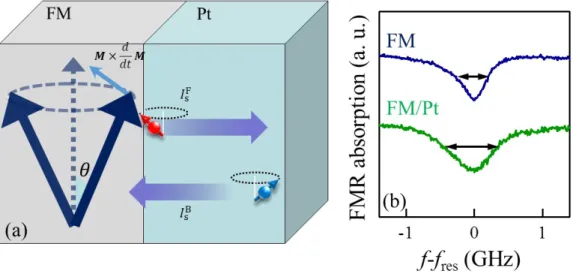
metal, and depends on the spin-relaxation properties on the non-magnetic metal. More- over, this means that when a ferromagnetic metal is attached to a non-magnetic metal during the ferromagnetic resonance (FMR), an oscillating spin current is emitted into the non-magnetic metal. J. C. Tserkovnyak et al.[24, 22] found that dc spin current is also generated in addition to the oscillating spin current by numerically analyzing the spin pumping effect in the ferromagnet/non-magnet bilayer structure during the FMR. As shown in Fig. 2.5(a), the spin current is accumulated at the ferromagnet/non- magnet junction due to the resonance precessional motion of the magnetization dynam- ics, and then the spin current is diffused into the non-magnetic metal. According to the reference[24, 56, 57], the generated spin current into non-magnetic metal by the spin pumping effect is simply described by the following equation.

I s F = ~

4π g ↑↓ (M × d

dt M), (2.10)

where, g ↑↓ is the real part of the mixing conductance[58, 59]. Equation 2.10 indicates that the spin current I s F induced by spin pumping effect, which goes into the non- magnetic metal, is perpendicular to both the magnetization direction M and change in dM/dt. The spin current I s F has ac- and dc-components, however, the time-average of the spin current I s F given by R

1 f
0 (I s F )dt = I dc ≈ 2πf sin 2 θ cone [24, 56, 57], where

θ cone is the cone angle of the resonance precessional motion. When the non-magnetic

metal with a strong spin orbital interaction such as Pt and a length sufficiently longer

than the spin diffusion length, the injected spin current quickly disappears, then it

corresponds to a loss of angular momentum and enhancement for the effective Gilbert

damping of resonant precessional motion of magnetization. In other words, because the

ac-spin current is precessing at high speed, the ac-component disappears due to the

(34)

2.3. DYNAMICAL SPIN INJECTION (SPIN PUMPING EFFECT) 17

Figure 2.5: (a) Schematic illustration of the spin pumping effect in the ferromagnet/non- magnet bilayer structure. (b) Frequency dependence of the ferromagnetic resonance spectra using by the VNA measurement for the ferromagnetic CoFeB film and the fer- romagnetic CoFeB/Pt bilayer structure, respectively.

spin-scattering process, which means that the dc-component spin current will remain in

the non-magnetic metal and flow into the ferromagnetic metal as a result. Figure 2.5(b)

show the FMR spectrum for the ferromagnetic single film and one for the ferromagnet/Pt

bilayer film, respectively. A frequency dispersion of the FMR spectrum for the bilayer

film clearly increased compared with the one for the single film. Enhancement of the

frequency dispersion on the FMR spectrum depends on the intensity of the spin current

caused by the spin pumping effect[23, 24, 60, 61]. Here, the case where the spin relaxation

in the non-magnetic metal is small is not taken into consideration.

(35)

2.4 Thermal spin injection

(Spin-dependent Seebeck effect)

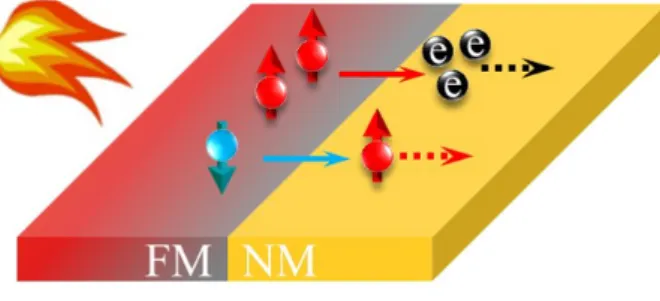
A spin current is known to induce various intriguing phenomena and could be employed to transport the information with low power consumption[18, 19, 62–67] . Moreover, the device structure can be simplified by using the spin current because of no necessity of the closed-circuit formation. So far, the spin current is mainly generated by the electrical methods [66–73]. Recently, it was demonstrated that spin current can be generated by the temperature gradient ∇T instead of the electrical spin injection, which is called spin- dependent Seebeck effect or thermal spin injection[28, 30, 74, 75]. When the temperature gradient ∇T exists at the ferromagnet/non-magnet junction as shown in Fig. 2.6, the thermal spin injection occurs because of the difference of the Seebeck coefficient between the up- and down-spin bands. Therefore, the generated spin current due to the thermal spin injection can be expressed as following,

I s ≈ (σ ↑ S ↑ − σ ↓ S ↓ )∇T, (2.11)

where S ↑ and S ↓ are the Seebeck coefficient for the up-spin and the down-spin, respectively. ∇T is the temperature gradient at the ferromagnet/non-magnet junction.

σ ↑ and σ ↓ are the the energy dependent conductivity around the Fermi level E f for the up- and down-spins, respectively.

Regarding with the thermal spin injection, the spin-dependent band structure is

quite important. In 3d-transition metals, such as the Co or NiFe, the electron states

can be expressed by s-d hybridized orbitals. Since the difference of the band structures

between the up- and down-spins is mainly caused by 3d orbital, the contribution from

(36)

2.4. THERMAL SPIN INJECTION (SPIN-DEPENDENT SEEBECK EFFECT) 19

Figure 2.6: Schematic illustration of thermal spin injection in the ferromagnet/non- magnet bilayer structure under the temperature gradient.

3d electrons is most important. However, in the case of ferromagnetic metal with the

crystalline structure, the electron transport is dominated by sp-like electrons because of

their high mobilities. On the other hand, in the case of a ferromagnetic metal with an

amorphous structure, sp-like electrons are eliminated from the movement of electrons,

3d electrons are dominant, and a thermal spin injection due to a large spin-dependent

Seebeck coefficient can be expected[30]. For this reason, an amorphous ferromagnetic

CoFeB is used as the thermal spin injection source in this thesis.

(37)
(38)

Chapter 3

Experimental method

3.1 Sample-preparation process

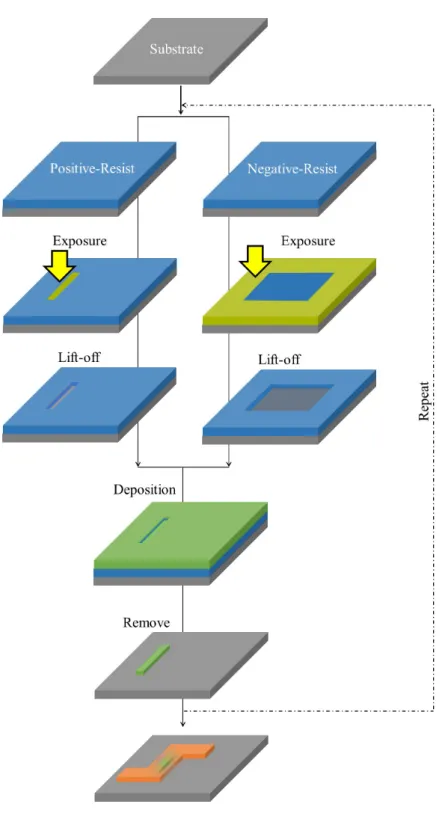
The rapid uncountable in vacuum thin-film deposition and lithographic techniques enable us to realize nano- or micro- scale solid state devices without deteriorating the material quality. This enables us to provide the better platform to deepen, our understanding of spin-dependent transport and magnetization dynamics. In this chapter, I introduce experimental techniques for the thin film growth and nano-fabrication as well as charac- terization and evaluation method of the fabricated sample structures. Complete sample fabrication process is illustrated in Fig. 3.1.

3.1.1 Magnetron sputtering system

Magnetron sputtering system is a useful deposition method, by which metals having uniformly strong adhesion are deposited with almost no change in the metal-alloy com- position ratio. Furthermore, since there is no need to melt the metal target, it can be

21

(39)

Figure 3.1: Schematic process of sample fabrication method using positive and negative

resists, resistively.

(40)

3.1. SAMPLE-PREPARATION PROCESS 23

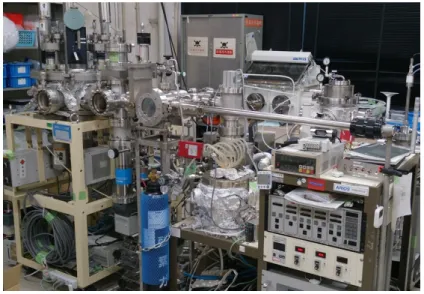
Figure 3.2: A photograph of our sputtering system.

used for deposition of various metals. In this deposition method, ionized atoms and the molecular ions in the plasma collide with the target metal at high speed, and atoms and molecules constituting the target are extruded and deposited on the substrate. Further, an oxide thin film or a nitride thin film can be deposited by mixing a reactive gas during sputtering deposition. However, the gas pressure necessary for plasma formation is high, the influence of the residual gas in the quality of deposition metal can not be neglected.

A photograph of the magnetron sputtering system I used is shown in Fig. 3.2.

3.1.2 Joule-heating evaporation system

The Joule-heating evaporation system is a metal-deposition method in which a target

metal is evaporated by Joule heat and deposited on a sample. Although this deposi-

tion system is a simple technique, the target material is limited due to the low boiling

temperature. A photograph of the Joule-heating evaporation system I used is shown in

Fig. 3.3.

(41)

Figure 3.3: A photograph of Joule-Heating Deposition System.

3.1.3 Electron-beam lithography system

An electron-beam lithography (EBL) system is an apparatus that performs lithography using an electron beam instead of the light. By accelerating the electrons, the pattern is directly written on the photo-resist as an electron beam of an extremely short wavelength, so extremely fine patterning becomes possible. In our electron-beam lithography system, it is possible to irradiate beams for ultra-fine lines with a beam diameter of 2 nmφ, and to draw a minimum of 10 nm. A photograph of the ELIONIX ELS-7500 electron-beam lithography system is shown in Fig. 3.4.

3.1.4 Scanning electron microscope

For the analysis of the fabricated device structure, a scanning electron microscope (SEM)

capable of observing a nano-meter order structure was used. A SEM can observe the

structure and surface condition of the sample from secondary electrons emitted when

(42)

3.1. SAMPLE-PREPARATION PROCESS 25

Figure 3.4: A photograph of ELIONIX ELS-7500 electron beam lithography system.

the sample is irradiated with electron beam. A photographs of SEM (Hitachi : S-4800)

used in this thesis is shown in Fig. 3.5(a). Figures 3.5(b) and (c) show the SEM image

of Cu coplanar waveguide and NiFe narrow wires fabricated by EBL system and Lift-off

technique, respectively.

(43)

Figure 3.5: (a) A photograph of Scanning Electron Microscope(Hitachi : S-4800). (b)

SEM image of the fabricated Cu coplanar wave guide. (c) SEM image of the fabricated

NiFe narrow wire.

(44)

3.2. MEASUREMENT TECHNIQUE FOR MAGNETIZATION DYNAMICS 27

3.2 Measurement technique for magnetization dynamics

3.2.1 VNA-FMR measurement

Recently, there are some trials of the ferromagnetic resonance (FMR) and the spin wave (SW) were measured by using a vector network analyzer (VNA), so-called the VNA-FMR measurement[33, 43, 78, 79]and the VNA-SW measurement[33, 80–82], respectively. In this technique, the ferromagnetic sample is mounted on a top of a coplanar waveguide (CPW) structure on the substrate. The microwave is irradiated via the CPW and the S-parameter is determined from the microwave transmission S 21or12 or reflection S 11 or 22

loss. This measurement has the advantage that local excitation near the CPW can be realized and it has a higher sensitivity than conventional FMR or SW measurement using the cavity. However, there is also a disadvantage; it is difficult to irradiate a microwave with strong power, and for the small sized ferromagnetic metals, the resonance properties were measured as an average of many small sized ferromagnetic metals. Figure 3.6 shows the photograph of the specially designed hand-made RF transports measurement systems enable us to evaluate the magnetization dynamics in the frequency domain using the VNA (E5071C).

3.2.2 Homodyne detection

Apart from the magnetization dynamics measurement technique using the VNA, the Ho- modyne detection for studying the magnetization dynamics is also extensively employed.

The Homodyne detection can sensitively detect the resonance properties even in a nano

scale ferromagnetic device. The resistance of the ferromagnetic device is monitored using

(45)

Figure 3.6: A photograph of the RF transports measurement system using a vector network analyzer (E5071C) and a micro probe station which capable of applied in-plane static magnetic field.

the Bias Tee and the lock-in technique. The resonance frequency could be distinguished

as the symmetric or anti symmetric peak resulting from the absorption when the irradi-

ated microwave frequency is consistent with the resonant frequency. The origin of this

detection signal is the rectification effect of resonant excitation induced by the injected

radio frequency current. In other words, when the FMR is excited in the narrow thin

wire, the magnetization precesses and results in resistance oscillation originating from

the AMR effect. However its analysis is complicated due to the coexistence between the

induction field and spin transfer torque.

(46)

Chapter 4

Magnetization dynamics under strong RF magnetic field

4.1 Introduction

Dynamic detection and manipulation of the magnetization properties in a ferromagnetic thin film have grown rapidly with the development of the physics on spin dynamics[33, 83, 84]. Especially, the spatially modulated spin configuration stabilized in the patterned ferromagnetic nano-structures is known to excite the non-uniform coherent spin preces- sion with a spatial periodical modulation, namely MSSW[85–88]. Owing to its fast time scale in GHz range and high compatibility with a Si-based semiconductor integrated circuits, the MSSWs in ferromagnetic thin films are expected to have various potential applications in future-telecommunication devices such as a microwave filter[79, 89, 90], oscillator[91–93] and fast spin-information transportation[80, 81, 94–97]. In addition, the development of high-performance spin-based telecommunication devices also makes an

29

(47)

innovation in military and security applications. Therefore, the dynamical properties of the MSSW and the exploration of their precise manipulation techniques have attracted much attention. Especially, for the practical application, understanding of the thermal stability and the nonlinear response induced by the RF magnetic field with a strong intensity is indispensable.

The magnetization dynamics for the coherent mode, namely ferromagnetic resonance (FMR) has been intensively investigated in the nonlinear region [98–105]. However, the nonlinear magnetization dynamics for the MSSW are also important for developing aforementioned telecommunication devices. So far, the MSSWs are mainly controlled by using geometrically induced magneto-static interaction [33, 106, 107]. However, the tunability for such systems is not so high because the modulation magnitude is fixed by their shapes. A patterned periodical electrode is known as an alternative method for controlling the spatial distribution of the spins in a ferromagnetic thin film[79, 89, 108].

Recent developments for the nano-fabrication techniques made it possible to prepare

well-defined patterned electrode with high accuracy. In this method, we can adjust the

modulation magnitude and phase. Moreover, since the deterioration during the nano-

patterning and non-uniformity due to the edge roughness and oxidation can be eliminated

completely, the magnetic properties as high as the bulk values will be expected. The

impedance transmission measurements based on the vector network analyzer (VNA)

have been mainly used for characterizing these systems. However, the detectable MSSWs

are limited by the electrode design because the inter-linkage magnetic flux is canceled

out. Moreover, the input power is restricted by the output power of the VNA. Here,

we demonstrate a sensitive detection method for the MSSW excited by the patterned

(48)

4.2. SAMPLE STRUCTURE AND FABRICATION EVALUATION METHOD 31 electrodes. Electrically separated excitation and detection circuits enable us to detect the standing MSSWs for various wave lengths sensitively and to investigate their stabilities against heating and strong microwave magnetic field.

4.2 Sample structure and fabrication evaluation method

Our device consists of a 40-nm-thick ferromagnetic NiFe film and a 200-nm-thick ladder- type non-magnetic Cu electrode, which are electrically separated by a 100-nm-thick SiO 2

sputtered film. A schematic diagram of our fabricated device is shown in Fig. 4.1(a).

The NiFe film is grown by a magnetron sputtering at the base pressure of 10 −8 Torr on

a conventional Si substrate. Here, the pressure during the sputtering is 2 mTorr and the

deposition rate is 2 nm/s. The Cu thin wires with a width of 200 nm were fabricated

by a conventional lift-off technique using an electron-beam lithography. The center-

center interval L between the Cu wires is 8 µm. The external static magnetic field

is applied along the Cu wire direction to fix the precession axis of the magnetization

dynamics. The magnetostatic surface MSSWs (MSSWs) propagating perpendicular to

the magnetization were generated by flowing a radio frequency AC current with 7 GHz in

the non-magnetic ladder-shape electrodes and were detected by measuring the resistance

of the NiFe film via the AMR effect. Here we adopt the pulse-modulated RF current to

lock-in detection technique to improve the signal/noise ratio of the sensed voltage[110].

(49)

Figure 4.1: Schematic illustration of the fabricated MSSW device together with the circuit diagram for the spin-wave excitation and detection.

4.3 Measurement result and spectra analysis

Figure 4.2(a) shows representative results of the external static magnetic field depen- dence of the voltage induced in the NiFe film under the RF magnetic field with the power of 10 mW. Here, the bias current for the measurement is 60 mA. The voltage clearly shows the resonant features consisting of the multiple peaks. As shown in Fig. 4.2(b), we found that each voltage peak can be reproduced by the several Lorentzian curves with different resonant magnetic fields. In order to investigate the origin of the de- tected resonant-like multi peaks, we fitted the resonant magnetic fields to the dispersion relationship for the MSSW given by the following equation[86].

f MSSW = γ 2π

q

H 0 (H 0 + 4πM S ) + πM S (1 − e πt/λ ). (4.1)

Here, γ is the gyro-magnetic ratio given by 18.4 MHz/Oe, M S is the saturation

magnetization 4πM S = 9.8 kOe. The quantities, t and λ, are the thickness for the

(50)

4.3. MEASUREMENT RESULT AND SPECTRA ANALYSIS 33

Figure 4.2: (a) Field dependence of the voltage for NiFe film under the microwave

magnetic field with the magnitude of 10 mW. (b) Numerical curve reproduced by super-

imposing several Lorentzian curves with different resonant magnetic fields.

(51)

ferromagnetic thin film and the wavelength, respectively. As shown in Fig.4.3(a), the

resonant magnetic fields are well explained by the MSSW with assuming that the half

wave length of the standing MSSW is given by the fraction of the integer number of the

electrode spacing L and the ferromagnetic resonance with the infinite wave length. This

indicates that our measurement method is more sensitive to the previously developed

method based on VNA[76, 77] which only can detect the standing MSSW with wave

length given by the fraction of the integer number of the electrode spacing L[79]. Here

we consider the reason why the present method can induce and detect the standing

MSSW with λ/2 = L/n. Since the methods for exciting the MSSW in both experiments

are the same, the difference should be caused by the detection scheme. As shown in

Fig 4.3(a), the standing MSSWs for n = 2 or other even numbers can be imaged by

assuming that the anti-node of the wave is located underneath the electrodes. These

MSSWs can be reproduced by superimposing the wave given by cos(kx + ωt) and that

given by cos(k(x −L) −ωt) with the condition that kL = 2πm, where m is the integer. In

these MSSWs, the time derivative of the magnetic flux underneath the electrode should

be large, leading to the rf voltage generation in the Cu electrode. In the case for n = 3

or other odd numbers, the standing MSSW with the node underneath the electrode is

satisfied with such a condition. Such MSSWs can be reproduced by superimposing the

waves cos(kx+ωt) and that given by cos(k(x−L)−ωt) with the condition kL = π(2m+1),

where m is the integer. In this situation, the magnetic flux around the electrode is always

zero and does not cause a voltage drop in the Cu electrode. Therefore, the VNA-FMR

measurement can detect the standing MSSWs with odd numbers but cannot detect those

with even numbers.[79] On the other hand, in our measurement method using the AMR

(52)

4.4. DC CURRENT DEPENDENCE OF RESONANCE CHARACTERISTICS 35

Figure 4.3: (a) Theoretical dispersion relationship between the FMR and the MSSW frequencies and the external magnetic field together with the experimentally obtained values (Solid circle). Here, we assume λ = 2L/n. (b) Schematic illustration of standing MSSWs with the different n stabilized by periodical Cu electrodes.

effect, the signal is related not to the local structure of the MSSW but to average angle of the magnetization in a whole sample. Therefore, the standing MSSWs stabilized in the NiFe film are effectively detected.

4.4 dc current dependence of resonance characteristics

The bias current dependence of the resonant features was investigated in this section.

Figure 4.4(a) shows the voltage spectra of the same device for various bias currents.

The shapes of the voltage spectra do not show significant change. However, the reso-

nant fields for the FMR and standing MSSWs were founded to increase with increasing

the bias current as shown in Fig. 4.4(b). According to Eq. 4.1, we naively expect that the

(53)

increase of the resonant fields in related to the modification of the saturation magnetiza- tion because it seems to be difficult to change other parameters such as the wave length by the bias current. Figure 4.4(c) shows the bias current dependence of the saturation magnetization estimated from Eq. 4.1. It should be noted that the saturation magnetiza- tions estimated from the standing MSSW for various wave number (n ≥ 1) show almost the same current dependence irrespective of n, while that for the FMR shows different behavior. The saturation magnetization estimated from MSSW shows a small reduction when the current increases. Observed reduction can be understood by the Joule-heating effect of the bias current. Regarding to the large difference in the M S estimated from FMR and standing MSSW, it should be noted that the value is estimated by assuming the uniform precession, in other words, infinity wave length. However, in realistic sit- uation, the precession area is only restricted underneath the electrode. Therefore, the saturation magnetization in the FMR was overestimated. The relatively large current dependence in the FMR is also related to the inhomogeneous magnetization precession motion. Since the FMR condition in the pattered sample structure is affected by the de- magnetizing fields, the bias current dependence of the saturation magnetization becomes large.

4.5 Power dependence of resonance characteristics

We investigated the irradiated RF magnetic field power dependence of the resonance

features. Figure 4.5(a) shows the voltage spectra of the same device under the RF

magnetic field irradiation with the various power. We summarize the resonant fields as

a function of the RF magnetic field power in Fig. 4.5(b), where the dashed line is the

(54)

4.5. POWER DEPENDENCE OF RESONANCE CHARACTERISTICS 37

Figure 4.4: (a) Voltage spectra for various dc currents. (b) Resonant fields for FMR and

MSSWs as a function of the dc current. (c) Saturation magnetization estimated from

the experimental results with Eq. 4.1 as a function of the bias current.

(55)

resonance fields estimated from the M S = 1T. When the microwave power is smaller

than 10 mW, the resonant fields for the FMR and the standing MSSW show a small

reduction without significant changes in the resonant properties. However, when the

microwave power exceeds 32 mW, the resonant magnetic field for the FMR significantly

reduces. When the large spin precession is locally excited underneath the Cu electrodes,

we can not use Eq. 4.1 for increasing demagnetizing field of the longitudinal direction

of the NiFe rectangle. Therefore, as a result of fitting with the equation considering the

influence of the demagnetizing field of the longitudinal direction of the NiFe rectangle, it

was found that the saturation magnetization is slightly decreased. This finding indicates

that the resonant precessional motion of the magnetization causes the heating effect of

the ferromagnet because of the energy dissipation through the damping torque.

(56)

4.5. POWER DEPENDENCE OF RESONANCE CHARACTERISTICS 39

Figure 4.5: (a) Resistance spectra for radio frequency (RF) currents with various input

power. (b) Resonant fields for the ferromagnetic resonance and the standing MSSW

as a function of the input RF filed power and the dashed lines is the resonance fields

estimated from the M S = 1T.

(57)

4.6 Summary

We have developed a method for detecting the standing spin wave using electrically

separated excitation and detection circuits. By changing the detection and excitation

techniques, we investigated the stability of the resonant spin precession. The influence of

the detection of current is simply understood by the reduction of the saturation magneti-

zation due to the Joule-heating effect. It was examined in relation to the radio frequency

(RF) magnetic field power dependence of the each resonant modes in the magnetization

dynamics. As a result, it was found that the RF magnetic field power dependence of

saturation magnetization is greatly decreased in the ferromagnetic resonance mode com-

pared with the spin wave mode. This finding can be explained by considering that the

resonance motion of the magnetization causes the heating effect of the ferromagnetic

metal due to energy dissipation via the damping torque. In the ferromagnetic resonance

mode, a precession motion having a large amplitude occurs in a wide region compared

to the spin wave mode, given rise to a high heating effect. It is considered that the

magnetization characteristics are largely modulated.

(58)

Chapter 5

Heating effect due to resonant magnetization motion

5.1 Introduction

The magnetization dynamics in the ferromagneic material under the applied magnetic field can be described by a phenomenological Landau-Lifshiz-Gilbart (LLG) equation[33, 111]. Application of the radio-frequency magnetic field induces the resonant precessional motion of the magnetization such as the ferromagnetic resonance (FMR)[33, 112–117]

and spin-wave (SW) excitation[81, 85, 86, 118, 119]. The frequency range of these resonances in the ferromagnetic metal (FM) can be widely tuned from sub GHz to a few 10 GHz because of a large gyromagnetic ratio γ , where γ/2π is approximately 29.2 GHz/T. Moreover, various phenomena combined with magnetization dynamics such as spin pumping[23, 120, 121] and spin torque precession[122–126] have been found recently. These properties are highly attractive for future applications in nano-electric

41

(59)

and telecommunication devices[81, 118, 119].

However, the phenomena related to the magnetization dynamics can be qualitatively explained by using different mechanisms such as inverse spin Hall effect[127–129], spin rectification[100] and spin motive force[130]. Exploring the manifesting the origin of the observed phenomena with deepening the understandings is an important milestone for the fundamental and technological development. So far, the magnetization dynamics have been investigated mainly in the linear response regime in which the magnetization responses are well explained by the LLG equation. However, when the precessional mo- tion is excited by a high-frequency or pulsed magnetic field with a strong amplitude, the dynamic response deviates from the nonlinear response regime[98, 131]. These de- viations may be related to the extrinsic natures such as the magnetic inhomogeneity and structural defects. On the other hand, it also should be noted that the dynamical magnetization motion produces the dissipation because of the existence of the damping term[23, 111, 120, 121]. This dissipation finally produces the heat through the direct and indirect magnon-phonon interactions. If the heating effect due to the dissipation is adequately large, the saturation magnetization and the phenomenological damping torque will be changed, leading to the modification of the magnetization dynamics.

Moreover, recently, the interaction between the spin and heat is found to play an impor-

tant role both in the localized magnetic moment and the spin polarization of conduction

electrons[28, 132, 133]. Thus, one has to take into account the influence of the heat on

the magnetization dynamics. Although the heating effect induced by the FMR is well

known as the FMR heating effect[134, 135], the study on the FMR heating effect has not

been investigated intensively. Especially, in the research of spintronics, there are only a

(60)

5.2. SAMPLE STRUCTURE AND EVALUATION METHOD 43 few reports about the relationship between spin dynamics and heat[134–136]. This may be due to difficult to evaluate the temperature precisely in hybrid nano structure. In this chapter, we develop a simple detection method for the FMR heating effect in a patterned ferromagnetic structures with the optimized device structure in order to minimize the spurious effects.

5.2 Sample structure and evaluation method

As shown in Fig. 5.1(a), our device consists of a ferromagnetic strip covered by a Cu strip, which plays a role of the coplanar wave guide (CPW) for the microwave irradiation. As a ferromagnet, we use CoFeAl strip, which is simply fabricated by an e-gun evaporation under the base pressure of 10 −9 Torr[30]. The dimensions for the CoFeAl strip are 2 µm in width, 500 µm in length and 40 nm in thickness. Here, the anisotropic magneto

resistance (AMR) effect for the CoFeAl is 0.03 % at room temperature, which is much

smaller than that of the conventional FMs. The Cu wave guide, which consists of

large Cu pads and a narrow strip line, is deposited by the joule evaporation. Here,

the dimension of the strip line is 4.5 µm in width, 450 µm in length, and 200 nm in

thickness. In order to clarify the influence of the heat, we fabricated the samples on

two kinds of the substrates with different thermal conductivities. One is a floating-zone

(FZ) Si substrate, which is widely utilized for the high-frequency and power devices

and has moderate thermal conductivity. The other is a glass substrate, which is also

often used for the high-frequency experiment but has poor thermal conductivity. The

temperature evaluation during the FMR is simply detected by the electrical resistance

measurement of the Cu strip line with a FM strip. Figure 5.1(b) shows the temperature

(61)

Figure 5.1: (a) Circuit diagram for the resistance measurement under the microwave magnetic field application together with the conceptual image of the FMR heating. (b) Temperature dependence of the resistivity for our Cu film.

dependence of the electrical resistivity for our Cu film in the range from 10 K to 320 K.

The resistance shows almost linear variation in the temperature range from 50 K and

320 K. We extend this linear relation to 400 K in order to estimate the temperature

increase from the resistance measurements. We want to emphasize that the electrical

resistivity for the Cu electrode is approximately 2 µΩcm at room temperature, which is

approximately 20 times smaller than that for the CoFeAl. This means that the current

flowing in the FM layer of the bilayer system is negligibly small because of the large

difference in the electrical resistivity and the film thickness. In addition, because of

the large size of the Cu pad, the resistance of the pad area, which is less than 0.1 Ω,

is negligibly small compared to the Cu strip line. This indicates that we can precisely

estimate the resistance of the strip line from the two-terminal measurement.

(62)

5.3. FMR PROPERTY OF THE FABRICATED SAMPLE 45

5.3 FMR property of the fabricated sample

We evaluate the microwave transmission characteristic of the waveguide and the magne- tization dynamics for two samples with different substrates by measuring reflection S 11 signal using a vector network analyzer (VNA)[44, 84]. Figures 5.2(a) and 5.2(b) show the FMR spectra for the CoFeAl fabricated on the FZ-Si and glass substrates, respec- tively. In both samples, the signal changes due to the FMR were clearly observed. The field dependence of the resonant frequency f res is well described by the Kittel equation described by the following,

f res = γ p

µ 0 H(µ 0 H + M S ). (5.1)

Here, µ 0 and M S are the vacuum permeability and the saturation magnetization. From the fitting of the Kittel equation, the saturation magnetization can be obtained as 2.2 T, which is a reasonable value compared with previous reports about Co-Fe based alloy[137].

Here, we focus on the spectrum shape due to the FMR. The signal change due to the

FMR in the glass substrate sample is smaller than that in the FZ-Si substrate. This

indicates that the transmission loss of the Cu strip on a glass substrate is worse than

that on the FZ-Si substrate, meaning smaller transmission power for the glass substrates

sample. However, from the spectra shown in Figs. 5.2(a) and 5.2(b), we can easily expect

that the damping constant for the glass-substrate sample is much larger than that for the

FZ-Si-substrate sample. This is because the surface of the glass substrate is relatively

rough compared to the FZ-Si substrate[138].

(63)

Figure 5.2: Image plots for the FMR spectra for (a) FZ-Si substrate sample and (b) glass

substrate sample together with the representative spectra for various magnetic fields.

(64)

5.4. DETECTION OF FMR HEATING AND ITS POWER ... 47

5.4 Detection of FMR heating and its power dependence

We measure the electrical resistance of the Cu strip under the micro wave irradiation in order to evaluate the temperature change during the FMR by using a current-bias low-frequency lock-in detection technique with the bias current of the 16 µA. Although the current for the resistance detection flows in the Cu/CoFeAl bilayer system, we can neglect the voltage drop in the CoFeAl because of much larger resistance of CoFeAl.

Moreover, since the CoFeAl strip is located underneath the Cu strip line entirely, the

Cu strip line should be heated by the FMR almost uniformly. Figures 5.3(a) and (b)

show the electrical resistances of the Cu strip on FZ-Si and glass substrates, respectively,

as a function of the external magnetic field. Here, the direction of the magnetic field

is parallel to the dc current corresponding to the longitudinal configuration. In both

samples, we clearly see the rapid increase of the resistance around H = 98 mT, which

is exactly the same as the magnetic field for the FMR at 16 GHz. Therefore, this

increase should be due to the heat dissipation during the FMR[134]. Since the resistance

change due to the AMR effect, which is very small as described above, provides the

opposite contribution, we can rule out the spurious effects from the AMR effect. More

importantly, the resistance increase for the glass substrate is roughly 50 times larger

than that for the FZ-Si substrate. This is also consistent with the assumption that the

resistance increase is caused by the FMR heating. Now, we evaluate the temperature

change ∆T due to the FMR. In the present system, since the heat source is the CoFeAl

wire, the temperature gradient perpendicular to the CoFeAl/Cu junction should be

induced. This perpendicular temperature gradient may give rise to the additional signals

such as the anomalous Nernst Ettingshausen, spin Seebeck, and spin-dependent Seebeck

Figure 1.1: Flow chart of chapters in this thesis.
Figure 2.1: Schematic diagram of the magnetization dynamics.
Figure 2.2: (a) Schematic illustration of the coherent magnetization dynamics around the direction of the applied magnetic field in the ferromagnetic thin film
Figure 2.3: (a) Illustration of the measurement method for the typical anisotropic mag- mag-netoresistance in the ferromagnetic metal
+7

参照

Outline

関連したドキュメント

(Construction of the strand of in- variants through enlargements (modifications ) of an idealistic filtration, and without using restriction to a hypersurface of maximal contact.) At

It is suggested by our method that most of the quadratic algebras for all St¨ ackel equivalence classes of 3D second order quantum superintegrable systems on conformally flat

[11] Karsai J., On the asymptotic behaviour of solution of second order linear differential equations with small damping, Acta Math. 61

Keywords: continuous time random walk, Brownian motion, collision time, skew Young tableaux, tandem queue.. AMS 2000 Subject Classification: Primary:

Kilbas; Conditions of the existence of a classical solution of a Cauchy type problem for the diffusion equation with the Riemann-Liouville partial derivative, Differential Equations,

This paper develops a recursion formula for the conditional moments of the area under the absolute value of Brownian bridge given the local time at 0.. The method of power series

Answering a question of de la Harpe and Bridson in the Kourovka Notebook, we build the explicit embeddings of the additive group of rational numbers Q in a finitely generated group

Then it follows immediately from a suitable version of “Hensel’s Lemma” [cf., e.g., the argument of [4], Lemma 2.1] that S may be obtained, as the notation suggests, as the m A