Ethnobotany and Ecology of Wild Taro
(Colocasia esculenta) in the Philippines:
Implications for Domestication and Dispersal
著者(英) Peter J. Matthews, E. Maribel G. Agoo, Danilo N. Tandang, Domingo A. Madulid
journal or
publication title
Senri Ethnological Studies
volume 78
page range 307‑340
year 2012‑03‑30
URL http://doi.org/10.15021/00002523
307
Edited by Matthew Spriggs, David Addison, and Peter J. Matthews
Ethnobotany and Ecology of Wild Taro (Colocasia esculenta) in the Philippines: Implications for Domestication and Dispersal
P. J. M ATTHEWS
1, E. M. G. A GOO
2D. N. T ANDANG
3AND D. A. M ADULID
21
National Museum of Ethnology, Japan
2
De La Salle University, Manila
3
National Museum of the Philippines
In Southeast Asia and the western Pacifi c, the natural range of taro, Colocasia esculenta (L.) Schott, has been little studied and is poorly known. We have surveyed the distribution, ethno botany, and ecology of wild taro in the Philippines, where previous authors assumed that wild taro is absent or derived from introduced cultivars. Wild taro is widespread, and may be naturally occurring in some areas. There is also widespread utilisation of wild taro as a leaf vegetable for food and fodder. Wild plants are managed as a shared, community food resource and are occasionally transplanted by people. In wet areas, the plants occupy a range of ruderal to apparently natural habitats. The leaves (blades and petioles) are widely used in popular forms of cooking in the Philippines. The stolons are also eaten, and less frequently the corms, and the entire leaves are also used as a fodder for pigs. The present variation, use and selection of wild taro may provide clues for understanding the domesti- cation and dispersal of taro in the past. We also note the discovery of a little-utilised wild species of taro in northern Luzon, which is here identifi ed as Colocasia sp. cf. formosana.
1. I NTRODUCTION
Taro (Colocasia esculenta L. Schott) is best known as a tropical root crop with starchy corms, but is also widely cultivated in cool-temperate latitudes, in both hemispheres, and is used as a leaf vegetable in many countries. It is cultivated throughout the Philippine archipelago, but varies greatly in abundance—locally and regionally. In this paper we report the use of leaves and stolons from wild taro in the northern, central and southern Philippines. The corms are also used, but to a much lesser extent. We suggest that taro may be naturally distributed in the Philippines, as an indigenous wild species, and discuss the possible signifi cance of wild taro use and management for primary or secondary domestication in the Philippines. We also note the discovery of another wild species of taro, Colocasia sp., which is here tentatively identifi ed as C. formosana Hayata.
Taro leaves have two main parts, the petiole (i.e., leaf stem) and blade (large and heart-
shaped). Mainly the petiole is used in Japan (Matthews 2004) and China (Jianchu et al. 2001,
Yongpin and Jianchu 2000). In the Eastern Mediterranean, use of the leaves has not been recorded (Matthews 2004, 2006). The petioles and blades are eaten in Nepal (Pandey et al.
2000), Vietnam (Nguyen 2000), and Myanmar (Matthews and Naing 2005). Taro leaves (daun talas) appear in many Indonesian recipes, but without the leaf parts identifi ed (D.P.
1967). Throughout the Pacifi c islands, it appears that mainly the blade is used, together with coconut milk and other ingredients (Brennan 2000, and other recipe books). Thaman (1984) states that wild taro is often ‘protected in streams or in the bush’ in Fiji, and is an important green vegetable in villages throughout Fiji. Stolons and infl orescences can be obtained from wild or cultivated taros, and culinary uses have been reported in Myanmar and China. The use of wild taro as both food and fodder is widespread in Southeast and East Asia (Matthews et al. 1992; Matthews and Naing 2005; Jianchu et al. 2001).
The common name for taro in Tagalog and in the closely-related national language, Filipino, is gabi. This name is now recognised throughout the Philippines. Many other species- level names are used among the more than 100 languages spoken in this country (Madulid 2001), and a few examples are noted here. Wester (1924) listed ninety-fi ve cultivar names, including near duplicates, and Papas (1986) listed a much smaller number of names for com- mon or commercial taro cultivars.
1.1 History and Uses in the Philippines
In 1668, just over 340 years ago, the Jesuit priest I. F. Alcina wrote a detailed account of the use of aroids, yams, sweet potato and other root crops in the Visayas islands, central Philip- pines, and stated that (cultivated) taro, gabi, was considered the ‘fi nest’ of these crops. He also counted more than 78 names (i.e., cultivar names) for the plant and observed that the
‘pulpy leaves’ with their ‘fl eshy portion’ (i.e., the petiole) were used for making ‘stew’ (Alcina 2002: 212–215). In the Philippines today, taro corms and leaves are commonly sold and eaten (cf. D.A.P. 1981) (Fig. 1). Within the period 1961 to 1985, estimates for commercial produc- tion of taro corms in the Philippines ranged from 86,000 and 155,00 tons, and taro ranked third in quantity of production, after cassava and sweet potato (both crops of South American origin) (Horton 1988). Wester (1924) ranked taro (gabi) as third in quantity of production after a sweet potato (camote) and yams (ubi, i.e., Dioscorea spp.), and reported that it is grown from sea level to at least 1000 m altitude, approximately, as an upland or aquatic crop. D.A.P.
(1981) mentioned without citation a report on the revenue obtained from varieties of taro with edible leaves (i.e., blades) and petioles, and indicated that the leaves are of special importance as a vegetable delicacy in Bicol region of southeastern Luzon. Papas (1986) stated that some upland (cultivated) varieties are grown for their leaves (blades) and petioles, while the cooking expert Cordero-Fernando (1992: 181) commented that most gabi grow ‘wild’ in the Philip- pines, and suggested that obtaining leaves from wild plants explained (at least in part) the variability in itchiness (acridity) of the leaves used for cooking. Acridity in taro has been attributed to the presence of a specifi c enzyme (protease) that is bound to crystals of calcium oxalate, in the form of sharp, needle-like raphides (Bradbury and Nixon 1997).
1.2 Wild Populations and the Origin of Cultivated Taro in the Philippines
A schematic map presented by Matthews (2006) was the fi rst attempt to compare the world
distribution of cultivated taro and the likely natural range of wild taro. Botanical reports of wild taro in the Philippines were lacking, so the suggested natural range in Southeast Asia did not extend to the archipelago. All boundaries for the suggested natural range, in Southeast Asia and elsewhere, need revision based on fi eld surveys aimed at locating natural wild popu- lations. The survey reported here introduces the general appearance, ethnobotany and ecology of wild taro in the Philippines, and is a fi rst step towards confi rming the presence or absence of natural wild populations in this country.
Few authors have commented on the origins of taro in the Philippines, and those that
Figure 1 Upper: fresh corms with leaves, from cultivation,
Banaue town market, Ifugao. Lower: Dried entire leaves
(blades and petioles) hanging upside down, in street market,
Manila city (plant sources unknown). Note the presence of
darker- (purple) and lighter-coloured (green) petioles (leaf
stems); the greater number of green bundles may refl ect a
greater abundance and general preference for green forms
of wild taro
have all regard the plant as a cultigen introduced from somewhere else (see timeline below).
The opinion of Merrill (1918), a leading botanical authority, appears to have been followed by later authors without question. Although Merrill described taro ambiguously as ‘at times ... at least subspontaneous’, he was certain that the plant was not native, and did not explain his opinion further:
‘The taro, widely known in the Philippines as gabi, is extensively cultivated, a number of forms or varieties being found in the Archipelago. It is at times at least subspontaneous, but is cer- tainly not a native of the Philippines’ (Merrill 1918: 92).
In Wild Food Plants of the Philippines, Brown (1920) makes no mention of taro but other aroids are noted as wild food plants, so it is likely that the author did not regard taro as part of the wild fl ora. Brown is also cited by later authors (see below). Later authors also commented on the presumed introduction of taro as a crop:
‘Of the introduced and well-established species of tropical fruits [i.e., food crops] ... the most important [among the vegetables] are kamote [sweet potato], ubi [Dioscorea yams], gabi [taro]
[and others]’ (Wester 1924: 11–12).
‘Gabi ... is a native of the Pacifi c islands’ (S.E.C. 1971).
‘This is one of the important food plants introduced into the Philippines during early prehistoric times’ (Pancho 1984).
‘Taro does not grow wild in this archipelago (Brown 1920). The limited isozyme variation observed among 146 cultivars indicates that C. esculenta is most likely an introduced crop’
(Lebot and Aradhya 1991).
‘The Austronesian model [of human movement] from Taiwan through the Philippines and thence eastward ... does not account for the introduction of plants such as taro into the Philip- pines’ (Peterson 2005).
Peterson (2005) cites the Kuk Valley in Papua New Guinea as the ‘earliest known origin’
for taro (with reference to archaeological reports by numerous authors), and suggests that taro was transported westward from New Guinea. Others have also proposed a westward move- ment into the Philippines. Lebot and Aradhya (1991) surveyed isozyme variation in 146 cul- tivars collected from throughout the archipelago and maintained by the Philippine Root Crop Research and Training Centre at Baybay, Leyte. The cultivars displayed remarkably little variation, and statistical analysis of the isozymes showed Philippine cultivars lying within an
‘Oceanian’ grouping of cultivars distributed from the Philippines to Micronesia, Papua New Guinea and Polynesia (ibid: Fig. 2, Table 2). DNA variation was subsequently analysed by Kreike et al. (2004) in a set of 255 taro accessions from across Southeast Asia and the Pacifi c.
These authors proposed that Pacifi c taro cultivars were most likely domesticated in Papua
New Guinea and the Solomon Islands, and were then carried westwards to the Philippines and
eastwards to Vanuatu. This proposal must be regarded as provisional, since few wild taro plants were analysed (none from the Philippines), and Philippine cultivars were not compared with cultivars in coastal China, the nearest possible source area in the Asian mainland.
1.3 Physical Environment and Climate
For surveys of agricultural crops and their wild relatives, the Philippine archipelago is a chal- lenging region to work in. Large areas lack any road access, and the few roads present in mountainous regions are frequently damaged by landslides and fl ooding, especially during wet periods and the typhoon season. The archipelago has a complex geography, with numer- ous island groups and deeply dissected mountains. The mountains reach altitudes of almost 3,000 m in two of the main islands (Luzon and Mindanao), and the archipelago extends more than 1,200 km from tropical to subtropical latitudes (5°N to 21°N approximately). Despite the wide latitudinal range, the main climatic regimes are most strongly differentiated on a West to East axis because the archipelago is exposed to competing continental and oceanic weather systems. From the western continental side to the eastern oceanic side, four main climate types are recognised (PAGASA 2007). These are numbered in a sequence that fol- lows seasonality, from strong (Type I) to weak (Type IV), but here we wish to emphasise the dry to wet geographical axis:
Drier climates
Type I: Two pronounced seasons, dry from November to April, and wet in other months (mainly along the Luzon Sea and Palawan Passage coasts)
Type III: Seasons not very pronounced, relatively dry from December to February or March to May, and wet in other months
Wetter climates
Type IV: Rainfall more-or-less evenly distributed throughout the year
Type II: No dry season but with a very heavy rainfall from December to February (mainly along the Pacifi c coast, where typhoons most commonly make landfall)
1.4 Habit, Growth, and Flowering of Taro
Taro is a soft, leafy herb with low tolerance for drought, and is unable to compete with woody
vegetation. When soil and temperature conditions are good, and light is limited, the vertical
leaf stems (petioles) can become greatly elongated (2 to 3 m). This allows the leaf blades to
catch light. Plant height is thus much more variable than other morphological characters such
as blade shape, or the shape and colour of corms (the underground storage organs), and side-
corms. Stolons (elongated side-shoots from which new plants grow at nodes) are also highly
variable in length, but the factors affecting their growth are not obvious, and have not been
studied. The plant requires continuous water supply, but tolerates a wide range of light, nutri-
ent, and temperature conditions. As an irrigated crop, taro can be grown in very low rainfall
areas (Matthews 2006), and when planting stocks are protected during winter, some cultivars
can be grown in very cool climates (Matthews 2002). In the Philippines, taro is best grown at
altitudes from sea level to 1800 m, and (within these limits) can be grown at any time and
anywhere as an irrigated crop, and at any time as rainfed crop in areas without a strong dry season (D.A.P. 1981, Papas 1986). The leading taro-producing areas are generally wet to very wet, with Type IV or Type II climates (Camarines Sur, Samar, Leyte, Iloilo, Negros Oriental, and Cotabato Provinces), and the main growing season for taro is during the wettest months.
Another important production area, Cavite Province (D.A.P. 1981), is close to the metropolis of Manila. This list of production areas is illustrative, not comprehensive. The provinces of Laguna and Quezon are also popularly known sources of taro (close to Manila), as are the large, supra-provincial regions of Bicol and Visayas.
In wild habitats—whether ruderal (obviously disturbed) or apparently natural (not obvi- ously disturbed)—and in rainfed cultivations, the geographical distribution, growth rate, size, and fl owering of taro plants are very closely linked to local climate and water supply, soil fertility, harvesting patterns, and vegetation cover. The full sequence of fl owering, fruiting and seed production by wild or cultivated taros (C. esculenta) has only been reported in tropi- cal to subtropical regions of Asia and the Pacifi c. Alcina (2002/1668) observed that cultivated gabi ‘do not produce any fruit or even seed, but only a stalk when they are large’. His observation is likely to be from Leyte island, where he lived for many years. On the western coast of Leyte, Pardales (1981) surveyed 299 cultivars of taro at the Philippine Root Crop Research and Training Centre at Baybay, and reported large variation in fl owering ability under ‘natural’ (i.e., outdoor) conditions in an experimental fi eld. Among the 53–61% of cultivars that fl ow ered, the fl owering period began in May, reached a peak in July and August, then gradually declined and ceased in September (ibid 1981). In A Flora of Manila, Merrill (1912a) reported September to December as the fl owering period for taro cultivated in low, wet areas. In different regions of the Philippines, it is likely that the fl owering of taro follows different seasonal patterns.
2. M ETHODS AND T ERMINOLOGY
To learn about wild taro in the Philippines, we examined herbarium specimens in the Philip- pine National Herbarium (PNH), and conducted fi eld surveys in three areas (Fig. 2) on a north to south axis through the Philippine islands: (1) Northern Luzon—vicinity Banaue town, Ifugao Province (May 2008), (2) Central Luzon—vic. Mt Arayat, Pampanga Province (February 2009), vic. Manila City, Metro Manila (all visits, 2006–2009), and vic. Mt Banahaw, Laguna Province (March 2006, May 2008, February 2009), and (3) Mindanao island—vic.
Davao City (Davao Del Sur Province and Davao Del Norte Province), and vic. Mt Apo, North Cotabato Province (March 2009).
Since taro is a distinctive and large herb, the fi eldwork generally consisted of visual surveys from a vehicle with occasional halts to examine plants and interview local residents.
In some locations, walking surveys were carried out on local foot-trails with the assistance of
local guides. Where possible we also met with local town and city offi cials, and agricultural
experts, to learn more about both wild and cultivated taros. Within each area, we looked for
wild taro in a range of environments, following local environmental gradients from lower to
higher altitudes, from lower to higher annual rainfall, and from urban to rural, agroforest, and
from ruderal to apparently natural habitats (streams emerging from forest, and valleys ex-
tending into forest). In the short time available, we were unable to explore remote locations with natural disturbance, where naturally distributed taro might be recognised most easily (stream banks, waterfalls, landslides and other gap habitats in forest, distant from roads and upstream from settled areas). Information about uses and cooking methods was gathered during interviews, and also by studying popular books on Philippine foods and cooking
Figure 2 Survey areas in the Philippine archipelago (schematic boxes). From north to south, boxes represent
the areas of Ifugao, Pampanga-Quezon, and Davao del Norte-North Cotabato. In each area, the
shaded part indicates an approximate focus of distribution for the plant taxa indicated. Data for
Taiwan and Borneo are from sources cited in the text
methods. Such books are treated here as an additional source of fi eld data.
For convenience, we use the phrase ‘wild taro’ to indicate self-propagating patches of taro on uncultivated ground in or alongside roads, trails, fi elds, ditches, canals, ponds, agroforest, fl ood channels, lakes, streams and waterfalls. These were mostly ruderal (dis- turbed) habitats, or were obviously modifi ed by humans for purposes other than growing taro, but we also found wild taro growing at the edge of forest, or slightly within forest, where the habitats were natural, close to natural, or apparently natural.
Most of our travel was conducted during relatively dry weather. Wild taro was most easily found by looking for locations that are wet even during the dry season. During interviews, the main topics investigated were: (i) local names for wild and cultivated taro, (ii) the known history of local wild taro patches (planted or spontaneous?), and (iii) local uses of wild taro as food, fodder, or medicine. We also looked for insects that might be closely associated with taro, since these can provide clues regarding the indigenous status of the host plant.
Living plants of taro with edible leaves were collected from uncultivated, ruderal habitats in the vicinity of Mt Banahaw, Laguna Province. To prepare the plants for transport, we washed the roots to remove soil, wrapped the corms, stolons, and roots in damp newspaper, removed the largest outer leaves to reduce transpiration, attached a label directly to each plant, and placed each plant in an open or loosely-tied plastic bag. Bagging was needed to keep samples separate and to create a humid but well-aerated environment for the plant. The plants were donated to a living collection of taro maintained by Dr Teresita H. Borromeo and her colleagues at the College of Agriculture, University of the Philippines at Los Baños.
3. R ESULTS
The results of our herbarium survey, and fi eld survey from north to south (Fig. 2), are sum- marized below. For each fi eld area, we comment on distribution, habitats, abundance, manage- ment, variation, naming, and uses. Initial observations of insects associated with taro are also noted in the fi nal section.
3.1 Philippine National Herbarium (PNH)
The herbarium was established in 1903, destroyed during World War II, and rebuilt in 1946.
By 1990, it had 170,000 specimens, the largest collection in the Philippines (now housed at
the National Museum in Manila), followed by the Los Baños (CAHUP) Herbarium with
60,000 specimens (Holmgren et al. 1990). One example of taro collected by R. B. Fox in the
vicinity of Mt Pinatubo (25
thMay 1948, fi eld no. 409, PNH 4595) was part of a collection of
500 plants, from diverse taxa, made in 1947–48 during a study of the ethnobotany of the
Pinatubo Negritos (Fox 1952: 173). PNH 4595 substantiates the observation by Fox (1952)
that those people were planting taro and letting it grow in various naturally wet locations in
their landscape. Fox (ibid) also reported a Pinatubo word for ‘taro fl ower’ but said nothing
further about the matter. Of particular interest is the collection of wild, fl owering taro by
D. R. Mendoza (10
thJune 1953, fi eld no. 1338, PNH 18384) Mayon volcano, Albay Province,
Luzon, at an altitude of 1000 m, in the bed of a creek in forest. The collector’s label reads:
‘wild gabi native in forest, never introduced in this place’. The two specimens noted above represent very different explanations for the presence of wild taro, but the contexts are not identical and the explanations are not mutually exclusive. Conklin and Buwaya (Banaue, 1962, PNH 78651) collected the vegetative parts of a cultivated variety (see below) that was said to have an edible infl orescence (hungyaahuy maqan). This may be the fi rst report of the use of taro infl orescences in the Philippines.
Specimens with infl orescences have been collected over a wide range of dates, from a variety of locations:
10
thJune 1953 (wild, Mayon volcano, Luzon; coll. Mendoza, PNH 18334),
10
thNovember 1953 (Mt Yagaw, Mindoro; coll. Conklin, PNH 19293 & 19300), and 10
thDecember 1962 (PNH 78650—‘accidental’ in irrigation ditch; an old type (mihday tuubuna) with stolons; only the leaf is used, Banaue, Luzon; coll. Conklin and Buwaya;
and PNH 78651—laaqat qan banig, Ifugao dialect name; in paddy; coll. Conklin and Buwaya).
3.2 Vic. Banaue Town, Luzon Island
Lat. 16°55’N, Long.121°03’E, 1000–1500 m a.s.l., in Mountains near Mt Polis (2010 m), Ifugao Province; Type III Climate
At altitudes up to about 1000 m, taro was seen planted as a minor crop in terraced ponds alongside rice, on the bunds and banks between rice terraces, in ditches or channels running alongside or through the terraces, and in house gardens. It was also planted opportunistically, along with other vegetables, on road banks and on eroded dirt deposits lying on road edges.
The morphology of taro growing in such locations varied. Some had a wildtype morphology with long stolons, but such plants might also be local cultivars, which include stolon-bearing forms. Roads here are cut deeply into steep hillsides, so there is frequent erosion of topsoil from slopes onto road surfaces. A mostly green and apparently wildtype form taro (C.
esculenta, plants with white basal parts, relatively small corms, and long stolons — cf. Matthews 1997; Matthews and Naing 2005) was seen growing on a small waterfall above the road at about 1300 m in Pitwan village. The leaves of roadside taros, whether wild or cultivated, are generally regarded as edible, and can also be cooked for pigs. The leaves of wild Schis- matoglottis sp. can also be fed to pigs, and are generally not favoured for human consumption.
Another edible aroid, Xanthosoma sagittifolium was common in the vicinity of settlements, along roadsides, in house gardens, and in other open areas. It is planted as a source of corms for people, and of leaves for pigs, and in some locations has become naturalised (wild).
Around Banaue, this South American species became common recently, within the living memory of local residents.
Roads in Banaue and nearby valleys follow contours between large areas of terracing, on
the lower valley slopes, and secondary rainforest or agroforest on the upper slopes that rise
steeply from around 1000 m. Where perennial streams or springs were located at the edge of
forest, along roadsides, we found a morphologically distinct wild form or species of taro
(Colocasia sp. cf. formosana Hayata) growing on stream banks, and among rocks next to
small waterfalls, at fi ve locations. At one location, an open and sunny stream bank, a large
plant was found with immature infl orescences. Local inhabitants regard this wild form as
inedible, though it is known as an emergency food among men who travel in the forest. The initial discovery by D. A. Madulid, and subsequent studies of this wild form, will be reported in detail elsewhere.
Local names for aroids included the following: C. esculenta = aba (which also refers to the edible corm), gabi, latud, pihing/pising (Kalanguya dialect of Tinok, Benguet), robingan (Ayangann dialect); C. sp. cf. formosana = aba-aba (lit. ‘like taro’); and apparently also kep- kedung (lit. ‘white’, in Kalanguya dialect of Tinok, Benguet); Alocasia macrorrhizos = galian or vila; Schismatoglottis sp. with edible petioles = pi’o, pikok; and Xanthosoma sagittifolium
= vila or San Fernando.
No distinct name was found for apparently wildtype taro (C. esculenta), and few locations were found. A number of informants indicated that wild taro is more widely distributed in the survey area. We have not been able to survey less accessible locations to confi rm this, and further road surveys in November 2011 did not provide any confi rmation. Flowering of cul- tivated taro was reported by a few people, and specimens with infl orescences were previously collected at Banaue by H. C. Conklin (see above). In contrast, C. sp. cf. formosana was com- mon, appeared to be naturally distributed above the main agricultural zone, had a distinct local name, aba-aba, and was recognized by local inhabitants as a wild plant associated with forest streams. At one location (a stream emerging from forest), we found a large plant with immature infl orescences, and an informant from the Tinok area (near Banaue) also reported having seen this wild form fl owering.
3.3 Vic. Mt Arayat, Luzon Island
Mt Arayat (15°09’N, 120°46’E, 1026 m), Pampanga Province; Type I Climate
This mountain is an isolated volcano rising abruptly from a low surrounding plain. The seasonally heavy rainfall sustains a number of permanent springs that supply villages and rice fi elds at the base of the mountain and in the surrounding plain. The mountain is not high enough to attract clouds and rain during the dry season, and supports a relatively open woodland forest. A few patches of apparently wildtype taro were seen in wet ditches in Arayat village, and more were said to grow around the rice fi elds. These patches are used as sources of leaves for eating. During the dry season, the village and fi elds are supplied with water from a single large natural spring at the foot of the mountain. The close association of taro with irrigated areas, in and near the village, suggests that the plant was transplanted here from elsewhere. Land clearing and drainage of former swamps near the base of the mountain could have led to a loss of natural habitats for wild taro in the area, but from our observations, we cannot recognise the presence of a wild or natural source population.
3.4 Vic. Manila City, Luzon Island
Manila City (14°36’N, 120°59’E, on Coast), Metro Manila; Type I Climate
The metropolis of Manila is located just above sea level on a low-lying isthmus between
a large freshwater lake (Laguna de Bay) and the sea (Manila Bay), is subject to frequent
fl ooding during the wet season, but experiences a long dry season. Wildtype taro was not seen
in city parks, vacant lots, waste places, or ditches. In A Flora of Manila, Merrill (1912a)
recorded the distribution of other taxa in such habitats, but not taro.
3.5 Vic. Mt Banahaw, Luzon Island
Mt Banahaw (14°08’N, 121°28’E, 2169 m), Laguna and Quezon Provinces; Climate Type III on Western Side to Type IV on Eastern Side
In 2006, an initial exploration was made by Matthews around permanent springs and streams at the edge of forest in Hidden Valley, Laguna, in a volcanic region approximately 80 kilometers south of central Manila. A mainly green and apparently wildtype taro (C. esculenta, cf. Matthews 1997; Matthews and Naing 2005) was found. The same form was also seen in 2008 at the edge of forest in the nearby foothills of Mt Makiling National Park, to the west, and around the edge of Lake Sampaloc to the east. From 13
thto 16
thFebruary, 2009, we visited Lake Sampaloc and the adjacent Lake Bunot, then followed a circular route around Mt Banahaw, a high volcano located near the wet eastern side of Luzon (Fig. 3).
The community around Sampaloc has a long history, extending back centuries to before the fi lling of a maar crater with water, after an eruption dated by local legend to about 500–
700 years ago. The present lake edge is almost entirely settled, with huts and houses located on one or both sides of a road that circles the lake. A ruderal fl ora occupied roadside banks and ditches, and wild taro was abundant in many wet places along the roadside. We found three distinct forms growing alongside each other. One form was entirely green with stolons (possibly the same form identifi ed as gabi laing at Lake Bunot, nearby), another was similar
Figure 3 Area surveyed in the vicinity of Mt Banahaw, in Luzon. Wild taro was most abundant on the wet
mid-altitude slopes, near the town of Lucban. Inset shows position of the mountain in a boundary
region between the wet and dry zones of Luzon. Black circles mark small towns, which in turn mark
the main areas of agricultural activity
in leaf colour, but the corm skin was slightly pink (gabi bako), and a third had a dark purple colour on the petioles and stolons (gabi ligaw). All were said to have edible leaves, but our informants generally preferred the leaves with green petioles. We saw cut petioles on many living plants. This showed that leaves were harvested without disturbing the corm. One woman mentioned replanting shoots after taking leaves, and occasional eating of the corm of a variety with green leaves. The frequency of deliberate planting or replanting could not be assessed during our rapid survey, but the different wild forms were all obviously self- propagating, with spreading stolons. The public road and roadside together form a very favourable environment for the spread of wild taros used as a communal food source, since they provide open many banks and ditches suitable for self-propagation and growth, a route for easy dispersal by people, and a route for easy access for harvesting.
Inside the nearby lake basin of Lake Bunot, there is no road. Instead, a narrow communal foot-trail passes through settlements on the lake shore. We found taro growing in small patches, without obvious cultivation. These are used as sources of corms and leaves. The morphological variation was similar to that seen around Lake Sampaloc, but the patches were located on private land, which extends down to the water’s edge, and the plants were considered private property. One patch that was originally planted had an apparently wildtype green form with stolons, was identifi ed as taro laing, and was said to be ‘well used’ for cooking.
In wetter locations close to Mt Banahaw, self-propagating and occasionally planted forms of wild taro were abundant in wet, ruderal habitats over a large region (Fig. 3). The people we met in this area generally did not recall patches being established by planting. One villager told us that some wild taro is planted, while some comes up by itself. A family in Barangay Lawigue (B. = village) reported that they had previously planted taro with edible leaves in the ditch outside their house, along the public roadside. This apparently wild-type form was well-established and self-propagating with stolons. The family explained that other people can take leaves from the plants, but the family would expect to be asked for permission.
At B. Maloa, cultivated taro was growing on a steep roadside bank above a ditch with running water. In the grassy border between ditch and road, an apparently wild-type taro was spreading by stolons, without cultivation. The owners of the garden called the plants between ditch and road lain, explained that it was not planted, and that they only eat the blade. A different form planted and cultivated by them is called inaw, and all parts (blade, petiole, and corm) are used (Fig. 4). Wild taro growing under trees in an agroforestry zone, above Lucban town, at the highest point in our survey (604 m) were self-propagating with stolons, and were said to
‘come up by themselves’. One speaker explained that ‘people from the lowland’ come to collect taro leaves in this area; although it is private land, the farm owners do not mind if people collect the wild taro. X. sagittifolium was also wild and abundant along the roadside in the area. People collect the corms for sale, and the blades and petioles are collected as fodder for pigs.
Near Mt Banahaw, a mostly green and apparently wildtype form of taro was most common, but other forms had pink or red-skinned corms and roots, and lighter or darker purple petioles. For example, a purple wild form known as gobat na laing, was said to be
‘itchy’ (acrid) and ‘not planted’, at B. Bigo. These forms were similar to those seen around
Lake Sampaloc. The related names lain and laing (leaf) may be used generally for any form,
wild or cultivated, that is used as a source of leaves for cooking, while the name gabi puti or just puti (white) may be common for the green form that is pale or white near the base of the petiole. The name gabi puli was also mentioned in relation to wild taro in the vicinity of Lucban, and gabi bako was described there as a cultivated form grown for its corms. This suggests that the ‘gabi bako’ growing wild around Lake Sampoloc, and used occasionally for
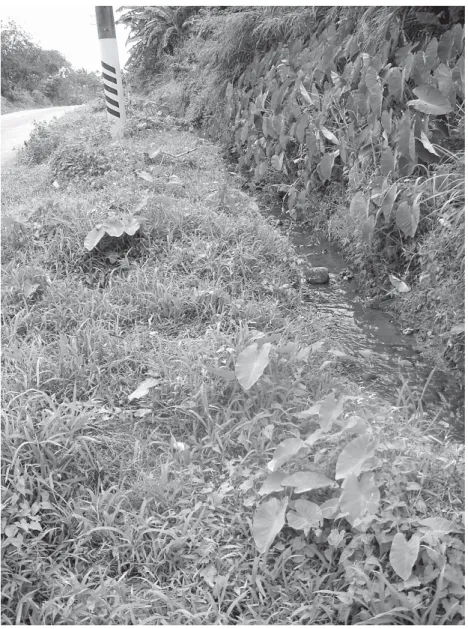
Figure 4 Wild taro growing alongside a wet ditch, at left, between the road and a fi eld with taro. The wild and
cultivated forms are morphologically distinct, and are managed differently. The wild form is a
source of leaves for eating, and was not planted, according to the farmer using the fi eld. The culti-
vated form on bank at right is a source of corms. Vic. Mt Banahaw, Luzon.
corms, might have been transferred from gardens. People questioned near Mt Banahaw generally preferred the leaves of wild forms that lack purple petioles, as in the vicinity of Lake Sampoloc. One speaker also preferred using X. sagittifolium with a green rather than purple petiole, despite the fact that the petiole of this aroid is not eaten (the corms are commonly eaten). At B. Maloa, the name inaw was recorded as a local vernacular name for gabi in general.
We found taro fl owering at Lake Sampaloc in May 2008 (a wild plant), and again in a village near the foothills of Mt Banahaw, in July 2009 (a cultivated plant). When asked, most people in the region told us that they had not noticed or seen taro fl owering, but men working in the agroforestry area above Lucban recognised a sketch of the taro infl orescence, and so did an older farmer (with large taro garden) near Taytay Falls. Wild taro was abundant along roadsides leading up to Taytay Falls, above Majayjay (Fig. 3) at the edge of the Mt Banahaw San Cristobal National Park, and was photographed in 2008 on a recently exposed slip face at the edge of one of the waterfalls (Fig. 5, D. Mateo pers. comm. 2009). In summary, wild and apparently wildtype taro is abundant on very wet mid-altitude slopes of Mt Banahaw, at the edge of mainly natural forest and in settled areas, on the northeastern fl ank, but we cannot say if a breeding population is present or not, as we have not visited this area during the wet season, when fl owering and fruiting is more likely. One of us (Tandang) revisited Mt Banahaw in 2010, and ascended to the upper slopes, above Lucban, but did not see further wild taro.
Although the plants are mainly self-propagating, and grow without cultivation, some trans- plantation of wild taro was reported in the Mt Banahaw area (Table 1), so the plants in some locations can be regarded as ‘semi-wild’.
Figure 5 Wild taro (at upper right) alongside one of the Taytay Falls, Mt Banahaw. Earlier photos of the same waterfall show that the taro has colonised the edge of a small slip face, along with other wild herbs.
(Photo Oct. 2008, courtesy D. Mateo)
Table 1 Wild and semi-wild (planted without cultivation) taro with edible leaves, collected in vicinity of Mt Banahaw, Luzon Island, Philippines. Abreviations: GPS 140441.5 E, 1212007.9 N = Global Posi- tioning System, base map WP84, 14 deg. 04 min. 41.5 sec. East, 121 deg. 20 min. 07.9 sec. N; m = metres a.s.l., gr. = green, pu. = purple; wh. = white; see Matthews (1997) for explanation of terms.
No. Date & site no. Location Description Name; comments; notebook ref.
1 14/2/09-1 L. Sampaloc, B. Concepcion, roadside ditch; GPS 140441.5 E, 1212007.9 N, 114 m
gr. blade and gr. petiole graded to white, pk. basal ring, pk. roots, pk. skin, wh. cortex, wh. core, gr./wh. stolon w. gr./wh. bract,
(?); leaf (no inf. about stolon);
PJM 1.23-24
2 14/2/09-2 spring at L. Sampaloc; B.
Concepcion; GPS 140452.0 E 1212004.0 N, 114 m, roadside ditch and around pool at spring source
gr. blade with pu. margin and entirely pu. petiole, wh. basal ring, wh. roots, wh. skin, wh.
cortex, wh. core, pu. stolon with pu. bract
gabi; leaf, though more itchy
than preferred type w. gr. petiole;
no inf. about stolon; PJM 1.25
3 14/2/09-6 L. Bunot, B. Concepcion; GPS 140446.6 E 1212046.8 N, 123 m;
on open grassy slope above foot trail
gr. blade, gr. petiole, wh. basal ring, wh. roots, wh. skin, brown stolon w. brown bract, young blades eaten (indictaed by cut petioles),
gabi laing; corm not used, stolon
not used; planted w/o cultivation, PJM 1.37
4 15/2/09-1 B. Bigo; GPS 135948.2 E 1213844.7 N, 111 m; planted at edge of road outside front yard of house
gr. blade, gr. petiole, wh. basal ring, wh. roots, wh. skin, wh.
cortex, wh. core, wh. stolon w.
brown bract
laing; no inf. on about stolon;
blade and petiole eaten; corm not eaten; planted w/o cultivation, PJM 1.48-49, 74
5 15/2/09-2 B. Mate; GPS 140001.4 E 1213822.7 N, 120 m; along roadside and edge of overgrown fi eld
gr. blade, pu. petiole, wh. basal ring, wh. roots, brown stolon with purplish brown bract
lain; only blade is eaten; petiole,
corm, & stolon not eaten; lain w.
pu. petiole more itchy than
lainwith gr. Petiole; PJM 1.49-51, 74 6 15/2/09-7a Kaluran Palale; GPS 140235.2 E
1213949.2 N, 219 m; along roadside ditch in settlement
gr. blade, pu. petiole, wh. basal ring, red roots, wh. skin, wh.
cortex, wh. core, brown stolon w.
purplish brown bract
lain; no inf. about stolon, leaf
more itchy & less popular than no. 7 (next); PJM 1.57
7 15/2/09-7b Kaluran Palale; GPS 140235.2 E 1213949.2 N, 219 m
gr. blade, gr. petiole, pk. basal ring, pk. roots, red skin, wh.
cortex, wh. core; stolons present but not collected
puti; corm, petiole & blade
edible; no inf. on edibility of stolon; corm v. starchy though small; poss. same plant as cv gabi
inawat B. Maloa (ref. PJM 1.69-70) ; leaf less itchy & more popular than no. 6; elsewhere cultivated for the corms; PJM 1.57, 75
8 15/2/09-8a Silangan Palale; alongside wall at edge of fi eld inside spa area; GPS 140347.8 E 1214038.6 N, 85 m
gr. blade with pu. piko, petiole purplish or gr. at top grading into gr. and wh. below; wh. basal ring, pk. roots, wh. skin, wh.
cortex, wh. core, wh. stolon with pk. bract
puti; blade and petiole edible;
no.inf. about stolon; PJM 1.59, 74
9 15/2/09-8b Silangan Palale; alongside wall at edge of fi eld inside spa area; GPS 140347.88 E 1214038.6 N, 85 m
gr. blade with pu. margin and pu.
piko, main veins partly u. on underside of blade, petiole strong pu. at top grading into gr. and wh. below, wh. basal ring, wh.
roots, wh. skin, wh. cortex, wh.
core, wh. stolon with wh. bract
pula; stolon not eaten, blade
edible; petiole edible or not acc.
to diff. speakers; PJM 1.59, 73
10 16/2/09-2.1 B. Paola, Lucban; in damp gully in coconut plantation above road;
GPS 140529.5 E 1213220.7 N, 604 m
gr. blade, pu. petiole, pk. basal ring
pula; mainly the blade is eaten;
stolon eaten in a dish called
paksiw; spontaneous, not planted;PJM 2.4-10 11 16/2/09-2.2 B. Paola, Lucban; in damp gully
in coconut plantation, above road; GPS 140529.5 E 1213220.7 N; 604 m
gr. blade, gr. petiole, wh. basal ring, red roots,
puti; no inf. about stolon; mainly