§22. Peltier Current Lead (PCL) Experiment for Liquid Helium System
Yamaguchi, S. (Chubu University)
In order to reduce heat flux to liquid helium system, we construct a Peltier current lead (PCL). This system includes a thermoelectric (TE) part, a copper part and high temperature superconductor (HTS) partI). Its design was performed by the computer software2) to minimize the heat lead. This software calculate the temperature profile along the current lead by using actual material parameters, such as the thermal conductivity, electrical resistance and the Seebeck coefficients of the copper, HTS and thermoelectric materials as the function of temperature. The given parameters of the software are the current, the size of thermoelectric part and the parameters of HTS part, and can find the optimum size of the copper lead part. However, the heat exchange ratio f 3) of the cold gas and the copper should be assumed to calculate, therefore we calculate many cases to fix the value of the heat exchange ratio.
The figure 1 shows the temperature profile of the current lead at the current of 150A. The temperatures were measured at the room temperature side and low temperature side of the thermoelectric element, and the high temperature side of the HTS. The temperature profile is changed by the heat exchange ratio, and the calculated temperature profiles for the f-values of 0.7 and 0.8 are also plotted in the same figure. We can conclude from this figure that the actual value of the heat exchange ratio is between 0.7 to 0.8, and the calculation result is matched well with the experimental data.
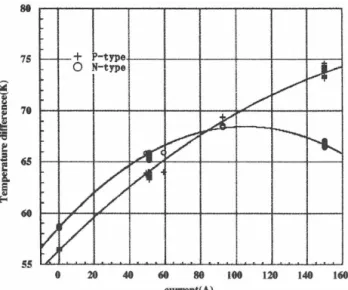
The figure 2 shows the temperature difference of the thermoelectric element and the current.
;:
'E'
--...
... fIII·U..,.
uro ~---r---r-
~ 1~ ~---~---~---r~~r--j
Gi Q.
~ e 100
o e:==~ __ ~ ______ ~ ______ ~ ______ ~
8 0.5 1
Length [mJ
2
Fig. 2. Calculated temperature profile for f=O.7 and 0.8, and the experimental temperatures of the current lead.
7S + P-type
0 N-type
;li t
= 7.
~ ;e;
.a e 65
8. f
Eo-< m
60
current(A)
Fig. 2. Calculated temperature profile for f=O.7 and 0.8, and the experimental temperatures of the current lead.
The temperature difference can be observed even in the current of zero because the thermal conductivity of the thermoelectric material is 11300 of the copper's. The temperature difference is increased along the increase of the magnitude of the current because of Peltier effect, and peaked at the optimum current. The maximum temperature differences are 68 K for N-type semiconductor and estimated to be 85 K for P-type's for the different current.
These temperature differences can reduce the heat leak about 30%. However, the transport parameters, such as electrical resistivities, thermal conductivities and Seebeck coefficients of the P-type and N-type semiconductors are similar to each other. The cause of the experimental result depends on the contact resistance of the copper block and the thermoelectric semiconductor because the voltage drops of the N-Type semiconductor is higher than that of P-type' s. This means that the contact of the electrode and the semiconductor is very important to perform the experiment.
Reference
1) Okada M, Tanaka K, Wakuda T, Ohta K, Sato J, "A new symmetrical arrangement of tape-shaped multifilaments for Bi-2212 round-shaped wire", IEEE Trans. Applied Superconduct., vo1.9, 1994 (1999).
2) Sato K, Okumura H. and Yamaguchi S., "Numerical calculations for Peltier current lead designing", Cryogenics, Vol. 41, pp. 497-503, 200l.
3) Wilson M.N., "Superconducting Magnets", Oxford University Press, 1983.
325