Plant Micro fossils from Marine Pleistocene Sediments of Kii Peninsula, Japan.
著者 SHIMAKURA Misaburo
journal or
publication title
奈良教育大学紀要. 自然科学
volume 17
number 2
page range 75‑88
year 1969‑01‑31
URL http://hdl.handle.net/10105/3159
sstf* mn«w.29os*) ra»i
Bull. Nara U. Educ, Vol. 17, No, 2, (Nat.),
Plant Micro fossils from Marine Pleistocene Sediments of Kii Peninsula, Japan.
(with 5 plates)
Misaburo SHIMAKURA
(Department of Earth Science, Nara University of Education, Nara, Japan) (Received June 29, 1968)
Marine terrace deposits are distributed along the coastal area of Kii Peninsula, southwest Japan. Many fossils belonging to foraminifera, coral, echinoids, mollusca and vascular plants have been found in these sediments.
This paper is concerned with the record of micro fossils and pollen
analysis of the Pleistocene sediments.
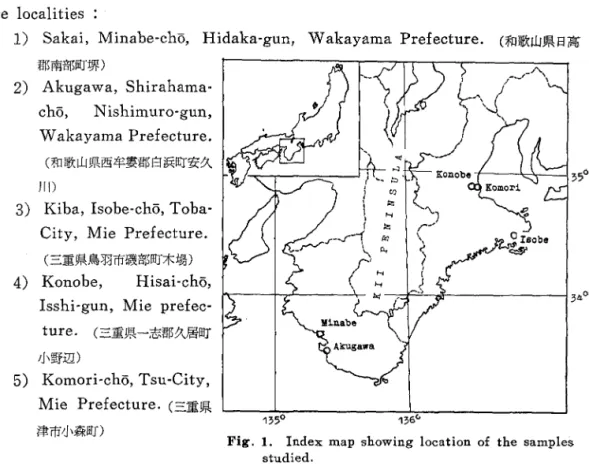
The samples dealt with in this article were collected from the following five localities :
1) Sakai, Minabe-cho, Hidaka-gun, Wakayama Prefecture.
2) Akugawa, Shirahama- clio, Nisliimuro-gun,
Wakayama Prefecture.
in)
3) Kiba, Isobe-cho, Toba- City, Mie Prefecture.
4) Konobe, Hisai-cho, Isshi-gun, Mie prefec-
ture. (zmm-ismiKMm
ibwn. )
5) Komori-cho, Tsu-City, Mie Prefecture. (3Sg
135° 156°
Fig. 1. Index map showing location of the samples studied.
75
Geological remarks of the localities 1. Minabe Pleistocene formation.
This formation is developed along the coastal area between Tsubaki-zaka and Sakai, composed of silty-sand and gravels, and unconformably overling the middle Miocene Tanabe Group. A dark-bluish sandy-silt bed, measured about 8m thick, is exposed at the rail-road side cliff of Ipponsugi,
and comprises many molluscan fossils. NAKAMURA and KURODA (1924)
identified 14 species of mollusca, and stated that the fauna indicated warm climate. Recently KONDA (1967) determined about 80 species of foraminifera, and considered that the shell bed had been deposited in the inner or central part of an ancient bay, under warm water condition.
Geological age : dln(OTSUKA 1931), J2 (IKEBE), J] (SHIKAMA 1952) 2. Akugawa Pleistocene formation.
Akugawa formation is distributed on the hill-side along the down stream å of the Akugawa, composed of gravels, and unconformably overlied the
middle Miocene Kanaya formation. A bluish-gray silt layer is exposed
at a cliff near Akugawa village, and comprises many fossils, such
as foraminifera, coral and mollusca. TAKEYAMA (1929) determined about 200 species of mollusca, and considered that the fauna was "Kuroshio"
warm current type. Further he correlated this formation to the upper and middle parts of Minabe formation.
Geological age: dlli(OTSUKA 1931) J2(lKEBE) Jx(SHIKAMA 1952) 3. The Sakishima Group.
In the northeast part of Shima Peninsula, a series of gravel and sand layers, called Ugata formation, Sakishima bed or the Sakishima Group, is widely developed forming marine terrace. It is unconformably overlied Mesozoic Matoya formation, and underlied the younger gravels. According to YAMADA (1963), stratigraphic classification of this group is following :
Fusesa gravel Ago gravel Ugata sand
unconformity
•Eunconformity-
Isobe formation (marine fossils)
unconformity
Pleistocene Plant Micro fossils of Kii Peninsula.
Kiba silt (marine fossils)
unconformity
77
Osatsu gravel
Of molluscan fossils, MATSUSHITA (1932) recorded 17 species, OlNO- MIKADO (1933) 45 species, and YAMADA (1961) 45 species. MATSUSHITA and OlNOMIKADO correlated this shell bed to Akugawa formation. MAKI-
YAMAand NAKAGAWA(1941) identified 80 species of foraminifera, and
considered that the fauna was "Kuroshio" warm current-type. MlKI (1948) recorded 16 species of Gymnosperm and Angiosperm remains, and included this bed in his "Sapium bed" (1948) or "Ruppia bed" (1957).SfflMAKURA
(1962) reported the pollen analytical result, and he compared this bed with Atsumi formation developed at Atsumi Peninsula.
The samples were obtained from the upper layer (probably Isobe
formation) and the lower layer (probably Kiba silt) of a road-side cliff near Hasama, Kiba.
Geological age : J2 (IKEBE) , Upper Pleistocene (MlKI 1948), early half of the Pleistocene (YAMADA 1963), din (OTSUKA 1931).
4- Konobe formation.
The type locality of this formation is exposed in a cliff of a paddy field in the eastern part of Konobe, Hisaicho, According to ARAKI, "the forma- tion consists of one meter thick massive bluish sikstone yielding Ostrea
gigas THUNBERG, Trapezium liratum (REEVE), in upward sequence and
overliain with two meter thick terrace deposite consisting of cobble size granite and gneiss". The sample-1 was obtained from the Ostrea-zone at
the type locality, sample-2 from 80cm upper part and sample-3 from a
outcrop 20m east from the type locality.
Geological age: Pleistocene (ARAKI 1959).
5- Komori "Sapium bed".
There is a cliff about 100m south of Kuroki-bridge between Fuji- kata and Komori-cho, southern end of Tsu City. The succession of the layers is as follows:
Terrace gravels
paraconformity
(1) Brown medium-grained sand, 0.5m.
(2) Dark gray silt, 0.8m.
(3) Bluish-gray sandstone, comprising small gravels, 0 5m.
(4) Whitish fine-grained sand, 0-2ni.
(5) Dark grayish sandy-silt, comprising plant fossils at the- basal part, 1.0m.
(6) Thin lamellated clay, 0.1m (7) Bluish-gray sandy-silt, 1.0m.
(8) Dark gray sandy-silt, 1.0m+
The samples were obtained from upper (2), middle (5) and lower (8)1 layers.
In 1948, MlKI classified the Pleistocene deposits distributed in Kinki and adjacent district into following four beds, and SHIKAMA (1950) and TAKAHASHI(1959) corresponded them to time-stratigraphical unit of Japanese^
Quaternary.
Upper Pleistocene Sapium bed Kx
M iddle Pleistocene \b?ri* bed ""V' j }3
[Lryptomena bed Ji
Lower Pleistocene Paliurus bed I2
After that KOKAWA (1961) classified the Pleistocene plant-assemblages of Japan into five floras, i. e. (5) Larix flora (J3), (4) Sapium flora(J2), (3) Syzygium flora (Ji), (2) Larix gmelini flora (Jx) and (1) Paliurus flora (Ia).
The locality may be almost equivalent to MlKI's ''Sapium. bed" at Komori-Ueno, Takazyaya.
Geological age : Uppermost Pleistocene (MlKI 1948), Ki (SHIKAMA
1952 and TAKAHASHI 1950), J2 (KOKAWA 1961).
Plant micro fossils Pollen grains.
Many pollen grains are found in all samples treated with pollen- analytical maceration method. Identified pollen types are given in the following table, and some of them are shown in PI.1-2-
M in a b e A k u g a w a
u p .L o w . N o .l ,N o .2 ,N o .3 , I so b e
U p . L ‑l . L ‑2 , 1 . K o n o b e
2 . 3 . K o m o r i
U p .M id .L o w .
A b ie s c c a a a c a c a a a a a a
P ic ea c c s r r r i r r
P i n u s a a a a a a a a a a a a a a .
T s u g a a a a a a c c c a a a a a a
Pleistocene Plant Micro fossils of Kii Peninsula. 79
P s e u d o t s u g a c c a a a s s s r r c s f c S c i a d o p i t y s s s f f c f f f s f f c s c C r y p t o m e r i a r r r r r r ‑ r s r f f r s J u g l a n s ¥
p t e r o c a r y a I
C a r y a ? r ‑ ‑ A l n u s
C a r p i n u s s f r r f r f s s s f s s s C o r y l u s ‑ ‑ r
B e t u l a F a g u s
Q u e r c u s r c r r r a a c c c c c c c C a s t a n o p s i s ?
Z e l k o v a r f ‑ r r r f r f f s f f r I l e x 2* ̲ ̲ f ‑
A c e r
T i l i a , , . ̲̲ ̲ Y T , ̲
B u x u s f ‑ ‑ ‑ ‑ ‑ ̲ ‑ ‑ ‑ ‑ ‑ r ‑ r S a p t u rn r r r r r c c c c c s c f c E l a e a g n u s ‑ f r ‑ ‑ S t y r a x
R h u s ? H e d e r a ?
E r i c a c e a e 」 V i b u r n u m
L o n i c e r a A b e l i a ?
P e r s i c a r i a ‑ ‑ ‑ ‑ ‑ f r f ‑ ‑ ‑ C a r i o p h y l l a c .
T r a p a
M y r i o p h y l l u rm ‑ ‑ ‑ ‑ ‑ ‑ ‑ r ‑ ‑ ‑ ‑ ‑ ‑ E p i l o b i u m ‑ ‑ ‑ ‑ ‑ ‑ ‑ r ‑ ‑
P a t r i n i a
蝣C i c h o r i d e a e ‑ ‑ ‑ ‑ ‑ r r r ‑ ‑ ‑ ‑ C a r d u o i d e a e ‑
*蝣 * 蝣サ ォ**・ # サ G r a m i n a e
a = a b u n d a n t , c = c o m m o n , s = s e v e r a l , f = f e w , r = r a r e , ‑ = a b s e n t .
Of Coniferous pollen grains, Abies, Pinus and Tsuga are predomi-
nant, while Picea and others being less abundant. A number of spheroidal,
psilate pollen grains are found in all samples, especially they are abundant
in the samples from Minabe and Akugawa. Although triradiate streaks on
å exine are not clear, these grains are determined to be Psudotsuga. Many
wood-fragments of Psudotsuga are also found in the same slides.
Sciadopiys pollen grains are easily distinguished from others by the size, shape and surface structure, and are found in almost all samples.
Wood-fragments of Sciadopitys are also found in the same slides.
Taxodiaceae pollen grains are identical with Cryptomeria by the characters of bended papillae, surface ornament and size.
On the whole, Angiosperm pollen grains, both AP and NAP, are
less abundant throughout every sample. Juglans, Alnus, Carpinus, Fagus,
Quercus, Zelkova, Sapium and Viburnum are common types. A few
pollen grains showing, respectively, characters of Carya-and. Liquidambar- type are observed in the samples from Isobe. Two genera are believed to extincted in Pleistocene age in Japan. It should be noted the herbaceous
pollen, such as Trapa, Epilobium and Patrinia occur in the same
samples.
Pollen analysis.
Pollen analytical results are set out in Text-fig. 2- The diagram is based on the counts of approximately 250 or more AP per sample.
P o l l e n
S a s p l e s
to d ta a
ォ9 蝣(0po
toh 蝣p
‑Ha , o
・aH u4>
a o
ms 3m a rWォ<
m3 a
・H to3 r‑{ <Q
q3 a
ォ>
o aj 9 10SI sM a 3
<aV ォo M
9
a>
・H 3
4)o
・H P (
3H T *P h
9 6Hta
・o 03 Phto
蝣 od
・Hu m
蝣pft ou
HbO3 蠎3
&
a>
u
&
oo 3M hォ
uCD a ?3 M rH<D N
Mサ r‑iH
.̲J l‑(w
」 <
1‑1a rata
0ォ r‑iH
u!蝣サ
‑Pm 蝣uHu fa
a・H tサ
Upper
Minabs > lowe r am^mt^a^mtmi I I
蝣 蝣
I" " B W M V 蝣 I il l No .1 蝣 蝣 蝣
Ai ugawa l s o .2 No .3
lEobe ITpp Low.1 Low.2 er
蝣I
Konobe .̲!
Upper
lowe r
" " "" ^ H H
l^ ^ ^ ^ l lBast 蝣 "蝣li^ H ^ ^ ^ ^ ^ ^ H ̲ M lH ftM lin M lH iM lH i M l H i 蝣I Eomori
Uppe r 蝣 蝣 蝣蝣I ; 1 I IX 蝣 I 0 1 蝣 I
蝣id. ^^ 蝣^ ^ ^ ^ ^ 蝣 ^ 蝣 1 蝣 蝣
Lowe r ¥^m^^^^^^m^^ 蝣 ll i I I
? . . . . s p y
F i g . 2 . P o l l e n - d i a g r a m s o f t h e P l e i s t o c e n e s e d i m e n t s f r o m K i i P e r i n s u l a .
Pleistocene Plant Micro fossils of Kii Peninsula. 81 In the pollen floras of Minabe and Akugawa formations, Pinus, Tsuga, Abies and Pseudotsuga are dominant, Pinus being exceedingly abundant
in the samples from Minabe. Sciadopitys is relatively scarce, and
Cryptomeria is still more rare. Of Angiosperm arboreal pollen genera,
Carpinus, Quercus, Zelkova and Ilex are common, though in a small
number.
The Sakishima Group is characterized by an abundance of vesculate
conifer pollen, by various types of Angiosperm pollen genera, and by
predominance of Sapium, Fagus and Quercus.
Konobe and Komori formations show almost similar pollen diagrams.
Abies, Pinus and Tsuga are dominant, Pinus being abundant. Pseudo-
tsuga, Sciadopitys and Cryptomeria are relatively scarce, though they
varied in amount according to samples. Carpinus, Quercus, Fagus and
Sapium are comparatively frequent.
The pollen analytical results show that there are close resemblaces
between Minabe formation and Akugawa formation, and between Konobe
formation and Komori "Sapinm bed". Although Isobe formation and Kiba silt of the Sakishima Group show somewhat different pollen diagrams, they may be included in MlKI's "Sapium bed".
Spores and spore-like micro fossils.
Fern spores, both Triletes and Monoletes, are found in all samples.
Most of them seem to belong to Leptosporangiopsida. Osmunda, Glei-
chenia, Polypodium. Pteris, Onychium and Lycopodium are distinguished.
Ratio of occurrence of fern spores to pollen grains are following:
Minabe Akugawa Isobe Konobe Komori
Identified pollen Fern spores Hystrichospheridiim
92.5 5.3 2.2
9 2 . 9 8 4 . 0 8 0 . 5 7 6 . 2
2 . 8 1 4 . 4 1 8 . 7 2 3 . 8
4 . 3 1 . 6 0 . 8
Fungal spores are also common in the samples. Most of them seem to he derived from rotten wood. Phragmothrites, clamydospore and ascospore
are found. Bryophyta spores are not clear, while many fragments of
Musci leaves occur in most samples.
Cutinized spore-like micro fossils which lack the morphographic features of the spores or pollen grains of vascular plants are found in the samples
from Isobe. A spheroidal micro fossil somewhat ressembles Haplocistia,
and a pyriform fossil seems to be analogous Palaeodinia.
Xylem.
Many fragments of woody elements such as tracheids, vessels, wood- fibers, wood-parenchyma and ray-tissue, are found in all samples. Coniferous tracheids characterized by bordered pits are most abundant, and scalariform perforation plates of vessels are found in some samples.
A number of wood fragments, showing Abietineous pitting on tracheids and Cedroid thickenings of ray cell-walls, seem to belong to Cedroxylon or Piceoxylon. Considering an abundant occurrence of Abies pollen, these^
elements may be Abies wood.
Several wood fragments characterized by fine, spiral thickenings in the vertical tracheids and Piceoid pitting on cross-fields of rays, are found
in the samples from Akugawa and Minabe. Pseudotsuga and Picea
Maximowiczii show the same woody structure. The samples comprise
abundant Psudotsuga-type pollen, but lack Picea-type pollen. This fact suggests that these elements are Pseudotsuga wood.
Sseveral wood fragments characterized by the presence of "Eiporen"
on cross-fields of rays, by lacking of resin cells and by absence of ray tracheids are identical with Sciadopitys wood.
Cuticles.
Fragments of epidermis and cuticles are the most commonelements of vegetable residue. A large number of them are so decayed in a state of preservation that their systematic determinations are hardly possible. Some cuticles characterized by Abietineae-type stomata are found in the samples from Akugawa and Isobe. Cuticles with dicotyledoneous-type stomata are abundant in the samples from Isobe.
Diatoms.
All samples comprise diatom frustulae, especially so in Konobe
formation. Identified species are listed in the annexed table.
Minabe Akugawa Isobe Konobe Koraori
Achnanthes crenulata geun.
A. inflata KUTZ.
A. inflata vat- elata hust.
A. septata CL.
Actinella bracilliensis grun.
Actioncyclus Ehrenbergii ralfs
c
r
r
r
r
c
1
o o
J 1
X I I X 1
o
I
o J
1 X
'HH3 VfOlUtS VU0q<?0}VlU1MVU£)-
HH3 3J23VUS
•E£)
'HH3 lunzvutiunov
vw3uou4uio£)
'saiVH vjsnqou -g-
'a'V SISU3V3JUV3S
'£
'OS SU3piq3Vu4
'gr-
"ava j,ouiiu -jea s}2VU}t?a<f
-g-
å avH uofvvi -gr
10 j,ouiui -oj timounj.8
•Egr
'xsiaw synovia
*g
'Oa vufsouiauny
vtfoung
'ZiflH vpiSunj -g-
Zxiih xauos -g-
'HXIJVS AV.
tlUV1upu&U V}W31{}}cfg
"ID vo}i<f}n3 -oj iiqttvis '(J
å 10 ttqtzws -Q-
10 Vivi3iin4oj4np
"°J v:>}u}f s}3u]o4}(2
4 'WHOS'W
V}VUtiu3S v}U3y4sotuiipt(j
"10 vpiSunj 'Q-
10 stjvsaoq -oj vpiiunt -Q
å xosmaH 'a vpiw.ni -q
"HonnaH 'A v^vjosauvj -q
'HHa vunaj4ou3f3q
-q
å zxa»
vtvp-i4sn3 -q
•ENI1HOvjntsio vilsqtuKQ
Avxaaina iunj.oi/[i%s
vijatoiaXQ
•ENnna }3U34w3t -q-
'HHa siptuz sninoo 'q
'AaHO snuvis}m,3j
-Q
'HH3 Snp}UfU33X3
•E£)
JIHa snjvi(4iuou3}sz>
-jo snosipouissoQ
10 vjnjtjts S13U0JVQ
'NflHa snuv%i3iu3vp
sn3stpouiC4tuvQ
•EAVH0v23i(Jin4 'S
HHa siaavi vii[42nPP}&
nva snsou}nu4
'V
'S
"V V1VJS0231VJ
-jba snjv23V3 -y
liva snivjava
snasijny
'HHa snjvuuo snostpioui[3VJ-y
SdlVH sntvjnpun sny3Kf4ou}ioy
M.XVHSsuaSut -y
'XSriH tisfjvj, 'JBA ti3j3qusuyg
-y
•EBjnsuin3,j £8
iijj jo sjtssojojorp^
}nej<j
anaoojsrajjj
Gylosigma eximium BOYER.
G. scalproides CL.
Frusturia sp.
Hanzschia amphioxys GRUN.
Hyalodiscus cf. annulus MANN.
Melosira sulcata KtiTZ.
M. undulata var. normanni KUTZ.
Navicula americana ehr.
N. cf. brasiliensis GRUN.
N. cuspidata KUTZ.
N. cf. burandii KITTON.
N. cf. latissima of. rostrata HEIDEN.
N. Lyra fo. elliptica A. S.
N. lyroides HENDEY.
N. maculata EDW.
N. monilifera var. constricta A.S.
N. punctata
N. punctata fo. marina CL.
JV. raeana CASTRAC.
N. Spectabilis GREG.
N. yarrensis GRUN.
Neidium iridus PFIAZER.
N. iridis var. ampliatum CL.
Nitzschia cocconiformis GRUN.
N. granulata GRUN.
JV. nicobarica GRUN.
N. vitrea NORMAN.
Pinnularia acrosphaeria BREB.
P. brebissoni CL.
P. brevico stata CL.
P. divergens var. capitata HUST.
P. divergens var. undulata H.&C.
P. episcopalis fo. subelliptica CL.
P. gentilis CL.
P. lata w.S.
P. lata fo. lastriata CL.
P. macilenta EHR.
P. viridis EHR.
Rhaphoneis ampluiceros EHR.
Stauroneis acuta w.S.
5. phoenicenteron EHR.
Stephanodiscus niagarae EHR.
Stephanopyxis grunwii GREG. &RALFS.
r r f r c f r r s
r r r s f
r f s r s s c
r f s f f r
s
s
f
r
f
r
f
f
r
c
f
r
r
r
r
f
r
s
r
f
f
s
r
s
s
Pleistocene Plant Micro fossils of Kii Peninsula. 85
S u r i r e l l a c u n e a t a A . S . S . r o b u s t a E H R .
S . t e n r a G R E G . S y n e d r a u l n a E H R .
T e r p s i n o e a m e r i c a n a R A L F S . T r i c e r a t i u m f a v u s E H R .
rt
r r
r r r
r f r r r r
f r
f r
r f
s
An agreement of diatom assemblages is seen between the samples from Minabe and Akugawa formations. Dominant species are Stephanodiscus niagarae, Actynocyclus Ehrenbergii, Nitzschia cocconiformis, Navicula
Lyra var. elliptica and Diploneis fusca.
In the samples from Konobe, diatom assemblage is characterized by trie enormous number of Melosira sulcata, Auliscus caelatus, A. prinosus
and Stephanodiscus niagarae. The samples from Komori, though diatom remains are not so abundant, show the same feature.
On the whole, the diatom assemblages comprise marine-, brackish- and fresh-water species. Therefore, the Pleistonce formations distributed along the coastal area of Kii Peninsula are considered to be deposited near the margin of sea coast, under the influence of a natural environment both marine and terrestrial.
Hystrichosphaeridae.
Several kinds of Hystrichosphaeridae are found in the samples from Minabe, Akugawa, Isobe and Konobe. Hystrichospheridium and Baltisp- haeidium are common types.
Conclusion
1. Marine Pleistocene formations distributed along the coastal area of Kii Peninsula comprise abundant plant micro fossils, such as pollen grains, fern spores, fungal spores, Phragmothris, tracheids and other xylem elements, cuticles, diatoms, and Hystrichoshaeridae.
2- Judging from pollen analytical results and features of diatom assemblages, the Akugawa formation is correlated to Minabe formation, and, Konobe formation to Komori "Sapium bed".
Konobe, Komori and the Sakishima Group (Isobe formation and Kiba silt) are characterized by a large number of Sapium pollen, and corresponded to MIKI's "Sapium bed".
3- Abundant occurrence of pollen grains and xylem elements of Pseu-
dotsuga and Sciadopitys in the sediments may indicate wide distribution and luxuriance of these plants in Pleistocene age.
References
1. Araki, Y. (1959) : A Pleistocen Marine Fauna from near the Cities of Tsu and
Yokkaichi, Mie Prefecture, Southwest Japan. Trans, Proc. Palaeont. Soc.
Jap., N.S,, No.33, 19-22.
2. (1960) : Geology, paleontology and Sedimentary Structnres (including Prob-
lematica) of the Tertiary Formations Developed in the Environs of Tsu City,
Mie Prefecture, Japan. Bull. Libral Arts Dep., Mie Univ., Special Vol. No.l.
3. KoKAWA, S. (1961) : Distribution and Phytostratigraphy of Menyanthes Remains in
Japan. Jour. Biol. Osaka City Univ., 12,123-151.
4. KoNDA, I. (1967) : Foraminiferal faunules from the Minabe-Sakai Shell bed, Kii
Peninsula, Central Japan. Bull. Osaka Museum Nat. Hist., No.20, 31-38.
5. MakiyamA, J. & T. Nakagawa, (1941) : Pleistocene Foraminifera from Sima, Mie
Prefecture. Jour. Soc. Geol., 48, 239-243 (in Japanese).
6. Matsushita, S. (1932) : On the Diluvium of Kiba, Isobe-mura, Shima District. Chikyu,
36-38 (in Japanese).
7. Nakmura, S. & T. kuroda, (1924) : The Diluvium series at Sakai, Minabe-ch6, Hidaka-
gun, Kii Province. Chicky, 1, 169-171 (in Japanese).
$å Miki, S. (1948) : Floral Remains in Kinki and Adjacent Districts since the Pliocene
with Description 8 New Species. Sci. Rep. Osaka Second Teachers Coll., No.2,
105-144 (in Japanese).
9. (1957) : Pinaceae of Japan, with special Reference to Its Remains. Jour.
Inst. Polytechnics, Osaka City Univ., Ser.D, 8, 221-272.
10. OiNOMlKADO, T. (1933) : Pleistocene Mollusca from Kiba, Shima Destrict. Chikyu,
19, 305-308 (in Japanese).
ll. OtSUKA, Y. (1931) : Quarternary, in Iwanami-koza (in Japanese).
12. Shikama, T. (1952) : Quarternary (in Japanese).
13. ShiMAKURA, M. (1962) : Pollenstratigraphic studies of Japanese Cenozoic Formations,
IV. The Pleistocene deposits in Sakihima and the Atsumi Peninsula. Jour. Nara
Gakugei Univ. (Nat. Sci.), 10, No.2, 113-119 (in Japanese).
14. TAKAHASHI, E. (1959) : Floral Changes since the Mesozoic Age of Western Honshu,
Japan. Sci. Rep. Yamaguchi Univ., 10, 181-237 (in Japanese).
15. TAKEYAMA, T.(1929) : The Diluvium series at Akugawa, Kii Province. Chikyu,
ll,222-224 (in Japanese).
16. Yamada, J. (1963) : Remarks on the Significance of the Pleistocene Mollusca from
the Shima Peninsula, Mie Prefecture, Japan. Bull. Liberal Arts Dep., Mie
Univ. , No. 17, 96-101.
Pleistocene Plant Micro fossils of Kii Peninsula. 87
9.
Explanation of Plates I-V.
Plate I.
(1-3, X400, others X600)
1 . P s e u d o t s u g a , L o c . M i n a b e . 1 3 . 2 . // L o c . A k u g a w a . 1 4 . 3 . A b i e s , L o c . M i n a b e . 1 5 4 . C r y p t o m e r i a , L o c . A k u g a w a . 1 6 . 5 . S c i a d o p i t y s , L o c . A k u g a w a . 1 7 . 6 . // L o c . M i n a b e . 1 8 . 7 . Q u e r c u s , L o c . M i n a b e . 1 9 . 8 . C a r p i n u s , L o c . 2 0 . 9 . B e t u l a , L o c . I s o b e . 2 1 . 1 0 . Z e l k o v a , L o c . A k u g a w a . 2 2 . l l . T i l i a , L o c . I s o b e . 2 3 .