
奈良教育大学学術リポジトリNEAR
A Comparative Study on English Textbooks at Senior High School in Japan and in China
著者 ZHOU Lin, ITO Harumi journal or
publication title
奈良教育大学紀要. 人文・社会科学
volume 48
number 1
page range 59‑74
year 1999‑11‑10
URL http://hdl.handle.net/10105/1460
Bull. Nara Univ. Educ.,Vol.48, No.KCult. &Soc), 1999
A Comparative Study on English Textbooks at Senior High School in Japan and in China
Lin ZHOU* and Harumi ITO
{Department of English Language Education, Nara University of Education, Nara 630‑8528, Japan) (Received April 30, 1999)
Abstract
The present research made a comparative study on English textbooks at senior high school in Japan and in China in order to find some good ways to improve English language education of each country. It analyzed two kinds of textbooks in Japan and one kind of textbook in China in terms of the following perspectives: 1) components of textbooks, 2) topics of textbooks and 3) culture orientation of textbooks. It has been made clear tha† the textbook in China tends to ti‑eat cultur,al materials as resources to develop linguistic skills while the textbooks in Japan tend to treat cultural mater、ials to promote international understanding.
Key Words: comparative study, textbook analysis, cultural orientation
1. INTRODUCTION
1.1. The Current Situation of English Language Education in China
English has become a global language. Five countries which include the USA, UK, Ireland, Canada, Australia and New Zealand use English as a mother tongue. There are about 320‑380 million people using English as a mother tongue (Crystal, 1997:54). Singapore, India and over fifty other territories use English as a second language.
There are about 150‑300 people using English as a second language (Crystal, 1997:54). Japan, China and a great number of countries teach English as a foreign language. There are more than 350 million people speaking English as a second language or a foreign language in Asia (Honna, 1997). Sixty percent of radio broadcasts transmit‑
ted all over the world are in English (Jiang, 1995).
Now people using English as a foreign language study English not only m order to understand the culture of English‑speaking countries, but also to
get most advanced information of every field, make technological innovation and promote economic development. The necessity of learning English as a for、eign language today cannot be underestimated.
Therefore, current research on English language education is extensive in the countries which use English as a foreign language.
China is a developing country. Now the govern‑
ment is doing their utmost to carry out reforma‑
tion m many aspects, especially in economics. The ex‑chairman Deng Xiaoping put forward and pur‑
sued an "opening policy , a policy of opening China to the outside world in order to use the experience and expertise of other countries, gather advanced information and import technology and equipment from other countries. Along with cultural and economic exchanges, qualified personnel with a high level of foreign language proficiency,
especially English language pi.oficiency, are required for successful communicating. Therefore, how to improve the English ability of secondary school students and how to make the English capabilities
* Currently enrolled at the Graduate School of Nara Women's University as a Ph. D. candidate
60
Lin ZHOU ・ Harumi ITOof university students suit the requirements of the society have become very important topics in China. There are more than ten academic journals on English language education in China.
Furthermore, English teachers and researchers hold meetings regularly to discuss issues of English language education.
Although China got a good awareness of the importance of English language education, there is a tendency that people pay much attention to practical aspects of English teaching rather than to the new theories of linguistics and applied linguis‑
tics. There is still a shortage of research on English language education. especially some com‑
parative research of English language education.
1.2. Reasons for the Present Research Focuses 1,2.1, Focus on a Comparison between Japan and
China
Both Japan and China belong to norm‑dependent countries (Jiang, 1995)'. They have many similari‑
ties in the language learning environment. For example, both of them are in the east of Asia. The two countries are far from the norm‑providing countries (Jiang, 1995〕 and English is not necessa‑
rily used m daily life. Both of their language systems are completely different from that of English. Moreover, the systems of English lan‑
guage education m secondary school are more or less the same. Both countries teach English as a foreign language generally from junior high school to university.
These similarities provide a base and some possibilities for comparison. Besides, there are many positive things in English language education m Japan which I believe will be helpful to English language education m our country.
1.2.2. Focus on English Textbooks
English textbooks play an important role in English language education. As Figure 1 showsi, English textbooks reflect the objectives of English language education. English textbooks are also necessary tools both for English teachers and students to teach and learn English. Good text‑
books can promote the interaction between the teacher and textbooks, the interaction between students and textbooks and the interaction between the teacher and students.
「 軸Istudent封 Figure1:The inEおof
la慧濫textbooks educati。n
Therefore,thepresentresearchaimstocarry outacomparisonofEnglishtextbooksofJapan andChinaandtofindsomegoodpointsfromeach other.
1.2.3.FocusontheSeniorHighSchoolPeriod ThesituationsofEnglishlanguageeducationin thetwocountriesareverysimilarinjuniorhigh schools,andarequitedifferentinuniversities.
Seniorhighschoolsinthetwocountriesarethe middleperiodsofEnglishlanguageeducation.This periodhighlightssomedifferencesandsimilarities ofthesyst′emsofEnglishlanguageeducationmost clearly.
Furthermore,Englishlanguageeducationinthis periodanticipatestheNationalUniversityEntranc‑e EnglishExaminationandundertakesthetaskto
helpstudentstopasstheexamination.Atthis point,itisnotgoingtoofartosaythatEnglish languageeducationmseniorhighschoolperiodis mostimportant.However,thereislittlecompara‑
tiveresearchonEnglishlanguageeducationduring seniorhighschoolyears,especiallybetweenJap釦I andChina.
1.3.PurposesofthePresentResearch 1.3.1.GeneralPurpose
Comparativestudiesingeneralaimtodrawon goodexperiencesfromothersandlearnone'sown problemsobjectively.Inotherwords,onecanlearn fromothersstrongpointsinordertooffsetone's ownweaknessesthroughcomparativeresearch.
Thepresentresearchaimstoobtainageneral understandingoftheactualsituationsofEnglish languageeducationofthetwocountries.
Moreover,thepresentresearchtriestodiscusssome
waystoimprovecurrentEnglishlanguageeducation
so that it will suit domestic conditions.
1.3.2. Specific Purposes
The present research will make a comparative study on English textbooks at senior high school in Japan and in China with three specific purposes.
The first specific purpose of this study is to obtain a primary understanding of the framework and features of English textbooks of the two countries.
The second specific purpose is to analyze the topics of English textbooks. The third specific purpose is to discuss international understanding orientation of English textbooks through an analysis of the contents of English textbooks.
2. GENERAL FRAMEWORK OF ENGUSH LANGUAGE EDUCATION IN JAPAN
AND N CH NA
2.1. School System
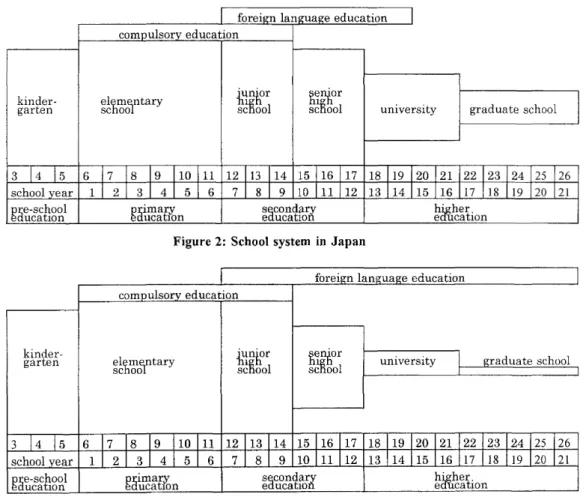
Both in Japan and in China, students spend six years in elementary school, three years in junior high school, three years in seniC,r high school and four years in university‑ Figure 2 and Figure 3
show the school systems in Japan and in China.
Compulsory education in both countries contm ues for nine years丘om elementary school to junior high school. The enrolment・ rates of upper second‑
al、y education and higher education in Japan are much high than those in China. The enrolment rate of upper secondary education is 96.8% of school‑age students ( 15 to 19 〕 in Japan3. The enrolment rate of upper secondary education is about 70‑‑もof schooLage students ( 15 to 19 〕 in China. The upper secondai‑y education includes the education in special training schools, miscellaneous schools and other part‑time courses. The percent‑
age of students advancing to universities in Japan is 55.0% of the students who graduated from senior high schools. The percentage of students advancing to universities in China is still below 5%'¥ The period of English language education in China as a required course is far longer than that in Japan.
Generally speaking. both countries teach a foreign language from junior high school to univer‑
sity. English is taught at most schools. In Japan, a foreign language is taught as a required
foreignlanguageeducation compulsoryeducation
富 加 ntary 望nior gn , nool kinder‑
garten
監
university graduate school
3 4 5 6 7 8 9 10 ll 12 13 14 15 1( i 17 18 19 20 21 22 23 24 25 26 schoolyear 1 2 3 4 5 6 7 8 9 10 ll 1:2 1こ i 14 15 16 17 18 19 20 21 冒 ducation re‑school gal豊ation 昌 econdary ducation hi education g her.
Figure 2: School system in Japan
foreign la n gu age ed uca tion com p u lsory e du cation
冒 恕 訂 tary 慧nior no ol k ind er‑
garte n slTihoI un iversity grad ua te sch oo l
J
3 4 5 6 7 8 9 10 ll 12 13 14 15 16 17 18 19 2 0 2 1 2 2 2 3 2 4 25 26 school y ear 1 2 3 4 5 6 7 8 9 10 l l 12 13 14 15 16 17 18 19 20 2 1 臨e‑sch < u cati30 nl >rim ary :du ca tion 昌 econ dary du cation h igh er , ed u cation
Figure 3: School system in China
62
Lin ZHOU ・ Harumi ITOcourse only at senior high school and will be taught as a required course from junior high school in 2002. In China, English is taught as a required course from junior high school to university. The situations of English language education in elemen‑
tary schools are the same in Japan and m China.
In China, some elementary schools in some big cities, such as Beijing, Shanghai, Tianjing, have tried to teach English as a foreign language. In Japan, some private elementary schools teach students English as a foreign language. Some public elementary schools teach a little English in some trial subjects, such as the subject of interna‑
tional understanding.
2.2. English Curriculum
2.2.1. Eng一ish Courses
At junior high school in Japan, English is taught as an elective course and will be taught as a required course in 2002. At junior high school in China, English is taught as a required course. As far as English courses in the curriculum are con‑
cerned, the two countries have the same situation in junior high schools. In other ords, there is only one course of English, called English.
At senior high school, English is taught as a required course both in China and m Japan. In Japan, there are seven English courses, which are ENGLISH I , ENGLISH n , ORAL COMMUNL CATION (A, B, and C), READING and WRITING.
One of the ORAL COMMUNICATION courses is compulsory and every senior high school has the right to choose. The Education Ministry of Japan stipulates the content of each course, but not the teaching order of the English courses. However, most senior high schools teach the courses of English in the following way. ENGLISH I and one of the ORAL COMMUNICATION courses are taught in the first year, ENGLISH n and READING in the second year、, and ENGLISH n and WRITING in the third year. ORAL COMMUNI‑
CATION is sometimes taught in the second year.
At senior high school in China, there is still only one course of English which is divided at two different levels. The first level is for students who will seek employment after graduating from high school. Students in the first year and the second year are asked to reach this level. The second level
is designed for students who will enter a university for further study. This level also aims to help students to pass the National University Entrance English Examination.
At university level, Japan and China have completely different systems of English language education. In Japan, English is taught as an elective at most universities. English is taught as a required course at a few universities. The Education Ministry of Japan does not stipulate anything at this level, such as textbooks, teaching periods and what English level university students should reach. Every university and English teacher at each university decide the requirements of English language education.
In China, English is taught as required courses in the first and second years at university. Non‑
English‑major students have six periods of English lessons each week. The six periods of English are composed of four periods of intensive English, one period of extensive English, and one period of listening and speaking. Unified English textbooks approved by the Education Committee are used.
After two years of English study at university, students have to take and pass the National College English Examination which is held twice a year. If one cannot pass the examination, one can not obtain the diploma. In the third and fourth years, students take English classes as an elective to study English for special purposes.
2.2.2. Class Size and English Teaching Periods Generally speaking, the size of classes in Japan is a little smaller than that in China. The official class size holds about 40 students in Japan while the official class size m China ranges from 40 to 60.
English is taught more frequently at junior high school and senior high school m Japan than m China. At senior high school, students have 630 English teaching periods for three years in Japan.
One period is 50 minutes at junior and senior high schools in Japan. In China, senioi、 high school students have 428 English teaching periods. One period is 45 minutes at junior and senior high schools.
English is taught more frequently at university
In China than in Japan. There are six English
teaching periods at university as a required course
for the first year students and the second year students m China. English language education remains a completely free situation at university in Japan. In other words, most universities teach English as an elective course. Moreover, English
teachers decide teaching contents and textbooks.
2.3. Eng一ish Syllabus
In Japan, the Education Ministry compiles English syllabuses for junior and senior high schools. In China, the Education Committee compiles English syllabuses not only for junior and senior high schools, but also for universities. The present research will describe English syllabuses for senior high school in both countries which have close relationship with the present research.
2.3.1. English Syllabus in Japan
The Course of Study for Senior High School in Japan which was drawn up by the Education Ministry of Japan in December, 1989, has been implemented since April, 1994. Although the Education Ministry does not stipulate how fre‑
quently the Course of Study for Senior High School should be revised, it has been revised about every ten years. The new Course of Study for Senior
High School will be put into implementation i工1
2002.
The Course of Study for Senior High School in Japan includes two English syllabuses. One is for the common subject, which is used at most high schools. The other is for the special subject. The English syllabus for the common subject includes the following three items:
1) teaching objectives
2) teaching contents of every subject and specific requirements
3〕 some principles of how t′o deal with the
content of every subject,.
The objectives of English language education have close relationship with English textbooks.
Therefore, the objectives will be shown in the following.
The Course of Study for Senior High School in Japan covers the overall objectives and objectives for every subject. The overall objectives of for‑
eign language education are "to develop students abilities to understand a foreign language and express themselves in it, to foster a positive atti‑
tude toward communicating m it, and to heighten interest m language and cultm、e, deepening interna‑
tional understanding."丁(Takanashi, 1995:225)
The objectives of ENGLISH I are "to develop students basic abilities to understand a speaker's or writers intentions, to express their own ideas e上c, in English, and to foster a positive attitude toward communicating in English.'' (Takanashi, 1995:225)
The objectives of ENGLISH n are the same with ENGLISH I except changing "to develop" into "to
=
further develop".
‖
The objectives of ORAL COMMUNICATION A,
B and C have a common objective, which is to foster a positive attitude toward communicating in English. Besides the common objectives, ORAL COMMUNICATION A also aims to develop stu‑
dents'abilities to undei‑stand a speaker's intentions and express their own ideas etc. in spoken English in everyday situations. ORAL COMMUNICATION B aims to develop students'abilities to understand a speaker's Intentions. ORAL COMMUNICATION C aims to develop students' abilities to organize their own ideas etc., present and discuss them.
The objectives of READING are "to further develop students abilities to read passages and understand the writer's intentions etc. and to foster a positive attitude towai・d understanding written English." (Takanashi, 1995:231)
The objectives of WRITING are "to further develop students'abilities to write their own ideas etc. appropriately, and to foster a positive attitude toward undei‑standing written English." (Takanashi, 1995:232〕
2.3.2. English Syllabus in China
The English Syllabus for Common Senior High School in China was drawn up by the Education Committee from 1990 to 1992 and implemented in 1993. This syllabus includes the following six items:
1) introduction 2) teaching objectives 3) curriculum arrangement
4) teaching purpose and requirements 5〕 teaching content
6) problems to pay attention to and examination assessment
Teaching content has four appendixes, which are
Daily Expressions in Communication, Phonetic
64
Lin ZHOU ・ Ha上,umi ITOItems, Vocabulary (1) and (2), and Grammar Items.
The objectives in China include the following aspects:
1) to consolidate and extend students'English knowledge, to develop students the four skills, specially focused on reading compre‑
hension
2) to train and foster students'tentative communicative ability in English 3〕 to let students have some education in
thought, moral character, and patriotism through English learning
4〕 to increase understanding of foreign countries, especially countries using English as the mother tongue
5) to arouse students' motivation to master
≡ ≡ 芋 二
English, to tap their intellectual resources, and to improve their observation, attention, memory, thinking, imagination and
association (Education Committee of China.
1992)'
2.4. Eng一ish Textbooks
The big difference of English textbook system is that the Education Ministry in Japan authorises the English textbooks for junior and senior high schools while the Education Committee in China authorises all the English textbooks from junior high school to university. Figure 4 and Figure 5 show the English textbook systems in Japan and in China.
2.4.1. English Textbooks in Japan
As Figure 4 shows, English textbooks for junior
Figure 4: English Textbook System in Japan
C0m piling
巨]
publication houses
junior high schools
approvm g and choosing
senior high schools
the Education Committee in China
English textbooks for junior high schools
↓ 、\ 、 、
E nglish textbooks 丘 )ど senior high schools
Figure 5: English Textbook System in China
universities
l
I
English teachers
l
I̲̲I,̲.,I̲̲II..̲̲̲̲̲ー̲
English textbooks
for Universities
high schools, senior high schools and universities are compiled by publication houses and approved by
the Education Ministry m Japan. English text‑
books forっumor high schools and senior high schools should be revised partly every three years.
At junior high school, t・here are seven different English textbooks m Japan. These seven English textbooks were examined, approved by the Edu‑
cation Ministry and were used as appointed text‑
books. Local education board decides English textbooks for every junior high school. At senior high school, there are more than 50 different English textbooks examined and approved by the Education Ministry. Every school has the right and duty to choose its own English textbooks.
At university, English teachers choose English textbooks tor their students.
2.4.2. English Textbooks in China
As Figure 5 shows, the Education Committee m China appoints all the English textbooks from junior high school to university. Moreover, the unified English textbooks are being used in junior and senior high schools.
In accordance with the new English syllabus of common senior high school, the People's Education Press of China in cooperation with the Longman Group Limited UK compiled two new sets of English textbooks, the series of Junior English for China and Senior English for Chinα These sets of English textbooks were put into tentative use m 1990. Junior English for China has been officially used in large and middle sized cities since 1993, and Senior English for China has been used in those cities since 1996. Now 75 percent of junior and senior high schools are using these two sets of textbooks.
There are a few different English textbooks for university level. The unified English textbooks are called as College English, which are used at most universities.
2.5. National University Entrance English Examination
There is the National University Entrance English Examination once a year in both countries.
2.5.1. English Examination in Japan
The English examination by the National University Entrance Examination Centre is usually
held m the middle of January for the students who want to enter national, public and several private
universities in Japan. Most private universities also hold their own English examination. There are about 500,000 examinees every year. The total score of the test is 200. The total number of questions are 50.
The English test by the National University Enti,ance Examination Centre in 1998 in Japan is made up of the following six parts:
1〕 Several questions about accent, pronunciation and sentences stress and problems of
completing dialogues
2) Several questions of structures and vocabulary, and several questions about writing by asking examinees to put words into sentences in the right order and make meaningful sentences
3〕 Several questions to test reading ability and writing ability by asking examinees to put some sentences into a paragraph
4) Several questions about reading compre‑
hension
5〕 Several questions about reading compre‑
hension
6) Several questions about reading compre‑
hension
2.5.2. English Examination in China
The situation is the same in China. If senior high school students want to enter university, they have to take the National University Entrance Examination, which is always held in mid July.
The total score of the test is 150. The time of t′he
test is 120 minutes.
The National University Entrance Examination composes the following six parts:
1) Several multiple‑choice questions about pronunciation, structure and vocabulary 2) A cloze test which tests grammar knowledge
and i・eading ability
3) Several questions for reading comprehension 4〕 Several questions to test examinees'
knowledge on spelling by asking them to translate Chinese words into English words 5) Several questions of correcting grammatical
mistakes m a l⊃aragraph
6) A question of writing a short composition
with six given pictures
66
Lin ZHOU ・ Harumi ITO2.6. English Teacher Education
Teacher training is divided into two ways both m Japan and m China. One is pre‑service training and the other is in‑service training.
2.6.1. English Teacher Education in Japan
In Japan, teachers of national or public Junior and senior high schools must meet the following
three qualifications of pre‑service training二
1) Bachelor's degree
2) Minimum number of credits to be earned at university for Teacher Certificates
3〕 Passing the examination of teacher recruit‑
ment held by the prefectural education board Teachers of private junior and senior high schools must meet the first and the second qualifications of pre‑service training.
Moreover, there are various programs for teacher education of in‑service training. In‑service training is carried out mainly m the following three ways:
1) Further study at graduate schools
2) Having intensive coin、ses in the workshop in the prefectural or municipal education board 3) Attending research meetings where professors
and experts often attend and give lectures 2.6.2. English Teacher Education in China
In China one with a Masterノs degree or
Bachelors degree will become a teacher in secon‑
dary school according to the mandatory planning of the government in China.
In‑service training is mainly in the following three ways:
1) Further study at graduate school
2) Attending extramural classes for teachers for one or two years at university
3) Attending intensive courses given by experts or professors
3. METHOD OF COMPARISON
3.1. Textbooks for Analysis
Two kinds of English textbooks for Japan will be compared to the unified English textbooks for China. There are seven subjects of English: ENG‑
LISH I , ENGLISH 工I, ORAL COMMUNICATION
A, B, and C, READING and WRITING. Publication
houses publish textbooks for the seven subjects.
There are about more than 50 kinds of textbooks.
The textbooks of ORAL COMMUNICATION are not so many as textbooks of other English subjects.
There are 17 different textbooks of ORAL COMMUNICATION A, 20 different textbooks of ORAL COMMUNICATION B and 3 different text‑
books of ORAL COMMUNICATION C (Takiguchi, 1995).
The present research chose the following two kinds of English textbooks of Japan: Sunshine English Course (SS hereafter) and New Horizon English Course (NH hereafter). Both SS and NH were examined and approved by the Education Ministry m February, 1997. SS was published in December, 1997 (by Kairyudou). NH was published in October, 1997 (by Tokyoshoseki). These two textbooks are one of the most commonly used textbooks for the students who want to enter universities. Therefore, the present research chose them for analysis. In order to
easy, the present research chose of ORAL COMMUNICATION B, Expressii‑av because Hello, there!
the same publication house with way was published by the same with SS.
keep the analysis the two textbooks
Hello, there! and
was published by NH and Express‑
publication house
The unified English textbook of China which was chosen for a comparison by the pi、esent re‑
search is the set of Senior English for China (SEFC hereafter). SEFC was compiled and published by the People s Education Publish House of China in cooperation with the I.ongman Limited UIく These textbooks came into use in 1996 and have been used in 75 percent of the high schools all over the country.
3.2. Perspectives of Analysis
The present research will analyze the three textbooks of SS, NH and SEFC fi‑om three perspec‑
tives m the next section. The three perspectives are 1) components of textbooks, 2) topics of textbooks and 3) cultural orientation of textbooks.
3.2.1. Analysis of Components
The table of contents of each textbook is cate‑
gorized by the components of each set of textbooks.
The components of SS are categorized with the following items:
1) lesson 2) reading lesson
3) listen and think 4) follow up lesson
5) reading skill 7〕 write your life 9) word‑formation
ll) notes to t′he text
13) list of phrases 15) photo
6) reading aloud 8) paragraph writing 10) summary of grammar 12) list of words
14) phonics table 16〕 total pages
The components of NH are categorized with the following items:
1) lesson
3〕 for communication 5) vocabulary
7) reading skill
9〕 summary of grammar ll) new words
13) proper name 15) photo
The components of SEFC the following items:
1) unit 3) grammar
5) vocabulary 7) three‑skill word
2) reading lesson 4〕 culture notes 6) word‑formation
notes to the text 10) basic words 12) phrases 14) phonics table 16) total pages
are categorized with
2〕 notes to the text 4) word and expressions 6) four‑skill words
photo 9) total pages
Furthermore, the components of one lesson or one unit of each textbook will be analyzed in the next section.
3.2.2. Analysis of Topics
There are different ways to categorize the content of topics. The present research will analyze the topics of SS, NH and SEFC with 14 items. The items for the topic analysis are as follows:
1) famous people 2) daily life
3〕 free time, entertainment (including music, sports, art and literature)
4) travel
5) society and relations between people 6) health and body care
7〕 school and education 8) place
9) language and communication lO) science and technology
ll) tradit五)nal custom and culture 12) ecological balance and environment
(including natural phenomena〕
13〕 human rights and peace 14〕 others
3.2.3. Ana一ysis of Cultural Orientation
The cultural orientation of SS, NH and SEFC will be analyzed in the next section in terms of the following two perspectives. One perspective is concerned about the distinction between large C culture and small c culture (Chastain, 1976:388)9.
The other perspective is concerned about regional preference, that is. what regions are included in the textbooks. The textbooks will be analyzed in terms of ll regions in order to find which countries' culture the lessons have introduced. The ll regions
are as follows二
1〕 U.K.
>) U.S.A.
3) Canada 4) Australia 5) New Zealand 6〕 Europe
7) America (other countries except U.S.A. and Canada)
Africa 9) Asia
lO〕 one's own country (Japan or China) 11) others
4. RESULTS AND DISCUSSION
4.1. Analysis of Components
The following tables show the components of the textbooks clearly. The categorized items are made with the reference to the table of contents of SS and NH. Two items, photo and totalpages axe added. The reason for adding the Item of photo is that most of photos are of foreign countries.
Photos are very vivid and a good way to give students a visual understanding of things in foreign countries. The reason for adding the item of total pages is that the total pages of textbooks show the
amount of input of English. According to Krashen (1987), enough comprehensible input can help stu‑
dents acquire a second language.
68
Tab一e 1: Components of Sunshine (SS)
Lin ZHOU ・ Harumi ITO
Table 2: Components of New Horizon (NH) C ontents E l E H OralC R W Total
D lesson 11 35 13 45 112
2)reading lesson 3 3 6
3)listen & think 3 ‑ ‑ ‑
4)follow up lesson 3 】 3
5)reading skill 4 ‑ 4
6)reading aloud 3 ー 3
7)w rite your life 6 6
8〕 paragraph w riting 2 2
9) word‑formation 10)summary of grammar ll)notes to the text 12)list of words 13)list of phrases 14)phonics tab 15)photo 16〕total pages
4.1.1. Components of SS
Table 1 gives a picture of the components of SS.
Table 1 includes the items of textbooks of five
subjects: ENGLISH I. ENGLISHE, ORAL COM‑
MUNICATION B, READING and WRITING of SS.
The numerals refer to the number of items. For example, ENGLISH I of SS has ll lessons, 3 reading lessons, one writing lesson, a word‑
formation, 13 photos and 174 total pages, etc.
The organization of each lesson of SS is as fOHows: Each lesson of ENGLISH I and H is
composed of five sections: 1) te玖2〕 review, which
includes some reading comprellension about the text or summary of the text, 3) grammar, 4) pronuncia‑
tion and 5〕 let's improve our skills, which focuses on reading comprehension.
EaCh lesson of ORAL COMMUNICATION B is composed of three sections: 1) introduction, 2)
listening wα1m‑up and 3) exercises.
Each lesson of READING is composed of five sections: 1〕 hり words, 2) text, 3〕 what do you think, which includes a native speaker opinion of the text followed by an oral exercise to enable the learners to express their own views, 4) listen and answer and 5〕 structure and expressions.
Each lesson of WRITING is composed of five sections: 1) text, 2〕 points for writing, which focuses on grammar, 3) exercises, 4) key phrases and 5) words and idioms for use.
4.1.2. Components of NH
Table 2 gives a picture of the components of
NH: ENGLISH I , ENGLISHH, ORAL COMMU‑
Contents E l E H OralC R W Total
1)lesson 12 10 11 14 28 75
2〕 reading lesson 2 2
3)for com m unication 3 2 5
4)culture notes 2 1 ‑ 2 ‑ 5
5)vocabulary 3 1 4
6〕 w ord form ation 2 2
7〕 reading skill 2 ‑ ‑ ‑ 2
8)notes to the text l l
9〕 sum m ary of gram m ar l l ‑ 1 1 4
2 10)basic words 3 11)new words 3 12)phrases 3 13)proper name 2 14)phonics table 62 15)photos 805 16)total pages
C O ^ f
^ H W t ‑ ' s f
こi irs
7
I T‑1T‑I I I T‑I C3I │ │ ,‑J,
1
l
l
T
l
'
1
1
1
一
1
4
9
1
I
I
I
I
2
2 1
1
1
1
1
1
4 1
7
1
t‑ I t‑ I
‑H I r
‑1 1 M t>
1 1 6
NICATION B, READING and WRITING. The nu‑
merals refer to the numbei、 of Items. For exam‑
pie, ENGLISH Iof NH has 12 lessons, two reading lessons, two culture notes and 167 total pages, etc.
The organization of each lesson of NH is follows. Each lesson of ENGLISH I and 】i composed of three sections: 1) let's start out,
aS
S ヽ
‑ ノ . 1 2
text and 3〕 eユerases, which includes reading com‑
prehension about text, grammar, pronunciation and conversation often about the text.
ORAL COMMUNICATION B is composed of five sections: 1) get set, 2) listen, 3) exercise, 4) culture notes and 5〕 listen and talk.
READING is composed of three sections: 1) pre‑reading questions, 2〕 text and 3) post‑re questions.
WRITING is composed of six sections: 1)
input(te二xt), 2) grammar, 3) exei‑rises, 4) review, 5)
learn by heart and 6) output(乙vrite).
4.1.3. Components of SEFC
SEFC is m six volumes. One book is for one term. There are two terms m a year. Each book includes 12 units with the same topic except the first volume which has 14 units and the following items. The six books have the same components.
They are as follows:
1) unit 2) exercises
3) notes to the text 4) grammar
5) word and expressions in each unit
6) vocabulary
7) four‑skill words which are required to mastered m listening, speaking, reading and writing
three‑skill word which are not required to be mastered m writing
The exercises cover one third of each book.
The organization of each unit of SEFC is as follows: 1) lesson one and several exercises, 2) lesson two and several exercises, 3) lesson three and several exercises, 4〕 lesson four and several exer‑
cises and 5〕 checkpoint, which is the point of grammar in the unit.
Four lesso工is in one unh have the same topic.
The firstつesson is about reading and speaking with a dialogue and some oral practice. The second lesson is composed of a text for reading‑ The third lesson is about grammar in the textbooks for the first year. However, the third lesson is often composed of a text for reading in the textbooks for the second and third years. The fourth lesson has some practices of listening and writing
4.1.4. Important Features of SS′ NH and SEFC
According to the anallsis of the components of SS, NH and SEFC and the organization of each lesson or unit of these three books, the present research will make a primary discussion on impor‑
tant features of SS, NH and SEFC.
SS and NH resemble to each other in general components because of the same system of English language education. In other words, 10 components out of the itemized components are the same, for example, lesson, reading lesson, word‑formation and phonics table, etc. However. there are still differ‑
ent orientations of the two textbooks.
SS str、esses reading skills in the following ways.
Firstly, ENGLISH Iand II of SS have more read‑
ing lessons than NH. In addition to this, each lesson of ENGLISH I and E of:' SS includes the section titled let s improve our skills, which focuses on reading comprehension. Secondly, among SS, NH and SEFC, only READING of SS has the
sections titled reading aloud with emotion, which focuses on reading aloud. Thirdly, four pieces of writing for reading skills have been taught in READING of SS. The contents of the four reading
skills are as follows:
1) guessing the meaning of the word unknown 2) prediction
3) understanding the main idea 4) catching the outline
Two pieces of writing for reading skills are taught in ENGLISH H of NH. Both of the two pieces are about how to use contexts. SEFC has not any pieces for reading skill. Finally, the pages of SS are 50 more than those of NH. In other words, the amount of input of SS is a little more than that of NH.
^H emphasizes oral communication in the following ways. Firstly, among the three different textbooks, only ENGLISH I and H of NH have sections which focuses on communicating. For example, there are two pieces of for communica‑
twn, which are conversations about certain topics such as on the u‑eather and on your health. There are three pieces of hints for smoother communica‑
twn. Secondly, only ENGLISH I and H of NH among 止e three different textbooks have five pieces of culture notes, which introduce the foreign culture or expressions and sentences about a certain situation. Each lesson of ENGLISH Iand E in NH has an conversation exercise about the text.
Although all of the three different textbooks have the feature of integration of four skills, SEFC reflects this feature very obviously. Each unit of SEFC includes four lessons focusing on different language skills. This system aims to overcome the
drawback of neglecting listening and speaking.
Another feature of SEFC is topic‑centredness.
There are 16 different topics in SEFC. Each unit revolves around one topic.
Moreover∴ SEFC has a great larger number of vaI・ious exercises than SS and NH. The exercises cover one third of the textbook in order to have students prac・tice a lot in four skills.
4.2. Analysis of Topics
Graphs 1, 2, 3 and Table 3 have been made primarily with the reference to specific notions in Threshold 1990 (van EK. and Trim 1991). Specific notions in Threshold 1990 are composed of the following 14 topics:
1) personal identification 2) house and home, environment 3) daily life
4)行ee time, entertainment
5) travel
70
Lin ZHOU ・ Harumi ITO6) relation with other people 7) health and body care 8) education
9) shopping lO) food and drink 11) services 12) places 13) language 14) weather
According to the content of lessons in SS, NH and SEFC, some items have been changed in a few ways to keep the categorization easy.
Firstly, some original topic names of the origi‑
nals were changed partly. For example, the topic of personal identification has been changed into famous people, the topic of education into school and education, the topic of language into language and communication and the topic of relations with other people into society and relations between people.
Secondly, some similar topics have been amalga‑
mated into one topic. For example, the four topics of food, shopping, services and daily life have been put into one topic daily life.
Thirdly, two topics have been added, namely human rights and peace and traditional custom and culture. After the modifications, the present research analyzed the texts of the three textbooks in terms of the 14 topics mentioned above.
Table 3 gives data of 112 lessons in SS, 75 lessons in NH and 74 units in SEFC. The topics of
Table 3: Comparison of topics in SS, NH and SEFC
topics SS N H SE F C
1)fam ou s people 13
2)daily life 19 29
3)free tim e, entertainm ent 10 11
4)travel 1 3 1
5)society & relations betw een people 13 13 6)health & bo dy care 5 3 1 7)school & education 4 9 6
8)place 12 8
9)language & com m unica tion 10
10)science & technology 2 2 8 ll)traditional custom & culture 5 4 2 12)ecological balance & environm ent 6 7 6 13)hum an rights & peace 3 5 2
14)others 2 1 1
total 112 75 74
these lessons or units have been analyzed.
The numerals stand for the number of pieces of texts, For example, SS has eight pieces of lessons with the topic of famous people, NH has two lessons and SEFC has 13 lessons with this topic.
4.2.1. Topics of SS
As Graph 1 shows, four topics cover more than l0% of the total each in SS. Daily life covers 21%
of the total. Society and relations between people covers 14% of the total. Place covers 12% of the total. Language and communication covers lO% of the total.
3K 2* 8X
団famous people I daily life
□ free time & entertainment ロtravel
I society & relations between people 血health and body care
Ischool & education 臼place
■ 一anguage & communication 田science & technology D tradition custom & culture 国ecological balance & environment
Ihuman right & peace
⊥ others
Graph 1: Classification of topics of SS
4.2.2. Topics of NH
As Graph2 shows, three topics cover more than 10% of the total each in NH. Daily life covers 31% of the total. Society and relations between people covers 14% of the total. Free time and entertainment covers lO% of the total. School and education and language and communication also cover a lager proportion, 9% respectively.
NH has a larger number of topics about daily
life, school and education, and human right and
peace than SS and SEFC.
language and commumcation 9%
school and education」
91
.I
society and re一ations
between people 14%
Graph 2: Classification of topics of NH 4.2.3. Topics of SEFC
As Graph 3 shows, there are three topics which cover more than 10% of the total each in SEFC.
Famous people covers 19% of the total. Free time and entertainment covers 15% of the total. Place and science and technology cover ll% of the total
respectively.
Graph 3: ClaSSi五cation of topics of SEFC
4.2.4. Topic Orientation of SS, NH and SEFC As the above result shows, both SS and NH cover high percentage for the following three topics: 1) daily life, 2) society and relations be‑
tween people and 3) language and communication.
All of the contents of the three topics attach much importance to helping students develop their com‑
mumcatmg ability. Both NH and SS have more than 20% of the total for daily life while SEFC only has 5% of the total for the topic.
SEFC covers high percentage for the following four topics: 1) famous people, 2) free time and entertainment, 3) science and technology and 4)
place. The contents of famous people focus on giving students moral education. The contents of science and technology and place focus on giving some information of advanced countries to stu‑
dents. Both SS and NH cover a low percentage for the topics of famous people, science and technology and place.
4.3. Cultural Orientation
Both of Course of Study for Senior High School in Japan and English Syllabus of Senior High School in China regard international understanding as one of the objectives of English language educa‑
tion.
According to the components analysis of SS, NH and SEFC, we can notice that all of the three textbooks have paid much attention to interna‑
tional understanding by introducing things about foreign countries in the form of lessons and photos.
SS has 40 lessons which cover 35.7% of the total and 62 photos to introduce foreign countrieslO. NH has 33 lessons which cover 44.6% of the total, 57
photos and a few culture notes to introduce foreign
countries. SEFC has 55 texts which are 74.3% of
the total and 54 photos to introduce foreign coun‑
tries.
Difference in cultural orientation between Japan and China is in the way international understanding is promoted. The culture orientation of SS, NH and SEFC will be analyzed in two perspectives as mentioned above.
4.3.1. Large C cu一ture and small c culture
Culture can be labelled by two definitions: large C culture and small c culture. Small c culture includes the 'lifeway of a population"ll. Material about small c culture will satisfy the objective for improving international understanding. Large C culture includes "economic, social, and political history and the great politicians, heroes, writers artists, etc. of the country." (Chastain, 1976:388) Chastain claimed that materials of large C culture
"may not contribute significantly to the students' ability to function linguistically and socially in the contemporary culture nor to their intercultural understanding.
According to Chastain (1976), SS and NH did a
better choice of topics than SEFC did. SS and NH
chose many topics about small c culture while SEFC
72
Lin ZHOU ・ Harumi ITOchose more topics about large C culture.
The present research has revealed firstly that the current English language education in Japan focuses on fostering students' communicating ability. The current English language education in China focuses on students' language ability.
Secondly, Chastam s view that materials of large C culture may not contribute significantly to the students ability to function linguistically and socially m the contemporary culture nor to their lntercultural understanding needs further study.
4.3.2. Analysis of Regional Cultures
The textbooks of SS, NH and SEFC will be analyzed in terms of ll regions in order to find what regions are included in the textbooks. The ll
regions ar、e as ment′loned above.
Table 4 and Figure 6 show the i‑esults of the analysis of a comparison of texts of different countries.
Table 4: Comparison of countries in texts SS NH SEFC country j surface deep surface deep surface
‑‑‑一一・‑・ 、‑1一 ・一十 I
DU.K.
2)U.S.A. ;1
3) Canada 4)Australia 5)New Zealand 6) Europe 7〕America 8) Africa 9)Asia 10)own country ll〕others
^r co n ^ 2
6 5 3 nd en i‑i5 C U l 1
1 O︹D CO (M O COHH ー﹂ だU ll CS) i‑I CSl‑i‑I 2 1 2 T‑ H LO T <
f
‑¥ T
‑H
2
5 4 13
1The word deep in Table4 stands for those lessons which have close relations with a country.
In other words, a lesson introduces more deeply the country or some places in the country or the culture of the country. The word surface stands for those lessons whose contents are partly linked with counti、y. In other words, a lesson introduces a
famous person of a country or something which happened in a country. Besides, there are just a few sentences which mention something about a country in a lesson.
Figure 6 shows a visual representation of the results of the analysis above.
As Table 4 and Figure 6 show, we can tell that both Japan and China have paid much attention to
others own country Asia Africa America Europe New Zealand Australia Canada U.S.A.
U.K.
0 5 1 15 20 25
囲ss 蝣NH ロSEFT
Comparison of texts of different countries
international underst・anding.
However, there is a difference in international understanding between Japan and China. SS and NH have touched upon the culture all over the world. For example, SS and NH have mentioned
Guinea, Spain, I工idonesia, Nepal, Philippines, Chile,
Argentina, Samoa Island and Galapagos Islands, which are not mentioned at all by SEFC . SEFC has mainly touched upon the things about U.K., U.S.A. and Europe (except U.K.).
As the analysis above indicates, the present research has revealed firstly that Japan has a higher awareness of international understanding
than China. Whether this awareness can bring up significant positive influence to studentsつanguage
developing or not reguires further study. Do Japanese students need more amount of exercises m their textbook m order to improve their four skills?
Secondly, China introduces cultures or things of foreign countries in order to improve students'
^uage ability because there is a very close relationship between language and culture. China made greater effort to introduce things about foreign countries where people speak English as a mother t・ongue.
5. CONCLUSION
The present research has made a preliminary
descriptive st・udy on a comparison of English
textbooks at senior high school in Japan and in
China. There are many positive things about the textbooks both in Japan and m China. Generally speaking, the textbooks of both countries have followed some linguistic and educational principles.
For example, both countries tired to teach English m an integrated way of four skills. Moreover, both countries pay attention to dealing with the rela‑
tionship between culture and language m the text‑
books.
Although many positive things happened in English language education both in Japan and in China, we still find that there are problems which need further study.
As far as English language education m Japan
is concerned言t is worth mentioning Ishida s view
(1999). Ishida (1999〕 claims that Japan has empha‑
sized the importance of Communication ability too much and this overemphasis led to deficiency in students language competence. The present re‑
seaz‑ch considez‑s that language abzlzty should be the core of language education and a good language competence is the key to communiC・ation.
Along with more and more cultural exchange and economic exchange with other countries, China should raise a level of international understanding.
Textbooks in China should include 工nore materials
labelled small c culture、 according to Oswalt s view (Chastain,1976: as mentioned above.
What English language education and foreign language education should be like in the 21 century is still being discussed. However. modern equip‑
merit will be used as much as possible in English language education, such as OHP, VTR, CAL and LL. E‑mail is providing a good way for learners to improve their international understanding.
We believe that more and more progresses of theories will be carried out into English language education according to the local situations of each country, Japan and China.
Notes
( 1 〕Kachru (1993) mentioned El as norm‑providing, ESL as norm‑developing, and EFL as norm‑
dependent.
(2)Graph 1 is made with reference to Osanai (1998:ll).
(3)The number is obtained from the homepage of Monbusho on the Internet. The address is http:
// www.monbu.go.jp/news/00000272子
(4)The number is obtained丘om the homepage of Monbusho on the Internet. The address is the
same with note 3.
(5)The data are obtained from the homepage of Monbusho on the Internet. The address is htt・p:
www.monbu.go.jp/hakusho/ 1995eng/appx6.
htm/.
(6)The teaching periods of English courses are as follows: ENGLISH I for four units, ENGLISH n for four units, ORAL COMMUNICATION (A, B, and C) for two units, READING for four units and WRITING for four units. There are 18 units together. Each unit requires 35
teaching periods. Therefore, t′here are 630
teaching periods all together.
( 7)The translation is from Takanashi (1995).
(8)The translation is given by Zhou Lin.
(9)This definition of "small c culture" was given by W.H. Oswalt (1970) in Understanding Our Culture (New York: Holt, Rinehart &
Winston), accol‑ding to Chastain (1976:1 ).
(10)The data on how many lessons are related to international understanding have not been shown m graphs or tables.
(ll)This definition was alsi⊃ given by Oswalt (1970).
(12)These small countries can not be shown clearly in Table 4 0r Figure
References
Aoki, S. 1990. Eigo Jugyou Jirei Jiten. Tokyo:
Taishukan.
Chastain, K. 1976. Developing Second‑language Skill: Theory and Practice (2nd ed〕 Chicago:
Rand McNally College.
Crystal, D. 1997. English as a Global Language.
Cambridge : Cambridge University Press.
Education Committee of China. 1992. Syllabus for Senior High School in China. Beijing: The People Education Publication House.
Honna, N. 1997. Asia eigo to nihonjm. Modern
English Teaching (Kenkyusha) 34/ 5二25‑27.
Ishida, M. 1999. Koukou no eigo kyoiku wo megutte.
Modern English Teaching (Kenkyusha) 35/10:
16‑18.
Jiang, Y. 1995. A research and analysis to world
English m recent, two decades. Fore乙gn
74
Lin ZHOU ・ Harumi ITOLanguage Education and Research Centre (Beijing Foreign Language University Publish
House) 10/3&4: 13‑18.
Krashen, S.D. 1987. Principles and Practice in Second Language Acquisition. London:
Prentice‑Hall International.
Monbusho. 1994. Handbook for Team‑teaching.
Tokyo: Gyosei Corporation.
Okihara, K. 1997. Chugoku no gaikokugo kyoiku
jijo. The English Teαchers Magazine
(Taishukan) 46/9: 8‑ll.


![[原著]Attitudes toward mental illness : A cross-cultural comparative study of nurses and high school teachers in Canada and Japan: 沖縄地域学リポジトリ](data:image/gif;base64,R0lGODlhAQABAIAAAP///wAAACH5BAEAAAAALAAAAAABAAEAAAICRAEAOw==)