A Model to Bring Back the User in the Center of Context Understanding in Ubiquitous Environment.
Yann Jacquinot, Shin Takahashi, Jiro Tanaka Department of Computer Science, University of Tsukuba
1. Introduction
We know the typical example of the ubiquitous mu- seum where, when we arrive close to an exhibition we receive the exhibit explanation in the museum device’s headphone. We can also change the language or even- tually cut off the listening. Also, when we enter/leave a new office room, the light goes on/off automatically.
In these simple life scenarios, we naturally get the feel- ing that our presence was sensed. In some cases like in the museum we can control it.
In the present and future world, there are and it will exist many situations where this feedback and control are not natural or even not provided to the user. For example surveillance and office cameras, public transportation systems that will identifying the passengers, intelligent cars which will sense several physical parameters in order to adapt driving systems, intelligent rooms which infer user’s feelings to adapt the room ambient parameters...
In a more and more complex ubiquitous environ- ment, it is important to bring to the user the under- standing of this environment, therefore the knowledge of the environment sensing. Our research aims at giv- ing this feedback and control to the user. yet it raises different questions: what, when and how to present sensing information to the user and give him their control. In this kind of issue, described by G.Abowd as new issues in ubiquitous computing [1], a context model is also required.
2. Model goal
Since Mark Weiser [2] introduced Ubiquitous Com- puting, one of the main issues has been to make the machines understanding the user situation in order to bring context awareness [1]. Many researchers de- fined user context by a set of information depending on their application needs (location, time...). A.Day and G.Abwod in [3, 4] attempted to bring a general definition about user context and what should be con- text awareness. This context model which aims at describing fully the current user situation in order to bring the right interaction at the right time [5] is still a grail.
In our purpose, the context model aims to represent a certain point of view about the user context. It represents information which are important for the user to know if the ubiquitous environment sense them and, in some situations to control them. It is a subset of the user context. Therefore it can be exhaustive.
3. Model description
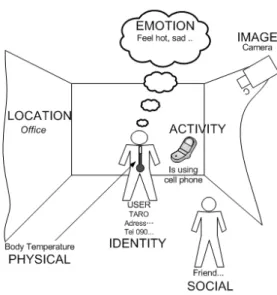
The representation model needed to fill our need contains seven dimensions, which are (Image, Identity, Location, Social, Activity, Physical and Emotion) as shown in Fig.1.
-Identitycharacterize a sensing which concern the user Identity. It can be quantified by scale, from
Figure 1: The model dimensions
anonymous to a full user identity (name , address, social number...)
- Location characterize a sensing which concern user location. Location can also be quantified by scale according to the sensed information precision (city, office,room, precise geographic position).
- Activity characterize a sensing witch concern user activity. The sensed activity can also be dif- ferently precise (user is at work, in a meeting, or is talking to the cell phone..).
- Image is used to characterize a sensing which concern user image. Image scale will be linked to the zoom of this sensed image.
-Socialis used to characterize sensing which con- cern the social environment of the user. for example the user is currently with taro and with his group team mates.
- Physical is used to characterize sensing which concern the internal physical variable of the user (body temperature, heart beat, blood pressure...).
-Emotionis used to characterize a sensing which infer emotional user information (user feels hot...).
There are two kinds of possible sensing informa- tion we need to characterize. One senses directly user’s characteristics and the other senses user’s envi- ronment information (room temperature...). The en- vironment information is characterized by the “user impact” induced by the use of this information. For example, if a system uses the room temp information to control the eating system it have an impact on user emotion, feeling more or less hot then can be charac- terize by emotion dimension.
In previous researches context descriptions, we can distinguish similar dimensions or categories. As A.dey shown in [3, 4] on different examples, researchers fo- cused on limited set of information depending on the application. After provide a general definition of user context, A.dey described that, Location, Identity, Ac- tivity and Time are the most important categories of context. Excluding time, we can find them in our set of dimensions.
However, as we described in the model goal, these categories aim at characterizing the user’s situation.
In our model these dimensions aim at characterizing the information that are sensed by Ubiquitous envi- ronment and evaluates this sensing intrusion on the user in a current situation. For this purpose, the cat- egories described in previous research cannot match every sensing information. Therefore Emotion, Phys- ical, Image and Social dimensions have been added to our set. There are some research where Emotion, Physical or Social informations are considered but not all together and for specific applications. Our seven chosen categories are a complete set of dimension to characterize sensed information according to the con- text model point of view in our need.
Although, to complete the characterization of sens- ing, the model needs other important information which influences when to inform and to give a cer- tain control to the user.
- The proximity between application and user: Does the application is a public or a private one? It is principally influencing the control.
- The sensing perception field: It has three states, the user can be “out” perception field then the information is kept hidden to him. The user can be “in” or “potentially in” the perception field, then sensing information can be shown and the control be given with a different probability between these two states. The “potential” state exists to represent situa- tions where the user is in a physical space containing sensing, but these sensing do not focus on him yet, like a Pan-Tilt-Zoom(PTZ) camera which is looking somewhere else.
- The user perception field: It represents the general space where the user can detect the sensing by himself. It influences the probability of informing the user. For instance, if the camera is big and its presence obvious there is no need to inform the user specifically, therefore disturbing him.
4. Filtering: model use
We can use these representations to determine, in a specific situation, if the user must be informed about a sensing and when we can provide him with a certain control about it. We call this decision “filtering”.
The ubiquitous application itself determines the quantification of its sensing information. This quan- tification can be static or dynamic. For example, the user image and activity influence of a PTZ camera will dynamically change depending on the zoom applied to observe the user. The identification and the pres- ence sensing user influence in an office building will be mainly static. The following table shows examples about some sensing information dimension influence qualification (Fig.2). A specific sensing information can concern one or several dimensions in the model.
For example a surveillance camera senses information on the user image, can allow to infer the user identity and the user location. A system which is inferring if the user feels hot may sense several physical parame- ters and user location then infer user emotion.
Each dimension used is quantified by some normal-
Figure 2: Sensing influence example
ized value depending on its scale of influence. A full Identification sensing will have a high value close to 1, while just the name or an anonymous identifica- tion will have one close to 0. Then these marks will be given some coefficients weight which represent the difference of importance the humans allow to each di- mension. This pondering will be provided by a study experiment.
The pondering associated to the mark and the other model information proximity and perception fields give a global intrusion mark. This mark is compared to a detection threshold level provided as user pref- erences. This comparison decides if the user must be informed about this sensing information.
5. Conclusion
In this paper we described a model of context de- signed from a different point of view than the tra- ditional one in context aware computing. It allows expressing the ubiquitous environment understand- ing about the user situation. Therefore, it can pro- vide to the user the feedback and in some situations the control of the environment sensing. We described this model with its seven dimensions, showed its dif- ferences between traditional context models used in context awareness. We described this model use for characterizing and filter the sensing information.
We need to evaluate the model accuracy and com- pleteness. An experiment will be made to initial- ize the dimension pondering parameters for the filter.
We need to design a module that will implement this model to provide these services to the user and apply this model on concrete ubiquitous scenario.
References
[1] Abowd, G., Mynatt, E. D., “Charting Past, Present and Future Research in Ubiquitous Com- puting”,ACM Transactions on Computer-Human Interaction, Special issue on HCI in the new Mil- lenium, 7(1):29-58, March 2000
[2] Weiser, M. 1991. The computer for the 21st cen- tury in,Sci. Am , 265, 3 (Sept.), 94-104.
[3] Dey,A.K. and Abowd, G.D. Towards a Better Un- derstanding of Context and Context-Awareness.
In 1st international symposium on Handheld and Ubiquitous Computing. Springer-Verlag, Karl- sruhe, pp304-307,1999
[4] Dey. A. K. Understanding and using context.Per- sonal and Ubiquitous Computing Journal, 5(1):4–
7, 2001
[5] Fischer, G.: User Modeling in Human-Computer Interaction, Journal of User Modeling and User- Adapted Interaction (UMUAI) , Vol. 11, No.1/2, pp.65-86, 2001.