ABSTRACT
国際的な移住が増加する昨今,移住者の心理的ウェルビーイングの低下が懸念されている。過去の研 究では,心理社会的エコロジカル要因(ソーシャルサポート,社会的つながり,コミュニティ感覚など)
が移住者の心理的ウェルビーイングや養育において保護要因となることが明らかにされてきたが,日本 においてはそれらの要因の関連がほとんど検討されていない。本稿は,都市部の在日フィリピン人母親 を対象に,心理的ウェルビーイングと養育に対する自己効力感における心理社会的エコロジカル要因の 役割を検討することを目的とした。質問紙調査の結果,ホスト社会及び移住者のコミュニティ両方にお
都市部の在日フィリピン人の母親の心理的ウェルビー イングと養育に関する自己効力感における心理社会的 エコロジカル要因の役割
The Role of Social-Ecological Correlates of Psychological Well-Being and Parenting Self- Efficacy among Filipino Migrant Mothers in Urban Japan
桑山 碧実 KUWAYAMA, Aomi
● 国際基督教大学平和研究所
Peace Research Institute, International Christian University
笹尾 敏明 SASAO, Toshiaki
● 国際基督教大学
International Christian University
移住,心理的ウェルビーイング,社会的つながり,コミュニティ感覚,養育自 己効力感
migration, psychological well-being, social connectedness, sense of community, parenting self-efficacy
研究論文 RESEARCH ARTICLE
ける心理社会的エコロジカル要因(社会的つながり及びコミュニティ感覚)が心理的ウェルビーイング 及び養育自己効力感に肯定的な影響を与えていることが示唆された。ただし,対象者の状況や時間的制 約などによってサンプルサイズが小さくなったことや非識字層の回答を得られなかったことが本稿の主 な限界として考えられ,今後は質的調査も併せた混合研究法により研究が行われることが期待される。
Migration experience brings psychological distress to migrant individuals in the process of acculturation.
Particularly, women are more exposed to additional stressors in the newly adopted host countries. In the previous literature, social-ecological correlates (e.g., social support, social connectedness, and sense of community) have been found to enhance psychological well-being and effective parenting among immigrants. However, the relationship between social-ecological correlates, psychological well-being, and parenting have rarely been investigated in Japan. This paper aimed at investigating the role of social- ecological correlates of psychological well-being and parenting self-efficacy among Filipino migrant mothers in urban Japan with an eye toward developing future interventions promoting their psychological well-being.
The SEM analyses showed that social connectedness in the Filipino community and sense of community mediated acculturation and life satisfaction, and social connectedness in the local Japanese community mediated acculturation and parenting self-efficacy. Also, it was revealed that participation in religious activities and neighborhood activities indirectly influence life satisfaction via social-ecological correlates;
and participation in neighborhood activities, school activities, and language learning opportunities indirectly influence on parenting self-efficacy via social-ecological correlates. Although the sampling method and sample size were noted as the major limitations, the current study still provided support for the notion that social connectedness and sense of community can have a positive effect on psychological well-being and parenting self-efficacy among Filipino migrant mothers in urban Japan. As a future research implication, focusing more on the strengths and the resource of migrant mothers and their community by using a mixed- method approach would be recommended.
1. Introduction
Migrant individuals often experience acculturative stress, negatively affecting psychological well-being in the host society (e.g., Berry, 1997; Bhugra & Gupta, 2011; Sam, 2006). Specifically, migrant women are relatively more exposed to additional stress-inducing factors resulting from domestic service works in the new cultural environment (Chandra, 2011; Sam, 2006;
Tsunogae, Iegami, & Shimizu, 2011). Previous research revealed that social-ecological correlates (e.g., social support, social connectedness, and sense of community) have been found to enhance psychological well-being among immigrants (Hombrados-Mendieta, Gomez-Jacinto, Dominguez-Fuentes, & Garcia-Leiva, 2013; Salo & Birman, 2015; Sasao, 2017; Yoon, Lee
& Goh, 2008). Particularly in the parenting literature, the importance of social-ecological factors as a set of important protective factors for effective parenting among immigrants has repeatedly been demonstrated (Izzo, Weiss, Shanahan, & Rodriguez-Brown, 2000;
Serrano-Villar, Huang, & Calzada, 2017). However, little research has focused on migrants’ social- ecological variables as predictors of psychological well-being and parenting in Japan. Thus, the current study aimed at understanding the role of social- ecological correlates of psychological well-being and parenting self-efficacy among Filipino migrant mothers in urban Japan.
The objective of the current study is to examine how social-ecological variables (defined as social connectedness and sense of community) affect
psychological well-being and parenting self-efficacy among Filipino migrant mothers in urban Japan with an eye toward developing future interventions promoting their psychological well-being. A field observation study with Filipinos was conducted in a Japanese urban community prior to the survey study, aiming at understanding the local community, building a trust relationship, and developing a survey. A questionnaire survey with Filipino migrant mothers residing in Tokyo’s urban areas was conducted to test some hypotheses that stem from a conceptual model (to be explained).
2. Literature Review
2.1 Psychological Distress and Well-Being in Migration
Migration or immigration occurs over various reasons such as socio-economic, political, cultural and religious reasons (Bhugra & Gupta, 2011; Cheng &
Chang, 1999), including seeking a better education and economic activities and pursuing freedom in politics and religions (Liu & Cheng, 2011). Although migration potentially enables migrant individuals themselves to enhance their educational and economic opportunities and to free them from political or religious restrictions, migrants often experience physical and psychological distress in their newly adopted host countries.
Empirical evidence suggests that migrants tend to experience psychological distress such as acculturative stress when they attempt adapting themselves to the host culture (Berry, 1997; Serrano-Villar et al., 2017;
Wong, Correa, Robinson, & Lu, Q., 2017; Yoon et al., 2008). It is also found in previous literature that foreign-born individuals often experience acculturative stress when they adopt the values, customs, norms, attitudes, and behaviors of the culture of the host society (Wong et al., 2017). Yet, individuals who experience more coping efficacy are likely to have better physical and psychological outcomes (Chu,
Saucier, & Hafner, 2010).
2.2 Psychological Distress and Parenting among Migrant Women
Among migrants, migrant women are considered more vulnerable to psychiatric disorders because of additional stressors resulting from domestic service work (Chandra, 2011). It was pointed out that since many women are involved in domestic work, they have limited opportunities to communicate with individuals of the host country, which makes them difficult to acculturate with the host society (Chandra, 2011). In particular, immigrant mothers often have additional responsibility in assisting their children in adjusting to multiple cultures such as their heritage culture and their family culture of the host country (Miura, 2015; Sam, 2006). Some studies showed that migrant mothers tend to be isolated at home due to the busyness with their domestic service work (Chandra, 2011; Sam, 2006; Tsunogae et al., 2011). In addition, Chandra (2011) suggested that social support and network is regarded as one of the most significant protective factors for the mental health of migrant women.
2.3 Social Ecology of Migrants: Concepts and Applications
Many studies found the importance of social- ecological variables in accounting for the migrant’s psychological well-being (e.g., Hombrados-Mendieta et al., 2013; Mahmud & Masuchi, 2013; Salo &
Birman, 2015; Sasao, 2017; Yoon et al., 2008) and parenting (e.g., Green, Furrer, & McAllister, 2007;
Izzo et al., 2000; Serrano-Villar et al., 2017) among migrants or ethnic minorities.
2.3.1 Social Support
In community psychology, social support has been studied as one of the key resources for promoting psychological well-being (Barrera, 2000; Dalton, Elias, & Wandersman, 2007; Saegert & Carpiano,
2017). Social support has been defined as “information leading the subject to believe that he is cared for and loved, esteemed, and member of a network of mutual obligations” (Cobb, 1976, p. 300).
Salo and Birman (2015) examined the impact of acculturation on psychological adjustment among Vietnamese refugees (n = 203) in the U.S. by operationalizing acculturation by a bilinear scale of American and Vietnamese culture. The results indicated that Vietnamese acculturation significantly predicted satisfaction with social support from Vietnamese individuals.
Furthermore, the influence of social support on parenting was examined in some other studies (Green et al., 2007; Serrano-Villar et al., 2017). Green et al.
(2007) examined the effects of attachment style and social support on parenting behavior among low- income African American parents in the urban area (n
= 152). Their study found that social support significantly positively influenced the frequency of parent-child activities mediated by the mother’s attachment style (defined as two dimensions:
avoidance and ambivalence) mediated between them.
Serrano-Villar et al. (2017) examined social support with respect to family and school network as a protective factor for the healthy childhood functioning among Latino immigrant families in the U.S. The study revealed that familial support had a significant effect on parenting practice via positive parenting practices. They emphasized that social support, in general, has been found to diminish the use of harsh disciplinary practices and to increase the use of positive parenting practices of responsiveness, acceptance, and warmth in parents of all backgrounds, including low-income migrant mothers (Serrano-Villar et al., 2017).
2.3.2 Social Connectedness
Social connectedness refers to a feature of the self that reflects the perception of enduring interpersonal closeness with the social world (Lee & Robbins,
1995). The emphasis on their concept of social connectedness is on the independent self in relation to others. (Lee, Draper, & Lee, 2001).
Although Lee and Robbins (1995) defined social connectedness in general, Yoon et al. (2008) extended the concept and developed its psychometric scale for immigrants: social connectedness in mainstream society and social connectedness in the ethnic community. The results showed that the former partially mediated acculturation and subjective well- being, whereas the latter fully mediated enculturation and subjective well-being. Their study contributed to providing the important notion of social connectedness among adult and long-term residents of the immigrant community.
Mahmud and Masuchi (2013) applied Yoon et al.’s (2008) study to the Japanese context. They investigated the relationship between acculturation/
enculturation, social connectedness in mainstream society and ethnic community, and subjective well- being of foreign residents living in Japan (n = 101).
This study found that both social connectedness in the mainstream society and the ethnic community had significant positive correlations with subjective well- being such as satisfaction with life and positive affect.
It is one of the few quantitative studies which discussed mental health among foreign residents in Japan from a community psychological perspective.
However, the study presented itself methodological limitations in sampling and analytic strategies: their sample included short-term residents (e.g., international students at colleges) and did not include the causal mechanism of correlates because their analysis relied only on correlation analyses and ANOVA.
2.3.3 Sense of Community
Psychological sense of community is regarded as the core of community psychology (Sarason, 1974).
According to Sarason (1974), the sense of community covers an individual’s feeling of belonging,
identification, and participation in communities.
Similar to Sarason’s idea, McMillan (1976) defines sense of community as “a feeling that members have of belonging, a feeling that members matter to one another and to the group, and a shared faith that members’ needs will be met through their commitment to be together” (as cited in McMillan and Chavis, 1986, p. 9).
Sense of community and its relationship to mental health have been investigated with some immigrant/
migrant populations (e.g., Hombrados-Mendieta et al., 2013; Sasao, 2017). For example, Hombrados- Mendieta et al. (2013) investigated the relationship between sense of community (SOC) and satisfaction with life (SWL) among immigrant and native populations in Spain (immigrants, n = 700; natives, n
= 946). Their study showed that there was a significant influence of sense of community on satisfaction with life. Since little has been studied about sense of community and its relationship with satisfaction with life in the native and immigrant populations, the present study would provide significant implications in the study of sense of community.
Additionally, an important study addressing sense of community of foreign residents in Japan was conducted by Sasao (2017). Sasao investigated the relationship between sense of community, social capital, and psychological well-being among Brazilians and Koreans residing in Japan. The study revealed that sense of community has a significant positive effect on psychological well-being via social capital among Brazilians. Their study is exceptional among studies about psychological well-being among foreign residents in Japan, while most of the mental health literature in Japan has examined individual characteristics and clinical cases using qualitative methods. The significance of Sasao’s study is that they focused on social-ecological aspects and use of the mixed method.
2.4 Challenges and Resources among Filipino Migrant Women in Japan
Filipinos are the fourth largest group of foreign residents in Japan (Japanese Ministry of Justice, Immigration Bureau, 2018), comprising a large population of “new-comers” in Japan (Westbrook &
Harden, 2010). Notably, the majority of Filipino migrants are female (Japanese Ministry of Justice Immigration Bureau, 2018), which is the unique feature of the Filipino populations in Japan. Filipino women have been considered economically and socially vulnerable in Japan because they have traditionally engaged in low-paid jobs (often defined as the so-called “entertainment business”) or unpaid jobs (often meaning being a housewife) (Paillard-Borg
& Hallberg, 2018; Parreñas, 2008).
Several studies clearly demonstrated difficulties in maintaining the good parent-child relationship among Filipino migrants in Japan (Miura, 2015; Ogaya, 2017;
Paillard-Borg & Hallberg, 2018; Takahata, 2007).
Specifically, Ogaya (2017) indicates that Filipino mothers and their children face challenges not only in language barriers and cultural differences but also in their unique family relationship and situations. The case studies by Miura (2015) revealed that some Filipino mothers feel a psychological distance from Japanese mothers due to their lack of Japanese proficiency or personal characteristics. Thus, Filipino mothers tend to rely on other Filipino women sharing similar difficulties (Miura, 2015).
On the other hand, Paillard-Borg and Hallberg (2018) identified factors associated with subjective well-being among Filipino migrant women workers in Japan by employing a focus group interview. Their study revealed that communication and social network, faith, and sense of identity were all found as the main factors of subjective well-being. Specifically, participants showed that being in contact with others or belonging to a group is a source of subjective well- being. The results highlighted the importance of family and church in the support network.
2.5 Mental Health Status among Filipino Migrant Women in Japan
Kuwayama (1995) and Kim and Tsuda (2015) conducted studies on mental health among Filipino migrant women in Japan. Kuwayama (1995) described the mental health of Filipino brides in rural Japan. This study found that Filipino women experienced tremendous stresses from differences in marital relationships, climate, religion, and relationship with families in Japan. He indicated that they faced many challenges in social networking. Meanwhile, he found that activities promoting multicultural understanding conducted by Japanese young women and self-help group of Filipino women appeared the key agents to change the situation.
Kim and Tsuda (2015) investigated psychosocial support for Filipino women suffering from domestic violence by conducting a case study of two NGOs.
Their study revealed insufficient resources of NGOs, inaccessibility to support, closed nature of the peer- support group, and lack of specialists (e.g., professional counseling staff). Kim and Tsuda implied that support for foreigners who were affected by domestic violence has been limited to postvention or retrospective reporting, as opposed to prevention.
Therefore, they suggested the importance of taking preventive actions toward this issue.
These studies clearly demonstrate the importance of social networking and prevention for the mental health of Filipino women, and as such, further research should be directed to the social-ecological factors related to the Filipino women’s lives.
2.6 Gaps in the Literature
Some strengths and weaknesses of the cited studies are found in the literature. First, concerning parenting, Green et al. (2007) and Serrano-Villar et al. (2017) revealed that social support helps to enhance immigrants’ parenting. However, the relationship between relational factors (such as social connectedness and sense of community) and parenting
of immigrants or ethnic minorities have rarely been examined. At this point, there is room for consideration of the matter in future research.
Then, Green et al. (2007), Salo and Birman (2015), and Yoon et al. (2008) presented strengths in their data analyses. They all analyzed path models and revealed the mechanism of immigrants or ethnic minorities’
psychological well-being. To the contrary, the study in Japan conducted by Mahmud and Masuchi (2013) limited to correlation analyses and ANOVA, which did not explain the effects as differentiated from each other.
Besides, Yoon et al. (2008) showed strength in their data collection in terms of their community-based sampling. Normally, many quantitative immigrant studies tend to use a convenient sample such as college students due to the sampling difficulties of communities. For example, Mahmud and Masuchi (2013) argued that the mental health of immigrants by collecting data, and about half of them were from international students. This tendency limits the understanding of acculturation experiences in adult immigrant communities. Also, long-term and short- term residents have different socio-economic status or situations from international students in college.
Therefore, it is essential to conduct community- oriented data collection in immigrant and ethnic minority studies.
Finally, Sasao (2017) showed their strength in the theoretical framework, sampling, and analysis in the field of community psychology in Japan. Although their study provided significant perspectives about the psychological well-being of foreign residents in Japan, more empirical studies should be done.
2.7 Research Framework
From a traditional psychological study which has focused on individual persons, community psychology has shifted their focus to the background or context of individuals (Bond, Serrano-García, & Keys, 2017).
Sasao and Sue (1993) proposed the importance of the
ecological framework when conducting ethnic-cultural community research. However, most of the studies in community psychology in Japan had focused on individuals and lacked its ecological context and community-oriented notions (Sasao & Yasuda, 2007).
Thus, the current investigation uses Bronfenbrenner’s ecological theory to understand the ethnic-cultural community in Japan.
Bronfenbrenner’s ecological theory (Bronfenbrenner, 1979; 1994; 2004) was used as an overarching framework for the current investigation. Bronfenbrenner proposes that the entire ecological system consists of five-socially-organized subsystems influences human development (Bronfenbrenner, 1994). Bronfenbrenner proposed five-layered systems surrounding the developing human being as follows: microsystem, mesosystem, exosystem, macrosystem, and chronosystem. Taking Bronfenbrenner’s framework as a point of departure, the present investigation focuses on how Filipino migrant mothers’ social relationships across different settings (mesosystem) are related to the mothers’ psychological well-being and relationships with their children (microsystem). Specifically, the current study defined social relationships in migrant community, Japanese society, and neighborhood as their exosystem: life satisfaction and parenting self-efficacy as their microsystem.
3. Method
3.1 Research Design and Hypotheses
To examine how Filipino migrant mothers’ social relationships across different settings (mesosystem) are related to the mothers’ psychological well-being and relationships with their children (microsystem), the hypotheses were generated based on the literature and preliminary investigation (a field observation).
Based on the previous research (e.g., Hombrados- Mendieta et al., 2013, Serrano-Villar et al., 2017, Yoon et al., 2008), it is hypothesized that acculturation influence psychological well-being and parenting self-
efficacy moderated by social-ecological variables (defined as social connectedness and sense of community). Particularly, it is hypothesized that acculturation in the host culture influences social connectedness in the host society; acculturation in the heritage culture influences social connectedness in the ethnic community; and acculturation in the host and heritage culture influence sense of community. Then, it is also hypothesized that each social-ecological factor (defined as social connectedness in the Japanese society, social connectedness in the Filipino community, and sense of community) influences parenting self-efficacy and psychological well-being.
In addition to the literature review, a field observation was conducted in a geographical community in Kawasaki, an industrial city known for the presence of many factories and retail stores where many migrants have been drawn to live (see Kuwayama, 2019, for the details of the field observation study). As the field observation revealed that Filipino mothers and their children tended to rely on the social network in the Filipino community and the Japanese community when they face challenges, social connectedness and sense of community were decided to be the focus in the survey.
Combining previous research and a field observation, the social-ecological correlates such as acculturation with Filipino culture (Fil. Acc.), acculturation with Japanese culture (Jpn. Acc.), social connectedness in the Filipino community (SC in Fil.), social connectedness in the Japanese society (SC in Jpn.), and sense of community would be expected to differentially affect psychological well-being and parenting self-efficacy in the proposed model (see Figure 1). The current study used survey method to examine this model.
3.2 Participants and Procedures
Participants (n = 102) were recruited from six different places (a self-help group, three churches, a factory, and a grocery store) and through personal
contacts based on the criteria. Participants were recruited based on the following criteria: (a) women born in the Philippines and migrated to Japan, (b) having experience of raising a child/children, and (c) residing in Tokyo’s urban areas.
At an early stage of the study, random sampling was attempted at the locations with large Filipino populations such as community centers, church groups, and peer groups. However, in the process of contacting key informants, methodological challenges in getting permission and cooperation to conduct a survey had emerged. For example, some religious organizations and peer support groups showed clear reluctance against any type of research. Even if the leaders give permission, it was difficult to find a large sample at one place. After a number of attempts and errors, several places gave permission and cooperation.
Given the limitation of resources, participants of the study (n = 102) were recruited through convenient and snowball sampling as a result.
All the instruments were originally developed in
English. Thus, instruments were translated into the Filipino language (Tagalog). To assure the equivalence of languages between English and the Filipino (Tagalog), a back-translation (Brislin, 1986) was conducted. The questionnaire was distributed at six places around Tokyo’s urban areas with permission of owners or leaders of the organization. Participants were explained about the purpose of the study, risks and benefits, voluntary and anonymous participation, and confidentiality by the investigator. Once they agreed to participate in the study and informed consent was obtained the questionnaires were given on the premises. For those who were not able to come to the meeting places, the online questionnaire was sent through the key informants. After completing the questionnaire, a small gift of groceries was given to each participant as a token of appreciation. For ethical consideration, this current study was approved by the Research Ethics Committee (an equivalent of an IRB) at International Christian University. The current study met the ethical requirements of the ICU Research Figure 1. The Hypothesized Model.
Note. The rectangles present observed variables. Fil. Acc. = Acculturation with Filipino culture; Jpn. Acc. = Acculturation with Japanese culture; SC in Fil. = Social connectedness in the Filipino community; SC in Jpn. = Social connectedness in the Japanese society.
Ethics Committee.
3.3 Instruments
3.3.1 Demographic Characteristics
Participants provided information about their demographic characteristics including age, length of stay, marital status, occupation, education level, number of children living with, financial support from the government, financial support to the family in the Philippines, life comfortability, and frequency of participation in community activities.
3.3.2 Social Connectedness
Social connectedness was measured using the Social Connectedness in Mainstream Society (SCMN; Yoon et al., 2008) and the Social Connectedness in Ethnic Community (SCETH; Yoon et al., 2008). Two sets of five items were asked to measure social connectedness in the Japanese society and in the Filipino community.
The initial scale for Social Connectedness by Lee and Robbins’ (1995) is a global construct; however, Yoon et al. (2008) focused on the difference of immigrants’
sense of connectedness in the mainstream society and the ethnic community. The items were answered on a 5-point Likert scale (1= strongly disagree through 5=
strongly agree). The Cronbach’s α of the SCMN was .914, and SCETH was .913 in this sample.
3.3.3 Sense of Community
Sense of community was measured using the Brief Sense of Community Scale (BSCS; Peterson, Speer, &
McMillan, 2008). Peterson et al. (2008) developed a brief measure of sense of community based on the study of McMillan and Chavis (1986) by using the sample of three hundred eight randomly-chosen residents in a Midwestern U.S city. There are eight items assessing four elements: needs fulfillment, membership, influence, and emotional connection.
Wording was changed to define the community as their neighborhood. The items were answered on a 5-point Likert scale (1= strongly disagree through 5= strongly
agree). The Cronbach’s α of the BSCS in this sample was .946.
3.3.4 Acculturation
Japanese and Filipino acculturation were measured using the Vancouver Index of Acculturation (VIA;
Ryder, Alden, & Paulhus, 2000). This scale consists of 20 items consisting of two subscales: acculturation with heritage culture (VIAH) and mainstream culture (VIAM). This scale was developed to test unidimensional model and bi-dimensional model of acculturation in three samples of Chinese, non-Chinese Asians, and a diverse group. The items were answered on a 5-point Likert scale (1= strongly disagree through 5= strongly agree). The Cronbach’s α of the VIAH was .906, and that of the VIAM was .899 in this sample.
3.3.5 Participation in Community Activities Participants were asked, “To what extent are you involved in the following activities or services?”
Participants answered on 5-point Likert scale (1= not at all through 5= very much) for the following each activity: 1) religious activity (e.g., mass or service, bible study); 2) neighborhood activity (e.g., cultural events at community center); 3) school activity (e.g., open class, parent-teacher meeting, PTA, etc.); 4) activity with colleague of workplace; and 5) Japanese language learning opportunities.
3.3.6 Psychological Well-Being
Psychological well-being was measured using the Satisfaction with Life Scale (SWLS; Diener, 1985) and the Psychological Well-being Scale (PWB; Ryff &
Singer, 1998). SWLS consists of five items to assess life satisfaction with life. Although this original scale was developed to measure satisfaction with life by using a sample of 176 undergraduates at the University of Illinois at Urbana-Champaign, a Midwestern city in the U.S., this scale was used and validated in some samples of immigrants (Hombrados-Mendieta et al.,
2013; Yoon et al., 2008). The items were answered on a 5-point Likert scale (1= strongly disagree through 5=
strongly agree). The Cronbach’s α of the SWLS in this sample was .808. On the other hand, PWB consists of eighteen items to assess the six elements of psychological well-being such as autonomy, environmental mastery, personal growth, positive relations with others, purpose in life, and self- acceptance by using a data from a nationally representative sample. In this scale, there are reversed- items (PWB 4, 5, 6, 7, 10, 14, and 15) included. The items were answered scored on a 5-point Likert scale (1= strongly disagree through 5= strongly agree).
Notably, the Cronbach’s α of the PWB in this sample was .382.
3.3.7 Parenting Self-Efficacy
Parenting self-efficacy was measured using the Multicultural Inventory of Parenting Self-Efficacy (MIPSE; Barrera et al., 2002) to assess parents’
perception of the capability of their parenting. This scale was developed based on the qualitative study of low-income parents of four ethnic groups (Anglo, African American, Mexican American, and Mexican immigrant) for the PRC ValMod study in 1997-1998 (Dumka, Gonzales, Wood, & Formoso, 1998). There are 24 items consisting of two subscales: Parenting Self-Efficacy and Parenting Educational Support Efficacy. The items were answered on a 5-point Likert scale (1= strongly disagree through 5= strongly agree).
The Cronbach’s α of the MIPSE in this sample was .955.
3.4 Analytic Strategies
Preliminary analyses were conducted using IBM SPSS 23 prior to the main analyses. First, correlation analysis was used to see what extent the following variables were related to each other: social connectedness in the Japanese society, social connectedness in the Filipino community, sense of community, life satisfaction, psychological well-being,
and parenting self-efficacy.
Next, hierarchical multiple regression analyses were conducted with life satisfaction and parenting self- efficacy as dependent variables to see the influence of indicators on well-being and parenting self-efficacy. In Step 1, demographic variables (marital status, financial support from the government, number of children, length of stay, education level, and life comfortability) were entered. Then, acculturation with Japanese culture (Jpn. Acc.), acculturation with Filipino culture (Fil. Acc.), were entered in Step 2. Finally, social connectedness in the Japanese society, social connectedness in the Filipino community, and sense of community were entered in Step 3.
Then, structural equation modeling (SEM) was conducted to test the hypothesized model (see Section 3.1, Figure 1) and find the best-fitted model which explains the mechanism of well-being and parenting self-efficacy by using IBM SPSS 23.0.0 AMOS version 4.0.
4. Results
4.1 Demographic Characteristic of Participants The sample comprised 102 Filipino migrant mothers in Tokyo’s urban areas. The participants’ ages ranged from 24 to 66 years old (M = 46.92, SD = 8.70). Eight percent of participants had not graduated from high school, 15.3% had graduated from high school, 23.5%
had entered college but had not completed, and 48.0%
had graduated from college. Sixty-four percent of participants were married or living with a partner;
others were single (either unmarried, separated, divorced, or widowed). The majority of participants were currently employed (81.6%, n = 80) as factory worker (16.7%, n = 17), caregiver (5.9%, n = 6), English teacher (21.6%, n = 22), company employee (6.9%, n = 7), building cleaner (5.9%, n = 6), and other jobs (21.6%, n = 22). About half of the participants had sent remittance to the Philippines on a regular basis to support their families and relatives. Nineteen
percent of participants had had their own children in the Philippines. Eighteen percent of participants had received financial support from the Japanese government for their livelihood. The majority of participants had been residing in Japan for more than ten years (78.4%, n = 80). While Japanese Ministry of Justice (2019) showed middle-term residents like job trainees has greatly increased these days (11 percent of the whole Filipino population in Japan), most of the participants of the current study were long term residents or permanent residents because the current study focused on mothers.
4.2 Preliminary Analyses
Correlation analysis revealed that parenting self- efficacy and life satisfaction (Satisfaction with Life Scale: SWLS) had a significant positive correlation with the following five main study variables:
acculturation with Japanese culture (Jpn. Acc.), acculturation with Filipino culture (Fil. Acc.), social connectedness in the Japanese society (SC in Jpn.), social connectedness in the Filipino community (SC in Fil.), and sense of community. However, Psychological Well-Being (PWB) scale did not significantly correlate with all study variables except for SWLS. Also, the reliability of the PWB scale was low (α = .382). Thus, this current study used only life satisfaction (SWLS) for measuring psychological well-being in the following analyses.
To further explore the influence of study variables and other variables, hierarchical multiple regression was conducted. Although demographic variables explained life satisfaction (27.2%) and parenting self- efficacy (6.1%) in some degree, the study variables (acculturation and social-ecological variables) substantially increased the percentage of explanation in life satisfaction (ΔR2 = 24.9) and parenting self- efficacy (ΔR2 = 35.0).
In Step 1, demographic variables (marital status, financial support from the government, number of children, length of stay, education level, and life
comfortability) explained 27.2 percent of life satisfaction. Of these, life-satisfaction revealed that life comfortability significantly positively influenced on the regression model in Step 1 (β = .473, p < .001).
Added acculturation variables in Step 2, the model of life satisfaction increased R2 by 11.3 percent. In Step 2, acculturation with Japanese culture (Jpn. Acc.) showed a significant positive effect on life satisfaction (β = .315, p < .05). When social-ecological variables were added in Step 3, the model of life satisfaction increased R2 by 13.6 percent. When all variables were added, sense of community significantly positively affect life satisfaction (β = .284, p < .05) (see Table 1).
Another hierarchical regression analysis on parenting self-efficacy revealed that there were demographic variables that did not have significant effects on parenting self-efficacy (R2 = .061, ns). By entering acculturation variables in Step 2, the model of parenting self-efficacy greatly increased R2 by 27.2 percent. In step 2, acculturation with Filipino culture (Fil. Acc.) showed a significant positive impact on parenting self-efficacy (β = .386, p < .05). When social- ecological variables were entered in Step 3, the model a slightly increased R2 by 7.8 percent (see Table 2).
4.3 Testing the Hypothesized Model
Regarding life satisfaction, the results showed that (a) social connectedness in Filipino community (SC in Fil.) (β = .41, p < .001) and sense of community (β = .38, p < .001) have direct effects on life satisfaction;
and (b) acculturation with Filipino culture (Fil. Acc.) has an indirect effect on life satisfaction mediated by social connectedness (β = .60, p < .001); (c) acculturation with Japanese culture (Jpn. Acc.) indirectly effected on life satisfaction mediated by sense of community (β = .51, p < .001). On the other hand, regarding parenting self-efficacy, the results showed that (a) acculturation with Filipino culture (Fil.
Acc.) (β = .38, p < .001) and social connectedness in Japanese society (SC in Jpn.) (β = .24, p < .05) have direct effects on parenting self-efficacy; and (b)
acculturation with Japanese culture (Jpn. Acc.) indirectly effected on parenting self-efficacy mediated by social connectedness in Japanese society (SC in Jpn.) (β = .61, p < .001) (see Figure 2).
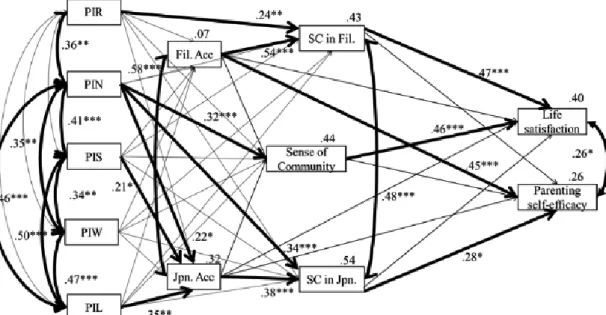
The additional analyses revealed that (a) active participation in religious activities and neighborhood
activities have significant indirect influence life satisfaction via social-ecological variables; and (b) active participation in neighborhood activities, school activities, and language learning opportunities have a significant indirect influence on parenting self-efficacy via social-ecological variables (see Figure 3).
Table 1
Hierarchical Multiple Regression Analysis Predicting Life Satisfaction Life Satisfaction
(R2 = .415)
B SEB β ΔR2
Step1 Marital status
Financial support from gov No. of children
Length of stay Education level Life comfortability Step2
Fil. Acc.
Jpn. Acc.
Step3
Sense of community SC in Jpn.
SC in Fil.
.869 -1.103 -.180 -.734 -.308 2.447 .050 .149 .123.199 .084
.913 1.048 .470.716 .465.614 .066 .065 .060.159 .153
.115 -.129 -.047 -.124 -.080
.473***
.108 .315*
.284*
.235.091
.272**
.113**
.136***
Note. *p < .05, **p < .01, ***p < .001
Fil. Acc. = Acculturation with Filipino culture; Jpn. Acc. = Acculturation with Japanese culture; SC in Fil. = Social Connectedness in Filipino community; SC in Jpn. = Social connectedness in Japanese society
Table 2
Hierarchical Multiple Regression Analysis Predicting Parenting Self-Efficacy Parenting self-efficacy
(R2 = .268)
B SEB β ΔR2
Step1 Marital status
Financial support from government No. of children
Length of stay Education level Life comfortability Step2
Fil. Acc.
Jpn. Acc.
Step3
Sense of community SC in Jpn.
SC in Fil.
2.363 -.643 -1.885 -3.505 2.999.042 .709 .518 1.187.160 -.158
4.286 4.999 2.463 3.701 2.362 2.919 .263 .266 .289.727 .707
.079 -.019 -.116 -.140 .003.147 .386**
.279 .091.342 -.043
.061 .272**
.078**
Note. *p < .05, **p < .01, ***p < .001
Fil. Acc. = Acculturation with Filipino culture; Jpn. Acc. = Acculturation with Japanese culture; SC in Fil. = Social Connectedness in Filipino community; SC in Jpn. = Social connectedness in Japanese society
Figure 2. Standardized Coefficients for the Revised Model.
Note: The rectangles indicate observed variables. *p < .05, **p < .01, ***p <.001
χ2(10) = 14.560, p < .149, CFI = .983, SRMR = .0574, RMSEA = .070, CI for RMSEA = .000 -.142, AIC = 50.560.
Figure 3. Standardized Coefficients for the Additional Model Containing Community Activity Participation Indicators.
Note: The rectangles indicate observed variables. The bold arrowsindicate significant paths. PIR = Participation in religious activities; PIN = Participation in neighborhood activities; PIS = Participation in School activities; PIW = Participation in workplace activities; PIL = Participation in language learning opportunities. *p < .05, **p < .01, ***p < .001
χ2(14) = 64.960, p < .000, CFI = .936, SRMR = .0461, RMSEA = .146, CI for RMSEA = .096 -.198, AIC = 169.960.
5. Discussion and Conclusion
G u i d e d b y a n e c o l o g i c a l f r a m e w o r k (Bronfenbrenner, 1979; 1994; 2004), the current investigation examined the factors influencing well- being, parenting, and their social-ecological correlates.
The findings generally showed that social-ecological factors significantly influence well-being and parenting, confirming the findings of previous immigrant research recognizing the importance of social-ecological factors as protective factors of well- being (Hombrados-Mendieta et al., 2013; Salo &
Birman, 2015; Sasao, 2017; Yoon et al., 2008) and parenting (Green et al, 2007; Izzo et al., 2000;
Serrano-Villar et al., 2017).
Regarding the effects of social connectedness, SEM results showed that social connectedness in the Filipino community and sense of community mediated acculturation and life satisfaction; social connectedness in the local Japanese community mediated acculturation and parenting self-efficacy.
This finding provides further empirical support in the Japanese context for the assertion that social connectedness mediated the association between acculturation and subjective well-being by Yoon et al.
(2008). Although Yoon et al. (2008) focused on social connectedness as a main variable in their study, the uniqueness of the current study was its inclusion of sense of community among its indicators. Besides, the findings showed significant neighborhood effects (defined as sense of community) on life satisfaction.
The result confirmed Sasao’s (2017) study asserting how sense of community influences well-being in the Korean community and the Brazilian community. This current investigation helped to advance the community psychology literature in Japan by demonstrating the mechanism of psychological well-being and parenting with an ecological perspective.
In addition to the theoretical contributions, there are also practical contributions that the present investigation suggested the direction of possible future
interventions. Based on additional SEM analyses, it was revealed that those who more actively participate in religious activities and neighborhood activities have higher life satisfaction, and those who more actively participate in neighborhood activities, school activities, and language learning opportunities have higher parenting self-efficacy. Although there are existing local activities for foreign women and children by church group (mostly consists of Filipino individuals), they have little chance to interact with Japanese and other foreign mothers. This study suggests the importance of a new intervention program in their neighborhood enhancing interaction between Japanese and immigrant members. It is suggested to create platform where migrant mothers and Japanese mothers can communicate and share their experience in cooperation in close communication between local government and NGOs.
However, several limitations should also be noted in the current investigation. First, investigation’s small sample size was a serious issue associated with the difficulty of recruiting a large number of community sample of Filipino mothers although this sort of methodological problems has been very much common in Japan. The current study was not able to reach the most marginalized population, especially those mothers residing in an economically disadvantaged industrial area, due to their illiteracy in either English or Tagalog. The other limitation is the narrow coverage of psychological well-being. The current study used only Satisfaction with Life Scale (SWLS) (α = .808) in measuring psychological well- being, instead of using both Psychological Well-Being (PWB) scale and SWLS due to the low reliability of the PWB scale in this sample (α = .382). This would result from the complexity of the questionnaire items of PWB; especially reversed items looked difficult for the participants to understand how to answer. Although it limits the coverage of psychological well-being measured in the current study, SWLS is still appropriate to measure psychological well-being, as
SWLS was repeatedly used in measuring psychological well-being among immigrants in the literature (e.g., Hombrados-Mendieta et al., 2013;
Yoon et al., 2008).
Despite these limitations, the findings provide support for the notion that social connectedness and sense of community can have a positive, and often salubrious effect on well-being and parenting self- efficacy among Filipino migrant mothers in urban Japan. As a future research implication, it is important to focus more on their strengths and resource of migrant mothers and their community using a mixed- method approach. For example, based on my experience in the community, it is suggested that interactive qualitative methods such as focus group discussions or photovoice methods should work better together with quantitative methods. A general question prompted by the present investigation was how Filipino migrant mothers would build those networks and strategize their parenting in Japan, which should be studied in the future research.
References
Barrera M. (2000). Social support research in community psychology. In J. Rappaport, & E.
Seidman. (Eds.), Handbook of community psychology (pp. 215-245). Boston, MA: Springer.
Barrera, Jr., M., Prelow, H. M., Dumka, L. E., Gonzales, N. A., Knight, G. K., Michaels, M. L.,Tein, J. Y.
(2002). Pathways from family economic conditions to adolescents’ distress: Supportive parenting, stressors outside the family, and deviant peers.
Developmental Psychology, 30, 135-152.
doi:10.1002/jcop.10000
Berry, J. W. (1997). Immigration, acculturation, and adaptation. Applied Psychology: An International R e v i e w / P s y c h o l o g i e A p p l i q u e e : R e v u e Internationale, 46(1), 5-34.
Bhugra, D., & Gupta, S. (2011). Introduction: Setting the scene. In D. Bhugra, & S. Gupta (Eds.), Migration and mental health (pp. 1-14) [Ebook version]. Retrieved from https://doi.org/10.1017/CBO9780511760990;
Bond, M. A., Serrano-García, I., & Keys, C. B. (2017).
Community psychology for the 21st century. In M. A.
Bond, I. Serrano-García, C. B. Keys, & M. Shinn
(Eds.), APA handbook of community psychology:
Theoretical foundations, core concepts, and emerging challenges (Vol.1 pp. 3-20). Washington, DC: American Psychological Association.
Brislin, R. W. (1986). The wording and translation of research instruments. In W. J. Lonner & J. W. Berry (Eds.), Field methods in cross-cultural research (Vol. 8, pp. 137-164). Thousand Oaks, CA: Sage Publications, Inc.
Bronfenbrenner, U. (1979). The ecology of human development: Experiments by nature and design.
Cambridge, MA: Harvard University Press.
Bronfenbrenner, U. (1994). Ecological models of human development. International Encyclopedia of Education (2nd ed., Vol. 3). NY: Freeman.
Bronfenbrenner, U., (Ed.). (2004). Making human beings human: Bioecological perspectives on human development. Thousand Oaks, CA: SAGE publications.
Chandra, P. S. (2011) Mental health issues related to migration in women. In D. Bhugra, & S. Gupta (Eds.) Migration and mental health (pp. 209-219) [Ebook version]. Retrieved from https://doi.
org/10.1017/CBO9780511760990;
Cheng, A. T. A. & Chang, J. C. (1999). Mental health aspects of culture and migration (Editorial Review).
Current Opinion in Psychiatry, 12, 217-22.
Chu, P. S., Saucier, D. A., & Hafner, E. (2010). Meta- analysis of the relationships between social support and well-being in children and adolescents. Journal of Social and Clinical Psychology, 29(6), 624-645.
doi:10.1521/jscp.2010.29.6.624
Cobb, S. (1976). Social support as a moderator of life stress. Psychosomatic Medicine, 38(5), 300-314.
Dalton, J. H., Elias, M. J., & Wandersman, A. (2007).
Community psychology: Linking individuals and communities (2nd ed.). Belmont, CA: Thomson Wadsworth.
Diener, E. (1985). The satisfaction with life scale.
Journal of Personality Assessment, 49(1), 71-75.
Dumka, L., Gonzales, N., Wood, J., & Formoso, D.
(1998). Using qualitative methods to develop contextually relevant measures and preventive interventions: An illustration. American Journal of Community Psychology, 26, 600-633. doi:10.1023/
A:1022145022830
Green, B., Furrer, C., & McAllister, C. (2007). How do relationships support parenting? Effects of attachment style and social support on parenting behavior in an at-risk population. American Journal of Community Psychology, 40, 96-108. doi:10.1007/
s10464-007-9127-y
Hombrados-Mendieta, M., Gomez-Jacinto, L.,
Dominguez-Fuentes, J., & Garcia-Leiva, P. (2013).
Sense of community and satisfaction with life among immigrants and the native population.
Journal of Community Psychology, 41(5), 601-614.
doi:10.1002/jcop.21559
Izzo, C., Weiss, L., Shanahan, T., & Rodriguez-Brown, F. (2000). Parental self-efficacy and social support as predictors of parenting practices and children’s socioemotional adjustment in Mexican immigrant families. Journal of Prevention & Intervention in the Community, 20(1-2), 197-213. doi:10.1300/J005v 20n01_13
Japanese Ministry of Justice. (2019). Zairyugaikokujin toukei toukeihyo. [A statistical chart of foreigners in Japan]. Retrieved from https://www.e-stat.go.jp/
stat-search/files?page=1&layout=datalist&lid=0000 01234467&toukei=00250012&tstat=000001018034
&tclass1=000001060399&cycle=1&year=20180&m onth=24101212&stat_infid=000031832819
Japanese Ministry of Justice Immigration Bureau.
(2018). Heisei nijukunenmatsu genzai ni okeru zairyugaikokujinsu ni tsuite. [The number of foreign residents as of 2017]. Retrieved from http://www.
moj.go.jp/nyuukokukanri/kouhou/nyuukokukanri 04_00073.html
Kim, A. & Tsuda, Y. (2015). Nihon ni okeru kokusai kekkonkatei ni kansuru shinrishakaitekishien:
Zainichi Firipin-jin no DV higaishashien ni tsuiteno ichikousatsu [Psychosocial support for international- marriage-households in Japan: Support for domestic violence victims among Filipinos in Japan].
Nagoyagakuindaigakuronshu, 51(4), 95-104. doi:
10.15012/00000094
Kuwayama, A. (2019). Identifying and understanding correlates of well-being and parenting self-efficacy among Filipino migrant mothers in urban Japan.
(Unpublished master’s thesis). International Christian University, Tokyo, Japan.
Kuwayama, N. (1995). Kokusaikekkon to sutoresu: Ajia kara no hanayome to henyousuru Nippon no kazoku [International marriage and stress: Asian brides and changes of Japan’s family.] Tokyo:
Akashishoten.
Lee, R. M., Draper, M., & Lee, S. (2001). Social connectedness, dysfunctional interpersonal behaviors, and psychological distress: Testing a mediator model. Journal of Counseling Psychology, 48(3), 310-318. doi:10.1037/0022-0167.48.3.310 Lee, R. M., & Robbins, S. B. (1995). Measuring
belongingness: The social connectedness and the social assurance scales. Journal of Counseling Psychology, 42(2), 232-241. doi:10.1037/0022- 0167.42.2.232
Liu, I. C. & Cheng, A. T. A. (2011). Migration and mental illness: An epidemiological perspective. In D.
Bhugra, & S. Gupta (Eds.), Migration and mental health (pp. 44-55) [Ebook version]. Retrieved from https://doi.org/10.1017/CBO9780511760990 Mahmud, S., & Masuchi, A. (2013). Foreign residents in
Japan: Acculturation, social connectedness, and life satisfaction. Psychology Research, 3(12), 737- 748.
McMillan, D. W., & Chavis, D. M. (1986). Sense of community: A definition and theory. Journal of Community Psychology, 14(1), 6-23. doi:10.1002/
1520-6629(198601)14:1<6::AID-JCOP2290140 103>3.0.CO;2-I
Miura, A. (2015). Nyukama no kodomo to imin komyuniti: Daini sedai no esunikku aidentiti [Children of newcomers and immigrant community:
Ethnic identity of the second generations]. Tokyo:
Keiso Shobo.
Ogaya, C. (2017). Firipinjin no kodomotachi [Children of Filipinos]. In S. Aramaki et al. (Eds.), Gaikokujin no kodomohakusho: Kenri, hinkon, kyoiku, kokuseki to kyosei no shitenkara [A white paper of children with foreign background: Perspectives from rights, poverty education, nationality, and coexistence].
Tokyo: Akashishoten.
Paillard-Borg, S., & Hallberg, D. (2018). The other side of the mirror: An analytic journalistic approach to the subjective well-being of Filipino women migrant workers in Japan. SAGE Open, 8(1), 1-10.
doi:10.1177/2158244018757288
Parreñas, R. S. (2008). The force of domesticity: Filipina migrants and globalization. New York, NY: New York University Press.
Peterson, N. A., Speer, P. W., & McMillan, D. W. (2008).
Validation of a brief sense of community scale:
Confirmation of the principal theory of sense of community. Journal of Community Psychology, 36(1), 61-73. doi:10.1002/jcop.20217
Ryder, A. G., Alden or, L. E., & Paulhus, D. L. (2000). Is acculturation unidimensional or bidimensional? A head-to-head comparison in the prediction of personality, self-identity, and adjustment. Journal of Personality and Social Psychology, 79(1), 49-65.
doi:10.1037/0022-3514.79.1.49
Ryff, C. D., & Singer, B. (1998). The contours of positive human health. Psychological Inquiry, 9(1), 1-28.
doi:10.1207/s15327965pli0901_1
Saegert, S., & Carpiano, R. (2017). Social support and social capital: A theoretical synthesis using community psychology and community sociology approach. In M.
A. Bond, I. Serrano-García, C. Keys, & M. Shinn (Eds.), APA handbook of community psychology:
Theoretical foundations, core concepts, and emerging challenges (Vol.1, pp. 295-314). Washington, DC:
American Psychological Association.
Salo, C. & Birman, D. (2015). Acculturation and psychological adjustment of Vietnamese refugees:
An ecological acculturation framework. American Journal of Community Psychology, 56, 395-407.
doi:10.1007/s10464-015-9760-9
Sam, D. L. (2006). Acculturation: Conceptual background and core components. In D. L. Sam, &
J. W. Berry (Eds.), The Cambridge handbook of acculturation psychology (pp. 11-26). Cambridge, UK: Cambridge University Press.
Sarason, S. B. (1974). The psychological sense of community: Prospects for a community psychology.
San Francisco, CA: Jossey-Bass.
Sasao, T. (2017). Psychological sense of community and related concepts in minority communities: A comparative global approach. Report of the Grant- in-Aid for Scientific Research (No. 25380851) by Ministry of Education, Science, Sports, and Culture.
Sasao, T. & Yasuda, T. (2007) Historical and theoretical orientations of community psychology practice and research in Japan. In S. M. Reich, M. Riemer, I.
Prilleltensky, & M. Montero. (Eds.), International community psychology. Boston, MA: Springer. doi:
10.1007/978-0-387-49500-2_8
Sasao, T., & Sue, S. (1993). Toward a culturally anchored ecological framework of research in ethnic-cultural communities. American Journal of Community Psychology, 21(6), 705-727. doi:10.1007/BF0094 2244
Serrano-Villar, M., Huang, K., & Calzada, E. J. (2017).
Social support, parenting, and social emotional development in young Mexican and Dominican American children. Child Psychiatry & Human Development, 48(4), 597. doi:10.1007/s10578-016- 0685-9
Takahata, S. (2007). The Filipino Community in Downtown Nagoya: Local and International Networking. Gendai Shakaigaku, 8, 73-83.
Tsunogae, H., Iegami, S., & Shimizu, M. (2011).
Firipinkei nyukama no kyouikuishiki ni kansuru Ichikousatsu: Yamato-shi no kokusaikekkonkatei no jirei wo chuushinni. [Discussion on education aspiration of Filipino newcomer: A case study of international marriage household in Yamato city].
Toinronso, 24, 89-97.
Westbrook, T. R., & Harden, B .J. (2010). Pathways among exposure to violence, maternal depression, family structure, and child outcomes through parenting: A multigroup analysis. American Journal of Orthopsychiatry, 80(3), 386-400. doi:10.1111/
j.1939-0025.2010.01042.x
Wong, C. C. Y., Correa, A., Robinson, K., & Lu, Q.
(2017). The roles of acculturative stress and social constraints on psychological distress in Hispanic/
Latino and Asian immigrant college students.
Cultural Diversity and Ethnic Minority Psychology, 23(3), 398-406. doi:10.1037/cdp0000120
Yoon, E., Lee, R. M., & Goh, M. (2008). Acculturation, social connectedness, and subjective well-being.
Cultural Diversity and Ethnic Minority Psychology, 14(3), 246-255. doi:10.1037/1099-9809.14.3.246