• 検索結果がありません。

   Little attention has been paid so far to errors like ( 1 ) that L2 English learners often make:

N/A
N/A
Protected

Academic year: 2021

シェア "   Little attention has been paid so far to errors like ( 1 ) that L2 English learners often make:"

Copied!
8
0
0

読み込み中.... (全文を見る)

全文

(1)

1  Introduction

   Little attention has been paid so far to errors like ( 1 ) that L2 English learners often make:

( 1 ) a. they are help people when people in trouble [they help people when people are in trouble]

b. he is want to up then

[he wants to go up then] ( Ionin & Wexler, 2002, p.111 )

These utterances, which are data from L1 Russian children, contain a finite form of be and an uninflected main verb. This phenomenon is called be overgeneration ( henceforth, BO ) . They usually do not bear progressive meanings, but “general/habitual or past-tense meanings” ( Ionin & Wexler, 2002; Fleta, 2003 ) .

  Ionin and Wexler ( 2002 ) seems to be the first attempt to give the phenomenon a systematic explanation. It runs as follows. The functional category of T is present early in the L2 grammar. L2 learners initially regard morphological agreement as a reflex of overt verb movement to T, and often fail to realize agreement morphology on unraised lexical verbs. This allows be , which is subject to overt raising to T, to be used to mark tense/

agreement in place of main verbs. If their explanation is correct, the phenomenon involves not only the matter of be acquisition but also the presence of the functional category T and the V-raising possibilities in L2.

  The first question to be addressed in this paper is whether BO is due to L1 transfer of the v-feature. Chinese, but not Japanese, is considered to be a language that does not allow V-to-T raising at all, and hence has no verbal element phonologically realized in T ( see Huang, 1991; Ernst, 1995; GU, 1995 for Chinese, and Koizumi, 1995, 2000 for Japanese ) . If the weak or strong v-feature triggers BO, it is expected that Japanese learners, but not Chinese learners, will overgenerate be in L2 English.

  If both Japanese and Chinese learners overgenerate be, on the other hand, another question arises concerning its degree: do Chinese learners and Japanese learners overgenerate be to the same degree? T in Chinese, unlike the one in Japanese, is assumed to have no tense features. If the overgeneration is for tense ( and agreement )

L1 Influence on   Overgeneration in L2 English

Miyuki N OJI

( Received September 30 , 2014; Accepted October 29 , 2014 )

ABSTRACT

L2 English learners with various L1 backgrounds reportedly produce errors like Tom is get up early everyday ‘Tom gets up early everyday’, where be is overgenerated. On the basis of Ionin and Wexler’s ( 2002 ) insight that the overgeneration involves the presence of the functional category T and V-movement possibilities in L2, the present paper addresses the question of whether the phenomenon is caused by the L1 v-feature of T and whether it is influenced by the tense features of T in L1. Analyses of translation data from Chinese and Japanese adolescents learning English as a second language show that Chinese learners’ rates of be overgeneration were significantly lower than those of Japanese learners, although the two groups overgenerated be and no significant difference was found between them with respect to the number of learners who overgenerated be. These results suggest that the phenomenon is influenced by the presence or absence of tense features in L1, but it is not triggered by the L1 v-feature.

KEY WORDS

be overgeneration, functional category T, L1 effects, L2 English

Humanities and Social Studies Education

(2)

realization as Ionin and Wexler ( 2002 ) argue, some difference is expected between the two groups of learners.

  The purpose of the present study is to give an answer to these questions, and examines the possibility that the phenomenon is influenced by the features of T in L1.

2  Theoretical Background

  The functional category of T consists of a v-feature, tense/agreement features, and a Case feature. The v-feature of T functions as a parameter to determine the position of a finite verb in a clause. Since auxiliaries, but not main verbs, can move across not to T as in ( 2 ) in English, the v-feature of T is assumed to be weak in the language ( Chomsky, 1995, chapter 2 ) .

( 2 ) a

John loves not Mary.

b.  John has not seen Mary.

   On the other hand, Chinese is a language that moves neither main verbs nor auxiliary verbs to T:

( 3 ) a. Zhangsan bu sihuan Lisi.

Zhangsan not like Lisi

‘Zhangsan does not like Lisi.’

b. Zhangsan mei you kanjian Lisi.

Zhangsan not have seen Lisi

‘Zhangsan has not seen Lisi.’ ( Huang, 1991, p.482 )

While ( 3a ) is a negative sentence with a main verb, ( 3b ) is a negative sentence containing an auxiliary verb in addition to a main verb. Chinese expresses sentential negation with bu or mei. Bu is more neutral and cliticizes to the following word, and since it does not occur with perfective you, mei is used instead in ( 3b ) ( Ernst 1995 ) . Based on the fact, as in ( 3 ) , that negation must precede not only main verbs but also auxiliary verbs, Huang ( 1991 ) argues that Chinese has no V-to-T movement.

  As for Japanese, a head-final language, Koizumi ( 1995, 2000 ) assumes that verbs overtly move to T ( and furthermore to C ) , and analyzes ( 4a ) as ( 4b ) .

( 4 ) a. Kazuo-ga [Miki-ni ringo-o 4 - tu] to [Takuya-ni banana-o 2 - hon] age-ta ( koto ) Kazuo-Nom [Miki-Dat apple-Acc 4 - cl] and  Takuya-Dat banana-Acc 2 - cl give-Past ( fact )

‘ ( the fact that ) Kazuo gave four apples to Miki and two bananas to Takuya.’

b. Kazuo-ga [[Miki-ni ringo-o 2 - tu t

v

] to [Takuya-ni banana-o 2 - hon t

v

] ageta ( koto )

  The strong/weak dichotomy is not carried over to the present framework of generative grammar as it is, which seeks for the possibility of head movement not in narrow syntax but in PF because it has no semantic effects ( Chomsky, 2001, p.37 ) . It is not clear, thus, how V-movement should be formalized. However, we can still maintain the idea that functional categories like T are involved in determining the position of a finite verb in a sentence in all languages and yield some word order differences among them, following a minimalist guideline called the Uniformity Principle:

( 5 ) In the absence of compelling evidence to the contrary, assume languages to be uniform, with variety

restricted to easily detectable properties of utterances. ( Chomsky, 2001, p.2 )

Let us, then, keep assuming that a feature such as the v-feature exists in T to capture the typological differences

among the three languages with respect to the position of verbal elements, and suppose for expository purposes

(3)

that T is specified as [+V-feature, +Strong] in Japanese, [+V-feature, -Strong] in English, and [-V-feature] in Chinese.

  The tense feature of T also functions as a parameter. While English and Japanese differentiate past tense and present or non-past tense morphologically as in ( 6 ) and ( 7 ) respectively, Chinese never realizes tense as in ( 8 ) :

( 6 ) Johnson eats /ate apples.

( 7 ) Johnson-ga ringo-o tabe-ru /tabe-ta.

Johnson-Nom apple-Acc eat- Non-Past/eat-Past

‘Johnson eats/ate apples ( 8 ) Zhangsan chi pingguo.

Zhangsan eat apple

‘Zhangsan is eating/ate an apple’

( 8 ) is ambiguous, and receives either a past tense interpretation or a non-past interpretation according to the context. Thus Chinese is assumed to lack the tense feature ( Li, 1990 ) , and contrasts sharply with English and Japanese.

3  The acquisition of T

3 . 1  Tense and agreement

  As for the realization of tense and agreement on verbs, research on L2 acquisition has revealed that a distinction has to be made between omission of inflection and incorrect inflection especially on thematic verbs.

Ionin and Wexler ( 2002 ) report on the basis of production data from L1 Russian children acquiring English that although the percentages of omission of third person –s and past –ed were 78% and 58% respectively, the number of incorrect affixal inflection was small ( 5% for third person –s and 0% for past tense –ed ) . They conclude that L2 learners, unlike L1 learners, use nonfinite forms in place of finite forms, and that the omission of verbal inflection should be attributed to a problem related to the realization of surface morphology rather than feature impairment, arguing in favor of Prévost and White’s ( 1999, 2000 ) Missing Surface Inflection Hypothesis ( henceforth, MSIH ) . They also got similar results from a grammaticality judgment test, and finally suggested that T is present in the learners’ L2 grammar.

  Another thing to note concerning the tense realization on verbs in SLA is that there can be a difference in the rate depending on what L1 background L2 learners have. Hawkins and Liszka ( 2003 ) report, based on spontaneous oral production data from 12 advanced learners of English, that Chinese speakers omitted inflection in past tense contexts at a significantly higher rate ( 37.5% for regular verbs and 15.5% for irregular verbs ) than Japanese and German speakers ( 8.1% and 3.7% for regular verbs, and 6.7% and 4.8% for irregular verbs ) . However, it is not clear whether such an L1 effect can be seen in the rate of BO as well, although the phenomenon is also concerning the tense ( and agreement ) feature realization ( Ionin & Wexler, 2002; Fleta, 2003 ) and Japanese speakers learning English reportedly produce BO errors ( Otaki, 2002 ) .

3 . 2  V-movement to T

  According to Ionin and Wexler’s ( 2003 ) analysis, BO results from the morphosynatactic reason that “L2 learners initially associate morphological agreement with overt movement,” and can use be forms, which overtly move to T, in place of thematic verbs which require long-distance agreement with T. Therefore, their analysis crucially involves two syntactic factors: the presence of T and its v-feature value in L2.

  As for the v-feature value of L1, however, their analysis does not regard it as a factor to trigger BO. The child

learners in their study are all native speakers of Russian. Following Bailyn ( 1995 ) , they assume that Russian does

not have thematic verb movement. However, Harves ( 2002, p.126 ) has a different position and argues that Russian

unergative verbs obligatorily move to T. If so, we cannot totally exclude the possibility that the L1 Russian children

(4)

who have acquired the knowledge that thematic verbs do not move to the position of T in English lexicalize T with be as a result of L1 [+V-feature] influence. That is, BO can also be seen as being caused by the transfer of L1 v-feature value. On the other hand, Fleta ( 2003 ) reports that Spanish children acquiring English also overgenerate be, and takes the position of no L1 influence because be can be overgenerated by learners of English with various L1 backgrounds, which is not tested yet. Therefore, we need to test the possibility to elucidate the nature of the phenomena.

  If the L1 [+V-feature] is a factor triggering BO, English learners without the feature as their L1 background would not overgenerate be. Recall that Chinese realizes no verbal element in the position of T, and the v-feature can be assumed to be [-] ( see section 2 ) . Thus, it is necessary to examine whether the prediction is borne out, targeting Chinese learners of English.

4  Experiment

4 . 1  Participants

  113 Chinese speakers learning English participated in the experiment in China. They were seventh and eighth graders learning English in a junior high school in Tianjin. 137 Japanese learners of English who were eighth and ninth graders of two different junior high schools in Japan also participated in the experiment at their junior high schools.

  All of the participants took The Quick Placement Test ( henceforth, QPT ) ( University of Oxford, 2001 ) , and were classified into the lowest three out of five levels, ‘beginner,’ ‘elementary,’ and ‘lower intermediate,’ according to the criteria of the placement test. The participants at the first two levels were examined for the present study

1

. Detailed information about the participants is listed in Table 1

2

.

Table 1 . Participants

L1 - Level Mean age [yrs] ( SD ) Mean length of studying

English [yrs] ( SD ) Mean QPT scores ( SD ) C-BL ( n=44 )

C-EL ( n=59 ) J-BL ( n=44 ) J-EL ( n=91 )

12 . 68 (. 67 ) 13 . 22 (. 83 ) 14 . 23 (. 57 ) 14 . 41 (. 61 )

5 . 27 ( 1 . 54 ) 5 . 83 ( 1 . 87 ) 2 . 70 ( 1 . 61 ) 3 . 42 ( 2 . 02 )

12 . 27 ( 2 . 17 ) 19 . 10 ( 2 . 46 ) 13 . 16 ( 1 . 54 ) 18 . 60 ( 1 . 87 ) Note. C=Chinese; J=Japanese; BL= beginner level; EL= elementary level.

4 . 2  Data collection

  A translation task was administered to examine the involvement of the L1 [+V-feature] and tense feature in BO. The participants were asked to translate underlined Chinese or Japanese sentences into English. Each sentence was given a context in Chinese or Japanese to make it sound natural. At the end of the sentence and the contextual information, some English words and the corresponding Chinese or Japanese words were given to avoid limitations of their lexical knowledge from affecting the results of the experiment.

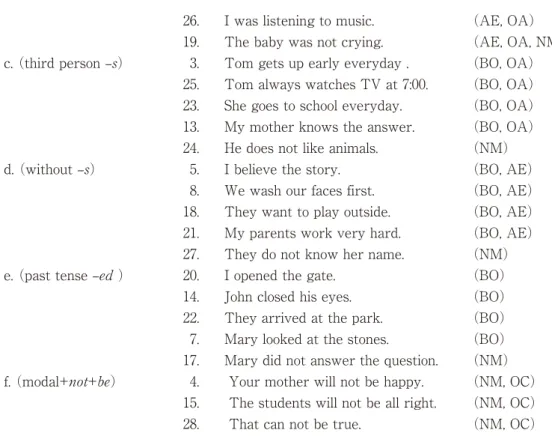
  The answers we expected are the following 28 English sentences of six categories.

( 9 ) a. ( copula be ) 12. I’m busy now. ( AE, OA )

16. The children are very poor. ( AE, OA ) 2. The man was angry. ( AE, OA ) 9. Her mother was very kind. ( AE, OA ) 11. The question is not difficult. ( AE, OA, NM ) b. ( auxiliary be ) 10. The girls are writing letters. ( AE, OA )

1. Tom is playing soccer. ( AE, OA )

6. The cat is sleeping. ( AE, OA )

(5)

26. I was listening to music. ( AE, OA ) 19. The baby was not crying. ( AE, OA, NM ) c. ( third person –s ) 3. Tom gets up early everyday . ( BO, OA )

25. Tom always watches TV at 7:00. ( BO, OA ) 23. She goes to school everyday. ( BO, OA ) 13. My mother knows the answer. ( BO, OA ) 24. He does not like animals. ( NM ) d. ( without –s ) 5. I believe the story. ( BO, AE )

8. We wash our faces first. ( BO, AE ) 18. They want to play outside. ( BO, AE ) 21. My parents work very hard. ( BO, AE ) 27. They do not know her name. ( NM ) e. ( past tense –ed ) 20. I opened the gate. ( BO )

14. John closed his eyes. ( BO ) 22. They arrived at the park. ( BO ) 7. Mary looked at the stones. ( BO ) 17. Mary did not answer the question. ( NM ) f. ( modal+not+be ) 4. Your mother will not be happy. ( NM, OC )

15. The students will not be all right. ( NM, OC ) 28. That can not be true. ( NM, OC )

The numbers in front of the sentences indicate the order in which the L2 learners were asked to write them in the experiment. Included in parentheses are errors that are potentially caused in each sentence and are used for the analysis here

3

.

4 . 3  Results and discussion

  We first need empirical data to judge whether T is internalized in the participants’ grammars of L2 English.

Following Ionin and Wexler ( 2002 ) , the occurrences of AE and OA were counted in those contexts where AE can be made, and in those contexts where agreement with the subject is obligatory, respectively. In fact, the following contexts were eliminated from the data: ( i ) sentences which have a modal or a preterit form of a main verb as a finite verb, and cannot induce AE nor OA; ( ii ) sentences where auxiliary do or have is used and required to be third person singular, but the agreement has not been treated as affixal nor suppletive ( see Zobl & Liceras, 1994;

Ionin & Wexler, 2002 ) ; ( iii ) sentences where an inflected form of be is used but with a nonfinite main verb, and hence cannot be classified as a copula nor an auxiliary.

  Table 2 shows the results concerning the third person singular ending taken as affixal inflection, and the results concerning copula and auxiliary be taken as suppletive inflection.

Table 2 . Occurrences of AE and OA

Affixal inflection (- s ) Suppletive inflection ( be )

L1 - Level AE OA AE OA

C-BL C-EL J-BL J-EL

 2/173 ( 1 %) 12/238 ( 5 %)  2/144 ( 1 %) 12/301 ( 4 %)

 80/157 ( 51 %)  66/231 ( 29 %)  69/149 ( 46 %) 102/329 ( 31 %)

10/390 ( 3 %) 10/541 ( 2 %) 26/385 ( 7 %) 41/796 ( 5 %)

52/390 ( 13 %)

10/541 ( 2 %)

31/384 ( 8 %)

37/794 ( 5 %)

(6)

( 12 ) a That not can true. ( cf. No.28 in ( 9f )) b. He likes not animal. ( cf. No.24 in ( 9c ))

The numbers of misplacement are few irrespective of the L1 background or English proficiency level. These results suggest that there is a syntactic position between the subject and negation which modals and finite forms of be, but not finite main verbs, can occupy. With the results in Table 2 and Table 3, we may safely conclude that T is internalized in the English grammar of the learners in each group.

  We are now in a position to ask whether the learners overgenerated be. Table 4 show the mean BO frequencies ( and standard deviations ) of each group, while Table 5 lists the number of participants who overgenerated be, namely those who made one or more than one BO error ( s ) .

Errors concerning affixal inflection and suppletive inflection are exemplified in ( 10 ) and ( 11 ) respectively, and the a-examples and b-examples illustrate AE and OA respectively.

( 10 ) a. We washes face first. ( cf. No.8 in ( 9d )) b. She go to school everyday. ( cf. No.23 in ( 9c )) ( 11 ) a. That baby aren’t crying now. ( cf. No.19 in ( 9b )) b. That question not difficult. ( cf. No.11 in ( 9a ))

  As for the results in Table 2, the frequency of AE is low in both affixal and suppletive inflection, although the difference in frequency between AE and OA is clearer in the case of affixal inflection

4

. These results suggest that T is present as a psychological reality in the learners’ L2 grammars and plays the role of ruling out derivations where the features of the subject do not match those of the verb.

  Additional evidence for the presence of T comes from the results in Table 3 concerning the relative order between a finite verb and negation. Some examples of misplacement are given in ( 12 ) .

Table 3 . Misplacement of finite verbs with respect to not

L1 - Level modal ( *not V ) be ( *not V ) main V ( *V not ) C-BL

C-EL J-BL J-EL

4/ 72 ( 6 %) 1/136 ( 1 %) 1/ 97 ( 1 %) 3/241 ( 1 %)

0/ 42 ( 0 %) 0/ 84 ( 0 %) 0/ 50 ( 0 %) 0/165 ( 0 %)

0/120 ( 0 %) 0/175 ( 0 %) 2/123 ( 2 %) 1/264 ( 0 %)

Table 4 . BO ( group results )

L1 - Level Mean frequency SD C-BL

C-EL J-BL J-EL

11 %  7 % 19 % 10 %

14 . 55 10 . 45 25 . 96 18 . 66

Table 5 . BO ( individual results ) L1 - Level Number of participants who

overgenerated be C-BL

C-EL J-BL J-EL

23 ( 52 %) 22 ( 37 %) 22 ( 50 %) 29 ( 32 %)

The rates of BO occurrence were analyzed by using a multivariate analysis of variance ( MANOVA ) with L1 and level as the independent variables, which revealed a significant main effect for L1 ( F ( 1, 234 ) = 5.66, p<.05 ) and a significant main effect for level ( F ( 1, 234 ) = 7.35, p<.01 ) . The interaction between the L1 and the level was not significant. As for the number of participants with BO, there was no significant difference between the C-BL and J-BL groups ( χ

2

( 1, N=103 ) = 0.05, ns ) nor between the C-EL and J-EL groups ( χ

2

( 1, N =135 ) = 0.47, ns ) .

  The results in Table 4 coupled with those in Table 5 show that Chinese learners and Japanese learners both

overgenerate be, and that the difference concerning BO between Chinese and Japanese groups is only a matter of

frequency.

(7)

5  Conclusions

  This article has investigated whether the L1 [+V-feature] is involved in causing BO and whether the presence or absence of the tense feature in L1 brings a difference in the rate of BO. As for the first question, we examined Chinese learners of English with their L1 v-feature value specified as [-]. Our experimental data revealed that a certain number of L1 Chinese learners of English overgenerated be, which suggests that the L1 v-feature value of T is irrelevant for the presence or absence of BO phenomena in L2. No L1 v-feature effects have been observed in many previous studies on finite verb placement ( White, 1992; Eubank, 1993/4; Yuan, 2004 ) . Thus we obtained the same observation from another viewpoint of BO.

  As for the second question, our finding that Japanese groups produced more BO errors than Chinese groups suggests that BO can be affected by the presence or absence of the tense feature in L1, which supports Ionin and Wexler’s ( 2002 ) analysis where be is overgenerated to mark tense and agreement in T. It is also consistent with a similar finding in Hawkins and Liszka ( 2003 ) concerning English past tense realization by Japanese and Chinese learners.

References

Bailyn, J. F. ( 1995 ) . A configurational approach to Russian ‘free’ word order. Doctoral dissertation, Cornel University.

Chomsky, N. ( 1995 ) . The minimalist program. Cambridge, MA: MIT Press.

Chomsky, N. ( 2001 ) . Derivation by phase. In M. Kenstowicz ( Ed. ) , Ken Hale: A life in language ( pp.1 - 52 ) . Cambridge, MA:

MIT Press.

Ernst, T. ( 1995 ) . Negation in Mandarin Chinese. Natural Language and Linguistic Theory, 13, 665 - 707.

Eubank, L. ( 1993/4 ) . On the transfer of parametric values in L2 development. Language Acquisition, 3, 183 - 208.

Fleta, M.T. ( 2003 ) . Is-insertion in L2 grammars of English: A step forward between developmental stages?. In J.M. Liceras, H.

Zobl, & H. Goodluck ( Eds. ) , Proceedings of the 6th generative approaches to second language acquisition conference ( pp.85 - 96 ) . Somerville, MA: Cascadilla Proceeding Project.

GU, Y. ( 1995 ) . Aspect licensing, verb movement and feature checking. Cahiers de Linguistique-Asie Orientale, 24, 101 - 131.

Harves, S.A. ( 2002 ) . Unaccusative syntax in Russian. Doctoral dissertation, Princeton University.

Hawkins, R. & Liszka, S. ( 2003 ) . Locating the source of defective past tense marking in advanced L2 English speakers. In R.

van Hout, A. Hulk, F. Kuiken, & T. Richard ( Eds. ) , The interface between syntax and lexicon in second language acquisition ( pp.21 - 44 ) . Amsterdam: John Benjamins.

Huang, C.-T.J. ( 1991 ) . Verb movement, ( in ) definiteness, and the thematic hierarchy. In P.J-K. Li, C.-R. Huang, & Y-C. Lin ( Eds. ) , Proceedings of Second International Symposium on Chinese Languages and Linguistics ( pp.481 - 498 ) , Taiwan:

Academia Sinica.

Ionin, T. & Wexler, K. ( 2002 ) . Why is ‘is’ easier than ‘-s’?: Acquisition of tense/agreement morphology by child second language learners of English. Second Language Research, 18, 95 - 136.

Koizumi, M. ( 1995 ) . Phrase structure in minimalist syntax. Doctoral dissertation, MIT.

Koizumi, M. ( 2000 ) . String vacuous overt verb raising. Journal of East Asian Linguistics, 9, 227 - 285.

Li, Y-H. A. ( 1990 ) . Order and Constituency in Mandarin Chinese. Dordrecht: Kluwer.

Otaki, K. ( 2002 ) . Be overgeneration in second language acquisition: A comparison between L2 English and L2 French. MA thesis, Keio University.

Pollock, J.-Y. ( 1989 ) . Verb movement, universal grammar, and the structure of IP. Linguistic Inquiry, 20, 365 - 424.

Prévost, P. & White, L. ( 1999 ) . Accounting for morphlogical variation in second language acquisition: Truncation or missing inflection? In M.-A. Friedemann & L. Rizzi ( Ed. ) , The acquisition of syntax ( pp.202 - 235 ) . London: Longman.

Prévost, P. & White, L. ( 2000 ) . Missing surface inflection or impairment in second language acquisition?: Evidence from tense and agreement. Second Language Research, 16, 103 - 133.

White, L. ( 1992 ) . Long and short verb movement in second language acquisition. Canadian Journal of Linguistics, 37, 273 - 287.

Yuan, B. ( 2004 ) . Negation in German-Chinese, French-Chinese and English-Chinese interlanguges. Transactions of the Philological Society, 102, 169 - 197.

Zobl, H. & Liceras, J. ( 1994 ) . Functional categories and acquisition orders. Language Learning, 44, 159 - 180.

(8)

Notes

  First of all, I would like to thank Kunimori Matsuzaki, Junji Shigeno, and Yanyan Zhao for their help in collecting data, and Ivan Brown, who proofread this paper. Also I have greatly benefitted from the comments and suggestions of Tetsuya Sano and other TPL members.

1 The number of the participants labeled as ‘lower intermediate’ was two and ten in the Japanese and Chinese groups respectively, and was judged as insufficient for data analysis.

2 The differences in the mean age and mean length of studying English between the Chinese and Japanese groups can be interpreted as reflecting the fact that the Chinese participants, but not the Japanese participants, had received English education at elementary school level.

3 Here the following abbreviations are newly used: AE =agreement error, NM=not misplacement, OC=omission of copula, OA=omission of agreement. As for negative sentences with do and a main verb such as No.24, No.27, No.17, it depends on assumptions whether be is predicted to be overgenerated, that is, to be used in place of do. Ionin and Wexler’s ( 2002 ) analysis assumes that be can be used as a substitute for affixal inflection, which is be overgeneration. If no additional assumptions are given, the analysis would predict that be would not be used in place of auxiliary verbs.

4 The higher rates of suppletive agreement errors by the Japanese participants than by the Chinese ones may be attributed to Japanese learners’ luck of the knowledge that children is the plural form of child, both of which are also used in Japanese ( as loan words from English ) often without their number distinction. The mismatch error of …children is…

accounts for 20 out of 26 in the case of J-BL and 29 out of 41 in the case of J-EL.

Table  1 . Participants
Table  2 .  Occurrences of AE and OA
Table  4 . BO  ( group results )

参照

関連したドキュメント