• 検索結果がありません。

YinPuiMun LauSimYee CanAidBuyGrowth?:EmpiricalEvidencesfromCambodia,LaoPDRandVietnam

N/A
N/A
Protected

Academic year: 2021

シェア "YinPuiMun LauSimYee CanAidBuyGrowth?:EmpiricalEvidencesfromCambodia,LaoPDRandVietnam"

Copied!
20
0
0

読み込み中.... (全文を見る)

全文

(1)

Can Aid Buy Growth?:

Empirical Evidences from Cambodia, Lao PDR and Vietnam

Yin Pui Mun

*

Lau Sim Yee

**

Abstract

ODA is advocated to be one of the major financial sources to promote economic growth in most of the developing countries. Despite receiving significant amount of ODA funds, many recipients are still grappled with poor economic growth. Earlier studies on foreign aid effectiveness are rather inconclusive until today. For thist reason, the study aims to sketch a clearer picture of whether aid can buy growth in Cambodia, Lao PDR and Vietnam which are presently major ODA recipients in South East Asia region. By incorporating time series data of the three mentioned countries from 1993 to 2009 and application of ARDL approach, the results indicate that there is a negative long run relationship between foreign aid and growth in Cambodia and Vietnam, whereas foreign aid has no impact on growth in Lao PDR within the period of study. Hence, our empirical findings imply that aid recipient countries need to seek for other alternative ways to stimulate growth since foreign aid is not the panacea. In short, aid has failed to buy growth

Keywords: foreign aid, economic growth, official development assistance, South East Asia, ARDL

JEL classification: F35, O19, O40, O53

1.0 Introduction

Since the end of the World War II, many countries that were colonized by European countries in Africa and Asia gained their independence. The most critical concerns for those newly independent countries (NICs) were nation building and economic development. One of the most severe constraints encountered by the then NICs was the mobilization of financial resources.

* Correponding author, School of Economics and Business Administration, Reitaku University, puimun.yin@gmail., com.

** School of Economics and Business Administration, Reitaku University, [email protected].

Journal of Economic Studies

Vol.21, No.2, September 2013

(2)

This constraint and others were anticipated by the United Nations of Monetary and Financial Conference, held in July 1944, where conference participants agreed to form an inter- governmental financial institution known as International Bank of Reconstruction and Development (IBRD)̶now part of the World Bank Group̶for the purpose of facilitating aid.

Since then, issues pertain to economic development in less developing attracted wide attentions from scholars, researchers, journalists, politicians and others. Notwithstanding enormous efforts by the industrialized countries in assisting the developing world in the last 50 years, the problems of development in general and alleviation of the absolute poverty in particular still persist.

Particularly since the least developed countries could not mobilize domestic financial resources because of their low income level, which is compounded with their limited access to the global capital market, foreign aid specifically official development assistance (ODA) plays a pivotal role in the provision of external finance to promote economic development. According to the Organization for Economic Cooperation and Development (OECD), ODA is defined as a disbursement of loan made on concessional terms of 25 percent of grants by governmental agencies of the members of the Development Assistance Committee (DAC), by multilateral institutions (such as United Nations, the World Bank), and by non-DAC countries for the purpose of promoting economic development and welfare in the developing countries.

ODA disbursements are made through bilateral donors or multilateral institutions.

According to DAC, the ratio of bilateral and multilateral ODA in 2011 was seven to three. Since the launch of UN Millennium Development Goals (MGDs), public awareness about the role of ODA and economic cooperation has risen, consequently, the ODA flows from the DAC countries have increased four folds from US$32.5 billion in 1970 to US$134. 0 billion in 2011 (OECD, 2013c). Furthermore, non-DAC countries have also contributed US$97.25 billion in 2011, which is more than 50 percent surge from 2007 (OECD, 2013c).

No one in the aid community would want to deny the basic principle of our moral obligation to assist development in poor countries. But, has foreign aid in actuality been effective to promote development? This debate has intensified in recent years. Peter Bauer (1972) criticizes that foreign aid is not necessary required to bring about large scale economic development in developing countries as many other countries have done it even before foreign aid was introduced. William Easterly (2005 ) argues that aid is not the cure for social and economic inequality problems within and among poor countries. In opposing these views, Jeffrey Sachs (2005) contends that because of insufficient aid amount and commitment from the donors, poor countries remain in “poverty trap.” Thus, Sachs alleges that if the right amount of aid is provided to the least developed countries in promoting investment in key economic sectors, a virtual cycle will consequently be created to promote economic growth in each of those countries.

In order to shed light on the effectiveness of aid in promoting economic growth, it is imperative to examine the development experiences of East Asia region because countries in the region, although in different period in the last five decades, have grown impressively.

Equally interesting, this group of countries utilized foreign aid effectively to lay the foundation

(3)

for propelling economic growth. The triumphant post-war reconstruction and subsequent economic takeoff in Japan triggered and transmitted a series of growth in East Asian region.

Korea and Taiwan grew impressively from the second half of 1960s to early 1980s, while Hong Kong and Singapore demonstrated impressive growth since 1970s. Malaysia, Thailand and Indonesia also follow quite similar growth trajectories since 1980s. Chinaʼs economic takeoff started in the second half of 1990s, and Greater Mekong Subregion ( GMS ) countries like Cambodia, Laos and Vietnam started their growth process in 2000s.

The combined nominal gross domestic product (GDP) per capita for Cambodia, Laos and Vietnam (CLV) is US$1,335 in 2011 (The World Bank, 2011). It is not difficult to predict that CLV will continue to growth impressively in the coming period. Currently, this group of GMS countries has emerged as the main ODA recipients in the Southeast Asia region. Vietnam is the second largest recipient in Asia 2009, with 11 percent of the ODA being disbursed in that region. The total amount of ODA received by CLV in 2009 was US$5.4 billion in constant 2011 US dollars (OECD, 2013b). Notwithstanding such a large amount of aid, mitigating absolute poverty has to be of the highest priority because poverty headcount in these three countries is still relatively high at around 20 percent of the total population. Otherwise, CLV will miss the targets of MDGs in 2015.

From hindsight, the success stories of Japan and Korea and other East Asian countries have given people in aid community a certain confidence level that aid does contribute to economic growth. This group of countries also set good examples with regard to how aid is a fundamental imperative in pushing economic takeoff. Notwithstanding the track records in East Asia region, many observers still have serious doubts that aid can work effectively in any least developed countries characterized by abject poverty in region like South Asia, the Middle East and North Africa, Sub-Saharan Africa and others. More critically, many aid pessimists allege skeptically that aid produces more bad outcomes than good results (Collier, 2007, Moyo, 2009).

Against this background, this study aims to shed light on the aid effectiveness by undertaking a case study of CLV. In particular, this paper attempts to investigate the aid-growth relationship in CLV. The rest of the paper is organized as follows. Section 2 gives a literature review with special focus on foreign aid, economic growth and aid effectiveness.

Section 3 conceptualize our analytical methodology, Section 4 shows our analytical findings and discussions. The last section concludes our empirical anlysis with policy recommendations.

2.0 Literature Review

2.1 Foreign Aid and Economic Growth in Developing World

In the past few decades, modern economics has generated several schools of thought in

explaining economic growth and policies that influence the expansion of national income in

developed countries and the developing world. Some theories expound the mechanics of

economic growth, whereas other concepts focus on identifying the sources of economic growth

and on those bases to predict future growth trajectory. Over time, supported by the advances

(4)

of computing power, growth theories have evolved from the simplest to the most sophisticated form as the globalization taken its cue.

The ascendancy of economic growth model in development economics was strongly related to the rapid surge in the number of newly independent countries in Africa and Asia continents after the World War II. How to mobilize financial resources to promote economic growth has attracted loads of attention from economists. As a consequence, Harrod-Domar (Domar, 1947; Harrod, 1948) growth model was popularized to explain how an economic growth rate is influenced by the availability of investment and the productivity of capital. This model contends that a stable economic growth is linked to the level of saving ( i. e., the level of investment) and population growth (i.e., the availability of labor force) in an economy. As such, Harrod-Domarʼs model established two insightful concepts with regard to economic growth.

The first one is called warranted growth which is determined from the ratio of the saving rate and the capital-output ratio. The second one is called the natural growth rate which is determined by the labor force in the absence of technological change. In essence, this theory suggests that the production takes place based on a fixed coefficient of production factors, and at the same time, it assumes that labor force is unlimited and thus it predicts that growth rate is proportional to capital stock. Put differently, thus this theory advocates a continuous effort in building factories the expansion of production capacity as well as the absorption of surplus labor. Moreover, this theory warns that growth instability would occur̶knife edge equilibrium̶if labor force grew faster than capital stock (i.e., insufficient capital to achieve full employment) and vice versa (i.e., insufficient labor force to utilize the capital stock).

The simplicity of Harod-Domar model gives clear insight to the contributory role of the foreign capital inflows (such as in the form of foreign aid and foreign direct investments) in propelling economic growth in developing countries where capital is scarce. Nevertheless, the model is arguably oversimplified with questionable assumptions in the real world. Easterly (1997) argues that the Harrod-Domar model failed both theoretically and empirically. In fact, in 1957, Domar himself stated that his model was not intended as a growth model but instead it was for improving the understanding of business cycles (Easterly, 1997).

The limitation of Harrod-Domar was critically pointed out in Solow ( 1956 ). Solowʼs growth model, also known as the Neoclassical growth model, corrected the unrealistic assumptions in the Harrod-Domar model. In his model, Solow shows how the economy would converge to a steady-state growth path based on a few main assumptions, which are robust in the observed reality: firstly, the proportion of labor and capital are not fixed and each is substitutable with the other; secondly, technology and productivity changes are taken into account in determining long-run growth; thirdly, labor force growth rate and saving rate is exogenously determined; fourthly, the production function has a property which is of constant return to scale; lastly, the capital per labor ratio has a property which is of diminishing returns.

While the knife-edge notion has constrained the Harrod-Domar theory in predicting growth

path, that limitation is eliminated by using Solowʼs model because the technological

improvement offsets the diminishing returns of capital accumulation by the rise of labor

productivity with similar capital intensity for stimulating long-run growth.

(5)

There are three popular definitions for neutral technological progress. The Hicks neutral occurs when the ratio of marginal products remain constant for the given capital-labor ratio (Hicks, 1932 ). Harrod ( 1942 ) expanded Hicksʼs work by defining neutral technological innovation as the phenomenon where the relative input shares remain unchanged at a given capita-labor ratio. On the contrary, Solow (1969 ) argues that a neutral technological progress means the relative input shares maintained for a given level of labor-capital ratio. In this context, therefore, the Harrodʼs model is unable to substantiate the role of labor in causing technological progress which is especially critical for explaining the convergence to steady state of growth in developing countries.

Notwithstanding the limitations, the Harrod-Domar growth model is among one of the most popular conceptual framework being used to explain how to overcome domestic saving-investment gap in a developing country by linking the relationship between foreign aid and economic growth. The role of foreign aid in spurring economic growth is derived from the concept of “ required ” investment to desired growth ratio which also well known as the incremental capital-output ratio (ICOR) which is defined by the followingequation:

ICOR= ΔK

ΔY

where K denotes capital stock and Y is total output. In addition, the model assumes that investment is the only factor to gain substantial growth and investment is contributed by savings. Therefore, capital stock is derived as:

ΔK =I =sY ⑵

where I represents investment, s is average propensity to save. By substituting equation ⑵ into ⑴, we will obtain the changes in output:

ΔY = sY

ICOR

Since growth rate is denoted as ΔY

Y , equation ⑶ is transformed into the following manner:

ΔY Y = s

ICOR

Equation (4 ) clearly implies that savings play a vital role in stimulating economic growth.

Suppose a developing country wants to generate growth rate of let say Y%, that country needs

X% of savings given the ICOR is constant. However, it is harder to achieve the desired growth

rate because its access to financial resources is severely limited in the developing countries

than in the developed countries. The insufficiency of the domestic savings to finance the

investment required to achieve the desired growth rate is commonly called the saving gap. In

developing countries, because people barely earn subsistence to sustain their basic needs, thus

it is relatively harder to fill the saving gap.

(6)

The foreign capital comes into play when the developing countries are not capable to mobilize large amount of domestic funds to fill up the saving gap. By and large, foreign capital comes in two forms. The private sectors provide foreign direct investment (FDI) funds while the public sectors could offer foreign capital in a form of foreign aid. Currently, Cambodia, Lao PDR and Vietnam are way below the high-income threshold for ODA eligibility 1) defined by the Organization for Economic Cooperation and Developmentʻs ( OECD ) Development Assistance Committee (DAC), with gross national income (GNI) amount to $830 USD, $1,130 USDand $1,260 USD, respectively (The World Bank, 2011 ). On top of that, the development level in these countries has yet to reach a level that could attract huge amount of FDI to cover their huge saving gaps. In 2013, Cambodia, Lao PDR and Vietnam rank at 133, 163 and 99 among 185 countries in the Doing Business 2013 compiled by the World Bank and International Financial Cooperation (IFC). These ratings are illustrative of the present limitation encounters in these three countries in relying on FDI, and thus they have to seek an alternative channel, viz., ODA to fill their domestic saving gaps.

2.2 Aid Effectiveness

In the past, the fact that ODA is always considered as a morally rightful action to take in engendering a better living for the barely subsistence poor has always been taken for granted.

Due to the nature of ODA projects, the society has no suspicious n on whether ODA really works. However, the lack of significant empirical evidences and a bulk of literature contenting about aid ineffectiveness have raised awareness on the issue of the ability of ODA to promote growth in developing countries.

The debates on aid effectiveness is well documented. On one hand, studies have proven that foreign aid has successfully generates economic growth in the recipient countries. On the other hand, empirical findings substantiate that foreign aid hardly achieves what they ought to have established. To sum up, researchers like Asteriou (2009 ), Chowdhury and Das (2011 ), Hansen and Tarp (2001), Hatemi-J and Irandoust (2005), Irandoust and Ericsson (2005), Levy (1988), Neanidis and Varvarigos (2009), Selaya (2005) and Whitaker (2006) claim that there is a positive relationship between foreign aid and economic growth in Africa and the South Asia.

On the contrary, Bruke and Ahmadi Esfahani (2006), Ellahi and Ahmad (2011 ), Malik (2008), Muhammad and Qayyum (2011), Nowak-Lehmann et al. (2009) and Nushiwat (2007) argue that there is no empirical evidence, but instead the analytical findings show a negative relationship between foreign aid and growth in recipient countries.

The widely cited research by Burnside and Dollar (2000) has raised concerns about the role of government intervention in aid effectiveness. The study claims that foreign aid has positive relationship with growth only in the presence of good policies. This contention is later reinforced in Collier and Dollar (2002). The assertion that foreign aid should only be provided to recipient countries with sound policies̶which is not likely the case in poor developing

1) DAC revises the ODA recipient list every three years. Countries that have surpass the high-income threshold

(around USD 9,000 at that the last revise date) for three consecutive years would make progress from being eligible

ODA recipient countries (OECD, 2013a).

(7)

countries̶has been challenged by several studies later. Hansen and Tarp (2002), Rajan and Subramanian (2005) and Easterly, Levine and Roodman (2003), Selaya (2005) and Selaya and Thiele (2010 ) dispute the findings in Burnshide and Dollar (2000 ). These studies insist that foreign aid has no positive correlation to economic growth even if a recipient country has put in place a good policy framework.

3.0 Model Specification and Analytical Method.

This study assumes that the inadequacy of domestic saving in a developing country is filled by foreign aid, which will be channeled into investment activities to promote economic growth.

However, it should be noted that in reality the foreign aid includes humanitarian aid as well.

Thus, in order to capture the specific impact of foreign aid on economic growth, our analysisuses ODA 2) as the indicator for foreign aid which excludes the elements for humanitarian aid.

Under these assumptions, we can expect foreign aid and foreign investment are directly proportional to the economic growth in developing countries. In addition, this study also assumes that trade openness which measures the economic liberalization would contribute positively to economic growth. As a result, the effect of the three independent variables viz. the ODA, FDI inflows and trade openness on economic growth which is denoted by the real gross domestic products (GDP), our analytical model can be specified as follow:

LRGDP

+ β

LRODA



LRFDI



+ β



LROPEN



where LRGDP

t

denotes the real GDP, LRODA

2t

represents the ratio of ODA to GDP, LRFDI

3t

is the ratio of FDI received to GDP and LROPEN

4t

is the trade openness ratio to GDP within the sample time frame. All these variables are expressed in natural logarithm form in the model. Whereas β

represents the coefficient for each variable and ε

indicates other factors that influence the economic growth in that particular period.

This empirical analysis uses the annual data of CLVfrom 1993 to 2009 comprises trending variables such as real GDP, real GDP per capita, ODA per capita, real FDI, import and export. This data set is retrieved from the World Development Indicator 2011 published by the World Bank. The dependent and independent variables adopted in the regression model are real GDP per capita and real ODA to GDP ratio, real FDI to GDP ratio and Trade Openness, respectively. Trade Openness is the sum of export and import.

In order to examine the relationship between ODA and economic growth in CLV, we apply the Auto Regression Distributed Lag (ARDL) cointegration approach 3) introduced by Pesaran and Shin (1996), Pesaran and Pesaran (1997) and Pesaran and Smith (1998). The ARDL

2) There are studies that adopt ODA as as one of their independent variables to examine the aid effectiveness. For example, Bruke and Ahmadi Esfahani (2006), Colier and Dollar (2002), Ellahi and Ahmad (2011), Hansen and Tarp (2001), Levy, 1988, Malik (2008), Murphy and Tresp (2006).

3) Asterious (2009), Ellahi and Ahmad (2011), Muhammad and Qayyum (2011) have applied the ARDL approach in

their studies to analyze the aid-growth relationship.

(8)

method is chosenbecause it has several advantages over other conventional cointegration tests.

Firstly, the approach allows the application on a small sample size. Secondly, this approach is capable to capture both long and short run dynamics in cointegration analysis which is the focus of this study. Thirdly, the approach can also tolerate different level of integration of the data series (Pesaran & Pesaran, 1997). Lastly, we use ARDL since this study is dealing with a relatively small sample size and it is found that the variables are integrated at different orders based on the unit root tests.

3.1 Integrational Test

In carrying out the ARDL cointegration analysis, unit root tests on the time series data is conducted in order to identify order of integration because the approach is inapplicable on I(2) variables. Furthermore, univariate unit root tests are also necessary before further tests to avoid spurious regression within the data as well as to determine which approach is more appropriate for further investigation. All three unit root tests namely the Augmented Dickey-Fuller (ADF) test, Phillip Perron (PP) test and Kwaitkowski-Phillip-Schmidt-Shin (KPSS) test are conducted to examine the “stationarity” of the time series data. We note that the KPSS test developed by Kwiatkowski et al. ( 1992 ) has stronger explanatory power in dealing with a small sample size over the other two methods 4) . Consequently, KPSS test resultsare given more emphasis because the sample size in this study is rather small. However, the ADF and PP tests are useful in gauging the results for other variables 5) .

3.2 Cointegration Test

After the pre-testing on the characteristics of the variables, the next step is to investigate the existence of long-run relationship between the tested variables. In other words, variables in equation ⑸ might be nonstationary and thus the dependent variable and independent variables are integrated series. The existing literature suggests several ways such as ARDL cointegration approach, Johansen-Juselius cointegration test 6) and Pedroniʼs cointegration test 7) to examine trending variables in this study, viz., the cointegration between the growth and aid.

This study applies the ARDL approach for its reliability on a small sample size and other strengths mentioned above. This approach is consistent with Asterious ( 2009 ), Ellahi and Ahmad (2011), Muhammad and Qayyum (2011), where their studiesuse the ARDL framework to analyze the impact of foreign aid on economic growth. In this analytical method, the computed F-statistics were obtained using the ARDL bound test to substantiate the null

4) According to Schwert (1989), Kwiatkowski et al. (1992) and Leybourne and Newbold (2000) ADF tests have lower power on small samples, particularly if the series consists of structural breaks.

5) ADF and PP tests are widely used (Bhavan et al., 2011; Chowdhury & Das, 2011; Ellahi & Ahmad, 2011; Malik, 2008 and Muhammad & Qayyum, 2011) to determine the presence of unit root.

6) For example, Chowdhury & Das (2011), Irandoust & Ericson (2004), and Malik (2008) apply the Johansen-Juselius cointegration test to determine the cointegration vector by looking at both the trace test and (λ

trace

) and the maximum eiganvalue (λ

max

) test.

7) Chowdhury and Das (2005) and Hatemi-J and Irandoust (2005) conducted the Pedroniʼs cointegration test to

establish the long-run relationship from panel data.

(9)

hypothesis of no cointegration in the long run. Furthermore, this refers to critical values tabulated in Narayan (2005) instead of those values in Pesaran et al. (2001) due to the relative reliability of the former set of critical value with relatively small data size 8) . The null hypothesis is rejected whenever the computed F-statistics are higher than the upper bound value. In contrast, the F-statistics lower than the lower bound value fail to reject the null of no cointegration.

3.3 Error Correction Model (ECM)

The Granger representation theorem states that there is a close linkage between cointegration and error correction model where the cointegrated time series must be supported by an error correction representation and vice versa 9) ( Engle & Granger, 1978 ). There are studies (Asteriou, 2009; Chowdhury & Das, 2011; Mailk, 2008; Ellahi & Ahmad, 2011) that apply ECM model to capture both the long run and short run dynamic simultaneously after the cointegration is identified beforehand as suggested by Keele (2005).

On one hand, eachestimated coefficient by the ECM system represents the short-run elasticity when the independent variables changes by one unit. On the other hand, the long run relationship can be determined by the error correction term (ECT) which demonstrates the speed of adjustment of the function towards the long run equilibrium.

3.4 Granger Causality Test

The causal relationship between the variables can be verified by conducting the Granger causality test. Engle and Granger (1987 ) show that the causal relationship can be examined based on the vector error correction framework ( VECM ) 10) instead of the vector autoregressive (VAR) model if any cointegrating vector is detected. They pointed out that the exclusion of ECT in the case of cointegrated variables within a VAR framework will lead to specification bias and thus cause the elimination of an important constraint. Therefore, they have developed the VECM model to accommodate the occurrence of cointegration vector.

Short run causality between the dependent variable and an explanatory variable in a time series can be determined by using the Wald test (F-statistics) through the significance of joint test with an application of sum of lags of the explanatory variables in the model. The rejection of the null hypothesis indicates that a time series explanatory variable Granger-caus- es the dependent variable.

8) According to Narayan (2005), the use of critical value available in Perasan et al. (2001) may be misleading because it was stimulated on the basis of larger sample size of around 500 to 1,000 observations. Whereas, the critical value computed by Narayan (2005) was based on smaller sample size of 30 to 80 observations.

9) The ECT needs to be negative, less than one and statistically significant at a certain level of significance in order to confirm the long run cointegration characteristic established in the cointegration test.

10) The result of ECT was reported in Asteriou (2009), Chowdhury and Das (2011) and Ellahi and Ahmad (2011) to

explain on the speed of adjustment.

(10)

4.0 Empirical Findings and Discussions 4.1 Unit Root Test Results

Three unit root tests, viz., ADF, PP and KPSS were conducted but this studyuses the results generated from the KPSS because its results are more reliable for a relative small sample size. This is consistent with studies carried out by Kwiatkowski et al.(1992), Leybourne and Newbold (2000) and Schwert (1989).

The test begins with testing the significance of the trend of a particular variable at level.

A significant trend component for a specific variable will be preceded with testing it with a trend component at level and first difference depending on its stationary process. On the other hand, a variable will be tested without the trend component at level and first difference whenever the trend is found to be insignificant. Stationarity at level indicates that the variable is integrated at order zero, I(0). Whereas, variables that are stationary at first difference are known to have first order integration, I(1) and so on.

Table 1 presents the results of the KPSS test and Table 2 summarizes the integration test outcomes for Cambodia, Laos PDR and Vietnam. These tables exhibit that the variables for all countries have mixed order of integration containing both I(0) and I(1) for each country. For this reason, the ARDL framework is used for cointegration testing to accommodate the variation of integration order.

Table 1 KPSS Unit Root Test Results

Variables Cambodia Lao PDR Vietnam

Level Specification Constant

Trend

Constant No Trend

Constant Trend

Constant No Trend

Constant Trend

Constant No Trend

LRGDPPC 0.1507(2)** - 0.2928(0)*** - 0.1945(0)** -

LODAGDP 0.0897(0) - 0.1601(2)** - - 0.1809(1)

LFDIGDP - 0.1296(2) - 0.1393(2) - 0.2049(2)

LOPNGDP 0.1509(0)** - 0.0763(1) - 0.1567(2)** -

First Difference

∆LRGDPPC - 0.1925(1) - 0.2070(2) - 0.1107(1)

∆LODAGDP - - - 0.3732(1) - -

∆LFDIGDP - - - - - -

∆LOPNGDP - 0.2960(1) - - 0.3621(0) -

Notes: The KPSS test is based on the null hypothesis of no unit root (stationary). Asterisks (*, **, ***) indicate the rejection of the null hypothesis at 1%, 5% and 10%, respectively. The critical value for KPSS 1%, 5% and 10% significant level is 0.

216, 0.146 and 0.119, respectively. The maximum bandwidth for KPSS has been chosen on the basis of Newey West (1994) and the lag selection is shown in parenthesis.

Table 2 Summary of Unit Root Test Results

Variables Cambodia Lao PDR Vietnam

LRGDPPR I(1) I(1) I(1)

LODAGDP I(0) I(1) I(0)

LFDIGDP I(0) I(0) I(0)

LOPNGDP I(1) I(0) I(1)

(11)

4.3 ARDL Bound Test Results

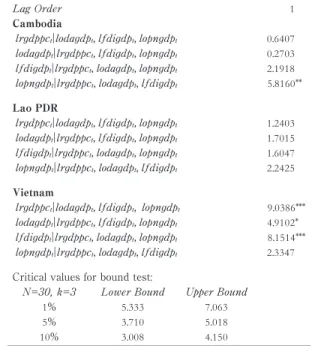
Table 3 presents the computed F-statistics for testing the null hypothesis of no long run cointegration among the variables. The significance level of F-statistics is marked with asterisks (*). The empirical findings show that the variables have long run relationship for Cambodia and Vietnam where a certain F-statistics in the equation set are larger than the upper boundʼs critical value at 5% significance level. On the other hand, the F-statistics for Lao PDRʼs ARDL equation fails to show that the variables are cointegrated in the long run given the test statistics generated are lower than the lower boundʼs critical values.

4.4 Diagnostic Tests

In order to verify the validity of the findings in the previous section, we conducted diagnostic tests. The existing literature suggests the autoregressive conditional heteroscedas- ticity (ARCH) model, Ramsey Regression Equation Specification Error Test (RESET) model, Jarque-Bera normality test, cumulative sum (CUSUM) test and CUSUM of square test are useful approaches for performing diagnostic tests used to gauge the goodness of fit of the model. These tests are proven to be useful to in examiningif there were any disturbance variances such as autocorrelation, specification error, non-normal distribution of error term in time series models. In addition, the CUSUM and CUSUM of square tests are useful to examine the stability of the model throughout the period of study.

Table 3 Results of Bound Test (F-statistics) for Cointegration

Lag Order 1

Cambodia

lrgdppc

lodagdp

, lfdigdp

, lopngdp

0.6407 lodagdp

lrgdppc

, lfdigdp

, lopngdp

0.2703 lfdigdp

lrgdppc

, lodagdp

, lopngdp

2.1918 lopngdp

lrgdppc

, lodagdp

, lfdigdp

5.8160**

Lao PDR

lrgdppc

lodagdp

, lfdigdp

, lopngdp

1.2403 lodagdp

lrgdppc

, lfdigdp

, lopngdp

1.7015 lfdigdp

lrgdppc

, lodagdp

, lopngdp

1.6047 lopngdp

lrgdppc

, lodagdp

, lfdigdp

2.2425 Vietnam

lrgdppc

lodagdp

, lfdigdp

, lopngdp

9.0386***

lodagdp

lrgdppc

, lfdigdp

, lopngdp

4.9102*

lfdigdp

lrgdppc

, lodagdp

, lopngdp

8.1514***

lopngdp

lrgdppc

, lodagdp

, lfdigdp

2.3347 Critical values for bound test:

N=30, k=3 Lower Bound Upper Bound

1% 5.333 7.063

5% 3.710 5.018

10% 3.008 4.150

Notes: The critical values of the lower bound and the upper bound are obtained from Narayan (2005, p1988 ) ‒ Appendix, Critical values for the bound test: case III: unrestricted intercept and no trend with k = 3. The Asterisk (*, **

and ***) denotes the rejection of the null hypothesis of no cointegration as the F-statistic is greater than the critical value

for upper bound.

(12)

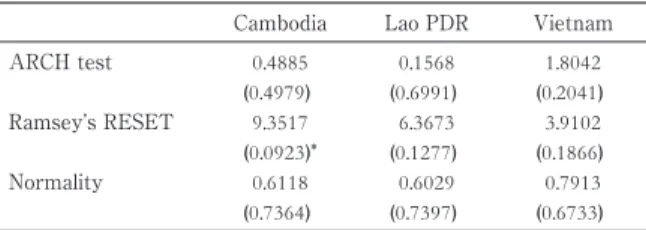
Table 4 presents the diagnostic test results for ARCH test, Ramsey`s RESET and Jarque-Bera test. The results infer that the models for all three countries are normally distributed, free from serial correlation and misspecification problems as the test-statistics could not reject the null of presence of the problemspertain to normality, serial correlation and specification at 5% significance level. Furthermore, Figure 1 illustrates the graphical results of the CUSUM and CUSUM of square tests. The plots for Cambodia, Lao PDR and Vietnam are all in 5% significance level. These findings validate that the estimated models are statistically stable throughout the period of study at 5% significance level.

4.5 Error Correction Model (ECM) Results

According to Kremers, Ericsson and Dolado (1992), the bound test itself is not sufficient to conclude the relationship between the variables. In order to confirm the existence of a long run cointegration, this analysis performs ECM test for the purpose of supporting the ARDL bound test results

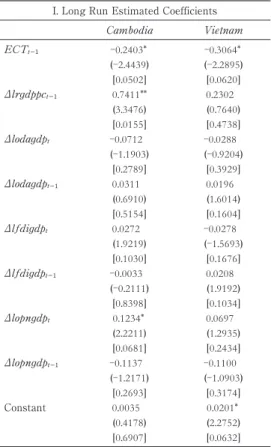
More specifically, we conduct ECM analysis for both the models for Cambodia and Vietnam in order to gauge the long run cointegration from ARDL bound test. Table 5 summarizes the results of ECM for Cambodia and Vietnam. The ECM results validate the presence of long run relationship among the variables as the ECT for both the countries are negative values, less than one and are statistically significant at 10% level.

Also, the estimated coefficients show the immediate impact of ∆LODAGDP, ∆LFDIGDP and ∆LOPNGDP on ∆LRGDPPC. The negative sign of the ∆ODAGDP coefficients in Cambodia and Vietnam, respectively, imply that ODA has inverse impact on the economic growth in the short run during the period of study. However, the estimated results are statistically insignificant in terms of ∆ODAGDP coefficients infer that the ODA components are not crucial in the economic growth in the short run in both countries.

The ECT coefficient is useful in estimating the speed of adjustment of the model towards the long run equilibrium. The estimated coefficient of ECT for Cambodia and Vietnam is -0.2403 and -0.3064, respectively. These findings imply that any disequilibrium in the system adjusts approximately 24% for Cambodia and 31% for Vietnam. Simply put, Cambodia takes around four to five years to revert back to equilibrium while Vietnam will take around two years to do so.

Table 4 Diagnostic Tests Results for ARDL Models

Cambodia Lao PDR Vietnam

ARCH test 0.4885

(0.4979)

0.1568 (0.6991)

1.8042 (0.2041) Ramseyʼs RESET 9.3517

(0.0923)* 6.3673

(0.1277) 3.9102 (0.1866)

Normality 0.6118

(0.7364)

0.6029 (0.7397)

0.7913 (0.6733)

Notes: The figure in parenthesis is p-value. Normality test is base on a test of skewness and kurtosis or residuals.

Ramseyʼs RESET test is for functional form, and the ARCH test for serial correlation. The asterisks *, **, *** denote

rejection of the null hypothesis at 10%, 5% and 1% respectively.

(13)

Figure 1 Plots of CUSUM and CUSUM of Squares

CUSUMofSquares 5% Significance

‑0.4 0.0 0.4 0.8 1.2 1.6

2007 2008 2009

CUSUM 5% Significance

‑6

‑4

‑2 0 2 4 6

2007 2008 2009

CUSUMofSquares 5% Significance

‑0.4 0.0 0.4 0.8 1.2 1.6

2007 2008 2009

CUSUM 5% Significance

‑6

‑4

‑2 0 2 4 6

2007 2008 2009

CUSUMofSquares 5% Significance

‑0.4 0.0 0.4 0.8 1.2 1.6

2007 2008 2009

CUSUM 5% Significance

‑6

‑4

‑2 0 2 4 6

2007 2008 2009

Plot of Cumulative Sum of Squares of  Recursive

Plot of  Cumulative Sum of Recursive  Residuals

Vietnam

Plot of Cumulative Sum of Squares of  Recursive

Plot of Cumulative Sum of Recursive  Residuals

Lao PDR

Plot of Cumulative Sum of Squares of  Recursive

Plot of Cumulative Sum of Recursive  Residuals

Cambodia

(14)

4.6 Short Run Causality Test

We performed the Wald test of F-statistics in order to corroborate the short run causality for Cambodia and Vietnam after the long run causality is determined in the ECM test.

Panel II in Table 5 summarizes the results of the causality test. The empirical evidences show that ODA, FDI and economic openness granger-cause the GDP in Cambodia at 10%

Table 5 Error Correction Model Results I. Long Run Estimated Coefficients

Cambodia Vietnam ECT



-0.2403*

(-2.4439) [0.0502]

-0.3064*

(-2.2895) [0.0620]

Δlrgdppc



0.7411**

(3.3476) [0.0155]

0.2302 (0.7640) [0.4738]

Δlodagdp

-0.0712 (-1.1903)

[0.2789]

-0.0288 (-0.9204)

[0.3929]

Δlodagdp



0.0311 (0.6910) [0.5154]

0.0196 (1.6014) [0.1604]

Δlfdigdp

0.0272 (1.9219) [0.1030]

-0.0278 (-1.5693)

[0.1676]

Δlfdigdp



-0.0033 (-0.2111)

[0.8398]

0.0208 (1.9192) [0.1034]

Δlopngdp

0.1234*

(2.2211) [0.0681]

0.0697 (1.2935) [0.2434]

Δlopngdp



-0.1137 (-1.2171)

[0.2693]

-0.1100 (-1.0903)

[0.3174]

Constant 0.0035

(0.4178) [0.6907]

0.0201*

(2.2752) [0.0632]

Notes: Value in parentheses is t-statistic. The value in square brackets is p-value. The asterisks *, ** and *** represents the rejection of H

0

significant at 10%, 5% and 1% respectively. ECT=LRGDPPC



−α

LODAGDP



−α

LFDIGDP



−α

LOPNGDP



II. Short Run Causality Test (Wald Test F-satistics) LRGDPPC 3.3665*

(0.0826)

2.1754 (0.1834) LODAGDP 2.7132

(0.1249)

3.6966*

(0.0683) LFDIGDP 1.2549

(0.3949)

4.1744*

(0.0529) LOPNGDP 1.3241

(0.3709)

0.9883 (0.5055)

Notes: LRGDPPC=Log of real GDP per capita; LODAGDP=Log of ODA-GDP ratio; LFDIGDP=Log of FDI-GDP ratio; LOPNGDP=Log of economic openness-GDP ratio. The asterisk * denote statistically significant at 10% level.

Figure in bracket represents the p-value.

(15)

statistically significant level. For the case of Vietnam, the result shows that GDP and FDI and economic openness collectively granger-cause the ODA inflow at 10% statistically significance level. From this result, it is plausible that ODA donors are aware of the growth in Vietnam reinforces economic performance which generates higher level of economic activities.

Similarly, the findings also show that GDP and ODA and economic openness granger-cause the FDI inflow to Vietnam.

The analysis also covers short run causality test for non-cointegrated functions (Lao PDR model for this case) to verify any short run causality. The null hypothesis test of short run granger causality is based on the p-value of its ARDL equation Table 6 displays the short run causality result for Lao PDR using the ARDL equation. The statistically insignificance implies no causal relationship between the dependent and explanatory variables.

5.0 Conclusions and Policy Recommendations

The conventional wisdom of Harold-Domar growth hypothesis suggests that foreign aid is a key source to fill the saving-investment in a developing country. Despite huge amount of foreign aid has been delivered to developing countries for the purpose of promoting economic growth in the past few decades, the economic performances in those countries are still meagre and their economies are vulnerable to external factors. For this particular reason, the question on effectiveness of foreign aid remains unanswered.

Against this backdrop, this study has attempted to apply ARDL cointegration method to examine the impact of foreign aid on economic growth of Cambodia, Lao PDR and Vietnam covering period from 1993 to 2009. This study is limited by a small sample size for a time series analysis. This is inevitable because Cambodia began its rehabilitation and reconstruction process from the end of its civil war in 1993, while Lao PDR and Vietnam started their systemic transformation from a centrally-planned economic system to a market-based economic system in earlier 1990s. Thus, the limited time series data inhibits our study to incorporate more robust variables. Consequently, this study is not able to conduct in depth empiricalinquiry to clarify what are the underlying factors which lead to aid ineffectiveness in these countries.

Essentially, our empirical investigation confirms that foreign aid has a negative Table 6 Short Run Causality Test for Lao PDR

Dependent Variables Lao PDR

LRGDPPC 1.5801

(0.3878)

LODAGDP 1.6819

(0.3658)

LFDIGDP 1.9816

(0.3114)

LOPNGDP 1.1782

(0.4986)

Notes: LRGDPPC=Log of real GDP per capita; LODAGDP=Log of ODA-GDP ratio; LFDIGDP=Log of FDI-GDP

ratio; LOPNGDP=Log of economic openness-GDP ratio. The asterisks * denote significant at 10% level. Figure in

brackets represents the p-value.

(16)

correlation with economic growth in the long run for Cambodia and Vietnam within the period of our analysis. Furthermore, the results show that foreign aid has not been an effective tool in promoting growth in Lao PDR. This empirical finding is consistent to the observed reality because the share of foreign aid was merely 0.7% of its GDP for the period between 2000 and 2008 (OECD, 2011c). In additional, Lao PDR is richly endowed with natural resources such as precious metals, hydropower and forestry. The development of natural resources sector tends to be capital-intensive industries, and thus Lao PDR is more likely to attract FDI instead of ODA.

The adverse relationship between foreign aid and economic growth in Cambodia and Vietnam is shocking yet understandable. Due to Vietnamʼs relatively bigger economy size, heavy investment on key economic infrastructures including railroads and telecommunication facilities are required to stimulate higher growth, where the key sources of these capital accumulation include the ODA inflows as well as FDI. According to other earlier studies, the negative relationship is likely to be attributed to a set of intertwined factors like corrupted government 11) , Dutch disease 12) , low governance capacity and others. However, our empirical findings suggest that a developing country need to reduce its dependency on foreign aid in stimulating economic growth due to the existence of negative long run relationship between foreign aid and economic growth. From this perspective, therefore, a developing country has to adopt a more self-sustainable approach in enhancing economic growth in the long run. Equally important, both the governments of the donor and recipient need to work together in strengthening aid distributional system so as to enable the target beneficiaries to receive the crucial resources in lifting their living standards instead of those resources being captured by unwarranted rent seekers who hinder aid effectiveness in promoting economic growth.

References

Asteriou, D. (2008). Foreign aid and economic growth: New evidence from a panel data for five South Asian countries. Journal of Policy Modeling, 31(2009), 155-161.

Bauer, P. T. (1972). Dissent on Development: Studies and Debates in Development Economics. Cambridge:

Harvard University Press.

Bhavan, T., Xu, C. S. & Zhong, C. P. (2011). The relationship between foreign aid and FDI in South Asian economies. International Journal of Economics and Finance, 3(2), 143- 149.

Bjerg, C., Bjørnskov, C. & Holm, A. (2011). Growth, debt burden and alleviating effects of foreign aid in least developed countries. European Journal of Political Economy, 27(2011), 143-153.

Bruke, P. J. & Ahmadi Esfahani, F. Z. (2006). Aid and growth: A study of South East Asia. Journal of Asian Economics, 17(2006), 350-362.

Burnside, C, & Dollar, D. (2000). Aid, policies, and growth. The American Economic Review,90(4), 847-868.

Chowdhury, M. & Das, A. (2011). Aid-growth nexus in South Asia: Evidence from time series and panel cointegration. Research in Applied Economics, 3(1:E3), 1-19.

11) Mauro (1995) and Gyimah and Camacho ( 2006) suggest that corruption effect obstructs economic growth by causing economic efficiency and uneven income distribution. Another study by Burnside and Dollar (2000) argues that bad government policies cause low aid effectiveness in recipient countries.

12) Rajan and Subramanian (2005) suggests that the adverse aid-growth relationship is caused by the Dutch disease

which describes a situation whereby the real exchange rate is overwhelmed by the large inflow of foreign aid which

undermine the competiveness of their export sector in the recipient countries.

(17)

Collier, P. (2007). The Bottom Billion: Why the Poorest Countries are Falling and What Can be Done About It. Oxford University Press.

Dickey, D. A. & Fuller, W. A. (1979). Distributions of the estimators for autoregressive time series with a unit root. Journal of the American Statistical Association, 74, 427-431.

Dickey, D. A. & Fuller, W. A. (1981). Likelihood ration statistics for autoregressive time series with a unit root. Econometrica,49, 1057-1072.

Domar, E. D. (1947). Expansion and employment. American Economic Review, 37(1), 34-55.

Easterly, W. & Levine, R. (1997). Africaʼs growth tragedy: Politics and ethic divisions. Quarterly Journal of Economics 112, 1203-1250.

Easterly, W. ( 1997 ). The ghost of financing gap: How the Harrod-Domar growth model still haunts development economics. Policy Research Working Paper 1807.

Easterly, W., Levine, R. & Roodman, D. (2003). New Data, New Doubts: A Comment on Burnside and Dollar’s “Aid, Policies, and Growth” (2000). NBER Working Paper No. 9846.

Easterly, W. (2006). The White Man Burden: Why the Westʼs Efforts to Aid the Rest Have Done So Much Ill and so Little Good. Oxford University Press.

Easterly, W. (2006). The Big Push Déjà Vu: A Review of Jeffrey Sachsʼs The End of Poverty: Economic Possibilities for Our Time. Journal of Economic Literature, 44(1), 96-105.

Ellahi, N. & Ahmad, M. (2011). Testing the joint impact of foreign aid and foreign direct investment on overtime economic growth of Pakistan. Paper presented at the 2

nd

International Conference on Business and Economic Research, Rawalpindi, Pakistan.

Engle, R. F. & Ganger, C. W. J. (1987). Cointegration and error correction: Representation, estimation and testing. Econometrica, 55, 251-276.

Granger, C. W. J. (1988). Some Recent Developments in a Concept of Causality. Journal of Econometrics, 39, 199-211.

Griffin, K. (1970). Foreign capital, domestic savings and economic development, Bulletin of the Oxford University Institute of Economics and Statistics, 32(10), 99-112.

Hansen, H. & Tarp, F. (2001). Aid and growth regressions. Journal of Development Economics, 64(2001), 547-570.

Harrod, R. F. (1942). Towards a Dynamic Economics: Some Recent Developments of Economic Theory and their Application to Policy. London: Macmillan.

Harrod, R. F. (1948). Towards a Dynamic Economics. London: Macmillan.

Hatemi-J, A. & Irandoust, M. ( 2005 ). Foreign aid and economic growth: New evidence from panel cointegration. Journal of Economic Development, 30(1), 71-80.

Hicks, J.R. (1932). The Theory of Wages. London: Macmillan.

Irandoust, M., Ericsson, J. (2004). Foregin aid, domestic savings, and growth in LDCs: An application of likelihood-based panel cointegration. Economic Modelling, 22(2005), 616-627.

Jeffrey Sachs, 2005, The End of Poverty: Economic Possibilities for Our Time, Penguin Press.

Keele, L (2005). Not just for cointegration: Error correction models with stationary data. Nufield College Working Paper in Politics n. 2005-W7.

Kremers, J. J. M., Ericsson, N. L., and Dolado, J. (1992 ). The power of cointegration tests. Journal of Econometrics, 31(9), 1129-1135.

Kwiatkowski, D., Phillips, P. C. B., Schmidt, P. & Shin, Y. (1992). Testing the null of stationarity against the alternative of a unit root: How sure are we that economic time series have a unit root? Journal of Econometrics, 54, 159-178.

Levy, V. (1988). Aid and growth in Sub-Saharan Africa: The recent experience. European Economic Review, 32(1988), 1777-1795.

Leybourne, S. J. & Newbold, P. (2000). Behavior of Dickey-Fuller t-tests where there is a break under the alternative hypothesis. Econometric Theory, 16, 779-789.

Malik, G. (2008). Foreign aid and economic growth: A cointegration analysis of the six poorest African

(18)

countries. Economic Analysis & Policy, 38(2), 251-260.

Mauro, P. (1995). Corruption and growth. Quarterly Journal of Economics, 110(1), 681-712.

Minoiu, C. & Reddy, S. G. (2010). Development aid and economic growth: A positive long-run relation. The Quarterly Review of Economics and Finance, 50(2010), 27-39.

Morrison, W. M. ( 2003 ). Thailand-U. S. economic relations: An overview. CRS Report for Congress, RS21478.

Moyo, D. (2009). “The World of Aid” in Dead Aid: Why Aid Is Not Working and How There Is a Better Way for Africa, pp. 1-70. New York: Farrar, Strauss and Giroux.

Muhammad Javid & Abdul Qayyum. (2011). Foreign aid-growth nexus in Pakistan: Role macroeconomics policies. MPRA Paper, No. 29-198.

Murphy, R. G. & Tresp, N. G. (2006). Government policy and the effectiveness of foreign aid. Boston College Working Papers in Economics No. 647.

Narayan, P. K. (2005). The saving and investment nexus for China: Evidence from cointegration tests.

Applied Economics, 37, 1979-1990.

Neanidis, K. C. & Varvarigos, D. (2009). The allocation of volatile aid and economic growth: Theory and evidence. European Journal of Political Economy, 25(2009), 447-462.

Nowak-Lehmann, D. F., Martinez-Zarzoso, I., Herzer, D., Klasen, S., & Dreher, A. (2009). In search for a long-run relationshipbetween aid and growth: Pitfalls and findings. Ibero America Institute for Econ.

Research (IAI) Discussion Paper, No. 196.

Nushiwat, M. (2007). Foreign aid to development countries: Does it crowd-out the recipient countriesʼ domestic savings? International Research Journal of Finance and Economics, 11(2007), 94-102.

OECD. ( 2013a ). History of DAC Lists of Aid Recipient Countries. Retrieved 24 May 2013 from http:

//www. oecd. org/dac/stats/historyofdaclistsofaidrecipientcountries. htm

OECD. (2013b) Satistics on Aid Disbursements to Countries and Regions. Retrieved 11 July 2013 from http:

//www. oecd. org/statistics/

OECD. (2013c). Statistics on Resource Flows to Developing Countries. Retrieved 11 May 2013 from http:

//www. oecd. org/dac/stats/

Pesaran, M. H. & Pesaran, B. (1997). Working with Microfit 4.0: An interactive approach. Oxford: Oxford University Press.

Pesaran, M. H. & Shin, Y. (1995 ). Long-run structural modeling. Department of Applied Economics, University of Cambridge, DAE Working Paper No. 9419.

Pesaran, M. H. & Shin, Y. (1999). An autoregressive distributed lag modelling approach to cointegration analysis, in S. Strom (Ed.), Econometrics and Economic Theory in the 20

th

Century: The Ragnar Frisch Centennial Symposium. Cambridge University Press, Cambridge.

Pesaran, M. H., Shin, Y. & Richard, J. S. (1999). Bounds testing approaches to the analysis of long run relationship. Cambridge Working Papers in Economics No. 9907.

Pesaran, M. H., Shin, Y.C. & Smith, R. (2001). Bound testing approaches to the analysis of level relationships.

Journal of Applied Econometrics, 16, 289-326.

Phillips, P. C. B. & Perron, P. (1988). Testing for a unit root in time series regressions. Biometrika, 75, 335-346.

Rajan, R. G. & Subramanian, A. (2005). Aid and growth: What does the cross-country evidence really show?

IMF Working Paper No. WP/05/127.

Sachs, J. (2005). The End of Poverty: Economic Possibilities for Our Time. Penguin Press.

Said, S. E. & Dickey, D. A. (1984). Testing for unit roots in autoregressive-moving average models of unkown order. Biometrika, 71(3), 599-607.

Schwert, G. W. (1989). Why does stock market volatility change over time? The Journal of Finance, 45(4), 77-102.

Selaya, P. & Thiele, R. (2010). Aid and sectoral growth: Evidence from panel data. Journal of Development

Studies, 46(10), 1749-1766.

(19)

Selaya, P. A. ( 2005 ). To aid or not to aid: Foreign aid and productivity in cross-country regressions.

Development Research. Working Paper Series, No. 03/2005.

Solow, R. M. (1956). A contribution to the theory of economic growth. The Quarterly Journal of Economics, 70(1), 65-94.

Solow, R. M. (1969). “Investment and Technical Changes” in Kenneth J, Arrow, et al., eds., Mathematical Methods in the Social Sciences, Palo Alto, Stanford University Press.

The World Bank. (1993). The East Asia Miracle: Economic Growth and Public Policy. Oxford University Press.

The World Bank. ( 2012 ). World Development Indicators 2012. Retrieved 11 May 2013 from http:

//databank. worldbank. org/data/home. aspx

Whitaker, M. T. (2006). The impact of foreign aid on economic growth. Unpublished degree of Bachelorʼs thesis, Duquesne University, Pittsburgh.

World Bank. (2011). World Development Indicator 2011. World Bank.

( Received for publication, August 22, 2013

Revision accepted for publication, September 25, 2013 )

(20)

Table 1 presents the results of the KPSS test and Table 2 summarizes the integration test outcomes for Cambodia, Laos PDR and Vietnam
Table 3 presents the computed F-statistics for testing the null hypothesis of no long run cointegration among the variables
Table 4 presents the diagnostic test results for ARCH test, Ramsey`s RESET and Jarque-Bera test
Figure 1 Plots of CUSUM and CUSUM of Squares CUSUMofSquares 5% Significance‑0.40.00.40.81.21.620072008 2009CUSUM5% Significance‑6‑4‑20246200720082009CUSUMofSquares5% Significance‑0.40.00.40.81.21.6200720082009CUSUM5% Significance‑6‑4‑20246200720082009CUSUMofSq
+2

参照

関連したドキュメント

In the third step, for obtaining high-order approximate solutions, we proceed with a regularization approach using the asymptotic performance of the unknown solutions that allows us

H ernández , Positive and free boundary solutions to singular nonlinear elliptic problems with absorption; An overview and open problems, in: Proceedings of the Variational

Definition 1 Given two piles, A and B, where #A ≤ #B and the number of to- kens in the respective pile is counted before the previous player’s move, then, if the previous player

We extend a technique for lower-bounding the mixing time of card-shuffling Markov chains, and use it to bound the mixing time of the Rudvalis Markov chain, as well as two

Keywords: Convex order ; Fréchet distribution ; Median ; Mittag-Leffler distribution ; Mittag- Leffler function ; Stable distribution ; Stochastic order.. AMS MSC 2010: Primary 60E05

The purpose of this paper is analyze a phase-field model for which the solid fraction is explicitly functionally dependent of both the phase-field variable and the temperature

Keywords: continuous time random walk, Brownian motion, collision time, skew Young tableaux, tandem queue.. AMS 2000 Subject Classification: Primary:

Inside this class, we identify a new subclass of Liouvillian integrable systems, under suitable conditions such Liouvillian integrable systems can have at most one limit cycle, and