• 検索結果がありません。

Awareness and Behavior on the Contraception of Youth

N/A
N/A
Protected

Academic year: 2021

シェア "Awareness and Behavior on the Contraception of Youth"

Copied!
11
0
0

読み込み中.... (全文を見る)

全文

(1)

Awareness and Behavior on the Contraception of Youth

journal or

publication title

熊本大学医学部保健学科紀要

volume 5

page range 53‑62

year 2009‑02‑27

URL http://hdl.handle.net/2298/11273

(2)

Awareness and Behavior on the Contraception of Youth

Hazuki Yamauchi n, Shiho Satomura n, Ginko Iwata 2)

Abstract Objective:

The purpose of the study was to disclose the awareness and behavior about the contraception of youth and to clarify the contemporary issues of the sexual education in Japan.

Design:

Study design was a surveillance study using a questionnaire.

Materials and Methods:

The surveillance study was performed using self-description to anonymous questionnaires by subjects composed of 150 male and 730 female college students in western Japan. Informed consent was obtained from the subjects immediately before taking the questionnaires.

These participants were asked about their knowledge and execution of the contraception, as well as selection criteria of contraceptive methods. They were further asked about their evaluation to the sexual education which they had in their school days, worries about contra ception and the attitude toward the partner.

Results were analyzed by the chi-squared test for statistical significance.

Results:

1. The main contraceptive method of youth was a condom, being male-dominated as in the past.

2 . As for the selection criteria for the contraceptive method, both men and women gave priority to technical easiness, convenience and economy rather than effectiveness.

3 . The execution rate of the contraception was low in both men and women, especially be ing lower in the latter (p<0.01).

4 . When young women who have experience of intercourse could not obtain partners' co operation for contraception, they were apt to leave the decision of the contraception to their male partners (p<0.01).

5 . The biggest worry about contraception was the certainty of contraception in both men and women.

6 . Many men and women preferred to get contraceptive education started at junior high school.

Conclusion:

1. The results clarified the necessity of improvement and enforcement of the sexual educa tion for youth which helps them to have correct awareness about contraception and to execute reliable contraceptive behavior.

2 . The necessity to establish and develop the personal consulting system for reproductive health of each youth was also elucidated.

Key words '. contraception, awareness, behavior, sexual education, youth

1) Division of Nursing, Graduate School of Health Sciences, Kumamoto University

2) Department of Nursing, Faculty of Human Science, Hokkaido Bunkyo University

(3)

I. INTRODUCTION MATERIALS AND METHODS

Recently, the sexual behavior of the adoles cents are becoming a serious social problem in Japan, which are manifested by the lower ing age of the first sexual intercourse, the high abortion rate and the increased morbid ity of sexually transmitted diseases (STD) among them 1-2). Both the abortion and STD are deleterious to psychophysical health of youth, especially to women who bear the next generation. Therefore, the sexual educa tion including the contraception is required for the adolescents.

There is a fact that the contraception in Japan has been dependent on mainly condom3).

In 1999, the low-dose pill, copper-added in- trauterine device (IUD) and female condom have become legally available, and women' s op tions for the contraception have increased in Japan. However, even after the accreditation of these devices, there was no improvement in the number of artificial abortion of ado lescents n. Here, we conducted the study about awareness and behavior of the contra ception of young men and women in order to disclose the contemporary issues of sexual education.

E. OBJECTIVE

The purpose of the study was to extract the new issues of reproductive health guid ance for Japanese youth by investigating their awareness and behavior about contra ception.

The research was conducted as the surveil lance study using anonymous questionnaires by subject's self-description. The survey cov ered students below the third grade who ma jored in science, social science or cultural sci ence. In total of 1,223 college students, male

(n=197) and female (n=l,026), in western Ja pan participated in the study as the subjects.

The documented informed consents for the purpose and methods including strict data management of the study were obtained from all participants. The research was per formed from June 2001 to July 2002 in their campuses using placement method of half a day.

The participants were asked about the knowledge, execution rate, troubles and selec tion criteria for conducting the contracep tion. They were also asked about the evalua tion to the sexual education of school and the attitude toward their partners 4"7).

The recovery rates of the questionnaires from men and women were 78.2% and 76.1%, respectively, and the response rates were 76.1% (n=150, average age of 21.4) and 71.2

% (n=730, average age of 19.2), respectively.

The answers were analyzed according to the sex. The answers were also analyzed with and without the experience of the sexual in tercourse.

Results were analyzed by the chi-squared

test for the statistical significant differences.

(4)

IV. RESULTS

One hundred and nineteen men (79.3%) and 358 women (49.0%) of the subjects had experience of the sexual intercourse, and they were designated as "Group A" and "Gr oup B" respectively hereafter. Thirty one men (20.7%) and 372 women (51.0%) did not have experience of sexual intercourse and they were designated as " Group a" and

"Group b" , respectively hereafter (Fig 1).

90

60

30

79.3 □ yes

Q no 49.0 51.0

20.7

Male n=150

Female n=730 Fig. 1 Experience of sexual intercourse

(1) The knowledge and the experience of each contraceptive method (multiple answers)

On both men (Group A) and women (Group B), the knowledge and the experi

ence of each contraceptive method were as follows. Condom was by far the most known by both men and women. The pills, Ogino method and vaginal douche were more known among men than women, though these contraceptives were for

women.

Male condom was the most used contra ception both by young men and women, and the other contraceptive methods were used infrequently (Table 1).

Table 1 Knowledge and experience of contraceptive methods

know by name how to use

condom BBT female condom pessary pills film tablet/jellies Ogino method coitus interruptus vaginal douche IUD

emergency pills

M • F 993 99.7 513 77.9 56.0 70.1 42.0 53.6 86.6 50.6 20.0 37.2 35.3 29.9 37.3 29.3 66.6 26.0 25.3 20.7 12.6 14.2 8.0 9.5

M • F 92.6 93.3 28.6 54.5 28.6 30.2 16.0 17.9 50.6 31.0 8.6 14.5 10.6 8.4 20.6 17.0 58.0 16.8 12.6 7.3 4.0 5.9 4.0 3.6

M • F 94.1 90.8 6.7 73 5.8 0.8 5.0 0.8

0.8 0.0 1.7 1.1 0.8 0.6 5.8 3.9 38.9 7.8 3.3 0.6 0.0 03 0.8 03 Male: Group A n=119,

multiple answers

Female: Group B n=358.

(2) Selection criteria for the contraceptive methods (multiple answers)

Selection criteria of the contraceptive methods of both men (Group A) and women

technical easiness convenience STD prevention

low price no side effect

effectiveness how to use

others

-

-

n 2.5 a 2 o

i

^3 16.5

20

^ 24.6 22.7

| 24.4

>.4

| 34.4

—| 37.0 31 3

40

1 54.6

60

\ "if**

□ Male n=119 E2 Female n=358

80 100 %

multiple answers

Fig. 2 Selection criteria of contraceptive method

(5)

(Group B) were as follows. On both men and women, the technical easiness (76.5% and 67.3%) was the largest number of answer, and was followed by the convenience (54.6%

and 39.1%, respectively). The answers on the effectiveness of the contraception were 24.4% of men and 16.5% of women (Fig 2).

(3) Execution rate of the contraception The subjects who always execute contra ception were 52.9% and 36.9% for men

(Group A) and women (Group B), respec tively. The subjects who did not always execute contraception were 47.1% in men (Group A) and 63.1% in women (Group B) (Fig 3). As for the execution rate of contraception, there was statistical signifi cance between men and women (p<0.01).

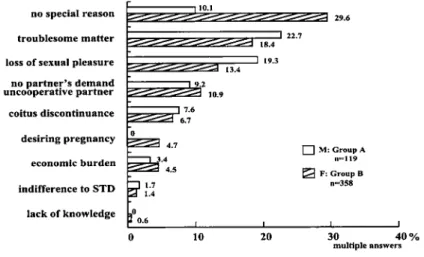
The reasons for avoiding contraception in men (Group A) were the troublesome (22.7%), the loss of sexual pleasure (19.3%), and so on (multiple answers, Fig 4). The reasons why women in Group A did not practice contraception were "no special rea son (29.6%)", "being troublesome (18.4%)"

and "uncooperative partner (10.9%)", and so on (multiple answers, Fig 4).

52.9

D always

□ not always

47.1

63.1

36.9

M: Group A n=119

F: Group B n=358

p<0.05 Fig. 3 Execution rate of contraception

(4) The attitude toward partner

About 90% of the male subjects, i.e., groups B and b, answered that they con sidered contraception positively, and 85%

answered that they accepted to female part ner's request of contraception.

In female subjects, not only Group B but also Group b was asked about the re sponses to uncooperative partner to contra ception. The results except for no-answers were as follows. The 31.6% of Group B and 66.4% of Group b answered that they re fused the coitus from the beginning. The subjects who discontinued the coitus were 29.3% and 22.8% of Groups B and b, re spectively. The 34.9% of Group B and 10.3% of Group b answered to commit the decision of the contraception to the male partners. The statistically significant dif ference existed between the results of groups B and b (p<0.01) (Fig 5).

Table 2 Information sources of the contraception

school education friends parents brothers/sisters television magazines others

Male n=150 62.0 62.0 5.3 2.7 37.3 56.7 9.3

Female n=730 73.6 38.9 5.2 2.9 27.1 40.0 2.5 multiple answers

(5) Information source about the contracep tion (multiple answers)

Information source about the contracep

tion of the entire male subjects were the

school education (62.0%), friends (62.0%),

magazine (56.7%), and so on (Table 2). In

formation source about the contraception

(6)

no special reason

troublesome matter loss of sexual pleasure no partner's demand uncooperative partner coitus discontinuance

desiring pregnancy

economic burden

indifference to STD

lack of knowledge

I I M: Group A n=119

[2 F: Group B

n=358

10 20 30 40%

multiple answers

Fig. 4 Reasons for avoiding contraception

% 70

50

30

10 0

r

- 31.6

66.4

• ' • '

m #

29.3 22.8

• ' • '

34.9

□ Group B

□ Group b

p < 0.01

10.3

——n 4.2

11=335 n=232

0.4 refuse

the coitus

discontinue the coitus

subject to partner

others

Fig. 5 The response to uncooperative male partner

of all the female subjects were the school education (73.6%), magazine (40.0%), friends

(38.9%), and so on (Table 2).

(6) Evaluation of the sexual education at school

Seventy-five point three percent of the male participants and 91.4% of the female ones answered that they learned the educa tion for human sexuality at school. In both men (Group A) and women (Group B) the most frequent answer on evaluation for the school education was that it was rather beneficial (44.0% and 58.2%, respec tively). Then the next answer was as

♦ « •

n 3.4

L_J7.6 10.3 U 15.8

/J17.3

12.9

|29.3 j

fjM:

44.0

"•'til 58-2

Group A n=116 Q] F: Group B

n=330

f f

greatly beneficial rather

beneficial

of little use

definitely useless unable to

evaluate

0 20 40 60 %

Fig. 6 Evaluation of the sexual education in school

follows, of little use (29.3% and 17.3%, re spectively), and greatly beneficial (10.3%

and 15.8%, respectively) (Fig 6).

Fifty-nine point three percent of the en-

(7)

desire

no desire

no preference

no answer

IS9.3

"J 3.3

^3 7.7

J 36

1 □ Male n=150

U \ . Q Female n=730

20 40 60 %

Fig. 7 Desire for the contraceptive education at school

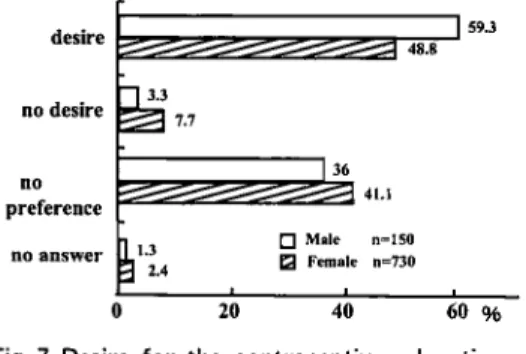
tire male subjects and 48.8% of the entire female ones answered that they wanted to have sexual education including contra ception at school (Fig 7). Many subjects in both men and women preferred the junior high school as the initiation time of the contraceptive education, by 55.7% and 60.9

%, respectively. The answers of men and women were followed by the elementary school (29.2% vs. 24.1%), and the senior high school (11.3% vs. 13.8%) (Table 3).

Table 3 Desire for the start of contraception education

college

senior high school junior high school elementary school

kindergarten

Male n=106

0.0 11.3 55.7 29.2 3.8

Female n=427 0.9 13.8 60.9 24.1 0.2

(7) Worries about the contraception (freely- described multiple answers)

Worries about contraception of subjects who have experience of sexual intercourse were as follows. Both men (Group A) and women (Group B) most worried about the effectiveness of the contraception (95.5%

and 63.7%, respectively). As for their

partner, women worried about the male partners'noncooperation (9.3%), and men worried about female partners' negativity on contraception (27.3%) (Table 4).

V. DISCUSSION

The actual condition of the young men and women on the contraception was disclosed from the findings of questionnaires, and was discussed by highlighting their reproductive health promotion.

The experience rates of the sexual inter course of the men and women were about 80% and 50%, respectively. Men's data of our study was higher than that (62.5%) re ported by The Japanese Association for Sex Education in 2001. Women's data of our study was very close to that (50.3%) re ported by the same association 4). However, our men' s and women' s data were much higher than those reported by Ochiai 5) in 1997 (51% for men and 39% for women).

These results suggest the current trend of lowering age of the first sexual experience.

Fifty-three percent of men and 37% of women answered that they always carried out the contraception. These execution rates were evidently lower than those reported by the Japanese Association for Sex Education in 20014) ; 66.0% in male students and 65.9%

in female students.

Both on men and women the condom was

used most, and the coitus interruptus fol

lowed. It was noteworthy that these top two

methods were male-dominated. As contrast

with these results, usage rates of the BBT,

the Ogino method, the pill, the female con

dom and the IUD, all which were dominated

(8)

Table 4 Worries about the contraception

effectiveness economic burden no suitable method poor knowledge partner's noncooperation difficult to use

no adviser side effects others

M: Group A n=44

95.5 38.6 6.8 15.9

27.3

9.1 9.1 13.6 20.5

F: Group B n=215

63.7 20.9 18.6 15.8 9.3

7.4 7.4 5.6 2.3

by females were extremely low. The execu tion rates of the each contraceptive method in this study were similar to those reported by the public opinion survey of Japan in 2000 3). In the other developed countries the pill is mainly used under the female leader ship 810). In Japan the contraception is male- dominated by using mainly the condom, and such condition is evidently different from that of developed countries where it is fe male-dominated by using the pills. Thus, our survey has reconfirmed the current status of the contraception of youth in Japan.

The selection criteria for the contraceptive methods in both men and women were mainly based on the technical easiness, con venience and affordable price, but not the ef fectiveness of contraception. These results were reflected in the other answers in which the condom and the coitus interruptus were listed at the top two among the contraceptive methods. The condom and the coitus inter ruptus, indeed, are technically easy to use, but it is well known that both result in fail ure of the contraception at a high possibility 611).

The ideal contraceptive method would be as

multiple answers v%)

follows; certainty of effectiveness, women's leadership, retaining sexual pleasure, minimal side effect, no adverse effect on the coming pregnancy and appropriate prices7). Thus, the results displayed the alarming situation in which the young men and women give pri ority of the selection of the contraceptive method to the technical easiness rather than the certainty of the effect.

As the reasons of avoiding contraception both men and women listed two answers at the top i.e. there was no special reason and they feel troublesome. These results seem to imply that they might not take the contra ception seriously. The human sexual inter course has, indeed, the significance of repro duction, but it also gives feeling of pleasure and promotes intimacy with the partner. As such, the answers that they do not prefer the loss of sexual pleasure and the interrup tion of coitus should not be neglected. It is, therefore, important that up- to-date educa tion of the contraception acceptable to ado lescents is necessary to avoid the unintended pregnancy 12).

The attitude to the contraception also ap-

(9)

peared on the relationship with their partner.

Most male subjects answered that they accept their female partner' s request about contraception. On the other hands, 10.9% of the women in Group B answered that they were unable to practice the contraception properly because of the uncooperative male partner. When the women with sexual expe riences could not obtain partner' s coopera tion, they tended to leave the contraception to partner' s feeling, accordingly the contra ception became uncertain. The execution rate of contraception was low in both men and women, and it was especially lower in women (53% vs 37%, p<0.01). These circumstances indicated the lack of subjective attitudes to ward the contraception of youth, and it was especially weak in women. Thus, it was sug gested that the weakness of the autonomy in the contraception of a woman lies behind the fact that a male plays a dominant role in the contraception in our country.

The main source of information about the contraception was the school education on both men and women (62.0% and 73.6%, re spectively). A 59.3% of all the male subjects and 48.8% of all the female ones desired the contraceptive education in school. Fifty-four percent of male Group A and 74% of female Group B answered that sexual education in school was useful. Ministry of Education, Culture, Sports, Science and Technology in troduced the sexual education into the formal subject of school since 1992 in Japan. It was suggested by the study that the sexual edu cation at school has contributed to improve the awareness and the behavior of the con traception of Japanese youth.

Nowadays the contraceptive education is

conducted at the senior high school, and many male and female in the study preferred to also have it in the junior high school (55.7% and 60.9%, respectively). From these findings it is suggested that the contracep tive education should be conducted at the lower grades of the school responding to the lowering of the age of the first sexual inter course. This consideration is consistent with WHO report in which the sexual education was most effective if it was given before ado lescents became sexually active13) and the education in schools has significantly im proved the levels of contraceptive use among teens 14). Use of contraception among adoles cents, particularly those unmarried, is sig nificantly different from that among older couples, and is specially influenced by educa tional factors 14). The correct knowledge and the detailed methods of the contraception should be given to them through education, which might help them establish their subjec tive attitude to the contraception 15).

The most worry about contraception was the assured effectiveness of the contraception in both male Group A and female Group B.

Surprisingly enough, this result was com pletely inconsistent with the other answers;

i.e. low executing rate of the contraception, facile selection of the method, ambiguous reasons for avoiding the contraception, and the most popular use of the condom which often results in failure of the contraception.

Other worries also described by them were

inadequate knowledge of how to get and use

the devices and inability to find the most

suitable methods to them. Furthermore, lack

of the cooperation from the partner and ab

sence of advisor about the contraception were

(10)

mentioned as their problems, too.

These results illustrated the following figures of the youth in Japan. Namely, even though they have less suitable method and less partner' s cooperation, they subject themselves into unprotected intercourse run ning the risk of unwanted pregnancy. These aspects indicated the weak awareness and un stable behavior of contraception of Japanese youth. Their subjective attitude to the con traception was less established and their awareness for the health was also insuffi cient.

However, these results, at the same time, would surely be interpreted as the reflection of the desire of the youth to improve the knowledge, behavior and the attitude to wards the contraception. The results sug gested the need of basic sexual education in cluding contraception, and the need of con sulting system which gives individually- targeted advice to youth.

Contraceptive education never promotes the sexual intercourse of unmarried young men and women. As for sexual behavior of ado lescents, it may be ideal advice to wait sex ual intercourse until marriage. Some re searcher reported that approximately 30 per cent of adolescents believed premarital sex was wrong16'. However, it was unraveled in the study that nearly half of female college students before marriage did experience the sexual intercourse. Therefore, the contracep tion education is surely needed for premari tal adolescents to avoid unintended pregnan cies. It is important that the education pro grams should be based on the concept of Re productive Health/Rights in which both sexes are esteemed by each other.

In the study a part of the awareness and the behavior on contraception of Japanese youth was elucidated even though the size of the subjects was relatively small. Further in crease in the number of subjects would raise the precision of the analysis.

ACKNOWLEDGEMENT

The authors sincerely appreciate the college students who answered the questionnaires in the study.

REFERENCES

1) Mothers'& Children's Health & Welfare Association. : Maternal and child health statistics of Japan. 86-87, Mothers' & Children' s Health Organization, Tokyo, 2004. in Japanese.

2 ) Ministry of Health, Labour and Welfare, Sentinel sur veillance group for Sexually Transmitted Diseases (Group leader ! Yoshiaki Kumamoto). ! A surveillance report on prevalence of Sexually Transmitted Diseases in Japan. Japanese Journal of Sexually Transmitted Diseases 2000. 1(1) : 72-103, 2000. in Japanese.

3 ) The Mainichi Newspapers. ! The 25th national survey of public opinion about family planning. 2000. in Japa

nese.

4 ) The Japanese Association for Sex Education. ! White report on the adolescent sexuality; The 5th national survey report on adolescent sexual behavior. 190, 2001. in Japa

nese.

5) Ochiai K. et al. ! A study on university students' rec ognition of the pill and the sexual behavior. Japanese Journal of Sexually Transmitted Diseases. 8(1) : 127-13 5, 1997. in Japanese.

6) Tanabe K. The current status of contraception in Ja pan. : Obstet.Gynecol.67 (Suppl) : 13-21, 2000. in Japa

nese.

7 ) Kitamura K. ! The choice of contraception. Obstet.

Gynecol. 52 (5) : 51-64, 2000. in Japanese.

8 ) Wagatsuma T. I Current state of contraception in abroad.

Obstet.Gynecol. Suppl : 29-42, 2000. in Japanese.

(11)

9) Mosher W D. et al. : Use of contraception and use of family planning services in the United States 1982-2002.

Adv Data 2004 (350) : 1-36, 2004.

10) Greydanus D E. et al. '. Contraception in the adolescent'.

an update. [Review] Pediatrics. 107(3) : 562-573, 2001.

11) Hofmann A D. : Contraception in adolescence : a re view. 2.

Biomedical aspects Bull World Health Organ. 62(2) : 331-344, 1984.

12) Kozinszky Z. et al. ! Contraceptive behaviourof teenagers requesting abortion. Eur J Obstet Gynecol Reprod Biol.

112(1) 180-83, 2004.

13) Department of Child and Adolescent Healthand Develop ment. Department of Reproductive Health and Research.

WHO DISCUSSION PAPERS ON ADOLESCENCE. Ge neva : World Health Organization, 2004.

http I //www.who.int/child-adolescent-health//New_

Publications/ADH/ISBN_92_4_159144J.pdf Accessed August 18, 2005.

14) Hofmann A D. '. Contraception in adolescence ! a re view. 1. Psychosocial aspects. Bull World Health Organ.

62(1) : 151-62, 1984.

15) Department of Reproductive Health and Research (RHR), World Health Organization. Sexual relations among young people in developing countries, Evidence from WHO case studies 2001.

ttp '. //www.who.int/reproductive-health/publications/

RHR_01_8/~Accessed August 18, 2005.

16) Zabin L S., et al. ! Adolescent sexual attitudes and

behavior: are they consistent? FAM PLANN. 16(4) :

181-5, 1984.

Fig. 2 Selection criteria of contraceptive method
Fig. 4 Reasons for avoiding contraception
Fig. 7 Desire for the contraceptive education at school
Table 4 Worries about the contraception effectiveness economic burden no suitable method poor knowledge partner's noncooperation difficult to use no adviser side effects others M: Group An=4495.538.66.815.927.39.19.113.620.5 F: Group Bn=21563.720.918.615.8

参照

関連したドキュメント

Proof of Theorem 2: The Push-and-Pull algorithm consists of the Initialization phase to generate an initial tableau that contains some basic variables, followed by the Push and

If condition (2) holds then no line intersects all the segments AB, BC, DE, EA (if such line exists then it also intersects the segment CD by condition (2) which is impossible due

Keywords: Convex order ; Fréchet distribution ; Median ; Mittag-Leffler distribution ; Mittag- Leffler function ; Stable distribution ; Stochastic order.. AMS MSC 2010: Primary 60E05

2 Combining the lemma 5.4 with the main theorem of [SW1], we immediately obtain the following corollary.. Corollary 5.5 Let l &gt; 3 be

Conley index, elliptic equation, critical point theory, fixed point index, superlinear problem.. Both authors are partially supportedby the Australian

The oscillations of the diffusion coefficient along the edges of a metric graph induce internal singularities in the global system which, together with the high complexity of

Inside this class, we identify a new subclass of Liouvillian integrable systems, under suitable conditions such Liouvillian integrable systems can have at most one limit cycle, and

The proof uses a set up of Seiberg Witten theory that replaces generic metrics by the construction of a localised Euler class of an infinite dimensional bundle with a Fredholm