Received October 16, 2014;accepted November 5, 2014 Reprint requests to:Hideyuki Satoh, M.D.
Department of Respiratory Medicine, Dokkyo Medical University Koshigaya Hospital, 2-1- 50 Minami-Koshigaya, Koshigaya, Saitama 343-8555, Japan
Analysis of the Characteristics of Patients Presenting with Exacerbation of Asthma to Emergency Care Units
Hideyuki Satoh M.D.
1, Kumiya Sugiyama M.D.
1,2, Ryosuke Souma M.D.
1, Shingo Tokita M.D.
1, Tomoshige Wakayama M.D.
1, Naruo Yoshida M.D.
1, Kentaro Nakano M.D.
1, Takeshi Fukuda M.D.
2, Yasutsugu Fukushima M.D.
1,21 Department of Respiratory Medicine, Dokkyo Medical University Koshigaya Hospital
2 Department of Pulmonary Medicine and Clinical Immunology Dokkyo Medical University
Conflict of interest:The authors have declared that they have no conflict of interest.
SUMMARY
Background:Fatal asthma remains a serious problem, and patient self-management of asthma is impor- tant to prevent exacerbation. To reduce the asthma mortality rate, we analyzed the characteristics of pa- tients who visited an emergency care unit with exacerbation of asthma.
Methods:Subjects were 317 patients(135 men, 182 women;mean age, 47.0 years)who visited the emergency room at Dokkyo Medical University Hospital or Dokkyo Medical University Koshigaya Hospital for exacerbation of asthma between April 2010 and March 2011. When categorized by severity, 41.3% of patients were step 1, 8.2% were step 2, 18.9% were step 3, 30.9% were step 4, and 0.6% were unknown.
When categorized by primary care physician, 60.3% of patients had a primary care physician at Dokkyo Medical University, 13.6% had one at another hospital, and 26.2% had no primary care physician. When cat- egorized by recovery from exacerbation, control was achieved within 1 day in 63.1% of cases, after more than 1 day in 30.6% of cases, and required admission in 6.3% of cases.
Results:The rate of admissions was highest for cases with step 1 severity(step 1, 55.0%;step 2, 20.0%;
step 3, 0.0%;and step 4, 25.0%). The rate of admissions did not differ significantly by age(age 15-39 years, 40.0%;40-65 years, 25.0%;>65 years, 35.0%). Initial value of oxyhemoglobin saturation(SpO2) measured by pulse oximetry was significantly lower in the admission group(SpO2 92.4%)than in the non- admission group(SpO2 95.2%, p<0.01).
Conclusion:Patients with step 1 severity who visit an emergency unit with exacerbation of asthma may need regular treatment for asthma. When initial SpO2 is less than 92%, we should consider hospitalization for treatment of asthma.
Key Words: asthma, emergency room, fatal asthma, pulse oximetry, exacerbation of asthma
Original
4, severe persistent10). This retrospective study con- formed to the guidelines of the Ethics Committee of Dokkyo Medical University.
Subjects
Study subjects were all patients who had presented with exacerbation of asthma at either of the Dokkyo Medical University(DMU)emergency care units be- tween April 2010 and March 2011. In total, 317 cases
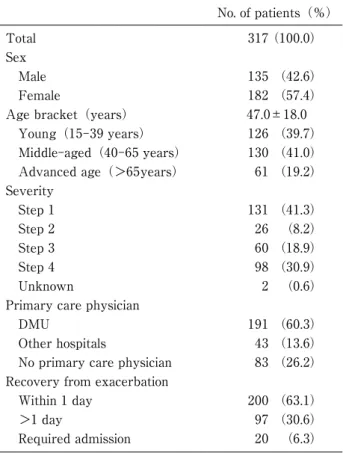
(135 men, 182 women;mean age, 47.0 years), who were excluded other lung disease such as COPD, were identified for analysis. The detailed characteristics of patients are shown in Table 1. When categorized by severity, 41.3% of patients were step 1, 8.2% were step 2, 18.9% were step 3, 30.9% were step 4, and 0.6
% were unknown. When categorized by primary care physician, 60.3% of patients had a primary care physi- cian at Dokkyo Medical University, 13.6% had one at another hospital, and 26.2% had no primary care phy- sician. When categorized by age, 39.7% of patients were 15-39 years old(young group), 41.0% were 40- 65 years old(middle-aged group), and 19.2% were>
65 years old(advanced aged group). Recovery from exacerbation of asthma was within 1 day in 63.1% of patients,>1 day in 30.6%, and required admission in 6.3%.
In regard to the treatment required for recovery from exacerbation of asthma, we divided patients into three groups according to corticosteroid dose:<60 mg of methylprednisolone( low-dose group), ≥6 0 to 125 mg of methylprednisolone(mid-dose group), and>
1 2 5 mg of methylprednisolone( high-dose group).
When patients took a corticosteroid other than methyl- prednisolone, we calculated the equivalent dose for methylprednisolone. Two cases in which corticosteroid dose is unknown are not shown as relative risk could not be calculated.
Statistical analysis
All statistical analysis was performed using Micro- soft Excel® and JMP® statistical software. Differences between two independent samples were examined by calculating relative risk along with the 95% confidence intervals by the chi-square test or Wilcoxon’s signed rank test. Differences at p<0.05 were considered sig- nificant.
INTRODUCTION
The asthma mortality rate is decreasing year on year in Japan. Around 6,000 patients died per year from asthma in the 1990’s in Japan, compared to 1,726 fatal cases recorded in 20131). This reduction in the number fatal asthma cases is thought to be due to im- provements in inhaled corticosteroids(ICSs)and leu- kotriene receptor antagonists(LTRAs)that are widely used to treat asthma2). However, although the asthma mortality rate is decreasing, severe exacerbation or poor management of asthma continues to reduce the quality of life(QOL)of some patients and is a known risk factor for death3〜5). In addition, exacerbation of asthma is associated with considerable healthcare costs and negatively effects on the quality of life of family members6,7). The prevalence of asthma has been re- ported to be 8.4% in Japan8,9)and exacerbation of asthma remains a serious problem.
To reduce mortality from asthma, it is very impor- tant to investigate the characteristics of patients who experience exacerbation of asthma. At the two univer- sity hospitals within Dokkyo Medical University(Dok- kyo Medical University Hospital and Dokkyo Medical University Koshigaya Hospital), we have emergency care units and provide 24-hour emergency care to all patients with exacerbation of asthma. In this study, we analyzed the demographic characteristics of patients who presented at our university hospitals with exacer- bation of asthma.
MATERIAL and METHODS
Study designIn a retrospective review of the medical records of patients who visited the emergency care unit of Dok- kyo Medical University Hospital or Dokkyo Medical University Koshigaya Hospital for exacerbation of asthma, we noted patient age, sex, initial value of oxy- hemoglobin saturation(SpO2)measured by pulse ox- imetry, medication for exacerbation of asthma, and their primary care physician. Physicians at our hospi- tals had recorded the severity of asthma based on treatment of asthma before exacerbation, according to the Asthma prevention and Management Guideline 2009, Japan(JGL2009):step 1, intermittent;step 2, mild persistent;step 3, moderate persistent;and step
3 in 17.6%, and step 4 in 6.4%), whereas the rate of step 4 patients was highest in the advanced aged group(23.0%, 8.2%, 16.4%, and 52.5%, respectively), followed closely by the middle-aged group(24.8%, 8.5
%, 21.7%, and 45.0%, respectively). Significant differ- ences were observed between the young age and the middle-aged groups, and between the young and ad- vanced age groups(p<0.001). A significant difference was observed within the three age groups(p<0.001).
In regard to the treatment required for recovery of the exacerbation of asthma, the rate of step 1 patients were highest in the ultrasonic nebulizer only group
(step 1 in 74.5% of patients, step 2 in 7.8%, step 3 in 3.9%, and step 4 in 13.7%), followed by mid-dose cor- ticosteroids group(56.0%, 9.0%, 22.0%, and 13.0%, respectively)and the low-dose corticosteroids group
(46.0%, 10.8%, 10.8%, and 32.4%, respectively). On the other hand, with the rate of step 4 patients being highest in the high-dose corticosteroids group(14.4%, 7.2%, 25.6%, and 52.8%, respectively). Significant dif- ferences were observed between the four treatment groups(p<0.05)as well as within them(<0.001). As for recovery from exacerbation of asthma, the rate of step 1 patients was highest in the required admission group(step 1 in 55.0% of patients, step 2 in 20.0%, step 3 in 0.0%, and step 4 in 25.0%, respectively), fol- lowed by the recovery within 1 day group(52.5%, 8.6
%, 18.2%, and 20.7%). In contrast, the rate of step 4 patients was highest in the recovery>1 day group
(16.5%, 5.2%, 24.7%, and 53.6%, respectively). Signifi- cant differences were observed between the within 1 day and>1 day groups and between the>1 day and required admission groups(p<0.001). Also, a signifi- cant difference was observed within the three recov- ery groups(p<0.001).
Analysis based on a primary care physician
In regard to patient age, the rate of patients who had no primary care physician was highest in the young age group(DMU in 38.9%, other hospital in 15.9%, no primary care physician in 45.2%), while the rate of pa- tients who had a primary care physician at DMU was highest in the advanced aged group(82.0%, 13.1%, 4.9
%, respectively), followed by the middle-aged group
(70.8%, 11.5%, 17.7%, respectively).
A significant difference was seen between the young
RESULTS
Analysis based on severity
Most patients with exacerbation of asthma who vis- ited the emergency care units had step 1 severity(Ta- ble 1). The results of analysis based on the severity of asthma are shown in Table 2. Two cases in which se- verity of asthma is unknown are not shown as relative risk could not be calculated. In regard to severity and the primary care physician, the rate of step 4 patients was highest for those with a primary care physician at DMU(step 1 in 15.7%, step 2 in 8.9%, step 3 in 27.2%, and step 4 in 48.2%), while the rate of step 1 patients was highest without a primary care physician(100.0
%, 0.0%, 0.0%, and 0.0%, respectively)and then at another hospital(43.9%, 22.0%, 19.5%, and 14.6%, re- spectively). Significant differences were observed be- tween the three groups(p<0.001)as well as within them(p<0.001).
Looking at severity with respect to patient age, the rate of step 1 patients was highest in the young age group(step 1 in 68.0% of patients, step 2 in 8.0%, step
Table 1 Background of patients
No. of patients(%)
Total 317(100.0)
Sex
Male 135 (42.6)
Female 182 (57.4)
Age bracket(years) 47.0±18.0
Young(15-39 years) 126 (39.7)
Middle-aged(40-65 years) 130 (41.0)
Advanced age(>65years) 61 (19.2)
Severity
Step 1 131 (41.3)
Step 2 26 (8.2)
Step 3 60 (18.9)
Step 4 98 (30.9)
Unknown 2 (0.6)
Primary care physician
DMU 191 (60.3)
Other hospitals 43 (13.6)
No primary care physician 83 (26.2)
Recovery from exacerbation
Within 1 day 200 (63.1)
>1 day 97 (30.6)
Required admission 20 (6.3)
DMU:Dokkyo Medical University
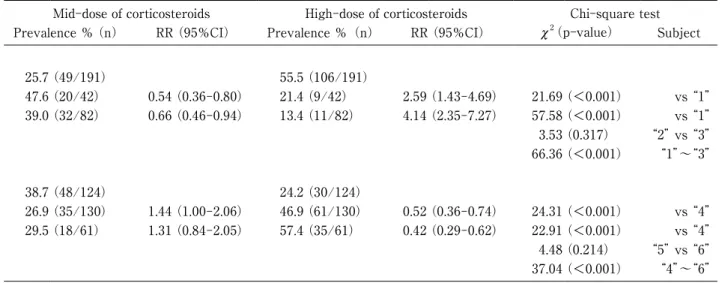
physician, most patients who were treated with high- dose corticosteroids had a primary care physician at DMU(ultrasonic nebulizer only in 6.8% of patients, low-dose corticosteroids in 12.0%, mid-dose corticoste- roids in 25.7%, and high-dose corticosteroid in 55.5%), while most patients treated with mid-dose corticoste- roids had a primary care physician at another hospital group(21.4%, 9.5%, 47.6%, and 21.4%, respectively), followed by those with no primary care physician(35.4
%, 12.2%, 39.0%, and 13.4%, respectively). Significant differences were observed between the DMU and oth- er hospital groups and between the DMU and no pri- mary care physician groups(p<0.001). A significant difference was also seen within these three groups(p and middle-aged groups and between the young and
advanced groups(p<0.001), A significant difference was also observed within the three age groups(p<
0.001). The table is not shown.
Analysis based on treatment for exacerbation of asthma As for the periods to visit the DMU emergency care unit from exacerbation of asthma,<24hr was 27.6%, 24hr-72hr was 38.7%, and>72hr was 33.7%. We di- vided the above three groups, because it is difficult for patients to know the correct onset of exacerbation as the time.
Table 3 shows the results of analysis according to treatment type. As for treatment and the primary care
Table 2 Analysis of patient characteristics according to severity of asthma
Step 1 Step 2 Step 3 Step 4 Chi-square test
Prevalence %(n) RR(95%CI) Prevalence % (n) RR (95%CI) Prevalence % (n) RR (95%CI) Prevalence % (n) RR (95%CI) c2 (p-value) Subject
Primary care physician
1. DMU 15.7(30/191) 8.9(17/191) 27.2(52/191) 48.2(92/191)
2. Other hospital 43.9(18/41) 0.36(0.22-0.58) 22.0(9/41) 0.41(0.19-0.84) 19.5(8/41) 1.40(0.72-2.71) 14.6(6/41) 3.29(1.55-6.99) 27.86(<0.001) vs “1”
3. No primary care physician 100.0(83/83) 0.16(0.11-0.22) 0.0(0/83) N/A 0.0(0/83) N/A 0.0(0/83) N/A 169.65(<0.001) vs “1”
57.16(<0.001) “2” vs “3” 184.96(<0.001) “1”〜“3” Age bracket(years)
4. Young(15-39) 68.0(85/125) 8.0(10/125) 17.6(22/125) 6.4(8/125)
5. Middle-aged(40-65) 24.8(32/129) 2.74(1.98-3.79) 8.5(11/129) 0.94(0.41-2.13) 21.7(28/129) 0.81(0.49-1.34) 45.0(58/129) 0.14(0.07-0.29) 62.61(<0.001) vs “4”
6. Advanced age(>65) 23.0(14/61) 2.96(1.84-4.77) 8.2(5/61) 0.98(0.35-2.73) 16.4(10/61) 1.07(0.54-2.12) 52.5(32/61) 0.12(0.06-0.25) 56.11(<0.001) vs “4”
1.14(0.767) “5” vs “6” 77.09(<0.001) “4”〜“6” Treatment for exacerbation
7. Ultrasonic nebulizer only 74.5(38/51) 7.8(4/51) 3.9(2/51) 13.7(7/51)
8. Low-dose of corticosteroids 46.0(17/37) 1.62(1.10-2.38) 10.8(4/37) 0.73(0.19-2.71) 10.8(4/37) 0.36(0.07-1.88) 32.4(12/37) 0.42(0.18-0.97) 7.98(0.047) vs “7”
9. Mid-dose of corticosteroids 56.0(56/100) 1.33(1.05-1.69) 9.0(9/100) 0.87(0.28-2.69) 22.0(22/100) 0.18(0.04-0.73) 13.0(13/100) 1.06(0.45-2.48) 8.87(0.031) vs “7”
10. High-dose of corticosteroids 14.4(18/125) 5.17(3.28-8.17) 7.2(9/125) 1.09(0.35-3.38) 25.6(32/125) 0.15(0.04-0.62) 52.8(66/125) 0.26(0.13-0.53) 63.30(<0.001) vs “7”
7.98(0.047) “8” vs “9” 18.88(<0.001) “8” vs “10” 54.82(<0.001) “9” vs “10” 86.41(<0.001) “7”〜“10” Recovery from exacerbation
11. Within 1 day 52.5(104/198) 8.6(17/198) 18.2(36/198) 20.7(41/198)
12. >1 day 16.5(16/97) 3.18(2.00-5.08) 5.2(5/97) 1.67(0.63-4.38) 24.7(24/97) 0.73(0.47-1.16) 53.6(52/97) 0.39(0.28-0.54) 45.54(<0.001) vs “11”
13. Required admission 55.0(11/20) 0.96(0.63-1.45) 20.0(4/20) 0.43(0.16-1.15) 0.0(0/20) N/A 25.0(5/20) 0.83(0.37-1.86) 6.27(0.099) vs “11”
23.14(<0.001) “12” vs “13” 54.19(<0.001) “11”〜“13” RR:relative risk, CI:confidence interval, DMU:Dokkyo Medical University
Two cases in which severity of asthma is unknown are not shown as RRs could not be calculated. Two cases in which corticosteroid dose is unknown are not shown as RRs could not be calculated.
ence was also observed within the three age groups(p
<0.001).
Analysis based on recovery from exacerbation of asthma Table 4 shows the results of the analysis based on recovery from exacerbation of asthma. Overall, 6.3% of patients who visited DMU emergency care unit re- quired admission(Table 1).
In regard to patient age, the risk of admission was higher in the advanced aged group(recovery within 1 day in 57.4% of patients, >1 day in 31.2%, and re- quired admission in 11.5%)than in the young age group(73.0%, 20.6%, and 6.4%, respectively)and the middle-aged group(56.2%, 40.0%, and 3.9%, respec-
<0.001).
As for treatment and patient age, the rate of patients treated with mid-dose corticosteroids was highest in the young age group(ultrasonic nebulizer only in 27.4
%, low-dose corticosteroids in 9.7%, mid-dose cortico- steroids in 38.7%, and high-dose corticosteroids in 24.2
%). On the other hand, the rate of patients treated with high-dose corticosteroids was highest in the ad- vanced aged group(6.6%, 6.6%, 29.5%, and 57.4%, respectively), followed by the middle-aged group(10.0
%, 16.2%, 26.9%, and 46.9%, respectively). Significant differences were observed between the young and middle-aged groups and between the young and ad- vanced aged groups(p<0.001). A significant differ- Table 2 Analysis of patient characteristics according to severity of asthma
Step 1 Step 2 Step 3 Step 4 Chi-square test
Prevalence %(n) RR(95%CI) Prevalence % (n) RR (95%CI) Prevalence % (n) RR (95%CI) Prevalence % (n) RR (95%CI) c2 (p-value) Subject
Primary care physician
1. DMU 15.7(30/191) 8.9(17/191) 27.2(52/191) 48.2(92/191)
2. Other hospital 43.9(18/41) 0.36(0.22-0.58) 22.0(9/41) 0.41(0.19-0.84) 19.5(8/41) 1.40(0.72-2.71) 14.6(6/41) 3.29(1.55-6.99) 27.86(<0.001) vs “1”
3. No primary care physician 100.0(83/83) 0.16(0.11-0.22) 0.0(0/83) N/A 0.0(0/83) N/A 0.0(0/83) N/A 169.65(<0.001) vs “1”
57.16(<0.001) “2” vs “3”
184.96(<0.001) “1”〜“3”
Age bracket(years)
4. Young(15-39) 68.0(85/125) 8.0(10/125) 17.6(22/125) 6.4(8/125)
5. Middle-aged(40-65) 24.8(32/129) 2.74(1.98-3.79) 8.5(11/129) 0.94(0.41-2.13) 21.7(28/129) 0.81(0.49-1.34) 45.0(58/129) 0.14(0.07-0.29) 62.61(<0.001) vs “4”
6. Advanced age(>65) 23.0(14/61) 2.96(1.84-4.77) 8.2(5/61) 0.98(0.35-2.73) 16.4(10/61) 1.07(0.54-2.12) 52.5(32/61) 0.12(0.06-0.25) 56.11(<0.001) vs “4”
1.14(0.767) “5” vs “6”
77.09(<0.001) “4”〜“6”
Treatment for exacerbation
7. Ultrasonic nebulizer only 74.5(38/51) 7.8(4/51) 3.9(2/51) 13.7(7/51)
8. Low-dose of corticosteroids 46.0(17/37) 1.62(1.10-2.38) 10.8(4/37) 0.73(0.19-2.71) 10.8(4/37) 0.36(0.07-1.88) 32.4(12/37) 0.42(0.18-0.97) 7.98(0.047) vs “7”
9. Mid-dose of corticosteroids 56.0(56/100) 1.33(1.05-1.69) 9.0(9/100) 0.87(0.28-2.69) 22.0(22/100) 0.18(0.04-0.73) 13.0(13/100) 1.06(0.45-2.48) 8.87(0.031) vs “7”
10. High-dose of corticosteroids 14.4(18/125) 5.17(3.28-8.17) 7.2(9/125) 1.09(0.35-3.38) 25.6(32/125) 0.15(0.04-0.62) 52.8(66/125) 0.26(0.13-0.53) 63.30(<0.001) vs “7”
7.98(0.047) “8” vs “9”
18.88(<0.001) “8” vs “10”
54.82(<0.001) “9” vs “10”
86.41(<0.001) “7”〜“10”
Recovery from exacerbation
11. Within 1 day 52.5(104/198) 8.6(17/198) 18.2(36/198) 20.7(41/198)
12. >1 day 16.5(16/97) 3.18(2.00-5.08) 5.2(5/97) 1.67(0.63-4.38) 24.7(24/97) 0.73(0.47-1.16) 53.6(52/97) 0.39(0.28-0.54) 45.54(<0.001) vs “11”
13. Required admission 55.0(11/20) 0.96(0.63-1.45) 20.0(4/20) 0.43(0.16-1.15) 0.0(0/20) N/A 25.0(5/20) 0.83(0.37-1.86) 6.27(0.099) vs “11”
23.14(<0.001) “12” vs “13”
54.19(<0.001) “11”〜“13”
RR:relative risk, CI:confidence interval, DMU:Dokkyo Medical University
Two cases in which severity of asthma is unknown are not shown as RRs could not be calculated. Two cases in which corticosteroid dose is unknown are not shown as RRs could not be calculated.
0.001), oral steroid(p<0.01), and short acting beta agonists(SABAs, p<0.001). The chi-square test anal- ysis results between two groups are shown in Fig. 1.
Figure 2 shows the results of the analysis of initial SpO2 values, using the Wilcoxon signed rank test. Ini- tial SpO2 values were significantly lower in patients who required admission(92.4±4.2%)than those with recovery from exacerbation within 1 day(95.1±2.6%, p<0.01)and those with recovery from exacerbation of
>1 day(95.4±3.0%, p<0.001). As another analysis, it is important to compare with usual SpO2 values with- tively). A significant difference was seen between the
young and middle-aged groups(p<0.01)but not be- tween the other pairs. A significant difference was ob- served within the three age groups(p<0.01).
Figure 1 shows the results according to treatment before exacerbation. Chi-square tests revealed that the number of patients differed significantly between three groups who used a combination of inhaled corticoste- roids and long acting beta agonists(ICSs/LABAs, p<
0.001), leukotriene receptor antagonists(LTRAs, p<
0.001), theophylline(p<0.01), anti-IgE antibody(p<
Table 3 Analysis of patient characteristics according to treatment for exacerbation of asthma
Ultrasonic nebulizer only Low-dose of corticosteroids Mid-dose of corticosteroids High-dose of corticosteroids Chi-square test
Prevalence % (n) RR (95%CI) Prevalence % (n) RR (95%CI) Prevalence % (n) RR (95%CI) Prevalence %(n) RR (95%CI) c2 (p-value) Subject
Primary care physician
1. DMU 6.8(13/191) 12.0(23/191) 25.7(49/191) 55.5(106/191)
2. Other hospital 21.4(9/42) 0.32(0.15-0.69) 9.5(4/42) 1.26(0.46-3.46) 47.6(20/42) 0.54(0.36-0.80) 21.4(9/42) 2.59(1.43-4.69) 21.69(<0.001) vs “1”
3. No primary care physician 35.4(29/82) 0.19(0.11-0.35) 12.2(10/82) 0.99(0.49-1.98) 39.0(32/82) 0.66(0.46-0.94) 13.4(11/82) 4.14(2.35-7.27) 57.58(<0.001) vs “1”
3.53(0.317) “2” vs “3” 66.36(<0.001) “1”〜“3” Age bracket(years)
4. Young(15-39) 27.4(34/124) 9.7(12/124) 38.7(48/124) 24.2(30/124)
5. Middle-aged(40-65) 10.0(13/130) 2.74(1.52-4.95) 16.2(21/130) 0.60(0.31-1.17) 26.9(35/130) 1.44(1.00-2.06) 46.9(61/130) 0.52(0.36-0.74) 24.31(<0.001) vs “4”
6. Advanced age(>65) 6.6(4/61) 4.18(1.55-11.2) 6.6(4/61) 1.48(0.50-4.39) 29.5(18/61) 1.31(0.84-2.05) 57.4(35/61) 0.42(0.29-0.62) 22.91(<0.001) vs “4”
4.48(0.214) “5” vs “6” 37.04(<0.001) “4”〜“6” RR:relative risk, CI:confidence interval, DMU:Dokkyo Medical University
Two cases in which corticosteroid dose is unknown are not shown as RRs could not be calculated.
Table 4 Analysis of patient characteristics according to recovery from exacerbation of asthma
Recovery within 1 day Recovery>1 day Required admission Chi-square test
Prevalence % RR(95%CI) Prevalence % RR(95%CI) Prevalence % RR(95%CI) c2 (p-value) Subject
Primary care physician
1. DMU 52.4(100/191) 45.0(86/191) 2.6(5/191)
2. Other hospital 74.4(32/43) 0.70(0.56-0.88) 4.7(2/43) 9.68(2.48-37.8) 20.9(9/43) 0.13(0.04-0.35) 37.92(<0.001) vs “1”
3. No primary care physician 81.9(68/83) 0.64(0.54-0.76) 10.8(9/83) 4.15(2.20-7.85) 7.2(6/83) 0.36(0.11-1.15) 30.82(<0.001) vs “1”
5.91(0.052) “2” vs “3” 60.88(<0.001) “1”〜“3” Age bracket(years)
4. Young(15-39) 73.0(92/126) 20.6(26/126) 6.4(8/126)
5. Middle-aged(40-65) 56.2(73/130) 1.30(1.08-1.57) 40.0(52/130) 0.52(0.35-0.77) 3.9(5/130) 1.65(0.55-4.91) 11.49(0.003) vs “4”
6. Advanced age(>65) 57.4(35/61) 1.27(1.00-1.62) 31.2(19/61) 0.66(0.40-1.10) 11.5(7/61) 0.55(0.21-1.46) 4.71(0.095) vs “4”
4.73(0.094) “5” vs “6” 14.95(0.005) “4”〜“6” RR:relative risk, CI:confidence interval, DMU:Dokkyo Medical University
Although patients who were older and had more se- vere asthma needed high-dose corticosteroids and took a longer time to recover from the exacerbation, their risk of admission was lower. The risk of admission was high for patients of advanced aged who were treated for step 1 asthma at another hospital. Moreover, the risk of admission was higher when the initial SpO2 val- ue was<92%. We suggest that when a patient shows
<92% initial SpO2 at presentation to the emergency care unit, admission for treatment of exacerbation of asthma is required.
out exacerbation of asthma. But, we could not analyze, because we could not know those in the other hospital group or the no primary care physician group.
DISCUSSION
The findings of this study suggest the following risk factors for visits to emergency care units with exacer- bation of asthma were being young with no primary care physician and being middle or advanced age and having more severe asthma although they were receiv- ing full treatment for their asthma at DMU hospital.
Table 3 Analysis of patient characteristics according to treatment for exacerbation of asthma
Ultrasonic nebulizer only Low-dose of corticosteroids Mid-dose of corticosteroids High-dose of corticosteroids Chi-square test
Prevalence % (n) RR (95%CI) Prevalence % (n) RR (95%CI) Prevalence % (n) RR (95%CI) Prevalence %(n) RR (95%CI) c2 (p-value) Subject
Primary care physician
1. DMU 6.8(13/191) 12.0(23/191) 25.7(49/191) 55.5(106/191)
2. Other hospital 21.4(9/42) 0.32(0.15-0.69) 9.5(4/42) 1.26(0.46-3.46) 47.6(20/42) 0.54(0.36-0.80) 21.4(9/42) 2.59(1.43-4.69) 21.69(<0.001) vs “1”
3. No primary care physician 35.4(29/82) 0.19(0.11-0.35) 12.2(10/82) 0.99(0.49-1.98) 39.0(32/82) 0.66(0.46-0.94) 13.4(11/82) 4.14(2.35-7.27) 57.58(<0.001) vs “1”
3.53(0.317) “2” vs “3”
66.36(<0.001) “1”〜“3”
Age bracket(years)
4. Young(15-39) 27.4(34/124) 9.7(12/124) 38.7(48/124) 24.2(30/124)
5. Middle-aged(40-65) 10.0(13/130) 2.74(1.52-4.95) 16.2(21/130) 0.60(0.31-1.17) 26.9(35/130) 1.44(1.00-2.06) 46.9(61/130) 0.52(0.36-0.74) 24.31(<0.001) vs “4”
6. Advanced age(>65) 6.6(4/61) 4.18(1.55-11.2) 6.6(4/61) 1.48(0.50-4.39) 29.5(18/61) 1.31(0.84-2.05) 57.4(35/61) 0.42(0.29-0.62) 22.91(<0.001) vs “4”
4.48(0.214) “5” vs “6”
37.04(<0.001) “4”〜“6”
RR:relative risk, CI:confidence interval, DMU:Dokkyo Medical University
Two cases in which corticosteroid dose is unknown are not shown as RRs could not be calculated.
Table 4 Analysis of patient characteristics according to recovery from exacerbation of asthma
Recovery within 1 day Recovery>1 day Required admission Chi-square test
Prevalence % RR(95%CI) Prevalence % RR(95%CI) Prevalence % RR(95%CI) c2 (p-value) Subject
Primary care physician
1. DMU 52.4(100/191) 45.0(86/191) 2.6(5/191)
2. Other hospital 74.4(32/43) 0.70(0.56-0.88) 4.7(2/43) 9.68(2.48-37.8) 20.9(9/43) 0.13(0.04-0.35) 37.92(<0.001) vs “1”
3. No primary care physician 81.9(68/83) 0.64(0.54-0.76) 10.8(9/83) 4.15(2.20-7.85) 7.2(6/83) 0.36(0.11-1.15) 30.82(<0.001) vs “1”
5.91(0.052) “2” vs “3”
60.88(<0.001) “1”〜“3”
Age bracket(years)
4. Young(15-39) 73.0(92/126) 20.6(26/126) 6.4(8/126)
5. Middle-aged(40-65) 56.2(73/130) 1.30(1.08-1.57) 40.0(52/130) 0.52(0.35-0.77) 3.9(5/130) 1.65(0.55-4.91) 11.49(0.003) vs “4”
6. Advanced age(>65) 57.4(35/61) 1.27(1.00-1.62) 31.2(19/61) 0.66(0.40-1.10) 11.5(7/61) 0.55(0.21-1.46) 4.71(0.095) vs “4”
4.73(0.094) “5” vs “6”
14.95(0.005) “4”〜“6”
RR:relative risk, CI:confidence interval, DMU:Dokkyo Medical University
The most important reason for the reduced mortality from asthma is the more widespread use of ICSs. Rates of ICSs prescription for asthmatic patients in Japan were 12% in 2000, 18% in 2005, and 34% in 201111〜13), indicating a negative correlation between asthma mor-
tality and prescribed ICSs. Although the rate of ICSs prescribed in Japan has increased, it is still lower than that in Western countries. 85.9% of patients treated at our DMU hospitals were prescribed ICSs, including ICSs/LABAs, a higher rate than the 12-34% reported by the Japanese studies being investigated in Ja- pan11〜13). Therefore, patients who receive full treat- ment at our DMU hospitals typically have well-con- trolled asthma, although some with severe asthma may not have full control over their condition. The patients we should focus on most to reduce mortality from asthma are those who do not have a primary care phy- sician and those who are not receiving full treatment by a non-specialist physicians. To narrow the focus, we tried to analyze treatment of asthma before exacerba- tion for the other hospital group and the no primary care physician group. But, we could not know the cor- rect kind or dose of asthmatic drugs for those patients.
Also, it was very difficult to analyze statistically, be- cause combinations of drugs were too many. In the present study, three patients required to inhale oxygen over 10 L/min at initial treatment. One of cases was a 40 year old woman who was aspirin induced asthma without regular use of ICS. The other cases were a 37 year old woman and a 65 year old man who used ICS regularly. Whether they received full treatment was Fig. 2 Initial SpO2 values on visiting the emergency care
unit according to recovery from exacerbation Significant differences were observed between the required admission and non-admission groups(p<0.01).
Data are expressed as means±SD.
Fig. 1 Treatment before exacerbation of asthma
Open bars denote patients with recovery of exacerbation within 1 day, gray bars denote patients with recovery of >1 day, and closed bars denote required admission. *p<0.05,
**p<0.001.
unknown because they have been treated at other hos- pitals. No cases of them required intubation and had asthma-related death.
In the present study, 41.3% of patients who visited our emergency care units with exacerbation of asthma were categorized with step 1 severity and 55.0% of the patients admitted by us were also categorized as step 1. Because we did not always know the severity of the asthma patient before the episode of exacerba- tion, we had to categorize the severity based on regu- lar treatment of asthma only in the present study10). However, step 1 may not denote mild asthma in all in- stances. Additional treatment might be needed for total control of asthma for those patients who are catego- rized as step 1 but subsequently require admission to a hospital with exacerbation of asthma. Most of our pa- tients who were categorized as step 1 were young and could not visit the hospital regularly due to daily life commitments. Therefore, they did not have a primary care physician assigned to them. However, because they do not actually have mild asthma, they sometimes experience exacerbation of asthma. Despite the impor- tance of total control of their asthma, it is very difficult for these patients to receive the full treatment for their asthma—a problem we pointed out in our previous study14).
Many asthma-related deaths have been reported in young people who were frequently using only SABAs, without regular anti-inflammatory treatment15,16). Be- cause mild exacerbation can be controlled by SABAs, patients do not think it is necessary to consult their physicians regularly. Patients are also unaware of the risk of asthma-related death because they lack suffi- cient information about asthma. Consequently, it is very important for patients without primary care phy- sicians to receive advice from the emergency physi- cian, because most do not have the opportunity to con- sult an allergist or pulmonologist. The educational interventions undertaken in emergency departments reduce subsequent asthma-related admissions to hospi- tal17). Thus, to reduce asthma mortality further, ideally emergency physicians should evaluate the need for regular treatment and advise patients of their need ac- cordingly. To facilitate proper care, we intend to estab- lish guidelines for the diagnosis and treatment of asth- ma by emergency physicians.
Another of our findings was that patients who were older and had more severe asthma were categorized as step 4 visited our emergency care units frequently, de- spite having well-designed treatment, which included ICSs. Persistence of severe asthma and the poor re- sponse to treatment in this group of patients may be because airway remodeling occurred before the use of ICSs became widespread. Older patients who die from asthma are included in this group. Airway remodeling is a risk factor for fatal asthma, and prevention of asth- ma-related deaths is extremely difficult in older pa- tients with airway remodeling18). The risk for multiple exacerbations and fatal asthma in such patients was noted in another Japanese study19). Although such pa- tients in the present study needed high-dose cortico- steroids and took a long time to recover from exacer- bation of asthma, their risk of admission was lower.
This could be because they have experienced exacer- bations many times and so visit the emergency care unit in the early stage of exacerbation. It has been re- ported, however, that patients with a history of near- fatal asthma show reduced sensitivity to dyspnea20〜26). In other words, these patients incorrectly perceive their symptoms to be mild rather than to be a more serious case of airway obstruction, and so can experi- ence a severe attack without premonitory symptoms.
It is important, therefore, to determine which patients are at risk before they experience a severe attack.
The present study highlighted a number of issues in the treatment of asthma. The most serious problem we should address concerns young patients without a pri- mary care physician. In addition, some patients with mild(step 1)asthma needed to visit our emergency care unit with exacerbation and they may be needed regular treatment for asthma. When initial SpO2 is less than 92%, we should consider hospitalization for treat- ment of asthma.
Acknowledgments We thank Ms. Seiko Sekiguchi, Ms.
Kuniko Okuyama, Ms. Mayumi Ito, and Ms. Natsumi Suzuki at Dokkyo Medical University Koshigaya Hospi- tal and Ms. Ayano Takeda at Dokkyo Medical Univer- sity Hospital for technical assistance.
REFERENCES
1) Ministry of Health, Labour and Welfare:Vital statis-
tics in JAPAN ─ the latest trends ─ . Tokyo, 2013.
2) Suissa S, Ernst P:Use of anti-inflammatory therapy and asthma mortality in Japan. Eur Respir J 21:101- 104, 2003.
3) Alvarez GG, Schulzer M, Jung D, et al:A systematic review of risk factors associated with near-fatal and fatal asthma. Can Respir J 12:265-270, 2005.
4) Hessel PA, Mitchell I, Tough S, et al:Risk factors for death from asthma. Prairie Provinces Asthma Study Group. Ann Allergy Asthma Immunol 83:362-368, 1999.
5) Andersson F, Borg S, Ståhl E:The impact of exacer- bations on the asthmatic patient’s preference scores. J Asthma 40:615-623, 2003.
6) Lane S, Molina J, Plusa T:An international observa- tional prospective study to determine the cost of asth- ma exacerbations (COAX). Respir Med 100:434- 450, 2006.
7) Skrepnek GH, Skrepnek SV:Epidemiology, Clinical and Economic Burden, and Natural History of Chronic Obstructive Pulmonary Disease and Asthma. Am J Manag Caew 10:S129-138, 2004.
8) Sugiyama K, Sugiyama T, Toda M, et al:Prevalence of asthma, rhinitis and eczema among 13-14-year-old schoolchildren in Tochigi, Japan. Allergol Int 49:205- 211, 2000.
9) Sugiyama T, Sugiyama K, Toda M, et al:Risk factors for asthma and allergic diseases among 13-14-year- old schoolchildren in Japan. Allergol Int 51:139-150, 2002.
10) Japanese Society of Allergology:Asthma Prevention and Management Guideline 2009, Japan. Tokyo:Kyo- wa Kikaku, 2009 (in Japanese).
11) Adachi M, Morikawa A, Ishihara K:Asthma insights
& reality in Japan (AIRJ) Arerugi 51:411-420, 2002
(in Japanese, Abstract in English).
12) Adachi M, Ohta K, Morikawa A, et al:Asthma In- sights & Reality in Japan 2005. Arerugi 55:1340- 1343, 2006 (in Japanese, Abstract in English).
13) Adachi M, Ohta K, Tohda Y, et al:Asthma Insights
& Reality in Japan:AIRJ 2011. Allergol Immunol 19:1562-1570, 2012 (in Japanese).
14) Sugiyama K, Yamada I, Ohara T, et al:An analysis of characteristics of patients with exacerbation of
asthma in a large university hospital in Japan. Asian Pac J Allergy Immunol 28:242-249, 2010.
15) Tanihara S, Nakamura Y, Matsui T, et al:A case- control study of asthma death and life-threatening at- tack:their possible relationship with prescribed drug therapy in Japan. J Epidemiol 12:223-228, 2002.
16) Sears MR, Taylor DR, Print CG, et al:Regular in- haled beta-agonist treatment in bronchial asthma.
Lancet 336:1391-1396, 1990.
17) Tapp S, Lasserson TJ, Rowe BH:Education interven- tions for adults who attend the emergency room for acute asthma. Cochrane Database Syst Rev 1 8:
CD003000, 2007.
18) James AL, Elliot JG, Abramson MJ, et al:Time to death, airway wall inflammation and remodelling in fatal asthma. Eur Respir J 26:429-434, 2005.
19) Koga T, Oshita Y, Kamimura T, et al:Characterisa- tion of patients with frequent exacerbation of asthma.
Respir Med 100:273-278, 2006.
20) Rubinfeld AR, Pain MC:Perception of asthma. Lan- cet 1:882-884, 1976.
21) McFadden ER Jr:Fatal and near-fatal asthma. N Engl J Med 324:409-411, 1991.
22) Molfino NA, Nannini LJ, Martelli AN et al:Respirato- ry arrest in near-fatal asthma. N Engl J Med 324:
285-288, 1991.
23) Barnes PJ:Poorly perceived asthma. Thorax 47:
408-409, 1992.
24) Kikuchi Y, Okabe S, Tamura G, et al:Chemosensitiv- ity and perception of dyspnea in patients with a histo- ry of near-fatal asthma. N Eng J Med 330:1329- 1334, 1994.
25) Magadle R, Berar-Yanay N, Weiner P:The risk of hospitalization and near-fatal and fatal asthma in rela- tion to the perception of dyspnea. Chest 121:329- 333, 2002.
26) Kamiya K, Sugiyama K, Toda M, et al:Relationship between sensitivity to dyspnea and fluctuating peak expiratory flow rate in the absence of asthma symp- toms. Asia Pac Allergy 2:49-58, 2012.