正六角形グリッドから得られるケルト結び目模様
Yukari Funakoshi (Nara Women’s University)∗1 Megumi Hashizume (Nara University of Education)∗2
1. Introduction
Celtic knots are traditional geometric symbol of the Celtic peoples of ancients Britain, Scotland and Ireland. They are stylized, interlaced patterns, representing ropes or threads tied in a knot. They also appear in the art ([2]). For example, a bible manuscript called by The Book of Kells is decorated by many Celtic knots. Fisher- Mellor [1] defined knotwork design as a kind of alternating link diagrams related to Celtic knot. In Definition 2.2, we define Celtic knot design as a generalized knotwork design. Let G be a closed subset of the plane arranged by p×q regular hexagons
“vertically and horizontally” without any space (see Definition 2.4). In this paper, we focus on Celtic knot design induced from G. Furthermore, let D be a link diagram representing a Celtic knot design induced from G. Let K be the set of the knot di- agrams corresponding to the components of D, where each element of K is arranged so as to superimpose D on G. We say that an element of K is Spur if the element passes through the regular hexagon at upper-left corner ofG (see Definition 2.5). The set excepted for Spur from K is called Track (see Definition 2.6). In Theorem 3.1, we give the number of components of a link obtained from D. In Theorem 3.3, we give that Spur passes through the regular hexagon at the lower-right corner of G. In Theorem 3.4, we give that any element of Track is uniquely determined up to ambient isotopy.
2. Preliminaries
Definition 2.1 (grid). Suppose that the plane (in general surfaces) is divided into polygons. A closed subset of this plane whose boundary consisting of some edges of the polygons is called agrid.
Fact 2.1. One type of regular polygon tiling the plane is a regular triangle, a square, or a regular hexagon.
Definition 2.2 (Celtic knot projection, Celtic knot design). For any grid, fix a mid- point of each edge of every regular polygon forming the grid, draw a new regular polygon inscribed at these points. The union of these new polygons can be regarded as a projection of a link. The projection is called Celtic knot projection(CKP). A link diagram obtained from the projection by adding alternating upper/lower information for each double point is called Celtic knot design (CKD).
Remark 2.1. For any grid G, there exist two types of CKD,Dand D∗, induced from G. For a CKDD, D∗ is the mirror image of D as in Figure 2.1 and Figure 2.2.
In this paper, we use the type of CKD as in Figure 2.1.
2000 Mathematics Subject Classification: 57R42, 05C12, 57M99.
Keywords: Celtic knot design, Celtic knot, alternating knot, plane graph, diagram, knotwork design.
∗1e-mail:[email protected]
∗2e-mail:[email protected]
Figure 2.1: Celtic knot designs.
Figure 2.2: Mirror images of Celtic knot designs as in Figure 2.1.
Definition 2.3 (regular triangle grid, square grid, honeycomb grid). We say that a grid is a regular triangle grid(asquare grid, ahoneycomb gridresp.) if the grid is tiled by a regular triangle (a square, a regular hexagon resp.)
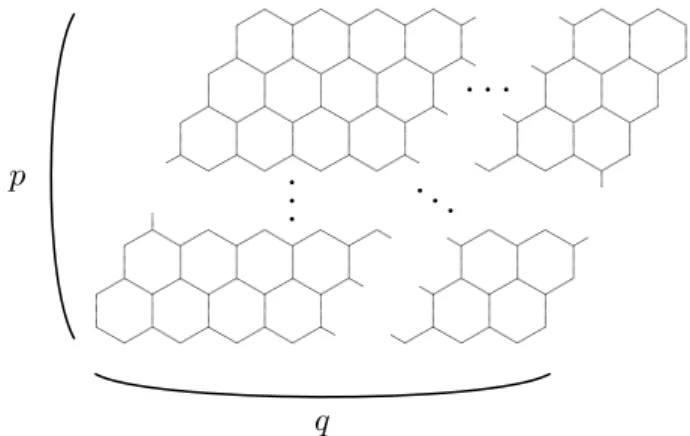
Definition 2.4 (p×q honeycomb grid). We consider an oblique coordinate with an angle of π3 degrees on the plane. For any element of{(x, y)|1≤y ≤p,1≤x≤q, x, y∈ N}, draw a regular hexagon whose length of one side is √13, centered at point (x, y) as in Figure 2.3. The regular hexagons are regarded as a honeycomb grid. Then, the honeycomb grid is called p×q honeycomb grid.
Figure 2.3: p×q honeycomb grid.
Let Gbe a p×q honeycomb grid and D a Celtic knot design induced fromG.
Notation 2.1. Any regular hexagon of Gwith center coordinates (i, j) is denoted by (i, j) simply. For example, the regular hexagon at the upper-left corner ofGis denoted by (1, p), and the regular hexagon at the lower-right corner ofG is denoted by (q,1).
LetKbe the set of the knot diagrams corresponding to the components ofD, where each element ofK is arranged so as to superimpose D onG.
Definition 2.5 (Spur). We say that an element of K is Spur if the element passes through (1, p) as in Figure 2.4.
Definition 2.6 (Track). The set excepted for the Spur fromK is called Track.
Each element of K passes through at least one regular hexagon on right side of G.
Let (q, j) be each hexagon on the right side of Gwhich the Spur passes through. Then r denotes the maximum number of {j} as in Figure 2.4.
Figure 2.4: The red line represents the Spur on p×q honeycomb grid.
3. Main results
LetG be a p×q honeycomb grid and Da Celtic knot design induced from G.
Theorem 3.1. The number of components of a link obtained from D is r.
Proposition 3.2. Suppose that q =m(p+ 1)−1 (m= 1,2,3, . . .). Then the number of components of links obtained from D is p and each component is a trivial knot.
Theorem 3.3. The Spur on G passes through the regular hexagon (q,1) at the lower- right corner as in Figure 3.5.
Figure 3.5: Red lines represent the Spur.
Theorem 3.4. Any element of the Track on G is uniquely determined up to ambient isotopy.
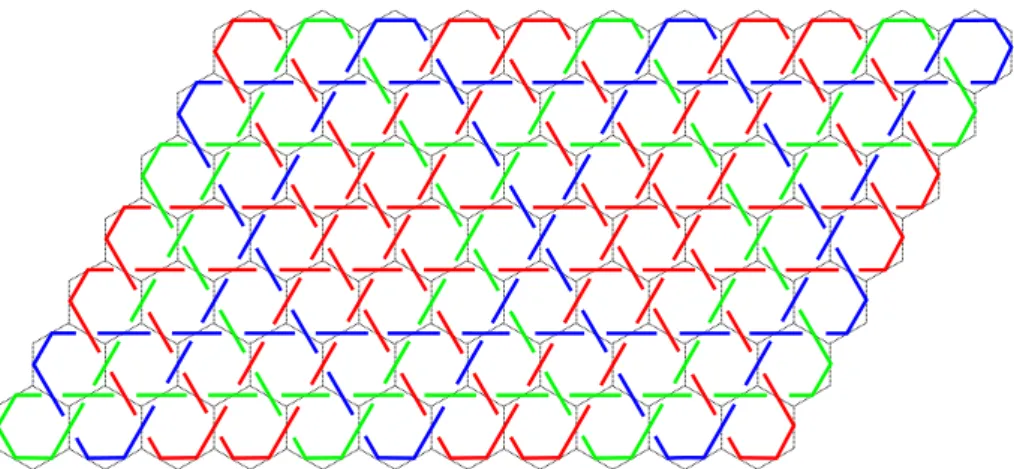
For example, we consider a CKD induced from 7×11 honeycomb grid as in Fig- ure 3.6. The Spur passes through the regular hexagon (11,1) at the lower-right corner as in Figure 3.7. On the other hand, the elements of the Track are unique up to ambient isotopy as in Figure 3.8.
Figure 3.6: A CKD induced from 7×11 honeycomb grid.
Figure 3.7: The Spur on 7×11 honeycomb grid.
Figure 3.8: The elements of the Track on 7×11 honeycomb grid.
References
[1] Gwen Fisher and Blake Mellor,On the Topology of Celtic Knot Designs, Bridges Math- ematical Connections in Art, Music, and Sicence, (2004), pp37–44.
[2] Aidan Meehan,Celtic Design, Knotwork, The Secret Method of the Scribes, Thames and Hudson, (1991).