Preparation and Application of Fluoroalkyl End-Capped Vinyltrimethoxysilane Oligomeric Composites - Encapsulated
a Variety of Polymetric Compounds Possessing a Superoleophilic/superhydrophobic Characteristic
Doctoral Course
Graduate School of Science and Technology Hirosaki University
Doctoral Thesis
March 2019
Jun-ichi Suzuki
Contents
General Introduction 1
1. Fluorinated polysoap 1
2. Application to Surface Modification of Two Fluoroalkyl End-Capped Vinyltrimethoxysilane Oligomer
7
3. Application to Separation of Mixture of Oil and Water by Using Two Fluoroalkyl End-Capped Vinyltrimethoxysilane Oligomer
9
4. Thesis outline 14
Chapter 1. Preparation of Fluoroalkyl End-Capped Vinyltrimethoxy- silane Oligomeric Silica/ Poly(tetrafluoroethylene) Nanocomposites Possessing a Superoleophilic/
Superhydrophobic Characteristic: Application to the Separation of Oil and Water
19
1.1. Introduction 20
1.2. Experimental 23
1.2.1. Measurements 23
1.2.2. Materials 23
1.2.3. Preparation of fluoroalkyl end-capped vinyltrimethoxysilane oligomeric silica/PTFE nanocomposites [RF-(VM-SiO2)n-RF/ PTFE]
24
1.2.4. Preparation of the modified glass treated with the RF-(VM-SiO2)n-RF/PTFE nanocomposites by dipping method
25
1.3. Results and discussion 27
1.3.1. Preparation and thermal stability of the RF-(VM-SiO2)n-RF/PTFE nanocomposites
27
1.3.2. Surface modification of glass, PTFE sheet and filter paper by the use of the RF-(VM-SiO2)n-RF/PTFE nanocomposites
31
1.3.3. Separation of oil and water by the use of the RF-(VM-SiO2)n-RF/PTFE nanocomposites
38
1.4. Conclusion 46
Chapter 2. Preparation of Fluoroalkyl End-Capped Vinyltrimethoxy- silane Oligomeric Silica/Alkyl-Modified Cellulose Nanocomposites, and Use Thereof for the Modification of Glass and Filter Paper Surfaces: Creation of a Glass Thermoresponsive Switching Behavior and an Efficient Separation Paper Membrane
52
2.1. Introduction 53
2.2. Experimental 56
2.2.1. Measurements 56
2.2.2. Materials 56
2.2.3. Preparation of fluoroalkylated vinyltrimethoxysilane oligomeric 57
silica/AM-Cellu nanocomposites [RF-(VM-SiO2)n-RF/AM-Cellu]
2.2.4. Surface modification of glass treated with the RF-(VM-SiO2)n-RF/AM-Cellu nanocomposites
58
2.2.5. Preparation of the surfactant-stabilized water in oil (1,2-dichloroethane) emulsion
59
2.3. Results and discussion 60
2.3.1 Preparation of the RF-(VM-SiO2)n-RF/AM-Cellu Nanocomposites 60 2.3.2 Surface Modification of Glass by Using the
RF-(VM-SiO2)n-RF/AM-Cellu Nanocomposites
61
2.3.3 Surface Modification of Filter Paper by Using the RF-(VM-SiO2)n-RF/AM-Cellu Nanocomposites
71
2.3.4 Separation of W/O Emulsion by Using the Modified Filter Paper Treated with the RF-(VM-SiO2)n-RF/AM-Cellu Nanocomposites as the Separation Membrane
77
2.4. Conclusion 80
Chapter 3. Preparation of Fluoroalkyl End-capped Oligomer/Cyclodextrin Polymer Composites: Development of Fluorinated Composite Material Having a Higher Adsorption Ability toward Organic Molecules
84
3.1. Introduction 85
3.2. Experimental 88
3.2.1. Measurements 88
3.2.2. Materials 89
3.2.3. Preparation of fluoroalkyl end-capped vinyltrimethoxysilane oligomeric silica/-CDP composites [RF-(VM-SiO2)n-RF/-CDP]
89
3.2.4. Surface modification of glass treated with the RF-(VM-SiO2)n-RF/-CDP composites
90
3.2.5. Preparation of the surfactant-stabilized water in oil (toluene) emulsion
91
3.2.6. Adsorption of bisphenol A in the aqueous solution by using the RF-(CH2CHSiO2)n-RF/-CDPs composites
91
3.2.7. Adsorption of volatile organic compounds (VOCs) in the aqueous solutions by using the RF-(CH2CHSiO2)n-RF/CDPs composites
92
3.3. Results and discussion 94
3.3.1. Preparation of RF-(VM-SiO2)n-RF/-CDPs composites 94 3.3.2. Surface property of RF-(VM-SiO2)n-RF/CDPs composites 103 3.3.3. Application of RF-(VM-SiO2)n-RF/CDPs composites to the
separation of the mixture of oil and water
107
3.3.4. Adsorption of organic molecules by using the RF-(CH2CHSiO2)n-RF/CDPs composites
110
3.4. Conclusion 119
Conclusions 126
Publications 130
Acknowledgements 132
General Introduction 1. Fluorinated polysoap
It is in general well-known that perfluoropolymers such as poly(tetrafluoroethylene)
[-(CF2-CF2)n-] can exhibit a wide variety of unique properties such as excellent thermal
stability, low surface energy, and low refractive index that set them apart from the
corresponding non-fluorinated polymers.1~3) However, these fluorinated polymers give an
extremely poor solubility toward organic solvents.1~3) Therefore, it is deeply desirable to
develop new fluorinated polymers possessing a good solubility toward a variety of solvents.
From this point of view, cyclic fluoropolymers such as CYTOPTR (see Chart 1) 4) and
TeflonTR AF5) (see Chart 2) have been already developed as the fluorinated polymers
possessing the solubility in the selected fluorinated solvents.
In addition, partially protonated ring-containing fluoropolymer (see Chart 3) can
exhibit a higher solubility toward polar organic solvents such as acetone, acetonitrile and
N, N-dimethylformamide, although these fluorinated polymers have no solubility toward
benzene, chloroform and methanol. 6)
On the other hand, partially perfluoroalkylated (meth)acrylated polymers, of whose
perfluoroalkyl groups are randomly introduced into polymer main chain through the ester
bond, provide interesting characteristics imparted by longer perfluoroalkyl groups that set
them apart from the corresponding non-fluorinated ones (see Chart 4). 7) Randomly
perfluoroalkylated polymers can exhibit a similar solubility to that of the partially
protonated ring-containing fluoropolymer.8) However, these perfluoroalkylated polymers
have a poor surface active property, compared to the usual low-molecular weight fluorinated
surfactants.8) In fact, Laschewsky et al. reported on the surfactant property of the fluorinated
polysoaps: that is, randomly perfluorohexylated methacrylate copolymers possessing the
hydrophilic comonomer unit such as 2-[(methacryloyloxy)ethyl]- trimethylammonium
bromide, of whose perfluorohexyl units are introduced into polymeric side chain through
the ester bonding (Chart 5 ).9)
These randomly fluoroalkylated polysoaps have a poor surfactant property, compared to that
of the usual low-molecular weight fluorinated surfactants, due to the entanglement of the
polymer main chain in the aqueous solutions.9, 10) Therefore, it is of considerable interest
to develop the partially perfluoroalkylated polymers, leading to not only the relatively good
solubility toward non-polar organic solvents including water but also the surface active
characteristic, similar to that of the traditional low-molecular weight fluorinated surfactants.
From this point of view, a variety of block-type perfluoroalkylated copolymers (see Chart 6)
have been hitherto synthesized through RAFT (Reversible-Addition-Fragmentation-
Transfer)11) and ATRP (Atom Transfer Radical Polymerization) techniques12, 13), and the use
of polymeric peroxide as a radical initiator (see Scheme 1)14).
Scheme 1 Synthesis of perfluoroalkylated methacrylated block copolymer by using a polymeric peroxide (ATPPO) as a radical initiator
These block-type perfluoroalkylated copolymers (block-type fluorinated polysoaps) can
exhibit relatively higher surface active characteristic and the self-assembled polymeric
aggregates resembling micelle in aqueous and organic media, which cannot be achieved in
the corresponding randomly fluoroalkylated polysoaps.15)
However, in these perfluoroalkylated polysoaps, perfluoroalkyl groups are in general
introduced into polymeric main chain through the ester groups owing to the synthetic
difficulty of the direct perfluoroalkylation with the carbon-carbon bond formation into
polymeric main chain.15, 16) Such ester groups are likely to suffer the hydrolysis to produce
the corresponding fluorinated alcohol as shown in Scheme 2.16) Therefore, we have some
difficulty to keep the good surface active characteristic related to the perfluoroalkyl groups
on their aqueous surface for a long time.
It is deeply desirable to develop new fluoroalkylated block-type polysoaps, of whose
fluoroalkyl groups are directly introduced into polymeric main chain through the
carbon-carbon bond formation from the developmental view point of new fluoroalkylated
block-type polysoaps which can exhibit the surface active characteristic imparted by
fluoroalkyl groups for a long time, quite similar to that of the low-molecular weight
fluorinated surfactants. In fact, two fluoroalkyl end-capped oligomers, of whose two
fluoroalkyl groups are directly introduced into both end-sites of the oligomeric main chain,
have been developed by using fluoroalkanoyl peroxide [RF-C(=O)OO(O=)C-RF] as a key
intermediate.17) These two fluoroalkyl end-capped oligomers [RF-(M)n-RF; RF =
fluoroalkyl groups, M = radical polymerizable monomers] can be synthesized by the
oligomerization of radical polymerizable monomer with fluoroalkanoyl peroxide.17)
For example, acrylic acid monomer can react with fluoroalkanoyl peroxides to produce two
fluoroalkyl end-capped acrylic acid oligomers as shown in Scheme 3.18, 19)
These fluoroalkyl end-capped acrylic acid oligomers can be classified according to their
structure into new ABA triblock-type fluorinated polysoap, of whose fluoroalkyl groups are
directly introduced into oligomeric end-sites through the carbon-carbon bond formation. 18)
Especially, this fluorinated oligomer can also form the nanometer size-controlled
self-assembled molecular aggregates through the aggregation of the end-capped fluoroalkyl
groups in aqueous and organic media (see Scheme 4). 20 ~ 24)
Scheme 4 Schematic illustration for the formation of self-assembled molecular aggregates with the aggregation of terminal fluoroalkyl groups in two fluoroalkyl end-capped oligomers in aqueous and organic media
2. Application to Surface Modification of Two Fluoroalkyl End-Capped Vinyltrimethoxysilane Oligomer
In a variety of two fluoroalkyl end-capped oligomers, especially, two fluoroalkyl
end-capped vinyltrimethoxysiane oligomers [RF-(CH2CHSi(OMe)3)n-RF; n = 2, 3; RF =
fluoroalkyl groups: RF-(VM)n-RF] are of particular interest due to exhibiting the higher
surface active characteristic and the stronger adhesion ability toward numerous substrates
than those of the traditional monomeric fluoroalkyl end-capped silane coupling agents
[RF-CH2CH2-Si(OMe)3; RF = fluoroalkyl group].25, 26) These fluoroalkyl end-capped
oligomeric silane coupling agents can undergo the sol-gel reactions under alkaline
conditions to produce the fluoroalkyl end-capped oligomeric silica nanoparticles
[RF-(VM-SiO2)n-RF] as shown in Scheme 5. 26)
Scheme 5 Preparation of fluoroalkyl end-capped vinyltrimethoxysilane oligomeric nanoparticles
The RF-(VM-SiO2)n-RF oligomeric nanoparticles have been already applied to the
surface modification of glass to supply not only a good oleophobicity but also a completely
RF-(CH2-CH)n-RF
[RF-(VM)n-RF]
+
RF-(VM-SiO2)n-RF Nanoparticles Si(OCH3)3
RF = CF(CF3)OC3F7
aq. NH3
MeOH
superhydrophobic characteristic (a water contact angle values; 180 degrees) with a
non-wetting property against water droplets. 27)
In addition, a variety of organic guest molecules such as biphenylene units can be
easily encapsulated into the RF-(VM-SiO2)n-RF oligomeric nanoparticle cores to afford the
corresponding fluoroalkyl end-capped oligomeric silica/biphenylene units nanocomposites,
leading to the superamphiphobic characteristic on the modified glass surface (see Scheme
6). 28)
Scheme 6 Preparation of fluoroalkyl end-capped vinyltrimethoxysilane oligomeric silica/biphenylene nanocomposites
Not only organic molecules but also inorganic particles such as hydroxyapatite (HAp)
can been encapsulated into the RF-(VM-SiO2)n-RF oligomeric nanoparticle cores to provide
the corresponding fluorinated oligomeric silica/hydroxyapatite (HAp) nanocomposites (see
Scheme 7).29) These fluorinated HAp nanocomposites were applied to the surface
modification of glass and poly(methyl methacrylate) to exhibit good hydro- and oleo-phobic
RF-(CH2-CH)n-RF
[RF-(VM)n-RF] +
RF-(VM-SiO2)n-RF/Ar-SiO2 Nanocomposites
Si(OMe)3 RF = CF(CF3)OC3F7
aq. NH3 MeOH Si EtO
EtO
EtO SiOEt
OEt OEt 4,4'-Bis(triethoxysilyl)-1,1'-biphenyl
[Ar-Si(OEt)3]
Scheme 7 Preparation of fluoroalkyl end-capped vinyltrimethoxysilane oligomeric silica/hydroxyapatite (HAp) nanocomposites
characteristics imparted by fluorine on their surface. 29) Interestingly, the formation of the
spherical HAp deposits was newly observed on the modified PMMA film surface treated with
the RF-(VM-SiO2)n-RF/HAp nanocomposites by soaking this modified film into the simulated
body fluid. 29)
3. Application to Separation of Mixture of Oil and Water by Using Two Fluoroalkyl End-capped Vinyltrimethoxysilane Oligomer
As indicated above, a variety of inorganic particles can be effectively encapsulated
into two fluoroalkyl end-capped vinyltrimethoxysilane oligomeric nanoparticle cores to
provide the corresponding fluorinated oligomeric silica/inorganic particles nanocomposites.
In fact, fluoroalkyl end-capped vinyltrimethoxysilane oligomeric silica/calcium silicide
(CaSi2) nanocomposites [RF-(VM-SiO2)n-RF/CaSi2] were prepared by the sol-gel reaction of
RF-(CH2CHSi(OMe)3)n-RF [RF-(VM)n-RF] oligomer in the presence of calcium silicide
particles under alkaline conditions as shown in Scheme 8.30) RF-(VM-SiO2)n-RF/CaSi2
+ RF-(VM)n-RF/hydroxyapatite (HAp)
nanocomposites EtOH
H3PO4 + Ca(NO3)2 4H2O RF-(CH2-CH)n-RF
[RF-(VM)n-RF] Si(OCH3)3 RF = CF(CF3)OC3F7
Scheme 8 Preparation of RF-(VM-SiO2)n-RF/CaSi2 nanocomposites
nanocomposites thus obtained, interestingly, can exhibit a superoleophobic/
superhydrophilic characteristic on the modified glass and polyethylene terephthalate [PET]
fabric surface30), although the original RF-(VM-SiO2)n-RF oligomeric nanoparticles
afford the usual oleophobic/superhydrophobic property on the modified glass surface26). The
modified PET fabric swatch treated the RF-(VM-SiO2)n-RF/CaSi2 nanocomposites
possessing a superoleophobic/superhydrophilic property was applied to the separation
membrane to separate the mixture of oil and water.30)
Other inorganic particles such as talc [Mg3Si4O10(OH)2] were also applied to the
encapsulation into the RF-(VM-SiO2)n-RF oligomeric nanoparticle cores, giving the
corresponding fluorinated nanocomposites-encapsulated talc to exhibit a usual
oleophobic/superhydrophobic characteristic (see Scheme 9), 31) quite similar to that of the
pristine RF-(VM-SiO2)n-RF oligomeric nanoparticles.31) However, interestingly, the
encapsulation of oleophilic low-molecular weight aromatic compounds such as
Si(OMe)3 + MeOH
aq. NH3 RF-(CH2-CH)n-RF
[RF-(VM)n-RF ] RF = CF(CF3)OC3F7
CaSi2 particles RF-(VM-SiO2)n-RF/CaSi2
nanocomposites
Scheme 9 Preparation of RF-(VM-SiO2)n-RF/talc nanocomposites
2-hydroxy-4-methoxybenzophenone (HMB) into the RF-(VM-SiO2)n-RF oligomeric
nanoparticle cores enables the obtained nanocomposites to supply a
superoleophilic/superhydrophobic characteristic on the modified surface.31) In contrast,
the encapsulation of the hydrophilic low-molecular weight guest molecules such as
3-(hydroxysilyl)-1-propanesulfonic acid and perfluoro-2-methyl-3-oxahexanoic acid into
the corresponding fluorinated nanocomposite cores can give not a superoleophilic/
superhydrophobic but a superoleophobic/superhydrophilic property on the modified surface
(see Scheme 10).31)
Mg3Si4O10(OH)2 RF-(CH2-CH)n-RF +
Si(OMe)3
[RF-(VM)n-RF oligomer]
RF = CF(CF3)OC3F7
aq. NH3 RF-(VM-SiO2)n-RF/talc Nanomposites
[Talc] MeOH
Scheme 10 Preparation of RF-(VM-SiO2)n-RF/talc/Orgs nanocomposites
Usually, silica gel is widely used as useful inorganic particles for the packing
material for column chromatography. Thus, the fluorinated nanocomposites possessing
such unique wettability are also expected to apply to the packing material for column
chromatography to separate the mixture of oil and water. However, since these encapsulated
low-molecular weight guest molecules in general possess extremely poor oil- and
water-resistance abilities, we have some difficulties to use these composites for the packing
materials for the separation of oil/water for a long time. From this point of view,
cross-linked polystyrene particles (PSt) possessing a good solvent resistance ability have
been already applied to the guest molecule for the encapsulation into the
RF-(VM-SiO2)n-RF/talc nanocomposite cores, leading to the similar superoleophilic/
superhydrophobic characteristic to that of the RF-(VM-SiO2)n-RF/talc/HMB
Mg3Si4O10(OH)2 RF-(CH2-CH)n-RF +
Si(OMe)3 [RF-(VM)n-RF oligomer]
RF = CF(CF3)OC3F7
aq. NH3 RF-(VM-SiO2)n-RF/talc/Orgs Nanocomposites
[Talc] + Orgs MeOH
Orgs:
C OHO
OMe
[2-hydroxy-4-methoxybenzophenone (HMB)]
[3-(hydroxysilyl)-1-propanesulfonic acid]
RF-COOH
RF = CF(CF3)OC3F7
[perfluoro-2-methyl-3-oxahexanoic acid(RF-COOH)]
(HO)3Si(CH2)3-SO3H
Scheme 11 Preparation of RF-(VM-SiO2)n-RF/talc/PSt composites
composites were applied to the separation of the fresh W/O emulsion under reduced
pressure to isolate the colorless oil.31) Heretofore, fluorinated polymeric compounds
possessing a good oil- and water-resistance abilities such as superhydrophobic/
superoleophilic poly(vinylidne fluoride) membrane have been also applied to the separation
of W/O emulsions. 32)
Oil pollution caused by the petrochemical, textile, and food industries as well as the
frequent oil-pollution accidents during offshore oil production or marine transportation has
become one of the most urgent global environmental problems.33) Therefore, the
exploration of practical methods for the collection and removal of large amounts of organic
pollutants from water has become attracting global attention.34, 35) Therefore, the above-
indicated fluorinated composites possessing a superoleophilic/superhydrophobic property
will have high potential as a wide variety of applicable materials for oil/water separation.
In the encapsulation of polymeric molecules into these fluorinated composite cores, it is of
considerable importance to develop not only the cross-linked polystyrene particles but also
Mg3Si4O10(OH)2 RF-(CH2-CH)n-RF +
SiH(OMe)3 [RF-(VM)n-RF oligomer]
RF = CF(CF3)OC3F7
aq. NH3 RF-(VM-SiO2)n-RF/talc/PSt Composites
[Talc] + P MeOH
[PSt]
Particle size: 92.0 mm
other polymeric compounds as the useful guest molecules toward the RF-(VM-SiO2)n-RF
composite cores.
4. Thesis outline
In this thesis, preparation and applications of fluoroalkyl end-capped oligomeric silica
composites - encapsulated a variety of polymeric guest molecules by using fluoroalkyl
end-capped vinyltrimethoxysilane oligomer as a key intermediate will be described.
In chapter 1, poly(tetrafluoroethylene) [PTFE] fine particles are used as a polymeric
guest molecule, and preparation of fluoroalkyl end-capped vinyltrimethoxysilane oligomeric
silica nanocomposites - encapsulated PTFE is described. The surface modification of glass,
PTFE sheet and filter paper by using these fluorinated nanocomposites is also described.
Especially, application of these composite powders to the packing material for the column
chromatography to separate not only the mixture of oil/water but also water-in-oil(W/O)
emulsions is described in detail.
Chapter 2 focuses alkyl-modified cellulose (AM-Cellu) on a polymeric guest
molecule, and preparation of fluoroalkyl end-capped vinyltrimethoxysilane oligomeric
silica/AM-Cellu nanocomposites is described. The surface modification of glass and filter
paper by using these fluorinated oligomeric silica/AM-Cellu nanocomposites is described.
Application of the modified filter paper to separate water-in-oil(W/O) emulsions is also
described in detail.
Chapter 3 focuses -, - and -cyclodextrin polymers (-, - and -CDPs) on a
polymeric guest molecule, and preparation of fluoroalkyl end-capped vinyltrimethoxysilane
oligomeric silica/-, - and -CDPs composites is described. The surface wettability of
these fluorinated oligomeric silica/ -, -, -CDPs composites is also described.
Application of these composites to the packing material for the column chromatography to
separate the mixture of oil/water and water-in-oil(W/O) emulsions is also described.
Application of these composites to the packing material for the solid-phase extraction
cartridge is described with particular emphasis on the adsorption of the low-molecular
weight compounds such as bisphenol A and bisphenol AF, and volatile organic compounds
by using these composites.
References
1) B. Ameduri and H. Sawada (Eds.), Fluorinated Polymers: Volume 1, “Synthesis, Properties, Processing and Simulation”, Cambridge, RSC (2016).
2) B. Ameduri and H. Sawada (Eds.), Fluorinated Polymers: Volume 2, “Applications”, Cambridge, RSC (2016).
3) D. W. Smith Jr., S. T. Iacono, and S. S. Iyer (Eds.), Hand Book of Fluoropolymer Science and Technology, John Wiley & Sons, Inc., Hoboken, New Jersey (2014).
4) G. Ogawa, N. Sugiyama, M. Kanda, and K. Okano, Reports Res. Lab. Asahi Glass Co., Ltd., 55, 47 (2005).
5) P. R. Resnick, and W. H. Buck, “Teflon® AF Amorphous Fluoropolymer”, Modern Fluoropolymers, J. Scheirs (Ed.), John Wiley & Sons Ltd., Chichester, New York, 1997, pp397 ~ 419.
6) Z.-Y. Yang, A. E. Fering, and B. E. Smart, J. Am. Chem. Soc., 116, 4135 (1994).
7) B. Ameduri and B. Boutevin, Well-Architectured Fluoropolymers: Synthesis, Properties and Applications, Elsevier, Amsterdam, 2004, pp231 ~ 348.
8) Y. Tanizaki, J. Jpn. Oil Chem. Soc., 34, 973 (1985).
9) P. Anton, O. Koberle, and A. Laschewsky, Makromol. Chem., 194, 1 (1993).
10) D. Cochin, P. Hendlinger, and A. Lachewsky, Colloid Polym. Soc., 273, 1138 (1995).
11) D. J. Keddie, Chem. Soc. Rev., 43, 496 (2014).
12) K. Matyjaszewski and J. Xia, Chem. Rev., 101, 2921 (2001).
13) M. Kamigaito, T. Ando and M. Sawamoto, Chem. Rev., 101, 3689 (2001).
14) Y. Oshibe, H. Ishigaki, H. Ohmura, and T. Yamamoto, Kobunshi Ronbunshu, 46, 81 (1989).
15) T. Imae, Curr. Opin. Colloid Interface Sci., 8, 307 (2003).
16) H. Sawada, Prog. Polym. Sci., 32, 509 (2007).
17) H. Sawada, Chem. Rev., 96, 1779 (1996).
18) H. Sawada, Y.-F. Gong, Y. Minoshima, T. Matsumoto, M. Nakayama, M. Kosugi, and T.
Migita, J. Chem. Soc., Chem. Commun., 537 (1992).
19) H. Sawada, Y. Minoshima, and H. Nakajima, J. Fluorine Chem., 65, 169 (1992).
20) H. Sawada, N. Itoh, T. Kawase, M. Mitani, H. Nakajima, M. Nishida, and Y. Moriya, Langmuir, 10, 994 (1994).
21) H. Sawada, K. Tanba, N. Itoh, C. Hosoi, M. Oue, M. Baba, T. Kawase, M. Mitani, and H.
Nakajima, J. Fluorine Chem., 77, 51 (1996).
22) J. Nakagawa, K. Kamogawa, H. Sakai, T. Kawase, H. Sawada, J. Manosroi, A. Manosroi, and M. Abe, Langmuir, 14, 2055 (1998).
23) J. Nakagawa, K. Kamogawa, N. Momozawa, H. Sakai, T. Kawase, H.Sawada, Y. Sano, and M. Abe, Langmuir, 14, 2061 (1998).
24) H. Sawada, K. Ikeno, and T. Kawase, Macromolecules, 35, 4306 (2002).
25) H. Sawada and M. Nakayama, J. Chem. Soc., Chem. Commun., 677 (1991).
26) H. Sawada, Y. Ikematsu, T. Kawase, and Y. Hayakawa, Langmuir, 12, 3529 (1996).
27) H. Sawada, T. Suzuki, H. Takashima, and K. Takishita, Colloid Polym. Sci., 286, 1569 (2008).
28) Y. Goto, H. Takashima, K. Takishita, and H. Sawada, J. Colloid Interface Sci., 362, 375 (2011).
29) H. Takashima, K. Iwaki, R. Furukuwa, K. Takishita, and H. Sawada, J. Colloid Interface Sci., 320, 436 (2008).
30) T. Saito, Y. Tsushima, and H. Sawada, Colloid Polym. Sci., 293, 65 (2015).
31) Y. Oikawa, T. Saito, M. Yamada, M. Sugita, and H. Sawada, ACS Appl. Mater. Interfaces, 7, 13782 (2015).
32) W. Zhang, Z. Shi, F. Zhang, X. Liu, J. Jin, and L. Jiang, Adv. Mater., 25, 2071 (2013).
33) S. E. Allan, B. W. Smith, K. A. Anderson, Environ. Sci. Technol., 46, 2033 (2012).
34) A. K. Kota, G. Kwon, W. Choi, J. M. Mabry, and A. Tuteja, Nature Commun., 3, 1025 (2012).
35) S. Parak, E. S. Lee, and W. R. W. Sulaiman, J. Ind. Eng. Chem. 21, 1239 (2015).
CHAPTER 1
Preparation of Fluoroalkyl End-Capped Vinyltrimethoxysilane Oligomeric Silica/Poly(tetrafluoroethylene) Nanocomposites Possessing a
Superoleophilic/Superhydrophobic Characteristic:
Application to the Separation of Oil and Water
1.1. Introduction
Poly(tetrafluoroethylene) (PTFE), is known as TeflonTR, is a thermoplastic material with high chemical inertness, low surface energy, low friction coefficient and non-adhesive property, and is also widely used in practice as good self-lubricating material.1, 2) Such low surface energy makes PTFE an ideal candidate for the surface modification of superhydrophobic coatings, of whose coating surface has been defined as water contact angle is higher than 150°, enlarging significantly its application areas like potential self-cleaning, aerospace industry, and low-friction coatings.3 ~ 11) There have been a variety of reports for the creation of the superhydrophobic polymers by templating12 ~ 18), etching19,
20), spray coating21 ~ 27) and sol-gel method28, 29), so far. Among these methods, the templating is the most convenient for the creation of the superhydrophobic PTFE surface.
For example, the filter paper has been used as a template to construct a lotus-leaf structure for providing the superhydrophobic PTFE surface, after removing the template through the sintering process.30) The creation of superhydrophobic surface has hitherto been comprehensively studied by using a variety of fluoroalkyl end-capped oligomers [RF-(M)n-RF; M = radical polymerizable monomers; RF = fluoroalkyl groups] as key intermediates.31 ~ 34) In these fluorinated oligomers, fluoroalkyl end-capped
vinyltrimethoxysilane oligomers [RF-(CH2CHSi(OMe)3)n-RF (RF-(VM)n-RF); RF = CF(CF3)OC3F7; n = 2, 3]35) can undergo the sol-gel reaction under alkaline conditions to provide the corresponding fluorinated oligomeric silica nanoparticles [RF-(VM-SiO2)n-RF].36) Especially, the modified glass surface treated with these fluorinated oligomeric silica nanoparticles can exhibit the completely superhydrophobic characteristic (water contact angle value: 180°) with a good oleophobicity.36) RF-(VM)n-RF oligomer can also undergo the similar sol-gel reactions in the presence of biphenylene unit-containing silane coupling agent [Ar-Si(OEt)3] to afford the RF-(VM-SiO2)n-RF/Ar-SiO2 nanocomposites.37) It was demonstrated that these nanocomposites provide the superamphiphobic characteristic on the modified glass surface.37) In this way, RF-(VM)n-RF oligomer is effective for controlling the surface morphology by the encapsulation of the guest molecule such as the specified silane coupling agent into the corresponding fluorinated oligomeric silica nanoparticle [RF-(VM-SiO2)n-RF] cores. The encapsulation of PTFE fine particles into the RF-(VM-SiO2)n-RF oligomeric nanoparticle cores is of particular interest, from the developmental viewpoints of new fluorinated oligomeric materials possessing an excellent surface active properties imparted by PTFE. This chapter shows that RF-(VM)n-RF oligomer can cause the sol-gel reaction in the presence of PTFE fine particles under alkaline
conditions to supply the corresponding fluorinated oligomeric silica/PTFE nanocomposites.
Interestingly, the obtained nanocomposites were found to exhibit a supeoleophilic/superhydrophobic characteristic on the modified glass, PTFE sheet and filter paper surfaces, respectively; although the oleophobic PTFE units are incorporated into the composite matrices. In contrast, the modified glass surface treated with the RF-(VM-SiO2)n-RF oligomeric nanoparticles and the original PTFE sheet surface provide the oleophobic/superhydrophobic and the usual oleophobic/hydrophobic characteristics, respectively. More interestingly, the modified filter paper treated with the RF-(VM-SiO2)n-RF/PTFE nanocomposites were applied to the oil/water separation membrane, and the fluorinated nanocomposite powders thus obtained were also applied to the packing material for column chromatography to separate not only the mixture of oil/water but also the W/O emulsions. These results will be described in this chapter.
1.2. Experimental
1.2.1 Measurements
Dynamic light scattering (DLS) measurements were measured by using Otsuka Electronics DLS-7000 HL (Tokyo, Japan). Thermal analyses were recorded on Bruker axs TG-DTA2000SA differential thermobalance (Kanagawa, Japan). Contact angles were measured using a Kyowa Interface Science Drop Master 300 (Saitama, Japan). Field emission scanning electron micrographs (FE-SEM) were obtained by using JEOL JSM-7000F (Tokyo, Japan). Dynamic force microscope (DFM) was recorded by using SII Nano Technology Inc. E-sweep (Chiba, Japan). Optical and fluorescence microscopies were measured by using OLYMPUS Corporation BX51 (Tokyo, Japan).
1.2.2. Materials
PTFE fine particles with an average particle size of 282 nm (20 % aqueous dispersed solution: KD-500 ASTR) were obtained from Kitamura Limited (Aichi, Japan) and used as received. Span 80 (sorbitan monooleate) was purchased from Tokyo Chemical Industrial
Co., Ltd. (Tokyo, Japan). Toluene, 1, 2-dichloroethane and 25 wt % ammonia were provided by Wako Pure Chemical Industries (Osaka, Japan). Fluoroalkyl end-capped vinyltrimethoxysilane oligomer was prepared according to the previously reported method.35) Glass plate (borosilicate glass) [micro cover glass: 18 mm x 18 mm] was purchased from Matunami glass Ind. Ltd. (Osaka, Japan) and was used after washing well with 1, 2-dichloroethane. Filter paper (Advantec 131) and PTFE sheet were received from Advantec Toyo Kaisha, Ltd. (Tokyo, Japan) and AS ONE Corporation (Osaka, Japan), respectively.
1.2.3. Preparation of fluoroalkyl end-capped vinyltrimethoxysilane oligomeric silica/PTFE nanocomposites [RF-(VM-SiO2)n-RF/PTFE]
A typical procedure for the preparation of nanocomposites is as follows: To methanol solution (5.0 ml) containing fluoroalkylated vinyltrimethoxysilane oligomer [300 mg;
RF-(CH2CHSi(OMe)3)n-RF; RF = CF(CF3)OC3F7; Mn = 730 (RF-(VM)n-RF oligomer) and 20 wt % aqueous well-dispersed PTFE particle (25 mg) solution (125 mg) was added 25 % aqueous ammonia solution (2.0 ml). The mixture was stirred with a magnetic stirring bar at room temperature for 5 h. Methanol was added to the obtained crude products after the
solvent was evaporated off. The methanol suspension was stirred with magnetic stirring bar at room temperature for 1 day. The fluorinated oligomeric silica/PTFE nanocomposites were isolated after centrifugal separation for 30 min. The nanocomposite product was washed well with methanol several times, and then was dried under vacuum at 50 °C for 1 day to afford the expected nanocomposites as white powders (190 mg) (see Scheme 1-1).
1.2.4. Preparation of the modified glass treated with the RF-(VM-SiO2)n-RF/PTFE nanocomposites by dipping method
To methanol solution (5.0 ml) containing RF-(VM)n-RF oligomer (300 mg) was added 20 wt % aqueous well-dispersed PTFE particle solution (125 mg) and 25 % aqueous ammonia solution (2.0 ml). The mixture was stirred with a magnetic stirring bar at room temperature for 5 h. The glass plates (18 x 18 mm2 pieces) were dipped into this methanol solution at room temperature and left for 1 min. These were lifted from the solution at constant rate and dried at room temperature for 1 day under vacuum to afford the modified glass. The modified filter papers (25 x 25 mm2 pieces) and PTFE sheet (25 x 25 mm2 pieces) were prepared under similar conditions. The contact angle values for dodecane and water were measured by depositing a drop of dodecane (2 l) or water (2 l) on the
modified plate surfaces.
1.3. Results and discussion
1.3.1. Preparation and thermal stability of the RF-(VM-SiO2)n-RF/PTFE nanocomposites
Sol-gel reaction of fluoroalkyl end-capped vinyltrimethoxysilane oligomer [RF-(CH2CHSi(OMe)3)n-RF; RF = CF(CF3)OC3F7 (RF-(VM)n-RF oligomer)] proceeded smoothly in the presence of poly(tetrafluoroethylene) (PTFE) fine particles under alkaline conditions to afford the corresponding fluorinated oligomeric silica/PTFE nanocomposites [RF-(VM-SiO2)n-RF/PTFE]. These results are shown in Scheme 1-1 and Table 1-1.
RF-(CH2-CH)n-RF Si(OCH3)3 [RF-(VM)n-RF]
+ 25 wt% NH3
MeOH
RF-(VM-SiO2)n-RF/PTFE Nanocomposites
[PTFE]
-(CF2CF2)n-
RF = CF(CF3)OC3F7
Particles
Scheme 1-1 Preparation of RF-(VM-SiO2)n-RF/PTFE nanocomposites
As shown in Scheme 1-1 and Table 1-1, the expected composites were obtained in 58
~ 65 % isolated yields. Fluorinated composites thus obtained were found to exhibit a good dispersibility and stability in traditional organic media such as methanol, 2-propanol, tetrahydrofuran, 1, 2-dichloroethane, N, N-dimethylformamide, and fluorinated aliphatic solvents [1 : 1 mixed solvents (AK-225TR) of 1, 1-dichloro-2, 2, 3, 3, 3-pentafluoropropane and 1, 3-dichloro-1, 2, 2, 3, 3-pentafluoropropane] except for water; although the parent PTFE particles have no dispersibility and stability in these solvents. Thus, the size of these fluorinated composites illustrated in Table 1-1 was measured in methanol by dynamic light-scattering (DLS) measurements at 25 °C. Each size of these fluorinated composites was found to be nanometer size-controlled fine particles: 41 ~ 56 nm (number-average diameter) as shown in Table 1-1.
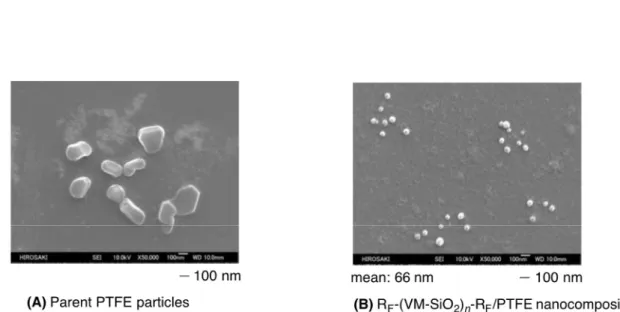
FE-SEM photograph of the RF-(VM-SiO2)n-RF/PTFE nanocomposites (Run 1 in
Table 1-1) methanol solutions was recorded. The FE-SEM measurements of parent PTFE particles were also measured under similar conditions, for comparison. These results are shown in Fig. 1-1.
Electron micrograph also showed the formation of fluorinated nanocomposite fine particles with a mean diameter of 66 nm, and the similar size value (46.1 ± 9.5 nm) to that of FE-SEM measurements was observed in DLS measurements (see Run 1 in Table 1-1). On the other hand, the size of the parent PTFE particles are higher than that of the RF-(VM-SiO2)n-RF/PTFE nanocomposites. This finding would be due to the coagulation or agglomeration of the original PTFE particles, and the original PTFE particles are unable to show the primary ones.
To verify the presence of the PTFE in the nanocomposites, the thermal stability of
the fluorinated nanocomposites in Table 1-1 was studied by thermogravimetic analyses, in which the weight loss of these composites was measured by raising the temperature around 800 oC (the heating rate: 10 °C min-1) in air atmosphere, and the results are shown in Fig. 1-2.
As shown in Fig. 1-2, the original PTFE particles give the perfect weight loss around 600 °C. The parent RF-(VM-SiO2)n-RF oligomeric nanoparticles, which were prepared by the sol-gel reaction of the RF-(VM)n-RF oligomer under alkaline conditions in Scheme 1-1, afforded the 73 % weight loss around at 530 °C, owing to the partial formation
of silica gel during the calcination process. In contrast, the RF-(VM-SiO2)n-RF/PTFE nanocomposites (Runs 1 ~ 5 in Table 1-1) were found to provide the weight loss behavior in proportion to the contents of the PTFE in the nanocomposites after calcination at 800 oC, and the contents of the PTFE in the nanocomposites were estimated to be from 1 to 18 %.
1.3.2. Surface modification of glass, PTFE sheet and filter paper by the use of the RF-(VM-SiO2)n-RF/PTFE nanocomposites
It was previously reported that RF-(VM-SiO2)n-RF oligomeric nanoparticles are applicable to surface modification of glass to exhibit the oleophobic/superhydrophobic characteristic on the surface.36) The present RF-(VM-SiO2)n-RF/PTFE nanocomposites have been also applied to the surface modification of glass under similar conditions, and the dodecane and water contact angles on the modified glass surfaces were measured. These results are shown in Table 1-2.
As mentioned above, dodecane and water contact angle values on the modified glass surface treated with the RF-(VM-SiO2)n-RF oligomeric nanoparticles are 48o and 180o, respectively.36) However, interestingly, the present RF-(VM-SiO2)n-RF/PTFE nanocomposites were found to provide a superoleophilic/superhydrophobic characteristic on each modified surface; because the dodecane and water contact angle values are 0° and 180° on each surface, respectively; although the oleophobic PTFE units are surely incorporated into the present nanocomposite matrices. In fact, the original PTFE sheet surface provides the usual oleophobic/hydrophobic property (water and dodecane contact
angles are 33° and 113°) (see Table 1-2).
Next, the surface modification of the PTFE sheet was tried by the use of the present RF-(VM-SiO2)n-RF/PTFE nanocomposites (Run 5 in Table 1-1).
In general, we have some difficulties to have the surface modification of the PTFE sheet due to the strong hydrophobic/oleophobic property on the surface.30) However, as shown in Fig. 1-3, the uniformly modified surface has been prepared by using the present nanocomposites.
This good adhesion ability toward the PTFE surface would be due to the oligomeric structures, which possess a few trimethoxysilyl [-Si(OMe)3] units in the oligomeric main chain, quite different from the traditional monomeric fluoroalkylated silane coupling agents [RF-CH2CH2Si(OMe)3; RF = longer fluoroalkyl groups]. Each modified PTFE sheet surface
treated with the nanocomposites depicted in Table 1-1 was found to supply the similar superoleophilic/superhydrophobic property (dodecane and water contact angle values are 0°and 180°, respectively) to that of the modified glass surfaces (see Table 1-2).
A similar superoleophilic/superhydrophobic characteristic behavior was observed on the modified filter papers treated with the present nanocomposites (see Table 1-2).
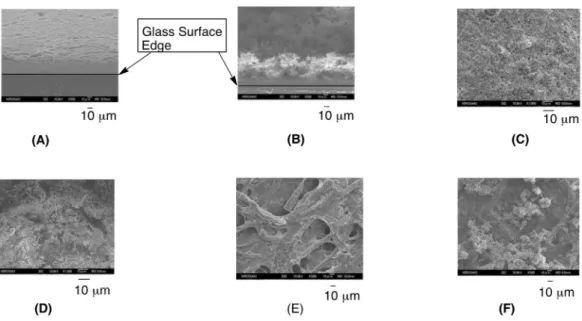
Superhydrophobic surface is in general realized by enhancing the surface roughness.38 ~ 41) Thus, FE-SEM measurements were used to study on the surface roughness of the modified glasses treated with the parent RF-(VM-SiO2)n-RF oligomeric nanoparticles, and with the RF-(VM-SiO2)n-RF/PTFE nanocomposites, of whose modified surfaces can exhibit an oleophobic/superhydrophobic property (dodecane and water contact angles: 48°
and 180°; see Table 1-2) and a superoleophilic/superhydrophobic characteristic (water and dodecane contact angles: 0° and 180°: Runs 1 ~ 5 in Table 1-2), respectively. These results are shown in Fig. 1-4.
As shown in Figs. 4-(B), 4-(D), and 4–(F), the architecture of the effective roughness was observed on the modified glass, PTFE sheet and filter paper surfaces treated with the RF-(VM-SiO2)n-RF/PTFE nanocomposites, compared with those (Figs. 1-4-(A),
Fig. 1-5 FE-SEM (field emission scanning electron microscopy) image of the original filter paper
10 m
1-4-(C), and 1-4-(E) of the parent RF-(VM-SiO2)n-RF oligomeric nanoparticles and the original filter paper (Fig. 1-5).
The DFM (dynamic force microscopy) measurements of the modified glass, PTFE sheet and the filter paper surfaces treated with the RF-(VM-SiO2)n-RF/PTFE nanocomposites have been also studied, and the results are shown in Fig. 1-6.
Fig. 1-6-(B), 1-6-(D), and 1-6-(F) show that the topographical image of each surface can provide a roughness characteristic, and the roughness average values: Ra (220 nm, 148
nm and 71 nm) of the modified glass, PTFE sheet and filter paper surfaces possessing the superoleophilic/superhydrophobic characteristic (dodecane and water contact angles: 0° and 180°) are extremely higher than those (Ra: 7 nm, 81 nm and 43 nm) of the modified glass surface (dodecane and water contact angle values: 48°and 180°), the modified PTFE sheet (dodecane and water contact angle values: 73° and 180°) and the modified filter paper (water and dodecane contact angle values: 21° and 180°) treated with the RF-(VM-SiO2)n-RF oligomeric nanoparticles (see Figs. 1-6-(A), 1-6-(C) and 1-6-(E), and Table 1-2).
These findings suggest that the nanocomposites containing PTFE particles are essential to the architecture of rough surface. Especially, the RF-(VM-SiO2)n-RF/PTFE nanocomposite particles are effective for the fabrication of the superoleophilic and superhydrophobic fractal surface. Such higher roughness surface would be likely to interact with oils such as dodecane possessing the lower surface tension than that of water to exhibit the superoleophilic characteristic, because an oil droplet could easily penetrate the very small orifice between the composite particles. On the other hand, the fluoroalkyl groups in the RF-(VM-SiO2)n-RF/PTFE nanocomposites should be regularly arranged on the modified roughness surface to exhibit the superhydrophobic characteristic.
1.3.3. Separation of oil and water by the use of the RF-(VM-SiO2)n-RF/PTFE nanocomposites
The superoleophilic surface has in general a strong affinity toward oils. Thus, the surfaces possessing the superoleophilic/superhydrophobic characteristic can simultaneously repels water and strongly absorbs oils. Such behavior should be applicable to the oil/water separating materials.42 ~ 45) Thus, the separation of the mixture of the blue-colored water (water was colored with CuSO4 5H2O) and 1, 2-dichloroethane was tried by using the modified filter paper treated with the RF-(VM-SiO2)n-RF/PTFE nanocomposites (Run 1 in Table 1-1) as the liquid-liquid separation membrane. The original non-treated filter paper was also used as the liquid-liquid separation membrane under similar conditions, for comparison. These results are shown in Fig. 1-7.
As shown in Fig. 1-7-(A), the mixture of oil/water was unable to separate under reduced pressure conditions by the use of the original non-treated filter paper. On the other hand, the colorless oil was smoothly isolated in 3 seconds under reduced pressure due to its superoleophilic/superhydrophobic characteristic illustrated in Fig. 1-7-(B). However, the blue-colored water flowed into the isolated colorless oil after 10 seconds due to the separation process under the reduced pressure.
The present RF-(VM-SiO2)n-RF/PTFE nanocomposites depicted in Scheme 1-1 and Table 1-1 are white-colored particle powders. Especially, the modified glass surface treated with the well-dispersed RF-(VM-SiO2)n-RF/PTFE nanocomposites powders (Run 5 in Table
1-1) methanol solutions through the casting technique was found to exhibit the same superoleophilic (dodecane contact angle: 0°)/superhydrophobic characteristic (water contact angle: 180°) to those of the Table 1-2. Thus, the present nanocomposite powders were applied to the packing materials for the column chromatography to separate not only the mixture of the blue-colored water and colorless oil illustrated in Fig. 1-7 but also the water-in-oil (W/O) emulsions. The surfactant (span 80: 30.0 mg)-stabilized water (0.05 ml)-in-oil (1, 2-dichloroethane: 5.00 ml) (W/O) emulsion and span 80 (30.0 mg)-stabilized water (0.05 ml)-in-oil (toluene: 5.00 ml) (W/O) emulsion were prepared under ultrasonic conditions for 5 min at room temperature. The RF-(VM-SiO2)n-RF/PTFE nanocomposites (Run 1 in Table 1-1) were applied to the packing material for the separation of the mixture of the blue-colored water/colorless oil and the W/O emulsions. Silica gel (Wakogel C-500HGTR) was also applied to the packing material under similar conditions, for comparison, since the silica gel is useful for the packing material for the column chromatography. These results are shown in Figs. 1-8 ~ 1-10.
As shown in Fig. 1-8-(A), the silica gel was not effective for the packing material to separate the mixture of the blue-colored water and colorless oil under reduced pressure conditions. However, interestingly, it was demonstrated that the present RF-(VM-SiO2)n-RF/PTFE nanocomposites are effective for the separation of the mixture of the blue-colored water and colorless oil, and only transparent colorless oil has been isolated under reduced pressure. The contamination of blue-colored water into the oil phase was not observed in 5 min [see Fig. 1-8-(B)].
Furthermore, the W/O emulsions were tried to separate by using the
RF-(VM-SiO2)n-RF/PTFE nanocomposites. As shown in Fig. 1-9-(B), the nanocomposites are effective for the separation of water-in-oil (1, 2-dichloroethane) emulsion under reduced pressure to isolate the colorless oil (1, 2-dichloroethane). Similarly, water-in-oil (toluene) emulsion was smoothly separated by using the RF-(VM-SiO2)n-RF/PTFE nanocomposites as the packing material to isolate the colorless oil (toluene) [see Fig.1- 10-(B)].
On the other hand, the silica gel (Wakogel C-500HGTR) was unable to separate these emulsions under similar conditions in each case [see Figs. 1-9-(A) and 1-10-(A)]. As shown in Figs. 1-11 and 1-12, optical micrograph also showed that the water droplet cannot be detected at all in the isolated colorless oil in each case, although we can easily detect the water droplet in the W/O emulsions which flowed out from the column chromatography by using the silica gel (Wakogel C500-HGTR) as the packing material.
9 min
40 min (A): Wakogel C-500HGTR
(B): RF-(VM-SiO2)n-RF/PTFE nanocomposites
Water-in-oli (toluene) emulsion stabilized by span 80
Fig.1-10 Separation of the water-in-oil (oil: toluene) by using Wakogel C-500HGTR: (A) and the RF-(VM-SiO2)n-RF/PTFE nanocomposite powders (Run 1 in Table 1-1): (B) under reduced pressure
The reusability was studied for the present nanocomposite particles as not only the separation membrane for the mixture of oil/water but also the packing material for the W/O emulsions, and the results are shown in Table 1-3.
Table 1-3 shows that the colorless oils were quantitatively isolated under similar conditions even after the use of the mixture of the blue-colored water and oil, and the W/O emulsions five times.
In this way, it was clarified that two kinds of W/O emulsions; one is the oil such as 1,2-dicholoroethane, of whose specific gravity is higher than water and the other (toluene) is lower than water can be easily separated by using the RF-(VM-SiO2)n-RF/PTFE nanocomposites. Therefore, the present nanocomposites possessing a superoleophilic/superhydrophobic characteristic could open new developments in the separation of oil and water.
1.4. Conclusion
It was demonstrated that fluoroalkyl end-capped vinyltrimethoxysilane oligomer [RF-(VM)n-RF] is effective for the preparation of the corresponding fluorinated oligomeric silica/poly(tetrafluoroethylene) (PTFE) nanocomposites through the sol-gel reaction of the RF-(VM)n-RF oligomer in the presence of PTFE fine particles under alkaline conditions.
The RF-(VM-SiO2)n-RF/PTFE nanocomposites thus obtained were applied to the surface modification of not only glass but also PTFE sheet and filter paper to provide the superoleophilic/superhydrophobic characteristic on these modified surfaces; although the oleophobic PTFE units are certainly incorporated into the nanocomposite matrices. PTFE is well known to possess oil- and water-repellent properties.1, 2) Thus, we have some difficulties to develop the surface modification of PTFE, quite different from the traditional hydrocarbon polymers. However, it was verified that the present RF-(VM-SiO2)n-RF/PTFE nanocomposites are effective for the surface modification of the PTFE sheet through the simple sol-gel technique under room temperature. Moreover, the modified filter paper treated with the RF-(VM-SiO2)n-RF/PTFE nanocomposites possessing the superoleophilic/superhydrophobic characteristic was applicable to the separation membrane for the mixture of oil/water. Especially, the W/O emulsions can be separated by using the
RF-(VM-SiO2)n-RF/PTFE nanocomposites as the packing materials for the column chromatography to isolate the transparent colorless oil from the W/O emulsions. Of particular interest, it was clarified that the present nanocomposite particle powders possess a good reusability for the packing materials even after 5 times. There has been an important worldwide problem for the oil/water separation in the area of industrial production, environmental protection and energy conservation; because, accidents of ships in the sea can often result in release of spill oil in seawater and rivers can be also contaminated by
wastewater including oil generated in numerous manufacturing industries.
Therefore, the present RF-(VM-SiO2)n-RF/PTFE nanocomposites may have high potential to develop into the practical oil-water separation materials in a wide variety of fields, since these nanocomposites contain the PTFE units, which have an excellent resistance to chemical reagents and high temperature stability.