Introduction
The annual AAAS (American Association for the Advancement of Science
*1) Forum
[1]was held in Washington D.C. on April 30 (the 101
stday of the Obama administration) and May 1, 2009. The forum is held every year for people in the science, engineering, and higher education communities of the United States and elsewhere so that they can learn about and discuss public policy issues and the federal science and technology budget. The forum provides an opportunity to understand key policy issues in science and technology in the United States. The participants include scientists, AAAS officials, policymakers, and students with an interest in the intersection of policy and science and technology. This year was the 34
thforum, and the number of participants exceeded 600 for the first time in its history, showing the Obama administration’s strong interest in science and technology policy.
Discussion topics included global economic issues and the role of science and technology, a huge increase in funding (more than 3% of the U.S. GDP) for science and technology and its proper use, as well as the present condition and future of science and the
5
Report on the Annual AAAS Forum on Science and Technology Policy (2009)
ayao h irano
General Unit
existing media. On the first day, the keynote address was made and analysis was conducted on budgetary and policy context for R&D in fiscal 2010
[NOTE 1]. On the second day, there was a discussion on the role of science and technology during the current global economic condition. Other discussion topics included serious threats of global warming and actions to be taken. The participants engaged in enthusiastic discussion on environmental problems and the roles of science and technology for the future.
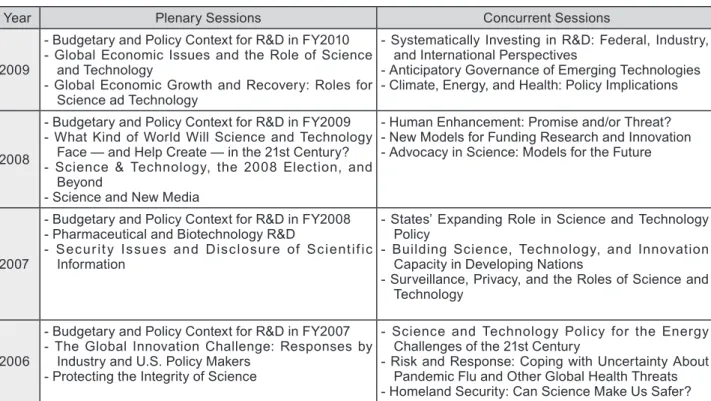
Table 1 shows the discussion topics of the 2006–
2009 forums.
Keynote address
Peter Agre, President of the AAAS, introduced the keynote address speaker John P. Holdren, who was greeted with enthusiastic applause. The following is an introduction of Holdren.
Holdren has been playing a major role in the fields of science and technology in the United States. He served as president of the AAAS from February 2006 to February 2007, and as chairman of the AAAS Board of Directors for a year after that. He is now working with President Obama as his Assistant for Science
[NOTE 1]
The budget proposals for fiscal 2010 (October 2009–September 2010) were announced later than usual (they are usually announced before the forum).
1
*1 AAAS: The AAAS (founded in 1848) is a non-profit organization with more than 140 thousand members that consist of scientists, engineers, science educators, policymakers, and others. The aims of the AAAS include promoting interaction and cooperation among scientists and providing policymakers with opportunities to exchange information. The AAAS is also known as the publisher of the journal Science.
2
Table 1 : Session Topics (2006–2009)
Source: The AAAS Forum on Science and Technology Policy website
[1](Please refer to References
[2-4]for the outlines of the previous forums.)
and Technology and as Director of the White House Office of Science and Technology Policy
[5](OSTP). As Assistant to the President for Science and Technology, he helps to coordinate analysis and recommendations related to science and technology policy in concert with a wide range of relevant agencies, and he provides independent and objective advice to the President and the Vice President.
Director of the OSTP John Holdren and four Associate Directors (of Science, Technology (CTO), Environment, and National Security and International Affairs Divisions) approved by the Senate will play an important role in the Obama administration’s science and technology policy by determining priority research topics (Supplement 1).
2-1 Summary of the Address
Prior to this forum, President Obama, on April 27, pledged to invest more than 3% of the nation’s GDP in research and development, an increase from the current level at 2.66%. This will surpass the level achieved at the height of the space race in 1964, when it was about 2.9% of the country’s GDP. The United States aims to effectively develop science and technology not only by substantially investing in science and technology but also by focusing on priority issues from a policy perspective. In particular,
the Obama administration plans to substantially invest in efforts to strengthen basic and applied research, to promote innovation for the realization of a clean energy-based economy, to improve the health care system, to enhance the whole society’s stance with respect to recognition of the importance of science and technology, and to improve mathematics and science education. The administration also plans to increase the budget of the National Institutes of Health (NIH), the Department of Energy (DOE), the National Science Foundation (NSF), the National Oceanic and Atmospheric Administration (NOAA), the National Aeronautics and Space Administration (NASA), and the Department of Defense (DOD).
Change of policy surrounding climate change issues
In his keynote address, Holdren touched upon global climate change and noted that the United States must become “a leader in the world in addressing this problem rather than a laggard.” Climate scientists in the United States are preparing for the Conference of the Parties to the United Nations Framework Convention on Climate Change (COP15)
[6]
in Copenhagen in December 2009. After his talk, Holdren said that the United States could enhance its position at global climate negotiations in Copenhagen
Year Plenary Sessions Concurrent Sessions
2009
- Budgetary and Policy Context for R&D in FY2010 - Global Economic Issues and the Role of Science
and Technology
- Global Economic Growth and Recovery: Roles for Science ad Technology
- Systematically Investing in R&D: Federal, Industry, and International Perspectives
- Anticipatory Governance of Emerging Technologies - Climate, Energy, and Health: Policy Implications
2008
- Budgetary and Policy Context for R&D in FY2009 - What Kind of World Will Science and Technology
Face — and Help Create — in the 21st Century?
- Science & Technology, the 2008 Election, and Beyond
- Science and New Media
- Human Enhancement: Promise and/or Threat?
- New Models for Funding Research and Innovation - Advocacy in Science: Models for the Future
2007
- Budgetary and Policy Context for R&D in FY2008 - Pharmaceutical and Biotechnology R&D
- Security Issues and Disclosure of Scientific Information
- States’ Expanding Role in Science and Technology Policy
- Building Science, Technology, and Innovation Capacity in Developing Nations
- Surveillance, Privacy, and the Roles of Science and Technology
2006
- Budgetary and Policy Context for R&D in FY2007 - The Global Innovation Challenge: Responses by
Industry and U.S. Policy Makers - Protecting the Integrity of Science
- Science and Technology Policy for the Energy Challenges of the 21st Century
- Risk and Response: Coping with Uncertainty About
Pandemic Flu and Other Global Health Threats
- Homeland Security: Can Science Make Us Safer?
if it approves climate and energy legislation in advance. “Without energy, there is no economy;
without climate, there is no environment; and without economy and environment, there’s no well-being,”
Holdren said during his keynote address, reiterating the importance of tackling environmental issues.
Substantial investment in energy
In his address to the forum, Holdren noted that the United States is more than 85% dependent on fossil fuels and said, “That’s not going to change overnight, so we can’t just say [that] we’re going to go immediately, all the way, to unconventional renewables. We have no way to do that. We have to fix in various ways the conventional options that we’re using, as well.” Holdren said that the Obama administration likely would want to focus on ramping up the rate of R&D and demonstration of renewable- energy technologies as well as how best to increase energy efficiency of buildings, cars, manufacturing processes, and more. He explained that alternative energy supplies would come in somewhat more slowly, but ultimately would grow to a very large level.
Attention also must be paid to conventional energy sources such as safer, next-generation nuclear energy, he added.
The Obama science plan includes $150 billion over the next 10 years to promote clean-energy strategies as part of a response to global climate change and the economic crisis. It is estimated that this will help create about 5 million new green jobs.
Improving basic science: focusing and improving education for children
The Obama science plan also includes $1.5 billion in funding over the next five years to enhance STEM
*2education and “get kids back on top” in science, technology, engineering, and mathematics .
[NOTE 2]However, fulfilling President Obama’s ambitious goals for science and technology “is going to be hard”
in the current economy, and it will be essential for the administration and Congress to work closely together, Holdren said.
Remarks on federal budget proposals for FY2010 [NOTE 3]
U.S. Representative Bart Gordon (Chairperson of the House Committee on Science and Technology) warned scientists, who will benefit from the increase in the science and technology budget under the Obama administration, by saying that he heard complaints from his constituents that the federal government was spending money on a research institute when cash- strapped local schools had to suspend bus service. He acknowledges that spending money on R&D is very important for the future of the American people, but he also urged scientists and engineers to communicate their work at the grassroots level to get funding within a limited budget. Gordon also described his vision for ARPA-E (the Advanced Research Projects Agency-Energy)
[9] *3, as an initiative to turn to some of the nation’s top researchers to boldly develop new energy technology breakthroughs. ARPA-E aims to reduce the country’s dependence on foreign energy, to increase energy efficiency, and to reduce global warming gas emissions. ARPA-E received $15 million under the FY2009 Omnibus Appropriations Act and received $400 million in funding under the American Recovery and Reinvestment Act of 2009.
[NOTE 4]Stanley Collender (Managing Director of the Washington, D.C. office of Qorvis Communications) suggested that the budgetary and political support for science and technology would not be stable. He warned that the budget increase for science and technology, the President’s initiatives, and investments to STEM education would not necessarily last long.
Collender also noted that if the financial stimulus plan is effective with the current recession, Congress and the President may come under pressure to reduce unprecedented deficit spending, and frustration with the economy might provoke a backlash against favorable trends in science
[NOTE 5]. He said that since President Obama had pledged to reduce the deficit to $500 billion by 2013, it would be unclear, with the recent economic situation and the deficit, how long the budget increase would last. To make the favorable trends for science and technology sustainable, Collender urged science and engineering leaders to do their best to communicate the true value of science and build better relationships with the American
3
people.
Al Teich (Director of the Science & Policy Programs for AAAS) said that the 2009 budget and the stimulus package had brought new commitments to address key science issues and an infusion of new funds for science. He noted that the total 2009 R&D budget for energy and climate, physical sciences, biomedical research, and other fields was $172 billion (including
the stimulus funding), a huge increase over the 2008 spending. And much of it went to research outside the defense realm, which has dominated R&D in recent years. Even without including the stimulus funding, the budget for energy research at the Department of Energy (DOE) went up by 21%, Teich said. Funding at the DOE Office of Science also went up by about 15%.
When the stimulus funding is included, budgets at the
[NOTE 2]
President Obama considers education reform to be an important political issue. In that sense, it may be appropriate to call the budget “the R&D and education budget” rather than just “the R&D budget.”
[NOTE 3]
The announcement of the budget proposals
[8]was delayed this year; it is usually made before the forum.
Therefore, the speakers did not mention detailed numbers. (Please refer to Supplement 2 for concrete numbers.)
[NOTE 4]
The FY2010 budget proposals included funding of $100 million through the Energy Transformation Acceleration Fund (separate from the budget to the DOE).
[NOTE 5]
This suggests that if the stimulatory fiscal policy works and the economy recovers, the pressure to trim the deficit may build and the substantial increase in the science and technology budget may turn into a decrease.
*2 STEM education: Education programs promoted by the Obama administration to improve education in science, technology, engineering, and mathematics.
[7]*3 ARPA-E: ARPA-E aims to improve the support for developing alternative energy, to enhance U.S.
economic independence and energy security, and to overcome long-term, high-risk technological difficulties that are related to the development of energy technology.