Time-segmentation and position-free recognition of air-drawn gestures and characters in videos
Yuki Niitsuma · Syunpei Torii · Yuichi Yaguchi · Ryuichi Oka
Received: date / Accepted: date
Abstract We report the recognition in video streams of isolated alphabetic characters and connected cursive textual characters, such as alphabetic, hi- ragana and kanji characters, that are drawn in the air. This topic involves a number of difficult problems in computer vision, such as the segmentation and recognition of complex motion on videos. We use an algorithm called time–
space continuous dynamic programming (TSCDP), which can realize both time- and location-free (spotting) recognition. Spotting means that the prior segmentation of input video is not required. Each reference (model) character is represented by a single stroke that is composed of pixels. We conducted two experiments involving the recognition of 26 isolated alphabetic characters and 23 Japanese hiragana and kanji air-drawn characters. We also conducted gesture recognition experiments based on TSCDP, which showed that TSCDP was free from many of the restrictions imposed by conventional methods.
Keywords gesture recognition · segmentation-free recognition · position-free recognition · moving camera · dynamic programming
Y. Niitsuma
Turuga Ikkichimachi, Aizuwakamatsu-city, Fukushima, Japan Tel.: +81-242-37-2500
E-mail: [email protected] S. Torii
same first author
E-mail: [email protected] Y. Yaguchi
same first author
E-mail: [email protected] R. Oka
same first author
E-mail: [email protected]
1 Introduction
Recognition in a video stream of air-drawn gestures and characters will be an important technology in realizing verbal and nonverbal communication in human–computer interaction. However, it is still a challenging research topic, involving a number of difficult problems in computer vision, such as segmenta- tion in both time and spatial position and the recognition of complex motion in a video. According to the results of a survey [1] of gesture and sign lan- guage recognition research, the following restrictions are necessary for realizing a gesture or sign language recognition system:
– long-sleeved clothing – colored gloves – uniform background
– complex but stationary background
– head or face stationary or with less movement than hands – constant movement of hands
– fixed body location and pose-specific initial hand location – face and/or left hand excluded from field of view
– vocabulary restricted or unnatural signing to avoid overlapping hands or hands occluding face
– field of view restricted to the hand, which is kept at fixed orientation and distance to camera
We used an algorithm called time–space continuous dynamic programming (TSCDP) [2] to avoid these restrictions. TSCDP can realize both position- and segmentation-free (spotting) recognition of a reference point (pixel) tra- jectory in a time–space pattern, such as a video. Spotting means that prior segmentation along the time and spatial axes of the input video is not required.
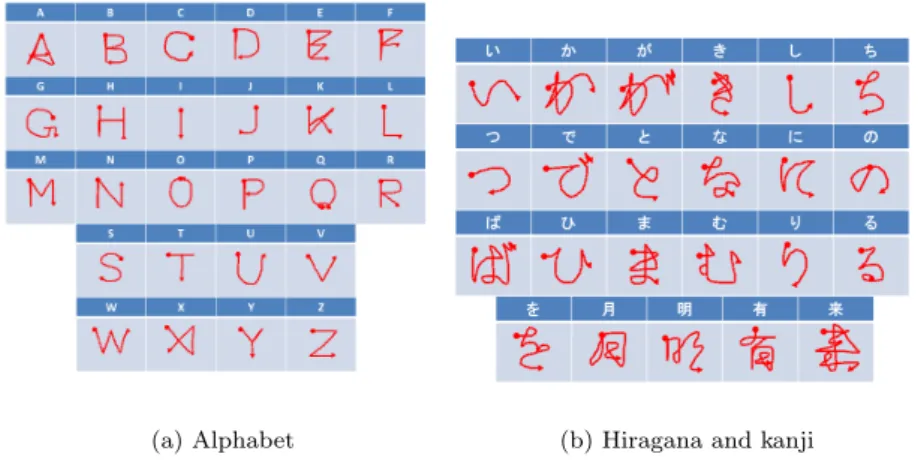
To apply TSCDP, we made a reference model of each character, represented by a single stroke composed of pixels and their location parameters. TSCDP can be applied to two kinds of characters in the air: isolated and connected.
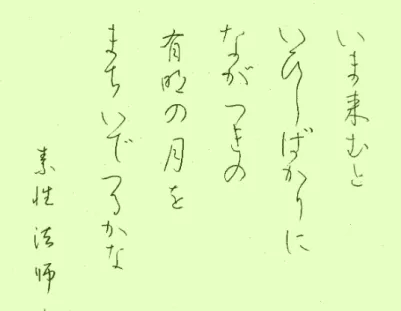
Spotting recognition via TSCDP is better than conventional methods for rec- ognizing connected air-drawn characters. This is because time segmentation is required to separate connected characters into individual characters, and because position variation can be large when connected characters are drawn in the air. We used a video of air-drawn isolated characters, unadorned with tagging data such as start or end times or the location of the characters. To obtain video data on connected characters, we used a work that is famous in Japanese literature (the “Waka of Hyakunin Isshu”), drawn in the air. We made a set of reference point trajectories, each of which represented a single stroke corresponding to an alphabetic, hiragana or kanji character.
2 Related Work
There has been much research on recognizing air-drawn characters. The projects
described below aimed to recognize isolated air-drawn characters, but recog-
nition in a video stream of connected air-drawn characters has not yet been investigated. Okada and Muraoka et al. [3][4][5] proposed a method for ex- tracting the hand area with brightness values, together with the position of the center of the hand, and they evaluated that technique. Horo and Inaba [6] proposed a method for constructing a human model from images captured by multiple cameras and obtaining the barycentric position of this model. By assuming that the fingertip voxels would be furthest from this position, they extracted the trajectory of the fingertips and were then able to recognize char- acters via continuous dynamic programming (CDP) [7]. Florian Baumann et al. proposed a feature called motion binary pattern by combining volume lo- cal binary patterns and optical flow [8] and applied it to the KTH dataset [9]
using histograms of the features. Sato et al. [10] proposed a method that used a time-of-flight camera to obtain distances, extract hand areas, and calculate some characteristic features. They then achieved recognition by comparing the reference features and input features via a hidden Markov model. Nakai and Yonezawa et al. [11][12] proposed a method that used an acceleration sensor (e.g., a Wii remote controller) to obtain a trajectory that was described in terms of eight stroke directions. They then recognized characters via a char- acter dictionary. Scaroff et al. [13][14][15][12] proposed a method for matching time–space patterns using dynamic programming (DP). Their method used a sequence of feature vectors to construct a model of each character. Each fea- ture vector was composed of four elements: the location (x, y) and the motion parameters (v x , v y ) (i.e., their mean and variance). Their method therefore requires users to draw characters within a restricted spatial area of a scene.
Moreover, movement in the background or video captured by a moving camera is not accommodated because the motion parameters for the feature vector of the model are strongly affected by any movement in the input video.
These conventional methods (except Ezaki et al. [16], which used an accel- eration sensor) use local features comprising depth, color(*), location param- eters, motion parameters, and so on, to construct each character model. They then applied algorithms, such as DP or a hidden Markov model, to match the models to the input patterns. These methods remain problematic because such local features are not robust when confronted with the severely demand- ing characteristics of the real world. When they are used to recognize air-drawn characters, conventional methods perform poorly if there are occlusions, spa- tial shifting of the characters drawn in the scene, moving backgrounds, or moving images captured by a moving camera.
3 CDP
CDP [7] matches and recognizes a reference temporal sequence pattern in
an unbounded and nonsegmented temporal sequence pattern with allowance
for nonlinear deformation of the reference pattern. Let g(τ ) be a value of
time τ, 1 ≤ τ ≤ T in a reference sequence and let f(t) be a value of time
t, t ∈ ( −∞ , ∞ ) in an input sequence. We define a function for the ith mapping
of each reference and input sequence from t(i) to τ(i) as r(i) = τ (i) | t(i) → τ(i), where i, t(i), and τ(i) are defined as i = 1, 2, . . . , T , t(i) ∈ ( −∞ , t] and τ(i) ∈ [1, T ]. This function r(i) is constructed as a vector of functions r = (r(1), r(2), . . . , r(T )). Hence, the definition of the minimum value of the eval- uation function with local distance d(t, τ) is given by:
D(t, T ) = min
r
∑ T i=1
{ d(t(i), r(i)) } , (1)
where t(1) ≤ t(2) ≤ . . . ≤ t(T) = t. Here, local distance is defined by:
d(t, τ) = || f (t) − g(τ) || . (2)
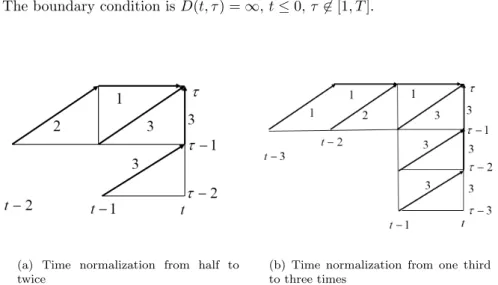
Let a constraint between r(i) and r(i + 1) set three paths, “equal,” “half,”
and “twice,” as shown in Figure 1(a) as determined by the local constraint of CDP for allowing nonlinear deformation of matching. The recursive equation for determining D(t, τ) is:
D(t, τ) = min
D(t − 2, τ − 1) + 2d(t − 1, τ ) + d(t, τ );
D(t − 1, τ − 1) + 3d(t, τ);
D(t − 1, τ − 2) + 3d(t, τ − 1) + 3d(t, τ).
(3) The boundary condition is D(t, τ) = ∞ , t ≤ 0, τ ̸∈ [1, T ].
(a) Time normalization from half to twice
(b) Time normalization from one third to three times
Figure 1 Two types of local constraints used in CDP. The number attached to each edge (arrow) indicates the weight of the path.
When accumulating local distances optimally, CDP performs time warping
to allow for variations from half to twice the reference pattern. The selection of
the best local paths is performed by the recursive equation in Eqn. (3). Figure
1 shows two types of local constraints used in CDP for time normalization. In
this paper, we use type (a). Other normalizations, such as from one quarter
to four times, can be realized in a similar way.
4 TSCDP
TSCDP [2] is an extension of CDP that embeds the parameters of the spa- tial axes (x, y) on an image sequence. The main goals of TSCDP are to avoid presegmentation of the input image sequence and to establish nonlinear de- formation and position-free matching. From these three main concepts, this method provides robust recognition of reference patterns. Most conventional recognition schemes have three steps: presegmentation, tracking and match- ing. Thus, these methods have numerous parameters that allow extraction of precise results in each step. Tracking and matching can be applied simulta- neously by a DTW-based method, but require precise presegmentation. The reasons for the success of TSCDP are:
– Segmentation-free design in temporal sequences derived from CDP – Applying relative position constraints in the local distance calculation – Applying relative color distances in the local distance calculation in the accumulation calculation in TSCDP.
The original paper [2] was not optimized to real motion data. Thus, we also provide better implementation for isolated air-drawn characters to improve the recognition rate.
4.1 Evaluation Function for TSCDP
Let f (x, y, t) be a pixel value at position (x, y) of frame t. Here, x, y, and t are limited to 1 ≤ x ≤ M , 1 ≤ y ≤ N, and 1 ≤ t ≤ ∞ , respectively, where M and N are the image width and height in an image sequence. If this image sequence has a gray scale, then f (x, y, t) is a scalar value, but if the image is in color, then f (x, y, t) is a vector that can be derived from any color model.
Define a sequence of pixel values for reference pattern Z as:
Z(ξ(τ), η(τ)), τ = 1, 2, . . . , T, (4) where (ξ(τ), η(τ)) is the location in a two-dimensional plane and Z is the pixel with a gray-scale or color value at that location. Here, ξ and η define a reference trajectory (a sequence of spatial positions) of x and y. Next, the local distance between a reference value and the input images is defined by:
d(x, y, τ, t) = ∥ Z(ξ(τ), η(τ)) − f (x, y, t) ∥ . (5) The minimum value of the evaluation function is defined using the following notations:
x(i) ∈ X, y(i) ∈ Y, ξ(i) ∈ X, η(i) ∈ Y, x = x(T ), y = y(T ),
τ(T) = T, t(T ) = t, (6)
a mapping function u i :(ξ(i), η(i)) → (x(i), y(i)),
Here, w = (r, u 1 , u 2 , . . . , u T ) is a vector of functions, where a vector of functions r is defined as for CDP. Finally, the optimization function is defined by:
S(x, y, T, t) = min
w {
∑ T i=1
d(x(i), y(i), τ(i), t(i)) } . (7) Here, the three-dimensional tensor S(x, y, 1, t) is a space of candidate start points for optimal matching: S(x, y, 1, t) = w · d(x, y, 1, t).
Incidentally, the parameters ξ and η are not used explicitly in either the solution algorithm or the local distance for position-free matching. To provide a position-free function for the reference pattern, we set a sequence of difference vectors V (τ) = (v ξ (τ), v η (τ)) as:
v ξ (τ ) = ξ(τ ) − ξ(τ − 1), v η (τ) = η(τ ) − η(τ − 1), (8) where τ = 1, (v ξ (τ ), v η (τ )) = (0, 0) for the boundary conditions.
4.2 Algorithm for TSCDP
When recognizing isolated or connected air-drawn characters, temporal shrink- ing and expansion can occur with spatial shifting. The following formula is the algorithm to determine S(x, y, T, t), by performing time–space warping. The allowable ranges for shrinking and expansion in time and space are each from half to twice the reference point trajectory. Temporal shrinking and expansion from half to twice is realized by the CDP embedded in TSCDP.
4.2.1 Spatiotemporal Deformation Model
We explain the basic mechanism of the local computation of TSCDP. Let the spatial shrinking and expansion be realized by the second minimum calculation of TSCDP, using a parameter A. Here, we define A as A = { 1 2 , 1, 2 } , which allows spatial shrinking and expansion from half to twice the reference pattern.
A allows these deformation patterns by reference vector. The deformation of each local selection is:
A = { 1 2 , 1, 2 } ,
S(x, y, 1, t) = 3d(x, y, 1, t), 2 ≤ τ ≤ T
Then the local distance selection with temporal deformation about t is defined by the following equation derived from the CDP scheme (3):
S(x, y, τ, t) = min
α ∈ A min
S(x − α · v ξ (τ), y − α · v η (τ), τ − 1, t − 2) + 2d(x, y, τ, t − 1) + d(x, y, τ, t);
S(x − α · v ξ (τ), y − α · v η (τ), τ − 1, t − 1) + 3d(x, y, τ, t);
S(x − α · (v ξ (τ ) + v ξ (τ − 1)), y − α · (v η (τ) + v η (τ − 1)), τ − 2, t − 1) + 3d(x − α · v ξ (τ), y − α · v η (τ ), τ − 1, t) + 3d(x, y, τ, t)
(9)
The boundary condition is:
S(x, y, τ, t) = ∞ , d(x, y, τ, t) = ∞ , if (x, y) ̸∈ [M, N ], t ≤ 0, τ ̸∈ [1, T ].
Eqn. (9) is used for the time–space optimization of the evaluation shown by Eqn. (7) as illustrated in Figure 2. The function of the time normalization part of Eqn. (9) is the same as that for CDP. The function of space normalization is simply added to CDP by introducing (x, y)-space to (t, τ) space. Therefore, we consider an algorithm working in a four-dimensional space such as (x, y, t, τ ).
4.2.2 Normalization for Local Deformation in Temporal Domain
The scheme of CDP has three candidate paths for selecting optimal local matching. In general DP matching, the problem is how to realize space nor- malization, and CDP already implements space normalization as shown in Figure 3. TSCDP inherits this scheme. The simplest example of a shrink path shown in Figure 2 corresponds to the third path of Figure 3. Here, the deciding path condition of TSCDP is in the four-dimensional space and it is embedded in two-dimensional space in the temporal space of the CDP scheme. In Figure 2, the t and t − 1 appearing twice in the third path of CDP have three points of τ, namely τ, τ − 1, τ − 2. Therefore, we can consider three points in 4-D space. Then the locations of the (x, y) coordinates of each of the three points have τ parameters, respectively.
We consider that the difference between τ parameters corresponds to a difference in (x, y) of the images in the input video. The difference in the point sequence (x, y) is represented as a difference vector (v ξ , v η ), as shown in Figure 2. This representation was already shown in Egn. (8). Then we embed suitable values of parameters of (v ξ , v η ) into S(x, y, τ, t) and d(x, y, τ, t) of Eqn. (9), but this equation defines only temporal normalization; spatial normalization is embedded as the symbol A.
If the size of (v ξ , v η ) is modified, spatial normalization of the reference
pattern can be realized. Now we consider three types of space size modification
at each local optimization, namely { 1 2 , 1, 2 } . This means that any combination
of local spatial size modifications from half to twice the reference pattern
can be realized. This function is realized by introducing the parameters α,
A = { 1 2 , 1, 2 } , and min α ∈ A into the recursive TSCDP equation. The first and
second candidate paths in Eqn. (9) are handled in the same way that the third
candidate path is handled.
Figure 2 Eqn. (9) realizes optimal pixel matching using three candidate paths for time normalization by accumulation of local distances between pixel values of the reference and the input video. The figure shows how the third path works during optimal path selection in 4-D space. The other two paths work in a similar way.
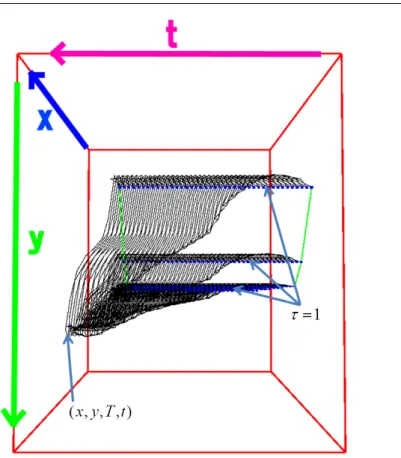
Consider the example reference pattern shown in Figure 3. The allowable time–space search area arrives at the time–space point (x, y, T, t), as shown in Figure 4. TSCDP determines the optimal matching trajectory in this allowable time–space search area. This area is dependent on the reference model for the pixel sequence. In other words, each reference model has its own allowable search area. This differs from conventional DP matching algorithms, which have the same search areas for all reference sequences.
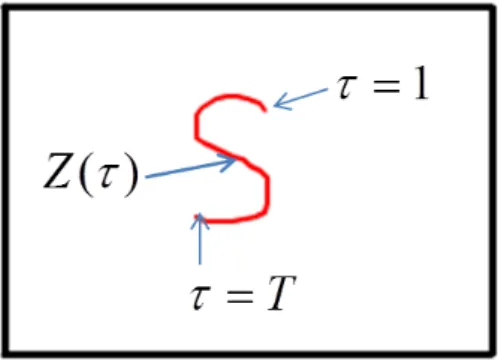
Figure 3 A reference pattern (pixel sequence) made by drawing one stroke sequence (a
sequence of location parameters, ((ξ(τ), η(τ)), τ = 1, 2, ..., T ) on a two-dimensional plane,
where the length of stroke corresponds to T ) of the reference pattern. Each pixel value
Z(ξ(τ), η(τ)) of the reference pattern is assigned a constant skin color.
Figure 4 Search space for TSCDP in arriving at the time–space point (x, y, T , t). Each reference model has its own search space.
4.3 Time-segmentation-free and Position-free Recognition
For the accumulation calculation in TSCDP, we use the recursive equation (9), which is convolved with minimal value selection on temporal and spatial candidates. In other words, S(x, y, 1, t) is a candidate space for a start point and S(x, y, T, t) is a candidate space for a position-free end (spotting) point of matching. Here, the optimal accumulated value S(x, y, T, t) at each time t indicates a two-dimensional scalar field with respect to (x, y). Location (x, y) is called a recognition location if it satisfies the condition S(x, y, T, t) ≤ h.
The recognition location indicates that a category represented by a reference pattern is recognized at time t ∈ [0, T ] and location (x, y). Usually, locations neighboring a recognition location are also recognition locations, because they have similar matching trajectories in the 4-D ((x, y, τ, t)) space. We define such location as the local area of recognition locations.
At each time t, we can find an arbitrary number of local areas of recognition
locations, depending on the number of existing time–space patterns that are
optimally matched with a reference pattern. Then we can determine a location,
denoted by (x ∗ , y ∗ ), giving the minimum value of S(x, y, T, t) for each local area of the recognition locations. The number of these locations is the number of recognition locations at time t. A local area of recognition location can be created at an arbitrary position on the (x, y)-plane, depending on the input video. This procedure, which is based on S(x, y, T, t), is the realization of the position-free (spotting) recognition of TSCDP.
On the other hand, a local minimum location (x ∗ , y ∗ ) has a time parameter t. If we consider the time series of a local minimum location, we can detect the time duration, denoted by [t s , t e ], satisfying S(x ∗ , y ∗ , T, t) ≤ h, t ∈ [t s , t e ]. The minimum value, denoted by S(x ∗ , y ∗ , T, t reco ), among S(x ∗ , y ∗ , T, t), t ∈ [t s , t e ], corresponds to the recognition considering time–space axes.
The time t reco indicates the end time of a recognized pattern in an input query video determined without any segmentation in advance. The starting time of the recognized pattern is determined by back-tracing the matching paths of TSCDP, starting from t reco . This procedure is the realization of time- segmentation-free (spotting) recognition, based on TSCDP. The following al- gorithms are used in the above procedures. The term [local area] in the follow- ing formulae is the local area of recognition locations, which was used in the above discussion.
(x ∗ , y ∗ , T, t) = arg min
(x,y) ∈ [local area] { S(x, y, T, t) } (10) Spotting recognition of multiple categories is determined by using multi- ple reference patterns. Define the ith reference pattern of a pixel series that corresponds to the ith category by:
Z i (ξ(τ), η(τ)), τ = 1, 2, . . . , T i . (11) TSCDP then detects one or more S i (x ∗ , y ∗ , T i , t) values as frame-by-frame minimum accumulation values for which S
i(x
∗3T ,y
∗,T
i,t)
i