• 検索結果がありません。

Mapping of perovskite oxides in the localized vs itinerant electron diagram and its relation with the ionic conductivity

N/A
N/A
Protected

Academic year: 2021

シェア "Mapping of perovskite oxides in the localized vs itinerant electron diagram and its relation with the ionic conductivity "

Copied!
18
0
0

読み込み中.... (全文を見る)

全文

(1)

Mapping of perovskite oxides in the localized vs itinerant electron diagram and its relation with the ionic conductivity

Sachi Taniguchi, Masaru Aniya*

Department of Physics, Graduate School of Science and Technology, Kumamoto University, Kumamoto 860-8555, Japan

Abstract

The electronic properties of perovskite-type oxides ABO

3

can be characterized by the

degree of localization of d-electrons. On the other hand, the complex perovskite oxides

A

1-x

A’

x

B

1-y

B’

y

O

3-δ

exhibit ionic conduction through the defects created by partial

substitution of metal atom A and (or) B. In the present study, the relationship between the

ionic conduction and the nature of electronic transport properties in perovskite-type oxides

is discussed by extending the classification scheme of localized and itinerant d-electron

diagram used for ABO

3

compounds. The classification scheme is based on the potential

parameter Z / r , where Z and r are the valence and ionic radii of the cation. From the

analysis, it is found that in perovskite oxides, the oxygen ionic conductivity decreases with

(2)

A A

/ r

Z of ion A. The result indicates that the nature of the electronic state influences the ionic conduction. An interpretation of the result found in terms of the bond fluctuation model of superionic conductors is given.

Keywords: Perovskite oxides, localized and itinerant electrons, ionic conductors

(3)

1. Introduction

Mixed oxides with the perovskite structure allow the synthesis of solid solutions containing various ions. They are also promising materials which can combine the properties of electronics and solid electrolytes. Therefore, the search of alternative cathode materials of the complex perovskite-type oxides is attracting much interest in the field of functional ceramics and other fields of applications [1-5]. For the development of functional materials, many investigations concerning the effects of temperature, chemical composition, structure and pressure have been performed to clarify the ionic conduction mechanism and the structural stability. Nevertheless, despite many studies, its understanding from the fundamental point of view remains still unclear. For instance, it is known that the perovskite-type oxides behave as metallic, semiconductive or insulators, depending on the degree of the overlap between the cation and anion orbitals [6]. However, it is not clear how these properties are reflected in the ion transport properties.

Concerning the electronic properties, the d-electrons in transition metal oxides ABO

3

are described as localized or itinerant electrons. A scheme to classify the ABO

3

type perovskite materials as having localized or itinerant d-electrons has been proposed by using

A A

/ r

Z and Z

B

/ r

B

as ordinate and abscissa, respectively [7]. Here, Z

A

and Z

B

are the

valences of the cations A and B, and r

A

and r

B

are their ionic radii. On the other hand, it

is known that the complex perovskite oxides A

1-x

A’

x

B

1-y

B’

y

O

3-δ

exhibit ionic conduction

through the defects created by partial substitution of metal atom A and (or) B. Recent

studies have revealed that in addition to defects, the nature of the chemical bonding between

(4)

cation and anion plays an important role in the ion transport processes [8]. Therefore, clarifying the role of the d-electrons of perovskite materials in the ion transport property is of primordial importance to understand the mechanism of ion conduction in this type of materials. In view of these points, it will be interesting to extend the classification scheme for ABO

3

compounds mentioned above in such a way to include the A

1-x

A’

x

B

1-y

B’

y

O

3-δ

oxides, and see how the classification is related with the ion transport properties.

2. Mapping of perovskite oxides

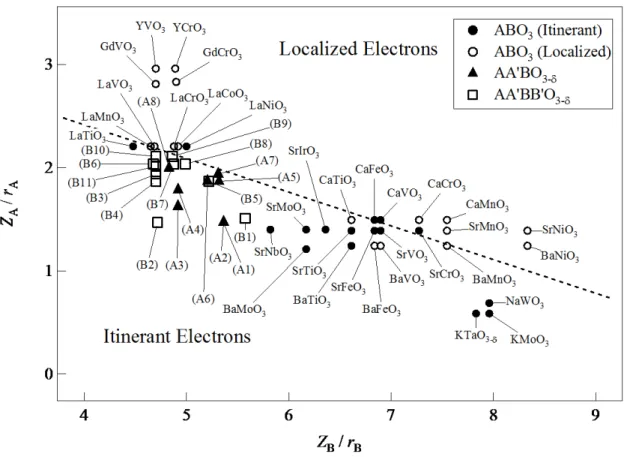
In Fig. 1, the ABO

3

and A

1-x

A’

x

B

1-y

B’

y

O

3-δ

compounds are classified in a map proposed

by Kamata and Nakamura [7]. The meanings of Z

A

/ r

A

and Z

B

/ r

B

have been

mentioned in the Introduction. The dotted line in the figure indicates the boundary between

the localized and itinerant d-electron systems. This separation line is based on the

classification of ABO

3

compounds [7]. Briefly, in the perovskite structure, B atom is

surrounded octahedrally by oxygen atoms. The B-O bonds are essentially covalent due to

the participation of d-electrons. An octahedron connects to an adjacent octahedron through

the formation of B-O-B bond. If this kind of bond percolates, the electronic transport

property will show an itinerant behavior. The electron attracting power of B cation increases

with the increase of Z

B

/ r

B

, because it gives a measure of Coulomb interaction. Since the

d-electrons orbital has a localized nature, with the increase of Z

B

/ r

B

, the degree of

electron localization increases. This explains the trends along the Z

B

/ r

B

axis observed in

(5)

Fig. 1. The trend along the Z

A

/ r

A

axis can be understood in the same way, however, without considering the effect of d-electrons. The combined effects of Z

A

/ r

A

and Z

B

/ r

B

determine the localized-itinerant nature of electronic transport shown in the figure.

In Fig. 1, for the complex oxides A

1-x

A’

x

B

1-y

B’

y

O

3-δ

, (A, A’ = La, Ce, Pr, Sr / B, B’ = Fe, Co, Ni, Mn), the composition weighted (x- and y-) average values of Z and r are used.

In the determination of Z

B

, the charge neutrality condition was also taken into account.

Such charge balance is necessary to account for the oxygen defects expressed by δ . For instance, for the case of Sr

0.9

Ce

0.1

FeO

3-δ

( δ = 0 . 315 ), the effective, or composition weighted average valence of the A cation is Z

A

= 0 . 9 × 2

(Sr)

+ 0 . 1 × 3

(Ce)

= 2 . 1 . By adopting the valence Z

O

= − 2 for the oxygen, the effective valence of B cation is determined from

0 ) 2 )(

315 . 0 3

(

(O)

B

A

+ Z + − − =

Z , giving Z

B

= 3 . 27 . That is, the transition metal located at the B site in the perovskite structure can take account for the charge balance by changing the valence. Concerning the ionic radii, the values reported by Shannon were used [9]. The newly added A

1-x

A’

x

BO

3-δ

, and A

1-x

A’

x

B

1-y

B’

y

O

3-δ

compounds shown in Fig. 1 are listed in Table 1. The ABO

3

compounds are those reported in [7]. It is interesting to note from Fig. 1 that complex perovskite oxides are mapped in the itinerant electrons side. However, this observation should be taken carefully, because the demarcation line is not strict as has been noted in a recent study [10]. The important point is to note the gross trend observed in Fig.

1.

(6)

3. Relationship between the potential parameters of the cations and the ionic conductivity

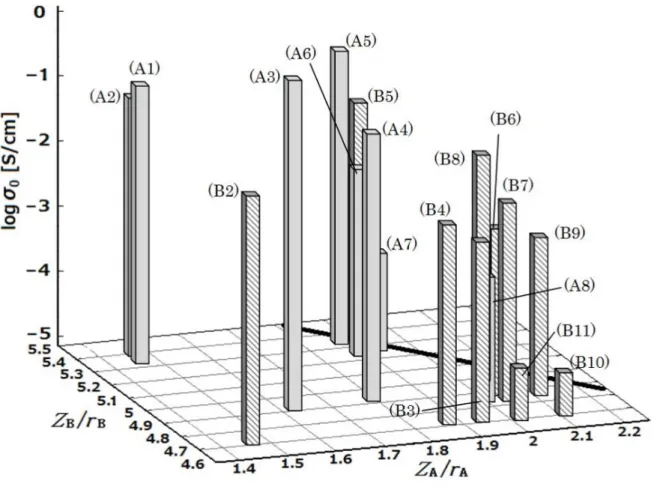
Fig. 2 shows the relationship between the oxygen ionic conductivity at T = 1073 K [11]

and the potential parameters Z

A

/ r

A

and Z

B

/ r

B

of the cations in complex perovskite oxides. From the figure, we recognize a certain trend. The ionic conductivity decreases with the increase of Z

A

/ r

A

. On the other hand, no clear trend is observed with the values of

B B

/ r

Z . This suggests that the A cation is playing the role of modulator in the ionic conduction. This observation can be understood as follows. It has been shown recently that the ionicity of A-O bond is larger than that of B-O bond [12]. In other words, the covalency which is caused by the overlap of orbitals is larger in the B-O bond than in the A-O bond.

The result is expected due to the presence of d-electrons in B atom, and is consistent with the short bond length of B-O than that of A-O. This implies that the bonding of B-O is strong compared to that of A-O bond. The results of Raman and IR measurements support these conjectures [13]. When there is a large difference in ionicity between A-O and B-O bonds, the oxygen ion will locate near the B site, because the bonding is strong. In contrast, when the difference in ionicity is small, their nature of the chemical bond become closer, and the oxygen ion might bind to B-site or to A-site ions. That is, the site where the oxygen ion is located becomes unstable. This effect will result in the increase of the oxygen ion conductivity. For instance, if we consider the compounds in the line Z

B

/ r

B

= const , the difference of the ionicity between A-O and B-O bonds is written as

const

AO BO

AO

− = −

=

i i i

i

f f f

Δ f . That is, the increase of Δ f

i

or f

iAO

or Z

A

/ r

A

(the

(7)

Coulomb interaction is proportional to ionicity), will result in the decrease of the ionic conductivity. This is the gross behavior observed in Fig. 2. Here, we have discussed about the role of A cation in the ionic conduction. The role of B cation will be discussed later.

The ionicity f

iµ

of the individual bond µ = AO or BO mentioned above has been calculated through the extended version of the dielectric theory of electronegativity widely used in the study of multicomponent systems [14, 15]. The chemical bonding of a multicomponent material can be decomposed into binary components A

m

O

n

or B

m

O

n

. The fractions of the ionicity f

iµ

and covalency f

cµ

of any individual bond µ in a multibond crystal are written as,

) , (

) (

2 2 µ µ µ

E

g

f

i

= C ,

) (

) (

2 2 µ µ µ

g h

E

f

c

= E (1)

where E

gµ

is the average energy gap that consists of homopolar E

hµ

and heteropolar C

µ

parts.

, ) ( ) ( )

( E

gµ 2

= E

hµ 2

+ C

µ 2

(2)

where

(eV),

) (

74 . 39

48 . µ 2 µ

E

h

= d (3)

( ) 1 ,

exp 4 . 14

0 O B

A,

0µ µ

µ µ

µ

Z r m Z n

r k b

C

s

 

  −

= (4)

, ) (

cµ 2

µ

b N

b = (5)

where r

0µ

is the average radius, which is a half of the bond length d

µ

, exp( − k

sµ

r

0µ

) is the

Thomas-Fermi screening factor, Z

A,B,O

are the number of valence electrons of the atoms A,

B and O involved in the formation of bond µ . b

µ

is a correction factor that is proportional

(8)

to the square of the average coordination number N

cµ

. In the above equations, d

µ

and r

0µ

are expressed in Å and energy is given in eV.

The relation between ∆ f

i

calculated based on the above expressions and some physical quantities of perovskite materials has been studied [12, 16]. For instance, it has been found that the thermal expansion coefficient decreases with the increase of ∆ f

i

. Based on such a result, an explanation to the empirical correlation reported for O ion conductivity and thermal expansion [11] has been given.

Many studies have stressed the importance of the tolerance factor (t-factor) in the ion transport properties of perovskites [17]. The t-factor is defined as

) (

2 ) (

O B

O A
r r

r t r

+

= + , (6)

where r

A

, r

B

and r

O

are the ionic radii of A cation, B cation and oxygen, respectively.

The t-factor gives a measure of how the crystal structure of a compound deviates from the ideal perovskite structure, t = 1.

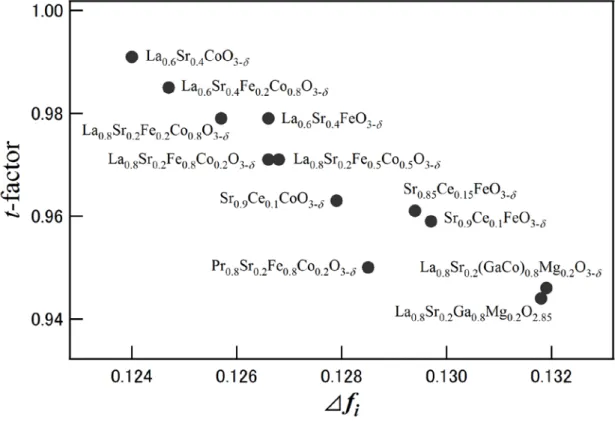
Fig. 3 shows the relationship between the difference of ionicity and the t-factor in A

1-x

A’

x

B

1-y

B’

y

O (A, A’ = La, Ce, Pr, Sr / B, B’ = Fe, Co, Mg, Ga), For the values of t-factor, we have adopted the values reported in [18]. From the figure, we note a correlation between the behaviors of t-factor and ∆ f

i

. We note also that with the decrease of the difference in ionicity, the t-factor approaches to t = 1.

It has been suggested by some authors that good ionic conductors have t-factor at around

0.96 [17]. In the light of Fig. 3, this observation suggests that good ionic conductors should

(9)

have small value of ∆ f

i

. The result shown in Fig. 4 confirms that the conjecture is true. We can see clearly that the ionic conductivity increases with the decrease of ∆ f

i

. It is also consistent with the discussion given in relation to Fig. 2. That is, the ionic conductivity increases with the decrease of Z

A

/ r

A

.

4. Interpretation in terms of the bond fluctuation model

In previous sections we have seen how the ionic conductivity depends on the

potential parameters Z

A

/ r

A

, Z

B

/ r

B

, and on the difference of ionicity. From the analysis,

an important concept to understand the origin of ion transport in perovskite materials was

gained. In this section, the results obtained are discussed in terms of the bond fluctuation

model of superionic conductors [8, 19]. According to the bond fluctuation model, the

superionic behavior is related to a change of bonding that occurs locally and fluctuates in

time. Since the site where change of bonding occurs is unstable, its propagation triggers

new bond fluctuating sites, which result in the correlated ion motions. This kind of ion

dynamics has been firmly confirmed by ab initio molecular dynamics studies performed in

some Cu and Ag halides and chalcogenides [20]. Experimental studies of temperature

dependence of dynamical effective charge also support the existence of bond fluctuation

processes [21]. An important message that we can learn from the model is that the fast ion

movement occurs in sites where different type of bond coexists [8].

(10)

An interesting point that should be noted in Fig. 1 and 2 is that the complex perovskite oxides exhibiting high ionic conduction are located near the demarcation line separating localized and itinerant electrons. This fact has been also noted by another group [22]. This observation is providing a hint to understand the role of electron orbital overlap in the ion transport. As discussed in previous section, the itinerant nature of electron transport changes to a localized nature when the percolation of -B-O-B- covalent bond mediated by d-electrons of B cation is disrupted. According to the bond fluctuation model, such disruption can be triggered by atomic vibration, because the d-electron orbital has a localized nature and its wave function does not spread over long distances. That is, in the light of the bond fluctuation model, the locations of the data points near the localized-itinerant demarcation line can be understood straightly.

5. Conclusion

The classification of the materials in terms of localized and itinerant d-electrons scheme

used for ABO

3

compounds was extended to complex perovskite oxides. Based on the

classification, the relationship between the ionic conduction and the nature of electronic

transport properties has been studied and discussed. It has been found that the complex

perovskite oxides exhibiting high ionic conduction are located near the demarcation line

separating localized and itinerant electrons. Such a characteristic can be understood in terms

of the bond fluctuation model of superionic conductors. Our analysis has also revealed that

(11)

small difference in ionicity between A-O and B-O bonds is favorable for the ionic

conduction.

(12)

References

[1] S.J. Skinner, Int. J. Inorg. Mater. 3 (2001) 113.

[2] K. Huang, J. Wan, J.B. Goodenough, J. Mater. Sci. 36 (2001) 1093.

[3] V.V. Kharton, F.M.B. Marques, A. Atkinson, Solid State Ionics 174 (2004) 135.

[4] T. Ishihara, Bull. Chem. Soc. Jpn. 79 (2006) 1155.

[5] S. Hashimoto, Y. Fukuda, M. Kuhn, K. Sato, K. Yashiro, J. Mizusaki, Solid State Ionics 186 (2011) 37.

[6] J.B. Goodenough, Rep. Prog. Phys. 67 (2004) 1915.

[7] K. Kamata, T. Nakamura, J. Phys. Soc. Jpn. 35 (1973) 1558.

[8] M. Aniya, Integr. Ferroelectr. 115 (2010) 81.

[9] R.D. Shannon, Acta Cryst. A 32 (1976) 751.

[10] J. Richter, P. Holtappels, U. Vogt, T. Graule, L.J. Gauckler, Solid State Ionics 177 (2006) 3105.

[11] H. Ullmann, N. Trofimenko, F. Tietz, D. Stöver, A. Ahmad-Khanlou, Solid State Ionics 138 (2000) 79.

[12] S. Taniguchi, M. Aniya, J. Phys. Soc. Jpn. 79 (Suppl. A) (2010) 106.

[13] P. Byszewski, R. Aleksiyko, M. Berkowski, J. Fink-Finowicki, R. Diduszko, W.

Gebicki, J. Baran, K. Antonova, J. Mol. Struct. 792-793 (2006) 62.

[14] J.C. Phillips, Rev. Mod. Phys. 42 (1970) 317.

[15] H. Li, S. Zhang, S. Zhou, X. Gao, Mater. Chem. Phys. 114 (2009) 451.

(13)

[16] S. Taniguchi, M. Aniya, Integr. Ferroelectr. 115 (2010) 18.

[17] H. Hayashi, H. Inaba, M. Matsuyama, N.G. Lan, M. Dokiya, H. Tagawa, Solid State Ionics 122 (1999) 1.

[18] H. Ullmann, N. Trofimenko, J. Alloys Compd. 316 (2001) 153.

[19] M. Aniya, Solid State Ionics 50 (1992) 125.

[20] M. Aniya, F. Shimojo, Solid State Ionics 177 (2006) 1567.

[21] M. Aniya, K. Wakamura, Solid State Ionics 86-88 (1996) 183.

[22] L.J. Gauckler, D. Beckel, B.E. Buergler, E. Jud, U.P. Muecke, M. Prestat, J.L.M. Rupp,

J. Richter, Chimia 58 (2004) 837.

(14)

Fig. 1. Mapping of perovskite oxides in a space formed by Z

A

/ r

A

and Z

B

/ r

B

. The circle,

triangle and square represent ABO

3

, A

1-x

A’

x

BO

3-δ

and A

1-x

A’

x

B

1-y

B’

y

O

3-δ

compounds,

respectively. The name of the compounds denoted by triangles and squares are given in

Table 1.

(15)

Fig. 2. A three-dimensional representation showing the relationship between the potential

parameters of the cations and the oxygen ionic conductivity at T = 1073 K [11] in complex

perovskite oxides. Gray and hatched vertical bars represent A

1-x

A’

x

BO

3-δ

and

A

1-x

A’

x

B

1-y

B’

y

O

3-δ

compounds, respectively. The symbols denote the compounds given in

Table 1. The full line in the basal plane is the demarcation line between localized and

itinerant ABO

3

compounds shown in Fig. 1.

(16)

Fig. 3. Relationship between the difference of ionicity f

i

and the tolerance factor in

A

1-x

A’

x

B

1-y

B’

y

O

3-δ

(A, A’ = La, Ce, Pr, Sr / B, B’ = Fe, Co, Mg, Ga) compounds.

(17)

Fig. 4. Relationship between the oxygen ionic conductivity at T = 1073 K [11] and the

difference of ionicity ∆ f

i

in A

1-x

A’

x

B

1-y

B’

y

O

3-δ

(A, A’ = La, Pr, Sr / B, B’ = Fe, Co)

compounds.

(18)

Table 1. Compounds added into the map proposed in [7] and showed in Fig. 1. σ

0

are the values of the ionic conductivity at T = 1073 K reported in [11]. Values of the tolerance factors reported in [18] and ∆ f

i

calculated through Eqs. (1) – (5) are also shown.

AA'BO

3-δ ZA

/r

A ZB

/r

B

Δ f

i t-factor

σ

O

[S/cm]

(A1) Sr

0.9

Ce

0.1

CoO

3-δ

1.469 5.361 0.1279 0.963 0.113 (A2) Sr

0.9

Ce

0.1

FeO

3-δ

1.469 5.364 0.1297 0.959 0.064

(A3) La

0.3

Sr

0.7

CoO

3-δ

1.624 4.918 0.76

(A4) La

0.5

Sr

0.5

CoO

3-δ

1.786 4.918 0.093

(A5) La

0.6

Sr

0.4

CoO

3-δ

1.868 5.318 0.1240 0.991 0.22 (A6) La

0.6

Sr

0.4

FeO

3-δ

1.868 5.206 0.1266 0.979 5.6×10

-3

(A7) La

0.65

Sr

0.3

MnO

3-δ

1.938 5.310 0.968 1.7×10

-4

(A8) Pr

0.65

Sr

0.3

MnO

3-δ

1.997 4.831 0.952 3.4×10

-4

AA'BB'O

3-δ ZA

/r

A ZB

/r

B

Δf

i t-factor

σ

O

[S/cm]

(B1) Sr

0.85

Ce

0.15

Fe

0.8

Co

0.2

O

3-δ

1.509 5.574 0.1294 0.967 0.016

(B2) Sr

0.9

Ce

0.1

Fe

0.8

Ni

0.2

O

3-δ

1.469 4.717 0.04

(B3) La

0.65

Sr

0.3

Fe

0.8

Co

0.2

O

3-δ

1.938 4.702 4×10

-3

(B4) La

0.6

Sr

0.4

Fe

0.8

Co

0.2

O

3-δ

1.868 4.702 8×10

-3

(B5) La

0.6

Sr

0.4

Fe

0.2

Co

0.8

O

3-δ

1.868 5.219 0.1247 0.985 0.058

(B6) La

0.8

Sr

0.2

Fe

0.9

Co

0.1

O

3-δ

2.035 4.677 2.2×10

-3

(B7) La

0.8

Sr

0.2

Fe

0.8

Co

0.2

O

3-δ

2.035 4.875 0.1266 0.971 2.3×10

-3

(B8) La

0.8

Sr

0.2

Fe

0.2

Co

0.8

O

3-δ

2.035 4.989 0.1257 0.979 4×10

-2

(B9) Pr

0.8

Sr

0.2

Fe

0.8

Co

0.2

O

3-δ

2.108 4.862 0.1285 0.950 1.54×10

-3

(B10) Pr

0.8

Sr

0.2

Mn

0.8

Co

0.2

O

3-δ

2.108 4.702 3×10

-5

(B11) Pr

0.7

Sr

0.3

Mn

0.8

Co

0.2

O

3-δ

2.012 4.702 4.4×10

-5

Fig. 1. Mapping of perovskite oxides in a space formed by  Z A / r A   and  Z B / r B
Fig. 2.  A three-dimensional  representation showing the relationship  between the potential
Fig.  3.  Relationship between the difference of  ionicity  ∆ f i   and the tolerance factor in  A 1-x A’ x B 1-y B’ y O 3-δ  (A, A’ = La, Ce, Pr, Sr / B, B’ = Fe, Co, Mg, Ga) compounds
Fig.  4.  Relationship between the  oxygen ionic conductivity  at  T  =  1073 K  [11] and the  difference  of  ionicity  ∆ f i   in  A 1-x A’ x B 1-y B’ y O 3-δ   (A, A’  = La, Pr, Sr / B, B’ = Fe, Co)  compounds
+2

参照

関連したドキュメント

The method employed to prove indecomposability of the elements of the Martin boundary of the Young lattice can not be applied to Young-Fibonacci lattice, since the K 0 -functor ring

An easy-to-use procedure is presented for improving the ε-constraint method for computing the efficient frontier of the portfolio selection problem endowed with additional cardinality

Kilbas; Conditions of the existence of a classical solution of a Cauchy type problem for the diffusion equation with the Riemann-Liouville partial derivative, Differential Equations,

We present sufficient conditions for the existence of solutions to Neu- mann and periodic boundary-value problems for some class of quasilinear ordinary differential equations.. We

Analogs of this theorem were proved by Roitberg for nonregular elliptic boundary- value problems and for general elliptic systems of differential equations, the mod- ified scale of

Then it follows immediately from a suitable version of “Hensel’s Lemma” [cf., e.g., the argument of [4], Lemma 2.1] that S may be obtained, as the notation suggests, as the m A

Correspondingly, the limiting sequence of metric spaces has a surpris- ingly simple description as a collection of random real trees (given below) in which certain pairs of

[Mag3] , Painlev´ e-type differential equations for the recurrence coefficients of semi- classical orthogonal polynomials, J. Zaslavsky , Asymptotic expansions of ratios of