Abstract: Spiro[furan-2(3H),1’-(benzocycloalkane)]
derivatives were obtained by the oxidation of methyle- nebenzocycloalkanes with manganese(III) acetate in the presence of 1,3-dicarbonyl compounds. A similar oxida- tion of the benzocycloalkene derivatives produced the benzocycloalka[1,2-b]furans in good yields. However, 1-benzyl-3,4-dihydronaphthalene gave both the corre- sponding spirofuran and benzocyclohexa[1,2-b]furan under the same oxidation conditions. The acid-catalyzed ring-opening reaction of the spirofurans and benzocy- cloalka[1,2-b]furans was also investigated.
Key words: oxidative radical cyclization, spirofurans, benzocycloalka[1,2-b]furans, manganese(III) acetate, dihydronaphthalene
Introduction
The construction of polyfunctionalized furans,1 spiro- furans, and furan-fused cycloalkanes is important from the standpoint of the synthesis of biologically active natural products, such as aflatoxin, asteltoxin, monensin, panacene, and so on,2 which consist of furan rings.3 Especially, the 4,5-dihydrofurans are convenient synthet- ic starting materials since the dihydrofurans can be easily transformed by dehydrogenation or reduction into the corresponding furans or tetrahydrofurans. In recent years, Snider developed the oxidative cyclization reac- tion using manganese(III) acetate in the presence of copper(II) acetate as a co-oxidant,4 and applied it to the total synthesis of many natural products.5 This tech- nique was also applied some natural product syntheses by other groups.6,7 We previously reported the conven- ient synthesis of the 5,5-diaryl-4,5-dihydrofurans using the oxidation of 1,1-diarylethenes with tris(2,4- pentanedionato)manganese(III) or manganese(III) ace- tate in the presence of 1,3-dicarbonyl compounds in boiling acetic acid (Scheme 1).8 Our manganese(III)- based dihydrofuran synthesis does not necessarily re- quire a co-oxidant because of the selection of the starting alkenes and relatively high-temperature reaction condi- tions.7,8 It is also well-known that a similar reaction is carried out at ambient temperature in air in the absence of a co-oxidant, such as copper(II) acetate, to quantita- tively give the 6,6-diaryl-1,2-dioxan-3-ols (Scheme 1).9 In connection with our study of the oxidative radical cyclization, we herein report the facile synthesis of new
*Corresponding author. Tel.: +81-96-342-3374; fax: +81-96-342- 3374; e-mail: [email protected]
types of spiro[furan-2(3H),1’-(benzocycloalkane)] de- rivatives and benzocycloalka[1,2-b]furan derivatives using the manganese(III)-mediated oxidation of methyl- enebenzocycloalkanes and/or benzocycloalkenes in the presence of various 1,3-dicarbonyl compounds.
Results and Discussion
Reaction of 1-Methylenetetralin (1b) with 2,4- Pentanedione in the Presence of Manganese(III) Ace- tate. We first investigated the reaction of 1- methylenetetralin (1b) with 2,4-pentanedione. In order to predominantly undergo the oxidative radical reaction, the mixture was heated in acetic acid, and then manga- nese(III) acetate dihydrate was added just before reflux- ing.8e,8g,10 The mixture was heated under reflux, and the reaction was over in 3 min. After work-up, contrary to our expectations, 3-acetyl-2,9b-dimethyl-3a,4,5,9b- tetrahydronaphtho[1,2-b]furan (4c) was obtained in 74%
yield instead of the desired spiro[furan-2,1’- tetrahydronaphthalene] 2b (Scheme 2). It was postulated that the exo-endo isomerization of 1b occurred under the acidic conditions since the endo isomer 3c is ca. 5 kcal/mol more stable than the exo isomer 1b,11 and then the endo isomer 3c preferentially reacted with 2,4- pentanedione to form 4c. Therefore, the desired 4- acetyl-5-methylspiro[furan-2(3H),1’-(1’,2’,3’,4’-
tetrahydronaphthalene)] (2b) was finally obtained in
Mn(III)-Based One-Pot Synthesis of Spiro- and Benzocycloalka[1,2-b]- furans and Their Acid-Catalyzed Trasformation
Reika Fujinoa and Hiroshi Nishinob*
a Department ofMaterials and Life Science, Graduate School of Science and Technology, Kumamoto University, Kurokami 2-39-1, Kumamoto 860-8555, Japan
b Department of Chemistry, Faculty of Science, Kumamoto University, Kurokami 2-39-1, Kumamoto 860-8555, Japan
OO Ar
Ar R
OH COR
Mn(OAc)3 Ar Ar Mn(OAc)3
O R
COR Ar
Ar AcOH
reflux
AcOH air, r.t.
Scheme 1 Ar
Ar
Mn(acac)3 AcOH air, r.t.
R = Me Mn(acac)3
AcOH reflux R = Me
R R
O O
68% yield by the simultaneous heating of the exo isomer 1b, 2,4-pentanedione, and manganese(III) acetate in
acetic acid before the exo-endo isomerization.
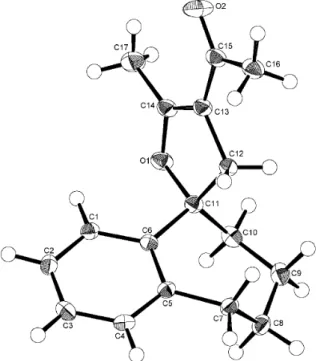
Synthesis of Spiro[furan-2(3H),1’-(2- benzocycloalkane)] Derivatives 2a-j. Since we found the reaction conditions for the formation of spirofuran 2b, a similar oxidation of other methylenebenzocycloalkanes 1a,c,d was carried out in the presence of various 1,3- dicarbonyl compounds (Scheme 3). As a result, the corresponding spirofurans 2a,c-i were obtained in the yields shown in Table 1. When 1-phenylbutane-1,3- dione was used in the reaction of 1b, two types of spiro- furan were produced (Table 1, entries 5,6). One was a 4- acetyl-5-phenylspirofuran 2e cyclized at the benzoyl oxygen, and the other was a 4-benzoyl-5- methylspirofuran 2f annulated at the acetyl oxygen. The trisubstituted alkene such as 9-benzylidene-9H-xanthene (1d) also gave the corresponding spirofuran derivatives 2h and 2i, however, the yields were moderate to fair (Entries 8,9).8a The structure of the obtained spirofurans 2a-i was determined by spectroscopic methods and ele- mental analysis. The spirofuran skeleton was so interest- ing that the exact structures of 2b, 2g, and 2h were elu- cidated by X-ray crystallography. The single crystals of 2b, 2g, and 2h were successfully grown as a racemic mixture from diethyl ether-hexane, and each ORTEP diagram was obtained after crystallographic analysis (Figures 1-1, 1-2, and 1-3) (see also Experimental Sec- tion). The bond angles of O1-C10-C6, O1-C10-C9, and O1-C10-C11 in 2b appeared as 105.9(1)°, 106.3(1)°, and 103.6(1)°, respectively, while those of C6-C10-C9, C6- C10-C11, and C9-C10-C11 showed 112.2(1)°, 114.4(2)°, and 113.5(2)°, respectively.
Table 1 Reaction of Methylenebenzocycloalkanes 1a-d with Various 1,3-Dicarbonyl Compounds in the Presence of Manganese(III) Acetatea
1,3-Dicarbonyl
compound Product Entry
Methylenebe nzocycloalka
ne R1 R2 (yield/%)b
1 1a: n = 1 Me Ac 2a (72)
2 1b: n = 2 Me Ac 2b (68)
3 1b: n = 2 Me CO2Me 2c (70) 4 1b: n = 2 Me CO2Et 2d (71)
5 1b: n = 2 Ph Ac 2e (39)
6 1b: n = 2 Me Bz 2f (18)
7 1c: n = 3 Me Ac 2g (75)
8 1d Me Ac 2h (19)
9 1d Me CO2Me 2i (39)
a The reaction was carried out in boiling acetic acid (50 mL) at the molar ratio of methylenebenzocycloalkane 1:1,3-dicarbonyl compound:Mn(OAc)3 = 1:3.5:3.
b Isolated yield based on the methylenebenzocycloalkane 1 used.
O
Me Ac
O Me Me Ac
2b 4c (74%)
Scheme 2
1) 2,4-Pentanedione heat
2) Mn(OAc)3, reflux Me
1b 3c
Scheme 3
n
O R2 R1
n
R1 R2 O
Mn(OAc)3 AcOH reflux, 3 min
: R1 = Me, R2 = Ac, n = 1 : R1 = Me, R2 = Ac, n = 2 : R1 = Me, R2 = CO2Me, n = 2 : R1 = Me, R2 = CO2Et, n = 2 : R1 = Ph, R2 = Ac, n = 2 : R1 = Me, R2 = Bz, n = 2 : R1 = Me, R2 = Ac, n = 3 2a
2b 2c 2d 2e 2f 2g 1a : n = 1
1b : n = 2 1c : n = 3
1a-c 2a-g
O Ph
O
O R1 R2
Ph
1d
2h 2i
: R1 = Me, R2 = Ac : R1 = Me, R2 = CO2Me R1 R2
O
Mn(OAc)3 AcOH reflux, 3 min
2h,i
Reaction of Benzocycloalkenes 3a-g with 2,4- Pentanedione in the Presence of Manganese(III) Ace- tate. In order to construct a consecutive ring system including the furan ring, we applied the current reaction to benzene-fused cycloalkenes 3a-g. The reaction of 3- phenyl-1H-indene (3a) with 2,4-pentanedione was con- ducted in the presence of manganese(III) acetate under similar conditions used in the case of the methyleneben- zoalkanes 1. After the usual work-up, the desired 4,8b- dihydro-3aH-indeno[1,2-b]furan 4a was produced in 67% yield (Scheme 4 and Table 2, entry 1). Other ben- zocycloalkenes 3b-f also gave the corresponding benzo- cycloalka[1,2-b]furan derivatives 4b-f in good yields (Entries 2-6). When 4-benzyl-1,2-dihydronaphthalene (3g) was used in the oxidation with 2,4-pentanedione, the desired benzocyclohexa[1,2-b]furan 4g was obtained in 36% yield along with spirofuran 2j in 25% yield (Scheme 5 and Entry 7). This phenomenon was also
explained by the endo-exo isomerization of 3g similar to the case between 1b and 3c. In fact, the formation ener gy of the endo–alkene 3g (49.1 kcal/mol) was similar to that of the exo isomer (49.4 kcal/mol) based on PM3 calculations.11 The structures of the benzocycloalka[1,2- b]furans 4a-g were characterized by spectroscopic meth- ods and elemental analysis. Especially, the exact struc- ture of 4d was ascertained by X-ray crystallography, and it was confirmed that the stereochemistry of the ring
Table 2 Reaction of Benzocycloalkenes 3a-g with 2,4- Pentanedione in the Presence of Manganese(III) Acetatea En
try Benzocycloalkene Product
(yield/%)b
1 3a: R = Ph n = 1 4a (67)
2 3b: R = 1-Naphthyl n = 1 4b (52)
3 3c: R = Me n = 2 4c (74)
4 3d: R = Ph n = 2 4d (56)
5 3e: R = 1-Naphthyl n = 2 4e (82) 6 3f: R = Ph n = 3 4f (92) 7 3g: R = Bn n = 2 2j (25), 4g (36)
a The reaction was carried out in boiling acetic acid (50 mL) at the molar ratio of benzocycloalkene 3:2,4- pentanedione:Mn(III) = 1:3.5:3.
b Isolated yield based on the benzocycloalkene 3 used.
Figure 1-1. ORTEP Drawing of 2b (R1 = Me, R2 = Ac, n = 2)
n
R
3a-g
n
R O
Me Ac
4a-g Me
O
Mn(OAc)3 AcOH
reflux 3 min
Me O
a b c d e f g
: R = Ph, n = 1
: R = 1-Naphthyl, n = 1 : R = Me, n = 2
: R = Ph, n = 2
: R = 1-Naphthyl, n = 2 : R = Ph, n = 3
: R = Bn, n = 2 Scheme 4
O Me Ac
Ph O
Bn Ac
Me +
Me O
Mn(OAc)3 AcOH
reflux 5 min
Me O 3g
2j (25%) 4g (36%) Scheme 5
Figure 2. ORTEP Drawing of 4d (R = Ph, n = 2)
junction of 4d was a cis-fused configuration (Figure 2).
Acid-Catalyzed Reaction of the Spirofurans and Ben- zocycloalka[1,2-b]furans. Recently, we reported the acid-catalyzed decomposition of the dihydrofuran de- rivatives giving the corresponding 4-hydroxy-3-penten- 2-ones.12 Therefore, in order to transform the dihydro- furan ring of the spirofurans 2 or benzocycloalka[1,2- b]furans 4 into a 2-oxo-4-hydroxy-3-penten-3-yl func- tionality, we carried out the acid-catalyzed reaction of spirofuran 2b in dry benzene at the reflux temperature (Scheme 6). Contrary to our expectation, the methyle- netetralin 5b was not obtained, but benzoindene 6 was isolated in 48% yield. Probably, the dihydrofuran ring of 2b was opened once to give the corresponding tetralin 5b, which would be then recyclized under acidic condi- tions to produce benzoindene 6.
However, the dihydronaphthalenes 5d and 5e having a 2- oxo-4-hydroxy-3-penten-3-yl functionality were ob-
tained by the acid-catalyzed decomposition of the ben- zocyclohexa[1,2-b]furans 4d and 4e, respectively (Scheme 7). Very surprisingly, a similar reaction of benzocyclohepta[1,2-b]furan 4f gave benzocyclo- hepta[a]naphthalene 7 probably through the ring- opening A, retro-Claisen deacetylation B, followed by recyclization (Scheme 8).
In conclusion, a convenient one-pot synthesis of functional- ized spirofuran derivatives 2a-i and benzocycloalka[1,2- b]furans 4a-g was demonstrated using the manganese(III)- mediated oxidative radical cyclization. In addition, ring assembly could be achieved by the manipulative use of the acid-catalyzed reaction of spirofuran 2b and benzocyclo- hepta[1,2-b]furan 4f.
Experimental
Measurements. All the melting points were determined using a Yanaco micromelting point apparatus MP-J3 and were uncorrected. All of the NMR spectra were record- ed on a JNM-AL 300 FT NMR spectrometer (300 MHz for 1H and 75 MHz for 13C) with tetramethylsilane as the internal standard. The chemical shifts are shown in δ (ppm) and the coupling constants in Hz. The IR spectra were measured using a Shimadzu FTIR-8400 spetrome- ter. The IR spectral data are expressed in cm-1. The mass spectra were measured on a Shimadzu GCMS- QP5050A at an ionizing voltage of 70 eV. High resolu- tion mass spectra were recorded using a JMS-HX110A mass spectrometer. Elemental analyses were performed at the Center of Instrumental Analysis Center, Kuma- moto University, Kumamoto, Japan.
Materials. Manganese(III) acetate dihydrate, Mn(OAc)3•2H2O, was prepared according to the litera- ture method.13 The alkenes were prepared by the Wittig reaction of the corresponding carbonyl compounds with O
Me O
Me H
O Me O Me
Ac Me p-TsOH dry benzene
reflux, 18 h
-H2O 2b
6 (48%) 5b
Scheme 6
Ar O Ac
Me
Ar
Me O
O Me p-TsOH H
dry benzene reflux
36 h 4d
4e
5d (73%) 5e (91%) d : Ar = Ph
e : Ar = 1-Naphthyl Scheme 7
PhO Me
Ac
O O Me Me Ph
O Me Ph Me
-AcOH
-H2O 4f
7 (53%)
A
B p-TsOH
dry benzene reflux, 36 h
Scheme 8
methyltriphenyl phosphonium bromide. Acetylacetone, methyl acetoacetate, and ethyl acetoacetate were pur- chased from Wako Pure Chemical Ind., Ltd., and were used as received. Benzoylacetone was purchased from Tokyo-Kasei Co., Ltd., and was used as received.
Manganese(III)-Mediated Oxidative Radical Cycliza- tion of Alkenes with 1,3-Dicarbonyl Compounds. A mixture of methylenebenzocycloalkane 1 or benzocy- cloalkene 3 (1 mmol), 1,3-dicarbonyl compound (3.5 mmol), and manganese(III) acetate dihydrate (3 mmol) was heated under reflux in acetic acid (50 ml) with stir- ring until the dark-brown color of Mn(III) disappeared (normally within 3 min). The solvent was removed in vacuo and the residue was treated with 2 M hydrochloric acid (50 mL), followed by extraction with dichloro- methane (20 x 3 mL). The combined extract was washed with water, followed by a saturated aqueous solution of sodium hydrogencarbonate, and dried over anhydrous magnesium sulfate. The products were sepa- rated by silica gel TLC (Wakogel B-10) using chloro- form or diethyl ether-hexane (4:6-8:2 v/v) as the devel- oping solvent. The yields are summarized in Table 1 and Table 2. The analytical samples were further puri- fied by recrystallization from the appropriate solvent mentioned below except for the liquid products.
4-Acetyl-5-methylspiro[furan-2(3H),1’-(2’,3’-
dihydroindene)] (2a): Rf = 0.52 (7:3 diethyl ether- hexane); yellow liquid, IR (neat) ν 1593 (C=O); 1H NMR (CDCl3) δ7.37-7.19 (4H, m, arom H), 3.34 (1H, dq, J = 14.5, 1.47 Hz, CHaHb), 3.12 (1H, dq, J = 14.7, 1.47 Hz, CHaHb), 3.07 (1H, dd, J = 15.8, 7.92 Hz, CHcHd), 2.88 (1H, dq, J = 16.0, 3.86 Hz, CHeHf), 2.51 (1H, dq, J
= 13.6, 3.86 Hz, CHeHf), 2.26-2.14 (1H, m, CHcHd), 2.24 (3H, s, COCH3), 2.22 (3H, t, J = 1.47 Hz, CH3); 13C NMR (CDCl3) δ 194.3 (C=O), 166.5 (C-5), 144.1, 143.7 (arom C), 129.2, 127.2, 124.9, 122.9 (arom CH), 111.8 (C-4), 96.1 (C-2(1’)), 41.5 (C-3), 40.8 (C-2’), 29.6 (C- 3’), 29.4 (COCH3), 15.3 (CH3); MS m/z (rel intensity), 228 (M+, 67), 210 (28), 195 (19), 167 (100), 141 (38), 128 (41), 113 (79), 43 (98); FAB HRMS found m/z 228.1153, calcd for C15H16O2 M+, 228.1150.
4-Acetyl-5-methylspiro[furan-2(3H),1’-(1’,2’,3’,4’- tetrahydronaphthalene)] (2b): Rf = 0.70 (8:2 diethyl ether-hexane); colorless plates (from diethyl ether), mp 62.0-64.0 ºC; IR (CHCl3) ν 1663 (C=O); 1H NMR (CDCl3) δ7.39-7.04 (4H, m, arom H), 3.13 (2H, ddq, J = 54.8, 14.3, 1.47 Hz, CH2), 2.92-2.72 (2H, m, CH2), 2.30 (3H, t, J = 1.47 Hz, CH3), 2.22 (3H, s, COCH3), 2.16- 1.77 (4H, m, CH2 x 2); 13C NMR (CDCl3) δ 194.5 (C=O), 166.8 (C-5), 139.5, 136.4 (arom C), 128.8, 127.9, 126.7, 126.2 (arom CH), 111.2 (C-4), 87.2 (C-2(1’)), 45.7 (C-3), 36.7 (C-2’), 29.5 (COCH3), 29.3 (C-4’), 19.8 (C-3’), 15.3 (CH3); MS m/z (rel intensity), 242 (M+, 24), 224 (12), 199 (14), 182 (33), 181 (59), 167 (15), 141
(11), 128 (23), 115 (18), 43 (100). Anal. Calcd for C16H18O2: C, 79.31; H, 7.49. Found: C, 79.38; H, 7.50.
X-ray crystallographic data of 2b: empirical formula C32H36O4; formula weight 484.63; colorless, platelet;
crystal dimensions 0.30 x 0.40 x 0.10 mm; monoclinic;
primitive; space group P21/c (# 14); lattice parameters a
= 9.2579(4) Å, b = 17.3043(9) Å, c = 16.2643(8) Å, β = 101.235(1)°, V = 2555.6(2) Å3, Z = 4; Dcalcd = 1.259 g cm-3; F000 = 1040.00; µ (Mo Kα) = 0.81 cm-1; 2θmax = 55.0°; no. of reflections measured total: 17591, unique:
5768 (Rint = 0.057); no. observations (I > 3.00σ (I)) 3297; no. variables 470; reflection/parameter ratio 7.01;
R = 0.040; Rw = 0.047. The X-ray crystallographic data have been deposited as supplementary publication num- ber CCDC249340. Copies of the data can be obtained, free of charge, on application to CCDC, 12 Union Road, Cambridge, CB2 1EZ, UK [fax: +44(0)-1223-336033 or e-mail: [email protected].
4-Methoxycarbonyl-5-methylspiro[furan-2(3H),1’- (1’,2’,3’,4-tetrahydronaphthalene)] (2c): Rf = 0.64 (5:5 diethyl ether-hexane); colorless plates (from hexane), mp 74.0-76.0 ºC; IR (CHCl3) ν 1687 (C=O); 1H NMR (CDCl3) δ 7.38-7.01 (4H, m, arom H), 3.70 (3H, s, COOCH3), 3.06 (2H, ddq, J = 55.9, 14.7, 1.47 Hz, CH2), 2.87-2.68 (2H, m, CH2), 2.26 (3H, t, J = 1.47 Hz, CH3), 2.15-1.72 (4H, m, CH2 x 2); 13C NMR (CDCl3) δ 167.2 (C=O), 166.5 (C-5), 139.7, 136.4 (arom C), 128.8, 127.8, 126.7, 126.3 (arom CH), 100.5 (C-4), 87.1 (C-2(1’)), 50.7 (COOCH3), 44.9 (C-3), 36.7 (C-2’), 29.3 (C-4’), 19.8 (C-3’), 14.3 (CH3); MS m/z (rel intensity), 258 (M+, 34), 226 (89), 211 (69), 208 (19), 183 (66), 155 (74), 153 (27), 128 (55), 115 (37), 43 (100). Anal. Calcd for C16H18O3: C, 74.39; H, 7.02. Found: C, 74.25; H, 7.10.
4-Ethoxycarbonyl-5-methylspiro[furan-2(3H),1’-
(1’,2’,3’,4’-tetrahydronaphthalene)] (2d): Rf = 0.63 (5:5 diethyl ether-hexane); colorless liquid; IR (CHCl3) ν 1682 (C=O); 1H NMR (CDCl3) δ7.39-7.02 (4H, m, arom H), 4.18 (2H, q, J = 7.17 Hz, COOCH2CH3), 3.07 (2H, ddq, J = 54.0, 14.7, 1.47 Hz, CH2), 2.89-2.66 (2H, m, CH2), 2.26 (3H, t, J = 1.47 Hz, CH3), 2.12-1.74 (4H, m, CH2 x 2), 1.28 (3H, t, J = 7.17 Hz, COOCH2CH3); 13C NMR (CDCl3) δ 166.9 (C=O), 166.1 (C-5), 139.8, 136.3 (arom C), 128.7, 127.8, 126.6, 126.3 (arom CH), 100.7 (C-4), 86.9 (C-2(1’)), 59.4 (COOCH2CH3), 45.0 (C-3), 36.7 (C-2’), 29.3 (C-4’), 19.8 (C-3’), 14.5 (CH3), 14.3 (COOCH2CH3); MS m/z (rel intensity), 272 (M+, 22), 226 (72), 211 (51), 183 (50), 155 (53), 153 (19), 128 (40), 115 (29), 43 (100); FAB HRMS found m/z 273.1513, calcd for C17H21O3 M+1, 273.1491.
4-Acethyl-5-phenylspiro[furan-2(3H),1’-(1’,2’,3’,4’- tetrahydronaphthalene)] (2e):
Rf = 0.30 (2:8 diethyl ether-hexane); light yellow liquid, IR (CHCl3) ν 1618 (C=O); 1H NMR (CDCl3) δ7.64-7.06 (9H, m, arom H), 3.33 (2H, dd, J = 55.4, 15.2 Hz, CH2), 2.92-2.73 (2H, m, CH2), 2.29-1.78 (4H, m, CH2 x 2), 2.01 (3H, s, COCH3); 13C NMR (CDCl3) δ 194.4 (C=O),
165.2 (C-5), 139.4, 136.5, 131.1 (arom C), 130.5, 129.2 (2C), 128.8, 128.2 (2C), 127.9, 126.7, 126.3 (arom CH), 113.7 (C-4), 87.1 (C-2(1’)), 46.4 (C-3), 36.6 (C-2’), 29.3 (C-4’), 29.0 (COCH3), 19.6 (C-3’); MS m/z (rel inten- sity), 304 (M+, 12), 286 (14), 244 (26), 128 (15), 115 (22), 105 (100), 77 (41), 43 (37); FAB HRMS found m/z 305.1543, calcd for C21H21O2 M+1, 305.1542.
4-Benzoyl-5-methylspiro[furan-2(3H),1’-(1’,2’,3’,4’- tetrahydronaphthalene)] (2f):
Rf = 0.45 (2:8 diethyl ether-hexane); colorless liquid; IR (CHCl3) ν 1599 (C=O); 1H NMR (CDCl3) δ7.64-7.05 (9H, m, arom H), 3.28 (2H, ddq, J = 65.7, 14.7, 1.47 Hz, CH2), 2.94-2.69 (2H, m, CH2), 2.20-1.75 (4H, m, CH2 x 2), 1.91 (3H, t, J = 1.47 Hz, CH3); 13C NMR (CDCl3) δ 193.0 (C=O), 168.0 (C-5), 141.1, 139.4, 136.5 (arom C), 130.8, 128.8, 128.2 (2C), 127.9, 127.7 (2C), 126.7, 126.3 (arom CH), 111.5 (C-4), 87.4 (C-2(1’)), 46.1 (C-3), 36.5 (C-2’), 29.2 (C-4’), 19.8 (C-3’), 15.8 (CH3); MS m/z (rel intensity), 304 (M+, 12), 286 (14), 244 (32), 128 (18), 115 (14), 105 (100), 91 (14), 77 (44), 43 (23); FAB HRMS found m/z 305.1543, calcd for C21H21O2 M+1, 305.1542.
4-Acetyl-5-methylspiro[furan-2(3H),1’-(1’,2’,3’,4’,5’- pentahydrobenzocycloheptane) (2g): Rf = 0.32 (5:5 diethyl ether-hexane); colorless prisms (from hexane), mp 74.0-75.5 ºC; IR (CHCl3) ν 1669 (C=O); 1H NMR (CDCl3) δ7.42-7.35 (1H, m, arom H), 7.22-7.08 (3H, m, arom H), 3.48 (1H, dq, J = 14.13, 1.47 Hz, CHa1Hb1), 2.95-2.72 (3H, m, CH2, CHa1Hb1), 2.37 (3H, t, J = 1.47 Hz, CH3), 2.19 (3H, s, COCH3), 2.10-1.89 (5H, m, CH2 x 2, CHa2Hb2), 1.50-1.29 (1H, m, CHa2Hb2); 13C NMR (CDCl3) δ 194.1 (C=O), 165.2 (C-5’), 145.1, 139.0 (arom C), 130.8, 127.3, 126.1, 123.8 (arom CH), 111.9
(C-4’), 92.1 (C-5(2’)), 40.2 (C-3’), 38.3 (C-4), 36.3 (C- 2), 29.2 (COCH3), 27.5 (C-1), 25.8 (C-3), 15.0 (CH3);
MS m/z (rel intensity), 256 (M+, 6), 238 (10), 214 (26), 196 (21), 195 (32), 169 (23), 167 (10), 141 (21), 128 (24), 115 (20), 91 (10), 43 (100). Anal. Calcd for C17H20O2: C, 79.65; H, 7.86. Found: C, 79.63; H, 8.01.
X-ray crystallographic data of 2g: empirical formula C16H18O2; formula weight 242.32; colorless, prism; crys- tal dimensions 0.50 x 0.40 x 0.03 mm; orthorhombic;
primitive; space group Pbca (# 61); lattice parameters a
= 8.4382(2) Å, b = 16.0661(5) Å, c = 20.4929(4) Å, V = 2778.2(1) Å3, Z = 8; Dcalcd = 1.159 g cm-3; F000 = 1040.00; µ (Mo Kα) = 0.75 cm-1; 2θmax = 54.6°; no. of reflections measured total: 25293, unique: 3134 (Rint = 0.040); no. observations (I > 3.00σ (I)) 2152; no. vari- ables 252; reflection/parameter ratio 8.54; R = 0.035; Rw
= 0.046. The X-ray crystallographic data have been deposited as supplementary publication number CCDC249341. Copies of the data can be obtained, free of charge, on application to CCDC, 12 Union Road, Cambridge, CB2 1EZ, UK [fax: +44(0)-1223-336033 or e-mail: [email protected].
4-Acetyl-5-methyl-3-phenylspiro[furan-2(3H),9’-
xanthene] (2h)8a: Rf = 0.51 (5:5 diethyl ether-hexane);
colorless prisms (from ethanol), mp 142.5-143.5 ºC (lit,8a mp 141 ºC); IR (CHCl3) ν 1669 (C=O); 1H NMR (CDCl3) δ7.51-6.67 (13H, m, arom H), 4.43 (1H, q, J = 1.47 Hz, CH), 2.69 (3H, d, J = 1.47 Hz, CH3) 1.78 (3H, s, COCH3); 13C NMR (CDCl3) δ 196.0 (C=O), 169.1 (C-5), 150.2, 149.3, 138.3 (2C), 121.4 (arom C), 129.2, 128.8, 128.3, 128.0 (2C), 127.1, 126.8 (2C), 124.1, 123.9, 122.5, 116.9, 115.7 (arom CH), 112.1 (C-4), 86.3 (C-2(9’)), 65.2 (C-3), 29.6 (COCH3), 14.8 (CH3); MS m/z (rel in- tensity), 368 (M+, 9), 350 (7), 325 (100), 310 (17), 281 (33), 197 (24), 181 (43), 152 (9), 129 (27), 77 (10), 43 (44).
X-ray crystallographic data of 2h: empirical formula C25H20O3; formula weight 368.43; colorless, prism; crys-
Figure 1-2. ORTEP Drawing of 2g (R1 = Me, R2 = Ac, n = 3) Figure 1-3. ORTEP Drawing of 2h (R1 = Me, R2 = Ac)
tal dimensions 0.30 x 0.40 x 0.10 mm; monoclinic;
primitive; space group P21/n (# 14); lattice parameters a
= 11.0904(4) Å, b = 10.9721(4) Å, c = 15.6705(5) Å, β = 93.0893(8)°, V = 1904.1(1) Å3, Z = 4; Dcalcd = 1.285 g cm-3; F000 = 776.00; µ (Mo Kα) = 0.83 cm-1; 2θmax = 55.0°; no. of reflections measured total: 16107, unique:
4357 (Rint = 0.030); no. observations (I > 3.00σ (I)) 3627; no. variables 334; reflection/parameter ratio 10.86;
R = 0.042; Rw = 0.065. The X-ray crystallographic data have been deposited as supplementary publication num- ber CCDC249342. Copies of the data can be obtained, free of charge, on application to CCDC, 12 Union Road, Cambridge, CB2 1EZ, UK [fax: +44(0)-1223-336033 or e-mail: [email protected].
4-Methoxycarbonyl-5-methyl-3-phenylspiro[furan- 2(3H),9’-xanthene] (2i): Rf = 0.61 (5:5 diethyl ether- hexane); colorless microcrystals (from ethanol), mp 151.0-152.5 ºC; IR (CHCl3) ν 1697 (C=O); 1H NMR (CDCl3) δ7.50-6.64 (13H, m, arom H), 4.41 (1H, q, J = 1.47 Hz, CH), 3.48 (3H, s, COOCH3), 2.66 (3H, d, J = 1.47 Hz, CH3); 13C NMR (CDCl3) δ 169.2 (C=O), 166.1 (C-5), 150.2, 149.2, 138.5, 126.8, 121.5 (arom C), 129.1, 128.6, 127.9 (2C), 127.6 (2C), 126.9, 126.5, 124.2, 123.8, 122.4, 116.7, 115.6 (arom CH), 103.0 (C-4), 86.1 (C- 2(9’)), 64.2 (C-3), 50.9 (COOCH3), 14.2 (CH3); MS m/z (rel intensity), 384 (M+, 17), 366 (12), 341 (24), 309 (13), 281 (100), 205 (12), 180 (15), 152 (14), 128 (18), 43 (13).
4-Acetyl-5-methyl-3-phenylspiro[furan-2(3H),1’-
(1’,2’,3’,4’-tetrahydronaphthalene)] (2j): Rf = 0.33 (2:8 diethyl ether-hexane); colorless needles (from ethanol), mp 111.0-112.0 ºC; IR (CHCl3) ν 1665 (C=O); 1H NMR (CDCl3) δ7.64-7.57 (1H, m, arom H), 7.41-7.00 (8H, m, arom H), 4.68 (1H, q, J = 1.10 Hz, CH), 2.79-2.56 (2H, m, CH2), 2.41 (3H, d, J = 1.10 Hz, CH3), 1.85 (3H, s, COCH3), 1.77-1.60 (2H, m, CH2), 1.57-1.42 (2H, m, CH2); 13C NMR (CDCl3) δ 195.1 (C=O), 168.4 (C-5), 140.5, 139.8, 136.7 (arom C), 130.2 129.1, 128.4 (2C), 128.3 (2C), 127.3, 127.0, 125.5 (arom) CH, 115.8 (C-4), 89.5 (C-2(1’)), 60.3 (C-3), 33.3 (C-4’), 29.6 (COCH3), 29.3 (C-2’), 19.4 (C-3’), 15.3 (CH3); MS m/z (rel inten- sity), 318 (M+, 20), 300 (17), 275 (22), 258 (48), 147 (16), 129 (47), 115 (14), 91 (23), 43 (100). Anal. Calcd for C22H22O2: C, 82.99; H, 6.96. Found: C, 83.23; H, 7.08.
3-Acetyl-2-methyl-8b-phenyl-3aH-
benzo[d]cyclopenta[1,2-b]furan (4a): Rf = 0.42 (5:5 diethyl ether-hexane); yellow prisms (from ethanol), mp 74.5–76.0 °C; IR (neat) ν 1620 (C=O); 1H NMR (CDCl3) δ7.35-7.13 (9H, m, arom H), 4.01 (1H, dsex, J
= 8.27, 1.29 Hz, CH), 3.57 (1H, q, J = 8.45 Hz, CHaHb), 3.15 (1H, dd, J = 16.9, 2.57 Hz, CHaHb), 2.28 (3H, d, J = 1.29 Hz, CH3), 2.22 (3H, s, COCH3); 13C NMR (CDCl3) δ 194.1 (C=O), 166.5 (C-2), 143.7, 143.5, 143.0 (arom C), 129.4, 128.4 (2C), 127.5, 127.4 , 125.6, 125.2, 124.9
(2C) (arom CH), 117.1 (C-3), 100.6 (C-8b), 55.5 (C-3a), 39.1 (C-4), 29.4 (COCH3), 15.4 (CH3); MS m/z (rel in- tensity), 290 (M+, 97), 271 (10), 247 (24), 229 (65), 215 (19), 202 (58), 189 (15), 115 (15), 77 (14), 43 (100).
Anal. Calcd for C20H18O2: C, 82.73; H, 6.25. Found: C, 82.72; H, 6.21.
3-Acetyl-2-methyl-8b-(1-naphthyl)-3aH-
benzo[d]cyclopenta[1,2-b]furan (4b): Rf = 0.54 (7:3 diethyl ether-hexane); colorless prisms (from ethanol), mp 202.0–204.0 °C; IR (neat) ν 1614 (C=O); 1H NMR (CDCl3) δ8.20-6.85 (11H, m, arom H), 4.33 (1H, d, J = 7.34 Hz, CH), 3.83 (1H, br s, CHaHb), 3.27 (1H, dd, J = 17.1, 2.20 Hz, CHaHb), 2.34 (3H, s, COCH3), 2.22 (3H, s, CH3); 13C NMR (CDCl3) δ 194.4 (C=O), 166.2 (C-2), 143.0, 134.6 (arom C), 129.5 (2C), 129.4, 129.2 (2C), 127.4, 126.0, 125.6, 125.3, 124.7, 124.3 (arom CH), 118.2 (C-3), 101.5 (C-8b), 53.9 (C-3a), 40.3 (C-4), 29.5 (COCH3), 15.5 (CH3); MS m/z (rel intensity), 340 (M+, 18), 298 (17), 253 (47), 212 (7), 170 (7), 43 (100). Anal.
Calcd for C24H20O2: C, 84.68; H, 5.92. Found: C, 84.64;
H, 5.94.
3-Acetyl-2,9b-dimethyl-3aH-benzo[e]cyclohexa[1,2- b]furan (4c): Rf = 0.28 (5:5 diethyl ether-hexane); col- orless plates (from diethyl ether), mp 61.0-62.5 ºC; IR (CHCl3) ν 1612 (C=O); 1H NMR (CDCl3) δ7.59-7.50 (1H, m, arom H), 7.33-7.07 (3H, m, arom H), 3.12 (1H, dd, J = 10.84, 5.14 Hz, CH), 2.77-2.48 (2H, m, CH2), 2.37-2.15 (1H, m, CHaHb), 2.33 (3H, s, COCH3), 2.30 (3H, s, CH3), 1.55 (3H, s, CH3), 1.44-1.24 (1H, m, CHaHb); 13C NMR (CDCl3) δ 194.4 (C=O), 166.5 (C-2), 137.7, 137.4 (arom C), 128.1, 127.6, 127.3, 126.7 (arom CH), 117.6 (C-3), 85.9 (C-9b), 49.4 (C-3a), 29.6 (COCH3), 29.3 (CH3), 28.4 (C-5), 27.9 (C-4), 15.8 (CH3); MS m/z (rel intensity), 242 (M+, 24), 227 (9), 209 (15), 181 (27), 165 (12), 142 (86), 128 (18), 115 (17), 43 (100). Anal. Calcd for C16H18O2: C, 79.31; H, 7.49.
Found: C, 79.24; H, 7.48.
3-Acetyl-2-methyl-9b-phenyl-3aH-
benzo[e]cyclohexa[1,2-b]furan (4d): Rf = 0.33 (5:5 diethyl ether-hexane); colorless prisms (from ethanol), mp 160.0-160.5 ºC; IR (CHCl3) ν 1619 (C=O); 1H NMR (CDCl3) δ 7.32-7.05 (9H, m, arom H), 3.50 (1H, ddd, J = 10.09, 5.32, 0.92 Hz, CH), 2.87-2.80 (2H, m, CH2), 2.43- 2.32 (1H, m, CHaHb), 2.40 (3H, d, J = 0.92 Hz, CH3), 2.24 (3H, s, COCH3), 1.72-1.57 (1H, m, CHaHb); 13C NMR (CDCl3) δ 194.2 (C=O), 166.8 (C-2), 146.9, 138.2, 137.3 (arom C), 129.9, 128.2 (2C), 128.1, 127.8, 127.1, 126.8, 124.8 (2C) (arom CH), 117.3 (C-3), 89.2 (C-9b), 52.0 (C-3a), 29.4 (COCH3), 28.2 (C-5), 27.9 (C-4), 15.5 (CH3); MS m/z (rel intensity), 304 (M+, 46), 262 (12), 243 (19), 228 (18), 217 (18), 204 (65), 91 (12), 43 (100).
Anal. Calcd for C21H20O2: C, 82.86; H, 6.62. Found: C, 82.82; H, 6.65.
X-ray crystallographic data of 4d: empirical formula C21H20O2; formula weight 304.39; colorless, prism; crys-
tal dimensions 0.15 x 0.40 x 0.40 mm; orthorhombic;
primitive; space group Pbca (# 61); lattice parameters a
= 13.9736(3) Å, b = 28.6550(8) Å, c = 8.0136(2) Å, V = 3208.8(1) Å3, Z = 8; Dcalcd = 1.260 g cm-3; F000 = 1296.00; µ (Mo Kα) = 0.79 cm-1; 2θmax = 55.0°; no. of reflections measured total: 23073, unique: 3630 (Rint = 0.041); no. observations (I > 2σ (I)) 2884; no. variables 289; reflection/parameter ratio 9.98; R = 0.066; Rw = 0.188. The X-ray crystallographic data have been de- posited as supplementary publication number CCDC249343. Copies of the data can be obtained, free of charge, on application to CCDC, 12 Union Road, Cambridge, CB2 1EZ, UK [fax: +44(0)-1223-336033 or e-mail: [email protected].
3-Acetyl-2-methyl-9b-(1-naphthyl)-3aH-
benzo[e]cyclohexa[1,2-b]furan (4e): Rf = 0.61 (8:2 diethyl ether-hexane); yellow prisms (from ethanol), mp 182.0–184.0 °C; IR (neat) ν 1587 (C=O); 1H NMR (CDCl3) δ7.81 (2H, t, J = 6.98 Hz, arom H7.72 (1H, d, J
= 6.98 Hz, arom H7.53-7.15 (6H, m, arom H), 6.93 (1H, t, J = 7.72 Hz, arom H 6.74 (1H, d, J = 7.72 Hz, arom H3.88 (1H, br s, CH), 3.00-2.82 (2H, m, CH2), 2.43 (3H, s, CH3), 2.39-2.24 (1H, m, CHaHb), 2.22-2.05 (1H, m, CHaHb), 2.16 (3H, s, COCH3), 13C NMR (CDCl3) δ 194.1 (C=O), 167.4 (C-2), 139.8, 139.2, 136.7, 134.7, 129.6 (arom C), 129.2, 129.0, 128.8, 128.4, 128.2, 126.7, 125.6, 125.3, 125.2, 124.8, 122.9 (arom CH), 117.1 (C- 3), 90.4 (C-9b), 49.6 (C-3a), 29.2 (COCH3), 27.7 (C-5), 27.0 (C-4), 15.3 (CH3); MS m/z (rel intensity), 355 (M+1, 33), 281 (16), 221 (9), 147 (24), 73 (100), 43 (22). Anal.
Calcd for C25H22O2: C, 84.72; H, 6.26. Found: C, 84.53;
H, 6.19.
3-Acetyl-2-methyl-10b-phenyl-3aH-
benzo[e]cyclohepta[1,2-b]furan (4f): Rf = 0.35 (5:5 diethyl ether-hexane); light yellow prisms (from hexane), mp 123.5-125.0 ºC; IR (CHCl3) ν 1627 (C=O); 1H NMR (CDCl3) δ7.69-7.61 (1H, m, arom H), 7.35-7.08 (8H, m, arom H), 3.70 (1H, dt, J = 11.21, 1.10 Hz, CH), 2.62- 2.43 (2H, m, CH2), 2.34 (3H, d, J = 1.10 Hz, CH3), 2.32 (3H, s, COCH3), 1.93-1.73 (2H, m, CH2), 1.65-1.48 (1H, m, CHaHb), 1.36-1.17 (1H, m, CHaHb); 13C NMR (CDCl3) δ 193.6 (C=O), 165.1 (C-2), 144.8, 139.4, 136.7 (arom C), 129.1, 128.4 (2C), 128.3, 128.3, 126.9, 126.6, 125.7 (2C) (arom CH), 118.4 (C-3), 95.0 (C-10b), 51.8 (C-3a), 31.6 (C-6), 29.3 (COCH3), 27.8 (C-4), 25.0 (C-5), 15.7 (CH3); MS m/z (rel intensity), 318 (M+, 4), 276 (12), 218 (100), 203 (23), 165 (10), 115 (15), 91 (13), 77 (10), 43 (88). Anal. Calcd for C22H22O2: C, 82.99; H, 6.96.
Found: C, 82.89; H, 6.99.
3-Acetyl-9b-benzyl-2-methyl-3aH-
benzo[e]cyclohexa[1,2-b]furan (4g): Rf = 0.25 (2:8 diethyl ether-hexane); colorless needles (from hexane), mp 79.0-81.0 ºC; IR (CHCl3) ν 1614 (C=O); 1H NMR (CDCl3) δ7.60 (1H, dd, J = 7.72, 1.10 Hz, arom H), 7.34-6.97 (6H, m, arom H), 6.84-6.78 (2H, m, arom H),
3.35 (1H, ddd, J = 11.76, 5.33, 0.92 Hz, CH), 3.06 (2H, dd, J = 23.33, 13.05 Hz, CH2), 2.46 (1H, dt, J = 15.25, 3.31 Hz, CHa1Hb1), 2.30-2.19 (1H, m, CHa1Hb1), 2.18 (3H, d, J = 0.92 Hz, CH3), 2.16 (3H, s, COCH3), 2.02- 1.88 (1H, m, CHa2Hb2), 1.12 (1H, ddd, J = 24.80, 12.68, 3.12 Hz, CHa2Hb2); 13C NMR (CDCl3) δ 193.9 (C=O), 166.1 (C-2), 138.9, 136.5, 135.0 (arom C), 130.3 (2C), 127.8, 127.7 (2C), 127.7, 127.5, 126.7, 126.5 (arom CH), 117.9 (C-3), 88.2 (C-9b), 48.7 (CH2), 46.0 (C-3a), 29.2 (COCH3), 28.4 (C-5), 27.8 (C-4), 15.6 (CH3); MS m/z (rel intensity), 227 (100), 91 (25), 43 (92). Anal. Calcd for C22H22O2: C, 82.99; H, 6.96. Found: C, 83.10; H, 7.04.
Acid-Catalyzed Reaction of the Spirofurans and Ben- zocycloalka[1,2-b]furans. A spirofuran or benzocy- cloalkafuran (0.2 mmol) was placed in a 30 mL flask.
Dry benzene (10 mL) containing p-toluenesulfonic acid (2 mmol) was added to the flask equipped with a reflux condenser and a gas inlet tube. The mixture was heated under reflux in an argon atmosphere for 18-36 h. The reaction was quenched by water (50 mL). The aqueous mixture was extracted with dichloromethane (20 x 3 mL).
The combined extract was washed with water and a satu- rated aqueous solution of sodium hydrogencarbonate, dried over anhydrous magnesium sulfate, filtered, and then concentrated to dryness. The residue was separated by silica gel TLC (Wakogel B-10) with diethyl ether- hexane (2:8-5:5 v/v) as the developing solvent. The dihydronaphthalenes 5d and 5e were further purified by recrystallization from ethanol.
2-(4-Hydroxy-2-oxo-3-penten-3-yl)-1-phenyl-3,4- dihydronaphthalene (5d): Rf = 0.56 (2:8 diethyl ether- hexane); colorless prisms (from ethanol), mp 108.0- 109.0 ºC; IR (CHCl3) ν 1597 (C=O); 1H NMR (CDCl3) δ 16.3 (1H, s, OH), 7.38-7.04 (8H, m, arom H), 6.77 (1H, d, J = 7.54 Hz, arom H), 3.01 (2H, t, J = 7.54 Hz, CH2), 2.60-2.52 (2H, m, CH2), 2.07 (6H, s, CH3 x 2); 13C NMR (CDCl3) δ 189.8 (2C) (C=O), 139.6 (C-1), 139.2, 135.6, 131.9 (arom C), 136.2 (C-2), 129.1 (2C), 128.2 (2C), 127.3, 127.2, 127.1, 126.4 (2C) (arom CH), 115.1 (C-3’), 30.5 (C-3), 28.9 (C-4), 23.9 (2C) (CH3); MS m/z (rel intensity), 304 (M+, 68), 262 (34), 243 (20), 228 (20), 215 (27), 204 (52), 115 (12), 91 (19), 43 (100). Anal.
Calcd for C21H20O2: C, 82.86; H, 6.62. Found: C, 82.88;
H, 6.63.
2-(4-Hydroxy-2-oxo-3-penten-3-yl)-1-(1-naphthyl)-3,4- dihydronaphthalene (5e): A mixture of keto and enol form (keto : enol = 1:2); Rf = 0.59/0.76 (CHCl3); color- less liquid, IR (neat) ν 1593 (C=O); MS m/z (rel inten- sity), 354 (M+, 11), 312 (17), 293 (12), 269 (30), 252 (28), 141 (18), 117 (31), 43 (100); FAB HRMS found m/z 354.1623, calcd for C25H22O2 M+, 354.1620.
Keto form: 1H NMR (CDCl3) δ 7.90-6.43 (11H, m, arom H), 4.24 (1H, s, CH), 3.28-3.13 (2H, m, CH2), 2.84-2.70 (2H, m, CH2), 2.07 (3H, s, CH3), 1.80 (3H, s, CH3); 13C