Impacts of ocean acidification and iron enrichment on photosynthetic ability of diatoms in the Bering Sea as estimated from their rbcL gene expressions
Hisashi Endo
1, Koji Sugie
2, Takeshi Yoshimura
2, and Koji Suzuki
11
Graduate School of Environment Science, Hokkaido University, Japan
2
Environmental Science Research Laboratory, Central Research Institute of Electric Power Industry, Japan
Rising atmospheric CO
2concentration is leading to greater CO
2uptake by the oceans, resulting in a concomitant decrease in seawater pH (i.e. ocean acidification). Although CO
2is the primary substrate for algal photosynthesis, it is largely unknown whether or not ocean acidification can promote photosynthetic carbon fixation by marine phytoplankton in situ. In addition, climate change might increase iron supply to surface water from dust deposition (Woodward et al., 2005). To clarify the physiological responses of marine phytoplankton to CO
2and iron enrichment, an on-deck CO
2-manipulated bottle incubation experiment was carried out in the Bering Sea during summer of 2009. Partial pressures of CO
2in the air injected into the incubation bottles were set at 180, 380, 600, and 1000 μatm. Because the study area is known to be one of the HNLC (high nutrient, low chlorophyll-a), iron-added (5nM) and non-iron-added bottles were also prepared. HPLC pigment based estimates of biomass (CHEMTAX) indicated diatoms were predominant phytoplankton group in all CO
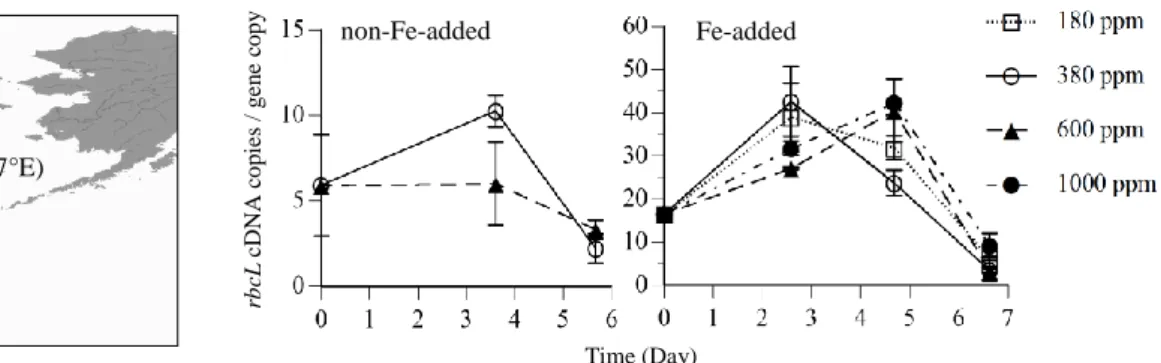
2and iron treatments throughout the experiment. We examined changes over time in the transcript levels of rbcL gene, which encodes the large subunit of RubisCO, in diatoms with different CO
2levels. As a result, rbcL gene transcription in diatoms decreased in response to CO
2increment in the non-iron-added bottles on Day 3. In the iron-added bottles, a similar trend was also observed on Day 2, while the opposite pattern was found on Day 4. The rbcL gene transcript levels of diatoms were clearly regulated by iron availability.
Previous studies (Corredor et al., 2004; John et al., 2007) showed that the transcript levels of diatoms rbcL gene correlated with maximum photosynthetic rates (P
max). Our results suggest that progression of ocean acidification and/or iron enrichment possibly regulate the rbcL gene transcript levels of diatoms, and those can affect the ability of CO
2absorption in the study area.
Figure 1. Sampling site of seawater for our incubation experiment.
References
Woodward, S., Roberts, D. L., and Betts, R. A.: A stimulateion of the effect of climate change-induced desertification on mineral dust aerosol, Geophys. Res. Lett., 32, L18810, 2005.
Corredor, J. E., Wawrik, B., Paul, J. H., Tran, H., Kerkhof, L., López, J. M., Dieppa, A., and Cardenas, O.: Geochemical rate- RNA integration study: Ribulose-1,5-Bisphosphate Carboxylase/Oxygenase gene transcription and photosynthetic capacity of planktonic photoautotrophs, Appl. Environ. Microb., 70, 5459-5468, 2004.
John, D. E., Wang, Z. A., Liu, X., Byrne, R. H., Corredor, J. E., López, J. M., Cabrera, A., Bronk, D. A., Tabita, F. R., and Paul, J. H.: Phytoplankton carbon fixation gene (RuBisCO) transcripts and air-sea CO
2flux in the Mississippi River plume, ISME, 1, 517-531, 2007.
Figure 2. Time-course of rbcL transcription rates in non-Fe-added and Fe- added bottles with different CO2. Error bars denote ± 1 SD (n = 3).
Time (Day)
rbcL cDNA copies / gene copy
non-Fe-added Fe-added
(53°N, 177°E)