Seasonal cycle of aerosol size distribution at Syowa Station, Antarctica
K. Hara1, C. Nishita-Hara1, K. Osada2, M. Yabuki3, and T. Yamanouchi4
1Fukuoka Univ., 2Nagoya Univ., 3 Kyoto Univ., and 4 NIPR
Atmospheric aerosols are distributed mainly in sub-m range in aspects of the number concentrations, and are related closely to the climate change through direct and indirect effects. Aerosol number concentrations and size distributions are one of the most important properties. Recently, aerosol size distributions have been measured even in the Antarctic regions during summer (e.g., Park et al., 2004; Virkkula et al., 2009; Asmi et al., 2010; Kyrö et al., 2013). These studies focused on the respect of new particle formation. However, only a few wintering-measurements of aerosol size distributions in fine - ultrafine modes have been made in the Antarctic regions (e.g., Ito, 1993; Hara et al., 2010, 2011a; Järvinen et al., 2013). Previous studies provided valuable information about seasaonal features of aerosol number concentrations, size distribution, new particle formation, hygroscopicity, and presence of less-volatile particles in ultrafine mode during the winter - spring. However, our knowledge is still too poor to understand atmopsheric aerosol cycles in the Antarctica. Therefore, we need to characterize aerosol size distributions, and their seasonal features, at first. This study aims to understand seasonal cycle of aerosol size distribution, new particle formation, and the relating processes at Syowa Station, Antarctica.
For measurement of size distribution in ultrafine - fine modes (Dp: 5–168 nm), a scanning mobility particle sizer (SMPS: 3936-N-25; TSI Inc.) was used from February 2004 - December 2006 at Syowa Station, Antarctica. The scanning time for one scan was 5 min in SMPS measurement. Also, an optical particle counter (OPC: KC-22B; RION) was operated to measure the number concentrations of aerosol particles in Dp>0.08, >0.1, >0.2, >0.3, >0.5 m in January 2005 – December 2006. OPC data recorded every 1 min. Locally contaminated data were filtered using CN data (Dp > 10nm, aerosol monitoring data) and wind data (observed by JMA). To compare modal structure of aerosol size distributions, we applied log-normal fitting to daily-mean aerosol size distributions (Dp: 5 – 500 nm).
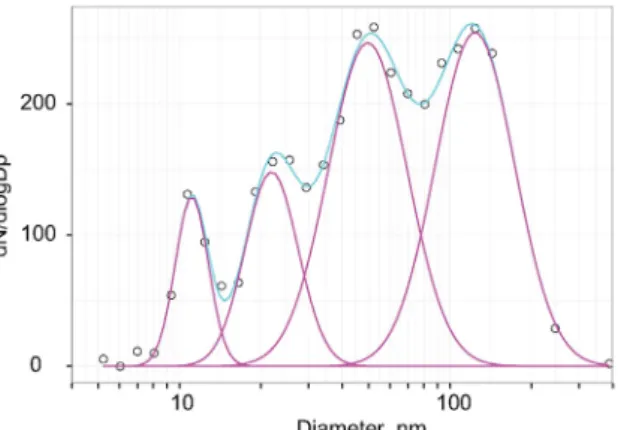
The log-normal fitting analysis to aerosol size distribution showed that mono-, bi-, tri-, and quad-modal structures were identified during the measurements (Fig.1). Appearing modes in each size distribution were classified into the following lognormal modes: fresh nucleation mode (Dp < 10 nm), aged nucleation mode (Dp = 10-25 nm), 1st Aitken mode (Dp = 25-50 nm), 2nd Aitken mode (Dp = 50-100 nm), and accumulation mode (Dp > 100 nm). As shown in Figure 2, modal structure and the number concentrations changed drastically in April and September. The number concentrations in fresh nucleation mode – 1st Aitken mode increased considerably from September till March. In April – August, number concentrations decreased in 1st Aitken mode. Mono-modal distribution was identifeid mainly in May – August, whereas tri- and quad-modal distributions appeared mostly in early September – end-March. Bi-modal structure was observed through the year. Strong mono-modal distribution appeared in 2nd Aitken and/or accumulation modes under/after the storm conditions in the winter –spring, when sea-salt particles were dominant even in ultrafine particles (Hara et al., 2011a). Furthermore, mode size (mainly 60-80 nm) of mono-modal structure was smaller than that (mainly >80 nm) in 2nd Aitken mode and larger than that (mainly 30-40 nm) in 1st Aitken mode of the other modal structures in winter-spring.
Considering that sea-salt particles in winter – spring were relased from surface of snow and sea-ice by strong winds, primary aerosol emission from surface of sea-ice/snow might lead to mono-modal structure with mode size of 60-80 nm in winter –spring.
Fresh- and aged nuclaetion modes appeared in tri- and quad- modal structures. Furtheremore, mode sizes of 1st and 2nd Aitken modes in tri- and quad-modal strucutes were similar to those in bi- modal strucutre. The similality of the mode sizes implies that new particle formation and particle growth change modal structure from bi-modal to tri-modal and quad-modal. Because abundance of tri- modal and quad-modal structures increased greatly in the summer, new particle formation might occur frequently in the Antarctic coasts during summer. The concentrations of aerosol precursors (i.e.
condensable vapors such as H2SO4) are expected to incerease during maximum of solar radiation (December – January). In spite of strong solar radiation in December – January, however, fresh nucleation
Figure 1. Typical example of aerosol size distribution and log-normal-fitted modes on 11 January, 2006. Open circles, magenta lines, and cyan line indicate aerosol number concentration in each size range, log-normal- fitted modes, and sum of the number concentration in each size range, respectively.
mode was identified rarely at Syowa Station. Fresh nucleation mode appeared mostly in March-April, and August-November (shown in Fig. 2). If new particle formation occured near surface around Syowa Station during the summer, fresh nucleation mode would appear in December – January. Therefore, less abundance of fresh nucleation mode in December – January might be explained by the following likelihoods. First, new particle formation occured in the other area (e.g., free troposhere) in summer, as suggested by Hara et al. (2011b). Then, the nucleated aerosol particles were transported to near surface at Syowa Station with continuous particle growth to larger than 10 nm during the transport. Because of lower concentrations of the photochemically formed condensable vapors in spring (September – early November) and autumn (March – early April), aerosol particles in fresh nucleation mode were transported to Syowa Station before growth to aged nucleation mode. Second, high concentrations of the condensable vapors in summer engender rapid particle growth. Therefore, shorter time for particle growth might involve smaller contirbution of coagulation loss to the aerosol number cocnentrations. In other words, the longer time for particle growth in spring and autumn might promote significant coagulation loss and lower aerosol concentrations in fresh- and aged- nucleation mode. Indeed, aerosol number cocnentrations in aged nucleation mode increased in December – January. In addition, aerosol number concentrations in 1st and 2nd Aitken modes showed clear seasonal feature (maximum in summer). The seasonal feature might be associated with seasonal cycles of (1) the concentrations of condensable vapors linked to photochemical reactions and biogenic activity, (2) new particle formation and growth, and (3) sea-salt particles released from sea-ice surface in the winter - spring. Here, we discuss and characterize seasonal cycle of aerosol size distribution in ultrafine – fine modes in the Antarctic coasts.
References
Asmi et al., Hygroscopicity and chemical composition of Antarctic sub-micrometre aerosol particles and observations of new particle formation, Atmospheric Chemistry and Physics, doi:10.5194/acp-10-4253-2010, 2010.
Hara et al., Haze episodes at Syowa Station, coastal Antarctica: Where did they come from?, Journal of Geophysical Research, 115(D14), doi:10.1029/2009JD012582, 2010.
Hara et al., Seasonal variations and vertical features of aerosol particles in the Antarctic troposphere, Atmospheric Chemistry and Physics, 11(11), 5471-5484, doi:10.5194/acp-11-5471-2011, 2011a.
Hara et al., Seasonal features of ultrafine particle volatility in the coastal Antarctic troposphere, Atmospheric Chemistry and Physics, doi:10.5194/acp-11-9803-2011, 2011b.
Ito, Size distribution of Antarctic submicron aerosols, Tellus B, 45(2), doi:10.1034/j.1600-0889.1993.t01-1-00007.x, 1993.
Järvinen et al., Seasonal cycle and modal structure of particle number size distribution at Dome C, Antarctica, Atmospheric Chemistry and Physics, 13(15), 7473-7487, doi:10.5194/acp-13-7473-2013, 2013.
Kyrö et al., Antarctic new particle formation from continental biogenic precursors, Atmospheric Chemistry and Physics, 13(7), 3527-3546, doi:10.5194/acp-13-3527-2013, 2013.
Park et al., Aerosol size distributions measured at the South Pole during ISCAT, Atmospheric Environment, 38, doi:10.1016/j.atmosenv.2002.12.001, 2004.
Virkkula et al., Review of Aerosol Research at the Finnish Antarctic Research Station Aboa and its Surroundings in Queen Maud Land, Antarctica, Geophysica, 45(1–2), 163–181 , 2009.
JARE45 - 47 SMPS Fitting Syowa Station, Antarctica
Diameter, nm
101 102
Month in 2004-2006
J F M A M J J A S O N D J F M A M J J A S O N D J F M A M J J A S O N D
Bubble size of Number conc. (cm-3)
102 103 104
Figure 2. Seasonal feature of mode size and the number concentration in each mode at Syowa Station, Antarctica in 2004 - 2006.
Bubble size indicates aerosol number concentrations.