Tokyo Metropolitan University Graduate School of System Design Department of Aerospace Engineering
Efficient Global Optimization with
Multi-Fidelity Approach for Aeronautical Applications
( Þ Þ Þë ë ëÁ Á ÁÕ Õ Õ£ £ £Ç Ç Çê ê êÆ Æ Æ£ £ £Õ Õ Õk k k ¹ ¹ ¹ ' ' 'ß ß ß i i i Õ Õ Õ n n nË Ë ËÉ É Éh h h* * *z z z_ _ _- - - x x xn n nÜ Ü Ü( ( ( )
Atthaphon Ariyarit (13991572)
Submitted in part fulfilment of the requirements for the degree of
Doctor of Philosophy in Aerospace Engineering, March 2018
Abstract
Developing a highly efficient optimization methodology is critical for the design process in the aerospace arena because an aeronautical design is usually complicated and expensive. In addition, design problems often have several objectives for simultaneous consideration. To increase the performance of optimization methodology, the efficiency global optimization (EGO) has been developed. The EGO needs to be further improved via an exploratory method, such as genetic algorithm (GA) and surrogate methods.
This thesis begins with reviews and the development of GA using an exploratory method for real-world design problems . Focusing on the distribution of the population, GA with a multi- modal crossover method (MMDX) was proposed to consider the skewness of the distribution of parent candidates. The proposed crossover method creates four segments from four selected parents, of which two segments are bounded by selected parents and two are bounded by one parent and another segment. After defining these segments, four offspring are generated.
This study considered the application of a proposed optimization method for the real-world problem of creating a multi-objective airfoil design using a class-shape polynomial function transformation parameterization (CST), which is of aerodynamic shape, to investigate the effectiveness of the algorithm. The exploration results are compared with the results of blend crossover (BLX) and unimodal normal distribution crossover (UNDX) algorithms, which are widely used. According to the design results, the developed algorithm found solutions that were superior to those found by the BLX and UNDX algorithms with regard to maintaining diversity of solutions. This is a beneficial feature for real-world problems.
Next, a multi-fidelity optimization technique based on an efficient global optimization method using a multi-fidelity approach was investigated for solving real-world design problems. In the proposed approach, a multi-fidelity surrogate model was developed for evaluating local deviation using Kriging method and for constructing a global model using a radial basis function. The expected improvement (EI) was computed based on the uncertainty of the model, which was evaluated using the Kriging method, to determine additional samples to improve the model and EGO. The proposed multi-fidelity approach was investigated by solving mathematical test problems whose results were compared with those of ordinary Kriging-based EGO using a single-fidelity approach and the co-Kriging-method-based EGO. The proposed method obtained better solutions than the other two. It was applied to the aerodynamic design optimization of
i
helicopter blades for hovering to maximize blade efficiency. The shapes of the helicopter blades were designed by changing their twist angle distributions. The performance of the optimal shape obtained using the proposed method was almost equal to that obtained using high- fidelity evaluation based on single-fidelity optimization by an ordinary Kriging. The results of the proposed method were compared with that of a co-Kriging based multi-fidelity approach.
The accuracy of the proposed method was the highest, while the total number of high-fidelity evaluation runs required to obtain a converged solution was the lowest.
Finally, the method was expanded to solve multi-fidelity/multi-objective problems. An ex- pected hypervolume improvement (EHVI) was used as an index to find additional samples for the optimization process. EHVI is computed based on the model s uncertainty to determine additional samples as well as EI. First, the proposed approach was applied to two-objective optimization test functions. Then, it was applied to airfoil design optimizations that have two- and three-objective functions, namely, minimization of aerodynamic drag and maximization of airfoil thickness at the trailing edge for the two-objective problem and minimization of aero- dynamic drag at cruising speed, maximization of airfoil thickness at the trailing edge, and maximization of lift at low speed assuming a landing attitude for the three-objective problem.
A panel method was used to apply the low-fidelity inviscid aerodynamic force and a Reynolds- averaged Navier-Stokes simulation was applied for high-fidelity aerodynamics in conjunction with a high-cost approach. For comparison, multi-objective optimization was applied using only a Kriging model with a high-fidelity solver (single fidelity). The design results indicate that the non-dominated solutions of the proposed method achieve greater data diversity than the optimal solutions of the Kriging method. Moreover, the proposed method has a smaller error than the Kriging method with the single-fidelity approach.
ii
Acknowledgements
I would like to thank a number of people who directly and indirectly contributed to the com- pletion of this thesis. First of all, I would like to express my sincerely thank to my supervisor, Assoc. Prof. Masahiro Kanazaki, for all of his patient guidance, understanding and continuous support throughout my whole study. I would also like to acknowledge Dr. Yasutada Tanabe and Dr. Masahiko Sugiura from Japan Aerospace Exploration Agency (JAXA) for the interesting times spent discussing and help about my research.
I would like to dedicate my special thanks to all of my friends in my department who made my life in the Japan enjoyable and memorable. Certainly special mention goes to Dr. Norazila Othman, Mr. Yuta Kurata and Mr. Yuki Kishi for their help and friendship throughout these many years.
I would like to thank all other friends, both in Thailand, Taiwan and Japan,whose names I am not able to write down here.
I would like to dedicate my grateful and deep appreciation to my parents and aunt for their unconditional love, support and encouragement for the whole of my life. I would like to thank my brother and sisters who take good care of our parents during my study here.
Finally, I would like to acknowledge the Asian Human Resources Fund (AHRF) from the Tokyo Metropolitan Government for their financial support throughout my PhD study.
iii
iv
Contents
Abstract i
Acknowledgements iii
1 Introduction 1
1.1 Current Situation of Aeronautical Design . . . . 1
1.2 Recent Researches on Optimization Techniques for Real World Problems . . . . 3
1.3 Objectives of this Thesis . . . . 6
1.4 Outline of this Thesis . . . . 6
2 Genetic Algorithm for Aeronautical Application 16 2.1 Introduction . . . . 16
2.2 Overview of Crossover Method . . . . 18
2.2.1 Blended Crossover (BLX) . . . . 18
2.2.2 Unimodal Normal Distribution Crossover (UNDX) . . . . 18
2.2.3 Proposed Crossover Method . . . . 20
2.3 Investigation of Proposed Method by Solving Test Functions . . . . 21
v
vi CONTENTS
2.3.1 Formulation . . . . 22
2.3.2 Results of Test Functions . . . . 23
2.4 Design Methods . . . . 24
2.4.1 Class-Shape Function Transformation Parameterization . . . . 24
2.4.2 Aerodynamics Evaluation . . . . 25
2.4.3 Cover Rate . . . . 26
2.4.4 Parallel Coordinate Plot (PCP) . . . . 26
2.5 Formulation . . . . 27
2.6 Results and Discussion . . . . 28
2.7 Conclusion . . . . 32
3 Multi-fidelity Efficient Global Optimization using Hybrid Surrogate Model 36 3.1 Introduction . . . . 36
3.2 Surrogate Model Methods for Multi-fidelity Optimization . . . . 39
3.2.1 Kriging Method . . . . 39
3.2.2 Hybrid Surrogate Model for a Multi-fidelity Approach . . . . 40
3.3 Efficient Global Optimization . . . . 42
3.3.1 Efficiency Global Optimization for single-fidelity optimization . . . . 42
3.3.2 Efficiency Global Optimization for multi-fidelity optimization . . . . 43
3.4 Investigation of Proposed Method by Solving Test Functions . . . . 44
3.4.1 Formulation . . . . 44
3.4.2 Results of Test Functions . . . . 47
3.5 Application of Proposed Method to Helicopter Blade Design . . . . 50
3.5.1 Evaluation Methods . . . . 55
3.5.2 Definition of Blade Geometry and Design variables . . . . 60
3.5.3 Objective Function and Calculation Condition . . . . 63
3.5.4 Results . . . . 63
3.6 Conclusion . . . . 69
4 Multi-objective/multi-fidelity Efficient Global Optimization 74 4.1 Introduction . . . . 74
4.2 Efficient Global Optimization for Multi-objective Problem . . . . 76
4.3 Investigation of Proposed Method by Solving Test Functions . . . . 77
4.3.1 Formulation . . . . 77
4.3.2 Two-objective Test Function Results . . . . 80
4.3.3 Three-objective Test Function Results . . . . 83
4.4 Airfoil Design Problem . . . . 85
4.4.1 Formulation . . . . 85
4.4.2 Evaluation Methods . . . . 88
4.5 Results . . . . 89
4.6 Conclusions . . . . 97
5 Conclusion 103 5.1 Conclusions . . . 103
vii
viii
List of Tables
3.1 Blade properties. . . . 63
4.1 Design spaces for airfoil design problem. . . . . 89
ix
x
List of Figures
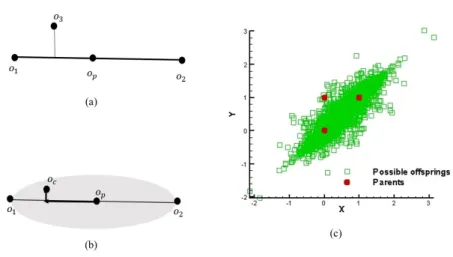
2.1 Schematic illustration and possible crossover region of UNDX (a) Selection par- ents (b) Generate offsprings (c) The possible crossover regions of the UNDX. . . 19 2.2 Schematic illustration and possible crossover region of the MMDX (a) Selection
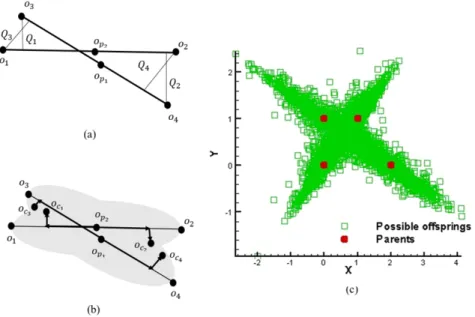
parents (b) Generate offsprings (c) The possible crossover region of MMDX. . . 22 2.3 The comparison of distribution of individuals generated by the MMDX, UNDX
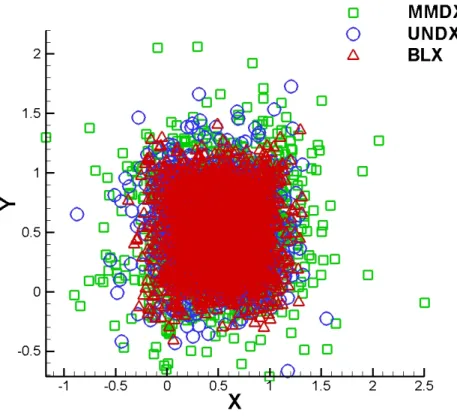
and BLX crossover method with 2000 offspring. . . . 23 2.4 Best solution of 20 dimensional Rastrigin function (a) History of best solution
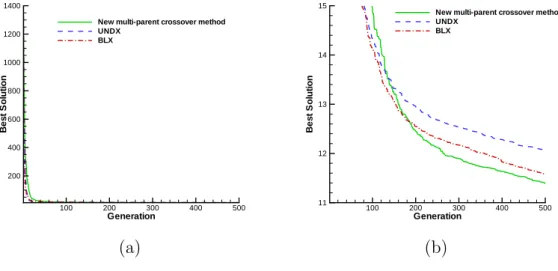
(b) Close up view near optimum value . . . . 24 2.5 Best solution of 20 dimensional Rosenblock function (a) History of best solution
(b) Close up view near optimum value . . . . 24 2.6 Schematic illustration and possible crossover region of the MMDX (a) Selection
parents (b) Generate offsprings (c) The possible crossover region of MMDX. . . 26 2.7 Resulting non-dominated solutions of the CST problem. . . . 28 2.8 The history of non-dominated solutions after the 30
th, 60
th, 80
th, 90
th, and 100
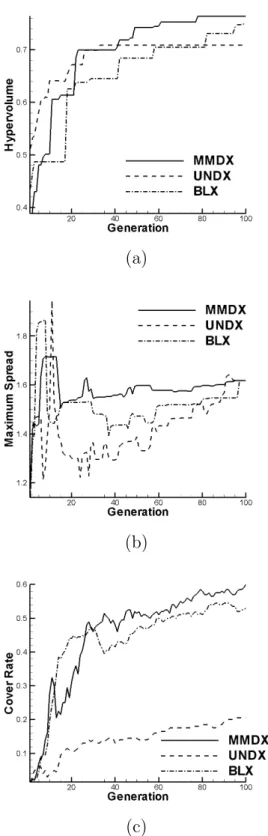
thgeneration. (a) Solutions obtained by BLX, (b) Solutions obtained by UNDX, (c) Solutions obtained by the MMDX method. . . . 29 2.9 Comparison of the history of metrics: (a) Hypervolume, (b) Maximum spread,
(c) Variance of Cover rate during the search. . . . 30
xi
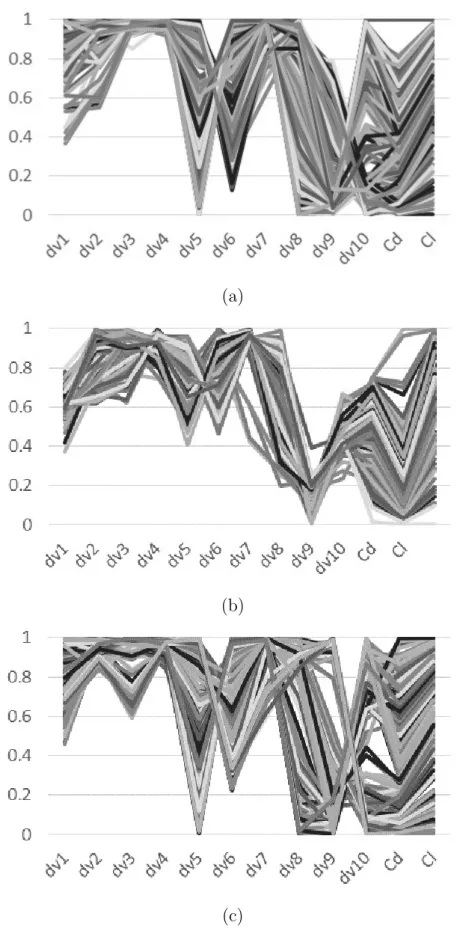
xii LIST OF FIGURES 2.10 The PCP of the non-dominated solution at the 100
thgeneration. (a) BLX (b)
UNDX (c) MMDX. . . . 31
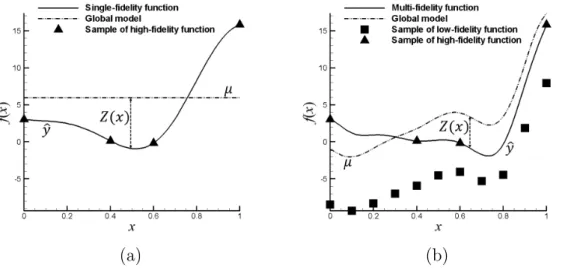
3.1 CFD example [9]. . . . 38 3.2 Schematic illustration of a single-fidelity and multi-fidelity surrogate model. (a)
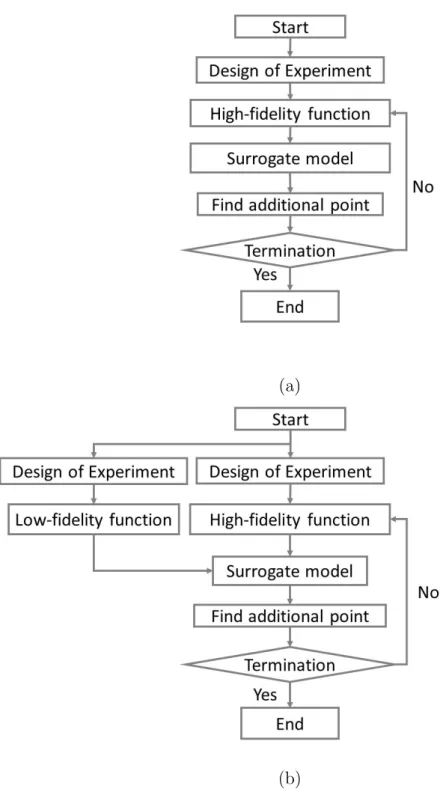
Ordinary Kriging model (b) Hybrid model. . . . 41 3.3 Flowchart of efficient global optimization. (a) Efficient global optimization (b)
Proposed EGO with multi-fidelity surrogate model. . . . 45 3.4 Search history of EI value for the first sampling of helicopter blade design problem. 46 3.5 Additional sampling in each iteration. (a) SC problem (b) BR problem (c) HIM
problem (d) ROS problem. . . . 50 3.6 Cross validation of SC problem. (a) Hybrid surrogate-model-based EGO (b)
Co-Kriging-based EGO (c) Ordinary Kriging-based EGO. . . . 51 3.7 Cross validation of BR problem. (a) Hybrid surrogate-model-based EGO (b)
Co-Kriging-based EGO (c) Ordinary Kriging-based EGO. . . . 52 3.8 Cross validation of HIM problem. (a) Hybrid surrogate-model-based EGO (b)
Co-Kriging-based EGO (c) Ordinary Kriging-based EGO. . . . 53 3.9 Cross validation of ROS problem. (a) Hybrid surrogate-model-based EGO (b)
Co-Kriging-based EGO (c) Ordinary Kriging-based EGO. . . . 54 3.10 Helicopter computation grid. (a) Grid around blade (b) Grid in stationary do-
main (c) Example of flow-field around rotor blades generated using CFD. . . . . 57
3.11 Blade section aerodynamics. . . . 60
3.12 Comparison of the high-fidelity data by CFD and the low-fidelity data by BEMT. 60
3.13 Definition of glade geometry: (a) control points, (b) controlled parameters. . . . 62
LIST OF FIGURES xiii 3.14 Additional sampling in each iteration of the helicopter design problem. . . . 64 3.15 The history of the additional samples discovery. (a) Θ
1(b) Θ
2. . . . 65 3.16 The multi-fidelity relationship contour of the design parameters (Θ
1and Θ
2)
and FOM. (a) Hybrid surrogate-model-based EGO (b) Co-Kriging-based EGO (c) Ordinary Kriging-based EGO. . . . 66 3.17 Cross validation of helicopter design problem. (a) Hybrid surrogate-model-based
EGO (b) Co-Kriging-based EGO (c) Ordinary Kriging-based EGO. . . . 67 3.18 Twist distribution of optimal designs. (a) Full length (b) r/R = 0.7´1.0. . . . . 68
4.1 Flowchart of efficient global optimization. (a) Efficient global optimization (b) Proposed EGO with multi-fidelity surrogate model. . . . 78 4.2 Initial sampling data and additional sampling data: (a) multi-fidelity approach,
(b) single-fidelity approach. . . . . 80 4.3 Hypervolume comparison of multi-fidelity approach and single-fidelity approach. 81 4.4 Non-dominated solution of two-objective optimization test problem. . . . 81 4.5 Cross-validation results: (a) result of f
1, (b) result of f
2. . . . 82 4.6 Initial sampling data and additional sampling data: (a) multi-fidelity approach,
(b) single-fidelity approach. . . . . 84 4.7 Comparison of non-dominated solutions of three-objective optimization test prob-
lem. . . . . 84
4.8 Hypervolume comparison of multi-fidelity approach and single-fidelity approach. 85
4.9 Cross-validation of f
3: (a) multi-fidelity approach, (b) single-fidelity approach. . 86
4.10 Computation structured grid: (a) full length, (b) grid around airfoil. . . . 88
4.11 Initial sampling data and additional sampling data: (a) multi-fidelity approach, (b) single-fidelity approach. . . . . 90 4.12 Non-dominated solution of two-objective airfoil shape optimization problem. . . 91 4.13 Hypervolume comparison of multi-fidelity approach and single-fidelity approach. 91 4.14 Cross validation of C
d. . . . 91 4.15 Parallel coordinated plots of non-dominated solutions: (a) multi-fidelity ap-
proach, (b) single-fidelity approach. . . . 92 4.16 Comparison of design geometries: (a) multi-fidelity approach, (b) single-fidelity
approach. . . . 92 4.17 Initial sampling data and additional sampling data: (a) multi-fidelity approach,
(b) single-fidelity approach. . . . . 94 4.18 Hypervolume comparison of multi-fidelity approach and single-fidelity approach. 94 4.19 Comparison of non-dominated solutions of three-objective optimization test prob-
lem. . . . . 95 4.20 Cross-validation results: (a) results of C
d, (b) results of C
l. . . . 95 4.21 Parallel coordinated plots of non-dominated solutions: (a) multi-fidelity ap-
proach, (b) single-fidelity approach. . . . 96 4.22 Comparison of design geometries: (a) multi-fidelity approach, (b) single-fidelity
approach. . . . 96
xiv
Chapter 1
Introduction
1.1 Current Situation of Aeronautical Design
In recent years, optimized aeronautical design has been increasingly popular in commercial aircraft design. Airbus designed the A380 while employing an optimization method to reduce the weight of the aircraft wing [1, 2]. The Japan Aerospace Exploration Agency (JAXA) used a shape optimization method to design the supersonic jet [3]. This method was used to increase aerodynamic performance and reduce sonic boom [4-6]. Thus, it has been required to use high- fidelity computation in aeronautical design. However aeronautical design commonly involves complicated problems and high-fidelity computation is expensive. In addition, designers should consider aeronautical design as a problem that involves several objectives. For example, it is necessary for a designer to simultaneously reduce the aircraft weight [7-11] and improve the aero- dynamic performance at all operating speeds, including during take-off, landing, and cruising conditions [12-14]. For this reason, several researchers [9, 10] have created optimization methods that consider the reduction of computational costs for multi- or many-objective optimization problems. For example, Drozdik [15] has developed multi-objective differential evolution (DE) algorithms to reduce the computation cost of multi-objective optimization problems. This method has better performance than the original multi-objective DE [16] because it includes domination rank and crowding distance in its process. The hybrid optimization algorithm [17],
1
2 Chapter 1. Introduction which combines a genetic algorithm (GA) and neural network, has been developed to enhance the performance of the optimization algorithm. However, these methods could not be used for expensive funcions because they still require many computation evaluations.
In principle, optimization techniques find the best solution to a problem by searching for the minimum or maximum values in a function. Unfortunately, traditional optimization methods, such as gradient-based methods [18-20] or evolutionary algorithms [21, 22], require several com- putation evaluations. Therefore, researchers have been trying to improve the efficiency of these traditional optimization algorithms. However, the highly accurate evaluations are too expen- sive if optimization algorithms are employed [23]. Consequently, a combination of surrogate models, such as the radial basis (RBF) [24-26], response surface [27, 28], and Kriging model [29, 30], are used to predict expensive functions and to find optimal shapes for aeronautical designs.
Highly accurate surrogate models that result in an accurate optimal solution are required for surrogate model-based optimizations. The efficient global optimization (EGO), which is based on model uncertainty, has been proposed [31]. The EGO uses expected improvement (EI) [31, 32] or expected hypervolume improvement (EHVI) to find an additional optimum point in the optimization process [33-35]. The advantage of the EGO is that it could increase the probability of the optimization process locating the global optimum point because the EGO involves an additional sampling process, which is based on model uncertainty.
To solve aeronautical design problems, aeronautic evaluations require many computation levels (i.e., fidelities that are determined by governing equations). For example, aerodynamic forces for airfoil design could be defined with a panel method for low-level computations [36, 47], as well as with a Navier-Stokes computation for high-level computations [28, 39]. Because of this feature of aerodynamic evaluations, the multi-fidelity approach can be considered for further improvements in the efficiency of surrogate model-based optimization [40-42].
The goal of this thesis is to propose a multi-fidelity optimization, using a surrogate model-based
EHVI, that can improve efficiency and accuracy when using a high-fidelity function to find the
optimum point for a multi-objective design problem.
1.2. Recent Researches on Optimization Techniques for Real World Problems 3
1.2 Recent Researches on Optimization Techniques for Real World Problems
Many optimization tools for engineering designs have been developed [8]. The traditional design methods that use the function gradient are known as the Newton method or sequential quadratic programming (SQP) [18-20]. While they have been widely used, the disadvantage of the gradient-based methods is the requirement of function gradients, which cannot be easily defined for real world problems. Consequently, the evolutionary computation methods have increased in popularity because they do not require gradients. Examples of the evolutionary computation [21, 22] method are genetic algorithms GAs [43, 44], particle swarm optimization (PSO) [45-47], DE [17, 48], simulated annealing (SA) [49, 50], among others [51-55]. GAs are a well-known method for aeronautical design because it has a high probability of locating the global optimum point. In addition, the concept of the GAs are easy to understand, and it is easily applied to various applications.
The GAs [43, 44] are a stochastic search method based upon the theory of natural selection. It
was developed by Holland at the University of Michigan in the 1960s and 1970s, and Goldberg
further extended its theoretical foundations and applications. The GAs are a popular algorithm
because it is easy to apply to optimization problems, and it can be considered a black box
method. The search procedure starts with an initial population whose individuals are randomly
created. By weighting the probability of a gene used for breeding in terms of its fitness, the
characteristics that give the best solutions are passed on from one generation to the next
generation. The genetic operators such as selection, crossover, and mutation are applied to
the parents to create the offspring. For example, the blend crossover method (BLX) [56] and
the unimodal normal distribution crossover (UNDX) [57] have been proposed and yield good
exploration performances. The GAs can be expanded to solve multi-objective optimization
problems via the Pareto ranking theory. A non-dominated sorting method that is called the
non-dominated sorting genetic algorithm (NSGA-II) [58] is widely used as a multi-objective
genetic algorithm. The performance metrics that have been considered for these multi-objective
4 Chapter 1. Introduction
optimization problems are maximum spread [59, 60] and hypervolume [60, 61].
In aeronautical design, GAs are popular for finding the optimum design. For example, the panel method [35, 36], blade element momentum theory (BEMT) [62, 63], and the NASA chemical equilibrium with applications (NASA-CEA) code [64] are often used to design rocket engines.
However, they do not always yield the true optimum shape because the evaluation is low-fidelity, which results in low accuracy. To include high-fidelity functions in the optimization process, the surrogate model is widely used. This method was first studied by Schmit in 1974 [65] with respect to wing structural optimization. This research demonstrated the concept of finding the optimum size of the wing structure by approximation of the response variables via Taylor series expansions to reduce the computational time of the optimization process. Response surface [26 - 28] is another surrogate model that is often used, and the RBF [23-25] and the Kriging [29, 30] are more flexible methods for predicting complicated functions. The RBF method was originally developed by Broomhead et al. [21]. This approximation process can be interpreted as a simple kind of neural network. The Kriging method, which was originally developed by Matheron [29], constructs surrogate models based on Gaussian stochastic process models. These methods are popular for real world applications because aeronautical design always requires non-linear functions.
The design of experiments (DoEs) are an important technique for obtaining sampling designs while including input-output relationships. The DoEs were originally studied by Fisher [66].
Traditional DoE techniques [67, 68] include central composite design, Box-Behnken design, full-factorial designs, and the Taguchi method [69]. Because the number of samples is fixed, this method is not commonly used for the optimization process. For the optimization process, a popular DoE method is Latin hypercube sampling (LHS) [70], proposed by McKay; LHS can maintain the space filling quality of the sampling points. Because of limitations in the number of function calls, the EGO method was developed to find additional samples, increasing the efficiency of the surrogate model. EIs locate additional samplings by using evaluations based on the uncertainty of models, improving the accuracy of the models for single-objective functions.
EHVI was developed from a concept similar to that of EI for multi-objective optimization
problems. Note that iteration by EGO will locate the global optimum point with less additional
1.2. Recent Researches on Optimization Techniques for Real World Problems 5
sampling if the surrogate model has higher accuracy.
The multi-fidelity approach is a promising way to increase the efficiency of the surrogate model- based optimization process, which requires time-consuming function evaluation to solve real- world design problems. Several multi-fidelity approaches and their applications have been studied using a co-Kriging model [41]. For example, Huang [71] used a co-Kriging method.
A multi-fidelity optimization method based on the error estimation of response surfaces using low-fidelity and high-fidelity functions was used to design low-boom supersonic jets [72]. In this study, exact values of additional samples by high-fidelity evaluation were not acquired.
Thus, the accuracy of high-fidelity functions could not be ensured, particularly around the optimum points for complicated functions. Another multi-fidelity approach with a parameter space reduction technique was proposed to reduce computational times for computational fluid dynamics (CFD) design of helicopter rotor blades [73]. This technique reduced the degree of the design parameter space (i.e., the number of design parameters) to define possible design ranges using a low-fidelity function. Then, a high-fidelity function was used to determine the optimum design in the primary defined design range. However, it is possible to obtain an optimal solution outside the parameter space because design ranges defined using low-fidelity functions are not always appropriate for high-fidelity functions. A multi-fidelity surrogate model was also applied to maximize annual energy production in wind turbine design [74]. An optimal point of a low-fidelity function was determined using GAs. Then, optimization was performed using a high-fidelity function and a gradient-based method, for which the optimum point obtained using the low-fidelity optimization, was used as the starting point. This method could not obtain the optimum for the high-fidelity function if the error between the low-fidelity and high-fidelity functions was large. Multi-fidelity optimization using the hybrid surrogate model based on the response surface method and the RBF method was developed by Sun [75]. This surrogate model could increase the efficiency when predicting a complex function.
However, this multi-fidelity optimization procedure cannot find additional sampling based on uncertainty of data.
An alternative solution to the multi-fidelity multi-objective optimization problem is the model
reduction technique [76, 77]. A multi-fidelity/multi-objective optimization approach with a
6 Chapter 1. Introduction parameter space reduction technique was applied to the design of helicopter rotor blades and airfoils. This technique reduced the design parameter space to define possible design ranges with a low-fidelity function. Then, a high-fidelity function was used to find the optimum design in the primary defined design range. The sampling for the high-fidelity function was chosen by selecting interesting design points from non-dominated solutions in addition to the initial point that was generated from the primary defined design range. However, this method has the potential to obtain an unexpected optimal solution outside the parameter space because the design ranges of the low-fidelity function are not always appropriate for the high-fidelity function.
1.3 Objectives of this Thesis
The objective of this thesis is to develop the efficient optimization tool for engineering de- sign problems. The final target of this research is increase the efficiency of the aeronautical performance optimization via mixed-fidelity approach of low-fidelity/ low-cost evaluations and high-fidelity/ high-cost evaluations. GA was employed to achieve the global design optimization by proposing the modification of the crossover method for improvement of the diversity and increase the convergence rate of the optimization process. The proposed multi-fidelity approach and GA were used in the enhanced EGO by means of the hybrid surrogate model for single- objective optimization problems. After the development of optimization method, it was tested by applying to real world problems, airfoil design and helicopter blade design. Then, the pro- posed multi-fidelity approach was expand to solve multi-objective design problems. The mehod was tested by applying to airfoil design problems which has two/three objective functions.
1.4 Outline of this Thesis
This dissertation is organized as follows: In Chapter 2, a new crossover method for GA, the
multi-modal crossover, is developed to increase the diversity and the convergence rate of the
1.4. Outline of this Thesis 7
optimization algorithm for EI and EHVI maximization. The applicability of the proposed
optimization to a real-world problem is considered by solving a multi-objective airfoil design
problem. In Chapter 3, a multi-fidelity hybrid surrogate model for EGO is developed. The
proposed multi-fidelity approach is investigated by solving mathematical test problems and is
applied to an aerodynamic design optimization problem involving helicopter blades (hovering
to obtain the maximum blade efficiency). In Chapter 4, the proposed multi-fidelity approach
from the previous chapter is extended to solve a multi-objective optimization problem. The
approach is investigated with multi-objective mathematical test problems and is applied to a
multi-objective unmanned aerial vehicle (UAV) aerodynamic airfoil design problem. In Chapter
5, the conclusions are presented.
Bibliography
[1] Krog, Lars, Alastair Tucker, and Gerrit Rollema. ”Application of topology, sizing and shape optimization methods to optimal design of aircraft components.” Proc. 3rd Altair UK Hy- perWorks Users Conference. 2002.
[2] Krog, Lars, et al. ”Topology optimisation of aircraft wing box ribs.” 10th AIAA/ISSMO multidisciplinary analysis and optimization conference. 2004.
[3] Sato, Koma, et al. ”Low-boom and low-drag optimization of the twin engine version of silent supersonic business jet.” Journal of Fluid Science and Technology 3.4 (2008): 576-585.
[4] Sakata, Kimio. ”Japan’s Supersonic Technology and Business Jet Perspectives.” 51st AIAA Aerospace Sciences Meeting including the New Horizons Forum and Aerospace Exposition.
2013.
[5] Sun, Yicheng, and Howard Smith. ”Review and prospect of supersonic business jet design.”
Progress in Aerospace Sciences (2016).
[6] Kanazaki, M., H. Takagi, and Y. Makino. ”Mixed-fidelity efficient global optimization ap- plied to design of supersonic wing.” Procedia Engineering 67 (2013): 85-99.
[7] Hicks, Raymond M., and Preston A. Henne. ”Wing design by numerical optimization.”
Journal of Aircraft 15.7 (1978):407-412.
[8] Sobieszczanski-Sobieski, Jaroslaw, and Raphael T. Haftka. ”Multidisciplinary aerospace de- sign optimization: survey of recent developments.” Structural optimization 14.1 (1997):1-23.
8
BIBLIOGRAPHY 9 [9] Miller, Gerald. ”An active flexible wing multi-disciplinary design optimization method.” 5th
Symposium on Multidisciplinary Analysis and Optimization. 1994.
[10] RA Martins, Joaquim R., Juan J. Alonso, and James J. Reuther.”High-fidelity aerostruc- tural design optimization of a supersonic business jet.” Journal of Aircraft 41.3 (2004):
523-530.
[11] Chiba, Kazuhisa, et al. ”High-fidelity multidisciplinary design optimization of wing shape for regional jet aircraft.” International Conference on Evolutionary Multi-Criterion Opti- mization. Springer Berlin Heidelberg, 2005.
[12] CWickramasinghe, Upali K., Robert Carrese, and Xiaodong Li. ”Designing airfoils using a reference point based evolutionary many-objective particle swarm optimization algorithm.”
IEEE Congress on Evolutionary Computation. IEEE, 2010.
[13] Nemec, Marian, David W. Zingg, and Thomas H. Pulliam. ”Multipoint and multi-objective aerodynamic shape optimization.” AIAA journal 42.6 (2004): 1057-1065.
[14] Li, Wu, Luc Huyse, and Sharon Padula. ”Robust airfoil optimization to achieve drag reduction over a range of mach numbers.” Structural and Multidisciplinary Optimization 24.1 (2002): 38-50.
[15] Drozdik, Martin, Hernan Aguirre, and Kiyoshi Tanaka. ”Attempt to reduce the compu- tational complexity in multi-objective differential evolution algorithms.” Proceedings of the 15th annual conference on Genetic and evolutionary computation. ACM, 2013.
[16] Babu, B. V., and M. Mathew Leenus Jehan. ”Differential evolution for multi-objective optimization.” Evolutionary Computation, 2003. CEC’03. The 2003 Congress on. Vol. 4.
IEEE, 2003.
[17] Poloni, Carlo, et al. ”Hybridization of a multi-objective genetic algorithm, a neural network
and a classical optimizer for a complex design problem in fluid dynamics.” Computer Methods
in Applied Mechanics and Engineering 186.2 (2000): 403-420.
10 BIBLIOGRAPHY [18] Rao, Singiresu S., and Singiresu S. Rao. Engineering optimization: theory and practice.
John Wiley & Sons, 2009.
[19] Arora, Jasbir. Introduction to optimum design. Academic Press, 2004.
[20] Vanderplaats, Garret N. Numerical optimization techniques for engineering design: with applications.McGraw-Hill College, 1984.
[21] Back, Thomas. Evolutionary algorithms in theory and practice: evolution strategies, evo- lutionary programming, genetic algorithms.Oxford university press, 1996.
[22] Eiben, Agoston E., and James E. Smith. Introduction to evolutionary computing. Springer Berlin Heidelberg: Imprint: Springer, 2015.
[23] Samareh, Jamshid A. ”Survey of shape parameterization techniques for high-fidelity mul- tidisciplinary shape optimization.” AIAA journal 39.5 (2001): 877-884.
[24] Broomhead, David S., and David Lowe. Radial basis functions, multi-variable func- tional interpolation and adaptive networks.No. RSRE-MEMO-4148. ROYAL SIGNALS AND RADAR ESTABLISHMENT MALVERN (UNITED KINGDOM), 1988.
[25] Park, Jooyoung, and Irwin W. Sandberg. ”Universal approximation using radial-basis- function networks.” Neural computation 3.2 (1991): 246-257.
[26] Chen, Sheng, Colin FN Cowan, and Peter M. Grant. ”Orthogonal least squares learning algorithm for radial basis function networks.” IEEE Transactions on neural networks 2.2 (1991): 302-309.
[27] Gunst, Richard F. ”Response surface methodology: process and product optimization using designed experiments.” (1996): 284-286.
[28] BBezerra, Marcos Almeida, et al. ”Response surface methodology (RSM) as a tool for optimization in analytical chemistry.” Talanta 76.5 (2008): 965-977.
[29] Matheron, Georges. ”Principles of geostatistics.” Economic geology 58.8 (1963): 1246-1266.
BIBLIOGRAPHY 11 [30] Oliver, Margaret A., and Richard Webster. ”Kriging: a method of interpolation for ge- ographical information systems.” International Journal of Geographical Information Sys- tem4.3 (1990): 313-332.
[31] Jones, Donald R., Matthias Schonlau, and William J. Welch. ”Efficient global optimization of expensive black-box functions.” Journal of Global optimization 13.4 (1998): 455-492.
[32] Kleijnen, Jack PC, Wim van Beers, and Inneke Van Nieuwenhuyse. ”Expected improve- ment in efficient global optimization through bootstrapped kriging.” Journal of global opti- mization (2012): 1-15.
[33] Emmerich, Michael TM, Andr é H. Deutz, and Jan Willem Klinkenberg. ”Hypervolume- based expected improvement: Monotonicity properties and exact computation.” Evolutionary Computation (CEC), 2011 IEEE Congress on. IEEE, 2011.
[34] Shimoyama, Koji, Shinkyu Jeong, and Shigeru Obayashi. ”Kriging-surrogate-based opti- mization considering expected hypervolume improvement in non-constrained many-objective test problems.” Evolutionary Computation (CEC), 2013 IEEE Congress on. IEEE, 2013.
[35] Hupkens, Iris, Michael Emmerich, and Andr é Deutz. ”Faster computation of expected hypervolume improvement.” arXiv preprint arXiv:1408.7114 (2014).
[36] Anderson Jr, John David. Fundamentals of aerodynamics. Tata McGraw-Hill Education, 2010.
[37] Katz, Joseph, and Allen Plotkin.Low-speed aerodynamics. Vol. 13. Cambridge university press, 2001.
[38] Nielsen, Eric J., and W. Kyle Anderson. ”Aerodynamic design optimization on unstruc- tured meshes using the Navier-Stokes equations.” AIAA journal 37.11 (1999): 1411-1419.
[39] Beam, Richard M., and RoF Warming. ”An implicit factored scheme for the compressible
Navier-Stokes equations.” AIAA journal 16.4 (1978): 393-402.
12 BIBLIOGRAPHY [40] Forrester, Alexander IJ, Andras Sobester, and Andy J. Keane. ”Multi-fidelity optimization via surrogate modelling.” Proceedings of the royal society of london a: mathematical, physical and engineering sciences. Vol. 463. No. 2088. The Royal Society, 2007.
[41] A new cokriging method for variable-fidelity surrogate modeling of aerodynamic data.”
Evolutionary Computation, 2003. CEC’03. The 2003 Congress on. Vol. 4. IEEE, 2003.
[42] Alexandrov, N., et al. ”Optimization with variable-fidelity models applied to wing design.”
38th Aerospace Sciences Meeting and Exhibit. 2000.
[43] Goldberg, David E., and John H. Holland. ”Genetic algorithms and machine learning.”
Machine learning 3.2 (1988): 95-99.
[44] Goldberg, David E. ”Real-coded genetic algorithms, virtual alphabets, and blocking.”
Complex systems 5.2 (1991): 139-167.
[45] Kennedy, James. ”Particle swarm optimization.” Encyclopedia of machine learning.
Springer US, 2011. 760-766.
[46] Eberhart, Russell, and James Kennedy. ”A new optimizer using particle swarm theory.”
Micro Machine and Human Science, 1995. MHS’95., Proceedings of the Sixth International Symposium on. IEEE, 1995.
[47] Reyes-Sierra, Margarita, and CA Coello Coello. ”Multi-objective particle swarm optimiz- ers: A survey of the state-of-the-art.” International journal of computational intelligence research 2.3 (2006): 287-308.
[48] Storn, Rainer, and Kenneth Price. ”Differential evolution a simple and efficient heuristic for global optimization over continuous spaces.” Journal of global optimization 11.4 (1997):
341-359.
[49] Van Laarhoven, Peter JM, and Emile HL Aarts. ”Simulated annealing.” Simulated An- nealing: Theory and Applications. Springer Netherlands, 1987. 7-15.
[50] Serafini, Paolo. ”Simulated annealing for multi objective optimization problems.” Multiple
criteria decision making. Springer New York, 1994. 283-292.
BIBLIOGRAPHY 13 [51] Dorigo, Marco, Mauro Birattari, and Thomas Stutzle. ”Ant colony optimization.” IEEE
computational intelligence magazine1.4 (2006): 28-39.
[52] Baluja, Shumeet. Population-based incremental learning. a method for integrating genetic search based function optimization and competitive learning. No. CMU-CS-94-163. Carnegie- Mellon Univ Pittsburgh Pa Dept Of Computer Science, 1994.
[53] Yang, Xin-She, and Amir Hossein Gandomi. ”Bat algorithm: a novel approach for global engineering optimization.” Engineering Computations 29.5 (2012): 464-483.
[54] Yang, Xin-She. ”Firefly algorithm, stochastic test functions and design optimisation.”
International Journal of Bio-Inspired Computation 2.2 (2010): 78-84.
[55] Passino, Kevin M. ”Biomimicry of bacterial foraging for distributed optimization and control.” IEEE control systems 22.3 (2002): 52-67.
[56] Schaer, J. D., and L. Eshelman. ”Real-Coded Genetic Algorithms and Interval Schemata.
Foundations of Genetic Algorithms-2-, D. Whitley, ed.” (1993).
[57] Kita, Hajime, Isao Ono, and Shigenobu Kobayashi. ”Theoretical analysis of the unimodal normal distribution crossover for real-coded genetic algorithms.” Transactions of the Society of Instrument and Control Engineers35.11 (1999): 1333-1339.
[58] Deb, Kalyanmoy, et al. ”A fast and elitist multiobjective genetic algorithm: NSGA-II.”
IEEE transactions on evolutionary computation 6.2 (2002): 182-197.
[59] Okabe, Tatsuya, Yaochu Jin, and Bernhard Sendhoff. ”A critical survey of performance indices for multi-objective optimisation.” Evolutionary Computation, 2003. CEC’03. The 2003 Congress on. Vol. 2. IEEE, 2003.
[60] Zitzler, Eckart. ”Evolutionary algorithms for multiobjective optimization: Methods and applications.” (1999).
[61] Zitzler, Eckart, and Lothar Thiele. ”Multiobjective evolutionary algorithms: a compar-
ative case study and the strength Pareto approach.” IEEE transactions on Evolutionary
Computation 3.4 (1999): 257-271.
14 BIBLIOGRAPHY
[62] Johnson, Wayne. Rotorcraft aeromechanics. Vol. 36. Cambridge University Press, 2013.
[63] Leishman, Gordon J. Principles of helicopter aerodynamics with CD extra.Cambridge uni- versity press, 2006.
[64] Kuo, Kenneth K. ”Principles of combustion.” (1986).
[65] Schmit, Lucien Andr é , and B. Farshi. ”Some approximation concepts for structural syn- thesis.” AIAA journal 12.5 (1974): 692-699.
[66] Fisher, Ronald Aylmer. ”The design of experiments.” EThe design of experiments. Ed. 5 (1949).
[67] Montgomery, Douglas C. ”Design and analysis of experiments.” (1991).
[68] Keane, Andy, and Prasanth Nair. Computational approaches for aerospace design: the pursuit of excellence. John Wiley & Sons, 2005.
[69] Taguchi, Genichi. System of experimental design: engineering methods to optimize quality and minimize costs.UNIPUB/Kraus International Publications, 1987.
[70] McKay, Michael D., Richard J. Beckman, and William J. Conover. ”Comparison of three methods for selecting values of input variables in the analysis of output from a computer code.” Technometrics 21.2 (1979): 239-245.
[71] Huang, Likeng, Zhenghong Gao, and Dehu Zhang. ”Research on multi-fidelity aerodynamic optimization methods.” Chinese Journal of Aeronautics 26.2 (2013): 279-286.
[72] Choi, Seongim, et al. ”Multifidelity design optimization of low-boom supersonic jets.”
Journal of Aircraft 45.1 (2008): 106-118.
[73] Leon, Enric Roca, et al. ”Multi-Fidelity Concurrent Aerodynamic Optimization of Rotor Blades in Hover and Forward Flight.” 40th European Rotorcraft Forum. 2014.
[74] Rethore, Pierre-Elouan, et al. ”TopFarm: Multi-fidelity optimization of offshore wind
farm.” The Twenty-first International Offshore and Polar Engineering Conference. Inter-
national Society of Offshore and Polar Engineers, 2011.
BIBLIOGRAPHY 15 [75] Sun, Guangyong, et al. ”Multi-fidelity optimization for sheet metal forming process.”
Structural and Multidisciplinary Optimization44.1 (2011): 111-124.
[76] Leon, Enric Roca, et al. ”Multi-Fidelity Concurrent Aerodynamic Optimization of Rotor Blades in Hover and Forward Flight.” 40th European Rotorcraft Forum. 2014.
[77] Leusink, Debbie, David Alfano, and Paola Cinnella. ”Multi-fidelity optimization strategy
for the industrial aerodynamic design of helicopter rotor blades.” Aerospace Science and
Technology 42 (2015): 136-147.
Chapter 2
Genetic Algorithm for Aeronautical Application
2.1 Introduction
The meta-hulistic optimization method is widely used to improve aspects of aircraft perfor- mance, such as aerodynamics and structural dynamics. In particular, optimizing airfoil design is very effective in increasing the performance of aircraft. In this chapter, the design perfor- mance improvement of real-coded genetic algorithms (GA) is carried out through the modi- fication of the crossover and investigated by optimizing an airfoil s performance. Generally, the main operators of GA are the selection, crossover, and mutation operators. In particular, the crossover operator is effective for increasing efficiency. Several well-known crossover opera- tors for real-coded GA are the blend crossover (BLX) [1], the simplex crossover (SPX) [2], the unimodal normal distribution crossover (UNDX) [3] and the Parent-centric crossover method [4].
One advantage of the BLX crossover is its simplicity; however, it is often hard to solve a nonlinear/multimodal problem. On the other hand, while UNDX converges quickly, it often results only in a local optimum, due to the lower diversity of potential solutions checked by this algorithm.
16
2.1. Introduction 17 The SPX crossover method is the multi-parents crossover based on a uniform probability to generate offspring. The advantage of SPX is it has simple scheme for multi-parent crossover method but it has show converge compared with other multi-parent crossover method because the crossover region of the SPX crossover method is too large [4]
The UNDX crossover is the multi-parents crossover which the offspring is close to the centroid of their parents. On advantage of UNDX is it has high efficiency for the low population size.
However, it has slower convergence rate than the PCX method [4].
The PCX crossover method is the multi-parents crossover which the offspring is close to their parents. It has fast converge compared to other multi-parent crossover method. However, this method has low efficiency when the population size is low [4].
In this chapter, the multi-modal distribution crossover method (MMDX) is proposed. The proposed crossover method is the multi-parents crossover which the offspring is close to the centroid of their parents but the centroid of this crossover method is expanded by another one parents. From this effect, the proposed crossover method could be has skewedness of the data, which it can in crease the diversity of the offsping.
The Roulette Wheel selection method is used for operator selection operator and the uniform mutation method is used for selecting the mutation operator. The advantage of the uniform mutation method is it has a simple scheme, but it has slower convergence than the Gaussian Mutation Operator [5]. The mutation rate is defined as 0.5.
The effect of this crossover for real-coded GA is investigated by test function. Then it applied to an airfoil optimization problem to investigate the effectiveness of the proposed crossover method for real-world problems, and is compared to the BLX and the UNDX operators.
This chapter is organized as follows. In Section 2.2, we provide an overview of the BLX and UNDX operators, and the multi-modal distribution crossover (MMDX) operator in introduced.
In Section 2.3, we investigated the effect of the MMDX crossover method by solving test
function. In section 2.4, we discuss the theory of the CST airfoil model [6], the aerodynamic
evaluation, the cover rate and the parallel coordinate plot (PCP). The airfoil optimization
18 Chapter 2. Genetic Algorithm for Aeronautical Application problems are discussed in Section 2.5. The results of these optimization problems are discussed in Section 2.6.
2.2 Overview of Crossover Method
2.2.1 Blended Crossover (BLX)
The BLX operator is a popular crossover for real-coded GA. This operator creates two off- springs from two parents according to the following equations:
o
c1= (1 − γ
i)o
1+ γ
io
2, (2.1a) o
c2= (1 − γ
i)o
1− γ
io
2, (2.1b)
where o
c1is offspring 1, o
c2is offspring 2, o
1is parent 1, and o
2is parent 2. Moreover, γ
i= (1 + 2ν)h
i− ν, where h
iis a random number between 0 and 1, and ν is set to 0.5 in accordance with Eshelman and Schaffer [1].
2.2.2 Unimodal Normal Distribution Crossover (UNDX)
The UNDX operator is a multi-parent crossover operator for real-coded GA. The general UNDX operator uses three parents to create one offspring. The offspring of the UNDX operator is decided by the procedure shown in Fig.2.1.
The process begins by choosing parents o
1, o
2, and o
3by the selection process. After the parents are selected, the midpoint o
pbetween parents o
1and o
2is located where
o
p= 1
2 (o
1+ o
2). (2.2)
2.2. Overview of Crossover Method 19 The differential vector is then calculated by
q = o
2− o
1. (2.3)
The distance, Q, between the third parent, o
3, and the line connecting o
1and o
2is calculated using the following equation:
Q = |o
3− o
1| × 1 −
(o
3− o
1)
T(o
2− o
1)
|o
3− o
1||o
2− o
1| !
. (2.4)
Finally, an offspring, o
c, is created by the following equation:
o
c= o
p+ ξd +
n−1
X
i=1
η
ie
iQ, (2.5)
where ξ is a random number following the normal distribution N (0, σ
ξ2). η
iare n − 1 random number independently following a normal distribution N (0, σ
η2) and the vector e
i, i = 1, . . . , n−1 is a normalized orthogonal vector. Recall that q is the differential vector, o
pis the midpoint, and Q is given by (2.4). The recommend values [3] for the parameters of the UNDX operator are based on numerical experiments where the variance of each normal distribution is σ
2ξ=
14and σ
η2=
(0.35)n 2.
Figure 2.1: Schematic illustration and possible crossover region of UNDX (a) Selection parents
(b) Generate offsprings (c) The possible crossover regions of the UNDX.
20 Chapter 2. Genetic Algorithm for Aeronautical Application
2.2.3 Proposed Crossover Method
Note that the number of offspring in the UNDX algorithm is less than the number of parents.
To increase the efficiency of the crossover, a new crossover operator is proposed as discussed in following paragraphs.
The multi-modal distribution crossover (MMDX) algorithm starts by selecting four parents, o
1, o
2, o
3, and o
4. The midpoint between parents o
1and o
2, and and the midpoint between x
3and x
4are calculated using the following equations:
o
p1= 1
2 o
1+ o
2, (2.6)
o
p2= 1
2 o
3+ o
4, (2.7)
where o
p1is the midpoint between o
1and o
2, and o
p2is the midpoint between o
3and o
4. The differential vectors, q
1and q
2, are given by:
q
1= o
2− o
1, (2.8)
q
2= o
4− o
3, (2.9)
After the set of parents is selected, The distance, Q
1, between the third parent, o
3, and line connecting o
1and o
2and The distance, Q
2, between the forth parent, o
4, and line connecting o
1and o
2are calculated by
Q
1= |o
3− o
1| × 1 −
(o
3− o
1)
T(o
2− o
1)
|o
3− o
1||o
2− o
1| !
, (2.10)
Q
2= |o
4− o
1| × 1 −
(o
4− o
1)
T(o
2− o
1)
|o
4− o
1||o
2− o
1| !
(2.11)
Likewise, The distance, Q
3, between the first parent, o
1, and the line connecting o
3and o
4and
2.3. Investigation of Proposed Method by Solving Test Functions 21 The distance, Q
4, between the second parent, o
2, and line connecting o
3and o
4are calculated:
Q
3= |o
1− o
3| × 1 −
(o
1− o
3)
T(o
1− o
3)
|o
2− o
1||o
4− o
3| !
, (2.12)
Q
4= |o
2− o
3| × 1 −
(o
2− o
3)
T(o
4− o
3)
|o
2− o
1||o
4− o
3| !
, (2.13)
Finally, four offspring o
ciwhere i = 1, . . . , 4 are generated by
o
c1= o
p1+ ξq
1+
n−1
X
i=1
η
1ie
1iQ
1, (2.14)
o
c2= o
p1− ξq
1+
n−1
X
i=1
η
2ie
2iQ
2, (2.15)
o
c3= o
p2+ ξq
2+
n−1
X
i=1
η
3ie
3iQ
3, (2.16)
o
c4= o
p2− ξq
2+
n−1
X
i=1
η
4ie
4iQ
4, (2.17)
where ξ is a random number following a normal distribution N (0, σ
ξ2). η
iare n −1 random num- bers independently following a normal distribution N (0, σ
2η), and the vector e
i, i = 1, . . . , n − 1, is a normalized orthogonal vector. The schematic illustration and possible crossover region of the MMDX is shown in Fig.2.2. The possible region of the proposed crossover method com- pared with the UNDX and the BLX with 2000 offspring is shown in Fig. 2.3. Figure 2.3 can show the proposed crossover method have larger crossover region than the UNDX and BLX.
2.3 Investigation of Proposed Method by Solving Test Functions
The efficiency of the GA with MMDX crossover is investigated by solving test function. The
results are compared with the GA with BLX and the UNDX crossover method. For the test
problem, the population number of GA is set to 300 and the generation is set to 500 with 20
22 Chapter 2. Genetic Algorithm for Aeronautical Application
Figure 2.2: Schematic illustration and possible crossover region of the MMDX (a) Selection parents (b) Generate offsprings (c) The possible crossover region of MMDX.
trials.
2.3.1 Formulation
The first problem is Rastrigin problem [5]. The feature of this function is this function is multi-modal with low epistasis function. The definition of the Rastrigin problem is defined as follows:
f
Rastrigin(x) = 200.0 +
20.0
X
i=1
[x
2i− 10.0cos(2πx
i)]
− 5.12 ≤ x
i≤ 5.12, 1 ≤ i ≤ 20
(2.18)
The second problem is Rosenblock problem [5]. The feature of this function is this function is multi-modal with high epistasis function. The definition of the Rosenblock problem is defined as follows:
f
RosenbrockF unction(x) =
20
X
i=2
[100(x
1− x
2i)
2− (x
i− 1)
2]
− 2.048 ≤ x
i≤ 2.048, 1 ≤ i ≤ 20
(2.19)
2.3. Investigation of Proposed Method by Solving Test Functions 23
Figure 2.3: The comparison of distribution of individuals generated by the MMDX, UNDX and BLX crossover method with 2000 offspring.
2.3.2 Results of Test Functions
The results are calculated by the average best of solution of these 20 trials. For the 20- dimensional Rastrigin function, the proposed crossover method obtained the best average op- timal solution of 0.051938 among all three crossover methods. The history of the best solution for the 20-dimensional Rastrigin function is shown in Fig.2.4. The results could be show the proposed crossover method could be used well for the multi-modal with low epistasis function.
The results of the 20-dimensional Rosenbrock function reveal that the proposed crossover method obtains a best average optimal solution of 11.38014. The history of the best solu- tion of the 20-dimensional Rosenbrock function is shown in Fig.2.5. However, the proposed crossover method has slower converge than the UNDX. The results could be show the proposed crossover method could be used well, but it has slow converge for the multi-modal with high epistasis function.
The results from the test functions could be show the proposed crossover method could be used
24 Chapter 2. Genetic Algorithm for Aeronautical Application well for multi-modal function, but it has slow converge for strong epistasis function.
Generation
BestSolution
100 200 300 400 500
0 20 40 60 80 100
New multi-parent crossover method UNDX
BLX
Generation
BestSolution
100 200 300 400 500
0 0.005 0.01 0.015 0.02
New multi-parent crossover method UNDX
BLX
(a) (b)
Figure 2.4: Best solution of 20 dimensional Rastrigin function (a) History of best solution (b) Close up view near optimum value
Generation
BestSolution
100 200 300 400 500
200 400 600 800 1000 1200 1400
New multi-parent crossover method UNDX
BLX
Generation
BestSolution
100 200 300 400 500
11 12 13 14 15
New multi-parent crossover method UNDX
BLX
(a) (b)
Figure 2.5: Best solution of 20 dimensional Rosenblock function (a) History of best solution (b) Close up view near optimum value
2.4 Design Methods
2.4.1 Class-Shape Function Transformation Parameterization
The CST proposed by Kulfan and Bussoletti [7] represents a two-dimensional geometry con-
sisting of the product of a class function C(v/c), and a shape function, S(v/c), plus a term
2.4. Design Methods 25 that characterizes the trailing edge thickness:
w
c = C v c
S v
c
+ v c
∆z
tec , (2.20)
where ∆z
teis the trailing edge thickness, C(v/c) is given in generic form by
C v c
≡ v c
N1h 1 − v
c i
N2for 0 ≤ v
c ≤ 1, (2.21)
and the shape function, S(v/c) is defined on the basis of the Bernstein binomials, by the introduction of weight factor b
ias follows:
S v c
=
p
X
i=0
b
i· K
i,p· v c
i· 1 − v
c
p−i, (2.22)
where p is degree of the Bernstein binomials. And K
i,nis given as
K
i,p= p!
i!(p − i)! . (2.23)
Fig.2.6 shows the example of a CST airfoil using a second order polynomial, N
1=
12, N
2= 1 with weight factors for the upper side of airfoil of .2 and 0.2, and for the lower side of airfoil of -0.3 and -0.1.
2.4.2 Aerodynamics Evaluation
XFOIL [8, 9] was employed as the computational flow solver. In XFOIL, the inviscid pressure
distribution is modeled using a linear vortex strength distribution, while the viscous effects and
the development of the laminar-turbulent boundary layer are modeled using integral boundary
layer theory.
26 Chapter 2. Genetic Algorithm for Aeronautical Application
Figure 2.6: Schematic illustration and possible crossover region of the MMDX (a) Selection parents (b) Generate offsprings (c) The possible crossover region of MMDX.
2.4.3 Cover Rate
The cover rate (CR) [10] is the method to evaluate the distribution of the solutions in the objective space. The value of CR is calculated by the following procedures. First, the width of a set of non-dominated solutions of the archive is divided into K parts. Next, the number k
iof dominated domains that solutions exist in are counted. Finally, the CR is calculated by iteration for all M objectives by following equation:
CR = 1 M
M
X
i=1