Orbital Debris Activities at CNES with a Focus on Space Debris Environment Impact Evaluation
Juan-Carlos Dolado-Perez and V. Ruch (CNES)
On this presentation an overview of orbital debris activities at CNES will be given. These activities cover Optical observation, Space surveillance and tracking activities, space environment modelling, re-entry predictions and collision prediction in orbit and at launch.
A focus will be given on studies done concerning the evaluation of the long term evolution of the orbital environment. The focus on this subject has been chosen as many exogenous and endogenous uncertainties sources may be still understood in order to define the mitigation and remediation measures to put in place to guarantee the long term sustainability of space activities.
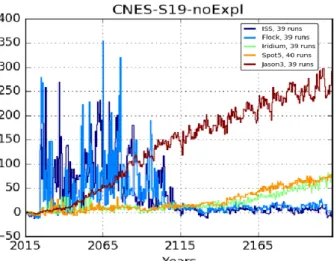
Fig. 1.- Collision risk increase for different missions depending an scenario with two mega-constellations at 1100 and 1200 km.
Biography
Juan-Carlos Dolado-Perez
Juan-Carlos Dolado-Perez is the head of the space debris modelling and risk assessment office at the “Centre National d’Etudes Spatiales”
(French Space Agency). Since 2008 he has worked at the system engineering and orbital dynamics sub directorate, where his main research topics concerns the long and middle term re-entry prediction, the long term evolution of the space debris population, the on orbit collision risk assessment, the orbit determination from radar and optical measurements and the uncertainty characterization and propagation.
He is a member of the Inter Agencies Space Debris Committee (IADC)’s French Delegation and of the International Academic of Astronautics (IAA)’s Space Debris Committee
Outline
Collision Avoidance at Launch
Optical Space Surveillance
Data Processing for Cataloguing – Space Surveillance
Collision Avoidance in – orbit
Orbital propagation
Re-Entry Predictions
Re-Entry Modelling
Space Debris Environment Modelling – Env. Index
8thJAXA Space Debris Workshop – Chofu, Japan – December 3rd– 5th2018
Orbital Debris Activities at CNES with a Focus on Space Debris Environment Impact Evaluation
J.C. DOLADO – V. RUCH
8th JAXA Space Debris Workshop Chofu, Japan, December 3rd– 5th2018
Collision Avoidance at Launch
Operational Collision Avoidance at Launch since 2010
Requirement from FSOA (French Law)
Collision Risk analysis with ISS, Soyuz, …
Every launch from Guyana Space Center
Preliminary joint work in the past between JAXA and CNES
Example Soyuz flight: no risk
Example Ariane 5: risks at 5thand 6thorbit 8thJAXA Space Debris Workshop – Chofu, Japan – December 3rd– 5th2018
Outline
3
Collision Avoidance at Launch
Optical Space Surveillance
Data Processing for Cataloguing – Space Surveillance
Collision Avoidance in – orbit
Orbital propagation
Re-Entry Predictions
Re-Entry Modelling
Space Debris Environment Modelling – Env. Index
Optical Space Surveillance
Operations of TAROTnetwork:
TAROT network covers 70% of GEO belt
An additional on-demand site in Australia allows to cover almost 100%
Catalogue build-up and maintenance of ~500 objects
8thJAXA Space Debris Workshop – Chofu, Japan – December 3rd– 5th2018
Outline
5
Collision Avoidance at Launch
Optical Space Surveillance
Data Processing for Cataloguing – Space Surveillance
Collision Avoidance in – orbit
Orbital propagation
Re-Entry Predictions
Re-Entry Modelling
Space Debris Environment Modelling – Env. Index
Observation of GALILEO Constellation Launch
Optical Space Surveillance
8thJAXA Space Debris Workshop – Chofu, Japan – December 3rd– 5th2018
7
Observation of GALILEO Constellation Launch
Optical Space Surveillance
Observation of GALILEO Constellation launch
Optical Space Surveillance
8thJAXA Space Debris Workshop – Chofu, Japan – December 3rd– 5th2018
9
Observation of GALILEO Constellation launch
Optical Space Surveillance
Progress on the development of techniques for the enhancement of the covariance realism:
Maintaining the Gaussianity of Covariances matrices
Use of a reference frame where T [m] is replaced by t [sec]
Data Processing for Cataloguing
8thJAXA Space Debris Workshop – Chofu, Japan – December 3rd– 5th2018
Outline
11
Collision Avoidance at Launch
Optical Space Surveillance
Data Processing for Cataloguing – Space Surveillance
Collision Avoidance in – orbit
Orbital propagation
Re-Entry Predictions
Re-Entry Modelling
Space Debris Environment Modelling – Env. Index
Data Processing for Cataloguing
Progress on the development of advanced techniques for correlation and cataloguing:
- Bayesian data association techniques - Joint Probabilistic Data Association - Multi Hypothesis Tracking
- Multi-Bernouilli – Finite Sets Statistics
Object 1
Object 2
Measurement 1 Measurement 2
# Joint Event
1 Meas. 1 and 2 from clutter
2 Meas. 1 from Obj. 1, Meas. 2 from clutter 3 Meas. 1 from clutter, Meas. 2 from Obj. 1 4 Meas. 1 from clutter, Meas. 2 from Obj. 2 5 Meas. 1 from Obj. 1, Meas. 2 from Obj. 2 8thJAXA Space Debris Workshop – Chofu, Japan – December 3rd– 5th2018
13
Progress on the development of orbit determination techniques using Gaussian mixture approachesas well as “new” correlation metrics
Log-likelihood vs Mahalanobis
Horwood, Aragon, Poore. Gaussian Sum Filters for Space Surveillance :
Theory and Simulations. Journal of Guidance, Control and Dynamics 34 (2011), 1839-1851
𝑑𝑑𝑑𝑑𝐿𝐿𝐿𝐿2= 𝐾𝐾𝐾𝐾 ln 2𝜋𝜋𝜋𝜋 + ln Σ + 𝑥𝑥𝑥𝑥 𝑥 𝑥𝑥𝑥𝑥 𝑇𝑇𝑇𝑇Σ−1 𝑥𝑥𝑥𝑥 𝑥 𝑥𝑥𝑥𝑥
Data Processing for Cataloguing
Additionalstudies to improve our capability to
Task and Schedule sensors
Evaluate information gain coming from observations and optimize observation strategies
Analysis of ionosphere correction models
Development of IOD methods
…
Space Surveillance System Analysis
8thJAXA Space Debris Workshop – Chofu, Japan – December 3rd– 5th2018
Space Surveillance System Analysis
15
Supporting the European Space Surveillance and Tracking Program through the analysis of the performanceof the actual and future architectures
On-Orbit Collision Avoidance
8thJAXA Space Debris Workshop – Chofu, Japan – December 3rd– 5th2018
Operational Collision Risk assessment of 99 satellites
- 24 LEO - 26 MEO - 49 GEO
Outline
17
Collision Avoidance at Launch
Optical Space Surveillance
Data Processing for Cataloguing – Space Surveillance
Collision Avoidance in – orbit
Orbital propagation
Re-Entry Predictions
Re-Entry Modelling
Space Debris Environment Modelling – Env. Index
Outline
Collision Avoidance at Launch
Optical Space Surveillance
Data Processing for Cataloguing – Space Surveillance
Collision Avoidance in – orbit
Orbital propagation
Re-Entry Predictions
Re-Entry Modelling
Space Debris Environment Modelling – Env. Index
8thJAXA Space Debris Workshop – Chofu, Japan – December 3rd– 5th2018
19
Collision Risk 3-D Probability Computation
On-Orbit Collision Avoidance
Improvement of STELAsemi-analytic propagator
Use of recurrence formulation for zonal perturbation: maximum degree of development is no more limited to 15
Development of third body perturbation up to order 8
Ability to propagate INTEGRAL orbits (sma = 87941 km, ecc=0.856)
Ability to propagate for a decade SIMBOL-X orbit (sma = 106247 km, ecc = 0.75)
Work ongoing on the inclusion of short periodsofnon-conservative forces
PRS
Drag
Work initiated on the propagation of space debrisusing density model approaches
Orbital Debris Propagation
8thJAXA Space Debris Workshop – Chofu, Japan – December 3rd– 5th2018
21
CNES IMCCE GRUCACI OCA UPM GME KIAM
NUMERICAL COWELL DOPRI
GBS
DROMO 7DEPRIF
SEMI-ANALYTICAL
CODIOR CODIOR
SATLIGHT IV SATLIGHT IV
STELA STELA
THEONA THEONA
DSST
HEOSAT HEOSAT
NADIA
ANALYTICAL SGP4
FAST FAST
ATESAT ATESAT
DRI DRI
Orbital Debris Propagation
Reentry Predictions
Tiangong-1Reentry
On-ground risk evaluation > a week prior to reentry
8thJAXA Space Debris Workshop – Chofu, Japan – December 3rd– 5th2018
Outline
23
Collision Avoidance at Launch
Optical Space Surveillance
Data Processing for Cataloguing – Space Surveillance
Collision Avoidance in – orbit
Orbital propagation
Re-Entry Predictions
Re-Entry Modelling
Space Debris Environment Modelling – Env. Index
Outline
Collision Avoidance at Launch
Optical Space Surveillance
Data Processing for Cataloguing – Space Surveillance
Collision Avoidance in – orbit
Orbital propagation
Re-Entry Predictions
Re-Entry Modelling
Space Debris Environment Modelling – Env. Index
8thJAXA Space Debris Workshop – Chofu, Japan – December 3rd– 5th2018
25
Tiangong-1Reentry
Refinement of the reentry epoch and location with radar observations
Reentry prediction 1 day prior to real reentry
Reentry Predictions
Reentry Modeling
8thJAXA Space Debris Workshop – Chofu, Japan – December 3rd– 5th2018
Reentry Modeling
27
EXPERIMENTAL DATA
From ground tests
From flight experiments
VALIDATION OF THE REENTRY MODELING TOOLS
CNES tools: DEBRISK, PAMPERO
Existing JAXA – CNES cooperation
Space Debris Environment Modelling
Long term evolution of space debris environment, shows a unstable behavior in the LEO regime, if efforts are not made to reduce the number of objects on the environment.
13000 18000 23000 28000 33000
Effective LEO Population (>10cm)
Year 30% PMD Compliance
60% PMD Compliance 90% PMD Compliance
N.B.: PMD Compliance refers to objects non compliant with the 25-Years rule that we have voluntarily de-orbited
8thJAXA Space Debris Workshop – Chofu, Japan – December 3rd– 5th2018
Outline
29
Collision Avoidance at Launch
Optical Space Surveillance
Data Processing for Cataloguing – Space Surveillance
Collision Avoidance in – orbit
Orbital propagation
Re-Entry Predictions
Re-Entry Modelling
Space Debris Environment Modelling – Env. Index
Space Debris Environment Modelling
Long term evolution of space debris environment, shows a unstable behavior in the LEO regime, if efforts are not made to reduce the number of objects on the environment.
13000 18000 23000 28000 33000
Effective LEO Population (>10cm)
Year 30% PMD Compliance
60% PMD Compliance 90% PMD Compliance
N.B.: PMD Compliance refers to objects non compliant with the 25-Years rule that we have voluntarily de-orbited
8thJAXA Space Debris Workshop – Chofu, Japan – December 3rd– 5th2018
Reality is 17% !!
Space Debris Environment Modelling
31
SATELLITES Compliance to LEO EOL guidelines
Global S/C compliance lying on natural effects
~17% of OCC satellites compliant thanks to a manoeuver6% of all non cubesats S/C
Space Debris Environment Modelling
Large Constellation Effect and Environmental Index
8thJAXA Space Debris Workshop – Chofu, Japan – December 3rd– 5th2018
Space Debris Environment Modelling
33
Mitigation and Remediation Complementarity
14000 19000 24000 29000 34000 39000
2013 2063 2113 2163 2213
Effective LEO Population (>10cm)
Year PMD30 Medium SA PMD30 Medium SA - ADR2 PMD30 Medium SA - ADR5 PMD30 Medium SA - ADR8
4000 6000 8000 10000 12000 14000 16000 18000 20000
2013 2063 2113 2163 2213
Effective LEO Population (>10cm)
Year PMD90 Medium SA PMD Medium SA - ADR2 PMD90 Medium SA - ADR5 PMD90 Medium SA - ADR8
Mitigation is needed whichever the Remediation Scenario
Scenario 10 vs. Baseline [Relative increase of flux vs. time]
GENERAL
Objects > 10 cm X
1cm < Debris < 10cm, generated by NASA BU BACKGROUND
PMD 90%
PMD 20%, max lifetime 25 years
PMD 20% in 2013, rising linearly and stabilizing at 90% in 2050,
max lifetime 25 years X
EXPLOSIONS
Explosions:
- random number of explosions per year (between 5 and 12) - 5 < nb debris < 250
- Exploding objects were launched before 2020 CONSTELLATIONS
Constellation Altitude (km) 600 1100 1200
Injection Altitude (km) direct 450 450
Electric orbiting duration (days) 50 50
Collision avoidance effectiveness rate (%) 90 90 90
PMD rate (%) 100 90 90
PMD deorbitation orbit type PMD target lifetime (years)
Electric PMD duration (years) 2 2
Launch stages : none (direct reentry) X X X
Launch stages : PMD 90%, target lifetime = 25 years CUBESATS
Cubesats launchs: from 200 in 2013 to 600 in 2050 and later,
<600km
Cubesats launchs: from 20 in 2013 to 60 in 2050 and later,
>600km
Space Debris Environment Modelling
Large Constellation / small sats Effect and Environmental Index
8thJAXA Space Debris Workshop – Chofu, Japan – December 3rd– 5th2018
Space Debris Environment Modelling
35
Large Constellation / small sats Effect and Environmental Index Scenario 1 vs. Baseline
[Relative increase of flux vs. time]
GENERAL
Objects > 10 cm X
1cm < Debris < 10cm, generated by NASA BU BACKGROUND
PMD 90% X
PMD 20%, max lifetime 25 years
PMD 20% in 2013, rising linearly and stabilizing at 90% in 2050, max lifetime 25 years
EXPLOSIONS
Explosions:
- random number of explosions per year (between 5 and 12) - 5 < nb debris < 250
- Exploding objects were launched before 2020 CONSTELLATIONS
Constellation Altitude (km) 1100
Injection Altitude (km) direct
Electric orbiting duration (days)
Collision avoidance effectiveness rate (%) 100
PMD rate (%) 90
PMD deorbitation orbit type eccentric
PMD target lifetime (years) 25
Electric PMD duration (years)
Launch stages : none (direct reentry) X
Launch stages : PMD 90%, target lifetime = 25 years CUBESATS
Cubesats launchs: from 200 in 2013 to 600 in 2050 and later,
<600km
Cubesats launchs: from 20 in 2013 to 60 in 2050 and later,
>600km
Thank You for your Attention
8thJAXA Space Debris Workshop – Chofu, Japan – December 3rd– 5th2018
37
Scenario 10 vs. Baseline [Relative increase of flux vs. time]
GENERAL
Objects > 10 cm X
1cm < Debris < 10cm, generated by NASA BU BACKGROUND
PMD 90%
PMD 20%, max lifetime 25 years
PMD 20% in 2013, rising linearly and stabilizing at 90% in 2050,
max lifetime 25 years X
EXPLOSIONS
Explosions:
- random number of explosions per year (between 5 and 12) - 5 < nb debris < 250
- Exploding objects were launched before 2020 CONSTELLATIONS
Constellation Altitude (km) 600 1100 1200
Injection Altitude (km) direct 450 450
Electric orbiting duration (days) 50 50
Collision avoidance effectiveness rate (%) 90 90 90
PMD rate (%) 100 90 90
PMD deorbitation orbit type PMD target lifetime (years)
Electric PMD duration (years) 2 2
Launch stages : none (direct reentry) X X X
Launch stages : PMD 90%, target lifetime = 25 years CUBESATS
Cubesats launchs: from 200 in 2013 to 600 in 2050 and later,
<600km
Cubesats launchs: from 20 in 2013 to 60 in 2050 and later,
>600km
Space Debris Environment Modelling
Large Constellation / small sats Effect and Environmental Index