著者名(英) Kazue Imasato, Geraldo Faria journal or
publication title
The journal of Kanda University of International Studies
volume 26
page range 409‑431
year 2014‑03
URL http://id.nii.ac.jp/1092/00001122/
Kanda University of International Studies
Kazue Imasato & Geraldo Faria Abstract
Bakairi is a language spoken in 12 tribes in the Southern Amazonia, The language is divided in two dialectal groups: Pakuera Bakairi, the Eastern speakers who have already devised a writing system; and a Western group (Bakairi de Santana), of more than 300 speakers. These two groups live some 150 kilometers apart separated by jungles, rivers and mountains. Neither dialect has had any formal documentation of their grammar. The authors wish to remedy this situation by describing how this Carib language typifies verbs. In an environment where they do not possess Western notions of hours, days of week, years as we normalize our lives, the Bakairi clarify indispensable cultural notions in highly agglutinative verbal paradigms.
1. Introduction
There are over 1,000 speakers1 of the Bakairi language, who live across scattered tribes in the Southern Amazonia. An estimated equal number of speakers temporarily or permanently live in nearby cities, in Mato Grosso, Brazil. This Cariban (Gildea 15) language is divided into two dialectal groups: Pakuera Bakairi, the Eastern speakers (about 70% of the total population) who have already conceived a writing
1 http://loja.ibge.gov.br/censo-demografico-2010.
system; and a Western group (Bakairi de Santana2). These two groups live some 150 kilometers apart, separated by jungles, rivers and mountains. Formal documentation of the grammar of the two dialects does not exist. There are a few publications (limited to anthropological studies and collections of oral stories) on the Eastern dialect, whereas there has so far been no study that analyzes or describes the Western dialect.
This paper aims to remedy this oversight by discussing the ways the Bakairi de Santana typifies verbs. (In the discussion that follows, the authors will use the term Bakairi to indicate solely the vernacular spoken in the Santana region.)
2. Linguistic Type
Typologically, verbs in any language are essential to configure thoughts and to express meanings. Verbs are a part of speech—a word class—that typically signals states and actions. Verbs constitute, singly or in a phrase, a minimal predicate in a clause—verbs are the head of the predicate. Oftentimes, verbs govern various types of constituents which may occur in a clause. And in some inflectional languages, verbs may be inflected to denote voice, person, number, grammatical gender, case, topic, degree, et cetera, in addition to tense, aspect, and modality (TAM). Languages specialize and do not show all of the aforesaid features.
In Bakairi, notions pertaining to the sequence of events, intention, and many other linguistic settings (bound person pronoun, reflexives/reciprocals, adverbial morphemes (such as again, against, contrary, up/down), collectivity/plural, tenses,
2 The Western Bakairi people live in two villages: about 250 of them have settled in the Catholic Santana village, and 50 people in the Protestant village of Nova Canaan. These two settlements are visible from each other. They share a school, a few public buildings, and agricultural machinery, among other things.
imperatives, negation) are inflected in highly agglutinative3-polysynthetic verbal paradigms4 (Kornai 62). Tenses range from realis to irrealis. Realis tenses—
something that has happened or is happening—are mainly present and past tenses.5 Irrealis refers to something that could have happened or might happen, such as future, conditional, subjunctive and purpose.6
Until fairly recently, the Bakairi people did not have Western notions of hours, days of the week, or a systematic chronology of years in their language. Currently they do possess these notions, thanks to loanwords borrowed from Brazilian Portuguese (BP). Despite these borrowed time markers, verbs in Bakairi are able to express distinctions which in many other languages are done periphrastically by adverbs of time, manner, quantification, position and similarity.
Typically, the word order (or constituent order) is Verb-Subject (VS) for intransitive verbs. Object-Verb-Agent (OVA) is the norm when the subject/agent is a free-pronoun (unmarked A). Nevertheless, when the subject/agent of the transitive verbs is a given name or a noun (marked A), the word order is Agent-Object-Verb (AOV). Furthermore, the language possesses a relatively complex bound-pronoun system, which must coordinate with the inflection of verbs.
3 Most words consist of various fully segmentable morphemes (roots and affixes). However, it is unlikely that every morpheme is agglutinative; a few grammatical elements are not segmentable, since the affix will fuse with the root. This makes Bakairi partly fusional, but highly agglutinative.
4 Almost all words are bimoraic, except for a few interjections and a handful of proper names.
Mora plays a significant role in stress allocation and assists in parsing and creating boundaries of phonological words, in Bakairi. However, stress (thus mora) plays a minor role in the morphology of Bakairi verbs, simply aiding the speakers in determining where and how to parse words.
5 Native teachers of the language identify only 4 realis tenses: present progressive, recent past, simple past and remote past. This list should also include t-stem-ze to indicate simple present instances.
6 Also, the speakers identify verbs that become attributes of a noun as infinitives.
3. Morphology of the Bakairi Verbs
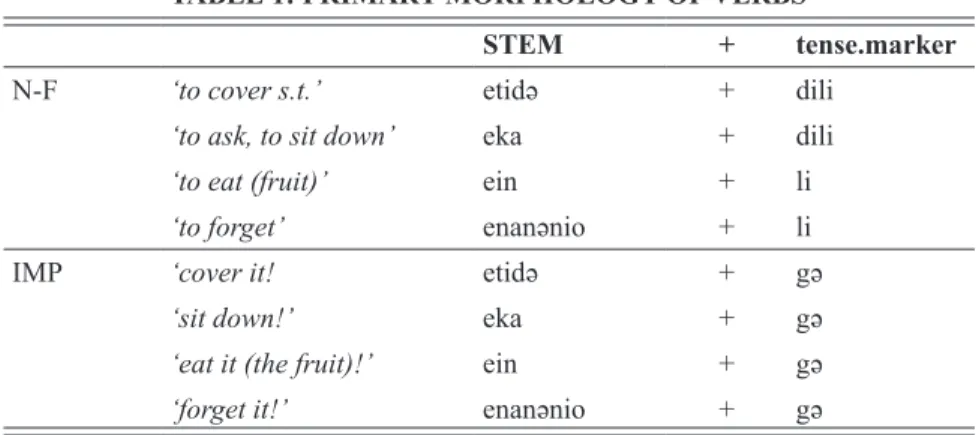
The primary morphology of verbs is a stem, oftentimes comprised of a verb root (sometimes preceded by a noun root), which is always followed by a tense marker (verbal suffix) (TABLE 1: PRIMARY MORPHOLOGY OF VERBS). This morphological structure typifies the ‘infinitive’7 as well as the ‘imperative’:
TABLE 1: PRIMARY MORPHOLOGY OF VERBS
STEM + tense.marker
N-F ‘to cover s.t.’ etidə + dili
‘to ask, to sit down’ eka + dili
‘to eat (fruit)’ ein + li
‘to forget’ enanənio + li
IMP ‘cover it! etidə + gə
‘sit down!’ eka + gə
‘eat it (the fruit)!’ ein + gə
‘forget it!’ enanənio + gə
No further morphological processes can be applied to the infinitive. The infinitive form in Bakairi refers to a non-finite (N-F) form, which is not marked for person or number of a subject. These N-F structures possess limited use, usually for phrases as it is time to eat, it is the place to sleep, it is a piece of paper to write (examples (1) and (2), below). Nevertheless, the most common tense, the present progressive, derives from this morphological structure always with the annexation of person inflection prefixes and the nasalization of the stem. Further verbal constructions directly derive from the N-F: the participle and causative.
7 The term infinitive tends to mislead readers, because it is highly charged with language specific characteristics, and so the authors chose to use the term non-finite instead.
1. edanwəli8 ome
edan-wə-li ome9 copula
eat_food-all-N_F time/now it is
‘It is time to eat (all of the food).’
2. sasewədili ome
sase-wə-dili ome copula
gather_fruit-all-N_F time/now it is
‘It is time to harvest (all of the fruit).’
Syntactically, the N-F is a nominalization. It occurs basically before a noun and functions as an attribute of that noun. It cannot be preceded by a bound pronoun.
Pragmatically though, utterances (1) and (2) indicate:
(a) a straightforward statement of a fact;
(b) an appeal for the cook to prepare and/or serve the solid meal (such as rice cake, corn bread, chips or bread—as long as all dishes are solid) in (1), and a suggestion so that one’s companions harvest all the fruit in (2); and,
(c) an invitation or an indirect command to eat or to harvest.
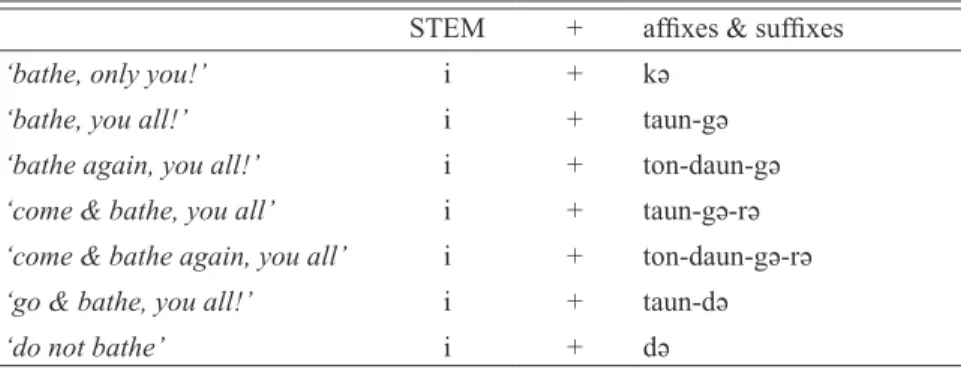
Unlike the N-F, a handful of morphological processes may be applied to the imperative (IMP), the lower tier of TABLE 1, leading to inflections and derivations (TABLE 2).
8 edanwəli is restricted to ‘eating solid food’, einli is limited to ‘eating fruit or liquid food, such as soup', and sədili to ‘eating meat.’
9 Bakairi is a language that lacks a copula verb for the verb ‘to be’. Negation of the copula however is expressed with a negative copula, as well as a past copula.
TABLE 2: MORPHOLOGICAL ALTERATIONS IN THE IMPERATIVE STEM + affixes & suffixes
‘bathe, only you!’ i + kə
‘bathe, you all!’ i + taun-gə
‘bathe again, you all!’ i + ton-daun-gə
‘come & bathe, you all’ i + taun-gə-rə
‘come & bathe again, you all’ i + ton-daun-gə-rə
‘go & bathe, you all!’ i + taun-də
‘do not bathe’ i + də
Before discussing the inflectional system of person (section 3.1.), it is necessary to explain the morphological verbal configurations in Bakairi that do not relate to tense, and do not take person inflection:
(a) verbs of the semantic type LIKING10 (i.e., love, hate, like doing something) are neither linked to past or present (example (3)) and have the morphological make-up of t-stem-ze/se.
(b) future constructions (subjunctives and conditionals as well) are irrealis, something that might happen (example (4)), and are formed as stem-ze/se;
(c) purposive constructions—constructions that show the purpose of an action represented by the main verb—require verbs not to be inflected to indicate person (example (5)); they are formed as stem-(di)li-ro.
3. kafe təniʔe əmə? en-hen, təniʔe
kafe t(ə)-eni-ze11 əmə? en_hen t(ə)-eni-ze.
10 Languages allow assertions such as ‘I like coffee’, ‘dogs bark’ to be expressed in a form that does not indicate a particular tense (Dixon 154).
11 As the reader may notice, /z/ or /h/ will appear many times as [ʔ], which is a distinguishing feature
coffee t-drink-like/do you? yes, t-drink-like/do
‘Do you like (drinking) coffee? Yes, I do.’
4. ogonekə itian idəʔe urə
ogonekə i-eti-an idə-ze urə
afternoon your-house/clothing-to go-FUTURE I
‘In the afternoon, I am going to your house.’
5. iwerə ma iʔe ikili-ro
iwerə ma ize ikili-ro
now/today well-INTERJECTION want sleep-perhaps
‘Now I go to sleep.’
As most statements in Bakairi refer to an action, a state or a property situated within a particular time frame, this time frame is shown through a system of tense choices. Such verbal statements must co-occur with a person inflection. For the realis tenses, the inflection for person is expected, especially for the 1st and 2nd persons of the singular (1sg / 2sg) and for 1st person plural inclusive and 2nd person of the plural.
person.inflection - STEM - tense.marker
The person inflection (section 3.1.) commonly indicates the subject (intransitive verbs) or the agent (transitive verbs) of the predicate in the active voice. The stem may
of the Western dialect. The choice of /z/ is based on the principle that Cariban languages typically possess /ze/ endings for verbs, leading to the conclusion that this glottal stop is a language specific.
undergo two alterations: (a) it is always nasalized to indicate durative (‘continuous’
or ‘progressive’ tense); and (b) a phonological vowel shift when the person inflections are k-12 and t-.13 The stem may be attached to its argument (a noun object before it).14 The tense.marker (section 3.2.) always follows the stem. The stem may be modified by adverbial morphemes preceding and/or following it. The verb may be followed by plural markers exclusively for 2nd and 3rd persons in the plural (2pl / 3pl).
3.1. The person inflection
The 1sg and 2sg are strictly speaking bound pronouns and they differ between non-past and past tenses. The free pronoun for 3rd person singular (3sg) of Bakairi is not a person pronoun per se. It is indeed a set of demonstratives used as free pronouns, and when 3sg is inflected in the verb as a bound pronoun it is usually an n- or Ø (unmarked)15 (except for in the present progressive, it is a nasalized j- as ɲ-).
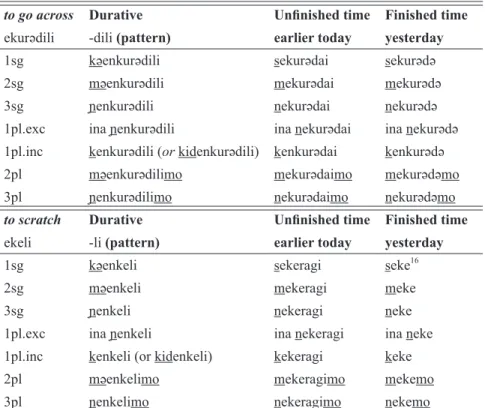
The 3sg is less sensitive to tense, i.e., sometimes it does not vary between present and past tenses, where the 1sg is the most sensitive to tenses being always different (highly marked). TABLE 3: PERSON INFLECTION IN TWO PATTERNS OF VERB PARADIGMS below gives an illustration of these bound pronouns.
12 The k- morpheme of the first person plural (1pl), we, denotes all of us.
13 The t- morpheme is an undetermined possessor, which fills a required synthetic slot, but semantically refers simply to someone.
14 In Bakairi, this core slot can be attached to the argument of the verb, such as to babysit, to headhunt in English.
15 The degree of markedness in Bakairi verbs is 1sg>2sg>3sg, with 3sg being the least marked.
TABLE 3: PERSON INFLECTION IN TWO PATTERNS OF VERB PARADIGMS to go across Durative Unfinished time Finished time ekurədili -dili (pattern) earlier today yesterday
1sg kəenkurədili sekurədai sekurədə
2sg məenkurədili mekurədai mekurədə
3sg ɲenkurədili nekurədai nekurədə
1pl.exc ina ɲenkurədili ina nekurədai ina nekurədə 1pl.inc kenkurədili (or kidenkurədili) kenkurədai kenkurədə
2pl məenkurədilimo mekurədaimo mekurədəmo
3pl ɲenkurədilimo nekurədaimo nekurədəmo
to scratch Durative Unfinished time Finished time
ekeli -li (pattern) earlier today yesterday
1sg kəenkeli sekeragi seke16
2sg məenkeli mekeragi meke
3sg ɲenkeli nekeragi neke
1pl.exc ina ɲenkeli ina nekeragi ina neke
1pl.inc kenkeli (or kidenkeli) kekeragi keke
2pl məenkelimo mekeragimo mekemo
3pl ɲenkelimo nekeragimo nekemo
16
The details of the inflection are:
• 1sg (speaker) is indicated by {kə-} for non-past and {s-}17 for past tenses.
• 2sg (addressee) is indicated by {mə-} for non-past and {m-} for past tenses.
• 3sg (non-speech act participant) is indicated by {ɲ-}, {n-} or Ø.
• For 1st plural exclusive (1pl.excl) (including speaker and a few others, the paucal we), the verb is borrowed from 3sg and cannot receive a plural marker {-mo}. It
16 The -li ending paradigm is formed with the -Ø morpheme for the simple past tense.
17 Or [ʃ-] if the stem begins with i- (also in nouns with u- as [ʃu-]), as palatalization obligatorily occurs.
must be preceded by the free pronoun ina.
• 1pl inclusive (1pl.incl) (including speaker and a large group or all, the collective we) is indicated by {k-} or {kid-}, and never receives the plural marker {-mo}.
• Verbs only receive a plural marker {-mo} when inflected for 2pl / 3pl. These 2pl and 3pl inflections are borrowed from their respective 2sg and 3sg.
3.2. Tenses
At the very beginning of any soliloquy or dialogue, the speaker sets the notion of time by using an adverb that indicates time (a long time ago, some time ago, yesterday, this morning, tomorrow), and by transforming the verb accordingly, with the use of morphemes added to the verb stem, indicating present (section 3.4.), unfinished time past, which is the recent past (section 3.6.), finished time past, which is the simple past (section 3.6.), intention, conditional-subjunctive (section 3.9.), or other more advanced tenses.
As this notion of time is also included in the verb at the very beginning of any discourse, the following sentences do not require the repetition of this tense in their verbs (avoiding redundancy). To illustrate, a text could be formed this way:
Yesterday I went to the river to bathe. I walk down, I enter the water, I clean. Finish.
The sequential phrases of the same topic will be formed with N-F verbs ending in -li (section 3.4.) until the topic is concluded and a new topic is introduced, setting a new time frame.
The first and most widely used tense is the present progressive—the durative. It is formed with a unique person inflection (especially for 1sg and 2sg) (section 3.1), the nasalized stem (section 3.3.), and ending with the -li morpheme (section 3.4.).
3.3. Nasality
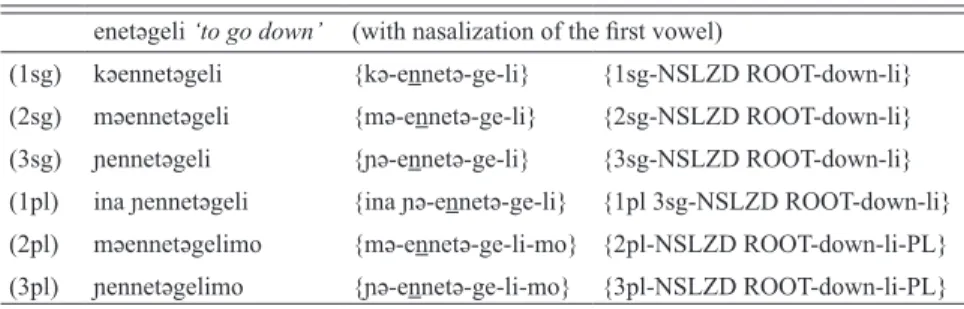
Nasality is the most distinct and widespread suprasegmental feature that must occur in the root of the verb to denote its ongoing progression. It is fashioned by the nasalization of the vowel in a single syllable root (TABLE 4: NASALIZATION OF ROOTS). With multiple-syllable roots, nasalization occurs in the first syllable, although multiple vowels may be nasalized by forward nasal spreading. Moreover, backward nasal spreading occurs, causing the nasalization of the semi-vowel /j/
(bound vowel in the C-slot of the syllable) to be perceived as [ɲ].
TABLE 4: NASALIZATION OF ROOTS enetəgeli ‘to go down’ (with nasalization of the first vowel)
(1sg) kəennetəgeli {kə-ennetə-ge-li} {1sg-NSLZD ROOT-down-li}
(2sg) məennetəgeli {mə-ennetə-ge-li} {2sg-NSLZD ROOT-down-li}
(3sg) ɲennetəgeli {ɲə-ennetə-ge-li} {3sg-NSLZD ROOT-down-li}
(1pl) ina ɲennetəgeli {ina ɲə-ennetə-ge-li} {1pl 3sg-NSLZD ROOT-down-li}
(2pl) məennetəgelimo {mə-ennetə-ge-li-mo} {2pl-NSLZD ROOT-down-li-PL}
(3pl) ɲennetəgelimo {ɲə-ennetə-ge-li-mo} {3pl-NSLZD ROOT-down-li-PL}
The presence of a nasal consonant in the root, such as /n/ or /m/ suffices as nasalization, making it ambiguous whether the verb is in the progressive form or not.
However, some speakers insist on the nasalization of the initial vowel of the stem, even in the presence of a nasal consonant. Nasality must always co-occur with -li to form the present progressive.
3.4. The -li morpheme
An inflected Bakairi verb with the -(di)li morpheme as a verb suffix indicates a fundamental tense. These -(di)li verbs—when formed with person inflection and the
nasalized stem—customarily refer to an ongoing tense in the indicative mood (realis).
This -(di)li morpheme is generally bound directly to roots as a suffix to form verbs—
except (♦) when -on- (meaning again), -wə- (meaning the totality), -ge-/-ke- (meaning contrary or a verbalizer) is added between the stem and -li. The most common affix added after the stem is -mo (section 3.5.). The -(di)li morpheme is replaced by -raki/- ragi, -tai/-dai, -də or Ø (section 3.6.) for non-present realis tenses.
person.inflection - STEM - (♦) - (di)li
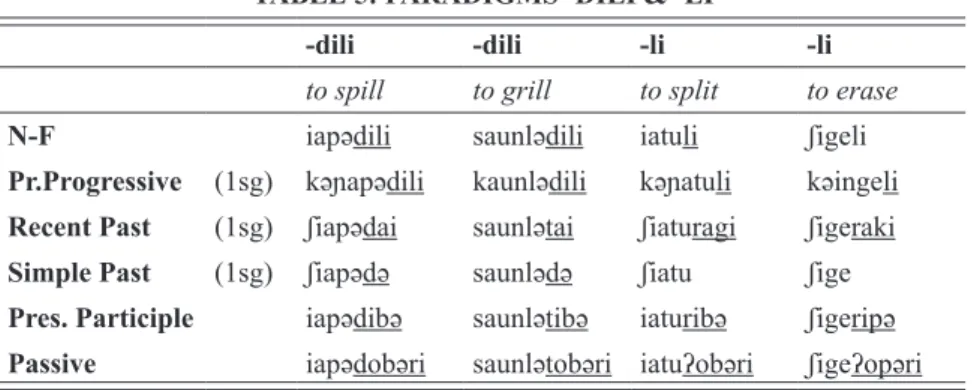
Two distinct paradigms are fashioned in relation to the -li morpheme:
(a) -dili > -dai (-tai) > -də, and;
(b) -li > -ragi (-raki) > Ø.
TABLE 5: PARADIGMS -DILI & -LI
-dili -dili -li -li
to spill to grill to split to erase
N-F iapədili saunlədili iatuli ʃigeli
Pr.Progressive (1sg) kəɲapədili kaunlədili kəɲatuli kəingeli Recent Past (1sg) ʃiapədai saunlətai ʃiaturagi ʃigeraki Simple Past (1sg) ʃiapədə saunlədə ʃiatu ʃige Pres. Participle iapədibə saunlətibə iaturibə ʃigeripə Passive iapədobəri saunlətobəri iatuʔobəri ʃigeʔopəri
3.5. The -mo morpheme
The verbal suffix {-mo} can be added to a verb to signify plurality. Bakairi does not have the exact equivalent of the Western concept of the plural, more than one.18
18 Although this study does not deal with nouns, it is important to note that -mo is used to signify a large group of or all of. The -mo morpheme is not used for a small number of people or things (paucal notion).
The 1pl cannot receive {-mo} even though it refers to a semantic plural. There are indeed two 1pl formations: (1) ima – I and a few others, paucal we; and, (2) kurə – I and many, or all, collective we. The {-mo} morpheme is the syntactic marker for the 2pl and 3pl, and is the only difference that distinguishes the verb from the 2sg and 3sg. The {-mo} morpheme does not vary according to tenses, and is added as the very last suffix.
present progressive
to host editədili məenditədili (2sg) məenditədilimo (2pl) ɲenditədili (2sg) ɲenditədilimo (3pl) to burn enaʔodonogeli məenaʔodonogeli (2sg) məenaʔodonogelimo (2pl)
ɲenaʔodonogeli (3sg) ɲenaʔodonogelimo (3pl)
recent past (unfinished time)
to circle enomidili menomidai (2sg) menomidaimo (2pl) nenomidai (2sg) nenomidaimo (3pl) to fan enukibəgeli menukibəgeragi (2sg) menukibəgeragimo (2pl)
nenukibəgeragi (3sg) nenukibəgeragimo (3pl)
simple past (finished time)
to pull epəgeli mepəge (2sg) mepəgemo (2pl)
nepəge(3sg) nepəgemo (3pl)
to lift eparadədili meparadədə (2sg) meparadədəmo (2pl) neparadədə (3sg) neparadədəmo (3pl)
3.6. The before-now tenses
Two sets of tenses indicate before now. Variations occur in each group depending on whether or not the N-F forming -li morpheme is preceded by -di-. Recent past shows variation in [± voice]. All verbal derivations that can possess devoiced suffixes will use as a reference the recent past to decide on the [± voice] of their suffixes. Devoiced suffixes can occur in causatives, participles, passive voice, and in the irrealis tenses. As mentioned before, a word can only have one devoiced consonant in an intervocalic position.
Recent past Simple Past
-dili > -dai/-tai > də
-li > -ragi/-raki > Ø
3.6.1. Recent Past
The recent past -ragi/raki & -dai/-tai, akin to the English ‘present perfect’ (only when designating unfinished time), indicates a finished action in an unfinished time. In other words, the recent past shows that the predicate occurred before now, however, in an unfinished time such as earlier this morning, earlier today...
6. awadu ajetai iwerə
awadu a-ʒe-tai19 iwerə beiju_chip it-1.make- REC.PST today ‘I have made beiju chips today.’
19 Both [ajetai] and [aʒetai] are acceptable pronunciations.
7. satugeragi s-atuge-ragi I-peel-REC.PST
‘I have peeled (earlier today).’
8. ʃitugeragi si-atuge-ragi I.it-peel-REC.PST
‘I have peeled it (earlier today).’
3.6.2. Simple Past
The Simple past is indicated with -Ø or -də. For -dili (present form) verbs, -dili is replaced by -də. For all other verbs ending in -li, the Simple Past is formed with -Ø.
This tense is used for finished time predicates (yesterday, last night, two days ago, some time ago). It is not possible to use time (one o’clock, two hours ago) in the language, simply because they did use to have watches until quite recently.
Nonetheless, as they do have watches now, time expressions are loanwords (or rather, loan expressions) from BP. Likewise, they do not possess a numerical system as Westerners do. They use a binary number system: one, two, two-one, two-two, two hands (=10). All more complex numbers are borrowed from BP.
9. etadədili – ❶ to herd cattle ❷ to incarcerate (something) setadədai ‘I have gathered it.’ (earlier today) setadədaie ‘I have just gathered it.’ (earlier today)
setadəba(inda) ‘I have not gathered it (yet).’ (not yet) setadədə ‘I gathered it.’ (yesterday)
10. etədili – to cast
setədai ‘I have sowed it.’ (earlier today) setədaie ‘I have just sowed it.’ (earlier today) setəba(inda) ‘I have not sowed it (yet).’ (not yet)
setədə ‘I sowed.’ (yesterday)
11. etageli – to release, to let go
setageragi ‘I have released it.’ (earlier today) setageragie ‘I have just released it.’ (earlier today) setageba(inda) ‘I have not released it (yet).’ (not yet) setage Ø ‘I released it. ’ (yesterday)
12. etamugeli – to remove dirt, to uncover
setamugeragi ‘I have uncovered it.’ (earlier today) setamugeragie ‘I have just uncovered it.’ (earlier today) setamugeba(inda) ‘I have not uncovered it (yet).’ (not yet) setamuge Ø ‘I have uncovered.’ (yesterday)
The {inda} morpheme is borrowed from the BP ainda (not yet). It is optionally incorporated with the negation. Negation, in examples 13-16, shows devoiced suffixes resulting in -pa. Section 3.8 will discuss negation in detail.
13. medanwəraki → medanwəpa ‘you’ve eaten / you didn’t eat (solid food)’
14. meinraki → meinpa ‘you’ve eaten / you didn’t eat (liquid food)’
15. mətai → məpa ‘you’ve eaten / you didn’t eat (meat)’
16. menweraki → menwepa ‘you’ve smoked / you did not smoke’
3.6.3. Participle
Participles take -ribə/-ripə and -dibə/-tibə endings. The present form -dili, is replaced by -dibə (-tibə).
This tense is used for finished time predicates that have another verb at the center of the verb phrase. However, it is also used to express a complete idea about the topic: ‘the one who has done’, ‘who has done’, ‘what is done’, ‘that is done’.
In Bakairi, animals and human beings, as well as supernatural entities are part of an ANIMATE notion, whereas INANIMATE refers to water, trees, plants and so forth. It is not possible to tell apart whether the referent is a human or animal as the language does not offer any lexical clue such as the English who or that. (17) to (20) are the participles of (9) to (12):
17. etadədili → etadədibə (that was gathered, who was incarcerated) 18. etədili → etədibə (that was sowed)
19. etageli → etageribə (that was released, who was released) 20. etamugeli → etamugeribə (that was uncovered, who was uncovered) The morphemes -dibə and -ribə take the alternative forms -tibə and -ripə. The easiest way to predict -tibə is by looking at the immediate past (recent past),
because one consonant of the recent past suffix can be devoiced. Devoiced recent past verb suffixes turn out to be devoiced participle endings (TABLE 6:
DERIVATION OF PARTICIPLES FROM RECENT PAST). Devoiced participles do not always correspond, in the same way, to devoiced imperatives. Prefixes and the verbal stem are identical to the N-finite forms, and suffixes depend directly on the recent past tense endings.
TABLE 6: DERIVATION OF PARTICIPLES FROM RECENT PAST Non-finite Participle Recent past (1sg) Imperative to bring all enewəli20> enetibə < senetai enekə to burn iaduwəndili > iaduwəntibə < ʃiaduawəntai iaduwənkə to cook idələdili > idələtibə < ʃidələtai idələkə to send igonodili > igonotibə < ʃigonotai igonokə to burn out ʃugeli > ʃugeripə < ʃugeraki ʃugekə to grate ʃigili > ʃigiripə < ʃigiraki ʃigigə ◄ to eat21 edanwəli > sedanwəripə < sedanwəraki edanwəgə ◄
to search ʃuili > ʃuiripə < ʃuiraki ʃuigə ◄
◄ indicates where devoicing did not match with recent past.
2021
High-frequency verbs—such as go, eat, drink, do, burn, give and a few others—
due to their nature of being constantly used show some degree of irregularity from the abovementioned principles. In example (21), the verb stem varied (eʔe- > e-) as well as the devoicing of the recent past did not carry over (tai > dibə). Such irregularities are very few.
20 -wə- can replace -di- to signify ‘all’.
21 To eat solid food, other than meat.
21. eʔedili ‘seeing’ > kəen’edili ‘I am seeing’ > setai ‘I have seen’ >
sedə ‘I saw’ > eʔedibə ‘is seen’ > egə ‘see it!’ IMP
It is possible to predict all tense markers accurately for all verbs by mastering the present progressive and the recent past tenses. As for the devoicing of the intervocalic consonant, it is predictable for all medium and low-frequency verbs.
Only 7 high-frequency verbs show a minor degree of irregularity in carrying over [±
voice] from the recent past to other tenses.
3.7. Modifying morphemes
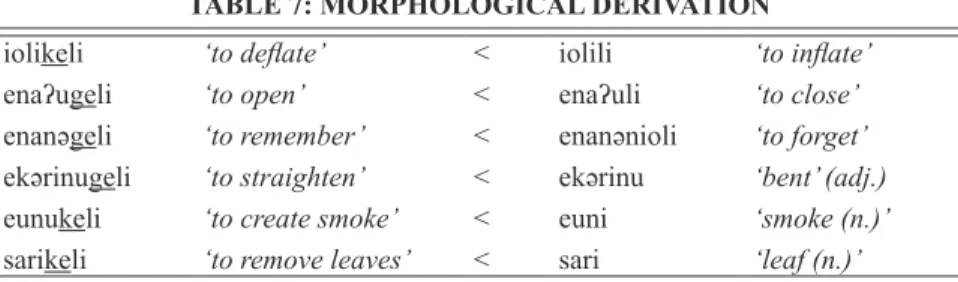
The most prominent modifying morpheme is -ge and its alternative -ke. The -ge suffix only appears after the root, before -li, and modifies the verb by (a) opposing the function of the verb, as does the English prefix de- in deform or (b) verbalizing nouns (n.) and adjectives (adj.), such as -ize in initialize. Verbs that end in -dili replace -di- with -ge- or -ke-. Again, the recent past of verbs will help determine the choice of -ge or -ke.
TABLE 7: MORPHOLOGICAL DERIVATION
iolikeli ‘to deflate’ < iolili ‘to inflate’
enaʔugeli ‘to open’ < enaʔuli ‘to close’
enanəgeli ‘to remember’ < enanənioli ‘to forget’
ekərinugeli ‘to straighten’ < ekərinu ‘bent’ (adj.) eunukeli ‘to create smoke’ < euni ‘smoke (n.)’
sarikeli ‘to remove leaves’ < sari ‘leaf (n.)’
Morphologically, derivations of all newly comprised -ge/-ke verbs are invariable:
-ragi to indicate recent past, -Ø for the Simple past, -ribə for participles, and -ʔobəri
for causatives. Take for instance, the verb ʃumekeli ‘to blow (a musical instrument)’.
Its participle, passive, causative, present progressive, recent past, and simple past are as follows:
ʃumekeribə (is) blown ʃumekeʔo that/which/who is blown ʃumekeʔobəri that/which/who was caused to be blown
Present progressive Recent past Simple past
(1sg) kunmekeli ʃumekeragi ʃumeke
(2sg) munmekeli mumekeragi mumeke
(3sg) ɲunmekeli numekeragi numeke
(1pl) ina ɲunmekeli ina numekeragi ina numeke
(2pl) munmekelimo mumekeragimo mumekemo
(3pl) ɲunmekeli numekeragimo numekemo
3.8. Negation
The only mark of negation in Bakairi is the addition of the suffix -ba/-pa to a verb which is the predicate head. In order to predict the morpheme -ba/-pa, it is necessary to master the recent past (-ragi/-raki & -dai/-tai) of any given verb. The recent past contains the clue to whether the negative suffix will be [± voice] (as a matter of fact, [± voice] of any verbal suffix that replaces the tense markers can be predicted based on this clue). All verbs that take -ragi & -dai are negated with -ba, and verbs with -raki & -tai are negated with -pa. The {-ba/-pa} morpheme replaces the realis tense endings, but the remaining bound person pronoun (person prefix) and verb stem usually carry enough semantic information to indicate whether it is a negated present or negated past. The following table (TABLE 8) shows the negation of the realis tenses of iaduwəndili ‘to burn’, with its recent past ending in -tai.
TABLE 8: NEGATION OF REALIS TENSES
Recent Past Simple Past Negation of both past tenses
(1sg) ʃiaduawəntai ʃiaduwəndə ʃiaduwəmpa
(2sg) miaduawəntai miaduwəndə miaduwəmpa
(3sg) niaduawəntai niaduwəndə niaduwəmpa
(1pl) ina niaduawəntai ina niaduwəndə ina niaduwəmpa
(2pl) miaduawəntaimo miaduwəndəmo miaduwəmpamo
(3pl) niaduawəntaimo niaduwəndəmo niaduwəmpamo
Present Progressive Negated Present
(1sg) kəiandunwəndili kəiandunwəmpa
(2sg) məiandunwəndili məiandunwəmpa
(3sg) ɲandunwəndili ɲandunwəmpa
(1pl) ina ɲandunwəndili ina ɲandunwəmpa
(2pl) məiandunwəndilimo məiandunwəmpamo
(3pl) ɲiandunwəndilimo ɲiandunwəmpamo
Other derived forms of this verb iaduwəndili ‘to burn’, such as iaduwəntibə ‘is burned’, iaduwənto ‘that/who is made to burn’ and iaduwəntobəri ‘that/who was caused to get burned’ also respect the [±voice] feature regulated by the verb suffix for the recent past.
Had the recent past tense ended in -dai or -ragi (a large number of the verbs actually end in these morphemes), the negation of the complete paradigm would have been with -ba. Note also that because the negative morphemes replace the realis tense endings, the two pasts (recent and simple) are no longer distinguished and become a single neutralized negated past form.
Recent past ending in
-dai -tai -ragi -raki Negation of all tenses
-pa -ba
3.9. The irrealis tense
The irrealis tense is not very elaborate in that neither conditionals nor subjunctives create significant changes in the morphology of the verb. A suffix -ro is placed adjacent to the verb, implying that it is in the irrealis tense. Orthographically it is marked with a hyphen and ro to indicate that it is either a conditional or a subjunctive formation. Nevertheless, this morpheme {-ro} alone does not adequately indicate the whole notion of the irrealis, and so waunlo, which means in case of or when/if, is the periphrastic word that completes the notion of a condition.
The following statement (22) demonstrates this tense in Bakairi:
22. adi peba-ro waunlo ma, kafe kulelə aɲenkilimo
ədi pe-ba-ro waunlo ma, kafe kulelə aɲenkilimo who has-NEG-may if EVID, coffee only it.3.make.PL
‘When one may have nothing (to offer), they serve only coffee’
4. Final Remark
The present progressive is the most widely used tense in Bakairi, possibly because people engage in conversations about ongoing situations. Verbs are formed with the amalgamation of the verbal stem and affixes. Arguments of the verb (subject and object) are prefixes added to the verbal stem. Tense, aspect and modality are
incorporated as suffixes. Morphologically, the most important tenses are the present progressive and the recent past tenses. Both tenses directly determine how most derivations are formed. The recent past tense is very limited in use (exclusively about actions that taken place earlier today), but contains relevant phonological and morphological information. Plural markers can only be used for the 2pl and 3pl.
Negation of a clause directly affects its realis marking. Realis tenses can be negated, but the realis suffixes must be erased altogether. Agglutination was only superficially mentioned here; however the authors hope that future studies will shed light on the morphology of other tenses, aspects and modalities of the Bakairi language.
5. Works Cited
Dixon, R.W.M. Basic Linguistic Theory volume 1. Oxford, U.K.: Oxford University Press, 2010.
Gildea, Spike. On Reconstructing Grammar. New York: Oxford University Press, 1998.
Kornai, András. Mathematical Linguistics. Cambridge, MA: Springer-Verlag, 2008.