The Role of Advising in Developing an
Awareness of Learning Processes: Three Case Studies
journal or
publication title
言語教育研究
number 28
page range 123‑161
year 2017‑11
URL http://id.nii.ac.jp/1092/00001510/
The Role of Advising in Developing an Awareness of Learning Processes: Three Case Studies
Jo Mynard
Abstract
Advising in language learning (ALL) is becoming a common feature of language education and although there is a growing body of research, few studies have yet to examine the role that advising plays in supporting self-directed learning.
In this paper, I will begin by defining ALL and giving an overview of recent research in order to situate this work in the literature. Taking a narrative inquiry approach, I examine three case studies of learners engaged in voluntary self-directed work in a university in Japan. Through qualitative analysis of multiple data sources, I uncover episodes indicating the vital role a learning advisor has in the learning process.
Keywords: Advising, narratives, self-directed learning, dialogue
What is Advising in Language Learning (ALL)?
Advising in language learning (ALL) is intentional dialogue aimed at promoting reflection and a deeper sense of understanding and control of language learning (Kato & Mynard, 2015).
The aim of advising is to help learners to become more effective and autonomous language learners (Carson & Mynard, 2012). Far from being regular conversation, Esch (1996) explains how advising is a “system of interventions which aims at supporting students’
methodology of language learning by means of ‘conversations’, i.e., by using language in the framework of social interaction to help students reflect on their learning experience, identify inconsistencies and steer their own path” (Esch, 1996, p. 42). Mynard (2012b) proposed the Dialogue, Tools and Context Model for advising which, within a sociocultural view of learning, assumes that the role of dialogue (i.e. advising) is key for promoting reflection resulting in shifts in thinking. This is done though an advisor’s “skilled use of language that extends and enhances the learner’s thinking processes and helps him/her to gradually develop his/her way to self-manage learning” (Mozzon-McPherson, 2012, p. 46). The environment or
‘sites of engagement’ (Scollon, 2001) where social practices such as advising take place are also important.
The concept of reflection is key in advising research. There are different ways of looking at reflection, but for the purposes of this paper, I draw upon the work of Dewey (1933) and Schön (1987). Dewey defines reflection to be “active, persistent, and careful consideration”
of beliefs or knowledge (Dewey, 1933, p. 118). Schön’s (1987) notions of reflection-in-action (i.e. the here and now) and reflection-on-action (i.e. looking back at what you have done) are adopted in advising discourse in order for learners to view their learning from different perspectives and develop a greater awareness of their learning process and progress.
Previous Research in Advising
There has been a growing body of research in ALL, investigating the field from a variety of perspectives. Candlin (2012) notes that advising “requires us to analyse the linguistic, discursive, pragmatic and social psychological features of such a process among persons in defined sites of engagement” (p. 13), and although we are some way from having a clear understanding of all of these features, there have been some developments recent years.
Research focus 1: Dialogue
One of the most common areas for research in advising has involved analysing and understanding the discourse of advising to see how dialogue is constructed. The aims of such projects are normally to describe and understand advising interactions (Kato & Mynard, 2015). Projects are often conducted by researchers new to the field, but as the field itself is relatively new, it is an appropriate place for us to start. Researchers (e.g. Kelly, 1996;
McCarthy, 2010, 2012; Mynard, 2010; Mynard & Thornton, 2012; Pemberton, Toogood, Ho,
& Lam, 2001; Rutson-Griffiths & Porter, 2016; Shibata, 2012; Thornton & Mynard, 2012) have attempted to explore the discursive features and categorise them in order to understand what advisors do, thus facilitating greater awareness and control of effective dialogue.
Connected with research into advising dialogue, the roles of advisors has been another area where a lot of work has been done; again, this is appropriate for a new field (e.g. Aoki, 2012;
Ciekanscki, 2007; Clemente, 2003; Lammons, 2011; Morrison & Navarro, 2012).
Research focus 2: Tools for advising
By taking a sociocultural view of learning, language itself is considered to be the most powerful tool in advising. However, research has also explored the role of other tools that facilitate the development of autonomy in conjunction with advising. Within the Dialogue,
Tools and Context Model for advising (Mynard, 2012b), there are three types of tools for advising (apart from dialogue): cognitive, theoretical and practical. Cognitive tools facilitate reflection and metacognitive awareness, theoretical tools include the knowledge the advisor has to draw upon, and practical tools provide administrative support for advising sessions.
Some previous research into advising tools have included exploring how technology-based tools can promote reflection (Kid & von Boehm, 2012; Lammons, Momata, Mynard, Noguchi, & Watkins, 2016; Mynard, 2012c), how activities that learners do can support the dialogue in an advising session (Yamashita & Kato, 2012; Thornton, 2012; Valdivia, McLoughlin, & Mynard, 2012); and how reflexive narratives can be a tool for understanding an advising episode (Karlsson, 2012).
Research focus 3: Learning development
Understanding the discursive features of advising and how tools might play a role is a good starting point and from there, researchers have then analysed the effects of discursive features of advising on learning (e.g. Mozzon-McPherson, 2012; Mynard, 2012a). Much of this this research has been explored by investigating the development of autonomy in individual case studies (e.g. Watkins, 2015; Yamashita, 2015). The present research aims to add to the knowledge we have about the role dialogue advising plays in development of learning.
Context
The context for the study is the self-access learning center (‘The SALC’) at Kanda University of International Studies (KUIS) in Japan. The aim of the SALC is to promote language learner autonomy and English language use. Participation in the SALC is optional, but it is a lively place on campus where students come by their own volition to study and practice using English. It is a supportive environment and offers a professional one-to-one advising service
and also courses and modules on self-directed learning. Modules are called Effective Learning Modules (ELM) and have been offered in one form or another since 2003. Both ELM 1 and ELM 2 are optional, one semester-long self-directed courses. In the first half of ELM 1, students develop knowledge and skills they need to understand their learning processes and to make a learning plan. In the second half, students implement a plan of study with help from an assigned learning advisor. ELM 2 involves making a plan and implementing it. Students can take the modules as many times as they like and they can earn 1 university credit if they complete the required amount of self-directed work. Learning advisors help the students to set goals, choose resources, consider different strategies and evaluate their learning, taking their personal learning needs as a starting point. They also give weekly feedback and meet with module takers regularly. Modules have been offered as paper booklets and purpose-built apps, online by using other tools such as Moxtra, GoogleDocs, and Edmodo, or a combination of several modes to suit the students.
Aims
The aims of this project were to (1) investigate whether/how learners develop a greater awareness of the learning process through self-directed study, (2) to investigate what role (if any) advising plays, and (3) to see how effectively the participants improved their language proficiency as self-directed learners. I was also originally interested in seeing if the advising mode (i.e. online / in-person) appeared to affect the experience and outcomes; however this part of the investigation will be explored in a follow-up paper. My initial observations are that the advising mode did not appear to affect the nature of the learner-advisor dialogue.
Participants and Procedures
I decided to recruit participants specifically for this project for two main reasons. Firstly,
although other students were engaged in ELM at the time of the study, I needed to be sure that the participants would complete the programme so that I could collect enough data.
Secondly, participants needed to be willing to take part in post-study interviews and to be open and honest about their experiences. Therefore, it was necessary to recruit participants who were willing to be part of a research project and who could honestly share their views.
The participants were three Japanese learners of English in their senior year. All of them were advanced users of English, two of them were not enrolled in any English language classes at the time of the study, and the other was taking one class, but used minimal English in the class. In order to recruit participants, I sent an email with details of my study to around 20 senior students who I knew well and thought might be interested in participating. Four people responded and the first three to respond were chosen for the study. Making use of some kind of connection is an effective way to recruit participants (Miyahara, 2015), and it is a benefit that my position at the university affords. The volunteer participants were paid for their time. I knew all three fairly well as I had taught them for one semester in their first year and had continued to talk to them either on a casual basis or in advising sessions in the SALC.
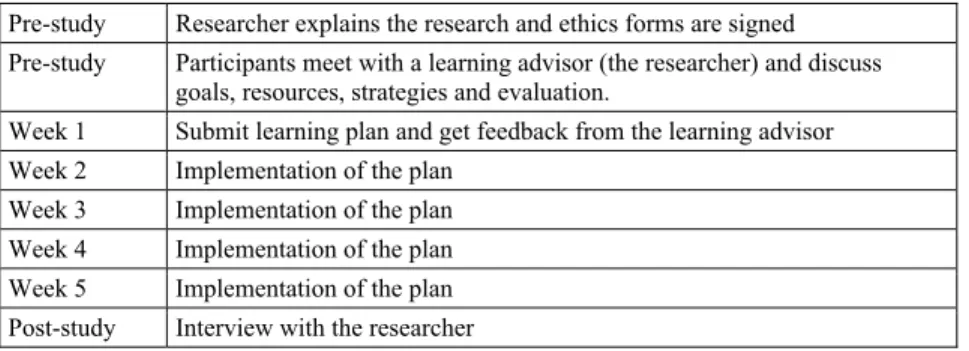
Each participant was asked to engage in a course of self-directed learning (similar to ELM 2) for a five-week period. Although a longer period would have been preferable, this was an initial study of its nature so it would be long enough to see if this method could be effective and would yield a sufficient yet manageable amount of data for analysis. Also, I did not want to put too much pressure on my participants. From experience, I knew that five weeks tends to be sufficient time for learners to begin noticing features of their learning and making changes to a plan they are implementing. The self-directed learning process – which is the same as the module – involved setting a plan and implementing the plan. A summary of the process is shown in Table 1.
Table 1. Overview of the Research Participation
Pre-study Researcher explains the research and ethics forms are signed Pre-study Participants meet with a learning advisor (the researcher) and discuss
goals, resources, strategies and evaluation.
Week 1 Submit learning plan and get feedback from the learning advisor Week 2 Implementation of the plan
Week 3 Implementation of the plan Week 4 Implementation of the plan Week 5 Implementation of the plan Post-study Interview with the researcher
Each week, completing the module involves a reflective cycle of learning. The cycle is based on a model by Kolb (1984), but incorporates reflective dialogue facilitated by the written feedback from the learning advisor and the face-to-face meetings. This is shown in Figure 1.
Figure 1. Weekly Cycle for Self-Directed Learning
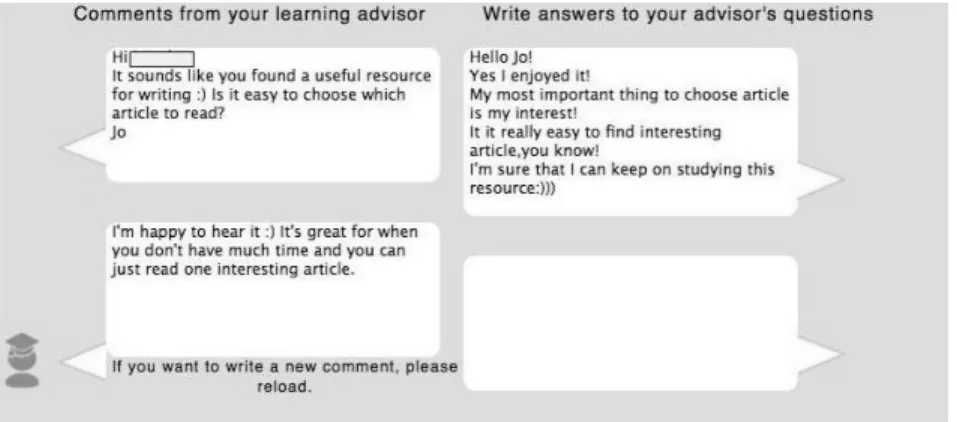
Each participant kept a reflective journal of self-directed English language learning over the five-week period using an app that was being used for ELM 2 modules at the time of the study (see Lammons et al., 2016 for more details). The app was a specially-designed iPad app where the learners completed text boxes and used drop-down menus related to their learning and submitted it to their learning advisor electronically each week. As their learning advisor, I typed responses to the participants’ plans, activities and reflections and returned it to them electronically. The participants normally replied to my questions using the app function. The dialogue was not shared with anyone else. Figure 2 shows a screenshot of how the dialogue exchange looks to learners using the app.
Figure 2. Example of Dialogue Exchange Using the Module App
Variation between participants
In order to explore the role of dialogue in learning, there were some differences in the learning conditions that each participant experienced. Participant 1 (pseudonym Sara) did not receive any advising support after the first week when I helped her to get started by talking
about her goals and methods in a one-to-one advising session and providing feedback on her plan via the app. I originally considered not providing Sara with any support at all, but on reflection, I felt that there needed to be some initial guidance as I already know from experience that not providing any support for self-directed learning means that learners are often not even able to get started. After the initial advising session, Sara continued to engage in planning and self-directed work. She submitted weekly reflections to me, but did not receive any feedback. I simply acknowledged that I had received her work. I did not meet Sara again until the post-study interview.
Participant 2 (pseudonym Emi) also participated in an initial one-to-one advising session to talk about her goals and get started. Like Sara, she also engaged in self-directed learning each week and submitted her reflections to me. However, unlike Sara, Emi received weekly written advising (feedback) from me via the app. In addition, she attended two online advising sessions during the five weeks at times convenient for her. The online sessions were real-time and used the video conference facility in a piece of free software called Moxtra. The final interview was held in person.
Participant 3 (pseudonym Yasu) had the same experience as Emi, but participated in face-to-face advising sessions instead of online ones at times convenient for him. Yasu’s experience was typical of most students who take a SALC module.
Each of the participants chose different and personally-relevant goals which can be seen in Table 2 along with a summary of their study conditions.
Table 2. Summary of Participants’ Goals and Conditions Name
KUIS year
Goals Conditions Sara
(F)
4 Listening / vocabulary
To be able to understand people with British accents in the workplace (airport)
- Initial 1-1 meeting - Initial feedback on plan - No other advising Emi
(F)
4 Speaking / vocabulary
to keep up her fluency and be able to speak confidently with friends from Australia.
- Initial 1-1 meeting - Initial feedback on plan - Weekly written advising - 2 online meetings Yasu
(M)
4 Reading / vocabulary
to increase knowledge of SLA and improve academic reading skills
- Initial 1-1 meeting - Initial feedback on plan - Weekly written advising - 2 in-person meetings
Methodology
The study is an interpretative study drawing on qualitative research methods common to narrative inquiry. I took a case study approach as it provides a framework for analysing social behaviour, relationships, and roles. My study could be considered to be a multiple case study (Hood, 2009) in that each of the cases will help me to understand the role of dialogue in self- directed learning, but each individual case will be unique.
Narrative inquiry
I used narrative inquiry to research the experiences of the three learners in my study.
Narrative inquiry is a way of exploring encounters and language-learning experiences by way of organising life and learning events as stories. Each narrative, or story, is told as part of a life journey of the participants (Karlsson, 2012). My interpretation is influenced by my knowledge, life experiences, and role in the research.
My roles and reflexivity
My role in this research project is complex. Firstly, I have the dual role of being both the researcher and the learning advisor, so I have a duty to record and analyse the data as faithfully and systematically as I can. I take a reflexive approach (Karlsson, 2012; Miyahara, 2015) to the data analysis thereby acknowledging the impact of my role on the research and research participants. The participants cast me in a role of researcher and teacher/learning advisor. I am also a foreigner, much older than they are, and have never learner languages at university. In addition, I am a native speaker of English - the language they are learning, and (from their perspectives) considered to be an expert in the field. I have been a language professional engaged in teaching and advising learners on self-directed work and promoting learner autonomy in different countries around the world for 24 years. Other factors that will have affected the interactions are that I am not a Japanese speaker, so the advising sessions and interviews take place in English. In addition, the interviews and advising sessions normally take place either in my office or in an advising room in the SALC where I work.
The substantial differences in our lives and a clear difference in positioning and other factors will naturally affect the interactions and the research. However, as a learning advisor, every attempt is made to reduce the distance during the advising sessions. For example, in advising sessions, the learners choose if and when to meet an advisor. In addition, advising by its very nature takes the learner’s needs as a starting point. The roles within an advising session are established with the learners leading the direction of the session and the advisor helping them to navigate their thoughts. From this point of view, although it is far from an equal relationship, it is quite different from a teacher-learner relationship. We could be considered co-constructors of the knowledge that the learner needs to navigate the learning process.
Research questions
1. Do the participants demonstrate a growing sense of awareness and control over their self-directed learning? If so, what are the contributing factors?
2. Do the participants improve their English skills?
Data collection
I used multiple data sources for this project which were analysed qualitatively in order to build up a rich description of each participant’s experience of self-directed learning. These were:
Learning plan
Each participant created a learning plan which included their goals, resources they planned to use, details of study strategies, and details of how they planned to evaluate linguistic gain.
Weekly plan and activity log
Each participant kept a log which included weekly targets and details of all activities they planned and completed, the time they spent doing them, and the location.
Weekly reflective journal
Each participant kept weekly reflections on how the self-directed work had gone and what they might like to change. Questions built into the app facilitated this process.
Advisor feedback dialogue
Each week Emi and Yasu received written (electronic) feedback from me as their learning advisor and they replied to the feedback electronically.
Recordings of advising sessions
Each advising session with Emi and Yasu was recorded and transcribed.
Self-evaluation
Each participant was asked during the post-study interview to evaluate their own language
improvement and support it with evidence.
Post study interview
All three participants took part in a post-study semi-structured interview within a week of completing the final week of their self-directed study. This interview was recorded and transcribed. Each participant was asked the same questions (Appendix 1) in order to be able to answer the research questions. However, the interview design was open enough to capture thoughts from each of the participants. Due to the nature of our learner–advisor relationship, the participants were comfortable in leading the direction of the discussion. Each interview lasted around 30 minutes.
Data Analysis
I took a reflexive narrative approach to the analysis of the data similar to ones advocated by Karlsson (2012) and Miyahara (2015). This allowed me to consider all of the data sources and my role as researcher and create a narrative account or ‘story’ which helps to explain the experience of each participant. The analysis began at the initial stages of the data collection period and continued throughout it. As the data came in, the analysis involved reading and re-reading written data, making notes, listening to recordings, attempting to understand phenomena, returning to the literature, and engaging in constant reflection and reflexivity.
The actual coding began once all three final interviews had been completed and all the data had been collected. The analysis involved making clean transcripts and documents of all of the data from all three participants and importing it into a software programme called HyperResearch which allows for easy qualitative coding. I drew emergent thematic codes from the data, but changed and collapsed them when each new data source was considered. I frequently returned to the original sources throughout the data-analysing process. Through this process and by running reports in HyperResearch, I interpreted connections and patterns.
The results will initially be presented as case study ‘stories’ supported with extracts from the data. These stories have been shared with and verified (member checked) by the participants (Hatch, 2002). After presenting each case study, I will return to my original research questions. Case studies require a lot of space to present in full, so they will be necessarily abridged in this paper. However, I tried to capture interesting episodes in each of the cases.
Results Case study 1: Sara
Sara is a highly reflective and persistent language learner. She had the opportunity to spend one year studying abroad in the United States and at the time of the study was in in her fourth year at KUIS. As she had recently found out that she had got a job at the airport starting eight months later, her language learning goals naturally turned to her future career. She decided that her goal would be related to developing her listening skills as one of her main jobs would be to interact with customers in English at work. As she had spent a lot of time in the United States, she felt comfortable understanding Americans, but noted that she often had problems understanding British accents and was often confused by British vocabulary and expressions.
Since I will be working at the airport from April, I want to study things like this to make things easier for me in the future. Also, I always wanted to study listening british accents, so that could keep me motivated.
(Extract from Sara’s learning plan, week 1)
I helped her to choose the resource. As a learning advisor, I encourage students to make their own resource choices as much as possible, but sometimes to save time, I also offer suggestions. As I was only going to have one meeting with Sara, it seemed appropriate to help her as much as possible in that session. I knew of a resource that I felt would be perfect
for Sara’s goal, so I introduced it to her. It was a series of episodes in a documentary aired recently on British television following new recruits to a British airline. The content included interviews with key staff and observations of daily work at the airport and matched what Sara would be experiencing personally. I felt it would give her the chance to listen to natural and unscripted conversations and hear plenty of examples of authentic British accents and expressions. Reflecting on my influence here, I wonder what Sara would have come up with herself had I not suggested the documentary. It is possible that the process of experimenting with other resources may have led to other learning opportunities and deeper learning experiences. Although I clearly influenced her learning in a very direct way, she still had the autonomy to use the resource or not and to choose how to use the resource. Her original plan involved the following:
TARGET SITUATION: I want to be able to understand british accent
BIG GOAL: Listening (british accent) to understand customers in the workplace SMALL GOAL: Vocabulary including expressions for airport use
STUDY: transcribe 10 mins of the video, and check the subtitles to see what I did not get.
RESOURCE: YouTube .videos -A Very British Airline - British Airlines Documentary - Britains Busiest Airport Heathrow (I found out that I can put subtitles on them) USE: Watch the video once a week.
REVIEW: Look at the transcript I wrote last time, and recognize which words I couldn't get. I'm going to use Word to remember what I've learned each time.
EVALUATE: Watch 10 minutes of one episode and count how many words/expressions I don't know. At the end , write the % I understood. At the end of the 5 weeks, watch the same 10 minute extract and count the words/expressions I don't know, also the % I could understand.
(Extract from Sara’s learning plan, week 1)
By analysing the logs and reflective journals, I was able to see that Sara continued to work on
roughly this plan with small adjustments throughout the self-study period. As there was no other input from the advisor, this was the only example of my influence in Sara’s self-study throughout the five weeks. In the post-study interview she confirms that I influenced her choice of resource:
The first time, I decided what to do with you - we talked about it. And the second time, I did the same thing...I did the same video so they had 4 episodes so I did them all, I watched them all
(Extract from post-study interview)
She was able to make the small adjustments by herself. In week 2, she notes in her reflections that she does not need to transcribe a ten-minute segment, but generally the resource and the study activities are suitable for her goal.
I planned to transcribe for 10 mins, but to be honest, transcribing for 1.30mins was pretty hard. I listened to the part more than 10 times again and again to understand what they are saying. Writing down everything doesn't seem a good way of studying, since it takes time to type while the video goes on. Other than that, I did a good job. I watched the whole episode and understood 90%. I think I did a good job because I planned well. As I planned, I wrote down new words, and words, which were pronounced differently from American English. Next time, I would understand those words!
I love this topic since it is super related to my future. I might be handling British Airways passengers at the airport from April!
(Extract from Sara’s reflections, week 2)
In the final week, Sara experienced a setback: She could not find another episode of the documentary. Instead she did an Internet search and found a video lesson explicitly comparing British and American English. As I read Sara’s plans and reflections each week, it
was very difficult for me as a learning advisor not to step in. I could see so many missed advising opportunities to help her think about how she could deepen her reflections and think about alternative approaches to working towards her goals. However, she is a resourceful learner and managed to complete five weeks of self-directed work and all the reflections.
Although I recognised where advising could have helped her, I was interested in asking Sara what she thought. This excerpt from the post-study interview indicates that Sara also felt that both written and face-to-face advising sessions would have been helpful:
Jo: And I didn’t help you. I just said thank you for submitting. How did you feel about that?
Sara: Um. (long pause). It would be nice if you could say something about what I did.
If you could tell me what I can improve for the next time. But it didn’t bother me not getting any comments from you because I knew it was only for 5 weeks… it would be nice if you could help me with finding some materials, but we did that in the first meeting, so it was OK.
Jo: What else could I have done? What else would have been useful?
Sara: What else? (long pause). I don’t know. If I had...It would be interesting if I had one-to-one session every week after the module after I submitted the reflection because I could talk about what I have learned, but I write them down. Like what I did and what I learned for the week. I don’t think that’s enough for learning. When I talk about it, that could make me understood what I learned I think. Talking about that, speaking about that make me understood I think
Case study 2: Emi
Emi had spent one year abroad working in Australia and felt disappointed that her English fluency had slipped since coming back to Japan. Her goal therefore was to work on her
speaking skills and develop confidence and fluency again. Her learning plan included the following details:
TARGET: Having a conversation with my friends in Australia
BIG GOAL: Talk or discuss with my friends(mention my opinion logically) SMALL GOAL: Learning vocabularies (academic as well)
RESOURCES: Vocabulary book (Yumetan) / TOFEL book at SALC / Using the web page of BBC or CNN (for discussing social issues with friends)
Movies in English (for fun:anything) (for study: no animation, no action) Ted talk (I could see Ted talk for studying mainly)
STUDY: I will study 10 vocabularies on the book everyday I record my speaking about some topics
USE: Talk to my friend once a week
REVIEW: I review my vocabulary note book once a week and make sure what I learned ( Wed.)
EVALUATE: I will compare my record which taken the first day of week, and record that I talk same topic on last day of a week.
I will test all vocabularies that I study a week.
(Extract from Emi’s learning plan, week 1)
As her learning advisor, I made several comments on this plan, and Emi subsequently made some minor changes. As I would be working with her for five weeks, I deliberately took a non-directive stance, which is my usual advising style with experienced learners like Emi (Mynard & Thornton, 2012). The idea behind being non-directive is that through experimentation the learner discovers for herself which methods are most effective for her goals. After analysing all of the data related to Emi’s learning and my advising approach and reflecting on my approach, I wonder if perhaps I could have been slightly more directive at this stage as there were several problems with the plan that contributed to Emi not fully achieving her weekly targets. The first is that she was emphasising vocabulary study rather
than communication, the second was that her plans to communicate with others were very vague, and the third was that her choice of resources did not really match her goals. Emi never actually practiced much speaking, particularly with other people, during the whole self- study period. Although my non-directive stance may have contributed to Emi not fully achieving her weekly targets, my approach did seem to have benefits. Through the self-study period, Emi developed confidence in herself and a deeper sense of self-awareness of how she best learned, which may have long-lasting implications. Throughout the five weeks, Emi made a lot of personal discoveries and had several noticeable ‘ah-ha moments’ (Kato &
Mynard, 2015, p. xxi). These seem to have been facilitated through a combination of the written advising and face to face online meetings. I will share three of her discoveries by examining the data here.
Discovery 1: There are more effective ways of learning personally-relevant vocabulary than making lists of words
It was interesting to see how Emi’s awareness grew throughout the self-study period. She began with plans to make lists of 50 words per week using a Japanese word book, but eventually focussed on learning expressions and phrases that she could actually use. She did this by listening to TED talks that interested her. These excepts from the data indicate the progression of thinking:
Jo: Is your goal still 50 words? that sounds like a lot...
Emi: I totally agree with you, maybe I can learn 30 words!
Jo: Still sounds quite a lot to me, but try it and see :)
Emi: Thanks for giving me feedback. Yes, I try to achieve it. That is why I reduced the
amounts of the words that I have to memorize.
I think I would be satisfied that I can acquire new vocabularies.
(Jo’s comments on Emi’s journal in week 2 and Emi’s reply) I will learn 30words new vocabularies and some vocabularies from Ted talk.
(Extract from Emi’s weekly plan in week 3) I think I heard 4 times with one presentation and learned 20 words.
(Extract from Emi’s journal in week 3)
I'm going to keep watching TED talk and learn vocabularies. I found it is more useful to study the phrases while presenter are talk to in the presentation. Most of the time the vocabularies are difficult and very academic which couldn't use in daily conversation. So I would like to focus on the phrases or idiom.
(Extract from Emi’s journal in week 4)
Discovery 2: It’s important to practice using what you have learned
It was clear to me that although Emi was enjoying the activities (watching TED talks and using the script to learn vocabulary), she was not doing much speaking. The speaking she was doing involved making recordings of herself talking about various topics. I made non- directive and encouraging attempts to help her to think about how she might build more actual speaking practice into her plan as the following excerpts show.
Emi: I achieved one goal which was the activity with TED. It was pretty fun for me, so I did just voluntarily. … I did not make actual opportunity to use those words, though.
It was one thing I feel a bit sad.
(Extract from Emi’s journal in week 3)
Jo: I really enjoyed reading about your activities and your reflections this week. Do you feel the activities helped you to achieve your goal?
I know you were disappointed not to be able to use the new words. Do you have ideas how you can make sure you can use them every week?
Jo: Using the words is always hard as you have to make opportunities for yourself.
(Extract from Jo’s comments on Emi’s reflections in week 3)
I achieve almost of all goals. But I couldn't make time to talk to my friend. I learned new English,but I didn't practice what I learnt.
I'm a little bit sad that I didn't have an opportunity to talk with someone in English. I was busy in last week until today as usual. I think I have to set the activity that would be achieved.
(Extracts from Emi’s reflective journal in week 4)
Jo: It's great that you did so much with the TED talk and got a lot out of it! Did you learn many words and expressions that you would like to use?
Maybe it would be good to think of other situations where you can use the new words (emails? In person? Yellow sofas? Blog? Twitter etc)
(Extract from Jo’s comments on Emi’s reflections in week 4)
Up until this point, it seems that Emi only has a vague plan to speak to someone in English, but she lacks the drive and opportunity to actually do so. After our meeting at the end of week 4, Emi listened to the recording and this made her notice that her speech with others is different from when she records her voice alone. She also realised why she needs to talk to others in English to develop her confidence again.
… I listened to my all speaking recording including when we talked on Moxtra. Then i found that I spoke slower when I talked to Jo than I record my speaking. It's because I guess I feel tense when I talk to someone. When I was Australia, I've never cared about my English cuz it was a tool for living in Australia. However, after came back from there, I focused on my English to brush up and improve my English skills. I think this is good
things, but sometimes I think I need to have a confidence to talk to anyone without making a mistakes. I'm glad to find this point this time.
(Extracts from Emi’s reflective journal in week 5) Jo: looking back, would you change anything?
Emi: Yes, maybe, I wanted to practice more speaking, so maybe after watching TED talk, maybe after I do next time I will try to speak more, with new vocabulary.
(Extracts from the post-study interview)
Discovery 3: It is important to enjoy what you are doing to keep your motivation high In Emi’s original plan, she included a Japanese word list book as her main resource. Through the self-study period she realised the power of using motivating resources and working with content that interests you. Discovering TED talks resulted in another shift in thinking as this excerpt indicates.
I think I I did learning English and listening to talk well. I really enjoyed [TED] Talk so much. That is why I had a high motivation while I was doing this activity. I mindfully watched TED
(Extract from Emi’s reflective journal in week 4)
Case study 3: Yasu
Yasu decided to participate in the project for a couple of reasons. First, he had some language goals he was trying to achieve, and he felt could benefit from some support and structure. He had recently returned from studying abroad in the USA, which meant that, apart from his seminar class, he had missed the enrolment for other English classes. He needed to improve his TOEFL score and also improve his academic reading skills so that he could read texts related to his graduation thesis in second language acquisition (SLA). The second reason he
decided to participate was because of his interest in applied linguistics research and future goal of becoming a lecturer in English or a learning advisor. Yasu established his goals as follows on his initial learning plan:
TARGET: To get knowledge about SLA by reading BIG GOAL: Reading
RESOURCES: Blogs / Journals / Asking for recommendations / Books / Academic articles
STUDY: Reading
USE: Talk to the members in the seminar about things what I read REVIEW: Listing keywords
EVALUATE: Reading more difficult articles. Reading the ones I couldn't understand before
MOTIVATION: Making a rigid schedule
(Extract from Yasu’s learning plan, week 1)
Analysing the reflective journals, the recorded sessions and the online exchanges, I discovered that there were several interesting episodes throughout the self-study period, and I will explore two of them in this case study. The first is how Yasu developed a deep understanding of effective ways to read academic articles. The second is how he managed to clarify his goals through the process.
Episode 1: Yasu clarifies effective ways to read academic texts
The advising and online exchanges seemed to help Yasu think more deeply about how he was developing his reading skills as these excerpts show.
Yasu: …My reading speed wasn't too bad since I had 5 minutes left to go over what I'd read. I just need to be able to focus on the contents themselves in order to enhance my comprehension skills. …. I'll have to expand my basic knowledge regarding
various academic and cultural contexts.
Jo: …. it seems like your reading speed is good, but your depth of knowledge is holding you back. How will you improve that?
Yasu: I'll just try to read as much as possible since that's the only way so far. Thank you for your comments!
Jo: Is just reading more enough do you think?
Yasu: By reading researches about SLA and if possible practicing and reading, TOEFL readings, academic articles or newspapers that include different topics, I'd like to be able to identify the main idea of the readings and thereby to be able to guess what questions will be asked and what is relevant to the readings, and what helps improve my fundamental knowledge.
(Yasu’s reflections and written exchanges with me in week 3)
He also realised how he was developing a deeper understanding of the texts by talking to others as these excerpts show:
Yasu: I sort of rushed reading a little bit so my understanding is not quite deep. I will have to read Duff (2014) again so that I will be able to focus on key elements of it….
Jo: What do you need to do to have a deeper understanding?
Yasu: I have to read this again and look up all the words I didn't know. I would also ask my professor about what I'm unsure about.
Jo: Sometimes attempting to explain something to another person helps you understand it more deeply. What do you think?
Yasu: I'll read this thesis again and read another one and try to associate different ideas or similarities to create a concrete idea of language socialization.
Jo: …Have you had the chance to talk to anyone else about it? Also, sometimes if you don't want to talk about it, blogging or tweeting about it can help you explain something succinctly.
Yasu: Yes that's right! I haven't had a chance to talk about it yet but I will probably on this coming Tuesday. I will try to use Twitter or other SNSs sometime! Thanks for the ideas!
Jo: Sounds good. Let me know how it goes!
(Yasu’s reflections and written exchange with me in week 4)
In week 4, Yasu started to use his weekly meetings with other seminar students to try to explain to them what he had learned through his reading. By attempting to explain concepts to other students in his seminar group, he realised how he might make his reading more efficient. Yasu continued to submit reflections in week 6 even though the research period had ended. His understanding of how to learn became deeper and indicated that he had a very good sense of how to read an article and understand the concepts enough to explain them to others and to include the ideas in his own thesis as the following exchanges show.
Yasu: I just realized I need more time to read and prepare for the slides to share.
Even though I took more time than usual but my understanding was not really clear for the reading. In order to improve it I'll have to spend much time for it and I'm sure I can work on it more or less everyday.
Jo: I see. Yes, it's a lot to do! Is there anything you can do to make your work more efficient?
Yasu: I'll try to take notes as I read! As I read Zappa-Hollman and Duff (2015) I'll try to organize my slides that include my basic idea of what my thesis is going to be like as well as reading different sources that support my thesis.
(Yasu’s reflections and written exchange with me in week 6)
Jo: Do you think generally your study was effective looking back, I mean do you think it was the best you could have done?
Yasu: I could have done better. I can think of come nicer ways to study, like I said I first read the entire thing, and then I read and take notes, but I would just read the entire thing and I would just make a summary. And I just pick some important points from the reading. Now I try to reorganise the article
Jo: So that’s something you’ll do next time?
Yasu: I would, yeah, but it takes time so I’m still thinking about it.
(Extract from post-study interview)
The importance of interacting with other people is something that came up several times in the post-study interview as being an important part of developing a deep understanding of content:
I always have to share what I read at the seminar... I need to explain it to people.
You need some interaction with other people. You need to keep your motivation high.
(Extracts from post-study interview)
Episode 2: Clarifying goals
Yasu’s original plan did not include TOEFL, yet by week three, the weekly target and activities began to incorporate preparation for the TOEFL test.
Take a TOEFL practice test (Reading section only) and try to achieve more than 60 points (Yasu’s weekly goal in week 3)
In weeks 3 and 4, Yasu was working on both TOEFL preparation and reading SLA texts.
Picking up on this, as his learning advisor I attempted to help Yasu to clarify his goals and prioritise as this written exchange shows. In the first exchange, he explains how academic reading is more important for him now, but how the skills can also apply to TOEFL reading.
Jo: It sounds like you are torn between two goals that are a little bit different: Applied linguistics knowledge and TOEFL practice. Is that right? How can you resolve this issue? Which one is more important for you (1) now (2) in the future (3) in your life.
Yasu: For now applied linguistic knowledge comes first and TOEFL second because reading articles regarding applied linguistics definitely helps improve my reading skills that often can be applied to TOEFL reading proficiency.
(Written exchange between Yasu and me in week 4)
In week 5, Yasu explains how the TOEFL has raised awareness of the need to pay attention to language use when you are reading. This awareness has transferred to his SLA reading.
I'm going to read Morita & Kobayashi (2008) this week paying attention to the language use because by taking a TOEFL test I realized that it is one of the crucial factors to raise my language awareness in order to be competent in reading as well as deeply understanding what is written.
(Extract from Yasu’s weekly plan in Week 5)
Discussion
In this section, I will turn specifically to the research questions.
Research question 1: Do the participants demonstrate a growing sense of awareness and control over their self-directed learning? If so, what are the contributing factors?
As the narratives show, each of the participants demonstrated a sense of awareness and control over their learning. Sara was able to overcome a couple of minor setbacks and complete the five-week self-study programme even without feedback from me. She realised the importance of talking about her learning as she experienced no advising support and reflected that she would ideally have appreciated some support. Emi made several significant realisations about her learning that were facilitated by the dialogue with me as her learning advisor. Yasu reached a deeper understanding of how to read an academic text in an efficient way and how to make sense of multiple learning goals.
The contributing factors for the development in thinking seem to be a combination of three things: (1) the structure and opportunities afforded by the module, (2) the written advising dialogue, and (3) the individual meetings.
(1) The structure and opportunities afforded by the module
All three participants mentioned that due to the fact that they had to submit something each week, they studied more than they would normally have done, as this excerpt from the interview with Yasu indicates.
It’s a nice way of organising my schedule, it, not forces me but, I study more than usual. I think I studied a lot. If I didn’t have this module, then I wasn’t able to continuously study every week… and also you give me feedback and I have to reply.
(Extract from post-study interview with Yasu)
In addition, features such as having to make a plan and write reflections each week were mentioned by the participants as important for helping them think deeply about what they were doing.
(2) The written advising dialogue
This was seen to be beneficial by the two participants who received weekly feedback. Firstly, it helped them to stay motivated. Secondly, there was evidence through the analysis presented in the case studies that the written exchanges contributed to the participant developing more depth in their thinking. The weekly feedback also influenced how the participants proceeded with their self-directed work. This was confirmed during the post-study interview with Yasu.
The following excerpts indicate that my comments were important as they gave well-timed feedback and enhanced social processes needed for him to keep going.
Yasu: When you do a module, you schedule and you plan by yourself and study by yourself and you reflect and get feedback. And you can do it anywhere basically.
Jo: Could you do this without an advisor?
Yasu: I don’t think so. You need some interaction with other people. You need some factors to keep your motivation high. By studying alone, I wouldn’t keep going. My motivation would probably go.
(Extracts from the post-study interview with Yasu)
(3) Influence of individual meetings
The individual advising sessions influenced all three participants as could be seen in the examination of the data presented in each case study. In the post-study interview, Emi explained that her thinking shifted after her meetings with me.
Jo: What are some of the benefits of learning this way?
Emi: …because I had several meeting with you and that was also very helpful for me to find more, better way to study, sometimes like middle of the week maybe I switch some method so maybe it was also good.
(Extract from the post-study interview with Emi)
She noted that the combination of the module and the meetings was effective at promoting metacognition:
Jo: How much time did you spend thinking about how you were learning? Or did you just keep going with your routine? Or did you think, how can I change this, how can I make it better?
Emi: When I wrote the reflection, while doing that, I was thinking “is that effective?”
And after I met you via Moxtra, I added some new idea or, tried to think more different way.
(Extract from the post-study interview with Emi)
Yasu mentioned that the connection and regular meetings with me were important, even if we didn’t always discuss his study plan.
Jo: Were the meetings important or were you fine without them?
Yasu: I think they were important to see what’s going on, to tell you what’s going on.
You can talk about anything, not just about the module.
(Extract from post-study interview with Yasu)
Sara completed five weeks of self-study and achieved her goals, so on the surface the experience seemed to be successful. However, after analysing the data from all three case studies, it seems that Sara did not experience significant shifts in thinking in the way the other two participants did. This could have been due to the fact that she received no input from me during the five-week study period, or it could have been due to my unusually directive stance with relation to resource suggestions made at the start of the process. Making suggestions for
learning resources and strategies does save time, but may also deprive the learner of vital opportunities for self-discovery.
Research question 2: Did participants improve their English?
In order to attempt to answer this question, I am only relying on self-assessment. Even though participants were asked to measure their language improvement in a relevant way at the beginning and the end of the study, only Yasu did this partially. Sara and Emi did no systematic check, and all three participants relied on gut feelings. In future studies, if this is the aim of the research, the researcher should conduct a relevant linguistic test at the beginning and the end of the study. Nevertheless, all three participants reported that they had made progress towards their goals as these excerpts from the post-study interviews indicate.
All participants were asked “Did your English related to your goals improve?”.
Sara: Every time, I did transcribing, right? In the beginning, there were so many words I didn’t know, but in the end, I didn’t really write down any words I didn’t know so that made me think I improved.
Emi: My first recording, I talked very ‘uh, uh, uh’ [with hesitation], after 5 weeks, the latest recording, I could speak more fluently, I can organise what I want to say... and also my feeling, I can speak more relaxing without hesitating, that’s why maybe. I feel I can talk better than before
Yasu: I think so. My reading is faster than before and I got 60 points in the TOEFL which is more than before. I got a better score. Also, my ability to tell people about what I read got better.
Conclusions
Through examining the data, the results show that the participants developed a deeper sense
of awareness of the learning process during the study due to a combination of factors: the structure of the module, the weekly written feedback, and the individual advising sessions.
Although this is not a comparative study, the participant who did not receive regular written feedback or attend any advising sessions did not seem to experience significant shifts in thinking. All three claimed to achieve the goals that they had set for themselves at the beginning of the process. The study suggests that the module and accompanying advising is an effective way for learners to manage their self-directed study and that the learning advisor has a significant role to play in the process. Through the analysis of this data, I also gained a deeper awareness of my advising approach through reflecting on my contribution to the dialogue. My advising was influenced by my background and experience and also by the contributions of the participants themselves. I will continue to grapple with the dilemma of how directive to be in my advising, but as we saw in a previous study (Mynard & Thornton, 2012), navigation of a continuum depending on the needs and awareness levels of the learners is appropriate.
References
Aoki, N. (2012). Can do statements for advisors. In C. Ludwig & J. Mynard (Eds.). Autonomy in language learning: Advising in action (pp. 154-163). Canterbury, UK: IATEFL.
Dewey, J. (1933) How we think, New York: D. C. Heath.
Ciekanski, M. (2007) Fostering learner autonomy: Power and reciprocity in the relationship between language learner and language learning adviser. Cambridge Journal of Education, 37(1), 111-127.
Candlin, C. (2012). Foreword: Some questions about advising. In C. Ludwig & J. Mynard (Eds.). Autonomy in language learning: Advising in action (pp. 12-21). Canterbury, UK: IATEFL.
Carson, L., & Mynard, J. (2012). Introduction. In J. Mynard & L Carson (Eds). Advising in language learning: Dialogue, tools and context (pp. 3-25). Harlow, UK: Pearson.
Clemente, M. A. (2003). Learning cultures and counseling: Teacher/learner interaction within a self-directed scheme. In D. Palfreyman & R. C. Smith (Eds.), Learner autonomy across cultures: language education perspectives (pp. 201-219. Basingstoke, UK:
Palgrave MacMillan Ltd.
Esch, E. (1996). Promoting learner autonomy: Criteria for the selection of appropriate methods. In R. Pemberton, E. S. L. Li, W. W .F Or & H. D. Pierson (Eds.) Taking control: Autonomy in language learning (pp. 35-48). Hong Kong: Hong Kong University Press.
Hatch, J. A. (2002). Doing qualitative research in education settings. Albany, NY: State University of New York Press.
Hood, M. (2009). Case study. In J. Heigham & R. Croker (Eds.), Qualitative research in applied linguistics: A practical introduction (pp. 66-90). Baisingstoke, UK: Palgrave Macmillan.
Horai, K., & Wright, E. (2016). Raising awareness: Learning advising as an in-class activity.
Studies in Self-Access Learning Journal, 7(2), 197-208.
Karlsson, L. (2012). Sharing stories: Autobiographical narratives in advising. In J. Mynard &
L. Carson (Eds.), Advising in language learning: Dialogue, tools and context (pp.
185-204). Harlow, UK: Pearson Education.
Kato, S., & Mynard, J. (2015). Reflective dialogue: Advising in language learning. New York, NY: Routledge.
Kelly, R. (1996). Language counselling for learner autonomy: The skilled helper in self- access language learning. In R. Pemberton, E. S. L. Li, W. W. F. Or, & H. Pierson (Eds.), Taking control: Autonomy in language learning (pp. 93-113). Hong Kong:
Hong Kong University Press.
Kid, K., & von Boehm, S. (2012). Kaleidoscope, an online tool for reflection on language learning. In J. Mynard & L. Carson (Eds.), Advising in language learning: Dialogue, tools and context (pp. 129-150). Harlow, UK: Pearson Education.
Kolb, D. A. (1984). Experiential learning: Experience as the source of learning and development (Vol. 1). Englewood Cliffs, NJ: Prentice-Hall.
Lammons, E. (2011). Finding my way: Transitioning from teaching to advising. Independence, 53, 27-31.
Lammons, E., Momata, Y., Mynard, J., Noguchi, J., & Watkins, S. (2016). Developing and piloting an app for managing self-directed language learning: an action research approach. In F. Helm, L. Bradley, M. Guarda, & S. Thouësny (Eds.), Critical CALL – Proceedings of the 2015 EUROCALL Conference, Padova, Italy (pp. 342-347).
Research-Publishing.net. doi:10.14705/rpnet.2015.000356
McCarthy, T. (2010) Breaking down the dialogue: Building a framework of advising discourse. Studies in Linguistics and Language Teaching, 21, 39-79.