Pedological Study on Man-made soils by Focusing on Artifact Influences
by
Kimihiro KIDA
Supervisor: Associate Professor Masayuki KAWAHIGASHI
Department of Geography, Tokyo Metropolitan University
March 2018
Pedological Study on Man-made soils by Focusing on Artifact Influences
人工物質の影響に着目した造成土の土壌生成学的研究
木田 仁廣
指導教員:川東 正幸
首都大学東京大学院都市環境科学研究科 都市環境科学専攻地理環境科学域
March 2018
首都大学東京 博士(理学)学位論文(課程博士)
論文名
Pedological Study on Man-made soils by Focusing on Artifact Influences
(人工物質の影響に着目した造成土の土壌生成学的研究)
著者
木田 仁廣
審査担当者 主査 委員 委員 委員
上記の論文を合格とする
平成 年 月 日
首都大学東京大学院都市環境科学研究科教授会 研究科長
DISSERTATION FOR A DEGREE OF DOCTOR OF SCIENCE
TOKYO METROPOLITAN UNIVERSITY
TITLE:
Pedological Study on Man-made soils by Focusing on Artifact Influences
AUTHOR:
Kimihiro KIDA
EXAMINED BY
Examiner in chief Examiner
Examiner Examiner
QUALIFIED BY THE GRADUATE SCHOOL OF URBAN ENVIRONMENTAL SCIENCES TOKYO METROPOLITAN UNIVERSITY
Dean
Date
i Abstract
Now, urban area is expanding because of global population growth and population concentration into urban areas. Construction processes of urban areas impact on their ecosystems. Land function in an urban area was evaluated as higher economic and social benefits and lower primary production and water resources as compared to forest and agricultural land. Soil functions provide various ecosystem services such as base of plant growth and water retention and purification. In urban areas, these soil functions are limited by soil sealing of impervious layers. Not only soil sealing but also other construction processes, such as land forming and waste reclamation, impact on soil functions, soil features, and soil environment. Contact of artifacts on soil is a form of human impacts on soils. Therefore, to reveal the process of artifact impacts on soils, position and concept of human impacted soils in soil science field was confirmed by comparison of soil classification systems, which provide a possibility to evaluate soil functions and soil formation processes. Then elemental dynamics in soils on an artificial island in Tokyo Bay and in soils beneath impervious soil sealing were investigated as examples of soils containing artifacts. To conclude, it was confirmed by comparison of soil classification systems that there is no international consensus about principal concepts of soil formation processes including human impacts. This result originated from the historical and geographical back ground of each classification system. Now, soil name translation is difficult between the soil classification systems due to uniqueness of descriptions and different priority of soil information in each soil classification system.
Moreover, a concept of soil formation process on human modified soils under anthropized environment was not established in the classification systems. From the result of surveyed soils in an artificial island and soils beneath impervious soil sealing, Ca leaching and soil alkalinization was confirmed as initial pedogenesis induced by calcareous artifacts in humid
ii
climate conditions like as in Japan. Influence of this Ca leaching on soil characteristics was different based on artifact distribution and soil sealing type in the surveyed soil. Finally, from the discussion of description and concept for human impacted soils and discussion of elemental dynamics confirmed as initial pedogenesis under anthropized environment, new concept of soil formation processes was suggested that soils modified by human impacts will be exposed soil formation processes under human impacted environment. Properties relating to Ca leaching can be indicators, which allow us to bring soils affected by calcareous artifacts into discussion for soils under zonal soil formation processes. The soil classification of human impacted soils with soil formation processes is useful for evaluation and prediction of soil function in soils of anthropized environment.
iii
Acknowledgements
I wish to thank my research supervisor, Associate Prof. Masayuki Kawahigashi for advice and support on processes for accomplishment of this doctoral dissertation. I also would like to thank Prof. Makiko Watanabe, Prof. Takehiko Suzuki, and Prof. Hiroaki Sumida for kind and fruitful discussions about my studies. I wish to thank the help given by members of past and present members of our laboratory in field survey and analyzing. I am grateful to Construction Division, Road Transport Department andSewage system Division, Water cycle Department of Hachioji-city and Specific construction joint venture of Obayashi and Fuji P.S Corporation for introductions of sampling sites.
iv
Table of contents
Abstract i
Acknowledgements iii
Table of contents iv
Chapter 1 Introduction 1-1 Impact of urbanization on environment system and function 1
1-2 Urbanization impacts on soils through construction processes 2
1-3 Definition of soils in classification systems 4
1-4 Objectives of this thesis 6
Chapter 2 Human impacted soils in classification systems 2-1 Introduction 12
2-2 Definitions and descriptions relating artifacts 12
2-3 Hierarchy of classification category for human impacted soils in the latest soil classification systems 15
2-4 Characteristics and issues about classification for human impacted soils 17
2-4-1 Remarkable characteristics of each classification system 17
2-4-2 Issues in identification of the soil surface 19
2-4-3 Issues in soil name translation 21
2-5 Conclusion 22
v
Chapter 3 Elemental dynamics in human impacted soils containing artefacts locating in the artificial island
3-1 Introduction 27
3-2 Materials and Methods 27
3-2-1 Study area 27
3-2-2 Laboratory analyses 28
3-3 Results 29
3-4 Discussion 31
3-4-1 Calcium dynamics in soils on the artificial island 31
3-4-2 Sulfur distribution relating to material sources in soils in the artificial island 33
3-5 Conclusion 34
Chapter 4 Elemental dynamics in soils beneath impervious soil sealing 4-1 Introduction 57
4-2 Materials and Methods 58
4-2-1 Structure of pavements and basement for buildings in Japan 58
4-2-2 Study area 59
4-2-3 Laboratory analyses 60
4-3 Results 61
4-3-1 Beneath the asphalt pavement 61
4-3-2 Beneath the concrete layer 63
4-4 Discussion 65
4-4-1 Calcium dynamics in soils beneath impervious soil sealing 65
4-4-2 Sulfur distribution relating to material source beneath impervious soil sealing 67
4-5 Conclusion 69
vi Chapter 5 General discussion
5-1 Introduction 106
5-2 Application of soil classification systems on investigated soils 106
5-2-1 Classification of a soil profile in an artificial island 106
5-2-2 Classification of a soil profile beneath asphalt pavement 108
5-3 Principal concept of soil formation processes in each soil classification system 109
5-4 Elemental dynamics as an initial pedogenesis induced by calcareous artifact 112
5-4-1 Calcium dynamics in soils on the artificial island and beneath impervious pavement 112
5-4-2 Sulfur distribution in soils on the artificial island and beneath asphalt pavement 114
5-5 Concept of pedogenesis on human modified soils under anthropized environment 115
5-6 Conclusion 115
References 120
1 CHAPTER 1
Introduction
1-1 Impact of urbanization on environment system and function
Now, global population tends to concentrate into urban areas. Half of the world’s population lives in urban areas. It is predicted that 70% of world’s population concentrate into urban areas in 2050 (UN 2014). Urban areas are spaces affected by high intensity of human activity and they influence on their surrounding environment (Mills 2007). Urban areas are enlarging to supply residential areas for people. Despite negative impacts of urbanization on ecosystems, urban areas intentionally expand to provide anthropized land areas for our life. Road constructions are recognized as a first step of urbanization (Laurance et al. 2014). Road contributes for transportations, infrastructures, and regional economies in urban development.
Constructions are also required for urban development. The areas of urban land use, such as roads, settlements and factories, are mainly converted from native lands in the world (Laurance et al. 2014). Japan is a special country which faced to population decrease and population concentration in urban areas. Two types of urban land use areas are expanding in Japan. One is an abandoned urban land use in rural areas and the other is reclamation of new urban area.
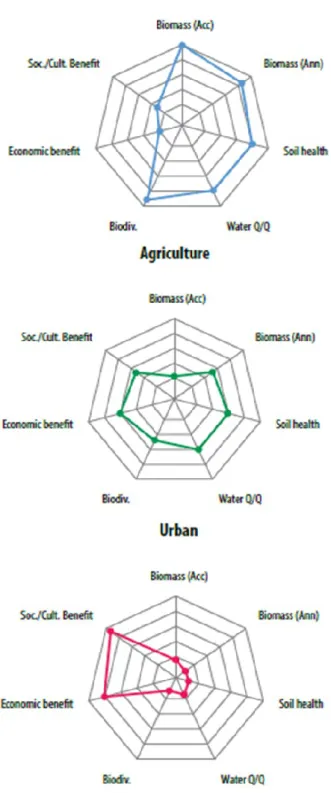
The ecosystem goods and services in different land use (Forest, Agriculture, and Urban) were evaluated by focusing on the actual status and trends of land resources expressed as six factors:
accumulated biomass (Acc), annually produced biomass (Ann), water resources, soil health, and economic benefit, and social/cultural benefit (Fig. 1-1) (FAO and ITPS 2015). The soil health status was obtained by comparing the soil suitability for the actual land use. The soil health was evaluated on the basis of a combination of ratings for the risk of erosion by water, the soil compaction risk, a nutrient balance, and the soil contamination and soil salinization risks. An urban area has higher resources for economic benefit and social/cultural benefit than
2
those in forest and agricultural land. On the other hand, values of the other 4 factors (accumulated biomass, annually produced biomass, water resources, and soil health), which are mainly provided by natural ecosystem, in urban area, where most of soils are sealed, were lower than those in forest and agricultural land. Thus, different land use areas have different land functions. The functions of soils contribute to land functions. In CEC (2006), 7 soil functions were recognized as 1 biomass production, 2 media (storing, filtering, and transforming) for materials (nutrients, substances, and water), 3 biodiversity pool, 4 physical and cultural environment for humans and human activities (soils provide space and inspiration to human), 5 source for raw materials, 6 carbon pool, and 7 archive of geological and archaeological heritage. Human activities have altered soil properties providing such functions with land use change. Urbanization processes have drastically altered land and soil functions.
1-2 Urbanization impacts on soils through construction processes
The areas of urban land use, such as roads settlements and factories, are mainly converted from native lands in the world (Laurance et al. 2014). For example, 90% of road areas predicted to expand by 2050 in the world will exploit native lands of developing countries. In Japan, urban land use area is still enlarging by conversion from farmland (MLIT 2015). Such urbanization from agricultural, natural or semi-natural land cover impacts on the ecosystem services that can be provided by soils on the production of biomass (FAO and ITPS 2015). Soil sealing in urban area by buildings and road pavements is one of the reasons of diminishing of many benefits provided by soils. Despite negative impact of urbanization on ecosystems, urban areas are forced to expand to provide comfortable and convenient land-use for humanity. Road constructions are recognized as a first step of urbanization. Road contributes for transportations, infrastructures, and regional economies in urban development. Buildings are also necessary for urban development.
3
In processes of construction for urbanization, various soil disturbances and modifications are occurred. Land forming and land cover change are example of such construction processes.
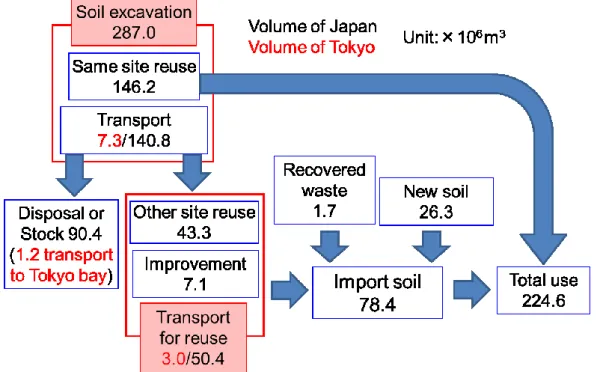
Land forming such as land leveling, mound, and digging generates soil movement as waste soils. In Japan, waste soils estimated to 287.0 × 10⁶ m3 was generated in 2012 and around one third of it was transported for land reclamation (MLIT 2014, Committee for issues of wastes in summit meeting of Tokyo, Kanagawa prefecture, Chiba prefecture, Saitama prefecture, and the cities of Yokohama, Kawasaki, Chiba, and Saitama 2006) (Fig. 1-2). One of possibilities to use such waste soils is reclamation of artificial island. Various soil properties change from the original conditions through the process. Soil structure is physically collapsed during soil transportation accompanying digging and filling. Soil compaction makes deeper soil harder due to running of heavy machines during the construction process. Waste soils generated by constructions have alkaline soil reaction caused by mixing of bentonite and cements to enhance the bearing capacity for traffic. Disposal of building debris also leads the reclamation soils alkaline in Japan (Sakuma 1998). In those land forming processes, land cover has also been modified. Vegetation should be removed during the construction process at the same time.
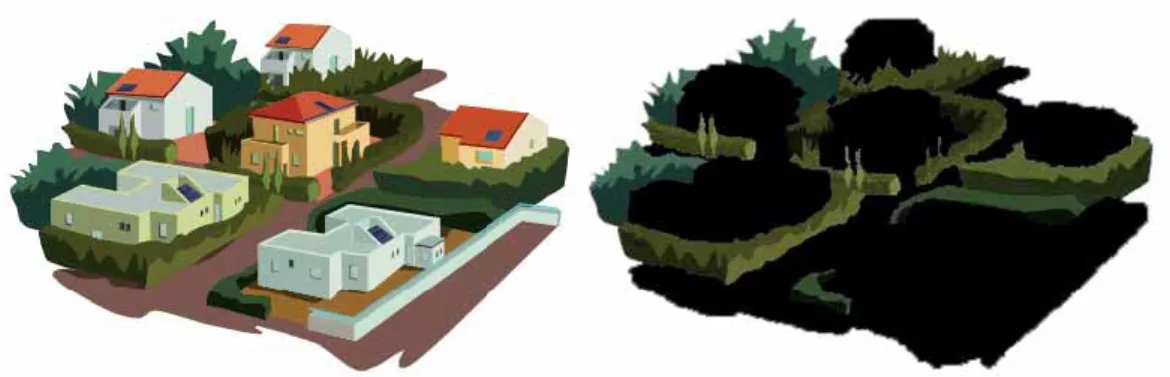
Changed land covers depend on the purpose of land use. In urban areas, most of areas are changed from open land into sealed land. In European Union (2012), a schematic diagram showing surface sealed area in settlements was introduced (Fig.1-3). In this figure, soil sealing in settlements reached to 70% of the total area. According to European Union (2012) soil sealing by impervious layers such as buildings and road pavements impacts on various soil functions. For example, soil sealing impacts on water dynamics in the soil system such as decrease of water infiltration into deeper soils, decrease of evapotranspiration, and increase of surface runoff. This impact of soil sealing on water cycle influences on local and global climate. Primary productivity and biodiversity of the above ground were also decreased by soil sealing. In construction processes and urban life, various and numerous waste is generated.
4
Providing space for waste disposal is an important function of soil to support human life.
Disposal of waste into soils of course influences on soils. Other waste disposal originated from urban life and industrial activities continuously affect soils in disposal areas. An artificial island is one of the terminations of those waste in Japan. Thus, urbanization impacts on soils through various processes. As mentioned above, artifacts contacting to soil by mixing of waste and covering by soil sealing is one of impacts on soil functions. Therefore, this study focused on artifacts in anthropogenic soils from the view point of soil classification and definitions according to changing properties affecting to soil formation processes.
1-3 Definition of soils in classification systems
Soil classification provides a possibility to evaluate soil functions and soil formation processes. For civil-engineering, soils recognized as materials for construction basement are classified by properties relating bearing capacity for traffic, and their composition of grain size, gravel content, soil origin and water content (The Japanese Geotechnical Society 2000 and ASTM 2011). In soil science, soils are recognized as a part of environmental system. Soils are classified by diagnostic features with respect to soil formation processes driven by environmental factors. Because of this concept, descriptions and soil names by the soil classification system in soil science field imply soil functions affected by existing environment.
Historically, soil science field has focused on soil functions relating to primary productions.
Now, rapid urbanization leads soil science field to deeply study human impacted soils mainly distributing in urban area, especially to incorporate the soil into their soil classification systems. In this study, the latest edition of two international soil classification systems and Japanese soil classification system in soil science field were discussed to recognize position of human impacted soils in soil science.
Principal concept of soil and target soil described as “objective soil” are different between the
5
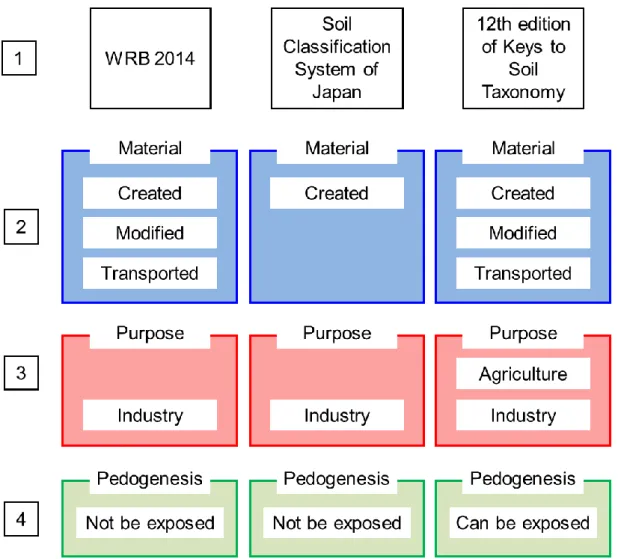
major soil classification systems depending on their own concept and systems. Important differences of “objective soil” in each classification system were illustrated as Fig. 1-4. The latest edition of World Reference Basis for Soil Resources (WRB) 2014 is an international soil classification system published in 2014 and updated in 2015 by Food and Agriculture Organization of the United Nations (FAO). The objective soil classified in the WRB 2014 (IUSS Working Group WRB 2015) is: “any materials within 2 m of the Earth’s surface that is in contact with the atmosphere, excluding living organisms, areas with continuous ice not covered by other material, and water bodies deeper than 2 m. If explicitly stated, the objective soil classified in the WRB includes layers deeper than 2 m. The definition includes continuous rock, paved urban soils, soils of industrial areas, cave soils as well as subaqueous soils. Soils under continuous rock, except those that occur in caves, are generally not considered for applying to the classification system”. This objective soil of WRB 2014 fits to concept of soil formation processes including human factors and allows us discussing environmental problems in a systematic and holistic way from soil science aspect. Therefore, the standing point of WRB 2014 is that soil is not exclusive from a natural body.
The 12th edition of Keys to Soil Taxonomy is the latest edition of international soil classification system published in 2014 by United States of Department of Agriculture (USDA) (Soil Survey Staff 2014). The definition of soil in 12th edition of Keys to Soil Taxonomy (Soil Survey Staff 2014) is “a natural body comprised of solids (minerals and organic matter), liquid, and gases that occurs on the land surface, occupies space, and is characterized by one or both of the following: horizons, or layers, that are distinguishable from the initial material as a result of additions, losses, transfers, and transformations of energy and matter or the ability to support rooted plants in a natural environment (Soil Survey Staff 1999)”. There was no mention about human activities with respect to soil formation processes except for agricultural operations in this classification system. This concept represents that soil
6 function is basement or medium for plant growth.
Soil classification System of Japan is a local soil classification system published in 2017 by The Fifth Committee for Soil Classification and Nomenclature The Japanese society of pedology. The objective soil for this classification system is defined from three aspects (soil depth, land cover, temporal and spatial continuity) in Soil Classification System of Japan.
From the view point of soil depth, objective soil is surveyed to the depth of “1 m or the depth up to the top of continuous rock when the bottom is appeared at shallower than 1 m depth”.
From the view point of land cover, objective soil defined as “Since soils have been developed under influences of various biological activities including human beings, any land covers should be taken into account. Exceptionally, because of difficulty in soil survey, this classification system excluded soils, which are covered with artificial structures, continuous rock, and water body for a long time from definition of objective soils. Moreover, from the view point of temporal and spatial discontinuity for natural environmental systems, this classification system excluded soils which exist on the roofs or in the pots or for horticultures from objective soils.
1-4 Objectives of this thesis
As mentioned above, contact of artifact and soils is a one form of urbanization impact on soils. Therefore, to reveal the impacts of land use change with urbanization on soil, this study discussed urbanization impacts on soils by focusing on artifact influences. In chapter 2, for this purpose, current concept and position of human impacted soils in soil science were identified by comparison of descriptions and definitions for human impacted soils in between the two international and one local soil classification systems. To reveal the process of artifact impacts on soils, as examples of soils impacted by human activities, elemental dynamics in soils on an artificial island in Tokyo Bay was discussed in chapter 3 and elemental dynamics in soils
7
beneath impervious soil sealing was discussed in chapter 4. As a conclusion, in chapter 5, new concept of soil formation processes affected by human impacts suggested from the discussions about current concept of soil classification systems in chapter 2 and discussions of elemental dynamics and modification of soil properties induced by artifact in chapter 3 and 4.
8
Fig. 1-1 Example of the effect of land use on indicative factors for ecosystem goods and services (FAO and ITPS 2015).
9
Fig. 1-2 Schematic diagram of soil translocation by constructions in Japan and Tokyo. Red letters
indicate the volume of soil translocation by constructions in Tokyo conducted in 2005(Committee for issues of wastes in the summit meeting of Tokyo Metropolitan, Kanagawa prefecture, Chiba prefecture, Saitama prefecture, and the cities of Yokohama, Kawasaki, Chiba, and Saitama 2006).
Black letters indicate the volume of soil translocation by constructions in Japan conducted in 2012 (MLIT 2014).
10
Fig. 1-3 Visualization of the terms “settlement area” and “soil sealing”. The left hand shows an
example of a suburban pattern, with houses, gardens, drive ways and yards. This pattern corresponds to the term settlement area. The right hand shows soil sealing field with black color where in the same settlement area, covering about 60 % of the area (European Union 2012).
11
Fig. 1-4 Differences of “objective soil” in each classification system. 1. Name of the classification system. 2. Soil materials which can be taken into account for the classification. 3. The depth where can be surveyed. 4. Availability of the classification system to soils beneath soil sealing.
12 CHAPTER 2
Human impacted soils in classification systems
2-1 Introduction
Recently, many soil classification systems (international and local) have been revised for descriptions and soil names of man-made soils. For example, A proposal for Canadian System of Soil Classification about descriptions of man-made soils as “Anthroposolic order” was published in 2011 (Naeth et al. 2011). A report for inclusion of anthropogenically transformed soils and soil like bodies in the Classification System of Russian Soils was published in 2010 (Prokofyeva et al. 2010). To clarify the position of man-made soils in international soil science field and soil classification system, major differences in soils of anthropized environments between major international classification systems (World Reference Basis for Soil Resources (WRB) (IUSS Working Group WRB 2014) and 12th edition of Keys to Soil Taxonomy(Soil Survey Staff 2014)) and Soil Classification System of Japan (The Fifth Committee for Soil Classification and Nomenclature The Japanese society of pedology) were discussed in this chapter mainly based on their concepts focusing human activities.
2-2 Definitions and descriptions relating artifacts
The common indicator for human impacts on soils in each classification system is “Artefact or Artifact” as a diagnostic material. The term of “artefact” is used in the WRB 2014 released from FAO and the “artifact” in the 12th edition of Keys to Soil Taxonomy United States of Department of Agriculture. Artefact concept in the Soil Classification System of Japan was brought from the WRB system. The English description of “artefact” is used in the topic of WRB or Japanese system and that of “artifact” is used in the 12th edition of Keys to Soil Taxonomy. The “Artefact or Artifact” defined as diagnostic material in 2006 for WRB 2006
13
(IUSS Working Group WRB 2006), in 2011 for Comprehensive Soil Classification System of Japan (Obara et al. 2011), in 2014 for 12th edition of Keys to Soil Taxonomy. Those definitions and concepts are different between classification systems. The WRB 2014 and Soil Classification System of Japan defined similar materials as “artefacts” to represent features of non-agricultural human activities. On the other hands, “artifacts” in the 12th edition of Keys to Soil Taxonomy include both of materials for agricultural and non-agricultural activities.
In the WRB 2014, “artefacts” were defined as follow; materials generated or modified in manufacture processes, or materials transported to surface from deeper environment which has never exposed to surface processes. Those materials have kept their own chemical and mineralogical properties since their generation, modification, or transportation in geological processes. Artefacts are recognized as materials don’t have features of soil formation processes.
Soil classification system of Japan defined artefacts as materials produced by humans not originally existing in natural earth’s surface environment. The “technic hard materials
“established as limited material of the “artefact” were defined as “consolidated material resulting from an industrial process and which has properties substantially different from those of natural materials and continuous or has free space covering < 5% of its horizontal extension”. Examples were introduced in WRB 2014 that technic hard material are asphalt, concrete or a continuous layer of worked stones. The soil name for soils characterized by existence of such “artefacts” was established as “Technosols”. In this classification systems,
“artefacts” mainly differentiated by source of materials. For example, “artefacts” originated in residential area is described as “urbic” artefacts. Only this system has description for soil surface sealing by “technic hard materials” as “Ekranic”.
Comparing these definitions, “artefact” in Soil Classification System of Japan only covered the criterion of materials which are generated by manufacture processes defined in the WRB 2014. Transported materials from deeper environment of underground and artificially modified
14
materials were excluded in Soil Classification System of Japan. For example, the crushed stone for the basement of artificial structures originated from river sediments is not classified as artefact in in the Soil Classification System of Japan but the WRB 2014. The soil name for soils characterized by existence of such “artefacts” was established as “Artifactual soils” in Soil Classification System of Japan. In this classification system, “artefacts” mainly differentiated by constituents of materials. For example, “artefacts” composed from organic matters is described as “organic” artefacts. Exceptionally, materials defined as same as
“technic hard materials” in WRB 2014 were named as “Ekranic”. In Soil Classification System of Japan, the description of “Ekranic” doesn’t have concept of soil surface sealing, just represents continuous consolidated impervious artefact layers.
The 12th edition of Keys to Soil Taxonomy has a completely different concept for “artifacts”.
The definition of “artifacts” is “materials created, modified, or transported from their source by humans usually for a practical purpose in habitation, manufacturing, excavation, agriculture, or construction activities”. Examples of those materials resulted by agricultural and non-agricultural activities were separately shown. Only 12th edition of Keys to Soil Taxonomy did not exclude surface processes on artifacts from definition as compared to WRB 2014 and Soil Classification System of Japan. The remarkable difference as compared to WRB 2014 and Soil Classification System of Japan is found in the purpose of materials as artifacts. Those materials can include items from not only non-agricultural activities but from agricultural activities for instance manure, lime, compost, and so on, which can be included in artifacts in 12th edition of Keys to Soil Taxonomy. “Artifacts” for agriculture should be exposed to surface processes or chemical reaction to be effective. To describe existence of “artifacts”, description named as “Anthropic” was established in this system. In this classification systems,
“artifacts” mainly differentiated by constituents of materials. For example, “artifacts”
composed of concrete materials is described as “concretic” artifacts. Differences in definition
15
of “artefact” were illustrated in Fig. 2-1. Remarkable differences in “artefact” definitions are recognition on transported natural materials from external environment like deeper area, purpose of materials, and concept of pedogenesis on artifacts. Only in Soil Classification System of Japan, transported natural materials in deeper region were not recognized as
“artefact”. The 12th edition of Keys to Soil Taxonomy is unique soil classification system that human generated materials for agriculture and pedogenesis on artifact are not denied in definition of “artifacts”.
2-3 Hierarchy of classification category for human impacted soils in the latest soil classification systems
Positions of classified soil names for human impacted soils were shown in Fig. 2-2. WRB 2014 positioned descriptions for human impacted soils at the highest category of the key out system to classify the soil as Reference Soil Groups (RSGs). The soil group is defined into two RSGs as “Anthrosols” representing agricultural features, and “Technosols” representing existence of artefacts originated from non-agricultural activities. The key-out order of
“Anthrosols” and “Technosols” are second and third, respectively. In this classification system, thick organic layers have first priority and human influence have second priority for determination of the key out order.
Soil Classification System of Japan positioned descriptions for human impacted soils at the highest category of the key out system to classify the soil as Great Soil Groups. “Man-made soils” are defined for soils impacted by humans consisted by two sub-category groups (Soil Groups) named as “Artefactual soils” representing existence of artefacts and “Reformed soils”
representing non-natural soil horizon orders formed by landfills. The key out order of
“Man-made soils” is the first in this system. The information for soils modified by agriculture is not clearly mentioned, only soils used as rice paddy field are recognized in Group or
16
Sub-Group categories. This first order to key out the human impacted soils, in Soil Classification System of Japan, decided from the concept that specific parent materials, such as artefact and organic matters (diagnostic materials for “Histosols” ordered at the third in this system), should be classified at first. Although both of WRB 2014 and Soil Classification System of Japan managed the human impacted soils at the highest category, the category of soil group for artefact is different between these two classification systems; “Technosols” is a group in the highest category (RSG) of WRB 2014, “Artefactual soils” is a group in the second highest category of Soil Classification System of Japan. Soil Classification System of Japan has two soil groups at the second category for human activities summarized in the higher category. WRB 2014 has only one soil group for soils impacted by humans at the highest category. In the history of WRB series (FAO 1998, IUSS Working Group WRB 2006),
“Anthrosols” divided into two groups, for agricultural (“Anthrosols”) and for non-agricultural activities recognized by “artefact” (“Technosols”). That’s a reason why WRB didn’t summarize “Anthrosols” and “Technosols” into one human influenced Reference Soil Group.
Anthropogenic information in 12th edition of Keys to Soil Taxonomy was summarized at the fourth category as “Subgroups”, for example “Anthropic”, and at the fifth category as “Class”, for example “Concretic”. This anthropogenic information is used as adjective for the soil name classified by natural pedogenic properties in other words by properties of matrix soils. This application of anthropogenic information is reflecting the concept of the soil formation process in this classification system that soils are natural body formed by five factors (climate, organisms, relief, parent material, time). Therefore, properties of potential soil generated in natural processes have higher priority than anthropogenic features in 12th edition of Keys to Soil Taxonomy.
All of three classification systems have own principal concepts for human activities. There are own priority of soil features and formation processes to determine the order and category
17
of key out system. These different concepts for human impacts and positioning of descriptions for soils affected by human activities make it difficult to translate the soil name each other.
2-4 Characteristics and issues about classification for human impacted soils
Previous sections introduced different definitions and positioning of descriptions for human impacted soils in each classification system. Establishment of these new descriptions, which are different in each classification system, leads issues in intra- and inter- soil classification systems. To reveal causes of such issues, this section compared characteristics of each classification system.
2-4-1 Remarkable characteristics of each classification system
One of the remarkable characteristic of WRB 2014 is broad object soils as compared to others as mentioned in chapter 1. This system defined object soils as “any materials in earth’s surface until 2 m depth” reflecting the stance to take soil science into account for environmental issues.
This stance generates the unique concepts of “Ekranic”, which describes soil sealing by technic hard materials, and “Isolatic” describing soils discontinuing to surrounding soil environment systems by continuous materials enough to isolate objective soils from other soil materials, such as soils on roof, in pots and soils sealed by seats. Soils described by “Ekranic”
and “isolatic” are excluded as objective soils in other systems. Soil Classification System of Japan omitted the soils beneath and above the sustaining artificial structures and beneath water body limited the depth until 1 m differing from the WRB 2014 definition. The Soil Classification System of Japan placed top priority in the practicality. Soil definition in the 12th edition of Keys to Soil Taxonomy is soil as a natural body. They consider that the plant supporting function is one of the most important soil functions. Therefore, the classification system does not recognize the materials existing at deeper than 2.5 m water depth as objective
18
soils. For the practicality of soil survey, moreover, the lower boundary of soil is arbitrarily set at 200 cm in depth. These different standing points for the soil classification lead different concept and application for human activities on soils.
Only Soil Classification System of Japan has a soil group and description for soils at a landfill site. Probably this specific point is derived from the geographical and historical back ground against narrower national land area for available land uses. Most of Japan is occupied by mountainous areas with steep slopes. Therefore, anthropogenic land forming process has been conducted at both of mountain and water front areas to create flat land spaces for agriculture, industry and resident. Other two soil classification systems don’t have the soil group at the higher category of their classification systems for soils at landfill sites, just described as a qualifier as “Transportic” in WRB 2014 and as “Anthroportic” in 12th edition of Keys to Soil Taxonomy.
Potential soil properties irrespective of human influence existing at a geographical location are a basic concept and a significant characteristic in the 12th edition of Keys to Soil Taxonomy. This concept related to their thought about soil function. They regarded plant supporting functions as one of the most important function provided by soils. This can be a reason why the defined “artifact” contained not only for components taken in soil by non-agricultural activities but also for those in soil by agricultural activities. The definition of
“soil” in 12th edition of Keys to Soil Taxonomy based on the traditional concept, that is a recognition of soils as natural bodies formed by the interaction of 5 natural soil forming factors (climate, relief, organisms, parent materials, and time). Keeping the traditional soil concept made the new classification system with minor revision from the previous edition of Keys to Soil Taxonomy. Then, the 12th edition of Keys to Soil Taxonomy solely classifies the soils impacted by human activities based on the information of matrix soils irrespective of artificial information.
19
An important common characteristic in all of the classification systems is no description for material dynamics in human impacted soils. Now, there are many descriptions both of unique and common over classification systems which have been established during their revision history. However, soil formation processes in soils affected by human activities have never discussed in all of classification systems.
Thus, each soil classification system have been revised according to the traditional history of the classification system itself and new opinion from the different standing points of editors who have different regional back grounds have been reflected. However, those thoughts make it difficult and complicate to translate and discuss about soil classification.
2-4-2 Issues in identification of the soil surface
There is an issue of inter-classification systems in determination of a “soil surface”.
Definitions of “soil surface” are different between classification systems. The definitions of the
“soil surface” play an important role to classify any soils. The classification systems determined the “soil surface” as a top of surveyed soil. Appearance of diagnostic horizons at a depth was a criterion for soil classification. Existence of artifacts at the top of a surveyed soil makes a difference in determination of the top of the surveyed soil according to the definition of a “soil surface” in each classification system. The 12th edition of Keys to Soil Taxonomy defined the “soil surface” as following. “The term of the “soil surface” is based on the upper limit of soil. The upper limit of soil is the boundary between soil and either air, shallow water, live plants, or plant materials that have not begun to decompose. The soil surface is a horizon composed of either mineral soil material or organic soil material.” This definition means that a ground surface composed of artefacts can’t be recognized as the soil surface.
On the other hands, the definition of a soil surface was not mentioned in WRB 2014.
Considering from objective soils of this classification system, any materials existing within 2
20
m depth of the Earth’s surface that is in contact with the atmosphere, (excluding living organisms, areas with continuous ice not covered with other materials, and water bodies deeper than 2 m), the “soil surface” means the Earth’s surface. In this soil classification system, any artificial layers existing at the Earth’s surface can be recognized as the “soil surface”.
Soil Classification System of Japan defined the “soil surface” from types of materials consisting of the surface layer and an andic property. Basically, the “soil surface” means a ground surface in this classification system. In the case of a surface horizon defined as an O horizon (organic horizon containing over 20 vol % of organic matter), the soil surface means top of the sub-horizon containing less than 20 vol % of organic matter or top of the horizon fulfilling the criterion of the andic property consisting of the O horizon. Artefacts are not mentioned in the definition of the “soil surface” in this soil classification system. Therefore, according to the basic concept of the “soil surface”, a surface horizon or layer composed of artefacts can be recognized as “soil surface” except for soil sealing materials.
This difference in the “soil surface” definition leads us to different starting points of scaling for depth of soil profiles relating to a criterion of each soil classification (Fig. 2-3). Then, some cases, that the same soil profile classified as different characteristic soil name, may occur using different classification systems. Many soil names require that the top of a diagnostic horizon was appeared within a certain depth from the soil surface. If a soil profile has 30 cm thickness of an artifact layer as the surface layer, although a soil surface was determined above of the artefact layer in WRB 2014 and Soil Classification System of Japan, the soil surface determined as beneath the artefact layer in 12th edition of Keys to Soil Taxonomy. In this case, the artifact layer thickness leads 30cm of gap in soil depth to appear of the top of subsoil horizons between WRB or Soil Classification System of Japan and 12th edition of Keys to Soil Taxonomy. Because of this gap, some soil profiles might be classified as different soil names between WRB or Soil Classification System of Japan and 12th edition of Keys to Soil
21 Taxonomy.
2-4-3 Issues in soil name translation
Information of human impact on soils has higher priority than matrix soil features in WRB 2014 and Soil Classification System of Japan. Therefore, some information about matrix soils is possibly disappeared from soil names. In Soil Classification System of Japan, there are no descriptions of matrix soil features at a lower category which are available to sub soil groups (third category in this system) for human impacted soils, such as “Urbic Artifactual soils”.
Therefore, matrix soil information will be disappeared through soil name translation from WRB 2014 and 12th edition of Keys to Soil Taxonomy into Soil Classification System of Japan. On the other hand, information of matrix soils has higher priority than artifact information in 12th edition of Keys to Soil Taxonomy. A human impacted soil classified as certain soil names representing matrix soil features in 12th edition of Keys to Soil Taxonomy are difficult to translate soil name representing human impacts in WRB 2014 and Soil Classification System of Japan. Thus, differences in which information has a priority for soil classification on human impact or matrix soils lead confusion in translation processes. If there is no information about soil features relating to matrix soils, a soil classified as “Technosols”
in WRB 2014 can’t translate into soil name in 12th edition of Keys to Soil Taxonomy. The soil name of “Reformed soils” representing land filling in Soil Classification System of Japan is another case relating to information priority. The information of land filling has higher priority and is positioned at second category in Soil Classification System of Japan. On the other hand, the descriptions for material transportation by human were positioned at lower than the fourth category in both of WRB 2014 and 12th edition of Keys to Soil Taxonomy. In the case that only soil name of “Reformed soils” using Soil Classification System of Japan are given, it is impossible to translate into soil name in the other soil classification systems because of
22
insufficient information to classify soils at a higher category. Thus, priority of information within human impact causes difficulty in direct translation of soil name.
The concept of surface soils sealed by “technic hard materials” described as “Ekranic” is unique in WRB 2014 as compared to the others. It means that there are no suitable soil names to describe the concept of “Ekranic” in 12th edition of Keys to Soil Taxonomy and Soil Classification System of Japan. Information of a surface soil sealed by ”technic hard materials”
is forced to lack information of matrix soils to translate the soil name. Since soils permanently sealed by “technic hard materials” are excluded from objective soils in Soil Classification System of Japan, moreover, translation of “Ekranic Technosols” from WRB 2014 into Soil Classification System of Japan is completely impossible. The description of “Anthropic”
recognized by existence of “artifact” for agriculture in 12th edition of Keys to Soil Taxonomy is also unique. Information about existence of agricultural “artifact” is also forced to disappear through translation process into the other classification systems. Thus, the descriptions for unique concept in a certain classification system also make soil name translation impossible.
2-5 Conclusion
Differences in information priority and descriptions for a unique concept in a certain classification system are originated from a principal concept of soil and its own background.
The higher priority on matrix soils and a unique concept of agricultural “artifacts” in 12th edition of Keys to Soil Taxonomy is reflecting the principal concept that soil is a natural body required to support plant growth. Higher priority on information of soil filling described as
“Reformed soils” is reflecting the geographical background in Japan. The land area of Japan is highly occupied by mountainous steep areas and any land forming processes to expand flat area has been conducted historically. Since the WRB 2014 is trying urban problems to discuss in soil science, the description of “Ekranic” and the broadest definition of objective soils were
23
established. Therefore, there is no consensus about soil and soil formation processes in soils under human impacts. To make consensus about soil formation processes including human impact, the data to reveal elemental dynamics in human impacted soils is necessary.
24
Fig. 2-1 Differences in the concept of “artifacts”. 1. Name of the classification system. 2.
Materials which can be recognized as “artifacts” in the classification system. 3. Purpose of materials which can be recognized as “artifact in the classification system. 4. Soil formation processes on “artifacts” mixed in soils.
25
Fig. 2-2 Schematic diagram of descriptions for human impacted soils and those category names arranged in hierarchy orders in each soil classification system. Soil classification systems described as publisher names. FAO (Food and Agriculture Organization of the United Nations) represents WRB (World Reference Base for Soil Resources) 2014, JSP (Japanese Society of Pedology) represents Soil Classification System of Japan, and USDA (United States Department of Agriculture) represents 12th edition of Keys to Soil Taxonomy.
26
Fig. 2-3 Schematic diagram of a difference in “soil surfaces” in each soil classification system.
The left figure represents a “soil surface” identified at the surface of a “artifact” layer using WRB 2014 and Soil Classification System of Japan. The right figure represents a “soil surface”
defined beneath an “artifact” layer using 12th edition of Keys to Soil Taxonomy.
27 CHAPTER 3
Elemental dynamics in human impacted soils containing artefacts locating in the artificial island
3-1 Introduction
Since most of Japanese land areas are occupied by steep slope mountainous areas, earth-working to make available lands has been traditionally general application and it has still continuously grown the scale using powerful machineries. Construction of artificial islands is a kind of large scale earth-working. Artificial islands have been constructed to create flat lands and waste disposal spaces in Japan, especially close to highly populated cities like as Tokyo Bay. In 2014, total area of reclaimed land including artificial island in Japan is 1157.5 km2 as equivalent to about 0.3% of Japanese land area (Special committee of land management in MLIT 2005, Geographical Information Authority of Japan 2007-2015) (Fig. 3-1). Some islands in Tokyo Bay have been developed along with population increases to create urban waste disposal spaces. Those artificial islands under construction and relatively new constructed artificial islands play an important role as terminal of material movement containing artifacts.
The soils in the Tokyo port area have been transported from different places in Tokyo to the same island. During the transportation and construction process of the island, different soil materials were mixed. Soil materials to fill from remote places in the Tokyo area occasionally contain artifacts mixed during demolition processes at the sites of waste soil source. This chapter provides examples and hypothesis about material dynamics in soils of an artificial-island focusing on artifacts in soils.
3-2 Materials and Methods 3-2-1 Study area
28
The study site named as “Umi-no-Mori Park” located in Tokyo Bay on an artificial island (Inner Central Breakwater Reclamation Area). According to the leaflet published by Bureau of Port and Harbor, Tokyo Metropolitan Government (2015), this island has been constructed by solid waste such as concrete, asphalt, cut soil materials mixed with 12.3 million tons of urban waste (Fig. 3-2). A base of this island was constructed by a sandwich structure consisting of repetition of 3m garbage and 0.5m excavated soil units (Fig. 3-3). The top of 1.5 m soil is prepared for plant growth composed with compost, soil conditioners, soil with quality for plant growth, and dirt from construction sites. The compost is made from twigs, leaves and other plant materials that have been generated in maintenance processes for parks and roadside trees in Tokyo. In the construction processes, component materials of artificial island were mechanically compacted.
Soil samples were taken from three soil profiles excavated on different plantation areas established in different plantation years on Umi-no-Mori Park. Soil layers of soil profiles were differentiated into three horizons by contents of artifacts and constituent materials (Fig. 3-4).
Surface soils consisting of transported soil originated from Andosols were named as “top mineral soils”. Sub horizons consisting of mixture of transported Andosols and dredged materials were named as “middle mineral soils”. The bottom horizons in the soil profile were named as “deeper mineral soils”, which is mainly consisting of dredged materials.
3-2-2 Laboratory analyses
Soil samples were air-dried for a week, and then sieved through a 2 mm sieve. In this process, coarse organic mutter was removed by tweezers. Residues of this process were weighed as gravel content. Samples sieved through 2 mm were finely powdered for elemental analyses using an agate mortar. The selective dissolution for determination of total amount oxides was applied to the finely powdered soil samples.
29
Values of pH and electric conductivity (EC) were obtained using a pH meter with a glass electrode and a handy EC meter (ES-51; HORIBA, Kyoto, Japan) using sample suspensions after mixing soils with 2.5 times ion-exchanged water. Total carbon (TC), total nitrogen (TN), and total sulfur (TS) were determined by a dry combustion method at 1150℃, under oxygen-saturated condition, using a Vario Macro Cube (Elementar Analytical, Hanau, Germany). Inorganic carbon (IC) content was determined using the rapid titration method (Piper 1947). Total organic carbon (TOC) content was calculated as the difference between TC and IC content. Elemental compositions of powder samples were analyzed by an X-ray fluorescence analysis, using a Shimadzu EDX-8000 (Shimadzu Co. Ltd., Kyoto Japan), under conditions of vacuum (RhKα radiation, 15 μA for Na to Sc channel and 50 μA for Ti to U channel). Amorphous iron (Feo) and aluminum (Alo) oxides were extracted by horizontal shaking for four hours under dark condition using oxalate buffer solution (adjusted pH at 3.0) (ISRIC 1993). Extracted iron and aluminum were determined by Inductively Coupled Plasma - Atomic Emission Spectrometry (ICPE-9000, Shimadzu, Kyoto, Japan).
3-3 Results
Physico-chemical properties of samples were shown as average values of horizons in Figs.
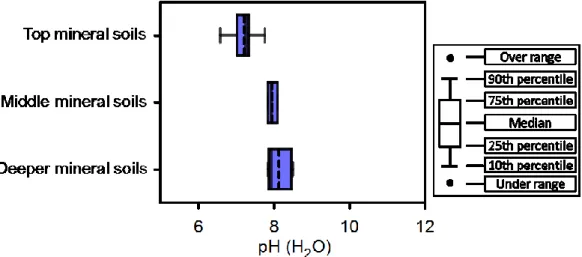
3-5 to 13 and Tables 3-1. Higher amount of gravel was observed in deeper mineral horizons (Fig. 3-5). Gravel content in top and middle mineral soil horizons was similar. Soil reaction of top mineral soils, which were showing approximately 7 as neutral soil reaction was lower than those of middle and deeper mineral soils. Values of pH (H2O) over 8.0 were observed in middle and deeper mineral soils, indicating that deeper soil materials are in alkaline condition (Fig. 3-6).
Electric conductivity (EC) of top mineral soils was significantly lower (Mean 13.8 mS/m, P
< 0.01) than those of middle and deeper mineral soils (Mean 22.9 mS/m and 27.6 mS/m,
30
respectively) (Fig. 3-7). The highest EC was in the deeper mineral soil horizon (39.2 mS/m).
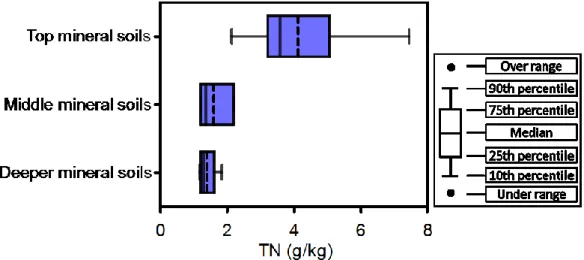
A wide range of total carbon (TC) content was observed in top mineral soils (24.3 to 98.6 g kg-1) (Fig. 3-8). The contents of TC in middle and deeper mineral soil horizons were lower than those of top mineral soils (19.2 - 24.2 and 18.9 - 24.1 g kg-1, respectively). Top mineral soils have relatively smaller amount of inorganic carbon (IC) as compared to those in middle and deeper mineral soils (Fig. 3-9). Deeper mineral soil materials showed the highest IC content of all samples taken. Total organic carbon (TOC) content, calculated as differences between TC and IC content, was similar in both middle and deeper mineral soils. Top mineral soils contained relatively high TOC ranging between 21.8 and 95.6 g kg-1. Total organic carbon contents in middle mineral soils and deeper mineral soils were similar ranged from 15.2 to 19.3 g kg-1 and from 15.0 to 19.1 g kg-1, respectively (Fig. 3-10). Top mineral soil samples contained TN ranging between 2.1 and 7.5 g kg-1 (Fig. 3-11). Middle and deeper mineral soil samples showed relatively low TN ranging from 1.2 to 2.2 g kg-1 and from 1.2 to 1.8 g kg-1, respectively. There was significant difference in TN between top and middle or deeper mineral soils (P < 0.05)..
The broader total sulfur content was observed in top mineral soils (0.1 to 1.0 g kg-1). In other horizons, ranges of TS content were narrower from 0.4 to 0.6 and from 0.5 to 0.8 g kg-1, respectively (Fig. 3-12). The average concentrations of TS in top, middle, and deeper mineral soils were not significantly different. The deeper mineral soils showed relatively high concentration of TS. Amorphous secondary minerals of aluminum and iron oxides were lower in middle and deeper mineral soils than those in top mineral soils (Fig. 3-13). There was a significant difference in content of Alo and Feo between top mineral soils and both of middle and deeper mineral soils (P < 0.01).
X-ray fluorescence analysis detected 17 elements (Al2O3, CaO, Cr2O3, CuO, Fe2O3, K2O, MgO, MnO, Na2O, P2O5, SiO2, SO3, SrO, TiO2, V2O5, ZnO, and ZrO2) from all samples. The