An empirical examination of the influence of error codes on the written work of Japanese
university EFL students
Fraser Gould
Abstract:
An empirical examination of the influence of error codes on the written work of Japanese university EFL students
Researchers and instructors have for years been debating whether feedback on student writing should be given at all, and if so, in what form. If the evidence is interpreted in a way that suggests feedback should indeed be given, a teacher must decide what kind of feedback should be provided, based on the needs of their students and the purpose of their course. The current study examined the effects of three kinds of corrective feedback on 11 types of error in Japanese university EFL writing, as well as the efficiency of these methods and student attitudes towards them. The results of the study revealed that the error codes used by some teachers may be an effective and efficient method in dealing with the sentence level errors of Japanese EFL writing students.
Key words:
writing feedback, error codes, direct correction, treatable vs untreatable errors
1. Introduction
Teachers and researchers continue to argue about how feedback on student writing should be implemented; indeed, if it should be implemented at all. One agreement that has been reached in recent years is an understanding that the research pool from which we can draw our assumptions on the topic is fallaciously small and more research needs to be done if we are to come to any accurate conclusions as to the effectiveness of error correction in writing
(Ferris 1999, Truscott 1999). The purpose of this study is to add to the research pool.
2. Literature Review: Treatable vs. Untreatable Errors
Ferris and Roberts (2001) have made a distinction between “treatable” and
“untreatable” errors. Treatable errors are those that are deemed to reflect language rules learned in a formal setting, such as errors pertaining to verb tenses and articles, while untreatable errors are thought to reflect acquired competence, for example, word choice errors.
Ferris and Roberts found that treatable errors were more likely to be self- edited than their untreatable counterparts, and that some kinds of untreatable errors were more problematic for self-correction than others. These findings have been corroborated by Bitchener et al. (2005).
Ferris (2004) notes the propensity of teachers to respond to treatable errors in an indirect way while responding to untreatable (such as word choice) errors using more direct methods. If the untreatable errors are indeed more resistant to less explicit methods of error correction, a reasonable way to deal with such errors may be to use more direct methods of feedback.
3. Procedure
3.1 Subjects and Pedagogical Context
The study involved three classes of EFL students enrolled in two separate courses in somewhat different pedagogical settings.
The first part of the study involved 56 non-language major students enrolled in two classes of a first year required writing course at Musashino University in Tokyo, Japan. The students met once a week for 90 minutes of instruction.
A similar study was conducted with a class of 25 language majors at Seisen Women’s University, also located in Tokyo. The students at Seisen University were second year students majoring in either English (19 students) or Spanish (six students). Almost all of the participants had some kind of experience in an English speaking country, whether it was a family trip or part of a homestay program. Due in part to this, the general overall attitude of the class could be seen as significantly more motivated than the Musashino University students.
The syllabus of this course dictated that students were to move beyond the writing of one-paragraph compositions into the construction of three paragraph essays.
In all, the data collection process involved 81 students and one teacher.
3.2 Method
Eleven major error categories were decided on, and a lesson was taught in which the students were given practice finding and correcting those specific eleven error types. The eleven error types that were decided on are included in Table 1.
Table 1. Error Types Included in the Study
Ferris (2004) contends that in order for a study on error feedback to prove useful to the academic community, both the types of error and how those errors
1. article errors 7. subject-verb agreement errors 2. capital letter errors 8. verb tense errors
3. intended meaning errors 9. word order errors 4. missing word(s) errors 10. wrong form errors
5. singular/plural errors 11. wrong word(s) used errors 6. spelling errors
are defined must be decided. Listed below are the parameters of the errors studied in this project, along with examples of each error type taken from the writing collected. In each example, the part of the sentence containing the error is underlined, and in the case of missing words resulting in a deemed error, a ∨ symbol is also used.
3.2.1 Article Errors
Errors involving the use of “a”, “an” and “the” were deemed article errors.
Article errors were almost exclusively instances in which an article was missing, but they could be distinguished as one of two types:
1. article missing
So I sank in ∨ water with her.
2. wrong article used
The most important invention in my life is a cell phone.
A third type of error, where an article is used when there is no need for one, was not found in the data from this study.
3.2.2 Capital Letter Errors
There were three kinds of capital letter errors defined in the study:
1. a capital letter used when a small case letter should have been used I can’t live without Mushrooms.
2. a small case letter used when a capital letter should have been used When I was accepted at Musashino university.
3. non-acronym proper nouns typed in capital block letters I like the band called TRIPLANE.
3.2.3 Intended Meaning Unclear
Perhaps the most challenging error type to consistently identify would be the
“intended meaning unclear” error. In some cases, errors that fell into this category may have been diagnosable as wrong word or missing word errors.
While efforts were made to ensure that what was defined as this error type remained consistent, this type of error could constitute anything from a poor lexical choice on the part of the writer to a string of several sentences that were deemed completely incomprehensible.
It was good that I could dance a very good dance in the real part.
Even if I said the sea to a fifth grade, I have not though that 99 villages or Erotica were too beautiful because they had not looked. But, I go to Okinawa, and the thought changes.
Shocked by the scenery called the conventional sea to be it.
Then speaking of a thing, the sea, there are Okinawa and me who think.
3.2.4 Missing Word(s) Errors
This error type could also be somewhat difficult to diagnose. In most cases a single word missing from the text rendered it grammatically incorrect or affected the intended meaning in a way that was deemed to have hindered the writer’s message. In other cases more than one word would need to be inserted into the text for it to be considered correct. Missing word errors were categorized as having one of the following three problems:
1. missing a preposition, pronoun, conjunction or determiner (other than the articles a/the/an)
When I came around, my family stared ∨ my face.
2. missing an adjective, verb or noun
To make matters ∨, the day’s dessert was chocolate mousse.
3. missing more than one word
Sadly, we ∨ separate high schools.
3.2.5 Singular/Plural Errors
Errors involving the plural forms of nouns are abundant in Japanese university EFL writing probably due in part to the fact that the Japanese language does not distinguish between singular and plural nouns.
Singular/plural errors found in the study involved one of the following problems:
1. a missing “s” or “es” at the end of a plural noun I came to love trip because of this experience.
2. an attempt to pluralize an uncountable noun I used to climb trees and play in the sands.
3. an irregular plural form miswritten
There were various kinds of fishes and shellfishes.
4. mistaken use of a singular pronoun for a plural pronoun, or vice- versa
So I can eat it every day.
A fifth type of error, where the plural form of a noun is mistakenly used in place of the singular form, was not found in the data from this study.
3.2.6 Spelling Errors
Spelling errors included three types, as outlined below.
1. word misspelled as a homonym
They announced a free concert schedule around all over Japan tour on there website.
2. word misspelled as a different word, one that could escape detection by a computer spell check function
I had a socking experience when I was 5 years old.
3. word misspelled as a non-word, one that should be discovered using a computer spell check function
I devoted myself to the softball culb when I was a junior high school and high school student.
3.2.7 Subject-Verb Agreement Errors
Subject-verb agreement is an English grammar skill that most students start to study in junior high school, but one that continues to pose problems in written compositions even at the university level. As such, it was included with this study.
The best time of my life is the time when something touch my heart.
3.2.8 Verb Tense Errors
Most verb tense errors in this study tended to be cases of students neglecting to use the past tense form of verbs in situations in which they were writing about the past. However, any tense usage error was included in the study. This included instances in which students should have used the modal “will” before a verb to denote a future action.
I grab the alarm clock for a weapon.
It was on a school excursion that we had begun to make friends.
I have been to her concert with my friend in November 2007.
3.2.9 Word Order Errors
Several types of word order errors have been diagnosed in previous studies, but for this study they were grouped together as one error type, representing
any two or more words that were written in an order that was grammatically incorrect or sounded clumsy.
But we after graduated, we went to different junior high schools
3.2.10 Wrong Form Errors
Wrong form errors generally consisted of the following three types:
1. mistaken use of a gerund in place of an infinitive, or vice-versa I played outside everyday and I was exciting.
2. mistaken use of a noun or verb form of a word in place of the adjective form, or vice-versa
But we went to difference high schools.
3. archaic or unnatural sounding grammar formations But now, I want not to be a teacher at school.
3.2.11 Wrong Word(s) Errors
One needed to be especially careful in diagnosing wrong word errors, as there is always the danger of misinterpreting a student’s meaning.
1. the use of a katakana-English word or expression The live was so exciting.
2. a mistaken preposition
I traveled in Nagasaki with my family.
3. the use of archaic or awkward language (sometimes the result of a
dictionary search)
But I felt sodden because I mistook some wine for juice.
4. a mistaken pronoun
I swam from morning to evening, and it was very happy.
5. the use of a word that conveyed the intended meaning, but sounded awkward (feedback was only provided if the instructor believed that the student would already have learned a more appropriate word)
By the grace of hard practice, I was stronger!
3.2.12 Unnecessary Word(s) Errors
Once the study began, it became obvious that a twelfth error type could have been included, namely the use of a word when none is necessary. Several papers collected needed to have words deleted in order to a) improve the communicativeness of the text and b) accommodate the error correction being provided for students. Words deemed unnecessary to the writing were all dealt with in the same manner, regardless of the prescribed feedback type for that paper. Two straight lines were drawn through them to indicate they should be deleted.
So we learned many things by there.
3.3 Classroom Procedure
At the beginning of the project the three types of feedback were explained and demonstrated to the students in an introductory lesson. Each student involved in the study was required to write three essays and three revisions. The Musashino students were to write three one-paragraph compositions, each consisting of 100 to 150 words. The compositions were meant to be narrative type paragraphs, as that was what their syllabus was focused on at the time.
In accordance with their higher level of English ability and the requirements of the syllabus of the course they were enrolled in, the Seisen University students were asked to write lengthier, more complex compositions than their Musashino University counterparts. Instead of one-paragraph compositions, the Seisen students were required to write three paragraph mini essays ranging
from 250 to 400 words each. All writing assignments were given as homework.
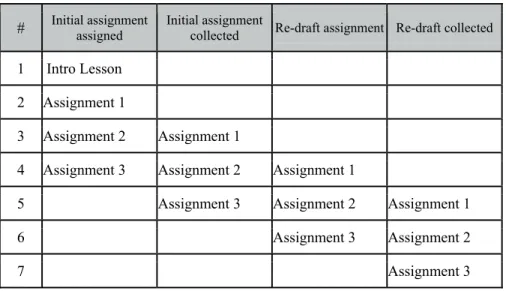
Following is a data collection plan that illustrates the schedule of the data collection phase of this study.
# Initial assignment assigned
Initial assignment
collected Re-draft assignment Re-draft collected 1 Intro Lesson
2 Assignment 1
3 Assignment 2 Assignment 1
4 Assignment 3 Assignment 2 Assignment 1
5 Assignment 3 Assignment 2 Assignment 1
6 Assignment 3 Assignment 2
7 Assignment 3
Table 2. Data Collection Schedule
The students in all three classes were divided into three separate groups according to the order of their names on the class’ registration sheets.
Group 1 Group 2 Group 3
Musashino Class 1 10 students 10 students 11 students Musashino Class 2 8 students 8 students 9 students
Seisen Class 8 students 8 students 9 students Table 3. Student Group Numbers
Group 1 for all classes received the error code feedback first, underlining second, and direct correction third. Group 2 received underlining first, followed by direct correction then error code. Group 3 received direct correction first followed by error code then underlining.
3.4 The Three Kinds of Error Treatment
Error coding was to be included in the study as it is a form of feedback used by many teachers in the author’s teaching context. It was desired to compare the error code with feedback forms at the extreme ends of the explicitness scale. The use of direct correction (reformulation) is perhaps the most explicit of all forms of error correction, while the simple underlining of errors might be considered the least explicit. This study is limited to these three forms of sentence level feedback:
1. Direct correction (most explicit of the three treatments) 2. Description of error type using an error code
3. Underlining of error only (least explicit of the three treatments)
Provided below are detailed explanations of the three feedback types.
3.4.1 Direct Correction
Direct correction, the most explicit of the feedback types, involved the instructor providing the corrected forms of the students’ sentences directly on their papers in the form of handwritten corrections. Missing words were added above or below sentences (depending on space available) along with a ∨ character to represent where the missing words should be inserted. Wrong word choice errors were corrected by the erroneous text being crossed out with a single line and the new word or words being written above in the instructor’s handwriting. Word order errors involving two words were corrected by circling one of the words and drawing an arrow to show the correct positioning of the word, a method similar to that of Zamel’s (1985).
There were several instances in which the intended meaning couldn’t be guessed. In such circumstances, a single line was drawn under the text with a question mark “?” to demonstrate my inability to understand the text.
3.4.2 Error Code
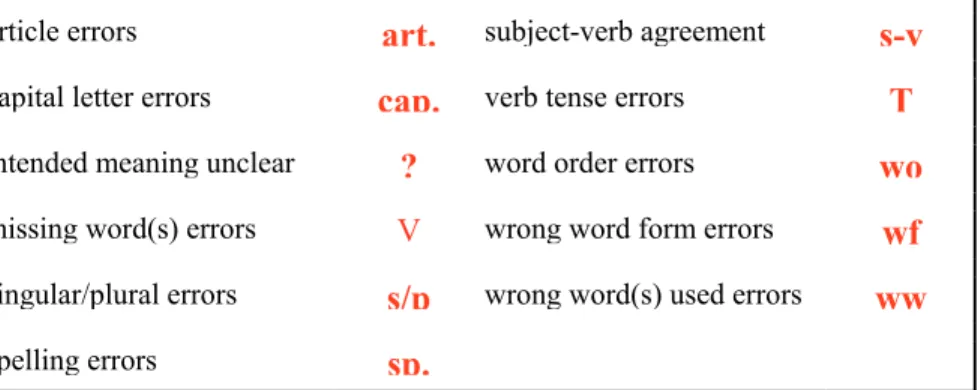
Error codes are used by many EFL writing instructors in Japan to call student attention to mistakes in written text. The choice of code seems to largely be a matter of personal preference on the part of the instructor. The error code which follows consists of several codes that have been used for years, along with some new codes created for this study.
The appropriate error code was written under each target error on students’
papers. In instances in which the space underneath the error was insufficient to write the code, the code was written above the error.
Following is a chart that gives the error code for each of the 11 targeted errors.
article errors
art.
subject-verb agreements-v
capital letter errors
cap.
verb tense errorsT
intended meaning unclear
?
word order errorswo
missing word(s) errors V wrong word form errors
wf
singular/plural errors
s/p
wrong word(s) used errorsww
spelling errors
sp.
Table 4. Error Code Used in Study
3.4.3 Underlining
Besides single lines being drawn under erroneous text, the only other writing done on papers receiving the underlining method of feedback was ∨ symbols added to show where any missing words, including articles, should be added. It was decided to include this visual cue in the papers receiving underlined errors because it was considered difficult to draw a line short enough to sit between two words yet visible enough to call students’ attention to an error. Also, if teacher correction time was to be considered in the study, the time needed to add this symbol would be comparative to the time necessary to draw a line where the missing word should be.
Although lines were usually drawn under complete words or combinations of words, in cases of singular/plural errors involving a missing “s” or “es”, an attempt was made to draw a line at the end of the noun in order to draw attention to where the error was located. Likewise, with subject-verb agreement errors and some wrong form errors, an effort was made to use shorter lines in order to better demonstrate to students where the error could be found.
3.5 Tabulating Target Errors
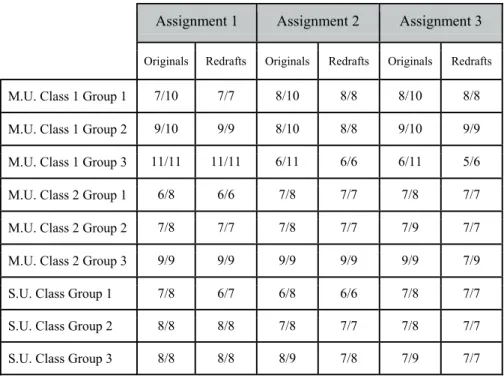
Due to student absences and some student writing being deemed unusable for the study, not all writing was collected in time to be included in the tabulation phase of this study. The table below shows how many assignments were collected and evaluated in each phase of the study.
Table Key: actual assignments collected / assignments due to be collected
Assignment 1 Assignment 2 Assignment 3
Originals Redrafts Originals Redrafts Originals Redrafts
M.U. Class 1 Group 1 7/10 7/7 8/10 8/8 8/10 8/8 M.U. Class 1 Group 2 9/10 9/9 8/10 8/8 9/10 9/9 M.U. Class 1 Group 3 11/11 11/11 6/11 6/6 6/11 5/6 M.U. Class 2 Group 1 6/8 6/6 7/8 7/7 7/8 7/7 M.U. Class 2 Group 2 7/8 7/7 7/8 7/7 7/9 7/7 M.U. Class 2 Group 3 9/9 9/9 9/9 9/9 9/9 7/9
S.U. Class Group 1 7/8 6/7 6/8 6/6 7/8 7/7
S.U. Class Group 2 8/8 8/8 7/8 7/7 7/8 7/7
S.U. Class Group 3 8/8 8/8 8/9 7/8 7/9 7/7
Table 5. Collected and Evaluated Assignments
Feedback for all students’ writing generally was limited to the target errors.
Exceptions were submissions in which the writer neglected to adhere to the course rules of paragraph writing, for example students’ writing sentences in
“list” fashion instead of continuing each sentence after the preceeding sentence.
Feedback on such problems was either given vocally to students individually, or written as instructions at the bottom of the page.
In some cases in which a student added an article where needed in their second draft, but the article was not the desired article, it was considered a successful correction if the sentence became a more coherent piece of text with the article. In cases in which one incorrect article was substituted for another incorrect one (for example “the” for “a” when “an” was necessary), it was considered an unsuccessful correction.
In cases of “meaning unclear” error in students’ text, any editing that led to a piece of writing that was more comprehensible than the original text was considered to be a successful correction. This included revisions in which sentences or strings of sentences of original compositions were omitted from revisions in favor of sentences that were more communicatively effective.
In a few cases, small grammatical or spelling errors were found within a sentence or group of sentences that were deemed incomprehensible. When students rewrote the sentences in question, often they were rewritten in such a way that the words or clauses containing the smaller errors would be omitted from the redrafted piece. In such cases, the original errors were struck from the study as it was impossible to guess as to whether or not they would have been corrected had the student simply revised the original sentence.
4. Findings and Discussion 4.1 Findings by Error Type
Following are tables that show how pervasive each error type was and how often it was successfully corrected after students received feedback. The tables below indicate total errors tabulated throughout the study. A tally of all errors found per assignment is included as Appendix 4.
Key: number of errors corrected / number of errors found (percentage of total errors successfully corrected)
4.1.1 Capital Letter Errors
Musashino Students Seisen Students
Direct Correction 27/28 (96.4%) 9/9 (100.0%)
Error Code 18/18 (100.0%) 10/10 (100.0%)
Underlining 8/8 (100.0%) 13/13 (100.0%)
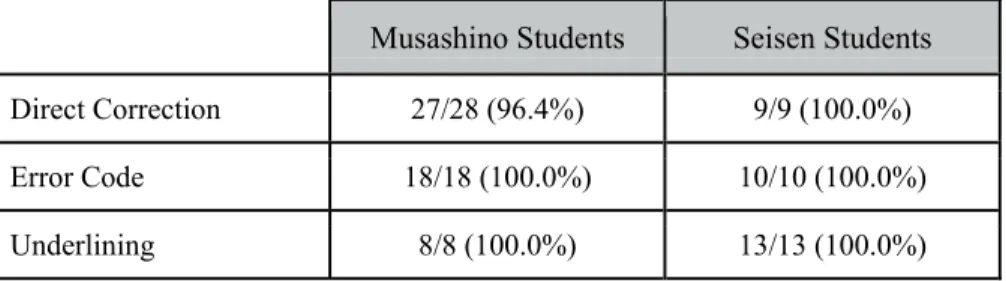
Table 6.1. Effect of Feedback Types on Capital Letter Errors
In the Musashino University students’ writing, 20 capital letter errors were noted in the first assignment, 18 errors in the second assignment, and 16 in the final assignment, for a total of 54 recorded capital letter errors. The Seisen University students’ writing included 14 capital letter errors in the first assignment, eight in the second assignment, and 11 in the final assignment, for a total of 33 capital letter errors.
In total, 87 capital letter errors were noted in all first drafts collected from the students at both universities. With only one exception, every error involving a capital letter was successfully corrected in students’ second draft. It would seem that such errors are relatively easy for students to correct, regardless of the explicitness of the feedback type they receive.
4.1.2 Word Order Errors
Musashino Students Seisen Students Direct Correction 10/10 (100.0%) 14/14 (100.0%)
Error Code 4/5 (80.0%) 11/11 (100.0%)
Underlining 5/7 (71.4%) 5/7 (71.4%)
Table 6.2. Effect of Feedback Types on Word Order Errors
Word order errors were documented eight times in the first assignments of Musashino students, nine times in the second assignments and five times in the third assignment for a total of 22 word order errors. Seisen students’ writing included nine word order errors in the first assignment, 15 errors in the second assignment, and eight errors in the third for a total of 32 word order errors.
While word order errors are considered to be “untreatable” by Ferris and Roberts (2001), it seems that in most cases both sets of students were capable of correcting the error with use of an error code or diagnosing the error themselves if it was underlined.
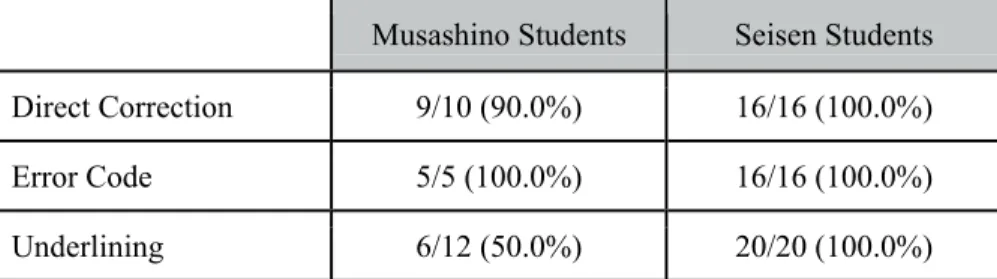
4.1.3 Subject-Verb Agreement Errors
Musashino Students Seisen Students
Direct Correction 9/10 (90.0%) 16/16 (100.0%)
Error Code 5/5 (100.0%) 16/16 (100.0%)
Underlining 6/12 (50.0%) 20/20 (100.0%)
Table 6.3. Effect of Feedback Types on Subject-Verb Agreement Errors
Subject verb agreement errors were another error type chosen for inclusion in this study because of the high frequency of this error type noticed in previous writing classes. Subject verb agreement errors did indeed appear in many of the students’ work, but they were not as pervasive as some other grammatically- based errors, for example verb tense errors and singular/plural use errors.
Three subject-verb agreement errors were discovered in the first assignments of the Musashino students. Seven were found in both the second and third assignments. Seisen students’ writing included 24 subject-verb agreement
errors in the first assignment, 17 errors in the second assignment, and 11 errors in the third for a total of 52 subject-verb agreement errors.
In total, 84 subject-verb agreement errors were recorded in all first drafts collected from the students at both universities. The success rate in correcting these errors was high in almost every category. The notable exception is that when Musashino students were provided with simple underlining as feedback, they could only successfully revise their subject verb agreement errors 50% of the time.
4.1.4 Singular/Plural Errors
Musashino Students Seisen Students
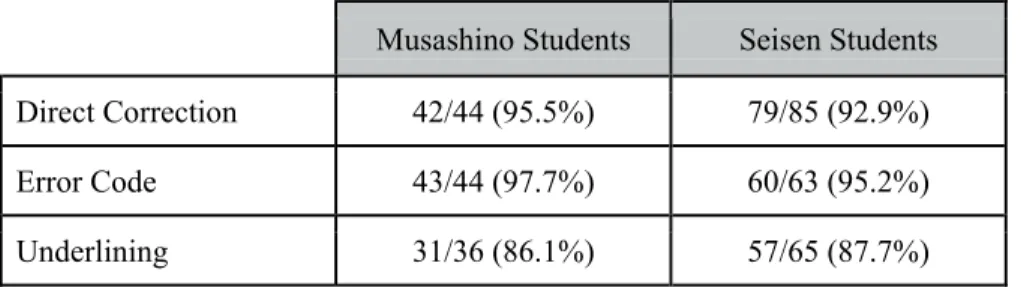
Direct Correction 42/44 (95.5%) 79/85 (92.9%)
Error Code 43/44 (97.7%) 60/63 (95.2%)
Underlining 31/36 (86.1%) 57/65 (87.7%)
Table 6.4. Effect of Feedback Types on Singular/Plural Errors
Errors involving the singular and plural use of countable nouns are often a common problem in the writing of Japanese EFL students, probably due to the absence of a plural noun form in the Japanese language. As had been expected, such errors represented a large portion of the total errors found in the writing of students from both universities.
In the Musashino students’ writing, 39 singular/plural errors were noted in the first assignment, 44 in the second assignment and 52 in the final assignment, for a total of 125 singular/plural use errors. The Seisen students’ writing included 91 such errors in the first assignment, 82 errors in the second assignment and 44 in the final assignment, for a total of 217 singular/plural use errors
In total, 342 singular/plural use errors were recorded in the first drafts of all assignments collected from students at both universities.
It should be noted that three individual students were responsible for a disproportionate number of singular/plural errors. One Musashino student was responsible for nine of the 44 singular/plural errors in the second assignments collected. Six of these nine errors were a repeated use of the singular noun
“mushroom” in erroneous place of the plural “mushrooms”. While there were a few other errors written by students multiple times in a single composition, this is probably the only case in which the number of errors may have potentially skewed the data tabulated.
All three feedback methods brought about high correction rates on singular/plural errors. It seems that these errors are indeed treatable, at least among Japanese university students.
4.1.5 Spelling Errors
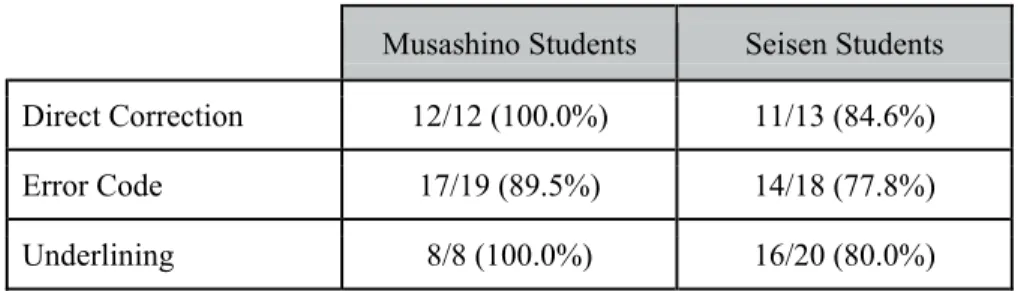
Musashino Students Seisen Students Direct Correction 12/12 (100.0%) 11/13 (84.6%)
Error Code 17/19 (89.5%) 14/18 (77.8%)
Underlining 8/8 (100.0%) 16/20 (80.0%)
Table 6.5. Effect of Feedback Types on Spelling Errors
Earlier in the semester, students at both universities were given a lesson on academic writing discipline, which stressed the importance of using a spell- checking tool before handing in written work. Most students did indeed employ spell checking as a part of the self-editing process before handing in their work.
Many of the spelling mistakes found in the writing were homonyms. These errors were judged to be spelling errors rather than wrong word errors.
In the Musashino students’ writing, 12 spelling errors were noted in the first assignment, 18 in the second assignment and 10 in the final assignment, for a total of 40 spelling errors. The Seisen students’ writing included 16 spelling errors in the first assignment, 27 errors in the second assignment and 17 in the final assignment, for a total of 60 spelling errors.
In total, 100 spelling errors were found in the first drafts of all students’ work.
It is curious that the less explicit method of underlining brought about a higher success rate in the correction of spelling errors. One possible explanation is that some students may have been confused by the code used for spelling error (sp.) and how closely it resembled the code used for singular/plural error (s/p).
4.1.6 Verb Tense Errors
Musashino Students Seisen Students
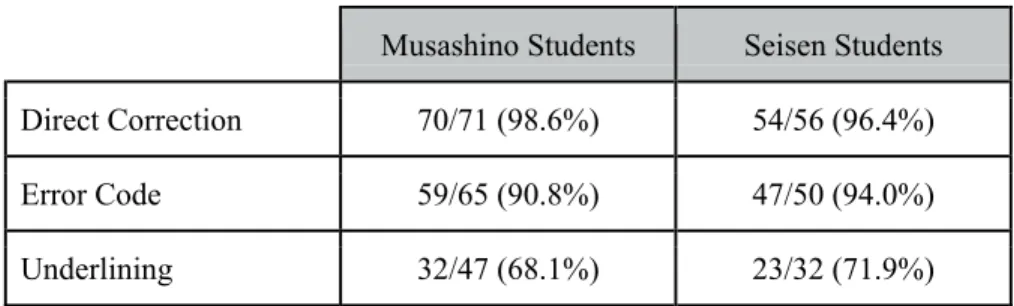
Direct Correction 70/71 (98.6%) 54/56 (96.4%)
Error Code 59/65 (90.8%) 47/50 (94.0%)
Underlining 32/47 (68.1%) 23/32 (71.9%)
Table 6.6. Effect of Feedback Types on Verb Tense Errors
While there were a few instances of the present perfect tense or the passive voice being misused, tense errors in this study consisted almost exclusively of students forgetting to use the past tense of verbs when necessary.
In the Musashino students’ writing, 72 verb tense errors were noted in the first assignment, 58 in the second assignment and 54 in the final assignment, for a total of 184 tense errors. The Seisen students’ writing included 36 verb tense errors in the first assignment, 56 errors in the second assignment and 52 in the final assignment, for a total of 144 verb tense errors.
Underlining was considerably less successful in bringing about the correction of verb tense errors than the use of an error code or direct correction.
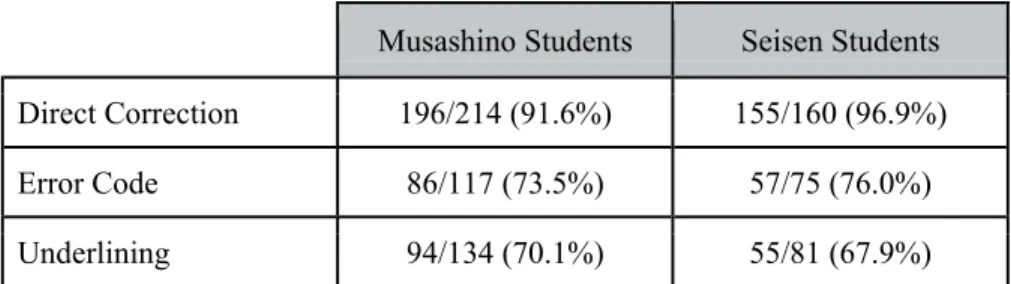
4.1.7 Wrong Word(s) Used
Musashino Students Seisen Students Direct Correction 196/214 (91.6%) 155/160 (96.9%)
Error Code 86/117 (73.5%) 57/75 (76.0%)
Underlining 94/134 (70.1%) 55/81 (67.9%)
Table 6.7. Effect of Feedback Types on Wrong Word Errors
The nature of this error type may have caused inconsistencies when providing feedback to students. While efforts were made to diagnose wrong word(s) errors as such, it is possible that in some cases the wrong words used may have made the meaning of the text unclear, and the error would have been marked as such.
This error type might be considered the most “untreatable” by Ferris and Roberts (2001), and as can be seen from the chart above, is much more apt to be corrected if it is dealt with in a direct manner.
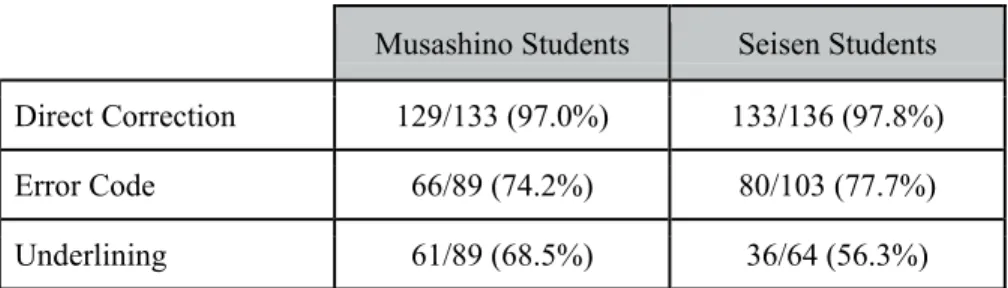
4.1.8 Missing Word(s)
Musashino Students Seisen Students Direct Correction 129/133 (97.0%) 133/136 (97.8%)
Error Code 66/89 (74.2%) 80/103 (77.7%)
Underlining 61/89 (68.5%) 36/64 (56.3%)
Table 6.8. Effect of Feedback Types on Missing Word Errors
Missing word errors were widespread in the writing of both Musashino and Seisen students. In the Musashino University students’ writing, 108 missing word errors were noted in the first assignment, 97 errors in the second assignment, and 116 in the final assignment, for a total of 321 recorded missing word errors. The Seisen University students’ writing included 109 missing word errors in the first assignment, 92 in the second assignment, and 110 in the final assignment, for a total of 311 missing word errors.
In total, 632 missing word errors were noted in all first drafts collected from the students at both universities.
Missing word errors proved more resistant than other error types to the less explicit feedback method of underlining, suggesting that teachers may have to employ more direct methods with such errors, such as providing the student with the missing word.
4.1.9 Article Errors
Musashino Students Seisen Students Direct Correction 93/95 (97.9%) 106/110 (96.4%)
Error Code 69/75 (74.2%) 61/76 (80.3%)
Underlining 54/67 (80.6%) 41/54 (75.9%)
Table 6.9. Effect of Feedback Types on Article Errors
Article errors factored heavily in the study and consisted almost exclusively of missing “a” and “the” articles, although there were a few instances of one article being used mistakenly in place of another, for example “a” for “the” or
“an”.
In the Musashino students’ writing, 88 article errors were noted in the first assignment, 63 in the second assignment and 89 in the final assignment, for a total of 240 article errors. The Seisen students’ writing included 81 article errors in the first assignment, 83 errors in the second assignment and 80 in the final assignment, for a total of 244 article errors.
While there were no surprises as to how each feedback type effected students’
revisions, it is curious that Musashino students were more successful than their Seisen counterparts at using all three feedback types to successfully correct their article errors.
4.1.10 Wrong Form Errors
Musashino Students Seisen Students Direct Correction 40/40 (100.0%) 64/66 (97.0%)
Error Code 25/32 (78.1%) 20/30 (66.7%)
Underlining 29/41 (70.7%) 24/44 (54.5%)
Table 6.10. Effect of Feedback Types on Word Form Errors
In the Musashino University students’ writing, 49 word form errors were noted in the first assignment, 32 errors in the second assignment, and 41 in the final assignment, for a total of 122 recorded word form errors. The Seisen University students’ writing included 66 word form errors in the first assignment, 36 in the second assignment, and 41 in the final assignment, for a total of 143 word form errors.
In total, 165 word form errors were noted in all first drafts collected from the students at both universities.
Seisen students seemed to have more problems negotiating their wrong form errors than their Musashino counterparts, particularly when underlining was employed as the feedback method. Possible reasons for this will be discussed later in the study.
4.1.11 Meaning Unclear
Musashino Students Seisen Students
Direct Correction 35/39 (89.7%) 10/14 (71.4%)
Error Code 50/60 (83.3%) 43/51 (84.3%)
Underlining 26/41 (63.4%) 17/33 (51.5%)
Table 6.11. Effect of Feedback Types on Meaning Unclear Errors
In the Musashino University students’ writing, 48 meaning unclear errors were noted in the first assignment, 47 errors in the second assignment, and 49 in the final assignment, for a total of 144 recorded meaning unclear errors. The Seisen University students’ writing included 36 meaning unclear errors in the first assignment, 39 in the second assignment, and 24 in the final assignment, for a total of 99 meaning unclear errors.
In total, 243 meaning unclear errors were noted in all first drafts collected from the students at both universities.
Again, Musashino University students seem to have outperformed their Seisen counterparts in using underlined errors to revise their compositions.
4.2 Findings by Feedback Type
Musashino Students Seisen Students Direct Correction 663/692 (95.8%) 651/679 (95.9%)
Error Code 474/529 (89.6%) 419/503 (82.8%)
Underlining 354/490 (72.2%) 307/433 (70.9%)
Table 7. Total Number of Errors Corrected/Found
Results of the study corresponded for the most part with the hypothesis.
Direct correction, the most explicit of the feedback methods, accounted for the highest rate of correctly revised second drafts for both Musashino (95.8%) and Seisen (95.9%) students. The underlining of target errors with no further feedback produced the least amount of correct revisions for both sets of students (Musashino 72.2%, Seisen 70.9%). The use of an error code to draw attention to mistakes and give students cues as to how to respond brought about 89.6% correct revisions for Musashino students and 82.8% for Seisen students.
The results of this study stand in sharp contrast to the findings of Ferris and Roberts (2001) who concluded that while written feedback did indeed help students correcting errors on the second draft of a composition, the type of feedback was of little consequence. The present findings do support previous studies by Greenslade& Felix-Brasdefer (2006) that suggest error codes are indeed an effective way to bring about significant self-corrections in students’
revised writing.
4.2.1 Error Code
There were instances in which an indecipherable piece of writing was redrafted into a comprehensible piece of work, albeit one that included other errors that were counted in the original study. For example, one Musashino student wrote in his original essay:
When I was five years old, a foreign people had what I was surprised at in the days of a child most for the first time.
Upon receiving error code feedback in the form of a “?” mark under the sentence in question, he resubmitted the work with the sentence:
When I was five years old, I was very surprised to look foreign people in Shinjuku station.
This sentence contains both a wrong word error (the use of “look” for “see”) and a capital letter error (in the word “station” as part of a proper noun), but still is a clear improvement on the communicativeness of the original sentence.
There were some curious cases in which a student would redraft a sentence, correcting target errors pointed out, but also self-correcting additional target errors missed in the process. One example comes from another Musashino student who originally wrote the sentence:
Still an elementary student, I went to swimming school and Syodo School.
While the student successfully used the error code provided to add an article where needed, she also corrected two capital letter errors that the instructor missed in his feedback:
Still an elementary student, I went to a swimming school and syodo school.
The instructor initially believed that “Syodo School” was a proper noun referring to the name of an institution, but realized later that the student had used the Japanese word for “calligraphy”. This is an example in which the use of an error code as feedback apparently called a student’s attention to target errors other than those marked by the instructor.
Some teachers in the past have given up using error codes in feedback because they believe there is a possibility that they could be confusing. This worry is apparently not without warrant. In one particularly humorous incident,
a Seisen student successfully negotiated seven singular-plural corrections, two unclear meaning edits, two of four missing word errors and a wrong word error, a subject verb agreement error and a tense error. However, instead of correctly adding a missing article in the eight places the error code was used to indicate a missing article, the student inserted the word “art” into her writing.
I was also initially worried that sentences containing many target errors would be crowded with codes, confusing students and hindering correction. It seems these fears may have been largely unfounded, as demonstrated by the following piece of treated writing which a Seisen student received:
Extract 1. Sample of Error Code Treatment
The student originally wrote the sentence
The all wall of out is gold.
When read outside of context (the student was writing about a trip to a temple), the sentence is almost indecipherable. It contained a word order error, a subject/plural error, a missing article, a wrong word error and a subject-verb agreement error. However, the student successfully used the error code provided to bring about the following corrected sentence:
All the walls of the outside are gold.
4.2.2 Underlining
When considering the effect of feedback on revisions, the assertion of Robb et al. that “less time consuming methods of directing students’ attention to surface errors may suffice” (1986: 91) is not entirely supported by the present study.
While the simple underlining of targeted errors was clearly the quickest way to respond to written grammatical and mechanical errors, it also accounted for the fewest correct revisions in student redrafts.
Also, as was expected, the use of underlining only of errors as a form of corrective feedback poses the danger that students may misinterpret what type of error has been made in the original work. One example can be found in the following sentence. A Seisen student made a tense error in the sentence:
But I soon find out it is not true.
The tense error was underlined and in the second draft of the student’s writing she chose to change the word and not the tense of the word, thus the revision contained the same error type as the original:
But I soon realize it is not true.
More often than not, students successfully addressed errors that were underlined, but the type of confusion documented above was prevalent enough amongst errors that received the underlining treatment that caution when using such feedback is probably warranted.
4.2.3 Direct Correction
Explicit instructions as to how to redraft a composition were not guaranteed to bring about 100% success rates on revisions. Musashino students successfully
addressed 95.8% of the errors that were directly corrected by the teacher, while Seisen students successfully corrected 95.9% of theirs.
Failure to exactly copy the teacher’s written revision could be attributed to two reasons. Students may have ignored the teacher’s feedback or they may have mistakenly copied the teacher’s revision. Teacher handwriting becomes an issue in direct correction, and a previous study has shown 9% of students complaining that they couldn’t read their instructors’ handwriting when they received written feedback (Ferris, 1995: 44). Given the reasons previously presented in section 1.6 of this paper, it could reasonably be assumed that most Japanese university students would not seek clarification if they did not understand the teacher’s handwriting.
4.3 Treatable vs. Untreatable Errors
Treatable errors were defined as those that are rule-governed and should be comparatively easy for students to diagnose on their own. Untreatable errors were seen as more idiosyncratic in nature, and required acquired language knowledge to address and correct. The table below represents how the particular error types in this study were categorized.
Treatable Errors Untreatable errors
Article errors Meaning unclear
Capital letter errors Missing word(s) errors Singular/plural errors Wrong word(s) used errors Spelling errors
Subject-verb agreement errors Verb tense errors
Table 8. Treatable and Untreatable Errors
Word order errors and wrong form errors are more difficult to classify as either treatable or untreatable. If one were to look at the distinction of error types on a scale, rather than as two distinct categories, word order errors and wrong form errors would probably lie closer to the middle of the scale than the other error types considered in this study. As they were considered difficult to categorize, these two error types were excluded from the portion of the study that compared treatable and untreatable error types.
Top = Musashino students’ results Bottom = Seisen students’ results Meaning
Unclear
Missing Word(s)
Wrong Word(s) Direct
Correction
35/39 (89.7%) 10/14 (71.4%)
129/133 (97.0%) 133/136 (97.8%)
196/214 (91.6%) 155/160 (96.9%) Error Code 50/60 (83.3%)
43/51 (84.3%)
66/89 (74.2%) 80/103 (77.7%)
86/117 (73.5%) 57/75 (76.0%) Underlining 26/41 (63.4%)
17/33 (51.5%)
61/89 (68.5%) 36/64 (56.3%)
94/134 (70.1%) 55/81 (67.9%) Table 9. Untreatable Errors
Untreatable Errors Treatable Errors
Direct Correction 360/386 (93.3%) 298/310 (96.1%)
253/256 (98.8%) 275/289 (95.2%)
Error Code 202/266 (75.9%)
180/229 (78.6%)
215/226 (95.1%) 208/233 (89.3%)
Underlining 181/264 (68.6%)
108/178 (60.7%)
137/178 (77.0%) 170/204 (83.3%) Table 10. Treatable Errors vs. Untreatable Errors
While the direct correction treatment did not seem to offer much difference between the successful correction of treatable and untreatable errors, there seems to be considerable difference in the students’ ability to use the less explicit feedback methods in correcting treatable and untreatable errors.
The error code treatment proved much more effective in assisting students to correct treatable errors than untreatable ones, for both the Musashino and Seisen students. Likewise, underlining as a method of error feedback seemed much less effective for untreatable errors (68.6% successful correction rate for Musashino students, 60.7% for Seisen students) than it did for treatable errors (77.0% successful correction rate for Musashino students, 83.3% for Seisen students). These results lend support to the findings of Ferris and Roberts (2001) and Bitchener (2005) that untreatable errors are going to be more difficult to treat with less explicit methods of feedback.
4.4 Implications for Teachers
As university EFL instructors in Japan come under increasing pressure to do more work in less time, they need to explore more efficient methods for responding to student writing. This study does seem to offer some encouragement to teachers who have spent years responding to their students’
writing with error codes. It seems an error code could be considered “a happy medium” between the more explicit direct correction and the less explicit method of underlining for the following reasons:
1. It results in a higher probability of the error being corrected by the student than simply underlining the error.
2. It ensures that the revision process will be treated as a problem solving activity, as espoused by Corder (1981), Brumfit (1980) and Chandler (2003).
3. It takes less time on part of the teacher to implement than direct correction.
4. Students seem to believe that such correction benefits both their revisions and their long-term English progress.
The results of this study cannot be seen as an endorsement of any particular error code, or a prescription as to what precise errors should be treated by error code. Many different error codes are used by different instructors. Prescribing an error code for other educators to use could possibly create confusion when marking texts and lead to incorrect diagnosing and marking of errors, a problem that has been discovered in other feedback studies that have had multiple instructors as participants (see Ferris and Roberts, 2001). Teachers should use their own experience and intuitions, and negotiate with their students to devise error codes for their own writing classes. It must also be remembered that error codes are probably not appropriate for all error types.
One suggestion for language instructors teaching in a similar context as described in this study might be to utilize some combination of the three feedback forms. An error code for most treatable errors could be implemented while incorporating more explicit feedback for more untreatable errors such as word choice and word order errors. Simple underlining for the most treatable of errors that students seem to be able to diagnose easily, such as capital letter errors, might suffice. The challenge here would be for the teacher to remain consistent in their diagnosis and treatment of errors. This might solve the problems of inconsistency in error correction that both Truscott (1996) and Ferris (2004) lament.
If the coursework involves a final product such as a book report or research essay, feedback on the sentence level errors can certainly improve what Ashwell (2000) calls the “communicative competence” of that composition. If a course is more concerned with general writing fluency and development, instructors still need to make the judgment as to whether the benefits of
feedback outweigh the potential dangers that Truscott warns us of (1996, 1999, 2004, 2007).
5. Conclusion
Three types of corrective feedback with three very different levels of explicitness were administered to the writing of Japanese university students.
Underlining took the least amount of teacher time to implement, but also was the least effective in bringing about successful revisions. It was also by far the least desired of the three feedback methods by students, who believed that the method didn’t give them enough guidance in correcting their errors. Direct correction was predictably the most successful of the three feedback types in bringing about successful revision, however it took considerably more effort on the part of the teacher (in way of time spent) to implement. Students were also skeptical of its usefulness in helping them develop their writing skills. The use of error codes seemed to be efficient in terms of teacher implementation and effective in the student revisions they brought about.
Since providing feedback requires so much time of writing teachers, we must be concerned with its effectiveness. What is the most effective (and efficient) method of addressing sentence-level errors? As Ferris points out “we clearly cannot afford to stop teaching and wait for the researchers to tell us how it should be done. So we must, in the meantime, rely on the research evidence that does exist, our own experience and intuitions, and the desires of our students to inform and guide us” (2004: 58). To this I would add that we should also consider the purpose and aims of the course the students are enrolled in.
Ultimately, error correction is going to be of use to some students and not of any use to others; thus error codes themselves are going to be of more use to some students than others. However, if the writing instructors of Japanese university EFL students are concerned with efficiently providing feedback that
will benefit the greatest number of their students while revising compositions, they may want to consider the use of an error code as outlined in this study.
References
Ashwell, T. (2000). Patterns of teacher response to student writing in a multiple-draft composition classroom: Is content feedback followed by form feedback the best method? Journal of Second Language Writing, 9(3), 227- 257.
Bitchener, J., Young, S., & Cameron, D. (2005). The effect of different types of corrective feedback on ESL student writing. Journal of Second Language Writing, 14, 191-205.
Brumfit, C.J. (1980). Problems and Principles in English teaching. Oxford:
Pergamon Press.
Chandler, J. (2003). The efficacy of various kinds of error feedback for improvement in the accuracy and fluency of L2 student writing. Journal of Second Language Writing, 12, 267-296.
Corder, S.P. (1981). Error Analysis and Interlanguage. Oxford: Oxford University Press.
Ferris, D. R. (1995). Student reactions to teacher response in multiple-draft composition classrooms. TESOL Quarterly, 29, 33-53.
Ferris, D. R. (1999). The case for grammar correction in L2 writing classes: A response to Truscott (1996). Journal of Second Language Writing, 8(1), 1-11.
Ferris, D. R. (2004). The “grammar correction” debate in L2 writing: Where are we, and where do we go from here? (and what do we do in the
meantime…?). Journal of Second Language Writing, 13, 49-62.
Ferris, D. R., & Roberts, B. (2001). Error feedback in L2 writing classes. How explicit does it need to be? Journal of Second Language Writing, 10(3), 161- 184.
Greenslade, T. A., & Felix-Brasdefer. J. C. (2006). Error correction and learner perceptions in L2 Spanish writing. In Clee, C. A., & Face, T. L. (Eds.) Selected proceedings of the 7th Conference of Spanish and Portuguese as first and second languages (pp. 185-194). Somerville, MA: Cascadilla Proceedings Project.
Leki, I. (1991). The preferences of ESL students for error correction in college- level writing classes. Foreign Language Annals, 24, 203-218.
Robb, T., Ross, S., &Shortreed, I. (1986). Salience of feedback on error and its effect on EFL writing quality. TESOL Quarterly, 20, 83-91.
Truscott, J. (1996). The case against grammar correction in L2 writing classes.
Language Learning, 46(2), 327-369.
Truscott, J. (1999). The case for “the case for grammar correction in L2 writing classes”: A response to Ferris. Journal of Second Language Writing, 8, 111- 122.
Truscott, J. (2004). Evidence and conjecture on the effects of correction: A response to Chandler. Journal of Second Language Writing, 13, 337-343.
Truscott, J. (2007). The effect of error correction on learners’ ability to write accurately. Journal of Second Language Writing, 16, 255-272.
Zamel, V. (1985). Responding to student writing. TESOL Quarterly, 19, 79-97.