博士学位論文 要約
乳児期における泣きの縦断的研究
-コミュニケーションの観点から-
Longitudinal studies of crying in infancy from the perspective of communication
聖心女子大学大学院 文学研究科・人間科学専攻
中山 博子
2015 年 3 月
1
要旨
乳児期における泣きの縦断的研究
-コミュニケーションの観点から-
本論文は,4 つの研究で構成される。日常生活における乳児の泣きの表出とそれに 対応する母親のかかわりを縦断的に観察し,泣きの発達過程や母子のコミュニケーシ ョンについて検討することを目的とした。研究 1,研究 2,研究 3 では,行動および 感情の両面から泣きの発達特徴を,研究 4 では,乳児の泣き声に対する大人の感じ方 を問う実験を試みた。
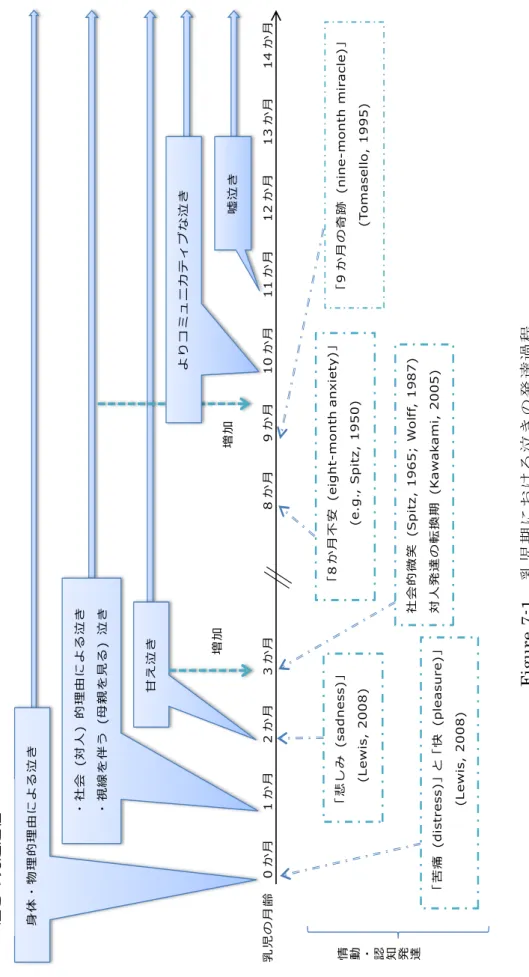
研究 1 は,生後初期における乳児の泣きの特徴やその発達過程を検討することを目 的とした。生後 0 か月から 1 か月の乳児 4 名を対象として,日常生活における泣きの 表出とそれに対応する母親のかかわりを縦断的に観察した。その結果,生後 3 か月以 降は対人的な理由による泣きの割合が増加するなど,乳児初期の泣きは生後 3 か月に 大きな転換期を迎える可能性が示唆された。また,対人的な泣きのなかでも, minimal
(no)-distress な状態でありながら母親との情動的なコミュニケーションを求める甘え
泣きが生後 2 か月から表出することが示された。母親はそうした泣きに積極的に介入 し,乳児の側からのはたらきかけに反応していたことも判明した。
研究 2 においては,生後 7 か月以降の乳児 2 名を縦断的に観察した結果,生後 11 か月から 12 か月にかけて嘘泣きが観察され,乳児期においてもあざむき行動をする 可能性が示唆された。また,乳児の泣き行動には個人差がある一方で,視線の使い方 や泣きのパターンに関しては両児に共通する特徴がみられた。生後 9 か月を過ぎると,
より精緻化された泣き行動を表出するようになった。乳児後期における泣き行動は,
嘘泣きの発現も含め,乳児の対人的なコミュニケーションスキルとして相当に発達し ていることが示唆される。
研究 3 では,乳児が泣く前と泣き止んだ後の機嫌の変化について検討した。その結 果,これまでは不快感の表出として乳児は泣くものであると考えられてきたが,例外 的に機嫌がよいと思われる場面も観察された。それらは嘘泣きと解釈される泣き行動 であった。泣くという行為が乳児にとって genuine な情動表出にとどまらず,他者の 注意や行動をコントロールするため意図的に用いられている可能性が示唆される。
研究 4 では,乳児の泣き声を大人が聞いた場合どのように感じるかという点に注目
し,泣き声を刺激とした聴取実験を行った。その結果,嫌悪感などは,音圧や振幅な
ど音の強さに関わる指標が影響していることが確認された。また,泣きの理由によっ
ては嫌悪感ではなく,好感を抱かせることが判明した。研究 4 の結果は,乳児の泣き
声が不快であるというこれまでの前提とは異なり,泣き声によっては聞いている人に
ポジティブな感情をもたらすことを示したといえる。すなわち,大人は乳児が表出す
るすべての泣き声に嫌悪感を抱くわけではなく,むしろ,一部の甘え泣きに対しては
好感を抱く可能性が高いことが示唆される。
2
本論文の特徴は,泣きを介したコミュニケーションは乳児の発達に大いに役立って いる可能性,すなわち,泣きの肯定的な側面を特に示した点である。
Longitudinal studies of crying in infancy from the perspective of communication
The purpose of this dissertation describing four investigations was to examine the development of crying behavior in infants and examine infant’s communication with their mothers through crying.
Study 1 examined the development of infants’ crying and their mothers’
responses to crying from birth to 6 months of age. Four infants were observed longitudinally twice a month for 7 months. The results showed that 3 months of age was a major turning point in crying behavior. Interestingly, crying for interpersonal and social causes, such as amae crying in pursuit of emotional communication with significant others, emerged at the age of 2 months old.
Study 2 examined the development of crying behavior in infants during the second half of the first year of life. Two infant girls between 7 and 14 months of age were observed twice a month for 6 months. These infants exhibited crying behavior that became more sophisticated with increasing age, which marked a proactive stance in communicating with the mother on the part of the infant.
Interestingly, at 11 and 12 months of age, “fake crying” was observed during a naturalistic interaction with the mother. This implied that infants are capable of fake crying by the end of the first year of life. It also suggests that deceptive infant behavior develops at a very young age.
Study 3 examined the affect of infants just before the onset of crying and just after crying terminated. Two infants nearly always displayed negative affect just before starting to cry and soon after the crying ended. However, there were exceptions and positive affect was also observed, which were identified as “fake crying”. This implies that crying is not only a genuine emotional expression, but can also be used deliberately by the infants as a preverbal communication.
Study 4 examined adult responses to infant’s crying sounds in cross-sectional
data. Female college students (N=26) participated in the experiment. They rated
their own emotional feelings and assessed the infant’s condition by using the
different crying sounds emitted by the infants. The results indicated a new and
different finding, which suggest that infant’s crying sounds have a positive effect
on listeners’ emotions, depending on the causes of crying. The study also suggested
3
that adults do not necessarily experience a feeling of aversion towards all crying sounds, but that they have positive feelings toward a certain type of crying, such as amae crying.
The above four studies suggest a more positive interpretation of infant crying
and encourage us to recognize the importance of developing favorable
environments for infants.
4
第Ⅰ部 問題と目的 ... 7
第 1 章 問題 ... 8
1.1 泣きのとらえかた ... 8
1.1.1 研究の背景 ... 8
1.1.2 泣きと涙 ... 9
1.1.3 コミュニケーションとしての泣き ... 10
1.2 乳児期の泣きと乳児の発達 ... 13
1.2.1 泣きと感情・情動発達および情動調整 ... 13
1.2.2 アタッチメント行動としての泣き ... 15
1.2.3 乳児の泣き声に対する養育者の知覚・反応 ... 16
1.2.4 乳児の泣きとあざむき ... 17
1.3 乳児の泣きにおける普遍性と文化差 ... 19
1.4 ヒトにおける乳児の泣き ... 21
1.5 本論文における泣きの定義 ... 22
第 2 章 研究の構成と目的 ... 24
2.1 研究の構成 ... 24
2.2 目的 ... 26
2.2.1 研究 1:生後初期における乳児の泣きの発達 ... 26
2.2.2 研究 2:乳児後期における泣き行動の発達 ... 26
2.2.3 研究 3:泣きが表出する前後における乳児の機嫌 ... 26
2.2.4 研究 4:乳児の泣き声に対する感じ方 ... 27
第Ⅱ部 研究 ... 28
第 3 章 生後初期における乳児の泣きの発達 [研究 1] ... 29
3.1 方法 ... 29
3.1.1 観察対象者 ... 29
3.1.2 倫理面への配慮 ... 29
3.1.3 観察手続き ... 29
3.1.4 評定方法 ... 30
3.1.4.1 泣きのエピソードの選定および場面抽出の信頼性 ... 30
3.1.4.2 評定のカテゴリーおよび観察の信頼性 ... 30
3.2 結果 ... 34
3.2.1 泣きの頻度および持続時間 ... 34
3.2.2 乳児の苦痛・不快度レベル (泣き声の強さおよび表情の大きさ ) 34 3.2.3 母親との近接性 ... 34
3.2.4 泣きのパターンおよび視線方向 ... 35
3.2.5 推測される泣きの誘発因 ... 35
3.2.6 泣いている間における乳児の機嫌 ... 35
5
3.2.7 母親の介入 ... 35
3.2.8 場面および場所 ... 36
3.3 考察 ... 36
第 4 章 乳児後期における泣き行動の発達 [研究 2] ... 38
4.1 方法 ... 38
4.1.1 観察対象者 ... 38
4.1.2 倫理面への配慮 ... 38
4.1.3 観察期間 ... 38
4.1.4 観察手続き ... 38
4.1.5 評定方法 ... 39
4.1.5.1 泣きのエピソードの選定および場面抽出の信頼性 ... 39
4.1.5.2 評定のカテゴリーおよび観察の信頼性 ... 39
4.2 結果 ... 42
4.2.1 泣きの頻度および持続時間 ... 42
4.2.2 泣き声の強さおよび表情の大きさ ... 42
4.2.3 母親との近接性 ... 43
4.2.4 泣きのパターンおよび視線方向 ... 43
4.2.5 推測される泣きの誘発因 ... 43
4.2.6 嘘泣き(fake crying)の発現 ... 43
4.2.7 母親の介入,介入するまでの反応潜時,および介入の効果 ... 44
4.2.8 場面および場所 ... 45
4.3 考察 ... 45
第 5 章 泣きが表出する前後における乳児の機嫌 [研究 3] ... 49
5.1 方法 ... 49
5.1.1 観察対象者 ... 49
5.1.2 倫理面への配慮 ... 49
5.1.3 観察手続き ... 49
5.1.4 評定方法 ... 49
5.1.4.1 エピソードの選定および場面抽出の信頼性 ... 49
5.1.4.2 評定のカテゴリーおよび観察の信頼性 ... 50
5.1.5 嘘泣きの操作的定義 ... 51
5.2 結果 ... 51
5.2.1 泣きが始まる前の乳児の機嫌 ... 51
5.2.2 泣きが終息した後の乳児の機嫌 ... 52
5.2.3 乳児の視線方向 ... 52
5.2.4 泣きが終息した後の身体的な接触 ... 52
5.2.5 乳児の機嫌と嘘泣き ... 52
6
5.3 考察 ... 53
第 6 章 乳児の泣き声に対する感じ方 [研究 4] ... 55
6.1 方法 ... 55
6.1.1 共同研究 ... 55
6.1.2 対象者 ... 55
6.1.3 倫理面への配慮 ... 55
6.1.4 実験場所 ... 55
6.1.5 手続き ... 55
6.2 結果 ... 56
6.2.1 泣き声に対する嫌悪感と乳児の不快度評価の相関 ... 56
6.2.2 泣きの推測因と泣き声に対する嫌悪感および乳児の不快度評価 56 6.2.3 泣き声の音声特徴と泣き声に対する嫌悪感および乳児の不快度評 価 ... 56
6.3 考察 ... 56
6.4 インタビュー調査 ... 57
6.4.1 方法 ... 57
6.4.1.1 調査対象者 ... 57
6.4.1.2 倫理面への配慮 ... 57
6.4.1.3 手続き ... 57
6.4.1.4 質問項目 ... 58
6.4.1.5 データの分析 ... 58
6.4.2 結果 ... 58
6.4.3 考察 ... 61
第Ⅲ部 討論 ... 63
第 7 章 総括的討論 ... 64
7.1 研究のまとめ ... 64
7.2 本論文における成果 ... 67
7.3 今後の課題 ... 71
引用文献 ... 73
関連業績 ... 88
謝辞 ... 89 図表目次
Figure 2-1 研究の構成 ・・・・・・・・・・・・・・・・・・・・・・・・・・・・・・ 24
Figure 6-9 母親による回答の内容 ・・・・・・・・・・・・・・・・・・・・・・・・ 60
Figure 7-1 乳児期における泣きの発達過程 ・・・・・・・・・・・・・・・・・ ・・・ 66