
Movement and Topological space in Japanese Contemporary Architecture [ PDF
4
0
0
全文
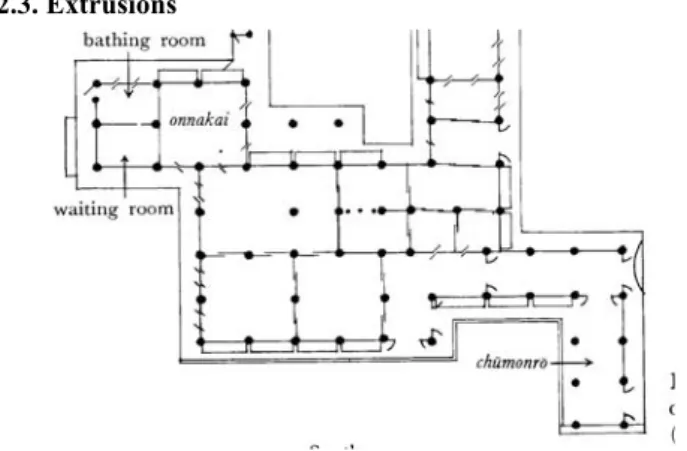
(2) This space is characterized, not by vistas, but by absence of. 2.3. Extrusions. vistas; walking through rooms, a new scene is discovered at every turn. “Each garden here is independent of the others and is intended for particular building. One’s position to the larger, outside world is indiscernible. In other words, this is a topological space. Movement space is an architectural space whose characteristics are fundamentally different from those of geometrical space. Terms as “irregularity” and “indeterminacy” are customarily used in characterizing this space. A, B, C…H indicates spatial units rooms Figure 3: Reconstructed plan of the Komatsu residence, Uji; R1 !. !. !. First “extrusion” appeared as an addition in the Zen temples as a consequence of the beginning of the process of autonomy of interior spaces. Architectural space in this instance” was like a bubble created by internal pressure from which expanded, in turn, smaller bubbles”. It created a variety of shapes and organic spaces that could be freely extended.. connected by a corridor or by some other means. The relative angle of A-B or B-C or the length of a connector and how it may twist and turn are almost entirely irrelevant to someone living inside since these facts can be recognized only in relation to the outside world.1. 2.4. Change in the connection of residential structures. Figure 7: Diagram of movement spaces; R1. Figure 4: Ancient shined !. !. !. Figure 5: Medieval and feudal period; R1. In ancient shinden (Figure 4) residence buildings were connected by intermediate ro while in medieval and feudal period (Figure 5) one interior space becomes directly connected to another. Residential plans were no longer restricted to the rectangular framework. Passageways in the ancient shinden-style residence become spatially and functionally integrated with the interior of the residence.. 2.5. Movement and Topological space Hommaru Palace (Fig.6) is the example of the developed stage of previously mentioned tendency. Only the part of the compound is displayed but it is easy to perceive the complexity of spatial organization.. Figure 6: Part of the Hommaru palace compound, Edo castle Dashed line indicates movement inside building. 3. TYPICAL SPATIAL ORGANIZATION OF TRADITIONAL DWELLING ! Afterwards came period of simplification from approximately the middle Edo period, buildings underwent a general process of disintegration. ! This happened not just in samurai-class residences but in urban commoners’ houses, large and small, as well even farmhouses were influenced by this development. This type is considered to be representational type since it was generally prevailed all over the country.2 Mentioned period was as well period of isolation of Japan and as the result, the achievements of this period, architectural, cultural, etc, are considered to be as authentically Japanese. !. Figure 8: Example of Meiji era residence, arch. Sotaro Okamoto; R1. 32-2.
(3) Figure 9: Center for Psychiatric Rehabilitation; R5 Bolded squares refer to the spatial topology. Figure 10: Moriyama House; R4 Dashed line indicates movement space. 4. CONTEMPORARY MOVEMENT AND TOPOLOGICAL SPACE Bearing in mind previous findings, to explain movement and topological space in contemporary expression this research will focus on four distinct types of spatial organization. As we could see topological space represents the physical properties of a certain building with reference to the way space is organized*, while the other property “movement space” is spatial characteristic evoked by certain arrangement; otherworldly exists as a feature of a topology of space3. Movement space is related to movement of people and the way spaces are interrelated. 4.1. Unit as a means of design Characteristic of this kind of design method is compartmentalization 4 of the program, where the requirements are perceived as units and randomly scattered on the site (Fig.9). Here, strikingly obvious are similarities between some of the contemporary and traditional buildings in layout. Conceptually they are different since one is thought out and the other is vernacular. However, plan is not cohesive to the grid system. The result, free plan is accomplished by means of units that are freely placed in space where addition of individual spaces is done with equal value, without particular spatial accentuation, culmination or finality. Space units though distinct in themselves, are not graded into minor and major or interior or exterior, rather the space making elements enclose both indoor and outdoor. As for the communications units are not connected directly, but rather related by means of intermediary spaces. Between them movement is not conditioned with any kind of given path. Such quality recalls a movement space (Fig.10).. Figure 12: Zollverein Design School; R4 Dashed line indicates movement space. Figure 11: Sendai Hospital Annex; R5 Grey squares refer to the spatial topology. 4.2. Rectangular division Design method in Sendai Hospital Annex (Fig.11) can be explained as a rectangular fragmentation of the spaces. What is interesting in this approach is non-conventional system of communications inside of building. It is architecture without corridors. 5 Unlike the previous type, here spaces are connected directly with programs or mediating programs and organized. It recalls on shinden spatial organization of the late Heian period (Fig.2). In that sense it could be understood as a contemporary interpretation. Spatial topology of this type is rather twodimensional or “programmatic topology”. Rooms are joined to form a group of continuous interior spaces (Fig.12). Here it is not important whether rooms are aligned or at some angle to each other, what is important, what other room a given room is connected to. 4.3. Construction defines the space Columns are randomly organized on the floor plan. They create variety of spaces imaginary bounded with columns. This space is not about actual topology since there are no constituting elements, but rather about “topological possibility”. The ambiguous relations between the spaces suggest the possibility (Fig.13). Same like in the previous types where relation between actual unit’s matters, here that relation is expressed through abstracted “possibility” of the relations of the spaces that emerges between the columns. It is like constellation connecting bright stars into the understandable images.6 Movement in this space is not defined by any path but rather organized as undulated and curved, expressing the spatial properties reasoned as movement space.. Figure 13: Park Caffe; R8 Grey squares refer to the topological possibility. 32-3. Figure 14: Structural part from Figure 8 Structure layout similar to the Park Café.
(4) Figure 15: Sendai Hospital Annex; R5 Bolded line emphasize the shape of the house. Figure 16: Bolded shape of Figure 8 Bolded and dashed line indicates the similarities of two. 4.4. Shapeless shape Programs are bounded either with linear (Fig.15) or “soft” and wave like (Fig.17) envelopes, creating an organic shapes. Conceptually this space was not perceived threedimensionally but rather born out from the two-dimensional planning process. Inner spaces support the flow of the movement and interact with surrounding. Concave and convex parts either introduce garden into the space or bring out programs into the landscape. The topology of this space again is not consisted from the actual units but it should be understood through blended amorphous structures (Fig.16). The requirements are on the simplest way edged with curved line defining the inner and outer space and concurrently with the least spatial intervention transformed into the architecture. The inner more substantial properties come in the foreground. 5. CONCLUSION What these types, among the others, have in common is that they can be perceived as continuation or contemporary interpretation of tendencies originated in 10th century. In that regard first two types have direct relation and reflect the spatial topology particular to the Japanese architecture. The other two types though have different topology, the movement inside still has the same properties of the “movement space” and as such it is understood as contemporary interpretation. Even if constituting topology is changing the movement inside exists in the equivalent frame and follows the identical rules where space appears to be organized as; organic, irregular, non-hierarchical and non-symmetrical. Above all what these buildings share is an underlying quality of Japanese architecture, the necessity as a source of 7. the form. Like their Western counterpart they are not realized in a way of inserting a program of the building into the previously conceptualized image but rather as materialization of the program. Fundamentally it is very simple process but relation between the programs, scale, construction, color, texture and relation toward landscape brings out a particular esthetic. Another property inherent to this architecture is reflection of 8. social phenomena. Japanese society as well greatly. Figure 17: Flower House; R4 Bolded line emphasize the shape of the house. withdraws its form from uniquely established relations between people and groups of people in general. Social relation as a notion is differently understood on the West and the East, and that is the core of some major differences in architectural approach. If we look at it from the broader perspective of cultural context, famous Japanese Sumi-e paintings where the austerity of means and reduction to the essential are used to depict the essence of the given object with the least stroke movements. In that regard can we ask how many lines does it take for architecture and isn’t it the case here, re-approach to the basic question of the essence either transforming the program into volume or enveloping it, however, in ultimate simplicity. On overall could it be the answer of the recognition of these offices, that their work coincides or interpret tendency of simplification present in the world. What are the icons of the beginning of the 21th century like; iPod in portable MP3 industry or MacBook-Air in mobile computing, that are SANAA’s, Sou Fujimoto and Junya Ishigami’s buildings in architecture. Simple, light and clean, liberated from any conventional or ideological concept, and based purely on sense of physical reality, and as such expressing, the “Japan-ness” in architecture. REFERENCES 1) MITSUO, Inoue (1985, original 1969), Space in Japanese Architecture, Tokyo, New York; WEATHERHILL 2) ENGEL, Heinrich (1964), The Japanese House/ A Tradition for Contemporary Architecture; TUTTLE 3) SANAA sejima+nishizawa 1998-2004, El Croquis 121/122 4) SANAA sejima+nishizawa 2004-2008, El Croquis 139 5) FUJIMOTO, Sou (2008), Contemporary Architect’s Concepts Series 1: Primitive Future, Tokyo; INAX, 6) ISHIGAMI, Junya (2008) Contemporary Architect’s Concepts Series 2: Small Images, Tokyo; INAX, 7) ISOZAKI, Arata (2006), Japan-ness in Architecure; The MIT Press 8) HASEGAWA, Yuko (2006), Kazuyo Sejima + Ryue Nishizawa, SANAA; ELECTA *Wikipedia; “The motivating insight behind topology is that some geometric problems depend not on the exact shape of the objects involved, but rather on the way they are put together.” *Sumi-e paintings consist of powerfully hushed, quickly dashed off lines. It expresses the Zen-belief that enlightenment can come at the speed of a flash of lightning.. 32-4.
(5)
図



関連したドキュメント
for topological spaces equipped with a local partial order, as continuous models of concurrent processes; in Section 8 we show how our fundamental category can be used to
Similarly, a skeletal generalized metric space is finitely cocomplete if and only if it can be given the structure of a co-metric semi-tropical module.. As we know that the
Topological methods, used in proving the existence of solutions to boundary value problems, such as: the continuation method of Gaines and Mawhin [5], [6]; or the topological
Oscillatory Integrals, Weighted and Mixed Norm Inequalities, Global Smoothing and Decay, Time-dependent Schr¨ odinger Equation, Bessel functions, Weighted inter- polation
We show that a discrete fixed point theorem of Eilenberg is equivalent to the restriction of the contraction principle to the class of non-Archimedean bounded metric spaces.. We
Instead an elementary random occurrence will be denoted by the variable (though unpredictable) element x of the (now Cartesian) sample space, and a general random variable will
In this work we give definitions of the notions of superior limit and inferior limit of a real distribution of n variables at a point of its domain and study some properties of
Shi, “The essential norm of a composition operator on the Bloch space in polydiscs,” Chinese Journal of Contemporary Mathematics, vol. Chen, “Weighted composition operators from Fp,
