ICSICT-2016 Participation Report
群馬大学大学院 理工学府
理工学専攻 電子情報・数理教育プログラム 修士
1年 アデイカリ ゴパール
Conference: 2016 IEEE 13th International Conference on SICT Location: White Horse Jianguo Hotel, Hangzhou, China
Date: 2016/10/24~2016/10/29
Presentation Title:
Study of Gray Code Input DAC Using MOSFETs for Glitch Reduction
Gopal Adhikari, Richen Jiang, Haruo Kobayashi
2016 IEEE 13th International Conference on SICT, White Horse Hotel, Hangzhou, China(Oct.26-28)
China, Hangzhou White Horse, Jianguo Hotel
Schedule
10/24 (Monday): Haneda Airport departure, arrival at the hotel 10/25 (Tuesday): Tour to West Lake, Lingyin Temple
10/26 (Wednesday): Hangzhou Conference (My presentation, 16:30, Meeting Room 3B) 10/27 (Thursday): Hangzhou Conference
10/28 (Friday): Hangzhou Conference, Banquet
10/29 (Saturday): Shanghai Airport departure, Haneda Airport arrival
Purpose of International Conference
To present my research in front of international delegates and other researchers To learn the research results of different researchers and students
To learn the presentation skills of students of different countries To learn about the Chinese culture, environment and arts To visit different places and taste different foods
10/24 (Monday): Haneda Airport departure, arrival at the hotel
Everyone met at the Haneda International Airport at around 12 pm, ready to take off and excited for the upcoming international event. Some pictures at the Haneda Airport before departure and some during train transfers are inserted below.
At Haneda Airport Waiting for Bullet Train Transfer at Shanghai
Mr. Wang JianLong helping all the way Jianguo Hotel Lobby, Beautiful !!
10/25 (Tuesday): Tour to Leifing Pagoda, West Lake, Lingyin Temple
The second day at China was exciting as well as tiresome. Visited the Leifing Pagoda, West Lake and Lingyin Temple. Language was the major problem during the visit. If Mr. Wang was not with us, we would have a lot of problem. It was very hard to communicate with the locals. Besides difficulties of language barrier, we also learnt to make Chinese Tea and taste it. Below are some pictures taken during the trip.
Exploring the Leifing Pagoda A temple in the West Lake
The Leifing pagoda Linyin Temple and statue of Lord Buddha
After a long trip at the locations around the west lake, everyone was tired. So we took a short rest and some great tea.
Taking a short rest after a long walk uphill
Learning to make Chinese Tea
10/26 ~28 (Wednesday~Friday): Presentation
This was the first day of presentation. I attended several presentations. I got interested in the keynote presentation by John A. Rogers titled Soft Electronics for the Human Body. After I attended several other presentations, it was time for my own. It was in meeting room 3B at 16:30. I was confident and gave a pretty nice presentation. It was a good opportunity to express my research. No questions were put forward, so I think that everyone understood my research. I attended several other presentations of our university too. During the presentations, I learnt that studying hard gives ideas for new inventions. Here are some presentations pictures of our laboratory members.
Presentation Photo Gallery
Gunma University professors and students during their presentation
10/29~10/30 Banquet and Departure
The final night of the ICSICT 2016 featured some exquisite cuisine of probably Chinese origin and some cultural session. All participants inside one big hall was a great experience. The cultural events were followed by prize distribution. Everyone of GU were happy as two of our presenters (Mr. Kojima and Mr. Tsukiji) were awarded for excellent student’s paper award.
Congratulations to these two heroes of the conference from GU. The moments during the Banquet were captured and depicted below
Finally, Early in the Saturday morning, we departed from the hotel and transferred trains to finally arrive at the Haneda Airport.
Finally
Displayed my research with international delegates and researchers.
Had a chance to listen and learn different innovations in Electronics
Had a chance to see different cultural aspects, art and religion.
Had a chance to taste different delicious food.
Visited temples, pagodas and see environment.
平成28年11月06日 ICSICT-2016参加報告書
群馬大学大学院 理工学府 理工学専攻 電子情報・数理領域 小林研究室 博士後期課程 2 年 王建龍 1.参加学会名称
2016 IEEE 13th International Conference
on Solid-State and Integrated Circuit Technology (ICSICT-2016) 2.開催場所
White Horse Lake Hotel, Hangzhou, China 3.開催期間
2016/10/25(火)~10/28(金) (滞在期間は2016/10/24(月)~10/29(土)) 4.発表論文
Analysis and Design of Operational Amplifier Stability Based on Routh-Hurwitz Method
JianLong Wang, Gopal Adhikari, Haruo Kobayashi,
Nobukazu Tsukiji, Mayu Hirano, Keita Kurihara(Gunma University) Akihito Nagahama, Ippei Noda, Kohji Yoshii (Ricoh Electronic Devices Co.) 5.発表日
2016/10/16(水) Room 3B
私の発表の様子
Last week, I went to Hangzhou with Professor Kobayashi, Professor Kobori and many students from Kobayashi lab and Takai lab at Gunma University, to attend ICSICT (International Conference on Solid-State and Integrated Circuit Technology).
Good time always passes quickly. So in order to remember significant and interesting time, and also to summarize important information and experience obtained from the conference, I write this report as follows:
CONFERENCE This is my first time to take
part in an international forum, and it left a deep impression to me. In my oral representation, I introduced own research to others (masters and researchers in the related field), told them my research using correct and
appropriate English, and I need to let them understand what we want to say to them, and what we want to express in my representation. And then, during Q&A time, I need to understand the questions from the audience and answer them. Everyone speaks English in the forum, not only in oral representation but also in poster sessions. English is very important for our research, because we need to communicate with other researchers, and we need their suggestions; it is a precious property for our research.
Sir Isaac Newton said: “If I have seen further, it is by standing on the shoulders of giants.” So, English and communication are very very important.
During my presentation, three people (one student, two professors) put forward their questions, and I could understand their questions by about 70%. After my presentation, I talked about my research with them, and continued to obtain helpful information.
In the course of the conference, other activities were provided, which were extensive opportunities for technical information
exchange as well as stimulating environments for mutual communication among the participants. An exhibition of equipment and materials for solid-state and integrated-circuit technologies was held concurrently with the conference.
The conference provided a chance to meet new friends who are like-minded and have a common goal. We had an enjoyable discussion about our studies and lives.
SIGHTSEEING Smartphone is a double-edged sword.
I have always felt that we excessively rely on smartphone in our ordinary life.
It has been influencing our life toward negative effects, more than positive effects. We can use it to communicate with friends in the APP, and play the internet games. It overmuch occupies our off-hours, and even our working hours. We do not have enough time to
think. But…, during the time staying at Hangzhou, my telephone did not have card and the internet was not used, and the related APPs were also not used. So I cannot call a taxi and cannot consult its maps. It was unlucky. Smartphone is sometimes useful, but we should not be addicted to it.
The happiness passed away the time with friends. I think that this trip will be becoming my sweet memories when I recollect it. Hangzhou is a beautiful city which has historical background, and I always wanted to go. I am very happy that I can explore the charming city with my mentor and friends together.
As another harvest, my speaking Japanese level has been enhanced by talking with my Japanese friends.
Thanks to Professor Kobayashi and Professor Kobori. Thanks to Mr. Ishikawa.
Thanks to all friends. Thanks to God. Thanks to everyone.
Let’s look forward to next time.
Congratulations on Mr. Tsukiji and Mr. Kojima’s Excellent Student Paper Awards
Participation Report
Gunma University Graduate School of Science and Technology Kobayashi Laboratory The Second Year of Doctoral Program Yifei Sun Conference name: 2018 IEEE 14th International Conference on Solid-State and Integrated Circuit
Technology (ICSICT-2018)
Host location: Huangdao Sheraton Hotel, Qingdao, China Holding date: October 31-November 3, 2018
Schedule:
October 29: Take plane to Qingdao, China October 30: Haier Group study tour October 31: ISICT2018 Tutorial
November 1: ISICT2018 Opening & Keynote & Session November 2: ISICT2018 Session
November 3: ISICT2018 Session & Banquet November 4: Return to Japan
Home page: http://www.icsict.com/
Publish paper: Full Automatic Notch Generation in Noise Spectrum of Pulse Coding Controlled Switching Converter
Authors: Yi-Fei Sun, Yasunori Kobori, Haruo Kobayashi 1. Conference overview
The ICSICT-2018 conference is the 14th in the series aiming to provide an international forum for the presentation and discussion of recent advances in solid-state and integrated circuit technology. The conference sponsored by IEEE and co-sponsored by Peking University and Fudan University; they are among the top universities in China. All aspects of solid-state devices, circuits, processing technologies, materials and other related research are within the scope of the conference. It was held for the first time in 1986 and has been held once every two years. This is the fourteenth time to holding the conference. The three days of contributed and invited presentations on the latest developments in diverse fields given in oral and poster sessions, panel discussions on leading edge technology issues, and other activities were provided extensive opportunities for technical information exchange as well as a stimulating environment for mutual communication among participants.
In this conference, paper acceptance rate is about 75%; number of regular paper submissions are 475 and 355 papers were accepted. Moreover 111 papers were invited submissions. Invited talks by inviting prominent teachers and scholars from abroad. There are including two papers from Prof. Kobayashi and a paper from Prof. Yin.
ICSICT-2018 main program data Host location: Huangdao Sheraton Hotel 2. Program
18 people from Gunma University participated in this conference. Including 5 professors and 13 students in Kobayashi Lab. There are 13 oral presentations. Invited paper takes 30 minutes: 25 minutes for talk and 5 minutes for question and answer. Regular paper takes15 minutes: 12 minutes for talk and 3 minutes for question and answer. Invited paper from Prof. Kobayashi and Prof. Yin on the second day. 9 papers on the second day and a paper on the third day from the Gunma University presentation of regular articles.
November 1: Registration Opening & Keynote session Oral presentation Poster session 8:30 Opening Ceremony
9:00 Keynote Speech 1: The Next Era of Hyper Scaling in Electronics Suman Datta
University of Notre Dame, USA
9:45 Keynote Speech 2: Energy-Efficient Electronic Technologies for Internet of Things Adrian M. Ionescu
Nanolab, Ecole Polytechnique Federale de Lausanne, Switzerland 10:45 Keynote Speech 3: All-solid-state battery - History, Current Status and Future Perspectives Ryojikanno
Tokyo Institute of Technology, Japan
11:30 Keynote Speech 4: Emerging Terahertz Technologies for Security, Quality Control, Vision and Medical Applications
Thomas Skotnicki & Wojciech Knap 13:30-17:30 Oral presentation
17:45-18:45 Poster session
Opening Ceremony Invited presentation by Prof. Kobayashi
November 2: Keynote session Oral presentation Poster session Panel discussion 8:30 Keynote speech 5: Silicon Technology Solutions for 5G millimeter-wave Applications Alvin Joseph
Essex Junction, USA
9:15 Keynote speech 6: The Path to Saving Moore’s Law Sanjay Natarajan
Applied Materials, USA 10:15-17:30 Oral presentation
17:45-18:45 Poster Session
20:00 Panel discussion: Consolidation of the semiconductor industry: is it real? Is it a good thing?
Most people from our laboratory have presentation on this day. The title of my presentation was [Full Automatic Notch Generation in Noise Spectrum of Pulse Coding Controlled Switching Converter]. Publishing time was 12 minute, and question & answer time was 3 minute. During the presentation I was a little nervous. The most feared session should be the question session. This time I found that the understanding of the question was not in place. In the future, I think I need more exercise and improve the level of English listening and speaking in order to answer the question and in research region.
In poster session, there were many posters in solid state devices and circuits area. They mostly came from Chinese Universities. I also learned some other fields knowledge by talking with them.
State of my presentation Excellent student paper certificate
November 3: Keynote Session Oral presentation Closing banquet
8:30 Keynote speech 7: Blurring the Lines Between Mind, Body and Prosthetics Ralph Etienne-Cummings
Johns Hopkins University, USA 9:15 Keynote speech 8: System-on Chip in the Age of AI Yong Lian
York University, UK 10:15-15:15 Oral presetation
19:00 Closing banquet
The excellent student paper award was announced on the closing banquet. Fortunately, my presentation paper was chosen as excellent student paper. I am very happy and want to thank Prof.
Kobayashi and Prof. Kobori very much. I also want to thank those who helped me in my studies and life.
Prof. Kobayashi and myself Prof. Kobori and myself
Banquet Banquet
3. Study Tour in Haier Group at October 30 and Qingdao City
Haier Group is a home appliance maker based in Qingdao, Shandong Province, China; it is a global enterprise group. Main products are white goods such as refrigerators and washing machines, televisions, air conditioners, laptop personal computers and so on. They are producing and selling in more than 165 countries worldwide.
Study tour in Haier Group Study tour in Qingdao City
4. Experience
In this conference and study tour I gained a lot of experience. The participation of this
conference is helpful to my future research and study. According to communication with students from top universities in China and listen to research presentation by top scholars from all over the world, I not only had a better understanding of my own research knowledge, but also known other scope knowledge. I also realized that English is very important, and I will improve English conversation ability and spoken English in the future. As an international student, it is a pleasure to go back to my home country to participate conference.
Qingdao is a very beautiful tourist port. In Qingdao I have eaten seafood that I have never eaten before and experienced different humanistic customs. The participation of this international conference was an unforgettable experience in life.
5. Acknowledgments
First of all, thank Prof. Kobayashi for giving me this rare opportunity. Thank you for your guidance and help. Thanks for Prof. Kobori who gives me a lot of guidance in my research and guidance in my slide and presentation. Also thanks for Prof. Matsuda, Prof. Yin and Prof. Kuwana who gave me guidance for accompanying. Thanks for my senior Jianlong Wang for taking care of us in Qingdao. Thanks for Mr. Ishikawa who gave us support for traveling. At last, thanks for students from Kobayashi laboratory, it was a very valuable experience for me.
Group photo
ICSICT-2018 Participation Report
EMI Reduction and Output Ripple Improvement of Switching DC-DC Converters
with Linear Swept Frequency Modulation
Minh Tri Tran*, Natsuko Miki, Yifei Sun, Yasunori Kobori and Haruo Kobayashi
Gunma University, Japan
*Email: [email protected]
ACKNOWLEDGEMENT
I would like to thank Prof. H. Kobayashi, Dr. Kobori and Kobayashi Lab members who gave me a good chance to travel many beautiful places at Qingdao in China.
I would like to thank my lovely Prof. Kobayashi!
It was the first time I attended a large conference, therefore I was very nervous.
I would like to thank my lovely Dr. Kobori!
I would like to thank my lovely Dr. Mastuda!
I could see many scholars from all over the world.
I would like to thank Prof. Thomas Skotnicki!
https://www.semiwiki.com/forum/content/4830-thomas-skotnicki-fd-soi-26-years-making.html
I would like to thank Prof. Adrian Ionescu!
https://people.epfl.ch/cgi-bin/people?id=122431&lang=en&cvlang=en
I would like to thank Prof. Yeo Kiat Seng!
https://epd.sutd.edu.sg/people/faculty/yeo-kiat-seng
I would like to thank Prof. Yong Lian!
http://eecs.lassonde.yorku.ca/faculty/peter-lian/
I would like to thank Prof. Cheng Yuhua!
http://eecs.pku.edu.cn/EN/People/Faculty/Detail/?ID=5954
I would like to respect, thank and acknowledge the ICSICT 2018 which gave me a chance to represent my research paper.
I would like to thank my new friend!
I would like to thank my new friend!
I would like to thank my new friend!
I would like to thank my new friend!
I would like to thank my new friends!
https://www.hisim.hiroshima-u.ac.jp/
Don’t be sad my friend!
I hope that you will be able to come back Qingdao on someday in future!
Simple Reference Current Source Insensitive to Power Supply Voltage Variation - Improved Minoru Nagata Current Source
Mayu Hirano, Nobukazu Tsukiji, Haruo Kobayashi*
Division of Electronics and Informatics, Gunma University, 1-5-1 Tenjin-cho Kiryu, Gunma, Japan 376-8515 Phone: 81-277-30-1789 Fax: 81-277-30-1707 *Email: [email protected]
Abstract - This paper describes design improvement of the constant current source (peaking current mirror), originally invented by Nagata Minoru in 1966. Our improved current mirror circuits with MOS and Bipolar are insensitive to wide range of power supply voltage variation; they are realized by addition of multiple current peaks. We show their circuit topologies, operations and simulation results. The proposed reference current circuits are simple, small yet well-insensitive to power supply voltage variations, and hence they can be widely used in analog ICs.
Keywords:Reference current source, Nagata current mirror, Peaking current mirror, Supply voltage variation I. Introduction
In many analog IC applications, one reference current/voltage source is required; the other current sources can be generated from the reference current/voltage. The reference current/voltage source should be stable against the change of the environment in analog IC.
Representative example of the reference voltage source is a bandgap reference circuit. This circuit provides a stable voltage against temperature and supply voltage variations, but its design is complicated and it occupies relatively large chip area.
Another example is a peaking current mirror invented by Minoru Nagata in 1966 [1,2]; hereafter we call this circuit as Nagata current mirror.Its output current has a peak with respect to the input current change. When it is biased at the vicinity of the peak, its output current change with respect to the input current change is slight.
When the input current is realized by a resistor whose one terminal is connected to a power supply voltage (VDD), a constant output current is obtained over the supply voltage fluctuation. Even though this circuit does not take care of temperature variation, it is widely used such as in DC-DC converter ICs due to its simplicity.
In this paper, we propose an improved Nagata current mirror which provides constant current over much wider range of the power supply voltage fluctuation than the original Nagata current mirror, using multiple current mirror circuits with different current peaks. Its MOS and Bipolar circuit configuration, analysis and simulation results are described.
II. Nagata Current Mirror Circuit
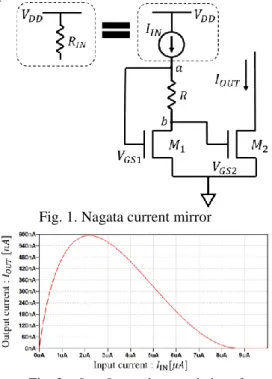
Fig. 1 shows the original Minoru Nagata current mirror circuit, and its output current (IOUT ) with respect to the input current (IIN) has a peak as shown in Fig. 2. When the input current (IIN) increases from a small value, the output current (IOUT ) follows and increases. For further input current increase, a voltage drop (RIIN) between nodes a and b is caused: then the gate-source voltage of M2 becomes smaller than that ofM1, and the drain current of M2 decreases.
We see from Fig. 2 that the output current has a peak, and the input current source can be realized with a resistor whose one terminal is connected to the power supply. Then at the vicinity of the peak, the output current is almost constant with respect to the power supply change, but the peak vicinity is narrow. In the following sections, we will describe its improved circuit whose output current is constant over the wide range of the input current.
Fig. 1. Nagata current mirror
Fig. 2. IIN-IOUT characteristics of Nagata current mirror (SPICE simulation result)
978-1-4673-9719-3/16/$31.00 ©2016 IEEE
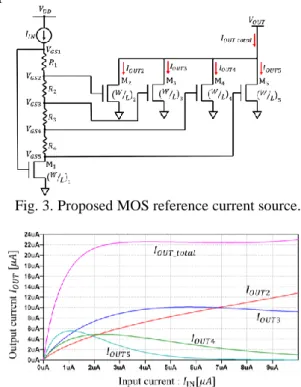
III. Proposed MOS Reference Current Source 3.1 Proposed Circuit Configuration and Operation Fig. 3 shows the proposed reference current source, which is an improved MOS Nagata current mirror. It uses multiples of Nagata current mirror circuits with different peaks, and its output current is their total current. As a result, the output current is constant over the wide range of the power supply voltage (or input current) as shown in Fig. 4.
Now we will explain the operation principle of the circuit in Fig. 3. It follows from Kirchhoff Voltage Law (KVL) that
n IN total GS
GSn V R I
V 1 1 (1)
) 5 , 4 , 3 , 2
(n ( totaln1 1 2 n1) R R
R
R .
Currents (IIN,IOUTn) flowing into M1 – M5 can be expressed by eqs. (2), (3), using the MOSFET current formula in the saturation region.
) 1
( )
( 1
2 1
1 GS TH DS
IN K V V V
I (2)
) 1
( )
( GSn TH 2 DSn
n
OUTn K V V V
I (3)
where
n ox
n L
C W
K
2 1
1
VGS and VGSn can be obtained from eqs. (2), (3).
TH DS IN
GS V
V K
V I
) 1
( 1
1
1 (4)
TH DSn n
OUTn
GSn V
V K
V I
) 1
( (5) Eqs. (1) and (2) are substituted into (3), and the output current IOUTn is obtained as:
) 1
( )
( 1 totaln1 IN TH 2 DSn
GS n
OUTn K V R I V V
I
) 1
( ) 1
( 1
2
1 1 1
2 1
DSn n DS
total IN
totaln IN n
V V
K R
I R I K
(6)
We will find the extreme value of input-output characteristics of the circuit in Fig. 3. Differentiate Ioutn in eq. (6) with respect to IIN and then we have:
) 1 ( 1 1
1 1 1
2 1
n DS total IN n DSn
total n IN OUTn
V K R I V R
dI K dI
(1 )
2 1
1
1 1 DS
totaln
IN R K V
I (7)
For 0
IN OUTn
dI
dI , we have the following:
) 1
( 4
1
1 1
2
1 DS
n total
IN R K V
I
(8)
Eq. (8) is substituted into (6), and the peak output current is given by
4 ((11 ))
1
4 1 12 1 DS1
DSn n
total n
OUTn V
V K
L R W
L I W
(9) We see from eqs. (8), (9) that the input current value at which the output current has the peak, and the amount of the peak output current can be changed by changing resistor values and MOSFET sizes. Fig. 4 shows SPICE simulated characteristics of the proposed reference current source circuit in Fig. 3, where TSMC 0.18µm parameters are used. We see that the total output current (IOUT_total) is almost constant over wide range of the input current IIN.
Fig. 3.Proposed MOS reference current source.
Fig. 4. IIN-IOUTncharacteristics of the proposed MOS refence current source.
Note that our simulation circuit has used 4 peaks, however, the number of peaks is not restricted to 4.
3.2 Influence of Resistor Values and MOS Characteristics Variation
In order to investigate the effect of the resistor value variation to the output current, we have performed SICE simulation: all resistance values are uniformly shifted by
±10%. In addition, MOS fast and slow models are used.
We see from Figs. 5, 6 that when MOS models and resistor values are varied, the total output current keeps constant, but its magnitude is varied.
Fig. 5. Simulation results of the proposed circuit in Fig. 3 in case that all resistor values decrease by 10%.
Fig. 6. Simulation results with SLOW NMOS model, of the proposed circuit in Fig. 4.
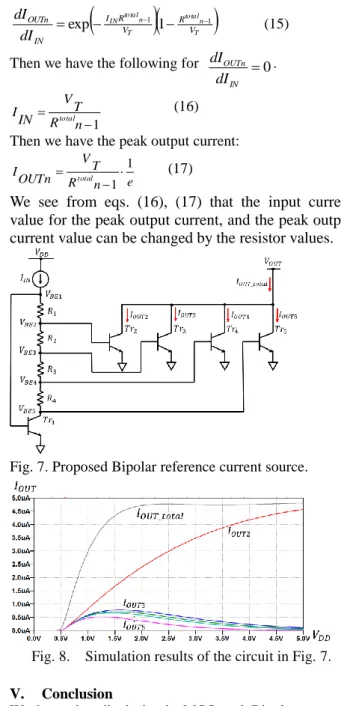
IV. Proposed Bipolar Reference Current Source Fig. 7 shows the proposed Bipolar reference current source using multiple Nagata current sources with different peaks. Fig. 8 shows its SPICE simulation result and we see that its output current is constant over the wide range of the supply voltage variation.
Now we will analyze the circuit in Fig. 7. Using KVL, we have the following:
n IN total BE
BEn V R I
V 1 1 (10) )
5 , 4 , 3 , 2
(n ( totaln1 1 2 n1) R R
R
R .
Note that
1
1 ln
s IN T
BE I
V I
V (11)
sn OUTn T
BEn I
V I
V ln (12) Here a thermal voltageVT kT q. It follows from eqs. (10), (11) and (12) that
n IN total sn
OUTn T
s IN
T R I
I V I I
V I 1
1
ln
ln
(13)
Suppose that all saturation currents (Isk, k=1, 2, .. 5) are the same. Then the output current (IOUTn ) of each Bipolar transistor is given by
INVtotalT n
R I IN
OUTn I
I exp 1 (14) Now differentiate IOUTnwith respect to IIN:
IN totalT n totalVTn
R V
R I IN
OUTn
dI
dI 1 1
1
exp
(15)
Then we have the following for 0
IN OUTn
dI
dI .
1
R n
VT
IIN total (16)
Then we have the peak output current:
n e R
VT
IOUTn total 1
1
(17)
We see from eqs. (16), (17) that the input current value for the peak output current, and the peak output current value can be changed by the resistor values.
Fig. 7. Proposed Bipolar reference current source.
Fig. 8. Simulation results of the circuit in Fig. 7.
V. Conclusion
We have described simple MOS and Bipolar constant current sources, insensitive to wide range of power supply voltage variation; they are realized by addition of multiple current peaks. Their circuit topologies, analyses, and SPICE simulation results are presented.
Authors would like to thank Dr. M. Nagata, Prof. H.
Tanimoto, Dr. T. Miki for valuable comments.
References
[1] Inventor M. Nagata, Japanese Patent, Showa 46-16463 (Dec. 12, 1966)
[2] P. R. Gray, P. J. Hurst, S. H. Lewis, R. G. Meyer, Analysis and Design of Analog Integrated Circuits, 5th edition, John Wiley & Sons Inc. (2009).