Abstract
Globalization of business operations and diversification of the market require firms to
organize flexible and effective supply systems. Supply chain management (SCM) is well
known as a strategic management approach to optimize the business process. In this
paper, we consider a supply chain consisting of a single manufacturer and a number of
suppliers. We suppose that the manufacturer decides buying prices of suppliers’ products
and purchase allocation to the suppliers, while suppliers compete on the frequency of
delivery to the manufacturer. The purpose of this paper is to determine optimal buying
prices, delivery frequencies and demand allocations that minimize the total cost incurred
by the manufacturer and maximize the profit made by the suppliers. We first establish a
mathematical model of decision-making in the supply chain as a tri-level non-cooperative
game. We then formulate the game as an optimization problem to obtain optimal
strategies and provide a numerical method with a smoothing technique. Moreover, we
conduct numerical experiments and discuss the property and behavior of solutions.
Contents
1 Introduction 1
2 Preliminaries 2
2.1 Nash equilibria and stationary Nash equilibria . . . . 2 2.2 Smoothing technique for complementarity conditions . . . . 3
3 A mathematical model of a supply chain 3
4 Formulations 5
4.1 Manufacturer’s optimization problem for demand allocations . . . . 6 4.2 Suppliers’ NEP for delivery frequencies . . . . 7 4.3 Manufacturer’s optimization problem for buying prices . . . . 9
5 Numerical experiments 10
6 Conclusion 16
1 Introduction
Now that business operations are globalized and the market is diversified, constructing a supply system which is able to respond quickly to the demand is an important issue for many firms. Supply chain management (SCM) is well known as a strategic man- agement approach to optimize the business process, and a number of firms including manufacturing enterprises are managed under SCM. Supply chain is a supply system of products that involves the procurement of materials, production, delivery, and sale [16]. In general, each process in a supply chain is managed individually and there are multiple decision makers in a supply chain. Therefore, it is important for SCM to clar- ify the decision-making process and optimize it from a broad perspective. In particular, controlling the balance of Purchase-Sales-Inventory (PSI) is thought to be a key to SCM, and how to optimize PSI has been discussed from various points of view [1, 9].
In this paper, we focus on pricing and delivery strategies related to PSI on SCM. We consider a contract between a number of suppliers and a single manufacturer, where suppliers engage in production and delivery of products, while the manufacturer makes use of suppliers’ products with holding them as inventories. The manufacturer orders and buys products from suppliers so as to meet the demand. Here, we suppose that the manufacturer decides buying prices of suppliers’ products and purchase allocation to the suppliers, while suppliers compete on the frequency of delivery to the manufacturer. The main purpose of this paper is to determine optimal buying prices, delivery frequencies and demand allocations that minimize the total cost incurred by the manufacturer and maximize the profit made by each supplier. To obtain the optimal solution, we firstly establish a mathematical model of decision-making in a supply chain composed of one manufacturer and n suppliers as a tri-level non-cooperative game. Then, based on this model, we formulate an optimization problem for determining the optimal strategies.
The steps of the formulation are as follows. We begin with the manufacturer’s optimiza- tion problem for demand allocation. Next, we consider the suppliers’ Nash equilibrium problem for delivery frequency. In the end, we finish with the manufacturer’s optimiza- tion problem for buying prices.
The rest of this paper is organized as follows. Section 2 gives the definition of equilibria in a Nash game and describes a smoothing technique to transform complementarity conditions into differentiable equations approximately, as preliminaries to the subsequent sections. Section 3 establishes a mathematical model of the supply chain we consider.
Section 4 formulates the optimization problem we have to solve. Section 5 investigates
the property and behavior of the solution by numerical experiments on a simple example
of the supply chain. Section 6 concludes the paper.
2 Preliminaries
In this section, we explain Nash games with the definition of equilibria and a smoothing technique to transform complementarity conditions into differentiable equations approx- imately.
2.1 Nash equilibria and stationary Nash equilibria
Here we state the Nash equilibrium problem (NEP) and provide the definitions of Nash equilibria and stationary Nash equilibria.
In the classical Nash game, all players choose their own strategies simultaneously under their respective constraints and try to minimize their own objective functions noncooperatively [13, 14]. NEP is a problem of seeking a tuple of strategies resulting from the game. The problems solved by each player in the Nash game are formulated as the following optimization problems [5, 6, 10, 11, 15]:
min x
νθ ν (x ν , x − ν ) s.t. x ν ∈ X ν
(ν = 1, . . . , N ), (1)
where N is the number of players and x ∈ R n denotes a strategy vector composed of all players’ strategies x ν ∈ R n
ν, ν = 1, . . . , N , where n = ∑ N
ν=1 n ν . For ν = 1, . . . , N , a tuple of all players’ strategies except that of player ν is denoted by x − ν , and player ν’s objective function and strategy set are denoted by θ ν and X ν , respectively. Note that we write θ ν (x) = θ ν (x ν , x − ν ) to emphasize the role of x ν in this problem.
A tuple of strategies x ∗ = (x ∗ 1 , . . . , x ∗ N ) T is called a Nash equilibrium if for all ν = 1, . . . , N,
θ ν (x ∗ ν , x ∗ − ν ) ≤ θ ν (x ν , x ∗ − ν ), ∀ x ν ∈ X ν .
In short, Nash equilibrium is a tuple of strategies such that no player can benefit by changing his/her own strategy unilaterally.
On the other hand, a tuple of strategies x ∗ is called a stationary Nash equilibrium if, for all ν = 1, . . . , N , x ∗ ν is a stationary point for the optimization problem (1) with x − ν = x ∗ − ν , where a stationary point means that it satisfies a first-order optimality condition for the problem [11]. For example, in the case that the strategy set of player ν is given by the inequality constraint g ν (x ν ) ≤ 0 for each ν, where g ν : R n
ν→ R m
νfor some m ν , a stationary Nash equilibrium x ∗ along with Lagrange multipliers γ = (γ 1 , . . . , γ N ) T satisfies the following Karush-Kuhn-Tucker (KKT) system [2]:
∇ x
νθ ν (x ν , x − ν ) + ∇ x
νg ν (x ν ) T γ ν = 0 (ν = 1, . . . , N ),
γ ν ≥ 0, g ν (x ν ) ≤ 0, γ ν T g ν (x ν ) = 0 (ν = 1, . . . , N).
Note that if problems (1) are convex, then the concept of stationary Nash equilibrium reduces to that of Nash equilibrium.
2.2 Smoothing technique for complementarity conditions
Here we describe a technique to transform complementarity conditions into differen- tiable equations approximately.
The complementarity condition a ≥ 0, b ≥ 0, ab = 0, a, b ∈ R can be written equiv- alently as the equation ϕ F B (a, b) = 0, where ϕ F B : R 2 → R is the Fischer-Burmeister (FB) function [7, 12] defined by ϕ F B (a, b) = a + b − √
a 2 + b 2 . This is because the FB function has the following property:
ϕ F B (a, b) = 0 ⇔ a ≥ 0, b ≥ 0, ab = 0.
However, the equation ϕ F B (a, b) = 0 is not always easy to deal with, since the FB function ϕ F B (a, b) is not differentiable at (a, b) = (0, 0). To circumvent this difficulty, we introduce the smoothing Fischer-Burmeister (SFB) function defined by ϕ µ F B (a, b) = a+b − √
a 2 + b 2 + 2µ 2 with a parameter µ > 0, and replace the equation ϕ F B (a, b) = 0 by the equation ϕ µ F B (a, b) = 0. For any fixed µ > 0, the SFB function ϕ µ F B is continuously differentiable everywhere and has the following property:
ϕ µ F B (a, b) = 0 ⇔ a > 0, b > 0, ab = µ 2 .
Furthermore, ϕ µ F B (a, b) coincides with ϕ F B (a, b) if µ = 0, and ϕ µ F B (a, b) ≈ ϕ F B (a, b) if µ > 0 is sufficiently small. The fundamental idea underlying a smoothing technique is to approximate the complementarity condition a ≥ 0, b ≥ 0, ab = 0 by such a smooth equation [3, 4, 8, 11].
3 A mathematical model of a supply chain
In this section, we describe a mathematical model of the supply chain treated in this paper.
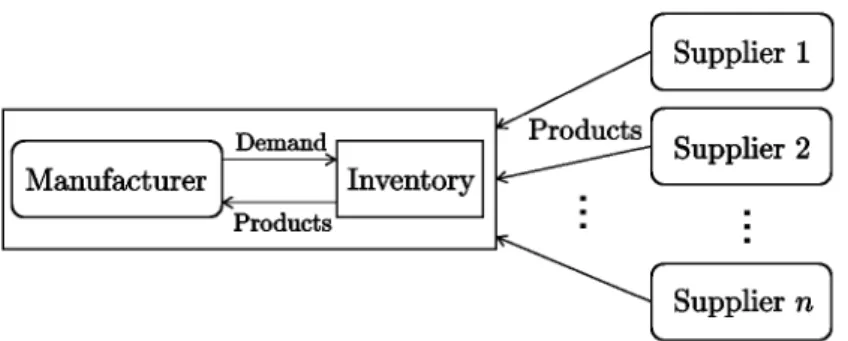
We consider a supply chain consisting of one manufacturer and n suppliers, where
suppliers engage in production and delivery of products, while the manufacturer makes
use of suppliers’ products with holding them as inventories (see Figure 1). The suppliers
incur production, shipment and transportation costs of products, and the manufacturer
bears inventory holding costs. In this supply chain, we suppose that the manufacturer
decides buying prices of suppliers’ products and purchase allocation to the suppliers so
as to minimize the total cost, while each supplier determines the frequency of delivery
to the manufacturer so as to maximize the profit.
Figure 1: Supply chain model
In this paper, we regard this decision-making process as a tri-level non-cooperative game between the manufacturer and suppliers. At the upper level, the manufacturer presents buying prices to the suppliers. At the middle level, the suppliers compete on the frequency of delivery to the manufacturer in response to the buying prices given by the manufacturer. At the lower level, the manufacturer determines the demand allocations to the suppliers in response to the suppliers’ delivery frequencies that form a Nash equilibrium in a non-cooperative game by the suppliers.
First, we list the symbols that represent the parameters and variables used to model the supply chain.
Parameters
D (> 0): the expected demand of the manufacturer h (> 0): unit inventory holding cost of the manufacturer
l i (> 0): lower bound of the expected delivery frequency of supplier i u i ( ≥ l i ): upper bound of the expected delivery frequency of supplier i
c i (> 0): unit cost of production of supplier i k i (> 0): unit cost of delivery of supplier i K i (> 0): fixed cost of delivery of supplier i
q i (> 0): unit profit to be guaranteed by the product of supplier i Variables
p i (≥ c i + k i + q i ): unit buying price of the product, determined by the manufacturer r i (l i ≤ r i ≤ u i ): supplier i’s expected delivery frequency, determined by supplier i
λ i (0 ≤ λ i ≤ 1): demand allocation to each supplier i, determined by the manufacturer
For simplicity of discussion, we regard the demand D as a deterministic parameter.
Furthermore we assume that suppliers can produce and deliver the products at once,
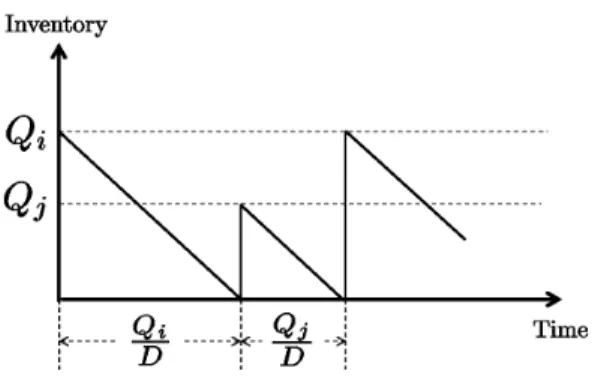
Figure 2: An example of inventory transition
and we do not take into consideration the time each supplier requires to produce, ship and transport the products. Moreover, we suppose that each supplier produces and delivers the products when the manufacturer’s inventory gets empty and that two or more suppliers do not deliver the products simultaneously. Let Q i denote the quantity of the products per delivery for each supplier i. Then it is written as Q i = λ i D/r i by the definition of parameters and variables. Under the above assumptions, an example of inventory transition can be depicted as in Figure 2.
4 Formulations
In this section, we formulate a problem for determining optimal strategies in the supply chain model established in the previous section.
We begin with the total cost incurred by the manufacturer and the profit made by each supplier. Let I i denote the total quantity of inventories resulting from supplier i’s deliveries in a unit period. Then, by the EOQ logic, it can be expressed as
I i = r i Q 2 i
2D = λ 2 i D 2r i .
From this and the fact that the total cost incurred by the manufacturer is the sum of purchasing costs and inventory holding costs, the cost function of the manufacturer, denoted by C(p, r, λ), can be written as follows:
C(p, r, λ) =
∑ n i=1
(p i λ i D + hI i ) =
∑ n i=1
(
p i λ i D + h λ 2 i D 2r i
)
, (2)
where p = (p 1 , . . . , p n ) T , r = (r 1 , . . . , r n ) T and λ = (λ 1 , . . . , λ n ) T .
On the other hand, the profit made by each supplier is selling benefits minus shipping costs. Thus, the profit function of each supplier i, denoted by Φ i (p, r, λ), can be written as follows:
Φ i (p, r, λ) = (p i − c i − k i ) λ i D − r i K i (i = 1, . . . , n). (3)
Using these functions, we formulate the problems that constitute the three-stage model, by the following steps. First, for any fixed buying price p and delivery fre- quency r, we formulate an optimization problem for demand allocation λ to obtain the optimal demand allocations of the manufacturer. Next, for any fixed buying price p, we consider a NEP for delivery frequency r to derive the equilibrium delivery frequencies of the suppliers. Last, we formulate an optimization problem for buying price p to obtain the optimal buying prices of the manufacturer.
4.1 Manufacturer’s optimization problem for demand allocations We describe the manufacturer’s problem for determining an optimal demand allocation λ for any fixed buying price p and delivery frequency r. The optimal demand allocation for given p and r can be regarded as a function of p and r. So we denote it as λ ∗ (p, r) = (λ ∗ 1 (p, r), . . . , λ ∗ n (p, r)) T .
The demand allocations of the manufacturer must satisfy the conditions that each allocation is nonnegative and the sum of all allocations is equal to 1. Therefore, the problem to obtain λ ∗ (p, r) is formulated as the following optimization problem:
min λ C(p, r, λ) s.t.
∑ n i=1
λ i = 1,
λ i ≥ 0 (i = 1, . . . , n).
(4)
By the definition (2), the objective function C(p, r, λ) is strictly convex and quadratic in λ. Thus the optimal solution of problem (4) exists and is unique. In addition, it is necessary and sufficient that the optimal solution along with Lagrange multipliers v and w = (w 1 , . . . , w n ) T satisfies the following KKT conditions:
(
p i + hλ r
ii
)
D − v − w i = 0 (i = 1, . . . , n), 0 ≤ w i ⊥ λ i ≥ 0 (i = 1, . . . , n),
1 − ∑ n
i=1
λ i = 0,
(5)
where a ⊥ b means ab = 0.
By substituting the first equation of (5) into the second one, we have 0 ≤
(
p i + hλ i
r i )
D − v ⊥ λ i ≥ 0 (i = 1, . . . , n).
Using the SFB function, the KKT conditions (5) can be approximated by the following
system of differentiable equations:
ϕ µ F B ((p i + h λ r
ii