Guidebook
for Foreigners
Living in Neyagawa
外国人のための生活ガイドブック
First and Foremost
This guide, a Guide Book for Foreigners Living in Neyagawa, was created in cooperation with NIEFA- (NPO)Neyagawa International Exchange and Friendship Association and it is available in 6 languages; English, Chinese, Korean, Tagalog, Spanish, Portuguese to assist international residents with daily living.
It is hoped that with this those who come from other countries can live comfortably here in Neyagawa.
This book provides valuable information on vital public services and resources
Please note that his book is current as of March 2012. The information and schedules are subject to change.
March 2012
TABLE OF CONTENTS
◆ PLEASE◆
When inquiring at many of the following places, you will find that many individuals cannot respond in English, and as such, whenever possible, please inquire along with someone who understands Japanese.
In Event of Emergency
Contacting Police ・・・・ 1
2 Fire・Ambulance ・・・・ 1
Gas Leak ・・・・ 2
Earthquake ・・・・ 3
Typhoon ・・・・ 4
Lost or Left Behind ・・・・ 4
Legal Procedures and Assistance
Status of Residence ・・・・ 6
2 Foreigner Registration ・・・・ 7
Getting Married Marriage Registration ・・・・ 9 Getting a Divorce Divorce Registration ・・・・10
Loss of Life Death Registration ・・・・10
Child Birth Birth Registration ・・・・10
Registration a Personal Seal ・・・・11
National Health Insurance ・・・・11
Accommodation and Housing
How to Find Housing ・・・・12
2 Signing a Contract ・・・・13
Public Service
Water ・・・・14
2 Electricity ・・・・14
Gas ・・・・15
Garbage ・・・・16
Telephone ・・・・22
Postal Services ・・・・22
Other Useful Information for Living
Living in your Community ・・・・24
2 Banks・Japan Post Bank Yucho Bank ・・・・24
TV・Radio ・・・・26
Express Home Delivery Services ・・・・26
Pets ・・・・27
Illness・Health
Medical Insurance Plans ・・・・28
2 In Case of Illness ・・・・31
Medical Check-up ・・・・32
Childbirth and Raising Children
Pregnancy ・・・・33
2 The Maternity Record Book ・・・・33
Childbirth ・・・・33
Support for Child Medical Expense ・・・・34 Child Allowance・Assistance for Single Parent ・・・・35
Day Care Services Hoikusho etc. ・・・・35
Childcare Support ・・・・36
School・Education
The Japanese Educational System ・・・・39
2 Kindergarten ・・・・39
High School ・・・・40 Foreign Children Attending Japanese Schools ・・・・41
Japanese Language Instruction ・・・・42
Transportation
Train ・・・・43
2 Bus ・・・・44
Discount Tickets ・・・・45
Taxi ・・・・45
Car・Motorcycle ・・・・46
Drivers‟ Licenses ・・・・46
Bicycle ・・・・47
Tax・Pension・Insurance
Tax ・・・・50
2 Pension ・・・・51
Insurance ・・・・53
Where to Seek Assistance
General Living Information ・・・・54
2 Legal Consultation ・・・・55
Visa Consultation ・・・・56
Employment ・・・・57
Housing ・・・・58
Child Care ・・・・58
Police Assistance ・・・・59
1 Available 24 hours
Call 110 to report a crime or an accident to the police. Say `Tasukete kudasai!`
If possible, inform them of the time, the place, and what happened. Also, give them your name, address, and contact details (phone number.) ●If a Traffic Accident occurs,
・Confirm the name, address, phone number, and license plate number of all involved.
・Quickly get in touch with the police. Call 110.
・In order to claim damages from the perpetrator and his/her
insurance company, a `Jiko Shomeisho` or official form regarding the accident, is required.
For non-emergency inquiries, please contact the Neyagawa Police. Neyagawa Police Station 072-823-1234
Fire ・Emergency
Available 24 hours
Call 119 to report a fire or to ask for an ambulance for example, sudden illness and injury, to the fire station.
What to Say:
・They will ask: `Kaji ka kyukyu ka dochira ka` In case of fire, say `Kaji desu.`
In case of a medical emergency, say `Kyukyusha onegaishimasu.` ・Tell them the location of the emergency or fire, and any nearby
landmarks.
・Also let them know your address, name, and phone number.
Matter・Accident
2
・In the event of fire, tell them exactly what is burning, and if people are trapped inside the structure.
・In the event of a medical emergency, let them know what state the injured person is in (conscious or unconscious, for example.) ※ If no-one present speaks Japanese, let them know over the phone that
only non-Japanese speakers are present.
An ambulance is used for transporting severely sick or injured people in need of urgent care to a hospital.
Please refrain from asking for an ambulance unless there is an urgent need. For example, when the injury or illness is not serious, or when the sick or injured person can manage to get hospital by a private car or taxi, etc. For non-emergency inquiries, please contact the number below.
Hirakata/Neyagawa Firefighting Association 072-852-9903 ●Dialing 110、119 from a public pay phone
・Can be used 24 hours a day.
・Before lifting the receiver from the phone, find the red button covered by a plastic cover. Firmly push the button through the
cover, then, you can use the phone to dial for an emergency. ・When you call to report an emergency from a cell phone or pay
phone, don`t hang up, and don`t leave the scene.
In the case of a gas leak, contact the gas company mentioned below and say, `Gasu more desu. Sugu kite kudasai.` Call from, and wait in, a location that is a safe distance away from the leak..
They respond 24 hours a day, 7days a week. ・If Connected to City Gas, contact Osaka Gas
0120-5-19424 (Center for Reporting Gas Leaks) ・If a Propane Leak Occurs,
There should be a sticker attached to the gas tank with a phone number. Dial this number to reach the appropriate company. ※ If an abnormal situation exists, put the gas cap on, and open doors and
windows to let the gas out. If you still notice a gas leak, ventilate the area, but under no circumstances should you use electric appliances or power.
3
Japan is a country where many earthquakes occur, and in the past many large earthquakes have occurred in the Osaka-Kyoto-Kobe area.
Earthquakes can occur at any time so it is essential to be prepared.
●If An Earthquake Occurs
・Act calmly and don`t rush outside; protect your body.
・If you are inside and you feel swaying, quickly dive under the table, protecting your head with a cushion.
・Wait for the swaying to stop.
・After the swaying has stopped, check to all appliances, such as cooking and heating appliances which may ignite causing a fire.
●Earthquake Preparation
・Securely attach cupboards, shelves and drawers to the wall to prevent them from falling over.
・Take cover in cupboards and drawers, near walls or pillars. ・At least 3 days` worth of food and drinking water (average 3 liters
per person per day) should be prepared and stored in advance. ・Prepare food and other items for emergencies (preserved or canned
food, cookies, flashlight, etc) in an easy-to-carry bag and make it easily accessible during emergencies.
●During Major Earthquakes, Floods and Other Disasters May Occur. Flee to the places called ~`Disaster Evacuation Shelters`, `Temporary Gathering Sites` or `Wide-area Evacuation Sites.`
Disaster Evacuation Shelters
These shelters are the places you can flee temporarily to from dangerous
situations such as your house collapsed. Local elementary schools,junior high schools and other public facilities are designated as disaster
evacuation shelters.
Temporary Gathering Sites
These shelters are the places you can stay temporarily and you will see how the disaster is going. Where you go depends on where you live.
4 Wide- area Evacuation Sites
These shelters are the places to evacuate and protect yourself when an earthquake occurs and a fire spreads through the town. Large scale areas have been designated.
Please take the time to confirm the location of the Area Disaster Shelter for the area in which you live.
Contact info the City Office Crisis Management Center 072-824-1181
The Typhoon Season in Japan runs from June to September. If a typhoon nears Japan, make sure to pay close attention to warnings from weather forecasters.
●Preparing for a Typhoon
・Make sure the power and gas mains are cut off, and water lines and phones are disconnected.
・Have flashlights, candles, drinking water for emergencies, and medicine prepared in advance.
・A portable radio is most useful to check outside conditions; it is recommended that you have one.
To Confirm City Office Crisis Management Center at 072-824-1181
●When you notice that you have lost money or an item
・Report it to the nearest police station or police box (`koban`).
・If you lost the item while riding a taxi, train, or in a department store, try to report it to those places.
●If you pick up something that has been dropped
・Report it to the nearest police station or police box and inform them about the circumstances and time when you picked it up.
・If picked up in a department store or while taking a train or bus, please take it to the nearest clerk or person in charge.
5 Typhoon
5
・Don‟t forget to pick up a receipt for proofing that you picked it up when
you submit it.
●If your lost item is recovered by someone else
・Thank the person who picked it up for you. According to law, you are obligated to pay them 5-20% of the value of the item.
●Reporting that you`ve lost something
・“Gaikokujin Toroku Shomeisho” or “Foreigner ID Card`”is lost: pick up a “funshitsu shomei”or a “lost form at the police station, fill it out, and deliver it to the City Office.
・If a Passport is lost: pick up a `funshitsu shomei` at the police station and deliver it to your nearest consulate or embassy.
・If a Credit Card is lost: contact the issuing credit card company. ・If a Cash Card is lost: contact the issuing bank or
6
*Due to the revision of Immigration Control Law, a new residency management system will start in July 2012. For details, please contact Foreign Residents` General Information Center of the following.
・Conditions of your stay in Japan differ according to your eligibility when you first entered Japan.
・To find out how long you can remain in Japan, first double-check your passport and visa.
・If you entered the country on a short-term tourist visa or a visa exemption, you are not permitted to work while in Japan.
・If you seek to engage in some form of activity outside the stipulation of your visa for legal approval, alternatively you can change our visa status.
・If you wish to extend your period of stay, you must apply for an extension before the expiration date of your current visa. ・If you wish to leave the country for any period of time during
your stay and would like to return on the same visa, get a reentry permit from the Immigration Affairs Bureau prior to your departure. ● Osaka Nyukoku Kanrikyoku (Osaka Immigration Affairs Bureau) Osaka-shi Suminoe-ku Nanko-kita 1-29-53 06-4703-2100
Business Hours: 9:00~16:00
(not available on weekends and public holidays) ● Gaikokujin Zairyu Sogo Information Center (Foreign Residents` General Information Center) 0570-013904
In case of IP phone, PHS, International call 03-5796-7112 Business Hours: 8:30~17:15
(not available on weekends and public holidays) Available in English, Spanish, Chinese, and Korean.
1 Status of Residence
7 Foreigner Registration
If you remain in Japan for a period exceeding 90 days, legally you must register as a foreigner. (Babies born to non-Japanese parents must be registered within 60 days of birth.) In Japan, various administrative services exist so that you can smoothly and easily register. A
GaikokujinToroku Shomeisho (Foreigner ID Card) is an important
document that is proof of your status. You are required by law to carry it at all times. The card may be obtained from
the City Office, Civil Registration Section.
Contact info: City Office, Civil Registration Section 072-824-1181
●When You First Register
Who can apply: Application must be made by person seeking registration Timeframe: Apply within 90 days of having first entered Japan (if
born in Japan, application must be made within 60 days of birth.)
What to bring: ・passport
・2 passport photos 4.5×3.5cm upper half of the body、 from the front、no hat, color or black & white ID Card Delivery: 1 month from the date of application at the City
Office. Please pick it up from the Civil Registration Section window at the City Office.
●Changing Your Address, Visa, or Length of Stay
Who can apply: In person or by a relative who lives in the residence Time frame: Within 14 days of the change
What to bring: ・Foreigner ID Card ・Passport
● In the Event Your Foreigner ID Card is Lost or Stolen
If your card disappears, immediately inform the police. The application for re-issuance of a registration certificate is dealt with by the City Office, Civil Registration Section. Report must be made
Who can apply: In person by card‟s owner
8 What to bring: ・Passport
・2 Passport photos 4.5×3.5cm、upper half of the body、 from the front no hat、color or black or white
Proof of loss or theft may be requested when you reapply. Proof can be obtained from the police when reporting the theft or loss.
● If Your Card becomes too Damaged, Dirty, Ripped or Torn Who can apply: Owner must apply in person
What to bring: ・Passport
・2 Passport photos as previously described ・Foreigner ID Card
● Renewing Your Card
Who can apply: Owner of previous card must apply in person When renewal is required:
(1)After initial registration, 5 years from your next birthday.
(2) 5 years after previous renewal, or 7 years in the case of some special residents.
(3)On your 16th birthday.
※In the case of (1)~(3), renew within 30 days of this event. What to bring:
・Passport
・2 Passport photos (as previously described.) ・Foreigner ID Card
●When a `Registered As A Foreign Resident Certificate` is required One of the following three in required from the applicant:
(1)An applicant must bapply in person
9 ● Leaving Japan Permanently
When leaving Japan permanently, you must return your ID Card to the immigration officer at the point of your departure. However if you have received a re-entry permit, it is not necessary to return your card.
If you get married in Japan, you should register your marriage
at the City Office Civil Registration Section and receive a registration of marriage (kon`in todoke).
●In the case of marriage between a Foreign National and a Japanese Citizen
What is required of the Foreign National
・A certificate of legal capacity to contract marriage issued by your embassy or consulate with a Japanese translation
・A Certificate of Foreign Residents Registration ・Passport
What is required of the Japanese Citizen
・Family Register (koseki tohon) unless it is already kept at the City Office
● In the case of two foreign nationals marrying in Japan What to bring:
・A certificate of legal capacity to contract marriage issued by your embassy or consulate with a Japanese translation ・Passport
Contact info: Your home country`s embassy or consulate
10
Getting a Divorce (Divorce Registration)
If you get divorced, it is necessary to notify the City Office. In the case of a couple with different nationalities, the law of the country in which they reside applies to the divorce proceedings. For example, if a couple living in Japan; one partner of couple „s nation does not recognized divorce by mutual consent and another partner „s nationality is Japanese, the devoice of mutual consent can be recognized by Japanese law
※A resident card is required for a Japanese who has registered as a citizen of another city.
Contact info : Your home country`s embassy or consulate
City Office Civil Registration Section 072-824-1181
Loss of Life (Death Registration)
It is necessary to notify the City Office Civil Registration Section within seven days of when the death occurs.
What is necessary:
・A death certificate (It is printed on the same form as a death registration document.)
●When The Deceased Is A Foreign National
The Foreigner ID Card (Gaikokujin Toroku Shomeisho) must be returned to the City Office. Also the embassy or consulate of the deceased person`s home country must be notified.
Contact info: Your embassy or consulate
City Office Civil Registration Section 072-824-1181
Child Birth (Birth Registration)
You should register the birth of your child at the City Office Civil Affairs Section within 14 days of birth.
What to bring:
・A certificate of birth (It is printed on the same form as the birth registration document)
11 Registration of Personal Seal
To bind any important contract in Japan, (for example, when you purchase real estate, a car, or anything expensive,) you must use a jitsu-in (special personal seal registered with the City Hall.) After you have had your own seal cut by a seal-maker, apply for registration of your seal at the City Office Civil Registration Section.
※In the some cases seals can‟t registered.
Contact info : City Office Civil Registration Section 072-824-1181
Foreigners who have completed an alien registration, hold a period of residence of more than a year and meet the conditions as follows, are required to join National Health Insurance. Please take your certificate of alien registration, passport and the following required documents to the city office when you enroll..
・When a person who is already ineligible for an employee's health insurance (such as a workplace health insurance) has moved into Neyagawa.
・When a person has lost the qualification of an employee's health insurance. (Health insurance disqualification certificate is required)
・When a person has stopped receiving public assistance.
(Notice of determination as to abolition of public assistance is required.)
・Although a child was born, the child is unable to join as a dependant in the employee's health insurance ,etc.
(Insurance certificate, a maternity passbook, etc. are required)
A person whose period of stay in Japan has expired cannot join the National Health Insurance.
Even if the period of stay is less than a year, it is possible to be able to join the National Health Insurance, depending on status of residence.
12
・You can find accommodation by consulting a real estate agent in the area of your choice. It is recommended to have a Japanese person accompany you when you go.
・Please check with the real estate agency as to what rental condition and utility (electricity, gas, water etc.) fees are included in your rent.
※ The introduction and viewing of a property is a free service and you are under no obligation to rent or buy.
※ Foreign students can also find rooms through the Student Office at their university or their university cooperative (Seikyo).
※ Public Housing Information is available at the following places: ・Osaka Prefectural Housing Corporation 06-6203-5454
HP: http://www.osaka-kousha.or.jp/
・Hirakata Administrative Center 072-844-1281
HP: http://www.osaka-fuei.com/
・Osaka Municipal Housing Information Center06-6242-1177
HP: http://www.sumai.city.osaka.jp/
・NPO Urban Renaissance Agency 06-6346-3456
HP: http://www.ur-net.go.jp/ How To Find Housing
13
●The followings are important things to know when signing a contract Guarantor (Hoshonin): The person who will take responsibility on
behalf of the renter should any problems arise, for instance, late rent payments, etc.
Deposit (Shiki-kin): The money that you entrust to the landlord to cover any damage
Part of the deposit is returned at the end of the contract.
Key money (Rei-kin): A non-refundable fee or „gift money‟ paid to the landlord.
Agent‟s fee (Chukai-tesu-ryo): A fee to the real-estate agent.
※ When renewing the contract, in some cases a renewal fee is required. ※ Remodeling and additions cannot be done without permission from
your landlord (for instance, painting or hammering nails into the wall, etc).
※ According to Japanese law, it is not permissible to sublet your rental property without the landlord‟s permission.き
Usually, rent must be paid in advance.
When renting a room in complex housings, such as apartments or
condominiums, a maintenance fee may be required, though in some cases it is already included in the rent.
A maintenance fee is charged in apartment complex residencies to maintain areas around the building such as lightning
at the entrance, cleaning, etc. Signing a Contract
14
The most convenient way to pay for public services ( Water、Electricity、Gas、Phone etc. is through an account transfer of funds at a bank or post office.
If payment is made late, please be aware that extra fees may be added on.
●Concerning beginning water service, ending water service, rates, or trouble.
Contact info:
Neyagawa Water Works 072-824-1181 (Evenings or holidays) 072-824-1177 Water Works is online at
HP: http://www.city.neyagawa.osaka.jp/index/ soshiki/suidokyoku.html
The notice of usage and bill is issued bimonthly.
Please be careful to check the standard when usingelectric appliances brought from overseas as standards
may differ.
The standard in Neyagawa is 60 hertz (60 Hz) and 100 volts.
●Concerning starting service, rates, frequencies, electric standards, and trouble.
Contact info:
Kansai Electric Power Co., Inc. Hirakata Office 072-841-1131 (Moriguchi Office 06-6908-4731
Online at: HP: http://www.kepco.co.jp/ The notice of usage and bill is issued monthly
Water
15 Two types of gas are used in Neyagawa: city gas and LP (liquid propane) gas.
When you first begin to use gas please check which type is used in your area.
●City Gas
For starting or stopping gas service, assistance and advice with gas, rates, or if you have any kind of trouble, following numbers
Contact info: Osaka Gas
(inquiry, to start service) 0120-594817 (in case of gas leak) 0120-519424
Osaka Gas Customer Service is online at:
HP:https://wwwe5.osakagas.co.jp/custserv
The notice of usage and bill is issued monthly
●LP Gas (Liquid Propane)
For starting or stopping gas service, assistance or advice with gas, rates, or if you have trouble, contact the store you originally made the contract with.
16
● Separate garbage depending on the types & please place it into clear plastic bags.
In Neyagawa, garbage should be separated into these nine types: combustible non-combustible used paper, fabrics cans and glass bottles waste plastics (plastic containers, wrappings) pet bottles
special garbage flourescent lightbulbs spray cans batteries, lighters
Household Garbage
・Both the day and the place to put out garbage (the station) are determined based on where you live. Please inquire with your neighbors.
・Everyday household garbage should be placed outside on collection day in a clear or translucent plastic bag before 9 AM.
・Regarding proper division and collection days for recycle garbage, used paper/ fabrics, non-combustible garbage and special garbage, please consult the Neyagawa City Clean Calendar(Waste Pick Up Schedule).
・ Please try to follow the rules and properly dispose of trash, and to reduce the amount of garbage, let`s try to recycle as well.
*Clean Calendar (Waste Pick Up Schedule) is available in English, Chinese, Korean, Portuguese and Spanish.
The place you can get: City hall Citizen section, Citizen Center, Service Place Neyagawa
Contact info:
Clean Center Clean Section 072-820-7400 Waste Reduction Section 072-824-0911 (Mon-Fri 8:30~17:00)
17
CD・DVD・floppy
including the case
Combustible Garbage Twice a Week
Where: The usual designated place
What to include:
な
Take Care:
・Wash kitchen garbage with water before placing it in a garbage bag. ・Futons、Garden waste etc should be taken out on Fridays to be picked up, if possible. (There is a limit of two bags of 45 liter plastic bag)
Non-Combustible Garbage Two or Three Times a Week, First, Third, Fifth Wednesday
Where: The usual designated place
What to include:
Use Caution ・Broken articles, glass, razors, nails and the like, should be wrapped in
paper and labeled KIKEN (means `Danger`) or WAREMONO (means “Breakables”) when put out.
・Dry batteries and lighters should be put out in their own separate clear plastic bag.
etc. garbage Garden Waste Futon,carpet
Bag,shoes
Tape of video&cassette;includ
ing the case
Paper diaper without a filth
Separation and Collection of Garbage
How to Throw Away
microwave fan
18 Batteries and lighters should
be packed into clear plastic bags.
・ Please return button batteries, charging batteries and ink cartriges for printers to the recycling boxes at the store you bought.
・ The followings are considered special garbage: (See p37 for details ) Chests, furniture (special garbage, even if they are knocked down) More than 40cm height×100cm width×40cm depth
More than 10kg
Cans・Bottles Twice a month, the second and fourth Wednesday Where: The usual designated place
What to include:
Restricted to the cans and bottles for beverage and food. Use Caution
・Please wash the inside of cans and bottles out with water. ・Please remove the lids from all bottles.
※Returnable bottles Alcohol・Soy Sauce・Draft Beer Bottles and the like should be returned to the shop for recycling..
※Cosmetics bottles . glasses, and heat-resistant glass should be placed with non-combustible garbage.
Waste plastic(plastic containers)・
Pet Bottles Once Every Four Weeks Where: The usual designated place
What to include:
●For collection ,containers bearing
only these marks should be thrown out.
aluminum・steel Candy can・food can
bottle
foam or plastic tray
plastic bottle plastic bottle for cooking oil etc. plastic pot of
instant noodle
19
Remove the caps Remove the labels
Rinse Crush
* Waste plastics and pet bottles (without labels and lids) should be put out in clear or translucent bags.
* Please check a containers of instant noodle and /or cushion as some of them are made of paper. * The plastic goods must not be taken out
even if they are made of plastic. * Please wash the dirt with water.
If dirt cannot be rinsed away, take them out for combustible garbage.
・How to throw out pet bottles: Please keep these rules
Used Paper・Old Fabrics Once A Week
Where: The usual designated place
What to include:
Separate the paper and fabrics into clear plastic bags or tie them with Stiring.
Caution
・Large amounts of cardboard boxes (used for moving ) are considered
special garbage.
・The followings may be put out with combustible garbage.
Paper coated with aluminum, smelly paper, dirty paper etc Fabric other than clothes
Please try to recycle as much as possible.
milk carton old cloth
old news papers cardboard
20
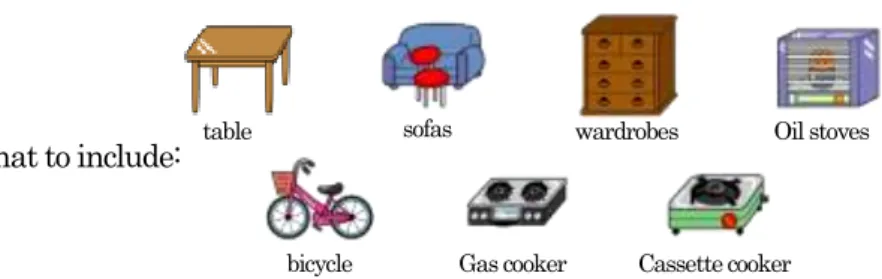
table sofas wardrobes Oil stoves
bicycle Gas cooker Cassette cooker
Special Large Size, Moving Garbage:Fee Required
Where: Door-to-door collection Reservation & Fee Required
OR take it directly to the Clean Center Fee Required Where: The usual designated place
What to include:
Oil stoves, gas burners, water heaters, wardrobes, tables and the like. Use Caution:
・Inquire if air conditioners, TVs, refrigerators, washers and other electrical appliances can be picked up by a local store. If the store is unable to take care of it for you, inquire and apply to have it picked up at the Post Office. ・For disposal of old computers, contact the manufactures directly. If you
don‟t know what the manufacturer is or you made them yourself, contact PC 3R Promotion Association.
03-5282-7685 HP http://www.pc3r.jp ・Be sure to remove kerosene and the batteries .
・You are required to be physically present for collection.
・The collectors will not enter your home to remove garbage for you.
★Garbage for Pick-Up (Reservation Required) 072-868-5374 Hours of Operation 8:30~17:00 Mon~Friday
※Reception is also open on holidays except Saturdays and Sundays Contact info: Clean Section 072-820-7400 ★Taking your own garbage to the center (Reservation is not required)
Hours of Operation 9:00~16:00(Mon~Friday)
21
Fluorescence lights Spray bottles
・Please show your ID (health insurance or driver‟s license and the like) to identify you as a legal resident
・Generally, carrying garbage in a vehicle that exceeds two tons and /or is considered a dump style truck is prohibited.
・A proxy (such as a moving company) cannot deliver your garbage for you. Moving companies must be accompanied by the owner with proper ID of residence in Neyagawa in order to deliver garbage to the center.
Contact info: Clean Facilities Section 072-821-4039
Spray Bottles・Fluorescent Bulbs(Any time at the specified place)
Where Special Collections (Residents` Association Civic Hall or a similar public facility)
What to include:
Use Caution
・The disposal of only general household items are allowed. ・These items will not be collected at the usual designated place. ・Please empty spray bottles, gas bottles (cartridges), then put them in
container , don‟t put them in a plastic bag.
・If fluorescent light bulbs are unbroken place them back in the container you bought them in before having them collected.
・These items can always be disposed any time at the special trash can at the main area
Items that are Delivered to or Picked Up by Shops
・Dangerous items: batteries, paint thinner, waste oil, fuel, paint, gas cylinders, chemicals, etc.
・Difficult-to-dispose-of items:motorbikes, tire, piano,fire extinguishers etc. ・Building materials :materials disposed of during construction (tiles、
tatami mats、bricks etc.)
・Button batteries, Nickel-Cadmium batteries, cellular phone, camera, or other unique batteries, etc.
22
●For telephone applications, removal, costs, or troubleshooting: Contact info: NTT Applications & removal 116
From mobile, PHS 0800-2000116 Bills 0120-712042 Troubleshooting 113
How to make oversea calls (Japan to oversea)
Carriers„prefix codes – 010 - country number –Receiver‟s number
Mobile phones can be purchased at the mobile phone stores throughout the city
●Post Office Hours of Operation
Neyagawa Post Office (Japan Post Service Company Neyagawa Branch) Post letters、packages : Mon~Friday: 9:00 ~19:00
Saturday: 9:00 ~15:00 `Yu-Yu` Window (General Questions): 0:00 ~24:00
Other Post Offices
Post: Mon~Friday:9:00 ~17:00
●Types of domestic post
The Post Office can handle regular mail, remittances, payments, financial exchanges, and public bill payments.
Regular post include postcards, sealed mail, mini-letters, registered mail, express mail, air and surface mail, and packages.
●If you move
Inform the Post Office of your move and for 1 year, your mail will be sent ahead from your old address to your new one. free
Telephone
23 ●When you are not at home
If a package or registered mail is delivered and you`re not home, a
Absence Notice is left at the delivery address. Within one week, please go and collect it with proper identification at the Post Office or call the post office and ask to have it redelivered.
●Extended absences from home
If you are away from home for an extended period (due to travel), let the Post Office know in advance and they`ll collect and keep your mail for you.
To be delivered within 30 days of returning.
Contact info: Neyagawa Post Office
(Japan Post Service Company Neyagawa Branch)
24
The fastest and best way to get along with your Japanese neighbors is to get used to the customs and rules where you live. Don`t hesitate to seek assistance from your neighbors and/or a social worker・ children's social worker.. In the area where you live, there is an organization "Jichikai" or a residents' association and you can join it.
The residents` association (membership fee needed) is used as follows. ・Cleaning public spaces, cooperation to prevent crimes and accidents, and
manage the local events.
・Distribution of the public relations‟ magazine, circulation of a notice called “kairanban,” which tells the information about the administration and community.
※Social Workers・Children‟s Social Workers
They are available to offer advice on life in Japan, children, and related issues. They can also assist in navigating the bureaucracy to get things done.
●Banks and Japan Post Bank (JP Bank /Yucho Bank)
Services such as automatic transfer of deposits, remittances, credit card payments, and payment of utilities such as electricity, gas, etc, are all offered at banks and JP bank. In order to take advantage of such services, it is first necessary to open a savings account.
(1) Opening an Account
To open a savings account with a bank or JP bank, fill out an application form (available at the particular bank or JP bank) and stamp your hanko (name seal) or sigunature (registration is required) on it. You will need to bring your Foreigner ID Card.
When you open a savings account at any bank or JP bank you will be issued a cash card.
Living in your Community
2 Bank ・ Japan Post Bank (JP Bank/Yucho Bank)
25 ※Some banks will not accept signatures.
※The use of cash cards and ATMs. Both deposits and withdrawals can easily be made. To access your account it is first necessary to enter your four-digit PIN number.
(2) Paying public utilities through an account transfer
After applying for account transfer payment, payment of public utilities such as electricity, gas, telephone, and NHK Television charges etc. can all be made through an automatic withdrawal from your account.
※You can also make the payment for utilities, telephone charges, NHK TV at a convenience store by bringing your bill you have received.
(3 Remittances
In order to transfer money through banks or JP Bank, you are required to fill out an application form and take the necessary procedure.
・The items you may be required to fill in the form are the bank name, branch name/number, account type and number, account
holder, address, name, and telephone number of the recipient.
※In order to receive an overseas remittance you must inform the sender of the above information.
※There are some countries which emittances are not accepted. For further more information
Contact info:
Japan Post Bank Company, Limited, Neyagawa branch
(Neyagawa Post Office) 072-820-2607 Yucho (JP Bank) Call Center Toll free 0120-108-420
26 ●NHK Programs (fee required
NHK is a public station which is not supported by advertisers. It differs from other TV stations in that it is mostly supported by funds from viewers.
For More Information:
NHK Osaka 06-6941-0431 http://www.nhk.or.jp/osaka/ ●Watching overseas channels
Contact each pay broadcast station which provides multichannel broadcasting.
●Foreign Language Broadcasts on FM Radio
FM COCOLO free
In the main cities of the Kansai Area (Osaka, Kobe, Kyoto, etc), FM COCOLO 76.5MHz can usually be picked up. It broadcasts daily living and sightseeing information, news, music, and emergency information in foreign languages (mainly Asian languages). For details, please visit the website. http://www.cocolo.co.jp/
When you wish to have something delivered other than by the postal system, several different couriers and express delivery services are available. In the event that you have a large parcel, couriers will often come directly to your home to pick it up.
※ You can ask for these services also at convenience stores.
For More Information:
Yu-pack (Parcels) 072-820-2602 HP: http://www.post.japanpost.jp/service/you_pack/index.html
Please ask each delivery company for further delivery service information. 3 TV・Radio
27 ●Owning a pet / In the case of a pet death
According to the Rabies Prevention Law, owners of dogs which are more than 90 days old have to register the dog in the city,town or village where it is kept within 30 days after acquisition of the dog (or after the dog becomes 91 days old, or if the dog was younger than 91 days when you got it ). Registration is required only once in its life.
Also dogs which are over 90 days old have to receive a rabies shot every year from April to June, and have to receive a tag which proves the dog has received a rabies immunization.
In the case of a dog‟s death, please submit a notice to the environmental policy division (Kankyo Seisaku-ka) in the City Office.
Contact info : Dog Registration
City Office Kankyo Seisaku-ka 072-824-1181 In the event of pet death
28 1 Medical Insurance Plans
・Individuals (even foreign national residents) who live in Japan for more than one year are required to enroll for a public medical insurance plan of Japan.
・There are two medical insurance plans: Social Health Insurance and National Health Insurance.
・When you enroll, you will receive a health insurance card.
・When you receive treatment at a hospital or clinic, show the card, and you are only required to pay 10 to 30% of the medical expenses.
1. Social Insurance (Shakai-Hoken)
・If employed by a company, you and your family are eligible for enrollment in the Shakai-hoken plan. Application and payment can be done at your place of employment.
※Foreign medical insurance can not be used in Japan. For Information:
Your Employer
Hirakata Social Insurance Office 072-846-5011 2. National Health Insurance (Kokumin Kenko Hoken)
Persons who are ineligible for social insurance and have decided to live in Japan for more than one year must enroll in the National Health
Insurance (Kokumin Kenko Hoken) plan, which, in Neyagawa, is administered by the City.
●How to apply for the insurance
Where City Office Insurance Affairs Office 072-824-1181 What you need
・Foreigner registration
・Living in Japan for one year or more has been decided.
※You must apply for insurance from the day you register as a foreign resident in Japan. For details, please see "2. Legal Procedures and Assistance" and "8. National Health Insurance."
29 ● Payment of Health Insurance Premium
・Insurance premiums are calculated for a one-year period based on your previous year`s income.
・The premium is paid in ten installments throughout the year, from June until March next year.
Methods of Payment
(1)Make anaccount transfer from your bank or JP Bank . (2)Take the payment slip and pay directly at the bank, JP Bank,
convenience store, city office or branch office.
Contact info : City Office Insurance Affairs Office 072-824-1181
●Health Insurance Certificate (Card)
・Only one health insurance card is issued per family.
・When visiting a hospital or clinic, make sure to take this card with you
・When traveling in Japan, take your insurance card with you as it can be used at any hospital or clinic nationwide.
(However, it cannot be used overseas.)
※ Cautionary Information Concerning Your Card
・It is against the law to lend, borrow, buy or sell a health insurance card to or from another person.
・If you change your place of residence, you must notify the city office. ・Invalid or expired health insurance cards cannot be used. You can
request a new card from the City Office. You will receive a new card days before your old card expires in the mail.
・If you enroll in the social health insurance plan, or move out of Neyagawa, you must return your card to the
City Office Insurance Affairs Office. ※Health Insurance can not be used to reduce the amount owed in
the following instances:
30
※In the event you receive medical treatment without possession of your insurance card
・You will be required to pay the entire amount of the bill. However, you can file for a reimbursement by taking your receipt and statement to the city office or to your company. After examining your case, the office or your company will reimburse 70% of the total cost.
・Partial refunds for medical treatment overseas are available on a case-by-case basis. Inquire about this at the City Office.
※Medical Expense Subsidy Scheme
・This scheme provides a refund for the portion of your medical expenses that exceed the established limit (kogakuryoyohi). Several months
after you received treatment, you will receive notification from the city office based on where you can apply for a refund.
・Please make sure not to lose the receipt you receive at the hospital.
Contact info : City Office Insurance Affairs Office 072-824-1181
● For individuals with low income
If your income is lower than the designated standard or you have no income, you can apply for “lawful reduction” to reduce 20, 50 or 70% insurance premium.
31 2 In Case of Illness
● Hospitals and Clinics
・Most hospitals and clinics take patients from Monday through Saturday, and there are no consultations on Sundays or holidays.
・In case of emergency, call an ambulance.(119
・When receiving your prescription, you should ask for full explanations from the doctor or pharmacist.
・After Hours or on Sundays and holidays, please go to the emergency hospitals and clinics.
Emergency Medical Service during Holidays and Sundays
Municipal Health & Welfare Center Clinic 072-828-3931 Open: Sundays, Holidays, and Dec. 30 - Jan. 4
Hours: 9:30~11:30 12:30~16:30 17:30~20:30( only Pediatrics) Departments: Internal Medicine, Pediatrics, Dentistry
Location: 28-22 Ikedanisimachi, Neyagawa (Municipal Health & Welfare Center 1stFl)
Nighttime Emergency Medical Service
Hirakata Municipal Health Center 4thFl 072-840-7555 Open: Everyday
Hours: 20:30~5:30
32 ●About AED
AED stands for Automated External Defibrillator and we call it "Jido Taigaishiki josaido ki" in Japanese.
It restores the heart rhythm to normal through electronic shocks in the event of a sudden heart spasm (atrial fibrillation).
When you turn it on, the voice guidance (Japanese) explains how to use it in order, so anyone can use. ( AED itself judges whether electronic shocks are needed)
AEDs have been placed in public areas such as the airports or stations.
3 Medical Check-up
Medical check-ups are occasionally held at the Health & Welfare Center or designated medical institutions. Regular Examinations are highly
recommended as they can prevent you from getting ill, and sometimes can pick up signs of serious illness in the early stages.
Information about dates and times can be found in the Neyagawa Bi-Monthly Bulletin.
Contact info : Health Development Division
33
Take a Pregnancy Certificate issued by a doctor to the city office or branch offices. Then you can obtain a Maternity Record Book (which is explained further below.)
Where to Apply: City Office Citizens` Section、any Citizens` Center
During your pregnancy, you can have check-ups on the progress of your pregnancy at hospitals or clinics which have an outpatient maternity ward. The Shiritsu Hoken-Fukushi Center (the Municipal Health and Welfare Center) offers free check-ups as well as information and advice. Feel free to consult nurses in your hometown, as well.
Contact info : Shiritsu Hoken-Fukushi Center 072-824-1181
HP: http://www.city.neyagawa.osaka.jp
・In the Maternity Record Book, the health of a mother and a baby is recorded during her pregnancy and birth, also the growth of baby is recorded.
・Make sure to take this book with you when you go to the hospital or have a consultation at Health and
Welfare Center, or when you take your baby to get vaccinations.
●What to do after you deliver the baby
1) Obtain a birth certificate, issued by the hospital. Pregnancy
Maternity Record Book
Childbirth
34
2) Take the birth certificate to the City Office Citizens` Section and hand it in along with a Registration of Birth (available at the City Office.) ※If one or both parents are not Japanese, they should notify their
respective embassy or consulate in Japan.
※Please take your newborn baby to regular medical checkups. You can also get checkups and vaccinations (some of which are required by law) at the Municipal Health & Welfare Center or another clinic of your choice.
●Lump-sum Payments for Childbirth
Medical Insurance subscribers are eligible to receive a `lump-sum payment for childbirth` when they deliver their baby. Even if a woman has a miscarriage or stillbirth, she is entitled to receive a payment once she reaches the 84th day of her pregnancy. If you enrolled the National Health Insurance, the amount of payment is 420,000yen.
※There is also a system for making a one-time a `lump-sum payment for childbirth` directly to the hospital, etc.
For details, please ask each individual insurer.
A child who records their foreigner registration in Neyagawa City has a support system for medical expenses including hospitalization or hospital visit from birth to graduation from elementary school (to March 31 after the child turns 12 years old).
These services for children are only available to medical insurance subscribers.
What to take:
・Insurance Certification of the child ・Tax (Income) certification
Where to apply: City Office Insurance Affairs Office
35 ●Child Allowance (as of October, 2011)
The parents who live in Japan with their child are eligible for get a child-rearing allowance until the child completes junior high school education.
● Single-parent family assistance
・Single parents are eligible to receive financial support for medical expenses. Single Parent Medical Expense Supplement
・A child-rearing allowance is also available. ・Single-Parent Counseling
Counseling is available to address problems of single-parent families.
Contact info : Kodomo Shitsu in the Sogo Center 072-824-1181
●Day Care Center
Day Care Centers are facilities that provide daytime care for infants and preschool children whose parents are unable to take care of them at home during the daytime.
・Conditions: Parents must be working or sick or circumstance preventing them from being able to look after their child.
・Period for the service: From the end of maternity-leave until the child‟s entrance into elementary school
・Day-care Fee : It is based upon the total amount of parents' income tax or municipal tax in the household. ・Place for application: A child care room or individual nursery school
・Document required: "Day-Care entrance application form" and "family situation form"
Contact info : Sogo Center Kids Room 072-824-1181 Child Allowance ・
Assistance for Single Parent
36
●After School Care Program : “Rusu Katei Jidou Kai” fee required ・This program is for taking care of elementary school children whose
parents are absent from home during the day.
・ Children attend〝Rusu Katei Jidou Kai" after school. Advance registration is required.
Contact info : Neyagawa City Board of Education Social Education 072-838-5355
HP:http://www.city.neyagawa.osaka.jp/index/soshiki/syak ai-kyouiku/t-1932.html
●A number of facilities are available for recreational use by infants together with their guardians. Facilities include the Kodomo Center (Oyako Hot Station), and individual day-care centers. You can also join in optional circle or parenting group activities there. Parents and young children play together and learn about each other through the games and sports.
Kodomo Center 072-839-8815
Facilities available to: all preschool children aged 0-6 and their parents.
Hours of Operation: 10:00~16:00 daily
Holidays: second Sundays of every month, Dec 29- Jan 3
37
●”Shinseiji Houmon” : Visitation for newborn babies
For new born babies younger than 28 days, a midwife can visit the home and talk with the mother about such matters as breast feeding, baby's development or mother's health, etc.
Application is by postcard "Shussei Renraku Hyou" (a notification of the child birth) with attached Maternity Recored Book or calling directly by phone is also acceptable.
Contact info : Health Development Division
Health & Welfare Center 072-824-1181 ●”Konnichiwa Akachan Houmon” : Visit for babies who haven‟t had “Shinseiji Houmon”
Home visitors, usually social workers or children's social workers visit every home in which there is a baby who is younger
than 5 months. They bring information booklets "Konnichiwa
Akachan" and "Neyagawa Kosodate Map" about support child-rearing. A family eligible for this service receives a postcard in advance (No application is required). If you are not at home on the first visit, home visitors will visit again several times.
※The staff members of home visitor are trained and they bring their IDs when they visit you.
※Please put your name plate on the front of your house. If there is no name plate, home visitors are not allowed to hand out the information booklets.
Contact info : Sogo Center Kids Room 072-824-1181
”Neyagawa Kosodate Navi” : Neyagawa child-raising information HP: http://www.city.neyagawa.osaka.jp/index/
38
●Counseling on Child-Rearing
・ Child Guidance
Advice on raising children, discipline, delinquency or disorderly conduct is available.
Contact info :
Osaka-fu Chuo Kodomo Katei Center 072-828-0161 HP: http://www.pref.osaka.jp/kodomokatei/index.htm
・Consultation regarding Child Guidance
Advice for any concerns or worries concerning children up to the age of 18.
Contact info :
Katei Jido Advice Room 072-838-0181
・Rights of Children `Kodomo no Jinken Hyaku-toban (110 Ban)` Consultation on issues such as bullying, corporal punishment, delinquency, or lengthy absences from school.
Contact info :
39
1 The Japanese Educational System
●The Educational System
In Japan, elementary and junior high schools are compulsory for all children, and parents are required to send their children there.
●The School System
The Educational System is comprised of 6 years of elementary school, 3 years of middle school, 3 years of high school, and four years of university (or 2 years at a junior college.)
・Classes are held from Monday to Friday. However, some private schools have school on Saturday as well.
・School hours vary from school to school, and grade to grade.
● Municipal Kindergartens (Updated October, 2011)
In the City of Neyagawa there are 6 kindergartens. Children between the ages of 4-5 can attend.
Contact info : Neyagawa Municipal Board of Education 072-824-1181 ● Private Kindergartens (Updated October, 2011)
There are 8 private kindergartens in Neyagawa. Children between the ages of 3-5 can attend.
Contact info :
The Osaka Prefecture Federation of Private Kindergartens HP:http://www.kinder-osaka.or.jp/ 06-6351-5574 2 Kindergarten
40
The school year begins on Apri 1st and ends on March 31st every year. In most schools, the school year is divided into 3 terms.
・Textbooks are provided free of charge at this level. ・In elementary schools, lunch is provided for a small fee. ・In middle schools, all students are required to bring their own
lunch.
・In the event of financial difficulty, it is possible to borrow money from the School Aid System (Shugaku-enjo.) Don`t hesitate to ask your teacher about this.
Contact info : Neyagawa Municipal Board of Education
072-824-1181
HP: http://www.city.neyagawa.osaka.jp/index/soshiki/kyoiku.html
High School
It is not compulsory for all children to attend high school. Students can choose their school from a range of national, public, and private institutions. In order to enter high school, a minimum level of scholarship above that of a middle school graduate is required.
Contact info :
Public High Schools:
Osaka Municipal Board of Education 06-6941-0351
HP:http://www.pref.osaka.jp/kyoikusomu/homepage/index.html
Osaka City Board of Education 06-6208-8181
HP: http://www.city.osaka.lg.jp/kyoiku/
Neyagawa Municipal Board of Education 072-824-1181
HP: http://www.city.neyagawa.osaka.jp/index/soshiki/kyoiku.html
41
Private High Schools:Please seek advice from the students` current middle school teachers.
● Multilingual Guidance
Counseling meetings for foreign students attending Neyagawa City schools, and their parents, are available every fall.
Data on schools is available, as well as interpretation, in 6 different languages.
Advance registration is required.
Please ask to each junior high school or the following.
Contact info : Osaka Municipal Board of Education,
Student Support Group 06-6944-9370 HP: http://www.pref.osaka.jp/jidoseitoshien/
While attendance in elementary and middle schools is compulsory for Japanese students, foreign children are under no legal obligation to attend. However, they are welcome to enroll by following the necessary application procedures.
●How to Enroll in Japanese Schools
・Apply by getting an application form at the City Office when you register yourself and your children.
・Get the information of the school (name, address). This is available at the City Office.
・Go to the school as instructed and hand in the completed application. Then, fill in an entrance notice for foreigners given from the school and submit it.
Contact info : The Neyagawa Municipal Board of Education Gakumuka 072-824-1181
42
●If your Children Cannot Speak Japanese Well
An interpreter can be made available to help your children to take lessons about twice a week for the first year.
Contact info :: The Neyagawa Municipal Board of Education
Kyouiku Shidouka 072-824-1181
●Meetings for Foreign Students and Parents
In Neyagawa, meetings are held for parents and foreign students enrolled in the middle and elementary schools. Attend these
meetings to get information and meet people like yourself. ・For Children Held twice a year ・For Parents or Guardians Held once a year
・Saturday School Every Saturday morning Place: Elementary shools and middle schools or Neyagawa City Hall Contact info : NIEFA 072-811-5935
6 Japanese Language Instruction ● Reading and Writing Japanese
Who: 15 years old or older.
(Except high school students, college students, students from overseas) Time: Every Wednesday 14:00~16:00、18:45~20:45
Place: Municipal Espoal (Esupoaru)
Contact info : City Office Area Education Promotion Room 072-838-2018
●Japanese Classrooms
At NIEFA, conversation lessons aimed at foreigners are held; these are open to those 15 years or older (in principle.)
Time: Every Tuesday 13:30~15:00 19:00~20:30 Place: Neyagawa Municipal Civic Hall
Contact info : NIEFA --Neyagawa-city International Exchange
43
In Neyagawa, there are four stations: JR Higashi Neyagawa, Keihan Kayashima, Keihan Neyagawashi and Keihan Korien.
● How to use the train
Purchase a ticket from the ticket machine. To pass through the ticket gate, insert the ticket into the appropriate slot and the gates will automatically open. Don‟t forget to take your ticket as you pass through.
If you have bought a ticket of lesser value than required,
you must pay the difference at fare adjustment machines located inside the ticket gate, or directly to a station
staff member.
※JR has women-only cars.
Keihan Railway has women-only cars on the limited express train during the morning rush hour on weekdays.
Contact info:
Keihan Railway Keihan Railway Customer Center
(Fare, Time tables) 06-6945-4560 ・Lost and Found Center (Kyobashi Station)
06-6353-2431 HP: http://www.keihan.co.jp/
JR ・JR West Customer Center 0570-00-2486 (Fare, Timetables, Lost and Found)
6:00~23:00 Open 7days a week HP: http://www.westjr.co.jp/
1. Train
44 Bus
Keihan Bus
● How to use the bus
Enter the bus from the back entrance and get off from thefront. To get off, push one of the buttons provided near the seat to inform the
driver just before you get off.
Put the proper coins or a coupon ticket into the fare box next to the driver‟s seat. You can also use a prepaid card.
● Bus Fare
The standard fare for most buses is 220 yen.
In some cases, the fare charges depend on the distance. On such lines, you must take a numbered ticket
(seiri-ken) when you board. Before getting off, compare the number on the ticket with the lit-up board at the front to determine the fare. Put the ticket and fare together in the fare box.
※ Children under the age of 12 can ride at half price.
※ Up to two children under the age of 6 may travel with an adult for free.
※ As only coins are accepted, it is better to change bills in advance. 150 yen loop line bus
The bus named „Town Kuru‟ travels on four routes round the city. (1) Otowacho Route (Neyagawashi Station Korien Station) (2) Koya Route (Neyagawashi Station – Korien Station) (3) Kida-Kawakita Route (Neyagawashi Station – Kawakita) (4) Kurohara Route (Kayashima Station Kurohara asahimachi)
Contact info:
Keihan Bus Neyagawa Office 072-830-2221 HP:http://www.keihanbus.jp/
45
Various types of discount tickets (Waribiki-ken) are available for trains and buses.
Multiple-ride cards (Kaisu card):
An economical purchase in small book form. You can buy discount coupon tickets for fixed routes.
Commuter Tickets (Teiki-ken):
Unlimited use within a fixed period and route. Special Discount For Students (Gakuwari):
Students can purchase a student pass at a discounted fare. Certification is required from your school or
university.
One-Day Pass (Ichinichi josha-ken):
You can ride any bus or train as many times as you like during a one-day period.
Taxi
A lamp at the top of each car indicates the name of the taxicab company.
In Japan, the back door opens automatically. Leave the opening and closing of doors to the driver.
●How to take a taxi
You can most easily find a taxi at taxi stands located next to train stations.
If a taxi is vacant, you can stop it by raising your hand and ride it. You can also call a taxi dispatch center and request that they pick you
up. ●Taxi Fare
Taxi fares are determined by distance and time of the ride. They are indicated on a fare meter next to the driver.
Higher fares are charged late of night and early in the morning.
46 Car and Motorcycle
Cars and motorcycles are driven on the left side of the street.
You are required to wear seat belts in cars and to wear helmets when you ride on motorcycles.
・Drunk driving is prohibited. Violations of this law will be met with severe punishment.
The use of a cell phone while driving is prohibited by law.
If you own a car, you must have it inspected every two or three years. It is advisable to buy voluntary insurance as security against
monetary loss from accidents .
Driver‟s License
● International Driver‟s License
If an international driver's license issued in another country is valid in Japan. The term of validity is one year from the date of issue.
※In the case of the person who came from a country which has not joined in "The international treaty on driving in foreign countries (the GenevaConvention)", an international license cannot be used. ● Using a foreign driver‟s license to apply for a Japanese driver‟s license
If you come to Japan without changing your driver‟s license to an international driver‟s license, you may apply for a Japanese driver‟s license at the Kadoma Driver‟s License Examination Center (located in Kadoma City.)
Conditions:
Possession of a valid foreign driver‟s license.
Proof that the applicant stayed in the issuing country for at least 3 months in total after obtaining the foreign license.
Necessary documents for application Your foreign driver‟s license
Proof that the applicant stayed in the issuing country for at least 3 months in total after obtaining the license.
47
※ You must have your foreign license translated into Japanese by an
embassy or consulate, or the JAF (Japan Automobile Federation). Passport
Certificate of Foreign Registration Personal seal (Signature is acceptable) 1 Photograph (3×2.4cm)
Application fee
● Obtaining a driver‟s license in Japan
・The practical test is conducted only in Japanese. The written test can be taken in English.
・In order to pass the test, you must study Japanese traffic rules and regulations.
※ The driving age in Japan is 18 for cars and 16 for motorcycles (less than 400cc). Unless you are of the above stated age, a driver‟s license cannot not be issued.
Contact info:
Neyagawa Police Station 072-823-1234 Kadoma Driver‟s License Examination Center 06-6908-9121 HP:http://www.police.pref.osaka.jp/08tetsuduki/index.html
JAF (Japan Automobile Federation)
HP:http://www.jaf.or.jp/inter/fr/intfra02.htm
Bicycle
Park your bicycle in the designated area as parking your bicycle on the sidewalk is a great inconvenience to many people.
48 ● When Riding A Bicycle
You must keep the following regulations.
Be aware that there is severe punishment for causing an accidents due to a violation while riding a bicycle.
・Ride along the left side of the street.
・On roads labeled “Pedestrians only,” please walk pushing your bicycle alongside you.
・On the sidewalk labeled „Bicycles Permitted,” proceed slowly along the side facing the road.
・Pedestrians have right-of-way; please yield to pedestrian traffic when necessary.
・2 people riding on one bicycle is prohibited.
※ Persons over 16 years of age can carry a child under 6 years of age if the bicycle is equipped with a child seat
・Use a headlight at night.
・Riding a bicycle while under the influence of alcohol is prohibited. ・While riding a bicycle, you are prohibited to use an umbrella, talk on
the cell-phone or exchange e-mail messages. Those are breaches of the traffic regulations.
●Bicycle theft prevention registration
In Osaka, an application for "Bicycle theft prevention registration" is required to ride a bicycle.
Registering a bicycle increases the chances for its recovery if stolen..Also, even if you get questioned by the police, they will soon know that you are the owner, so you will have less chance of being suspected of stealing the bicycle.
49 ● Removal of Bicycles
Neyagawa City has designated the places around railway stations in the city as prohibited for parking of bicycles and motorcycles.
Illegally parked bicycles and motorcycles left in these areas are immediately removed.
● Bicycle Impoundment
Removed bicycles/motorcycles are kept at Uzumasa Bicycle Storage (Uzumasa Jitensha Hokan Basho) for 1 month.
The city disposes of unclaimed bicycles after a storage of one month. If the owner is discovered by the registration number,a notification card
of return will be sent out.
● Retrieval of impounded bicycles
Where to Go Uzumasa Jitensha Hokan Basho 072-824-5165 (3-1, Takamiya Asahioka, Neyagawa )
Hours of Operation
Monday to Friday, 2nd / 4th Saturday and 1st / 3rd Sunday, 9:00 ~ 17:00
(Except on Holidays, Dec.29 ~ Jan.4) Removal Fee
Necessary Documents
Bicycles ¥ 2,000 Motorcycles ¥ 3,000 Identification
(Driver‟s license, Health insurance card or Student ID card, etc.)
Bicycle key Seal(Inkan)
Notification card of return
Contact info:
50 Tax
Like all Japanese, foreign residents are required to pay various taxes including: income taxes, city taxes, consumer taxes, vehicle taxes, and fixed property taxes.
●Income tax
This is a tax imposed on your personal income. If you are employed, your employer will draw a certain amount of tax from your monthly salary and pay it for you.
※If you retire from your company in the middle of the year, get a withholding slip from your employer.
※Those who suffered financially due to medical treatment or because of a disaster are able to have their income tax partially refunded by filling out an income tax return.
※What is a Year End Adjustment? (Nenmatsu Chosei)
A certain amount of tax is deducted from your monthly income. The excess and deficiency of one-year tax are adjusted at the end of the year. The necessary procedures are done by the company.
●City Tax
It is a tax concerning the income of the previous year, and you pay for it at the tax office for your residence as of January 1.
●Consumer Tax
There is a 5% consumer tax imposed on the cost of buying goods and services throughout Japan.