Fishing Gears and Methods in Java, Madura, and
Bali Islands, Indonesia
著者
KAWAMURA Gunzo, MONINTJA Daniel R.,
MANGUNSUKARTO Kusman
journal or
publication title
南方海域調査研究報告=Occasional Papers
volume
2
page range
9-40
URL
http://hdl.handle.net/10232/15830
Fishing Gears and Methods in Java, Madura, and Bail Islands, Indonesia
Gunzo KAWAMURA
(Faculty of Fisheries, Kagoshima University, Kagoshima. Japan 890) Daniel R. MONINTJA and Kusman MANGUNSUKARTO (Faculty of Fisheries, Bogor Agricultural University, Bogor, Indonesia)
Introduction
The progress in development of fishing gear and methods has not been based on completely new concepts. It has been, rather due to the ingenuity of fishermen, backed by engineers and scientists, in improving the quality and effectiveness of the basic components of fishing gear such as netting, lines, hooks, floats, and sinkers, and inventing impressive varieties of fishing gear and techniques to meet different fishing
conditions and socio-economic requirements. The highly modernized gear, therefore, are
not fundamentally different in their basic components and in operation from the so-called
traditional or primitive gear17'. The traditional gear and methods are still found, even in
developed countries. These, in spite of the relatively primitive technology, are being constantly improved. Nevertheless, the gear and methods can still be considered effective for the purpose which have suited the nature of fishing preys and fishing grounds.
In most developing countries, there is little interaction between people who use modern knowledge and technology and those who are limited to traditional ones. Although the traditional fishing technology is rational, it is not based on scientific knowledge and almost lacks the institutional arrangement for its continuing improvement through innovation. And. at least some transfers of technology from the industrialized to the developing countries have enabled the latter to modernize and industrialize to some
extent. However, a better understanding and appropriate evaluation of the traditional
technology and its economical back ground in rural areas must enable the transfer and the
share of rational traditional technology more successful. These could be achieved by knowledge integration from various disciplines.
The authors surveyed the fishing gear and methods in Java, Madura, and Bali in Indonesia in July-August 1981, under the project "Ecological Biology and the
* This work was financed by the Overseas Scientific Survey No. 5641062 from the Ministry of Education, Japan, in 1981.
Promotion of Tropical Primary Industry". The purpose of this study was to observe the existing production systems of agriculture and fishery in the humid tropics, and then to
consider the methods of modification and introduction of modern technology to maintain
or increase the productivity of the primary industry. This paper reports on the fishing
gear and methods used in these islands, with special focus on the traditional and primitive
o n e s .
For convenience of presentation, the fishing gear and methods were arranged as
follows KAWAMURA and Bagarinao"" under a classification rearranged from VON
BRANDT181. The local name of the various gear and of some products are given in italic capitals. The area covered by the survey are shown in Fig.l with key locations.JGy*K.AflTA
Fig. 1. The area covered by the survey, with key locations shown.
Before going to the explanation of fishing gear and methods, it must be kept in mind that man's activities have been related directly or indirectly with the water from rivers,
lakes, and sea wherein fishing is achieved, and the same water-masses and coast have been shared by many industries. Sand and rocks for building construction are collected from river bottom and intertidal zone (Figs.18-21). As the collection of coral reefs for
building construction is done despite government restrictions, this activity, although practiced in small scall, will eventually lead to the destruction of these grounds. Such utilization of the coast would cause a friction between fishery and other types of
Results and Discussion
I Collection
The term "fishing" is commonly used to mean the capture of many aquatic animals
such as fishes, crustaceans, mollusks, and even sponges, birds, and mammals. Moreover,
the harvesting of algae underwater or from the intertidal zone is often an important job for
the fishermen. Fishing gear is the implement developed for the purpose. A fishing method
can be applied by means of various gear, just as a fishing gear can sometimes be used in
the application of several methods.
Fishing without gear was the very beginning of human's fishing activities; from it all other fishing techniques have developed. Even in developed countries, collection by
hand and feet has considerable economic signifcance at present. Some fishes and
mollusks bury themselves in the bottom substrate of shallow waters, as in rice fields and
harvested fish ponds. The soft ground is groped with hands and feet (Figs. 22 and 23) to
find fishes and other animals. Algae, fishes, and many other animals are also collected
from the intertidal zones (Fig. 24). Collection of both diurnal and nocturnal animals at
night, is easier than in the daytime because most of the diurnal animals which rest on the
shallow bottom at night are quite clearly seen in the clear water and the nocturnal animals
come out of their hiding places during this period. For the night collection of these
intertidal zone animals, a papaya leafstalk filled with kerosene is used as torch which be used for more than 20 minutes (Fig. 25).
Small tools such as a knife or a pick are often used to kill fish in a tide pool or
remove oysters from rocks (Figs. 2 and 26). To enable effective collection in a tide pool,
a small double stick net with a shallow bag is used (Fig. 27). A rake. ESKAER, is
frequently used to unearth hard clams from the sand (Fig. 28); the shells are then picked
up by hand.
The gathering activity of fishermen who work without gear is not restricted to the beach or to shallow waters. In deep warm water areas, diving is a common method for the collection of materials, such as shells. Many economically impor tant animals are reported to be collected by divers in Indonesia, but no information
Fig. 2. Pick used to remove oysters from rocks.
about the diving could be obtained from
II Wounding gear
While the spearfishing in clear coastal waters is reported to be found in Indonesia, we could not observe such fishing nor any wounding gear throughout the survey period. By using a wounding gear such as a pointed stick, lance or spear, fisherman can reach and
secure more distant prey than his arm reach. The wounding gear is popular worldwide. But, we could not understand the reason why the divers and such fishing gear can not be found in the areas surveyed.
DJ Stupefying devices
To prevent fish from escaping, stupefying or stunning methods are often used17'. In shallow waters many kinds of fish are found just beneath the rocks and stones. These
fishes could be temporarily stunned or narcotized and prevented from escaping by
heavily knocking on the rocks or stones. Mechanical narcosis is produced to a great
extent by using explosives. Fishing with dynamite is known all over the world and still
are poacticed in several counties. Use of dynamite is prohibited due to the fact that young fish are also destroyed by the blast. In Indonesia, the use of exposives is known but we
could not find it during the survey.
Catching fish with ichthyotoxic plants has also a prevalent practice in tropical and subtropical countries and seems to be common in West Java. In Merak, West Java, we incidentally saw the operation; fishermen smashed bundled branches and soaked them into a pool for "knocking down" fish and collecting the stupefied fish by hand or with a scoop net. The fishermen were so nervous that we could not confirm the species of the plant used.
Toxic chemical, sodium cyanide (NaCN) locally called POTAS, was used to knock—down fish in tide pools around Pasirputih, East Java. Sodium cyanide is a prevalent material to polish gold as sodium cyanide solution in water readily dissolves gold and silver, and is easily available from gold shops in Indonesia. Its solution is highly alkaline and toxic, MLD s.c. in rabbits: 2.2mg/kg. but rapidly decomposes141. A part of pool was partitioned with a gill net and then white solid sodium cyanide was dissolved underwater by hand just as soap is done. Stupefied fishes came out of their hiding places and were collected by hand or with a scoop net (Fig. 29). This method can be used in wide pools and is very efficient, but is not common in Indonesia.
IV Lines
The method of capture is to offer fish a bait, in such a manner that it is difficult for the fish to let go once it bites, or to pierce the fish body once it comes within range. Attached to lines are hooks which may be single or multiple, big or small, depending on the species desired. Line fishing is one of the most common fishing methods in Indonesia.
This includes handline, pole and line, troll line, longline, and jigs. The natural materials of line had been replaced by synthetic fiber and are no longer found in the areas surveyed.
Hand line is used on a very small scale and it is operated from not mechanized boats
but mostly from small sailboats with double riggers. There are several varieties of handlines. The most primitive one is the line with one sinker tied to the distal end and has no hooks. This gear with bait is casted and is left on the bottom, and when the clinging of
the crab has been indicated the gear is lifted, thus the mangrove crab KEDITING Scylla serrata is captured from fish ponds and rivers (Fig. 3).
A hand line carries a single hook for bait fishing or several hooks for lure fishing. Lure fishing is restricted only to daytime and the lures are made of white synthetic fiber and no colored ones were found in the areas surveyed,
although the lures have much variations in material and color and the colorful lures have been used widely even lor color—blind species in many other countries. Immediately before the nighttime operation of hand line, fishermen capture anchovy or sardine attracted to kerosene lamps with a scoop net for the bait.
While the balance fishing line is especially to be found in the northern fisheries17', it is quite
popular in Indonesia and has a long history. It is made of a horn of water buffalo and is
called PANCING TANDUK(Fig. 4), but is most likely to be replaced by wire-made ones. Fishing with various kinds of pole and line is also done on a very small scale in waist—deep waters
along the beach, lakes, and rivers,
usually by men and even children to meet their family demands (Fig. 28). Although skipjack tuna fishing tech nique with pole and line using live chum bait had been introduced to Indonesia from Japan in the 19,h century51, it is not found in the areas surveyed.
Fig. 3. The most primitive line for catching mangrove crab from fish ponds and rivers. Madura.
Fig. 4. Balance made of a horn of water buffalo.
G. Kawamura, D. R. Monintja and K. Mangunsukarto
The octopus GURITA is often captured from shallow tidal zone with pole and line
which has no hook. To attract octopus from their shelter two or three small crabs are tiedto the distal end of the line and moved underwater vertically by vibrating the pole.
Another typical traditional technique of line fishing is PANCINGLAYANG. This is
pole and line with a kite and specially operated for catching garfish Tylosurus sp. IKAN
JULUNG-JULUNG, in the northern waters off West Java. This gear has no hook and its
distal end forms a running noose having three fine wires (Fig. 5) which is believed by the
Fig. 5. Operation of pole and line fishing with kite, PANCING LAYANG, specially operated for catching garfish.
fishermen to attract the garfish. The running noose submerged in water to a depth of
about 25 cm, is moved vertically by the opertionof the kite, and the attracted garfish darts
into the running noose and thus its swordlike nose is held. The fishermen claimed that,although the catch is stronglyaffected by the wind condition, this method is the only one
and quite efficient technique for catching garfish.Both vertical and horizontal long lines of wide varieties, size and construction, are
operated in the areas surveyed. The biggest one in scale is the tuna long line RAWAI
TUNA and the most primitive one in scale is PANCING PRAWE which is a line sethorizontally between two fixed poles and is found in East Java.
The bottom long line for dogfish shark is one of the old fishing gear in Indonesia and
is still used in Kedonganan, Bali. Its sekiyama. a line between hook and the branch line, made of bamboo fiber was recently replaced by steel wire. The branch line is made of synthetic monofilament. A main line has 50 to 100 branch lines and hooks; each branchline is arranged at 15-m interval. This gear is set at a depth of about 400 m, usually in the
late afternoon and hauled before 0400 hr. Little tuna meat is used as bait. The fishing boat is not mechanized. From the catch, liver oil and dried fins are produced which are exported to overseas countries.
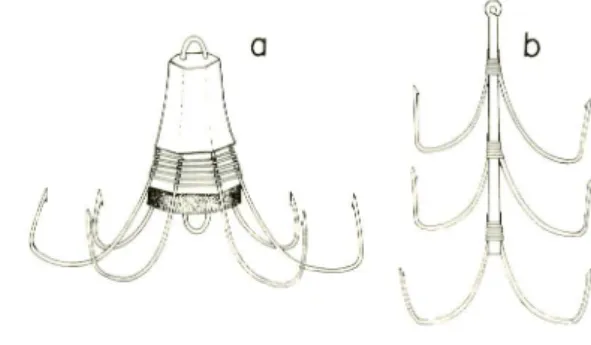
There are two types of jigs for catching squid CUMI—CUMIand cuttlefish SOTONG. One of them has six hooks and several jigs can be arranged vertically (Fig. 6b). The other, PANCING RAMES (Fig. 6a) carries bait. The fishermen prefer IKAN LA TANG as
Fig. 6. Two type of jigs for catching squid and cuttlefish.
bait material because this fish has white skin which is believed to be most attractive to squid and cuttlefish. The former is found in West Java and the latter is found in Madura.
V Traps
V —1 Submerged luring implements
Luring implements include two categories of traps. One is that by which fish are aggregated or attracted to. To prevent the fish from escaping and hence capturing them, other implements are used. This category of traps acts as shelter or substratum, or as barrier. The other category includes traps in which fish enter voluntarily and are prevented from coming out. Auxiliary devices are usually not used in these traps.
A simple method of manufacturing shelter or substratum is to bundle grass or twigs of shrubs or trees and submerge them in water where fishing is desired. This method is very common in tropical and subtropical waters. In Banten Bay, West Java, submerged
bundles of shrubs are used to lure shrimps, prawns, and young fishes (Fig. 31). The
collection of the lured animals is made with a skimming net DOTOK. Similar method is applied for fishing giant perch hates sp. spawners in the northern coast waters off West Java. When the fish which are expected to be lured hide inside the shrubs which have
been set and submerged beforehand, they are encircled with a bamboo matting fish fence
or a gill net. The fish inside are driven out by hitting water surface with half—cut coconut
shell with a handle.
drifting objects and often associate with them. According to HUNTER and MITCHELL41 the
Sectator ocyrus (115-160 mm SL) residented beneath a moored object for more than 32
days. Many obsevations have been carried out and several hypotheses have been
forwarded regarding the mechanism of the association of fish with drifting objects, but
none of them explain well the mechanism involved. Apart from the mechanism, it was evident that natural and artificial drifting objects in the sea are effective devices to gather widely distributed fishes and have been utilized to facilitate fishing. Fishing with mooredrafts in Indonesia are very popular, as in the Philippines.
The raft RUMPON consists of a raft of two bamboo poles beneath which hangs a line to which are attached fresh coconut leaves at about 1-mintervals (Figs. 15, 32, and 33).
When the water is deep and the raft can not be anchored, the anchor is replaced with a
simple stone sinker, and then the raft drifts with current. For convenience, raft always
carries the owners marks. The attracted fishes are captured with a Danish seme PAYANG and a purse seine which was introduced to these areas in 1974. In the PAYANG and purseseme operation, the line with coconut palm leaves is lifted up by hand and removed from
inside the net. Therefore, the scale of the raft is limited to the power of the fishermen, and the RUMPON is smaller in size and mobile than the raft in the Philippines. While the
RUMPON is the only device to allure large pelagic fishes migrating offshore, the number
of RUMPON is very likely to decrease because the PAYANG are gradually being
replaced with purse seines which are operated mainly at night with fishing lamps.
V—2 Barriers
Many fishing gear have been developed in areas with changing water levels all over
the world; stone dams, fish fences, and fish corrals are examples.
Along the gently-sloping beach where stones and corals are found, stone dams of various sizes are found. Stone dams are so arranged that they are flooded at high water
and the fishes can enter them; then as the tide falls, some fishes, crustaceans, and other
animals are retained (Fig. 34). The actual fish catching has to be done by hand or other gear.
GALANGAN is a barrier specially designed for milkfish fry NENER and acts as
barrier or substratum for the fry which are distributed mostly in the surface water121. It is a line with dense coconut palm leaves, dried coconut palm husks, or dried straw (Fig. 35).
They are found in most fry grounds and are set with bamboo poles at about 50 m interval,
perpendicularly to the beach (Fig. 36). This fry collection method, using barriers, is
typical of Indonesia but may not be found in other countries.Fish fences EMPANGare usually set in the intertidal zones. Netting or split bamboo matting are usually used as they could easily be removed and transported. Existence and
use of fish fence have not been previously reported from Indonesia, though several types of fish fence are found that are being used in the rivers and coast in the areas surveyed. They are all nylon nettings set in the manner of a barricade. A fish fence seems to be the most efficient gear for animals which inhabit shallow coastal waters. Around Gending, East Java, fish fence WAGER, 300 m long and 1.5 m high, are set along the sandy or muddy beach at high tide to trap various species of fish and crustacean (Figs. 37 and 38).
In fish ponds, bamboo matting fish fence LOHO are used to drive cultured fishes to a harvesting point after the drainage (Fig. 39).
Fish corrals, which we think is a more appropriate name for "labyrinth trap", are found widely in tropical and subtropical areas. Formerly, the fish corrals SERO are prevalently operted along the coast of Java and Madura, they are superseded by other kinds of gear and are likely to disappear from these areas. However, many fish corrals are still used in Jakarta Bay and a few in Madura. A typical fish corral consists of a series of four enclosures of chamber, flanked by two wings, and a prolonged leader. The set up is made of bamboo poles and slabs of split bamboo (Figs. 7 and 40). Fish lamp, usually a kerosene lamp, is set at the distal point of the final chamber where fishes are captured with scoop net, lift net, or other types of net. As observed, fish corrals are set usually in 7—8 m of water and harvesting is carried out from 3 o'clock in the morning, in Jakarta Bay.
The fish corrals are regarded as traditional gear. They are apparently inefficient because fish that go in
side, can easily find its way out again. This has led many Indonesian
fishermen into believing that
Japanese trap nets like the otoshi-ami are much efficient than the tradi tional fish corrals. Such, however, is not strictly true. HlRAMOTO31 from his studies at
seven different fishing grounds, reported that when the trapped fishes were tagged and
released in the final chamber of the otoshi-ami, the ratio of recapture the next morning
ranged from 0 to 11.7%; and in four of seven tests, there was no recapture. Inspite of the
relatively primitive construction, fish corrals are well developed gear for catching fishes
that inhabit or migrate to the coastal waters, and are still widely operated in the tropical
and subtropical waters. From fishery point of view, it has been planned that otoshi-ami
can be introduced to Indonesian fishery, at least on a small scale, because it is lesssusceptible to rough sea conditions than are bamboo fish corrals and can be operated
Fig. 7. Typical fish corral, SERO. in Jakarta
G. Kawamura, D. R. Monintja and K. Mangunsukarto
almost the whole year-round, but we do need to consider the economic efficiency of the
gear in fndonesia.
In East Java and Madura, PRA YANG is the most common fish corral. A typical small
PRAYANG consists of one or two traps, a chamber, and a prolonged leader which are
operated to harvest tiger prawn Penaeus monodon from fish ponds (Figs. 8 and 41). It is
Fig. 8. Typical small, PRAYANG. set in fish pond for capture shrimps. Madura.
operated during nighttime with the help of a kerosene lamp which is set in the chamber or
inside the trap. According to the fihermen, tiger prawn has positive phototaxis to low intensity light but shows negative phototaxis to strong light. PRAYANG has several variations in size and construcion. Examples are shown in Fig. 9.
Fie. 9. Two variations of fish corral. Madura.
V-3 Baskets
Baskets include pots, fyke nets, and tubular traps with or without non —return devices. It is believed that these traps were originally devised independently in several
were subjected to modifications to suit the local fishing conditions. These traps were
originally operated in inland waters1"1.
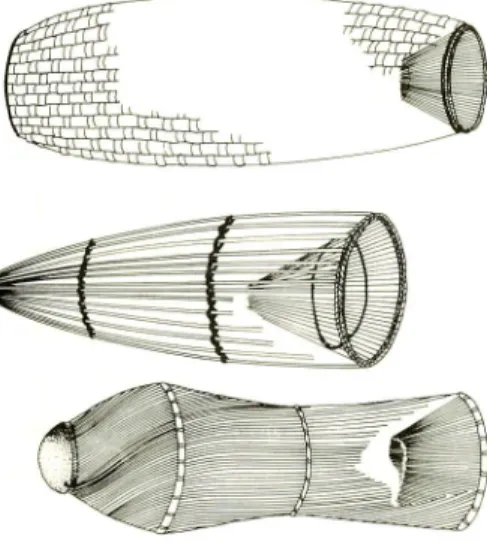
In Indonesia, baskets BUBU are usdd to capture crabs, shrimps, prawns, and small
fishes from fresh-, brackish-, and littoral marine waters. While bait is placed inside the
baskets to lure carnivorous fishes and crabs, no bait is used to capture herbivorous fishes
like sigamds using the same gear. Various types of baskets are currently in use in these
areas (Figs. 10 and 42). However, modification of thisgear is relatively poor as compared
Fig. 10. Variation of basket, BUBU.
to that in the Philippines.
The fyke net is not operated in the areas surveyed.
VI
Scoop nets, Skimming nets, and Filter bagnets
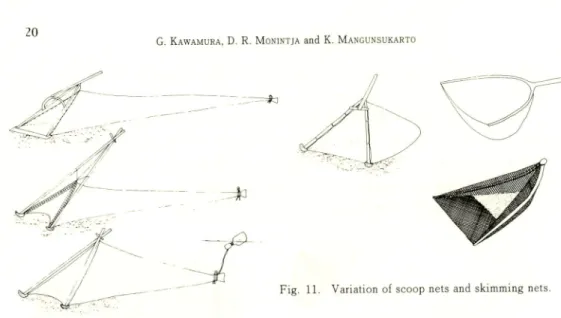
Scoop nets have much variations in form, design, and size depending on the purpose
of use and local availability of materials for the frames (Figs. 11, 43-45). This gear is
frequently used as the main gear and sometimes as an auxiliary device in a fishing
operation. PENGONCOR light fishing with a pressured kerosene lamp is common in Bali;
usually the anchovy are attracted to the surface and are captured with scoop nets. Hand
liners also obtain their bait for fishing bottom fishes by PENGONCOR. Similar light
fishing with scoop nets is carried out in Japan specially for catching Japanese mackerel
and is believed to be highly effective technique for catching fishes which have strong
positive phototaxis.
Skimming nets are triangular in shape with two poles which may be fixed or moved
(Fig. 11). With poles fixed, the net is kept permanently open; and on the other hand, with
.^Jfl
Fig. 11. Variation of scoop nets and skimming nets.
small and hand-operated or big and motor-driven. The size of the hand-operated
skimming net is limited to the power of the fishermen. The smallest ones are usually of
the fixed type and can be operated even by small children to catch shrimps and milkfish
fry from shallow shore waters, creeks, and similar backwaters. Skimming nets with
runners at the front ends of the poles are very popular for catching shrimps. The biggerskimming nets SODUO also called SEDUO are pushed by motorized boats. The catch
generally comprises small shrimps (Acetessp. and mysids) that are salted and marketed as
shrimp paste TERASI or ACANG.
Filter bagnets or stow nets could be set or towed against current. Usually they have
wings of netting, bamboo matting or leaves and branches in other countries, but only
JERMAL has wings of bamboo poles in Indonesia (Fig. 12). JERMAL is fixed, with the
mouth open, to bamboo poles and set semipermanently in relatively deep waters of the strait between East Java and Madura. Similar type of filter bagnets TOGO or TUGUKare
operated in the deeper portions of the rivers. Bamboo basket is attached to the end of the
bagnet to facilitate small fishes and shrimps harvest (Fig. 13). More simple filter bagnets
t^^i<3--•'-Fig. 13. Filter bagnet, TOGO or TUGUK, set in the rivers.
TOROS are operated at the outlet of creeks (Fig. 46). W Dragged gear
This group of fishing gear includes all netbags and netwalls which are towed through the water at different depths to catch animals of various origin e.g. pelagic, benthic etc. The capture is done by the filteration of the passive preys by actively moved gear. A small dragged gear JABAK, equipped with bamboo frames to keep the netbag open, are often used on waist—deep water along the sandy beach of Jepara, Central Java (Fig. 14). It is operated during dusk and seems quite successful for catching shrimps.
Trawl fishing had been very common in Indonesia, and commercially the most important catch, shrimps, were exported to Japan and several European countries. However, trawl operation was prohibited in 1980, and was replaced by purse seines, gillnets, and trammel
nets for several reasons. VU Seine nets
The manner of capture is by surrounding an area and towing through, using net walls with or without bag or bags. This group of nets includes double stick nets and other genuine seme nets17'. In the areas surveyed, only one type of double stick net was found in operation. A net of fine mesh less than 1 m long and 1/2 m high, and Fig. 14. Hand-operated dragged gear
JABAK, for catching shrimps. Jepara, Central Java.
is operated inside stone dams to capture animals trapped during low tide, in Madura. All beach seines in these areas are of the same basic design; with one bag, long
wings, and warps which function as scare lines. They are operated from non^mechanized boats along the sandy beach without any hauling device to capture mostly sardines,
anchovies, and shrimps (Fig. 47). A relatively big beach seine KAPINGused in Bali has a series of tufts of synthetic fiber attached to the ground rope at net mouth (Fig. 48). The beach seiners believe that the tufts reduce the underwater towing resistance. The smallest
size beach seines are operated by two people to capture tilapia in Batur Lake in Bali (Fig. 49). Beach semes can be operated in the surface waters to capture large pelagic fishes, as found in the Philippines10'. Indonesian fishermen do not capture large pelagic fishes with beach seines. At night, fishes are attracted by kerosene lamps at desired points and are captured with beach seines. The fishing fleet for this purpose consists of one net boat and
one light boat.
• PAYANG is a traditional Danish seine and is used to capture fishes associated with
RUMPON(Fig. 50). Its operation is shown schematically in Fig. 15. RUMPONhas been
Fig. 15. Operation of Danish seme, PAYANG.
very popular in Indonesia and the only device to attract at desired fishing points and
gather widely dispersed fishes migrating offshore waters. While PAYANG are nets
specially designed for catching fishes associated with RUMPON, they are gradually
being replaced by purse seines. Purse seines are operated to capture fishes attracted to fish lamps at night and also schooling fishes, without any gathering fish technique, in daytime.
LX Surrounding nets
The manner of capture is to surround the fish not only from the sides but also from beneath, thus permitting the capture of fish over very deep waters by preventing their escape to the depths.
Purse seine which is operated by either one boat or two boats, was introduced to Indonesia in 1974 and is a very new fishing gear to Indonesian fishermen. Nevertheless, it has been used extensively since the prohibition of trawl nets. While the trawl boats were well equipped with relatively modern machines, these boats are not suitable for purse seine operation without modification. At present, the purse seme fishermen use old wooden boats with inboard or outboard engines and kerosene lamps as fish attracting
device. During the daytime, fishermen locate fish schools by observing surface water
disturbances such as a distinct patch of air bubbles. RUMPON is not commonly used in purse seining, and light fishing is more common than daytime purse seining.
As there has been a tendency to increase the number of kerosene lamps, the light
intensity seems too high for the size of the present nets. It is known that fishes can be
attracted from wide area and that the fishes form a dense and compact school under a
weeker light intensity. Moreover, it is also known that activity of fishes attracted is
proportional to the light intensity of the fish lamps. Anchovies and mackerels move very actively under the fish lamps7-9'. If we expect more catch by purse seme using stronger
light intensity, bigger size nets have to be used. Higher light intensity fish lamps are getting very common among fishermen, but not bigger size nets. In spite of the small scale purse seine fishing, fishermen reported that the purse seme catch is decreasing year by year. It might partly be due to the meaningless increase in the intensity of the lamps.
X Drive—in nets
Drive—in nets have many advantages : 1) they can be operated in the coral reef areas
where nets can not be dragged because of the rough bottom; 2) they can be operated in many places several times a day; 3) widely dispersed fishes can be captured by driving
them into nets set previously; 4) the fishes that are captured can be killed at once and. therefore, can be kept fresh. The last one is of great importance, especially in tropical and subtropical waters.
The extent of fishes' activity entering passive gear is so small in relation to the time unit that these gear have to remain set for a long time till the profitable catch is produced. The fish caught first would die very quickly in warm waters and would then no longer be
G. Kawamura, D. R. Monintja and K. Mangunsukarto
commercially valuable. For these reasons, drive—in nets have been developed and introduced to many tropical or subtropical areas.
In deep waters, fishes are driven by swimming or "diving fishermen". This can also be done with the help of scare lines. One of the deep—water drive—in nets is the MURO—AMI which was introduced from Japan widely to the South Pacific and also to Indonesia by Itoman fishermen101115"'1. While there was no MURO—AMI in the areas surveyed, the operation is common in the coral reef waters around smaller islands. In shallower waters, fish can be driven in by rows of wading and splashing people, and by noise made by striking the water with poles and paddles or casting stones.17'
A scare line is used in a tide pool to drive larval or juvenile fishes and are captured with a scoop net or a skimming net (Fig. 52). The same method is applied in the collection of milkfish fry which is an important fishing activity to the subsistence fishermen. While milkfish fry are collected in several other countries, the drive—in technique is applied only in Indonesia. As mentioned above, drive—in nets are quite effective and are operated in both clear and turbid waters as seen in several other countries, for catching various species of fish. Small—scale gear of this type which are also easy in construction should be introduced to the areas surveyed for their simplicity, effectiveness, easy operation, and cheapness.
XI Lift nets
The manner of capture is .by lifting nets from the water when the fish sought to be caught have gathered over them. Though lift nets, when not equipped with other fishing devices, are regarded as passive and inefficient gear; once they are operated with alluring baits or fish lamps, they become extremely effective and efficient. Lift nets can be used in shallow as well as in deep waters.
Lift nets are commercially important and very common in Indonesia. The most important one is BAGAN. It is a box-shaped net hung from a platform of bamboo poles, gradually sunk to the sea bed, and is frequently operated at night using fish lamps. When
enough fish have been attracted by the lamps (kerosene lamps), set above the center of the net, the net is then lifted by hauling the hanging lines by means of rollers. After collecting
the catch with a long—handled scoop net, the net is sunk again for the next catch. Three
types of BAGAN are common in Indonesia; BAGAN TANCAP (set lift net), BAGAN
RAKIT(rah lift net), and BAGANPERAHU(boat lift net) (Fig. 16.). While the BAGAN
TANCAP is illegal in the areas studied, it is still very common in bays and calm shore
waters. Fishermen use two or three pressured kerosene lamps at once to attract fishes. But the light intensity from two / three lamps seems too high for the present size lift nets, as
Fig. 16. Variation of traditional lift nets, BAGAN.
Variations are found in lift net operated in shallow coastal waters, rivers, and ponds. Most of these nets are operated in daytime without any fish-attracting device. The nets are lifted at desired time and small fishes captured (if any) are collected with a
long-handled scoop net ANCO (Figs. 53-55). In Japara, the nets are operated from
towers and set infront of the tip of a barrier set perpendicular to the beach. This artificial barrier is a series of submerged bulk of tree branches arranged in a line and is believed to guide fishes towards the net as do the leading net of set trap net.
XII Falling gear
The manner of capture is to cover the fish with a gear. This can be done in shallow
waters but there are records of operation of such gear in deep waters1''.
Two types of falling gear are found operated usually to meet family fish demand in
Indonesia ; cast nets with or without pockets and cover pots SUSUK.
The cast net is believed to have originated from India191, and is one of the most
popular gear in Indonesian rivers, ponds, and shore waters. Synthetic monofilament is
most widely used as the netting material for cast nets.Cover pots made of bamboo have been used to capture nectobenthic animals from
rivers and swamps and are getting out of use in many countries because of the prevalence
of other kinds of gear. In the areas surveyed, however, cover pots are still widely used by
subsistence fishermen for the reason that cover pot is the only gear which can be used inswamps covered with dense grasses and shrubs and similar areas, where other kinds of
gear are very difficult to apply (Fig. 57).XffJ Gill nets
Gill nets are single-walled nets found in various mesh sizes. Fish of different body
sizes get gilled or tangled into the netting when they try to pass through it. Trammel netsare included in this group. These are passive gear, but fish can also be driven into gill
nets.
Gill nets TARING INSANG also known as DOBEL m Madura and JARING in Bali, are the most popular gear in the areas surveyed and probably in the entire Indonesia. The
netting material is synthetic monofilament for small scale gill nets and synthetic
multifilament for large-scale gill nets. Small gill nets, usually 1 to 1.5 m high and 7 cm
mesh size, are operated by wading fishermen in shore waters and, in some places, shells
are attached to the bottom of the net as sinkers (Fig. 58). Large scale gill nets are operated
from sailboats for catching sardines, anchovies, mackerels, and little tunas in the offshore
waters. A unit of a drift net, for fishing little tunas, usually has a height of 7 m, length 12
m, mesh size 10 cm, and 40% hanging ratio. While common gill nets are set underwater
vertically with floats and sinkers, JARING KLITIK bottom gill net designed for shimps,
is set on the sea bed to form an "igloo—like structure with many doors" (Fig. 1.). Same gill
net is found also in Taiwan. Trammel nets are in the stage of introduction for replacing
the trawl nets in catching shrimps.
Summary
Fishing gear and methods were observed throughout the survey period in Java, Madura, and Bali, Indonesia. Result summary is presented below;
l)Most boats are not mechanized and sailboats are still used widely.
2)Synthetic fiber, either monofilament and multifilament, has replaced the natural
fiber and is commonly used for netting materials and lines.
3)Fishermen have skilfull hand net—making technique for monofilament gill net.
Nevertheless, modification of this gear is poor.
4)Although drive—in nets have many advantages especially in tropical and
subtropical waters, these fishing gear are not popular in the areas surveyed, except for the milkfish fry collection with scoop nets and scare lines.
5)Trawl net operation has been prohibited since 1980.
6)Purse seine was introduced to Indonesia in 1974 and is a relatively new fishing
gear to Indonesian fishermen. Nevertheless, it has been used extensively since the
prohibition of trawl nets.7)Pressure kerosene lamps are widely used as fish attracting lamps, and electric fish
lamps has not been found in the areas surveyed . The light intensity of the fish lamps seems too high for the present size purse seines and lift nets.
8)While the fish attracting moored raft RUMPON is the only device to allure and
gather pelagic fishes migrating offshore, the number of rafts is very likely to decrease because the Danish seines (specially designed for catching fishes associated with the raft) are gradually being replaced by purse seines.
We surveyed all fishing gear and methods "that came to our light" in Java, Madura, and Bali during our research in Indonesia. However, it is possible that we might have missed some of them. For one, we were working within a limited schedule because of time restriction. And also, because there are gear that are operated seasonally. Nevertheless, it can be concluded from the results of the survey, that most of the Indonesian fishing techniques have changed very slowly over the years except for the trawl nets and recently introduced purse seines.
In many countries, some of the traditional gear, as a result of modernization, became "extinct" or superseded by modern fishing gear. Such modernization of fishing gear and methods has always been closely related to the behaviour of fishing preys such as migration and reaction to gear, and also with socio-economic back grounds such as availability of labor, consumers' qualitative and quantitative change in needs, and
technical developments in related disciplines. Therefore, such mechanization or modernization of fishing techniques achieved in industrialized countries can not be directly applied to developing countries which have different socio-economic back grounds compared with industrialized countries.
Eventhough the Indonesian fishing techniques are traditional, some of them are thought to suit the nature of fishing preys and fishing grounds in Indonesia. If these traditional but rational fishing gear and methods were improved or reformed with the help of fishing gear technologists and related experts, Indonesian fishery could be developed to a great extent. For example, from the technological view points, the construction of the moored raft RUMPON could be improved and applied to line fishing, better catch of gill nets could be expected by changing mesh size and hanging ratio (depending on the species of fishing prey). Several types of drive—in nets and lift nets could be introduced to many of these fishing grounds, the construction of traps could be improved to facilitate fish entry and hence retaining the catch without loss of fish once they are in the trap.
Such recommendations, we believe, should be tried and their effects analysed, before the introduction of highly modernized fishing techniques to the Indonesian fishery. It
should be confirmed here again, that the highly modernized gear are not fundamentally
different in their basic components and in operation from the so—called traditional or primitive gear.
Acknowledgements
The authors wish to acknowledge to Ir. S. HARIJONO, Ir. A. A. Gde HARMONY, and Ir. B. WlYARSO of the Department of Fisheries of East Java, Bali, and Central Java, respectively, Ir. S. ADISUKRESNO of the Brackishwater Aquaculture Development Center in Jepara, Mr. M. YAMASH1TA of the Laboratry of Marine Fish Culture in Serang, Ir. W. ISMAIL of the Marine Fisheries Research Institute in Jakarta for their support throughout the survey. Special gratitude is owed to Dr. M. ElDMAN, Dean of the Faculty of Fisheries, Bogor Agricultural University for his help which facilitated the survey.
References
1 ) BURI, P. ; Ecology on the feeding of milkfish fry and juveniles, Chanos chanos
(FORSSKAL) in the Philippines. Mem. Kagoshima Univ. Res. Center S. Pac, 1, 25-42 (1980)
2 ) and KAWAMURA, G. : The mechanics of mass occurrence and recruitment
strategy of milkfish fry Chanos chanos (FORSSKAL) in the Philippines. Ibid., 3, (in
press)HlRAMOTO, Y. : On the chuteiso—trap net operated in Maegawa fishing ground. Trap
net fisheries, 40, 20-29 (1969) (in Japanese)
HUNTER, H. R. and MITCHELL, C. T. ; Association of fishes with flotsam in the offshore waters of Central America. Fish. Bull, 66, 13-29 (1966)
ICHIKAWA, H. and MATSUURA. F. : Some problems on skipjack fishing in the Banda Sea. Prompt Reportof theSurvey Team on EcologicalBiology in theBanda Sea, Fac. Fish.,
Kagoshima Univ., 29—30 (1975)
ISHIKAWA, T. : "Kaigai—imin no tenkai". m Boad of Education, Okinawa Prefecture (ed.), History Okinawa Prefecture, p. 332—361, Okinawa Prefecture, Naha (1974) (in Japanese)
KAWAMURA, G. : Field observation on the movements of fishes aggregated to attracting lamps. Bull. Japan. Soc. Sci. Fish., 40, 27-34 (1974)
: Fundamental study on application of the vision of spotted mackerel, Pneumatophorus tepeinocephalus (BLEEKER), to angling techniques—VI Movement of fish school attracted to fish lamp estimated from the time series of catch. Ibid., 45, 1241-1247 (1979)
: Ditto —VII Movements of fish school attracted to fish lamp observed by fish finder. Ibid., 45. 1355-1358 (1979)
10) and BAGARINAO, T. : Fishing methods and gear in Panay Island, Philippines.
Mem. Fac. Fish., Kagoshima Univ., 29, 81-121 (1980)
11) KONO, M. : Panay—to no engan—gyogyo (prompt report). Hiroshima Shudo Daigaku
Sogo Kenkyujo Report, 3/4, 22-41 (1979) (in Japanese)
12) KUROKI, T. and CHUMAN, M. : An example of three—dimensional records of fish—school attracted by underwater lamps. Mem. Fac. Fish., Kagoshima Univ., 6. 77-81 (1958)
13) SAITO, S. : "Nanpo no suisan". Tokyodo, Tokyo (1932) (in Japanese)
14) STECHER, P. G. (ed.) : The merck index. 8th ed., Merck & Co. Inc., N. J.. U.S.A., p.957 (1968)
15) UEDA, F. : in ASHITOMl, C. et al.(eds), Our sea, the greatest blessing. Okinawa Prefecture Tourist Develoment Center, Naha (1975)
16) UEDA, F. : History of Roman fishery. Blue Ocean, 81, 112-123 (1981) (in Japanese)
17) VON BRANDT, A. : Fish catching methods of the world. Fishing News (Books), London (1972)
18) VON BRANDT, A. : Classification of fishing gear, in KRISTJONSSON, H. (ed.), Fishing News (Books), London (1959)
G. Kawamura, D. R. Monintja and K. Mangunsukarto
"Gyogyobunka jinruigaku no kihonteki shiryo to sono hosetsuteki kenkyu.' p.374—377, Kazama Shobo, Tokyo (1978) (in Japanese)
Explanation of figures
Plate 1
Fig. 18. Collection of dead corals from intertidal zone. Panimbang, West Java. Figs. 19 and 20. Divers collecting sand from river bottom. Mojokerto, East Java. Fig. 21. Collection of sand in intertidal zone. Kalianget, Madura.
Plate 2
Fig. 22. Groping for fish in a harvested fish—pond. Gresik, East Java.
Fig. 23. Collection of clams and snails with a basket in a swamp. Gresik, East Java. Fig. 24. Collection of algae Ulva sp. BULUNG in intertidal zone. Kalianget,
Madura.
Fig. 25. Night collection in shore waters using a papaya leafstalk filled with kerosene. Pasirputih, East Java.
Fig. 26. People removing oysters TEREM from rocks. Kalianget, Madura. Fig. 27. Collection with a net to facilitate capture animals in intertidal zone.
Pasirputih, East Java.
Plate 3
Fig. 28. Unearthing hard clams with a rake ESKAER. Pasirputih. East Java.
Fig. 29. Fishermen collecting fishes stupefied with sodium cyanide POTAS in a
tide pool. Pasirputih, East Java.
Fig. 30. Pole and line fishing in shore waters. Jepara, Central Java.
Fig. 31. Submerged bundle twigs for shrimps and small fishes. Banten Bay, West Java.
Fig. 32. Natural materials for making RUMPON, locally called ONJEM in
Madura. Pasongsongan, Madura.
Fig. 33. A line with coconut leaves which to be hung beneath bamboo raft. Ketapang, Madura.
Plate 4
Fig. 34. Stone dam build on the shore. Prenduan, Madura.
Fig. 35. Line with dried coconut palm husks, which is used as a barrier
GALANGAN also called PANGKALANm Madura, and also used as a scare
line BRANBAN specially for milkfish fry. Pasean, Madura. Fig. 36. GALANGAN set in the milkfish fry ground. Pengastuluan. Bali.
Figs. 37 and 38. A fish fence in operation. Gending, East Java.
Fig.
39.
A fish fence LOHO used to drive cultured fishes to a harvesting point in
fish pond. Gresik, East Java.
Plate 5
Fig. 40. Fish corral SERO under the construction. Jakarta Bay.
Fig.
41.
Fish trap set in fish pond. Semarang, Central Java.
Fig. 42. Bamboo traps for herbivorous fishes. Jakarta.Fig. 43. Fishermen catching fish with scoop net in a river. Mojokerto, East Java. Fig. 44. Shrimp catching with bamboo basket in a swamp. Merak, West Java. Fig. 45. Shrimp catching with a scoop net in a creek. Bojonegara, West Java.
Fig.
46.
Operation of filter bagnet set at the outlet of creek. Prenduan, Madura.
Plate 6
Fig. 47.
Operation of beach seme JARING ARAD. Cilacap, West Java.
Fig. 48. Beach seine with a series of tufts attached to the ground rope at net mouth.Pengastulan, Bali.
Fig. 49. Small beach seine in operation. Batur Lake, Bali.
Fig. 50. PAYANG Danish seine, locally called LAYANG or LEMURU in Bali.
Ketapang, Madura.
Fig. 51. Typical PAYANG boat. Besuki, East Java.
Fig. 52. Collection of juvenile fishes using scare line in a tide pool. Prenduan, Madura.
Fig. 53 Fig- 54 Fig. 55 Fig- 56 Fig. 57 Fig. 58 Fig. 59 Plate 7
Lift nets SAROK in operation. Prenduan, Madura. Lift net ANCO in operation. Bojonegara, West Java. Lift net ANCO in operation. Jepara, Central Java. Cast net in operation. Paiton, East Java.
Cover pot SUSUK in operation to capture cat fish in a harvested rice field. Serang, West Java.
Monofilament gill net with shells at the bottom. Pasirputih, East Java. Multifilament gill nets being dried for next operation for anchovies and
Plate 2 v. , •
Mm
23 fiSif £11111G. Kawamura, D. R. Monintja and K. Mangunsukarto
Plate 3
... " .•. • '. •.••
-Plate 4 ••«':r?:.. «5rf# 'ftJ*i 36 r«i«s&;
ii§
" • •--£ r:^mMISJI;-Jih
tilli!
§1
mm
•;: 1.:''^ • Plate 5 ••:••. • .. •• .•• • •••• • .. • • , :>Wl)L:WMM0§:il^KB:
Plate 6
. . . ,
EO
m m
G. Kawamura, D. R. Monintja and K. Mangunsukarto