ショウボウ ヨウ ボウカ フク チャクヨウ ジ ノ ショネツ ストレス ト ソノ ケイゲン ホウ ニ カン スル ケンキュウ
周, 金枚
九州大学大学院芸術工学研究院
https://doi.org/10.15017/13838
出版情報:Kyushu University, 2008, 博士(芸術工学), 課程博士 バージョン:
権利関係:
Thermal strain and its alleviation in workers wearing firefighting protective clothing
消防用防火服着用時の暑熱ストレスと その軽減法に関する研究
2009 年 1 月
周 金枚
Chin-Mei Chou
The objectives of this study were to investigate the relationship between clothing property factors and physiological effects, and techniques for alleviating physiological strain and enhancing the performance of firefighters on physiological and subjective responses while wearing protective clothing (PC). The studies measured rectal temperature (Tre), mean skin temperature (T
_
sk), heart rate, body weight loss and subjective responses.
The first study examined the relationships between clothing properties and the physiological effects on physiological/subjective responses for four types of PC and a light work garment. Eight male firefighters performed a bicycle ergometer exercise at 30%, 45% and 60% of V
・
O2peak for 10 minutes each at 30ºC. Clothing surfaces coated with aluminized sliver (PC2) compared to other PCs were almost the same or lower in regard to clothing weight and thermal insulation (clo-value). The latent heat resistance of PC2 was the greatest. Physiological and subjective heat strain experienced while using PC2 was greater than other PCs. The physiological strain of firefighting protective clothing, shown in the difference between Tre and T
_
sk, depends more upon resistance to latent heat than clothing weight and clo-value, suggesting that latent heat
i
resistance is more closely related than clothing weight or clo-value to the physiological effects.
The second study examined the effectiveness of ice-packs (ICE) and phase change material (PCM) cooling devices in reducing physiological load based on subjects’
physiological/subjective responses while exercising on an ergometer and wearing protective clothing at 30ºC. Eight non-firefighter subjects participated in four exposures: control (CON), ICE, PCM at 5 ºC (PCM[5]) and 20 ºC (PCM[20]), rested for 10 minutes, performed 30 minutes, exercise at 55% V
・
O2peak, and had a 10
minute-recovery period. An increase in Tre for PCM(5) and PCM(20) which was less than that for CON and ICE was observed. The increases in T
_
sk were lower while using cooling devices, and the cooling effects of PCMs were greater than that of ICE.
The larger surface cooling area, higher melting temperature and softer material of PCMs, which reduce absorption capacity, caused a decrease in Tre and T
_
sk for PCM(5) and PCM(20) which was more than that for CON and ICE. Furthermore, PCM(20) does not require refrigeration. PCM(20) is more effective than other cooling devices in reducing physiological load at 30°C.
The final study examined the effects of wearing trousers/shorts under firefighting protective clothing with PCMs on physiological/subjective responses with exercise on a
ii
iii
improved while wearing shorts under protective clothing with PCMs, although no significant difference in reducing thermal stress while wearing shorts instead of trousers was revealed.
Table of Contents
Abstract………... i
Table of Contents……….... iv
Chapter 1. General Introduction 1.1. Hazards of firefighting activities………... 2
1.2. The structure and efficiency of protective clothing…... 3
1.3.Physiological strain of protective clothing………... 5
1.4. The questionnaire survey on firefighters’ protective clothing………... 9
1.4.1. Introduction………. 9
1.4.2. Methods………... 10
1.4.3. Results………... 11
1.4.4. Discussion………... 17
1.5. Alleviating physiological strain and discomfort……… 19
1.6. Objectives of this thesis………. 22
1.7. Structure of this thesis……….... 23
1.7.1. Chapter 2-Objectives and publication………... 23
1.7.2. Chapter 3-Objectives and publication………... 24
1.7.3. Chapter 4-Objectives………... 25
iv
Chapter 2. Effect of clothing properties on physiological and subjective responses of working firefighters’ protective clothing
2.1. Introduction……….……... 27
2.2. Methods………...…….. 29
2.2.1. Subjects………... 29
2.2.2. Determination of the maximal rate of oxygen consumption……... 29
2.2.3. Clothing conditions………. 30
2.2.4. Thermal environments and experiment procedures…... 33
2.2.5. Physiological responses……….. 35
2.2.6. Subjective responses………... 36
2.2.7. Statistical analysis……….. 36
2.3. Results……….... 37
2.3.1. Physiological responses……….. 37
2.3.2. Subjective responses………... 42
2.3.3. Color-coded Evaluation of Firefighting Protective Clothing…….. 45
2.3.4. Relationships between clothing properties and physiological responses……….. 47
2.4. Discussion……….. 48
2.5. Conclusions……… 52
v
Chapter 3. Physiological and subjective responses to cooling devices on firefighting protective clothing
3.1. Introduction……… 54
3.2. Methods………. 56
3.2.1. Subjects………... 56
3.2.2. Determination of the maximal rate of oxygen consumption……... 56
3.2.3. Clothing ensembles and cooling devices………... 57
3.2.4. Experiment procedures and physiological responses... 61
3.2.5. Subjective responses………... 64
3.2.6. Statistical analysis……….. 64
3.3. Results……….... 65
3.3.1. Physiological responses……….. 65
3.3.2. Subjective responses………... 71
3.3.3. Cooling devices for body heat storage………... 73
3.4. Discussion……….. 74
3.5. Conclusions……… 78
vi
Chapter 4. Effects of wearing trousers or shorts under firefighting protective clothing on physiological and subjective responses
4.1. Introduction……… 80
4.2. Methods………. 83
4.2.1. Subjects………... 83
4.2.2. Clothing ensembles………. 84
4.2.3. Experiment 1………... 86
4.2.4. Experiment 2………... 88
4.2.5. Statistical analysis……….. 92
4.3. Results……….... 93
4.3.1. Experiment 1………... 93
4.3.2. Experiment 2………... 96
4.4. Discussion……….. 100
4.5. Conclusions……… 103
vii
viii
Chapter 5. General Discussion and Conclusions... 104
Reference………... 111
Acknowledgements………... 125
Appendix A………... 128
Appendix B………... 129
List of Figures………... 131
List of Tables………... 135
• Chapter 1
General Introduction
Chapter1 General Introduction
1.1 Hazards of firefighting activities
Firefighters have special duties that place them at high risk in regard to personal safety during the course of duty. This risk is associated with emergent danger, uncertainty and unpredictability. General emergency scene hazards for firefighters involve physical, environmental, chemical, biological, thermal, electrical, radiation-related, and equipment hazards (International Association of Fire Fighters, 2003).
In Japan, there were 18 deaths of firefighters during firefighting activities, firefighting training, and occupational tasks in 2002. 2,545 firefighters were reported injured according to the Fire and Disaster Management Agency (2003). Furthermore, in the United States 52 percent of firefighters have reported injuries, and of those, 10 percent involved burns while 22 percent were caused by excess fatigue (Karter and Leblance 1995; Ross, 2003). Moreover, in incidents resulting in death, over 50 percent (23 out of 43) were caused by heart attacks and 48 percent by heat stress.
(Washburn et al., 1996; Ross, 2003).
2
1.2 The structure and efficiency of protective clothing
Firefighting protective clothing is what firefighters wear when they perform firefighting or rescue activities at fire scenes. Therefore, high heat-resistance and flame-resistance are required for clothing to protect firefighters from heat and flames experienced during firefighting activities (Pandolf and Goldman, 1978; Speckman, 1988; Nunneley, 1989;
Faff and Tutak, 1989; White and Hodous,1989; White et al., 1991b; ISO11613, 1999;
Graveling and Hanson, 2000). Firefighting protective clothing consists of capsulated type clothes with high thermal resistance. Firefighting protective clothing generally consists of outer and inner layers to block flame, and decrease shock from falling objects (Faff and Tutak, 1989). Firefighting protective clothing in such multilayer construction is mainly of the fully encapsulated types which have an extremely high thermal resistance, resulting in high heat insulation capacity (Raheel, 1994). The total weight of a firefighter's equipment, which includes heavy self-contained breathing apparatus and firefighting clothing (the clothing itself is heavy and bulky) in actual firefighting activities, reaches as much as 25 to 35 kg and the burden caused by the weight is remarkable (Gavhed and Holmér, 1989; Simth et al., 1997; von Heimburg et al., 2006; Eglin, 2007).
3
Chapter1 General Introduction
However, heat-resistance, flame-resistance and water-resistance lead to clothing with poor moisture permeability which does not allow the release of sweat or evaporation, that is, the clothing restricts the release of latent heat produced by sweating (Ftaiti et al., 2001), because it is made with materials which do not allow liquids or gases to pass. With heat storage due to physical metabolism and the thermal burden from the external environment, firefighters experience an excessive thermal load.
Therefore, it is critical to design high-quality firefighting protective clothing to raise the concentration levels on the job of battling the blaze and rescuing trapped persons, and also to reduce the risk.
Physiological and subjective responses while wearing firefighting protective clothing should be considered. Consequently, firefighting protective clothing has been developed to protect the human body from the external environment and to reduce the risk of thermal load at the same time (Faff and Tutak, 1989; Simth et al., 1997; Holmér, 2006; Eglin, 2007).
4
1.3 Physiological strain of protective clothing
During the past decades, interest in protective clothing research for worker safety and health in hazardous environments has grown. The Occupational Safety and Health Administration and the Environmental Protection Agency have issued guidelines, recommendations, and rules for worker safety in various occupational hazard situations.
Moreover, industry and independent organizations have developed standards for personal protective equipment such as the International Organization for Standardization and the European Standardization Organization (Raheel, 1994; Holmér , 2006).
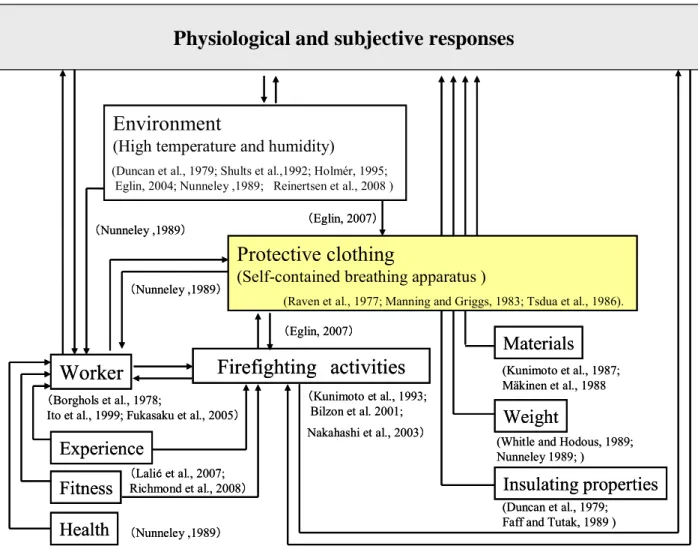
Figure 1.1 shows a representation of the multidimensional problem of physiological strain factors on physiological and subjective responses during firefighting activities with protective clothing. Many studies have been carried out to investigate the effects of firefighting activities in high temperature and humid environments on physiological responses (Duncan et al., 1979; O'Connell et al., 1986;
Romet and Frim, 1987; Davis and Dotson, 1987; Gavhed and Holmér, 1989; White et al., 1991b; Shults et al., 1992; Holmér, 1995; Nakayama, 1998; Baker et al., 2000;
Machida et al., 2000; Ikuno et al., 2002; Mclellan and Sellirk, 2004; Eglin et al., 2004;
5
Chapter1 General Introduction
Eglin, 2007; Reinertsen et al., 2008), and thermal sensation (Aoyagi et al., 1998;
Holmér, 1995). In order to develop materials leading to less thermal stress, many studies have been carried out and reported by Kunimoto et al. (1987), Mäkinen et al.
(1988), Veghte (1988), and Richardson and Capra (2001). Moreover, there have been many studies which reported that the clothing weight and insulating properties of protective clothing impose additional heat stress on humans (Whitle and Hodous, 1989;
Nunneley 1989; Graveling and Hanson, 2000). Several studies have been carried out to investigate the effects of self-contained breathing apparatus during maximal exercise on humans (Raven et al., 1977; Manning and Griggs, 1983; Tsdua et al., 1986).
The above studies have been conducted to investigate physiological load and clothing properties; there are, however, few that have taken up psychological effects such as comfort when working in firefighting protective clothing. Moreover, Davis and Santa Maria (1975) mentioned that while wearing firefighting protective clothing under a moderate workload, a firefighter’s working efficiency decreased by 33% before working at strenuous firefighting activity. It is necessary to consider the design of firefighting protective clothing in the future from a viewpoint that includes both physiological and psychological effects such as the alleviation of physiological load and the easing of discomfort caused by the clothing, to allow firefighters to concentrate on
6
their firefighting activities and to perform efficiently. Protective clothing needs to be designed to be more efficient.
Other studies have been carried out to investigate actual firefighting activity or protective clothing ensembles via questionnaires and/or simulated firefighting tasks (Lemon and Hermiston, 1977; Kunimoto et al., 1993; Bilzon et al. 2001; Nakahashi et al., 2003; Havenith and Heus, 2004) as well as investigating the fitness levels and physical ability of experienced and novice firefighters (Borghols et al., 1978; Ito et al., 1999; Fukasaku et al., 2005; Lalić et al., 2007; Richmond et al., 2008), but little is known about the requirements for protective clothing and experience of heat illness during actual firefighting in firefighters. In the next section, a questionnaire survey regarding firefighters’ protective clothing is shown.
7
Chapter1 General Introduction
(Lalićet al., 2007;
Richmond et al., 2008)
Worker Firefighting activities Protective clothing
(Self-contained breathing apparatus )
Environment
(High temperature and humidity)
Physiological and subjective responses
Fitness Experience
Health
Weight Materials
Insulating properties
(Duncan et al., 1979; Shults et al.,1992; Holmér, 1995;
Eglin, 2004; Nunneley ,1989; Reinertsen et al., 2008 )
(Kunimoto et al., 1987;
Mäkinen et al., 1988
(Whitle and Hodous, 1989;
Nunneley 1989; )
(Duncan et al., 1979;
Faff and Tutak, 1989 ) (Raven et al., 1977; Manning and Griggs, 1983; Tsdua et al., 1986).
(Kunimoto et al., 1993;
Bilzon et al. 2001;
Nakahashi et al., 2003)
(Nunneley ,1989)
(Eglin, 2007)
(Eglin, 2007)
(Borghols et al., 1978;
Ito et al., 1999; Fukasaku et al., 2005)
(Nunneley ,1989)
(Nunneley ,1989)
(Lalićet al., 2007;
Richmond et al., 2008)
Worker Firefighting activities Protective clothing
(Self-contained breathing apparatus )
Environment
(High temperature and humidity)
Physiological and subjective responses
Fitness Experience
Health
Weight Materials
Insulating properties
(Duncan et al., 1979; Shults et al.,1992; Holmér, 1995;
Eglin, 2004; Nunneley ,1989; Reinertsen et al., 2008 )
(Kunimoto et al., 1987;
Mäkinen et al., 1988
(Whitle and Hodous, 1989;
Nunneley 1989; )
(Duncan et al., 1979;
Faff and Tutak, 1989 ) (Raven et al., 1977; Manning and Griggs, 1983; Tsdua et al., 1986).
(Kunimoto et al., 1993;
Bilzon et al. 2001;
Nakahashi et al., 2003)
(Nunneley ,1989)
(Eglin, 2007)
(Eglin, 2007)
(Borghols et al., 1978;
Ito et al., 1999; Fukasaku et al., 2005)
(Nunneley ,1989)
(Nunneley ,1989)
Figure 1.1. Diagram of physiological strain factors on physiological and subjective responses during firefighting activities with protective clothing
8
1.4 The questionnaire survey on firefighters’ protective clothing
1.4.1 Introduction
Firefighters conduct dangerous missions. Firefighters’ protective clothing should be designed with great heat, flame, and water-resistant properties to protect wearers (ISO11613, 1999). On the other hand, it must also be designed to alleviate physiological strain and discomfort. Strain and discomfort occur when wearing protective clothing in conditions of great thermal storage by the body’s metabolism and heat stress from fire (Smith et al., 1997; Baker et al., 2000; Havenith and Henus, 2004).
Although a large number of studies have been made using questionnaires for firefighters (Lemon and Hermiston, 1977; Kunimoto et al., 1993; Bilzon et al. 2001; Nakahashi et al., 2003; Havenith and Henus, 2004), little is known about the requirements for protective clothing and experience of heat illness during actual firefighting.
This study conducted a questionnaire survey with 796 Japanese firefighters to investigate their experience of heat illness during practice and firefighting work and their evaluation of their protective clothing.
9
Chapter1 General Introduction
1.4.2 Methods
Subjects and period
The participants for this study were 796 firefighters, 792 male and 4 female, from 16 fire departments in Japan. The average physical characteristics of the subjects were age 39.8 years (from 18 to 60 years); height 171.2cm (from 157 to188 cm); weight 69.1kg (from 45 to 104 kg). This study was conducted in October and November 2004.
A questionnaire included the following items:
1) Basic Information on each subject
2) Priorities for protective clothing selection
Protection and safety, ease of movement, and comfort
3) Trouble experienced with protective clothing during the previous year
・ Due to heat
・ Due to cold
・ Due to difficulty of movement
・ Due to burn injury
・ Due to it being torn
10
4) Evaluation of PC worn the previous year
・ Ease of putting on and taking off protective clothing
・ Ease of movement
・ Light weight
・ Not excessively stiff
・ Not excessively hot while wearing protective clothing
・ Flame resistance
・ Degree of waterproofing
・ Not excessively cold while wearing protective clothing
1.4.3 Results
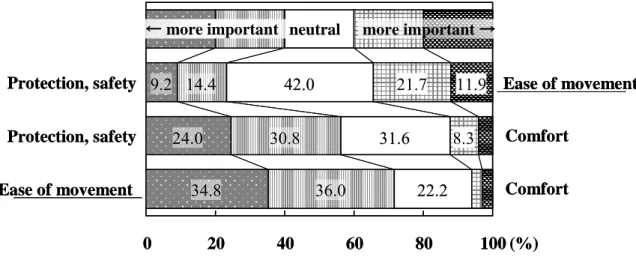
1) Priorities for protective clothing selection
Firefighters ranked degrees of importance for protective clothing selection on 3 factors:
protection and safety, ease of movement, and comfort (Figure 1.2). Ease of movement ranked higher than protection and safety, and comfort.
2) Difficulties experienced while firefighting
Firefighters were asked to describe difficulties they experienced while working (Figure 1.3). 48.6% had experienced feeling very ill because of heat during the previous year.
11
Chapter1 General Introduction
The second highest (41.0%) response rate was the experience of restricted movement while firefighting. 16.3% of the firefighters had experienced tearing whilst wearing their protective clothing.
Follow-up questions were asked to the 387 firefighters who had experienced heat illness. The number of times they had experienced heat illness was an average of 3, while about 30 firefighters had experienced it over 10 times. The questions regarding handling heat illness resulted in multiple answers (Figure 1.4). 79.1% had gone on firefighting at some time in spite of feeling ill. 40.1% had stopped firefighting for some time during the year. Symptoms of heat illness were dehydration for over 40%
of firefighters and dizziness or nausea for 40%. Figure 1.5 shows the periods and times for firefighters who had experienced heat illness. Heat illness was experienced most often in July (27%) and August (49.4%), between 1-2 pm (41.4%).
3) Evaluation of protective clothing in current use
Firefighters were asked to rank their current protective clothing according to five grades. The questions involved the following aspects of protective clothing: ease of putting on and taking off, ease of movement, thermal sensations, and protective properties, etc. (Figure 1.6). Firefighters’ evaluation indicated that they felt discomfort arising from heat and dampness while wearing protective clothing. A
12
five-grade evaluation of protective clothing produced a response of “poor” or
“somewhat poor” from over 70% of firefighters for heat and dampness. The next highest levels of complaints were for ease of movement, weight, and stiffness of protective clothing, producing a response of “poor” or “somewhat poor” from about 40% of firefighters. Regarding ease of putting on and taking off protective clothing, flame resistance and thermal properties against cold, they evaluated their protective clothing ‘poor” or “somewhat poor” at a rate of less than 30%.
13
Chapter1 General Introduction
34.8 24.0 9.2
36.0 30.8 14.4
22.2 31.6 42.0
8.3 21.7 11.9 neutral
0 20 40 60 80 100
Ease of movement Protection, safety Protection, safety
←more important
Ease of movement Comfort
Comfort
(%) more important →
34.8 24.0 9.2
36.0 30.8 14.4
22.2 31.6 42.0
8.3 21.7 11.9 neutral
0 20 40 60 80 100
Ease of movement Protection, safety Protection, safety
←more important
Ease of movement Comfort
Comfort
(%) more important →
Figure 1.2. Degrees of importance for protective clothing selection
Has your PC been torn?
- suffered a burn while wearing PC ? - felt difficulty in moving due to PC ?
- had difficulty while firefighting because of cold?
- experienced feeling very ill because of heat?
16.3 2.6
41.0 13.3
48.6
0 10 20 30 40 50 60
(%) Have you …
PC: protective clothing
*
*
*
Has your PC been torn?
- suffered a burn while wearing PC ? - felt difficulty in moving due to PC ?
- had difficulty while firefighting because of cold?
- experienced feeling very ill because of heat?
16.3 2.6
41.0 13.3
48.6
0 10 20 30 40 50 60
(%) Have you …
PC: protective clothing
*
*
*
Figure 1.3. Difficulties experience while firefighting
14
Gone on firefighting
in spite of feeling ill Stopped firefighting for a moment Lay down for a while
Medical treatment at hospital Missed work for more than one day
79.1 40.1
7.2 1.0 0
0 10 20 30 40 50 60 70 80 90
(%) Gone on firefighting
in spite of feeling ill Stopped firefighting for a moment Lay down for a while
Medical treatment at hospital Missed work for more than one day
79.1 40.1
7.2 1.0 0
0 10 20 30 40 50 60 70 80 90
(%)
Figure 1.4. Handling heat illness
15
Chapter1 General Introduction
0 10 20 30 40 50 60
1 2 3 4 5 6 7 8 9 10 11 12 Month
(%)
10.6
20.7 20.7
0 5 10 15 20 25
0 2 4 6 8 10 12 14 16 18 20 22 Time
(%)
0.3 0.3 2.3 1.3 4.4 28.0
49.5
6.7 1.6 0.3 0 0
0 10 20 30 40 50 60
1 2 3 4 5 6 7 8 9 10 11 12 Month
(%)
10.6
20.7 20.7
0 5 10 15 20 25
0 2 4 6 8 10 12 14 16 18 20 22 Time
(%)
0.3 0.3 2.3 1.3 4.4 28.0
49.5
6.7 1.6 0.3 0 0
Figure 1.5. The periods and times for firefighters who experienced heat illness
16
Not excessively cold while wearing PC
Degree of waterproofing Flame resistance
Not excessively damp while wearing PC
Not excessively hot while wearing PC
Not excessively stiff Light weight
Ease of movement Ease of putting on and taking off PC
0 20 40 60 80 100 (%)
24.7 9.9 12.6 12.5
28.5 15.9
23.3 13.7
14.8 16.5
19.2
31.3 43.5
55.0 20.3
19.9
42.1 40.1 36.4
43.3
11.9 19.7 37.0
37.1
29.3 28.2 32.0
19.5
11.0 38.2 40.0 good somewhat
good neutral
PC: protective clothing
10.4
6.6 10.9 poor
9.5 5.5 somewhat
poor
*
*
*
*
Not excessively cold while wearing PC
Degree of waterproofing Flame resistance
Not excessively damp while wearing PC
Not excessively hot while wearing PC
Not excessively stiff Light weight
Ease of movement Ease of putting on and taking off PC
0 20 40 60 80 100 (%)
24.7 9.9 12.6 12.5
28.5 15.9
23.3 13.7
14.8 16.5
19.2
31.3 43.5
55.0 20.3
19.9
42.1 40.1 36.4
43.3
11.9 19.7 37.0
37.1
29.3 28.2 32.0
19.5
11.0 38.2 40.0 good somewhat
good neutral
PC: protective clothing
10.4
6.6 10.9 poor
9.5 5.5 somewhat
poor
Not excessively cold while wearing PC
Degree of waterproofing Flame resistance
Not excessively damp while wearing PC
Not excessively hot while wearing PC
Not excessively stiff Light weight
Ease of movement Ease of putting on and taking off PC
0 20 40 60 80 100 (%)
24.7 9.9 12.6 12.5
28.5 15.9
23.3 13.7
14.8 16.5
19.2
31.3 43.5
55.0 20.3
19.9
42.1 40.1 36.4
43.3
11.9 19.7 37.0
37.1
29.3 28.2 32.0
19.5
11.0 38.2 40.0 good somewhat
good neutral
PC: protective clothing
10.4
6.6 10.9 poor
9.5 5.5 somewhat
poor
*
*
*
*
Figure 1.6. Evaluation of protective clothing
1.4.4 Discussion
Priority for protective clothing selected by firefighters ranked ease of movement during firefighting work higher than protection and safety, and comfort as shown in Figure 1.2. However, the most common difficulty (48.6%) experienced while working was heat illness (Figure 1.2). Next, they also felt restricted movement while firefighting (41%). It was found that heat illness was induced during the hottest hours of the day
17
Chapter1 General Introduction
in summer. About 80% of firefighters had gone on firefighting in spite of heat illness, while 40% of firefighters who had suffered more severe heat illness had taken countermeasures like short breaks (Figure 1.4).
These results suggested that firefighters tended to select protective clothing for work performance over their own comfort and safety during firefighting. This might cause a higher risk of heat illness, leading to wearers experiencing feelings of extreme discomfort. Firefighters also felt discomfort arising from heat and dampness while wearing protective clothing (Figure 1.6). Moreover, the frequency of heat illness rose as evaluation of protective clothing scored worse in terms of heat, dampness, and weight. Therefore, protective clothing design must consider comfort and usability to avert the risk of heat illness and concentrate firefighters on efficient firefighting, in addition to protective properties to reduce heat stress.
18
1.5 Alleviating physiological strain and discomfort
An exterior thermal load is added to the heat stock from the body metabolism that causes an excessive heat load upon firefighters. While the functions of firefighting protective clothing have improved, there is still the possibility that the physiological load on firefighters may increase. The questionnaire survey on 792 firefighters, reported that 48.6% had experienced feeling very ill because of heat during the previous summer. Therefore it is important to examine the reduction methods of thermal stress on firefighters from protective clothing.
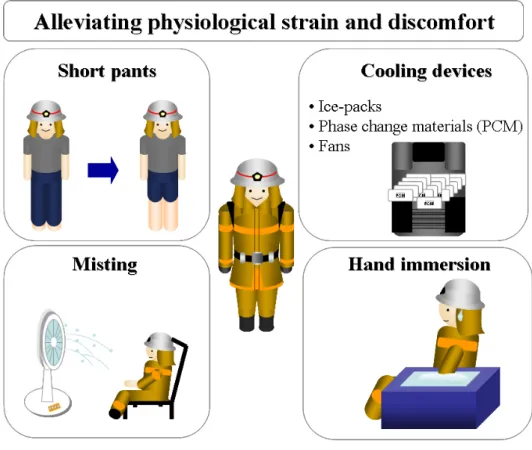
Several different techniques such as using cooling devices (including ice, dry ice, and air-cooled and water-cooled modes of cooling), misting, fans, forearm submersion, etc (Bennett et al., 1957; Konz et al., 1974; Smith et al., 1997; Bishop et al., 1991;
White et al., 1991a; Nag et al., 1998; Carter et al., 1999; Muir et al., 1999; Monobe et al., 2002a, b; Duffield et al., 2003, 2007; Price and Mather 2004; Ross et al., 2004;
Selkirk et al., 2004; Carter et al., 2007) are available to extend work capacity in the heat and to accelerate rehabilitation from hyperthermia. It has been found that using a cooling vest with ice-packs can reduce heart rate, skin temperature and perspiration rate (Muir et al., 1999; Webster et al., 2005). Bennett et al. (1995) and Carter et al. (1999)
19
Chapter1 General Introduction
have reported that torso cooling attenuates the rise in core temperature with reductions of 0.4 to 1.7 ºC in a variety of occupations, including firefighters. Recently, the use of phase change materials (PCM) has been applied in many fields, such as in garments, home furnishings and cooling products (see Appendix A). Pause et al. (2003) and McLellan and Frim (1998) reported that a protective suit with PCM can slow down the rate of temperature increase and prevent heat stress. PCM can reduce thermal stress and provide improved thermal comfort for wearers of protective clothing (Mondal, 2008; Reinertsen et al., 2008).
An additional technique of alleviating the impact of excessive heat strain is using hand and forearm cooling, as an effective technique to accelerate recovery from hyperthermia (House et al., 1997; Selkirk et al., 2004; Carter et al., 2007). Hand and forearm immersion in cool water at 10ºC and 20ºC reduced heat strain quickly and effectively dropped from 1.2 to 1.6ºC for 25-30 minutes to accelerate recovery from hyperthermia in heavy firefighters clothing (House et al., 1997). Moreover, Selkirk et al. (2004) found that using forearm submersion at 17ºC reduced heat strain effectively during the first rest period core temperature dropped 0.4ºC, mister reduced heat strain effectively during the first rest period core temperature dropped 0.08ºC (Selkirk et al., 2004; Cater et al., 1999). Fan cooling has been found to attenuate the rise in core
20
temperature by 0.6-0.7 ºC during work and rest periods.
McLellan and Selkirk (2004) and Malley et al., (1999) reported reduced physiological responses when wearing short pants and T-shirts under a firefighting protective uniform, compared with wearing long pants and T-shirts.
Figure 1.7 shows a simplified representation of methods of alleviating physiological strain and discomfort.
Figure 1.7. Diagram of methods of alleviating physiological strain and discomfort
21
Chapter1 General Introduction
1.6 Objectives of this thesis
A number of studies have documented the environmental, physiological, and physical stress of physically demanding firefighting duties, which physically demanding.
Hence, it is important to design ways of alleviating physiological strain and discomfort in firefighters’ protective clothing, in order to protect firefighters.
Therefore, the present study, investigated physiological and subjective responses to different garments during strenuous firefighting activities by examining clothing property factors related to the physiological effects on the firefighter. Techniques of alleviating physiological strain and enhancement of performance while wearing firefighters’ protective clothing were also investigated.
22
1.7 Structure of this thesis
1.7.1
Chapter 2: Effect of clothing properties on physiological and subjective responses of working firefighters’ protective clothing
The purpose of this study was to investigate the physiological and subjective responses of four kinds of firefighters’ protective clothing and a light work garment during strenuous firefighting activities by examining clothing properties such as clothing weight, thermal insulation (clo-value) and resistance to latent heat, and factors related to physiological effects while wearing for firefighters’ protective clothing.
Publication
Chapter 2 has been submitted to the Journal "Industrial Health", under the title “Effect of clothing properties on physiological and subjective responses of working firefighters’
protective clothing” (Chinmei Chou, Yutaka Tochihara and Mohamed Saat Ismail).
23
Chapter1 General Introduction
1.7.2
Chapter 3: Physiological and subjective responses to cooling devices on firefighting protective clothing
The purpose of the this study was to examine ice-packs and phase change materials cooling devices for reducing physiological load based on subjects’ physiological and subjective responses under the condition of exercising on a bicycle ergometer while wearing firefighting protective clothing in a relatively high temperature environment.
Publication
Chapter 3 has been published in the "European Journal of Applied Physiology", Vol 104 (2), p369-p374, 2008, under the title "Physiological and subjective responses to cooling devices on firefighting protective clothing" (Chinmei Chou, Yutaka Tochihara and Taegyou Kim).
24
25
1.7.3
Chapter 4: Effects of wearing trousers or shorts under firefighting protective clothing
on physiological and subjective responses
The purpose of this study was to examine the effects of wearing trousers or shorts under firefighting protective clothing using Phase change materials on physiological and subjective responses with a 30-minute exercise period which is the average Japanese actual firefighting task time.
.
• Chapter 2
Effect of clothing properties on physiological and subjective
responses of working firefighters’ protective clothing
2.1 Introduction
Firefighters work at a variety of strenuous tasks in varied environments while wearing firefighting protective clothing. Hence, firefighters’ protective clothing should be designed with great heat, flame, and water-resistant properties to protect wearers.
However, it has been reported that protective clothing causes physiological stress, which increases skin temperature, heart rate and core body temperature (Bishop et al., 1994;
Duncan et al., 1979; Faff and Tutak, 1989; Smith et al., 1997). Duncan et al. (1979) reported that insulative clothing led to greater physiological strain when working in high temperatures. The strain and discomfort occurred when wearing protective clothing in conditions of great thermal storage from body metabolism and heat stress from fire.
Moreover, Tochihara et al. (2005) conducted a survey of 796 Japanese firefighters to investigate their experiences of heat illness during training, firefighting activities and firefighters evaluation of their protective clothing. It was reported that 48.6% had experienced feelings of illness because of high temperatures during the previous summer.
Davis and Santa Maria (1975) mentioned that while wearing firefighting protective
27
Chapter2 Effect of clothing properties on physiological and subjective responses of working firefighters’ protective clothing
clothing under a moderate workload, walking efficiency decreased by 33% before a firefighter worked at a strenuous firefighting activity. Alleviating physiological strain and discomfort could result in firefighters’ increased ability to concentrate on efficient firefighting. It is important to consider that firefighters’ protective clothing should be designed to alleviate physiological strain and discomfort.
Thus, although it seems that the development of the material and efficiency of firefighting clothing has advanced in recent years, research has not fully investigated the physiological burden whilst wearing firefighting clothing. Moreover, although much research has been carried out regarding the physiological responses to firefighter protective clothing (Faff and Tutak, 1989; Graveling and Hanson, 2000; Mclellan and Sellirk, 2004), little is known regarding specific clothing property factors pertaining to its physiological effects.
Therefore, the purpose of this study was to describe physiological and subjective responses of four kinds of firefighters’ protective clothing and a light work garment during strenuous firefighting activities by examining clothing properties such as clothing weight, thermal insulation (clo-value) and resistance to latent heat, and factors related to physiological effects while wearing firefighters’ protective clothing.
28
2.2 Methods
2.2.1 Subjects
The subjects were eight male Fukuoka City firefighters. The physical characteristics of the subjects were as follows (mean±SD): age 35.8±3.8 years; height 169.9±5.0 cm;
weight 68.9±11.2 kg; body mass index 23.9±4.0 kg·m-2 and the maximal oxygen consumption 48.6±6.9 ml·min-1·kg-1. The subjects were informed of all details of experimental procedures and the associated risks and discomforts. Each subject gave informed consent before participation. This study was approved by the ethical committee of Kyushu University.
2.2.2 Determination of the maximal rate of oxygen consumption
The maximal oxygen consumption (V
・
O2 peak) was measured in a room at 30ºC (a relative humidity of 60%) using an expiration gas analyzer (AE300s, Minato Electronics Inc., Japan) conducted on a bicycle ergometer (Aerobike 75XL, Combi Co. Ltd., Japan).
The subjects wore light clothing: a T-shirt, shorts, socks and running shoes. V
・ O2 peak
protocol was calculated using continuous incremental loading based on Fitchetts (1985).
The protocol was divided into 4 phases of 4 minutes duration each, for a total of 16
29
Chapter2 Effect of clothing properties on physiological and subjective responses of working firefighters’ protective clothing
minutes. Heart rate was monitored for one minute continuously using a Life Scope 6 (Nihon Kohden Co. Ltd., Japan).
2.2.3 Clothing conditions
This study provided five clothing conditions including four kinds of firefighters’
protective clothing (PC1, PC2, PC3 and PC4) and a light work garment, which is currently used by several fire departments offices, as a control (CO).
Table 2.1 shows the specifications for the various types of protective clothing conditions. The PC1~PC4 conditions included protective clothing, basic clothing, gloves, boots, and a helmet. The firefighter’s a light work garment condition (CO) consisted of a work-shirt, basic clothing, gloves, boots, and a helmet. The CO condition used a protective helmet was different to the PCs conditions helmet, and similar to those worn on building sites. The basic clothing consisted of a T-shirt, trousers, underwear and socks. However, no condition included respiratory protection (self contained breathing apparatus: SCBA).
The clothing weight of the four firefighter’s protective garment and a light work garment were as follows- PC1: 2,480 g, PC2: 2,340 g, PC3: 2,160 g, PC4: 1,860 g and CO: 660 g. The thermal insulation (clo-value) of the PC1~PC4 and CO were as
30
follows: - PC1: 1.60, PC2: 1.60, PC3: 1.65, PC4: 1.54 and CO: 1.25 (where 1 clo, or clothing unit 0.155m2 ·ºC·W-1, Gagge et al.[1941]) (data from Tamura, 2007). The resistances to latent heat of the PC1~PC4 and CO were as follows: - PC1: 0.029 kPa·m2·W-1, PC2: 0.045 kPa·m2·W-1, PC3: 0.030 kPa·m2·W-1, PC4: 0.029 and CO:
0.022 kPa·m2·W-1 (data from Tamura, 2007). PC1 had heavier clothing weight than other conditions. The clo-value of PC3 was higher than other conditions, while PC1 and PC2 were the same values. PC2’s latent heat resistance was higher than other conditions. PC1 and PC2 were manufactured with the same water-resistant and heat-insulating material, but there was a difference between PC2 and PC1 in that PC2 had a surface coated by silver aluminized. PC4 used the same heat-insulating layer as PC1; however, PC4 was without a water-resistant layer. All PCs materials were defined by the ISO 11613 (1999) standard except for PC4.
In the PC1~PC4 conditions, the total clothing weight measurement included protective clothing. In the CO condition, the total clothing weight measurement included the work-shirt and trousers. None of the clothing weights for PC1~PC4 and CO conditions included shorts, socks, gloves, boots or helmet.
31
Chapter2 Effect of clothing properties on physiological and subjective responses of working firefighters’ protective clothing
Table 2.1. Specifications for the various types of protective clothing
PC1 PC2 PC3 PC4 CO
Base material (g·m-2)
Aromatic polyamide 280
Aromatic polyamide 280
Aromatic polyamide 240
Aromatic polyamide
240 -
Heat insulation (g·m-2)
Stripe geometry 200
Stripe geometry 200
Waffle geometry 150
Waffle geometry
150 -
Water- resistance (g·m-2)
Moisture -permeable waterproof film 100~140
Moisture -permeable waterproof film 100~140
Moisture -permeable waterproof film 100~140
- -
Surface layer - Aluminum Coated
- - -
Clothing Weight (g) 2480 2340 2160 1860 660
Clo-Value 1.60 1.60 1.65 1.54 1.25
Latent heat resistance ( kPa· m2·W-1)
0.029 0.045 0.030 0.029 0.022 Photo
32
2.2.4 Thermal environments and experiment procedures
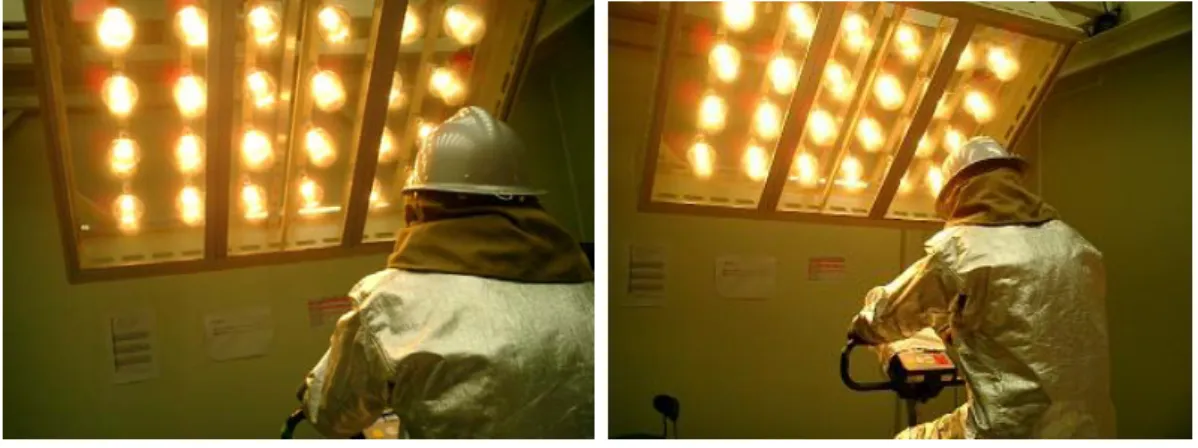
The pre-test room acted as a control and was kept at a constant air temperature (Ta) of 25ºC and a relative humidity (RH) of 50~60%. The test-room was kept at a constant Ta of 30°C with an RH of 50%, and additional infrared heat radiation (1.1 kw·m-2) was used during exercise activities only. During exercise activities the black globe temperature started at 30°C rose to 70°C and then fell back to 30°C. The infrared heat radiation was produced using a bank of 375 W photoflood lamps (Toshiba Lighting and Technology Corporation, R100V375WRHE, Japan). Each subject rested in the pre-test room for 40 minutes before entering the test-room where they rested on a bicycle ergometer saddle for another 10 minutes, followed by exercise and recovery in turns of 10 minutes each for a total of 3 cycles.
The cycles are hereafter referred to as Exercise period I (E I), Recovery I (R I), and so on to Exercise III (E III), and Recovery III (R III). The exercise intensity was set at 30%, 45% and 60% of V
・
O2 peak for E I, E II, and E III, respectively (Figure 2.1, Figure 2.2-a,-b).
Each subject drank 200 ml of water, and then urinated before testing began.
33
Chapter2 Effect of clothing properties on physiological and subjective responses of working firefighters’ protective clothing
70 min Pre-test room
25 degree C, 50~60 %RH
Test-room 30 degree C, 50%RH 0
-40
Rest E I
10-min
30%
Vo2peak
10-min E II 45%
Vo2peak
10-min E III 60%
Vo2peak
-5 1 8 18 28 38 48 58 68 Rectal Temperature
Sensation Skin Temperature
Weight Heart Rate
10-min
Rest R I
10-min R II
10-min R III
★ ★ ★ ★ ★
★
★
★
★
★ ★
.
. . .
70 min Pre-test room
25 degree C, 50~60 %RH
Test-room 30 degree C, 50%RH 0
-40
Rest E I
10-min
30%
Vo2peak
10-min E II 45%
Vo2peak
10-min E III 60%
Vo2peak
-5 1 8 18 28 38 48 58 68 Rectal Temperature
Sensation Skin Temperature
Weight Heart Rate
10-min
Rest R I
10-min R II
10-min R III
★ ★ ★ ★ ★
★
★
★
★
★ ★
.
. . .
Figure 2.1. Experiment protocol and measurement items
(a) (b)
Figure 2.2. Subject remained on a bicycle ergometer saddle during the rest (a) and exercise periods (b)
34
2.2.5 Physiological responses
Rectal temperature (Tre) and skin temperatures were measured with thermistors. The subjects inserted a thermistor to a depth of 15 cm into the rectum. The skin thermistors were placed on the right side of the body (the head, abdomen, back, forearm, hand, thigh, calf and foot). The mean skin temperature (T
_
sk) was calculated using Hardy and DuBois’ equation(1938). Tre and T
_
sk were collected on a portable data logger (Gram, LT-8A, Japan). Heart rate was monitored using a Life Scope 6. Body weight loss (BWL) was determined using change in body weight (±1 g accuracy) (ID1, Mettler Toledo, Japan) weighing before and after the experiment. The absorbed sweat volume in clothing (ASV) was determined using the change in clothing weight (±1 g accuracy) (ID1, Mettler Toledo, Japan) weighing before and after the experiment. The physiological strain index (PSI) was calculated as suggested by Moran et al. (1998) as follows:
PSI=5(Tret-Tre0) · (39.5-Tre0)-1+5(HRt-HR0) ·(180-HR0)-1
Where Tre0 and HR0 are the initial Tre and HR, and Tret and HRt are measurements taken in the last three minutes during the E III period. The PSI was scaled in a range of 0-10 to evaluate heat stress.
35
Chapter2 Effect of clothing properties on physiological and subjective responses of working firefighters’ protective clothing
2.2.6 Subjective responses
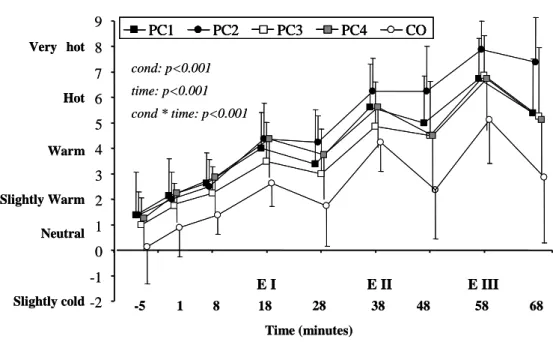
Subjective responses included thermal sensation, thermal discomfort, humidity sensation and the rate of perceived exertion (RPE). The scale of thermal sensation was from slightly cold (-2) to very hot (9). The scale of thermal discomfort was from neutral (1) to very uncomfortable (8). The scale of humidity sensation was from slightly dry (-2) to very wet (7). The rate of perceived exertion was from extremely light (6) to extremely hard (20)(Borg, 1982).
2.2.7 Statistical analysis
The effect of the four kinds of firefighter’s protective clothing and a light work garment on all measurements was examined by a two-way analysis of variances (ANOVA) with repeated measures for rest, followed by exercise and recovery in turns of 10 minutes each for a total of three separate cycles (experimental conditions: PC1, PC2, PC3, PC4 and CO; time). Scheffe’s post hoc comparisons were used to assess significant main effects using ANOVA. In the E III period, the values were analyzed using Pearson's correlation coefficient of variance. Statistical significance was set at p<0.05. The values were presented as mean values with standard deviation (SD).
36
2.3 Results
2.3.1 Physiological responses
Rectal temperature and mean skin temperature
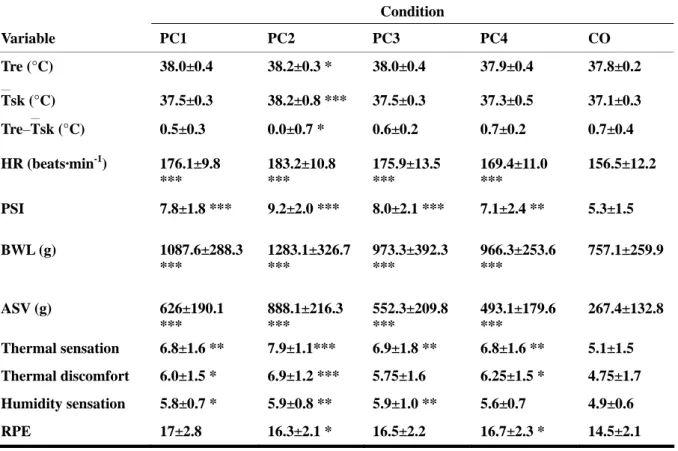
Rectal temperature for eight subjects for one hour fifty minutes duration in the five conditions is shown in Figure 2.3. The Tre showed almost the same transition from beginning to end under all conditions, with a gradual increase following the start of the exercise. The Tre was 38.2±0.3°C at its highest for PC2, 38.0±0.4°C, 37.9±0.4°C, 37.8±0.2°C for PC1, PC3, and PC4 at the E III period. The Tre at PC2 was significantly higher compared to CO conditions (p<0.05). The Tre was 38.8±0.4°C at its highest for PC2, 38.4±0.5°C, 38.5±0.6°C, 38.4±0.6°C for PC1, PC3, and PC4 in R III period at the end of the experiment. The Tre at PC2 was significantly higher compared to PC4 and CO conditions (p<0.05~0.001).
The mean skin temperature at PC2 showed a significantly higher difference than PC3, PC4 and CO conditions at the E III period (p<0.01~0.001) . During the R III period, PC2 was significantly higher compared to all other conditions (p<0.01~0.001).
However, no significant differences were found between PC1, PC3 and PC4.
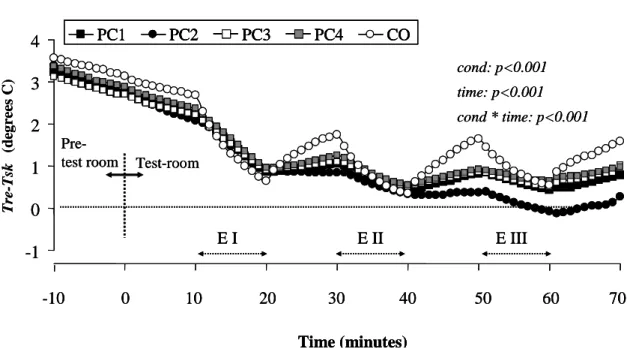
Difference between Tre and T
_
sk (Tre– T
_
sk) showed approximately 3°C at almost
37
Chapter2 Effect of clothing properties on physiological and subjective responses of working firefighters’ protective clothing
the same transition from beginning to the end under all conditions, with a gradual decrease following the start of the exercise. There was a significant decrease below 0 °C in Tre– T
_
sk at PC2 at the end of E III period (p<0.001) and the difference for PC2 was significantly lower than for PC4 and CO (P<0.05). During the R III period, the PC2 were significantly lower compared to PC3, PC4 and CO conditions (p<0.05~0.001) (Figure 2.4).
36.9 37.1 37.3 37.5 37.7 37.9 38.1 38.3 38.5 38.7 38.9 39.1
-10 0 10 20 30 40 50 60 70
PC1 PC2 PC3 PC4 CO
Pre-
test room Test-room
E II E III
E I
Time (minutes)
Rectal Temperature (degrees C)
time: p<0.001 cond: p<0.01
cond * time: p<0.001
n= 8 36.9
37.1 37.3 37.5 37.7 37.9 38.1 38.3 38.5 38.7 38.9 39.1
-10 0 10 20 30 40 50 60 70
PC1 PC2 PC3 PC4 CO
Pre-
test room Test-room
E II E III
E I
Time (minutes)
Rectal Temperature (degrees C)
time: p<0.001 cond: p<0.01
cond * time: p<0.001
n= 8
Figure 2.3. Time courses of the rectal temperature (Tre) of PC1~PC4, and CON.
Values are means.
38
Tre-Tsk(degrees C) -1
0 1 2 3 4
-10 0 10 20 30 40 50 60 70
Time (minutes) Pre-
test room Test-room
E I E II E III
time: p<0.001 cond: p<0.001
cond * time: p<0.001
PC1 PC2 PC3 PC4 CO
_ Tre-Tsk(degrees C)
-1 0 1 2 3 4
-10 0 10 20 30 40 50 60 70
Time (minutes) Pre-
test room Test-room
E I E II E III
time: p<0.001 cond: p<0.001
cond * time: p<0.001
PC1 PC2 PC3 PC4 CO
-1 0 1 2 3 4
-10 0 10 20 30 40 50 60 70
Time (minutes) Pre-
test room Test-room
E I E II E III
time: p<0.001 cond: p<0.001
cond * time: p<0.001
PC1 PC2 PC3 PC4 CO
PC1
PC1 PC2PC2 PC3PC3 PC4PC4 COCO
_
Figure 2.4. Time courses of the difference between rectal temperature and mean skin temperature of PC1~PC4, and CON. Values are means.
Heart rate
In Figure 2.5, HR increased during all exercises across time in the five conditions and decreased during all recovery periods. At the E III period, HR of PC2 (183.2±10.8 beats·min-1) was significantly (p<0.001) higher compared to PC4 and CO, however, no significant difference was found between PC1, PC3 and PC4. At the R III period, the HR of PC2 was significantly higher compared to all other conditions (p<0.01~0.001).
39
Chapter2 Effect of clothing properties on physiological and subjective responses of working firefighters’ protective clothing
Heart Rate (beats·min-1)
60 80 100 120 140 160 180 200
-10 0 10 20 30 40 50 60 70
Time (minutes) Pre-
test room Test-room
E I E II E III
time: p<0.001 cond: p<0.001
cond * time: p<0.001
PC1 PC2 PC3 PC4 CO
Heart Rate (beats·min-1)
60 80 100 120 140 160 180 200
-10 0 10 20 30 40 50 60 70
Time (minutes) Pre-
test room Test-room
E I E II E III
time: p<0.001 cond: p<0.001
cond * time: p<0.001
PC1 PC2 PC3 PC4 CO
60 80 100 120 140 160 180 200
-10 0 10 20 30 40 50 60 70
Time (minutes) Pre-
test room Test-room
E I E II E III
time: p<0.001 cond: p<0.001
cond * time: p<0.001
PC1 PC2 PC3 PC4 CO
PC1
PC1 PC2PC2 PC3PC3 PC4PC4 COCO
Figure 2.5. Time courses of the heart rate (HR) of PC1~PC4, and CON. Values are means.
Physiological strain index
The physiological strain index was greatest in PC2 at 9.2±2.1, followed by PC1 at 7.8±2.0, PC3 at 8.0±2.2, PC4 at 7.1±2.6 and CO at 5.3±1.6. Among PC conditions, the PSI of PC2 was significantly greater than in the PC4 condition (p<0.001). The PSI of the CO condition was significantly lower than all protective clothing conditions (p<0.001).
40
Body weight loss
There was a significant effect of the subjects’ body weight on BWL (p<0.001). In four protective clothing conditions, the BWL at PC2 (1.3±0.3 kg) was significantly higher compared to PC1, PC3 and PC4 (p<0.05, p<0.001), however, no significant differences among PC1, PC3 and PC4 were ascertained. The BWL of the CO condition (0.8±0.3 kg) was significantly lower than all protective clothing conditions (p<0.001).
Absorbed sweat volume in clothing
There was a significant effect of clothing weight on the absorbed sweat volume in the clothing (p<0.001). In four protective clothing conditions, the ASV at PC2 (0.9±0.2 kg) was significantly higher compared to PC1, PC3 and PC4 (p<0.001). A significant difference existed between PC1 and PC4 (p<0.05), however, none was apparent between PC3 and PC4, or between PC3 and PC1. The ASV of the CO condition (0.3±0.1 kg) was significantly lower than all other protective clothing conditions (p<0.001).
41