59
Foreign Language Policy in Japan
--Historical Study Through Textbooks—
Masako Kamijo
Introduction
Japan was controlled under the Feudal system of the Tokugawa Shogunate for about 250 years until 1868 ; meanwhile she closed her borders to the world except for a few countries. With increasing pressure to open her borders by advanced countries from the 1850's, Japan was compelled to open the country under the complicated climate of her society.
In order to begin Japan's diplomatic relations with advanced countries and to maintain Japan's independence, Japan promoted modernisation and industrialisation on the western model by promot- ing "Civilization and Enlightenment" and "National Prosperity and Defense" from 1868. As a result, Japan achieved modernisation and industrialisation in the 1970's, an achievement to which the modern education system established on western model in 1872 contributed.
National policy is reflected in the textbooks of each period, for textbooks in elementary and seconday schools have been written based on the official manual for the school curriculum, which are then authorized by the state or compiled by the State. Thus the purpose of educating ideal Japanese citizens is indicated in the text- books (Nagata, 151). Foreign languages, especially English were the most important subjects as a practical means of obtaining informa- tion and ideas from advanced western countries.
In this respect, this paper tries to study the changes in English language policy as reflected in textbooks historically from 1872 until the present on the following topics
I National policies seen in school textbooks in general II Foreign language policies seen in school organizations III English teaching policies seen in English textbooks
I. National policies seen in school textbooks in general
The Ministry of Education from 1872 made an effort to edit appropriate textbooks in its editorial department and began to control textbooks from 1880 by not adopting textbooks which distur- bed public peace, morals and education. Such a control was realized in the system of authorized textbooks by the State from 1886 and the system of textbooks compiled by the State from 1902.
The way in which national policy is reflected in textbooks of each period is explained by the following five periods (Nagata, 151-157).
1~ Chaotic period : Japanese version of western textbooks and textbooks influenced by Confucian ethics (1872-1855), 2®Textbooks infusing Nationalism : authorized textbooks by the State and text- books compiled by the State (1886 - 1909 ),CD Textbooks infusing Imperialism : textbooks compiled by the State (1910 -1932 ) , Textbooks infusing Fascism : textbooks compiled by the State (1933- 1944 ), ®5 Textbooks infusing Democratism : textbooks compiled by the State and authorized textbooks by the State (1945-) .
1. Chaotic period (1872-1885)
In the beginning of the chaotic period, the `Civilization and Enlightenment' policy was taken in education in order to obtain knowledge and ideas in advanced western countries for establishing modern systems in all fields and modernizing Japan on the western model. Under this policy textbooks were influenced strongly by America, Britain and France and the import of universal and enlight- ened ideas. Accordingly, text books in a Japanese version of western textbooks were used in all schools. Western textbooks were used for most subjects, e.g. mathematics, geography, history in upper secon-
Foreign Language Policy in Japan 61 dary schools and universities (Ohmura, 229) .
From the 1880's the Meiji government switched the policy from
`Civilization and enlightenment' t
o Obedient policy to control educa- tion by confucian ethics. It was because the government considered it dangerous to the system that citizens awaken to spontaneity and independence through the enlightenment policy , as it was seen in the
`Democratic movement'
. With this policy the government began to control editing textbooks in normal schools and elementary and secondary schools both public and private.
2. Textbooks infusing Nationalism (1886-1909)
Nationalism assumed greater prominence in the 1880's and educa- tion was increasingly influenced by Herbart's school of Germany.
Minister of Education, Urei Mori adopted a system of authorized textbooks by the State in 1886. Textbooks were given a role to educate children with a nationalistic nature, when the Imperial rescript on Education of 1890 was adopted as the principle of the system of authorized textbooks. Such a role is shown in ideal teachers who had to learn obedience, friendship and dignity in militaristic training.
In 1902 the authorized textbooks changed to the first textbook compiled by the State. It was when the Anglo--Japanese Alliance was concluded and the time of capitalism began to flourish. Being affected by this climate, textbooks showed modern ethics and human- ity of Britain and America, as seen in topics on Benjamin Franclin , George Wasghington and Abraham Lincoln in moral textbooks, while textbooks stressed on nationalistic and oriental morals.
3. Textbooks infusing Imperialism (1910-1932)
Prior to World War I (1914-1918) the Second textbook compiled by the State was adopted. It aimed to consolidate the Imperial State by uniting family-state relations, in which attachment to the family,
ancestors, and fidelity to the head of a family were concentrated on with the Emperor as a symbol uniting the state.
The Third textbook compiled by the State was adopted in 1918. In the climate at the end of First World War in the same year and with Japan joining as a member of the League of Nations in 1920, text- books showed features of the democratic and American progressive school. International cooperation, pacifism, democratism were stressed in "Letters from America" in Japanese language textbook, while Shintoism was taught in the history textbook.
4. Textbooks infusing Fascism (1933-1944)
The Fourth and the Fifth textbooks compiled by the State were adopted : the Fourth was when Japan withdrew from the League of
Nations in 1933 and the Fifth was when Japan joined in World War II in 1944. Nationalistic characteristics which had been latent in the Third textbook appeared on the surface after the Manchuria Incident
of 1931. The Fourth textbook was strongly influenced by German and Italian fascism, which aimed children to be loyal subjects. The Fifth textbook showed militaristic aspect encouraging children to cooper-
ate with the War. The variety of textbooks were limited because of scarce materials in 1940 and textbooks in 1944 were compelled to be authorized textbooks. Some of these examples are stated in the study on English textbooks (Ohmura, 275-276) .
5. Textbooks infusing Democratism (1945)
This period is divided into three parts : 1) textbooks compiled by the State (1945-1947), 2) authorized textbooks by the State (1948- 1951) and 3) authorized textbooks by the State after 1952.
1) 1945-1947 : Immediately after the end of World War II, the prewar textbooks were used with painted out passages about military matters by the order of the American Occupation Fouces (Ohmura, 278) . The American Educational Mission came to Japan in 1946 and
Foreign Language Policy in Japan 63 recommended decentralisation of the education system
, nine years compulsory education and democratization of textbooks in order to democratize militant Japan. With the American recommendation
, the Fundamental Law of Education and School Regulation Law for Education were promulgated and the system of 6 years elementary school and 3 years lower and 3 years upper comprehensive secondary schools was put into effect. According to a tentative official manual on the curriculum, the Sixth textbook compiled by the state was adopted in 1947.
2) 1948-1951 : The authorized textbook system resumed on April 30, 1948 and the first authorizied textbook in the postwar was published in August of the same year (Ohmura, 277) . Authorized textbooks thereafter were edited on the former model ; however their contents were thoroughly examined by CIE (Civil Information Edu - cation Section).
3) After 1952 : It was from 1952 when the Peace Treaty between Japan and America was concluded that the Ministry of Education alone authorized textbooks. The authorization standard was strict , for there were absolute and necessary conditions for authorization
, which became uniform from 1958 (Ohmura , 278).
Prewar textbooks centred on morals based on Confucian ethics and Japanese history were replaced by newly introduced Social Studies from America (Nagata, 157). Prewar Moral teaching was abolished and a new Moral teaching was introduced in 1958 . Postwar textbooks aim at infusing democratism and had great American influence . The following shows the goal of children becoming ideal Japanese citi-
zens.
According to the Offical manuals for the curriculum , in Social Studies children should "Understand Japanese land and history as citizens, cultivate a basis of necessary civil character as builders of a democratic, peaceful state and society" . Moral teaching aims that children should "Endeavour to create a rich culture and develop
democratic society and state, cultivate morals for Japanese citizens who can contribute to a peaceful international society". The case of English is stated in the latter section.
The revised new official manual for the curriculum in 1989 introduced the subject of "Life Environment Studies" in elementary schools, "Home Economics" to be compulsory for both sexes and
"Oral Communication" as a subject . With these changes, textbooks aim at educating children who could cope with social changes, e.g.
internationalization, advanced information, global warming, people living longer etc. Yet, the Official manual for the curriculum as a national standard is problematic, since it restricts the freedom of teaching content in textbooks (Nagata, 311) .
II. Foreign language policies seen in school organizations
The state of teaching foreign languages regarding subjects, various schools and foreign teachers, is described here.
1. 1872-1945
From 1872 foreign languages, e.g. English as the first foreign languages, German, French, Russian, Chinese, Korean, Latin were taught as a required subject in general for secondary schools, e.g.
Normal schools, special training schools, miscellaneous schools, even in elementary schools as an elective subject (Sato, 156-200). Foreign teachers were employed in schools of the Ministry of Education and public and private schools. Table 1 shows the "Number of Foreign Teachers by Nationality and Period". The above shows a pressing need for Japanese to study foreign languages, especially English as the main language, in order to obtain western information in line with the policy of "Civilization and Enlightenment".
The first foreign language was English and the second was German or French in general in lower secondary schools and upper secondary schools, in the latter of which Latin was introduced as an elective language in 1886. English was taught in Normal schools.
Table
Foreign Language Policy in Japan 65 I Number of Foreign Teachers by Nationality and Period Period 1867 1873 1878 1883 1888 1893 1898 1903 1908
Nationality 72 -77 -82 -87 -92 -97 -1902 -7 -12 Total
Germany 9 33 25 22 17 13 10 4 3 136
Britain 9 12 14 11 11 7 6 4 5 79
U. S. A. 13 20 11 5 5 3 3 4 3 67
France 7 13 5 3 4 3 3 2 3 43
Others 2 4 4 1 3 4 5 23
Total 40 78 59 45 37 27 25 18 19 348
tfiI \ Japan International Cooperation Agency, Handbook for General Orien- tation, p. 79
There were many students who specialized in western learning , thus various special training schools were established and flourished . Schools where foreign teachers taught were called special training schools from 1872 and such schools included foreign language schools , commercial schools, fine arts schools, music schools etc . In Tokyo Foreign Language Schools, English, French , German, Russian, Chinese were taught to learn conversation, writing , grammar and composition. In commercial schools, departments of French , German, Chinese, Korean were opened besides the English department . Italian teachers taught in the departments of Drawing and Sculpture between 1876-1892. Music teachers were invited from America to
engage in the study of meter theory and melody in Tokyo Music School in 1880. English studies was taught even in Girls schools which aimed to educate modest ladies.
Miscellaneous schools offered the Studies of English , French, German and Russian in 1885. Subjects of the English Studies were given in private schools, some of which later upgraded to univer- sities, e.g. Keio, Doshisha, Military university and Naval Engineering School.
2. After 1945
Official manuals for the curriculum in lower and upper secondary schools state the purpose of learning foreign languages in textbooks as follows : "It aims to develop the basic ability to express oneself in foreign languages, to increase an interest in languages and to under- stand about the life and thinking of foreigners." The purpose and teaching contents for English, German and French are indicated separately in the Official Manual for the Curriculum of upper secon- dary schools for each grade. English is taught from lower secondary schools as an elective subject. The revised Official Manual for the Curriculum of upper secondary Schools in 1989 introduced for the first time the subject of Oral communication in English area studies
and German and French are mentioned as elective subjects.
III. English policies seen in English textbooks
Unlike the textbooks in general being categorized by the period of changes of textbooks, a history of English textbooks is categorized by the Japanese calendar except for the first period as follows
(Omura, 1-3) .
GD Before authorized textbooks by the State (1872 1886 ), Meiji era from 30-45 (1897-1911), CD Taisho era (1912-1925), Showa era, pre World War II (1926-1939), 0 Showa era during the World War II (1940-1945), © Showa era, post World War II (1945-)
1. Before authorized textbooks by the State (1872-1886)
In the eary period of the Meiji era Japanese people were trying hard for Civilization and Enlightenment. In order not to be colonized and but to modernize Japan by importing western civilization, Eng- lish was the means of restoring the state. Accordingly, Japanese people were enthusiastic for learning English, having followed Eng-
land the strongest country in the world as a model. However English textbooks were influenced greatly by America, for the development
Foreign Language Policy in japan 67 of English textbooks was remarkable in America in order to unite the country as an English speaking country.
English textbooks were imported books or reprinted textbooks . In secondary schools pupils learned various subjects such as geography
, history, mathematics, biology and zoology through textbooks in English. Almost all English textbooks of spelling , readers, grammar were from America. Textbooks of world geography and world history were used to learn western civilization . The following text- books were popular.
Learning English began with the 'Webster's Spelling Book' by Noah Webster (1756-1843). The next step was to read 'Peter Parley's Universal H istory, On the Basis of Geography' . This world history of 718 pages stated the history of each country in the order of Asia
, including Japan, Europe, America and Oceania ; it was written for young children by an American (Ohmura, 4,6).
`Michell's New School G
eography, 1887' of 456 pages was also popular in lower secondary schools. The following passages interest- ingly describe different cultures comparing civilized and non civilized countries (Ohmura, 17-18). "Half-civilized nations , however, are jealous of strangers, and treat their women as slaves. China, Japan, Turkey, and Persia are the principal countries of this class ." "In this way comforts and luxuries are provided , and the bulk of the people are rendered contented and prosperous. The best examples of enlight- ened nations are the United States, England , France, and Germany."
`Elementar
y History of the United States by G.P. Quackenbos, 1886' and `A Pictorial History of England by S.G. Goodrich' are medium level texts.
The following textbooks describe the life , customs, thought and religion in Europe and America (Ohmura , 32-36). Wilson's Reader 2, Part V, Lesson II, Spring Time' described the rural landscape in America, while encouraging children not to forget about God . Others are `GENERAL HISTORY OF CIVILIZATION , IN MODERN EUR-
OPE, FROM THE FALL OF THE ROMAN EMPIRE TO THE FRENCH REVOLUTION' by M. Guizot, Ninth America, from the Second English Edition, by C.S. Henry et al, Kaishindo Co., 1891 and 'HISTORY OF CIVILIZATION IN ENGLAND' by Henry Thomas Buckle, Vol. 1. from the Second London Edition, New York, 1883.
In the lower secondary school textbook, `New National First Read- er' by A.S. Barnes & Co., New York, 1893 and its series, family life and rural life of American people and moral stories are described in conversational style with illustrations on each page. Volume 5 (480 pages) includes 100 lessons on famous works of writers in Europe
and America, e.g. Dickens, Irving, Andersen, Beethoven (Moonlight sonata) (Ohmura, 1-82).
2. Meiji ear from 30-45 (1897-1911)
Textbooks by Japanese scholars began to appear, while British and American textbooks were also used. Accordingly, there were various types of textbooks of mixed elements, some of which were individual- istic (Ohmura, 82-84, 143). In this period, having been affected by Nationalism, textbooks became authorized by the State then compiled by the State. Such a policy is shown as follows. The Ministry of Education requested Walter Daniel to write `English readers - The High School Series' (84-143) . In its Lessons, contents on Japan and China such as `The Moral Courage of Tadaoki's Wife' and `MOSHI's Early Training' increased. It was said to be a failure as an English textbook in terms of contents. English texts on reading, grammar, composition and translation written by Japanese scholars indicate increasing western knowledge and initiation of Japanese people in English.
3. Taisho era (1912-1925)
The content of textbooks was not imperialistic in the 1912's since those in the foremer period were revised and used. Later democratic
Foreign Language Policy in Japan 69 contents were increasingly written into the textbooks.
Teachers in Normal schools and universities began writing English textbooks, joining in the publishers' commericial policy . Textbooks stressed reading and translation, affected by the entrance examina- tions and Juku, which is a private non-formal institution to help children for entrance examinations (Ohmura, 82, 143). `Crown Readers' had democratic ideas and British and American contents such as "Friendship Among Nations". `The International Readers' , 5 Volumes by Masuda were authorized for publication during the midst of World War I and were used in all schools (Ohhara , 152). These textbooks adopted universal common topics such as National Col- ours, The Baseball, Department Stores, The Theater , The Concert and The Duty of Vote. Topics on The Camera, Air ship and Aero- planes appeared for the first time in textbooks. It was the time when baseball was popularized.
4. Showa era pre World War II (1926-1939)
Including western and American cultures in English textbooks continued and an interest in learning spoken English increased , for which Palmer was invited and the direct method developed. However , theory and practice in English learning did not meet the needs of entrance examinations and teachers. Abolishing English as a subject was discussed from 1924. In 1927 Professor Fujimura of Tokyo Imperial university anounced "the pressing needs of disposing English as a subject" in a Magazine, `Gendai'. In 1927 public opinion support- ed it at large that English learning was not useful and rather an obstacle to other subjects. The variety of English textbooks de- creased towards the beginning of the World War II and learning English lost its status as the main subject.
Palmer was the main writing of English textbooks in this period . He wrote the following authorized textbooks ; The Standard English Readers, 4 Volumes and The Abridged Standard Readers. Topics of
the former were interesting such as ENGLISH WIT AND HUMOUR, GOOD LOGIC, PUNS, RIDDLES. In spite of his hard work in terms of the content, his textbooks were found not satisfac- tory, for he did not stress structural differences in linguistics between Japanese and English. Yet, the technical method of beginning to learn English from the spoken form influenced greatly on the latter text- books.
COMPASION READERS, 1924, Revised in 1936 by Ijima was said to be an excellent text book for children and teachers, for it included measures to cope with the entrance examination, thesis on English and English literatures, cities and rural life in Europe and America, manners and customs e.g. English, a World-Wide Language ; What it Literature ?, The Postman, Christmas, An English Breakfast, The World's Chief Industrial Regions, A Day's Sight-Seeing in London, Impressions of America, Restless Energy of American People (Oh- mura, 106, 161) .
5. Showa era during the World War II (1940-1945)
During World War II, textbooks compiled by the state to infuse Fascism continued. In 1937 various controls were increased by the Sino-Japanese Incedent and the breaking out of World War II in 1941. Teaching English was affected greatly by the War. In some military schools English teaching and research continued but teach- ing English almost ceased in secondary schools. The English reading textbook was limited to five kinds in 1941 and English teaching hours decreased to four hours per week in 1943 (Ohmura, 195) .
As English textbook throughout oral method was written by Hoshiyama et al according to the state policy and compiled by the state ; this was used from 1944. Infusing Fascism and militarism was found significant in the textbook on colours, illustrations, contents as follows. In the former English Readsers, their titles were written in English such as `NEW KING'S CROWN READERS BOOK 1', which
Foreign Language Policy in Japan 71 changed to Japanese titles. The design of Crown on the cover of the textbook changed to Mt. Fuji, for the former raised an issue in the Diet. English Readers which introduced cultures in Europe and America changed to the goal of establishing Japan's identity. Illustra- tions in the text were, e.g. national combat cloth with field service cap, battleplane, Japanese flag and Tom playing footall and Mary playing tennis, then a Japanese boy and a German boy, which shows the state policy of contrasting Britain-America and Japan-Germany.
`The North Wind and the Sun' by Aes
op, whose theme is about migratory birds leaving to the South, pushes children to think of their father and brothers who were sent as soldiers to the South. `Be a Good Japanese' is a military topic which was to define an ideal Japanese in the war time.
A consideration of British and American cultures was also found in topics such as English Meals, Christmas, How We Spent a Week.
This accords with the object of English teaching in 1943, that is `to develop one's ability to understand foreign language and to speak in public', to recognize correctly on foreign information, which should help one's national awareness.
6. Showa era, post World War II (1945-)
The way in which textbooks were compiled followed the same procedure as other subjects.
1) 1945-1947 : When World War II ended, teaching English restar- ted. English teaching was adopted in compulsory education of lower secondary schools as an elective subject, but not in elementary schools. On the basis of the tentative textbooks, `Let's Learn English, Volume 3' compiled by Ministry of Education and `The World Through English, 3 Volume' with `The Road to English' grammar for upper secondary schools, which were the first kind of authorized textbooks for new upper secondary schools were published (Ohmura, 277) .
`Let's Learn English' was a conversational style text for all round purposes including reading and listening. Its title seemed to be taken from the American text, `Let' Read'. British style hithertofore in use such as `Have you a pen ?' changed to American style, `Do you have a pen ?'. The contents of Volume 1 centred around home and school life of secondary school children in Britain and America e.g. My parents, Mary goes to church on Sunday, School subjects, Our town
(Ohmura, 204). The Volume 2 stressed world famous events, stories or biographies such as Gulliver's Travels, Graham Bell and The Telephone. The Volume 3 introduced manners and customs, history, culture, poems, e. g. All Fools' Day, Independence day, Payne, Home, Sweet Home.
`The World Through English
, 3 Volumes' included topics such as English Literature, Essays of Bacon's Essays, Thoreau's Walden, Shakespeare's Julius Caesar, John Lock and their titles showed a strong will to learn about the world through English.
It was a confused era for English teaching in the immediate postwar. The number of secondary schools increased, while the number of teachers was short. The Oral Approach of an American scholar of English, Charles Fries Carpenter was introduced. Educa- tional materials such as audio visual and L. L. (language labolatory) gradually developed and were adopted. Educational materials on the whole stressed American English after 1948 ; pronounciation, gram- mar, usage in English. A variety of topics in English textbooks were required for the purpose of helping children to `understand basically daily life, manner and customs, thinking of people using foreign languages', which has been the same from 1872. The official manual for the curriculum was revised with social changes ; accordingly the content of English textbooks was changed to cope with social prob- lems.
The recent official manual for the curriculum was revised in 1989.
As a result, the content on natural environmental problems in the
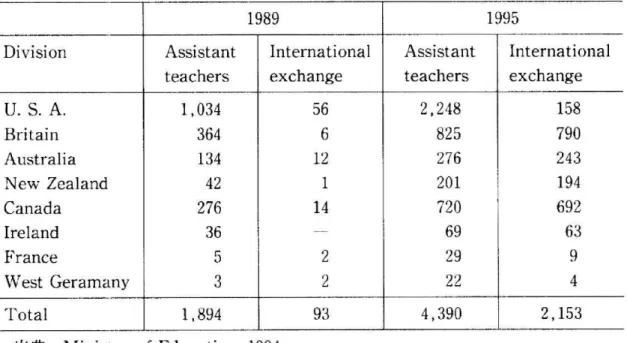
Foreign Language Policy in Japan 73 world such as destruction of nature or global warming were introduced in English textbooks ; "Earth Day", `New Total', Shubun- sha in lower secondary schools or "Tropical Rain Forest", `Creative English Course 1', Daiichi Gakushusha in upper secondary schools. In English teaching, `Oral Communication' as a subject was also adopted for the first time in upper secondary schools, for which the number of assistant foreign teachers in secondary schools and universities has been increasing. There were 4390 such teachers as of 1995 and Table 2, Number of Foreign Young People Invited under the JET Program
in 1989. shows it in detail (Outline of Education in Japan, 48). The purpose was to educate 'international citizens' who can communicate with foreigners and promote the internationalization of Japan. As a
result, the new secondary school textbooks now stress conversational practice and the content of English textbooks became easier, which has been affecting entrance examinations in terms of including oral
questions. Recently some trial teaching of English on conversational level has been practiced in some elementary schools, which indicates more stress on English teaching.
Table 2 Number of Foreign Young People Invited under the JET Program
1989 1995
Division Assistant International Assistant International
teachers exchange teachers exchange
U. S. A. 1,034 56 2,248 158
Britain 364 6 825 790
Australia 134 12 276 243
New Zealand 42 1 201 194
Canada 276 14 720 692
Ireland 36 69 63
France J 2 29 9
West Geramany 3 2 22 4
Total 1,894 93 4,390 2,153
al .,. Ministry of Education, 1994
Conclusion
Historical examination of English textbooks shows that the state policy influenced English teaching as it did other subjects, however foreign cultures continued as content of English textbooks (Table 3) .
English teaching policy was promoting civilization and enlighten- ment for modernization vigourously from 1872 until modern systems were established, for English was the direct means of getting foreign information. The content of English textbooks was , therefore univer- sal and worldwide including a wide range of information not only culture and literature but also history and geography . Such a zeal for English learning is shown by teaching English in various types and all levels of school, even in elementary school .
Confucian ethics infusing Nationalism is shown by introducing Japanese content and morals in the authorized English textbooks in the 1890's, which seemed to be a failure.
Imperialism did not affect English textbooks since the former textbooks were revised and used. From the 1910's English teaching focused on entrance examinations , which influenced English text- books centred in grammar, composition and translation . Promoting democratism and pacifism was frequently found in English textbooks after 1918 being influenced by end the of World War I and capitalism flourishing.
In pre World War II, the issue of disposing of English was raised by public opinion from 1924 and the variety of English textbooks de- creased. Facism was certainly infused into English textbooks during World War II. English titles and designs on the cover and western illustrations and certain content changed to those of Japanese . The kinds of textbook and teaching hours decreased . Finally English was hardly taught in any schools except in some military schools , which was the English avolition policy .
After 1945 English teaching policy was influenced basically by democratism and American English . Meanwhile it followed the state
Table 3 STATE POLICY Education CIVILIZATION ENLIGHTENMENT
NATIONALISM Educational control Educational Rescript
IMPERIALISM
FASCISM
Foreign Language Policy in Japan Historical Changes of Texstbooks & Policy
Year
1872
1880
1886
1902
1910 1918
1933
1941 1944 1945
1947 1948
1952
1958 1976
1984 1990s
• C. 1. F (Civil
policies of the 1990's.
uniform in teaching m
Type CHAOTIC translation confucian
Authorized
State( 1 )
State(2) State ( 3 )
State( 4 )
State(5) Authorized
State( 6 ) Authorized C. I. E.
Authorized M. E.
TEXTBOOK Context
universal filial piety respect
eldest
modern ethics shintoisrn international pacifism
militalisrn
constitution Fundamental Law of Education
Social Studies
Morals International understanding
interculture
Influence Identity
USA • BRITAIN civilized FRANCE
obedient
Germanyfamily- cent
Capitalismfamily+sta
= Emperor USA
progressive Germany Italy
subject
USApeace
USA
75
ideal Japanese
international cit- izen
citizen global citizen
• C. I. F (Civil Information Education Section)
policies of internationalization from the 1970's and globalism from the 1990's. Yet, the authorized textbook as the national standard and uniform in content would be an issue together with problematic teaching methods to cope with the present social problems.
REFERENCES
Aoki, Kazuo et al ed., `Japanese History', Gakuyoshobo, Japan, 1979.
English textbook for upper seconday school, "THE WORLD THROUGH
ENGLISH 2', The secondary school textbook publishing Co., LTD, Japan, 1947.
English textbook for lower secondary school, `New Total', Shubunsha,
Japan.
English textbook for lower secondary school, `Creative English course 1' Daiichi Gakushusha, Japan.
Furuta Gyo et al ed., `Inter-cultural Communication-Requirements for New International Citizens', Yuhikaku, Japan, 1987, Revised in 1996.
Japan International Cooperation Agency, `Handbook for General Orien- tation'
Kamijo, Masako, The Study on Internationalisation of Japanese Educa- tion', Tagashuppan, Japan, 1989.
Kamijo, Masako, "Can English Contribute to the Internationalisation of Japan ?-Conflict between Traditional and Modern Ideas" in `The
Journal of Psycholgy and Education', Kanagawa University, No.8,
1990, The Study Group of the Teacher Training course, Kanagawa
University, Japan, 1990.
Ministry of Education, `EDUCATIONIN JAPAN-A Graphic Presenta- tion, 1994', Gyousei Publishing Co., Japan, 1989, 1994.
Ministry of Education, Outline of Education in Japan, 1991, Unesco Asia Cultural Centre, Japan, 1991.
Ministry of Education, `Official Manual for the Lower Secondary School Curriculum', 1977, 1994.
Ministry of Education, `Official Manual for the Upper Secondary School Nagata Shin ed., `History of Japanese Education', Ochanomizu-
shobo, Japan, 1979.
Ogawa Yoshio et al ed., `DICTIONARY OF LANGUAGE TEACHING',
Sanseido, Japan, 1964, Revised in 1991.
Omura Kiyoshi et al ed., `History of English Teaching Vol. 3, The Changes in English Textbooks', Tokyo Horeishuppan, 1980.
OECD Education Investigation Group ed., educational Policy of Japan, Asahi Newspaper Co., 1976, pp. 133-140.
Sato Seimi, `History of Education 2', Heibonsha, Japan, 1973.
Shiozawa Toshio et al ed., `Development on New English Teaching',
Eichosha, 1993.
Tanaka Akira, `Iwakura
Foreign Language Policy in Japan 77 Mission Abroad', Kodansha, Japan, 1981.