WORD ACCENT AND RELATED FEATURES IN JAPANESE
an Acoustic Analysis---
Toshiaki Fukasawa
1 Aim
To analyse acoustically the following three points:
i ) What are the acoustic correlates of Japanese accent ? ( ii) When there is more than one Head in a Tune, what are the
acoustic features manifesting them, especially the Head
other than the first one in a Tune ?
(iii) What are the acoustic features of unvoiced morae ?
2 Method
2.1 Material
In order to examine the above points, four groups of words , eleven words altogether, were selected according to their segmental similar- ities and their accentual differences.
Each of the eleven words was put into the frame sentence , which was uttered with Tune 1.: // 1 moo icido/ . ^ to iQte kudasai //
`say ---j again pleas e', literally `more once ---I say please'.
The use of a frame sentence for the examination of accent in Japanese is thought to be an important prerequisite for (i) achiev- ing a close approximation to natural speech , (ii) minimizing extra-
2
neous variability which is expected to be greater when words are uttered in isolation than in a frame sentence and (iii) avoiding the influence of intonation on the duration of the segment in the utter- ance final position, since the segment in the utterance final position is known to be lengthened.
The phonological form of the frame sentence// / //was chosen here in order to examine the acoustic features of a Head other than the first one.
This particular segmental structure of the frame sentence was chosen in order to obtain, when the words are put into it, some unvoiced morae to be examined.
The procedures taken for the preparation of the material for recording was as follows :
(i ) Five tokens for each word, altogether fifty-five tokens were obtained in random order.
( ii) The scripts were all written in Japanese orthography.
The eleven words selected are reproduced below in phonological transcription with English equivalents indicated.
Group 1
/ ikoo / `since, afterwords'
/ ikoo / `let's go' / ikoo / `intention' Group 2
/ jakimoki / `impatiently'
/ kakimoci / `broken rice-cake'
/ jakimoci / `jealousy'
/ kakemoci / `holding additional post' Group 3
/ cikaku / `neighbourhood'
/ cikaku / `perception'
Group 4 / huku / huku
WORD ACCENT AND RELATED FEATURES IN JAPANESE
/ `blow' / 'wipe'
3
2.2 Recording
Three tokens were found to be improperly pronounced , and so they were rejected.
Setting for recording 1.
2.
3.
4.
5.
6.
Distance from lips to microphone : 32 cm Recording level volume : 7
V. U peak intensity reading : —5 dB Recording characterisitic : NAB
Output from oscillator : 48 mV (1 KHz tone) Peak S. P. L. at microphone :
Before recording session ; 44 dB After Recording session ; 44 dB Filter ; LIN
2.3 Acoustic analysis
2.3. 1 Equipment used
All the acceptable tokens were acoustically analysed using a sound spectrograph.
Both narrow -band and wide-band spectrograms were made , with amplitude displays on the narrow-band spectrograms . The trace was not calibrated.
2.3.2 Measurement
Tracings were made of the Fo curve and of the amplitude curve of every token of each set of utterances from the narrow-band
.汐︒コε唱コ≧窯e﹃のbゆ個国εのΦ且g曾←①の︒︒ヨト︒︒︒①薫聴リモ霧お℃①の2り口Φ辺℃﹂o汐bbお鵠↑
8慧N石o豊り鼠・︒も岩唄o山甚
︒欝日①﹄①き轟石9頸り琴2
①琶琶毫885祠5の︒壽娼=咽唱①﹄8ぢこ8巌謁凪こε署ヨ帽三藷茗:角申︒の︒器お畳藷︒︒円.⇔︒国
mU,﹂①ρOOJOOε咽ヱO門O"因UOOε
11 重1■■π置‑冒II'ロE凶トー
ノ 〜
のEOO囲
O∈咽ト 5コ⑩N芒o﹄名集oしoセ咽9 禺呂護25﹄コε2ご
ー
冗
到
4 2脇
裂 響一」 一 卸
.μ
2答
Nエ
(Oη}
WORD ACCENT AND RELATED FEATURES IN JAPANESE 5 spectrograms.
Synchronization for the tracings was made at the onset of the
vocalic element of [o] in [to], which was observed by the sudden
rise of the amplitude trace which took place in every token immedi- ately after the small rise of the trace which corresponded to the release of consonantal element of [t] in [to] . One such exampleof a trace is given below in Fig. 1, p. 4 to illustrate the point of synchronization.
3 Result and discussion
Figs. 2 to 12 (pp. 6 to 16) show the traces of the Fo and the amplitude patterns of eleven sets of utterances which contain the eleven target words.
Each set shows certain variations in the Fo and the amplitude patterns, but there is no token that is noticeably different within each set, so that it can be said that the utterances in each set are homogeneous.
In order to compare the overall Fo and amplitude patterns of the eleven sets of utterances, an average line for each set of traces was estimated visually and drawn (Figs. 13 to 16, pp. 17 to 20) : Figure
13 compares three sets of utterances which contain the words of Group 1. Likewise, Figures 14, 15 and 16 compare the average Fo and amplitude traces for the words of Groups 2, 3 and 4 uttered in a frame sentence respectively.
3. 1 Results on Accent
Accent was defined phonologically in terms of the location of the
"marked" mora in a lexical item .
Fundamental frequency
Figures 13 to 16 clearly show that the Fo traces for the eleven
①9昌①ゼ昌Oq自①自謁﹄鯛郎唱順 .①﹂冨bゆ哨﹂ Φ調"信O脚信O匂自Φ﹂qO﹂σこの口ω図〇一﹂コO﹄
唱①﹄①りリロ\OO出蝋\﹄O鯛①唱=↓踏臓琵娼娼賃¢O﹄鯛Oqロ①9̀﹄﹄ぺN.らめ哨﹄
のOコ﹂●﹂ロOり0OX
M
O石咽oOOE
ー
ー' 1 1
X
6
㌔
7WORDACCENTANDRELATEDFEATURESINJAPA,'ESE
.Φ旨b£属㊤ε¢︒誓ΦωΦaΦ﹂而のお湿2Φ﹀ぼ
85犠①︒︒①罎・3亀︒δ三零﹄①↓ぢ\8着こεぞ3暑蔑帽剛壽ξ}oの8田↑
い ︒︒.営隔
"臼鞘駒ざoρロ0ρO0翠咽O℃りOO薩
1 ノ ' ー
X
.田&浅Φヨロo岩①のΦ拭Φ﹂邸誓幽εΦ﹀に
85り5・︒㊤目"占帽三喝㊤葛βぢ\︒︒着こε①唱ε三蓬煽噂濤︒﹄鯛︒︒︒①冨自寸.⇔︒罠
咽1伺ηコ潔のρO0詞OOX0η碑U0OE
8
9WORDACCENTANDRELATEDFEATURESINJAVANESE
8唱①蔵①㎝①理頸轍邸 ,㊤臼⇔ゆ蛋Φ曇き岩①のΦ乙㊤旨邸︒︒口当ε葺£
﹄唱①﹄3甘こ着巌鶯nこ︒嫡㊥噂ε畳員︒δ唱奮£転e・・8・窃自耽.﹄︒琶
咽田℃コ潔oりO嗣oμ一o嘗輔‑帽hO℃りOOE
①9口①↓昌①ω①類帽﹄鯛帽 .㊤﹄コbゆ帽﹂ Φ調剃¢O剰口ΦのΦレαΦ﹄邸の¢①誠〇一㊤ン囲﹂
口帽宅㊤﹄O↓り5\桐90嘉個讃帽謡\﹄O鯛①唱類謡剛自類⇔唱唱儒O角蝸Oの①⇔帽﹄﹄ドO.⇔め嘱﹂
mUコー①"口耐o同uOE咽ヱ冊潔OηUOOE
ー
ーノ ︽ ' 1
X
WORDACCENTANDRELAZ̀EDFEATURESINJAPANESE
.Φヨbゆ¢㊤餐8蟹ΦのΦa︒亮の萄巷=琴縞
8き誓拐舞"と帽石彫﹄︒↓誓こ8蓬類黒こε㊥唱5個剛島鑓儒娼匿£鯛︒磁8頸↑
O帽OコよO"〇一︒周副UPε潔o﹁oOU b.軸蔵
OOE
①9口8口霧①角弱占帽 ︒㊤﹄&蛋Φ石¢ε岳の㊤拭Φお︒︒毒湿BΦ﹀ぼ
三唱§彗こ8日①莞ミ﹄︒=唱5咽三藷喝慧︒巴︒︒,①9"占︒︒.⇔£露
咽O⑩Oコ﹂O﹂O咽o細咽りO巨O1潔0η判O司00E
1 '
8' '
X
WORDACCENTANDRELATEDFEATi1RESINJAi'ANESE B
8唱8國ou︒①目田細娼三 .①旨b鵡二〇ヨ蓉"器のΦa雲邸宥皇eΦ﹀蔵
窟﹄8ぢこ莞謡矧こε︒窟榊凋三琶弱も壽£噸︒の8誠↑①.ヒ︒国
咽Og臨嘩Oコ﹂oり口一〇ρコ﹂O苫咽OoO咽0瞬OOε
ー 1
,̀ノ ' ー
X
.①ヨbβ匡Φヨ琴芒①の①aΦ詰︒︒口当2㊤﹀刷﹂
①︒5帽①の①日宙と¢唱モ①﹄①りり=\三"着ミ﹄ε①唱3帽三自帽う壽︒﹄もの8頭臼〇一.6£国
i4
刷㎝僑O,淫oρOO﹂コユ帽﹂Oロ℃00OE
WORDACCENTANDRELATEDFEATURESINJAPANESE エ5
,Φ﹄島颪①翁︻倒2竈の①拭Φ﹂而宥幽︒細①﹀己
①呂8器・︒㊥霞¢と"覇噂窺①りぢ\鰐三こε①唱3畳琵6℃慧︒底もの8銭臼
咽O⑩Oコ遮oρO咽Oρコ﹂コ̀OO咽o判 =.⇔£国
OO喋
ーー'
ノ ー
翼
.︒﹂&閏Φヨ琴}8︒,︒aΦおの8漏9Φ﹀蛋 85↓器の①日頭触弱三喝①おβぢ\三三こ︒細名ヨ言琶超宅濤︒﹄もの①器占輯.⇔の罠
咽O国Oコメ①りOO'コざコニoO噂ω咽OOE
ノ
畠■置uI且層1 σ
翼
z6
WORDACCENTANDRELATEDFEATURESINJAPANESE 17
8屋5︒︒舞ε=モ①﹄①りリミ8着.︒︒着.8着こε・︒§ム①薯葺昌藷をぎ隊①⇔の頸①超︒︒一.わ㊨迄
りoηコよo岬α㈲oθ
ppCi
二こOY
咽1咽 咽
oη噌oOO能
\ \ \
..溜・ξ喜
OOざ
oコ
OO﹂ \
周\
ー\ ■●■●⁝ ・郵
4 f
̀906・9.夢の' 岡
層、
亀̀
●̀晶.
;.・ ・。
こ8∈︒莞凶.旧8忌鶯鴨︑刷8巌莞出
ooη3﹄①ρ ㊤o蛋①芒①の①岳弱ζ轄三唱28帽.馨員還副こε§霊①零り愚藷ヨ:口①響﹄①葛
Oσ
0 μ 一
・‑1・d
・W・"1 Y.xuu
OOOIロ
蔭̀∈ 曜E
==に1
掌 嘘
OO 蕊.らo霞
咽oO匠
.'・藷7f‑・
〃
.■冒\ \ \ \
‑uu]
0欝
oE咽
OE
OE 喝翠\
田﹁\
のー\
潟\
i
■■●,∠ 停 ●冥
●
,
609︑.
■・
・ ■ ●
も ■
呵 田 ●
1
,・ ■
、=
z8
WORDACCENTANDRELATEDFEATURES1NJAPANESE
8繧8器の舞頭=£冨﹄①一リミ三能嘱9.三能咽9こε︒︒8銭細署ε嘱剛含閏唱葱£①6︒謹窪く雲.軸筐
UqOコ溺m綱αOθ コ﹂囎
コ藩耐 苫
﹂ 畷O
訓
OO一OO薩\ \
..24
コXm誕U コ誕翰潔dO ..ヨ
\⁝.
\ ●■O
グ
湾.'
●■●・・の■
聾
r
・ ・
■ o■ ●
鼻・
o・
● ψ'.
■
■
ow ,
o
。ニン
X
,..㌔9 讐
¥・ ・
繊●
8昌85の①壽ζ¢石窓おりぢ\三三.三劃こε︒︒︒り窪①唱ε言目帽窯:﹄㊤﹄︒頸窪くo網.⇔︒罠
咽■O"コ忍oμOO﹂ コー,=
,﹂コ̀ O℃U明OO∈ ー..・・.︒劃●・細
タ ー
WORD ACCENT AND RELATED FEATURES IN JAPANESE 21 words are noticeably different, which suggests that the Fo is likely to be relevant to the acoustic description of Japanese accent. In order to study this point in detail, average Fo traces for these target words were visually estimated and drawn from Figs. 2 to 12
(pp. 6 to 16), and are given below (Figs. 17 to 20).
A thick solid line represents the Fo trace for the target word which is actually present on the spectrograms.
A thick dashed line represents the Fo trace for the morae preceding and following the target word which is actually present on the spectrograms.
A thin dotted line represents a gap in Fo on the spectrograms which was filled in by inferring from the movements of Fo sur- rounding the gap (see below for more detailed descriptions of how the line was inferred in each case) .
An arrow represents the approximate location where a sharp descent in Fo was actually observed on the Fo trace. When the location was inferred from the observation of the movements in Fo , it was shown by putting the arrow in brackets.
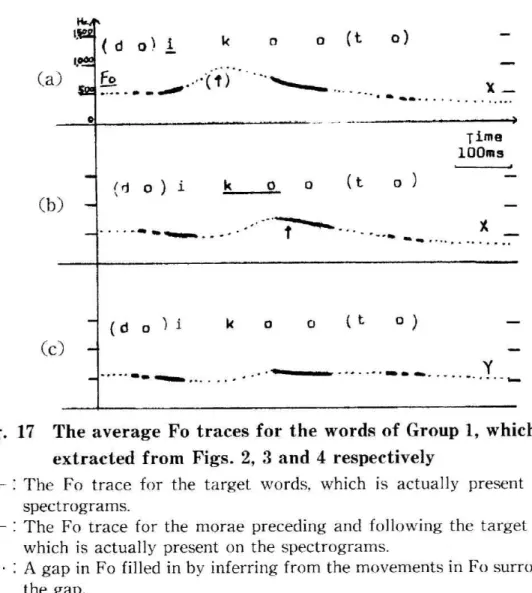
(1) Group 1 /ikoo, ikoo, ikoo / (See Fig. 17 below)
The Fo movements for / i / and / oo / for these words shown in Fig. 17 below suggest that
(i) in the case of (a), a peak in Fo comes somewhere before / 00 / , and that a sharp descent in Fo starts somewhere
between / i / and / ko /,
(ii) in the case of (b), a peak in Fo comes somewhere in the region of / o / after / k /, and that a sharp descent in Fo starts somewhere between / ko / and / o /,
(iii) in the case of (c), a peak in Fo comes somewhere in the region of / o / after / k /, and that there occurs no sharp
descent in Fo.
22
(a)
1.
(d Fo_ .
o) i k o 0
p w
(t o)
w ..•II.. . . x
(b)
7
(d o ) i k 0 0'. "'
(t o )
. _".
,~ ,
Time 100ms
x
(c)
7
0 ) ik 0 0 (t a)
Y
MO ID 41116
Fig. 17 The average Fo traces for the words of Group 1, which were extracted from Figs. 2, 3 and 4 respectively
--- : The Fo trace for the target words , which is actually present on the spectrograms.
- - : The Fo trace for the morae preceding and following the target words , which is actually present on the spectrograms. ...
: A gap in Fo filled in by inferring from the movements in Fo surrounding
the gap.
T : Location of a sharp descent in Fo.
(T) : Location of a sharp descent in Fo inferred from the Fo movements
sourrounding the gap.
X,Y : The height of Fo after the target word, which shows a consistent differ- ence (Y is higher than X) between a word with a "marked" mora (X)
and a word without a "marked" mora (Y) , which signals the presence
or absence of sharp descent in Fo in the target word.
The above settings apply to Figures 18 to 20 which follow.
The fact that the Fo is higher for (c) than for (a) and (b) in the trace after the target word, signals the absence of a sharp descent in Fo for (c) , and the presence of it for (a) and (b) . This feature is consistent throughout the traces examined below (see X and Y in the following figures).
WORD ACCENT ANI) RELATED FEATURES IN JAPANESE 23
(2) Group 2 / jakimoki, kakimoci, jakimoci, kakemoci / (Fig. 18, p.24)
The observation of the Fo traces for these words, following the same method adopted above, suggests that
(i) in the case of (a), a peak in Fo comes before / i / of the second more / ki /, with a sharp descent in Fo which starts
somewhere between / ja / and / ki /,
(ii) in the case of (b), a peak in Fo comes somewhere in the region of / i /of / ki /, with a sharp descent in Fo which
starts somewhere between / ki / and / mo /,
(iii) in the case of (c), a peak in Fo comes somewhere in the region of / i / of / ki/, with a sharp descent in Fo which
starts somewhere after / mo /,
(iv) in the case of (d) , a peak in Fo comes somewhere in the region of / e / of the second mora / ke / , with no sharp
descent in Fo. This lack of sharp descent in Fo is also
signaled by the higher Fo than the others after the target
word. (see Y for (c) and X for the others in Fig. 18.)
(3) Group 3 /cikaku, cikaku/(see Fig. 19, p. 26).
In both cases above, there is no voice present for the first more / ci /. But in the case of (a), the Fo movement for / a / of the second mora / ka / suggests that there comes a peak in Fo somewhere before / a /, and that a sharp descent in Fo starts somewhere between / ci / and / ka /. In the case of (b), however, the Fo movement for / a / of / ka / suggests that a peak in Fo does not come before / a /, and that there occurs no sharp descent in Fo in the target word which is also signaled by the Fo height in the trace which follows the target word (see Y in comparison to X) .
24
(a) G
H
(b)
(d o) j a k
...00°'(+. )
I m a
. `' ....
k i (t o)
X.
.."
(d1
0)
...
• y
a)
X
.'r
Fig.
Fig.
(c)
(d) I
e m 0 C 1 ( t o)
18 The average Fo traces for the words of Group 2, which were extracted from Figs. 5, 6, 7 and 8 respectively
(a)
19 The average Fo traces for the words of Group 3, which were extracted from Figs. 9 and 10 respectively
WORD ACCENT AND RELATED FEATURES IN JAPANESE
(4) Group 4 / huku, huku / (see Fig. 20 below)
25
The traces for the above two words in Fig. 20 below show no voicing takes place for the entire words / huku / . However, the Fo movements which follow the target words suggest that , in the case of (a), a peak in Fo comes before / to /, and that a sharp descent in Fo starts somewhere within / huku / , whereas no such sharp descent in Fo occurs for (b) .
As for the location of the peak in Fo for both (a) and (b) , it is estimated as shown below according to the knowledge obtained in the examinations of other words in Gruop 1 and 2 : The results in Group 1 and 2 have shown that the Fo for the first mora is always lower than for the second mara if the first mora is not "marked" , and that if it is "marked", the Fo for the first more is always higher than for the second mora.
Here again, the lack of a sharp descent in Fo is signaled by the higher Fo trace for (b) than for (a) after the target word (see X and Y in the figure below) .
(b)
Fig. 20 The average Fo traces for the words of Group 4, which were extracted from Figs. 11 and 12 respectively
26
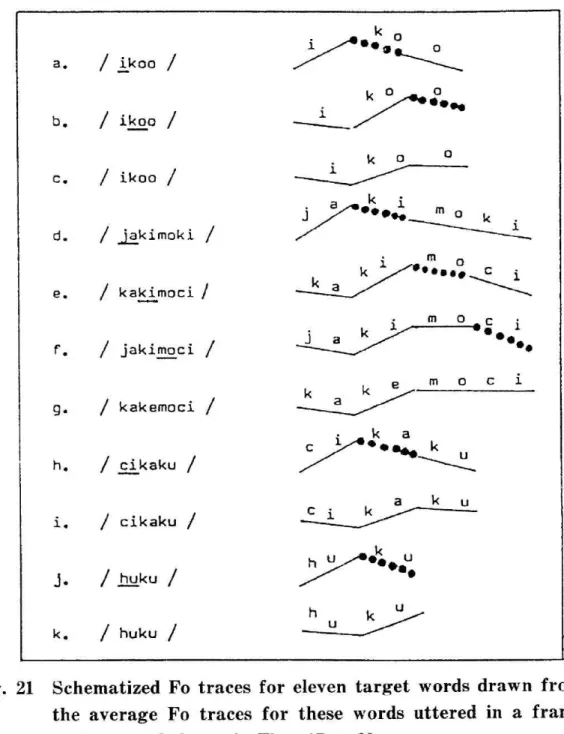
(5) Summary (see Fig. 21 below)
Sketches are given below of the Fo traces for the eleven words examined above, which illustrate, among others, the Fo movement which follows the "marked" rnora (if there is one) in the words.
k K
^e•a
k u
Fig. 21 Schematized Fo traces for eleven target words drawn from the average Fo traces for these words uttered in a frame
sentence and shown in Figs. 17 to 20
• • • : Represents the Fo movement for the mora which follows a "marked"
mora.
WORD ACCENT AND RELATED FEATURES IN JAPANESE 27 Amplitude
Figs. 13 to 16 (pp. 17 to 20), which compare the average Fo and Amplitude traces for the target words within each group , were examined to see whether the amplitude feature is also relevant in the description of Japanese accent.
Figs. 13, 15 and 16 show that, in spite of the clear differences in the Fo traces for the three target words, there is no noticeable difference at all in the amplitude traces. In fact , they are more or less identical.
Fig. 14 shows that the Fo traces for / jakimoki / and / jakimoci / are different, but the amplitude traces are not different (almost identical). The Fo traces for / kakimoci / and / kakemoci / are different and the amplitude traces are also different. But the reason for this difference is thought to be due to the difference in the vocalic elements for the second mora : [i] for the former appears to be responsible for the lower amplitude and [el for the latter for the higher amplitude. The fact that the amplitude traces for / jakimoki / and / jakimoci / are different from the traces for / ka- kimoci / and / kakemoci / is also thought to be due to the differ- ences in their segmental structure : The voiced contoid [j] for the former appears to be responsible for the higher amplitude and the voiceless contoid [k] for the latter for the lower amplitude .
The Figures also show that the amplitude for "marked" mora is not necessarily higher than the amplitude for the following mora , where the Fo starts falling sharply. In other words , a sharp descent in Fo for the mora following a "marked" mora does not necessarily accompany a sharp drop in amplitude (for this point, see Figs . 2, 3, 6, 9 and 11 as well) .
The above observations strongly suggest that the amplitude is not likely to be relevant in describing Japanese accent.
28
3.2 Head
By definition, the Head is either the first or the second mora of the first lexical item in a Tune.
There are two Heads in the Tune of this experiment. The first one is the second mora / o / of the first lexical item/moo /, the first mora / mo / being the Prehead. The second Head is either the first mora or the second mora of the eleven target words put into a frame sentence and uttered with Tune 1.
Fundamental frequency
As far as the first Head is concerned, it is clear from Figs. 2 to 12 that the Fo for the first Head / o / is higher than for the Prehead / mo / .
In order to examine the Fo feature for the second Head, the average Fo traces for the eleven words in Figs. 17 to 20 (pp. 22 to 25) were used. The traces were schematized focussing on the beginning part of the words and are given below (Fig. 22). A thick dotted line represents the Fo for the Head and a thin solid line for the morae preceding and following the Head.
The traces below clearly show that the Fo for the Head rises, without any exception, which means that the peak Fo for the Head is always higher than the Fo for the preceding mora.
Amplitude
The amplitude traces for a Head in relation to those for the preceding and following morae were examined. There was no consistent relationship of "higher amplitude for a Head than for the preceding mora." In other words, the increase in Fo for a Head, which is a consistent feature, does not necessarily accompany an increase in amplitude. In addition, no consistent ralationship was found for a Head and the following mora in respect to amplitude.
The above observations suggest that the amplitude is not likely
WORD ACCENT AND RELATED FEATURES IN JAPANESE 29
a.
b.
c.
d.
e.
r.
g.
h.
i.
i•
/ ikoo / ikoo /
ikoo /
/ j akimoki /
/ kakimoci / jakimoci / kakemoci /
/ cikaku /
/ cikaku / huku /
•• k o
(d O) ••
k
:.•
(to)
k*°'0 (to)
••
j
t^• (do)*
k. / huku /
k••45• `~—`""- i t o)
• m O
a)
keq.mo ca~t©)
ka
c•••k ak u
(d o)•.•
k a• k u (t o)
u k
(d o)---••.••u.,,o)
h k• (t 0)
el
Fig. 22
• • • •
C ):
to be
schematized average Fo traces for eleven words which focus on the Head part in the Tune
The traces were drawn from Figs. 17 to 20.
The Fo trace for the Head.
The Fo trace for the morae preceding and following the Head . The mora or morae preceding or following the target word.
relevant in the acoustic description of Head.
3.3 Unvoiced morae
In this experiment, some morae in the target words were found
30
to be completely lacking in voice, which was observed both in the wide-band and narrow-band spectrograms.
In the auditory analysis of intonation, intonation was perceived as continuous and unvoiced morae were plotted on the scale in brackets*.
It is this problem of treating unvoiced morae in an intonation contour that is dealt with in this section. The morae lacking voice were studied from an acoustic point of view, and an attempt was
made to see whether the above treatment was justified.
In the following, the lack of voice for certain morae in the target words is indicated by marking the vocalic elements with a circle underneath. A circle in brackets indicates that a little voice was present for some tokens.
moo icido ikoo
ikoo ikoo
jakimok i kakimoc i jakimoc i kakemoci cikaku cikaku huku huku
to iQte kudasai
As for the amplitude feature for unvoiced morae, this does not seem to serve to distinguish the accent of otherwise identical words. It was observed in 3.3. 1 that the Fo for the unvoiced
"marked" mora / ci / of / cikaku / (neighbourhood) was higher
* `THE PHONOLOGY OF JAPANESE SENTENCE PROSODIES' (1) -(4), JIN- BUN KENKYU 114-117 (KANAGAWA DAIGAKU JINBUN GAKKAI).
WORD ACCENT AND RELATED FEATURES IN JAPANESE 31
than for the unvoiced "unmarked" mora / ci / of / cikaku / (per - ception). However, as the amplitude traces for these words in Fig .
15, p. 19 clearly show (both are nearly identical in their traces) , they are not differentiated from each other by the amplitude feature. The same applies to / huku / and / huku / (see fig . 16, p.
20) .
As far as the Fo feature for unvoiced morae are concerned , we found in 3. 3. 1 that even when there were no harmonics present for certain morae, the Fo value for these morae was easily estimated based on the Fo characteristics for the surrounding morae , and that the whole Fo pattern thus worked out conformed to the general pattern for a Tune whose accentual patterns are the same, which means that the Fo pattern for a Tune is predectable if only we know the location of a "marked" mora in it .
Thus the way unvoiced morae were treated in the auditory analysis of intonation can be said to have strong acoustic evidence to support it.
4 Conclusions
In this experiment Accent and Head were studied for some of their acoustic correlates, using eleven words which were grouped into four according to their segmental similarities and accentual differences, which were uttered in the frame sentence ;
/ / 1 moo icido ---1 to iQte kudasai / /
Unvoiced morae in the Tune were also studied from an acoustic point of view. The following is the summary of the results obtained.
Unvoiced morae
Acoustically it was found to be possible to estimate the Fo movements for unvoiced morae by examining the movements for
32
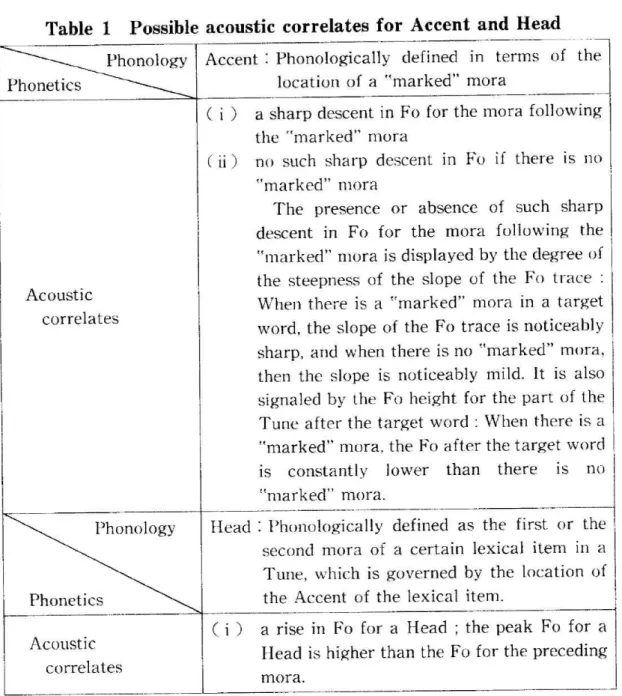
Table 1 Possible acoustic correlates for Accent and Head Phonology Accent : Phonologically defined in terms of the
Phonetics location of a "marked" mora
(i ) a sharp descent in Fo for the mora following the "marked" mora
( ii) no such sharp descent in Fo if there is no
"marked" mora
The presence or absence of such sharp descent in Fo for the mora following the
"marked" mora is displayed by the degree of the steepness of the slope of the Fo trace : Acoustic
When there is a "marked" mora in a target correlates
word, the slope of the Fo trace is noticeably sharp, and when there is no "marked" mora, then the slope is noticeably mild. It is also signaled by the Fo height for the part of the Tune after the target word : When there is a
"marked" mora
, the Fo after the target word is constantly lower than there is no
"marked" mora .
Phonology Head : Phonologically defined as the first or the second mora of a certain lexical item in a Tune, which is governed by the location of
Phonetics the Accent of the lexical item.
i ) a rise in Fo for a Head ; the peak Fo for a Acoustic
Head is higher than the Fo for the preceding correlates
mora.
the preceding and the following morae. It was also found that the whole Fo pattern, the gaps of which were filled in, conformed to the general pattern for different utterances whose accentual patterns were identical or near identical in teams of the location of a
"marked" mora .
REFERENCES
_-- (1992) [H* ril* itado-RL H--a
WORDACCENTANDRELATEDFEATURESINJAPANESE 33
53‑62(「 日 本 語 音 声 」 国 際 シ ン ポ ジ ウ ム)
杉 藤 美 代 子(198の 「ア ク セ ン ト,イ ン ト ネ ー シ ョ ン の 比 較 」 『日 英 語 比 較 講 座1音 声 と 形 態 』1U7‑183(大 修 館)
杉 藤 美 代 子(1982)『 日 本 語 ア ク セ ソ ト の 研 究 』(三 省 堂)
杉 藤 美 代 子(1990)「 日 本 語 と 英 語 の ア ク セ ン ト と イ ン ト ネ ー シ ・ ソ 」
『講 座 日 本 語 と 日 本 語 教 育3日 本 語 の 音 声 ・音 韻(下)』349‑378(明 治 書 院)
ネ ウ ス ト ゥ プ ニ ー,J.V.(1966)「 日 本 語 の ア ク セ ソ ト は 高 低 ア ク セ ソ トか 」 『音 声 学 会 会 報 』121号,1‑7
藤 崎 博 也(1989)「 日 本 語 の 音 調 の 分 析 と モ デ ル 化 一 語 ア ク セ ソ ト ・統 語 構 造 ・談 話 構 造 と 音 調 と の 関 係 一 」 『講 座 日 本 語 と 日 本 語 教 育2日 本 語 の 音 声 ・音 韻(上)』(明 治 書 院)
Abercrombie,D.(1967).Elements(ゾG醜2ηzlPh .onetics.(Edinburgh UniversityPress.)
Fry,D.B,(1968)."ProsodicPhenomena",Manualげ ノ】物o耀'ゴ6s ,ed.B.
Malmberg(North‑HollandPublishingCo.),365‑410 .
Fry,1).B.(197())."SpeechReceptionandPerception" ,NewHorizons Zy2Lガ ㎎ 雇sガ6s,ed.J.Lyons(PenguinBooks) ,29‑52.
Kubozono,H・(1992)、̀̀JapaneseProsodyandProsodicTheory"
r『 日 本 語 音 声 の 研 究 と 日 本 語 教 育 』175‑185(「 日 本 語 音 声 」 国 際 シ ン ポ ジ
ウ ム)
Ladd,D.R(1992)."CurrentTheoriesofProsody=anIntroductory
Sketch"『 日 本 語 音 声 の 研 究 と 日 本 語 教 育 』197‑206(「 日 本 語 音 声 」 国 際 シ ン ポ ジ ウ ム)
Ladefoged,P.(1982).〆1Course勿jPlzθ ηθ'ガ̀召.(HarcourtBrace Jovanovich,正nc,)
Lehiste,1.(1970).Sψ ηs69耀 η観s.(M.1.T .Press) Lovins,J・B'(1976)."PitchAccentandVowelDevoicinginJapanese:
aPreliminaryStudy",AnnualBulletinげ 漉6彪5ω π1zInstituteof lLogρ ρ64ガω(UniversityofTokyo),Nv.10,11,3‑‑125.
Weitzman,R.S.(1970).Wnrd山6θ 雇in加 伽8sθ .(AcousticPho.
neticsResearchLaboratory,UniversityofSouthernCaiifornia .)