The purpose of this study is to empirically examine the impact corporate reputation has on financial performance and determine mechanisms affect financial performance. In order to carry out the empirical research, we started by conducting a questionnaire survey in 2013 to clarify the following three questions before establishing the hypotheses for the project.
Firstly, to ascertain if most business managers in Japan place the high priority on economic value that business managers in Western countries do, or if they place importance on other types of value ― e.g., customer value, social value, and organizational value ― when they were asked about overall corporate value? Secondly, is the greatest importance placed on shareholders in Japanese companies similarly to Western countries, or is importance placed on other stakeholders? If they place importance on other stakeholders, which stakeholders do they place importance on? Thirdly, do the business managers in Japan think that good corpo-rate reputation improves financial performance?
The questionnaire survey was conducted in order to provide additional evidence for the con-clusions obtained from our interviews of many business managers in Japan. After confirming these preliminary issues, we examined the hypothesis regarding whether corporate reputation improves(or damages)financial performance.
The questionnaire survey is our group’s third examination of corporate reputation. We used the officers and executives information file in the D−VISION DATABASE of Diamond Inc. to select the recipients of our questionnaire. We selected companies with paid−in capital of 500 million yen or more, 200 or more employees. We selected controllers or financial directors for respondents. In total, 1,135 companies were selected and we sent the questionnaires to these companies on January22,2013. By the last day of February we had also sent reminder notices to survey subjects who had not replied after the deadline of February 15. This action was in-tended not only to increase the response rate but also to reduce the non−response bias. A total *Professor, School of Commerce, Senshu University
**Assistant Professor, Faculty of Business Administaration, Hokkai−Gakuen University
***Visiting Professor of Accounting, Faculty of Management and Information Sciences, Josai Interna-tional University
The Relationship between Corporate Reputation
and Financial Performance
―Empirical Analysis Research in Japanese Corporations―
1 Analysis of the 2013 Survey
In the survey we asked three main ques-tions in addition to others. The first question is whether business managers in Japan place the same level of importance on economic value as do business managers in Western countries.
1-1 What is corporate value?
The question was “What image do you have when you hear the term corporate value? Does corporate value mean only eco-nomic value? Or does it mean ecoeco-nomic value and social value? Or does it mean eco-nomic value, social value, and organizational value?” The responses(n = 157)were as fol-lows.
In order to enhance understandability we included explanations of each element : eco-nomic value, social value, and organizational value. According to the explanations, eco-nomic value is exemplified by net income, EVA, cash flow, etc. ; social value by social contribution, participation in local community activities, environmental preservation, etc. ; and organizational value by the
organiza-tional culture, the leadership of the business managers, the enthusiasm of the employees for their work, and compliance.
The results of the survey are consistent with the results of the similar survey[Aoki et al., 2010, pp.191−215]conducted in 2009 (in which89% of the respondents replied that
corporate value was comprised of economic value, social value, and organizational value). Why do business managers in Japan place importance on not only economic value but also social and organizational value? Based on our interviews with the business manag-ers, we made the inference that the reason for this may be related to the unique values of Japanese people, who value not only the shareholders but also the customers, local community and employees. We examined this question next.
1-2 What stakeholders are the focus of Japanese business managers?
In the questionnaire we asked “In your company how much importance do you place on(i)shareholders,(ii)financial institutions, (iii) customers, (iv) local community, (v)
employees, and(vi)suppliers? Please answer “5” for those items on which you place an
of 163 companies responded out of 1,135 companies(a response rate of 14.36%). We used 157companies with no missing values in the question items as the subjects of our analyses.
We also performed a comparative analysis with the 2009 survey[Aoki et al., 2010, pp.191− 215], a survey targeting CSR/IR officers, PR officers, and heads of management planning de-partments. That questionnaire was sent to 1,026 companies and 126 companies responded(a response rate of 12.3%)and the 2011 survey[Sakurai et al., 2012, pp.31−43], a survey mainly targeting heads of management planning departments. That questionnaire was sent to 1,250 companies and 186 companies responded(a response rate of 14.9%)for the survey items that are similar between both surveys.
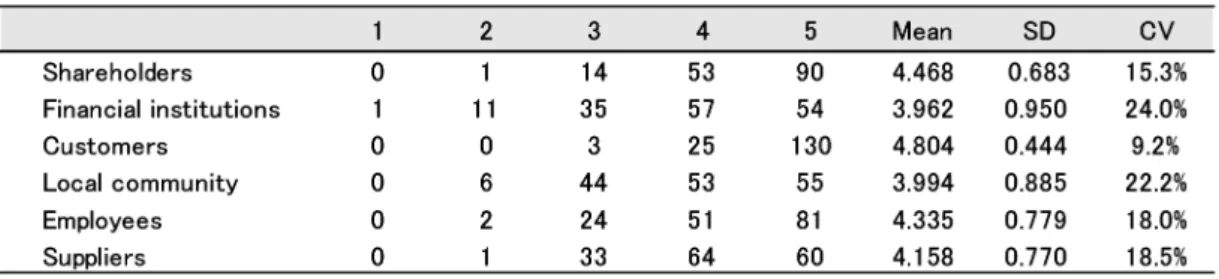
extremely high level of importance and an-swer “1” for those items on which you place no importance at all.” The results(n = 158) were as follows.
Based on Table 2, a ceiling effect1is
rec-ognized for three kinds of stakeholders : shareholders, customers, and employees.2
The survey results indicate that the stake-holders on which the business managers of Japanese enterprises place the most impor-tance are the customers, followed in order by the shareholders, the employees, the suppli-ers, the local community, and financial insti-tutions. This is consistent with the results of the 2011 survey[Sakurai et al., 2012, pp.31− 43]. According to that survey, the stakehold-ers on which the most importance was placed were the customers(4.783), followed by the shareholders(4.025), the employees (3.944), and the local community(3.447).
The CV(coefficient of variation = standard deviation / mean)was the smallest for the customers in this survey as well.
Why are shareholders not ranked number one in Japanese companies as they are in Western countries? Yoshimori[1998, pp.44− 45]classifies the concepts of the enterprises into three types. These are(i)the one−di-mensional enterprise concept primarily em-ployed in the United States and the United Kingdom which is centered on shareholder profits, (ii) the two−dimensional enterprise concept in Germany and France which seeks to realize a balance between the interests of capital and labor, and(iii)the multi−dimen-sional enterprise concept which considers the
employees to be the central interest group (stakeholders)but takes into consideration the long−term profits of other interest groups. In order to provide backing for this hypothe-sis Yoshimori interviewed 378 business man-agers from five countries, i.e., Japan, Ger-many, France, the United Kingdom, and the United States, about whose property compa-nies “are”[Yoshimori, 1998, pp.44−45]. The results were that in the United States 76% of the respondents replied that companies are the property of the shareholders(24% replied that companies were the property of other in-terest groups)whereas in Japan just 3% of business managers think that companies are the property of shareholders and the vast majority of the respondents(97%)responded that companies are for all of the interest groups. Germany and France lie in between Japan and the United States, with 83%(17% replied that companies are for shareholders) and 78%(22% replied that companies are for shareholders) of their respondents respec-tively appearing to understand that compa-nies are for the interest groups.
As we have seen above, we can conclude that many business managers in Japan hold the strong view that enterprises exist not only for the shareholders but also for the other stakeholders. They also look upon cor-porate value as a comprehensive concept en-tailing not only the economic value that shareholders place importance on but also social value and organizational value on which stakeholders place importance.
So why do Japanese companies place so
much importance on customers? Martin [2010, pp.58−65]claims that business manag-ers in the United States over the past 30 years have given the top priority to maximiz-ing shareholder value but profits for share-holders can only be realized after the com-pany makes the customers the first priority. He calls this kind of society customer capital-ism. Johnson & Johnson(J&J)places share-holders fourth behind its customers(e.g., pa-tients, doctors, and nurses), employees, and communities in its credo(corporate philoso-phy).Martin claims that this is precisely why the company was able to quickly respond to the1982Tylenol incident without concern for profits. We can also mention that there are many companies of this type in Japan too. For example, Brother Industries[Fujii, 2012, p.11]places the most importance on its cus-tomers followed by, in order, its employees, its business partners, and the local commu-nity.
1-3 Corporate reputation and financial performance
Thirdly, we asked what kind of relationship could be seen between corporate reputation and financial performance. The question was “Does improvement(or damage)of corpo-rate reputation enhance(or reduce)financial performance?” The responses(n =158)were as follows.
Slightly more Japanese managers felt that financial performance impacted corporate reputation more than an improvement in cor-porate reputation improved financial perform-ance. This is a completely opposite result to the 2011 survey(reputation → financial
per-formance, mean of 3.897; financial perform-ance → reputation, mean of3.759).
How should we interpret these results? The previous survey respondents were the heads of management planning departments. The present survey is a survey of controllers but we do not think that this difference changed the responses greatly. On the con-trary, it may be due to the limits in the ques-tionnaire survey itself. To explore this further we extended our empirical research in this area. In particular, we analyzed the behavior of business managers in Japan regarding “the impact that corporate reputation has on finan-cial performance and the mechanisms of these impacts,” for which the results of for-mer empirical research have not obtained clear conclusions in the past.
2 Literature
Looking at surveys conducted in Western countries on the relationship between various reputation indexes and financial performance, quite a few papers have succeeded in verify-ing that corporate reputation has a positive effect on financial performance. Hammond and Slocum[1996, pp.159−165]did empirical research on whether financial performance in 1981 and 1986 had a positive impact on cor-porate reputation in 1993 by using factor analysis. They found that ROS was positively associated with subsequent reputation and high ROE in 1981 is positively associated with reputation in 1993. Fortune’s reputation indices called “America’s Most Admired Cor-poration” was used as their reputation drivers. In conclusion, they pointed out that the level
of correlation between firm performance and subsequent corporate social responsibility or corporate reputation is weakly supported.
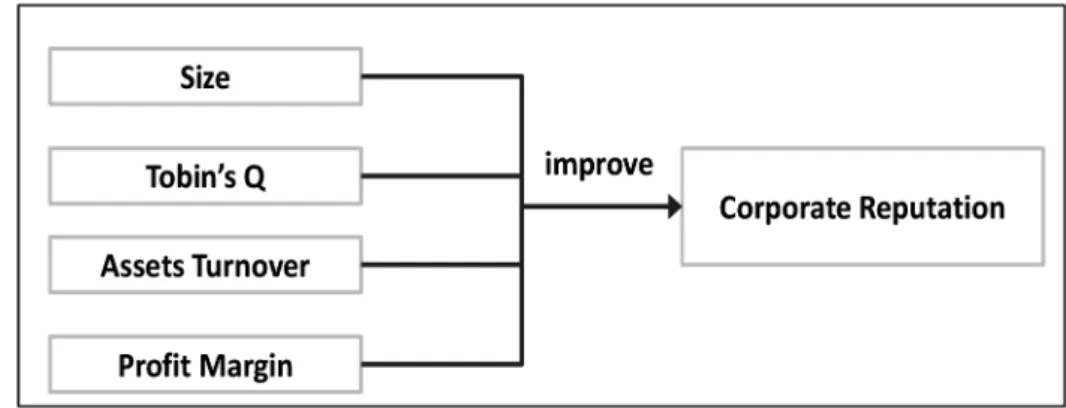
Belkaoui [2001, pp.1−13] conducted em-pirical research using size, Tobin’s Q, asset turnover, and profit margin as independent variables to examine their influence on cor-porate reputation. The research used attrib-utes of corporate reputation, namely quality of management, quality of products/services offered, innovativeness, long−term invest-ment, soundness of financial position, ability to attract/develop/keep talented people, re-sponsibility to the community/the environ-ment, and wise use of corporate assets, as dependent variables. The research results showed, as discussed in Sakurai[2005, pp.51 −59],that all of the variables improved corpo-rate reputation. The dependent variables used by Belkaoui are taken from Fortune magazine reputation index 1987 and 1988 survey, covering 300 and 306 firms for the “Most Admired Companies” at that time.3
See Figure1.
Fombrun and Shanley[1990, pp.233−258] pointed out the difficulty in directly connect-ing improvement in corporate reputation to improvement of financial performance. Since then, this view became the common view in the academic world. Later, Fombrun and van Riel[2004, p.27]introduced Bharadwaj’s re-sults from a survey targeting 125 American
manufacturers, showing that corporate repu-tation has major influence on operating in-come.
Even if a company’s reputation improves in the short term, it is unlikely that the im-provement would immediately be reflected in the company’s financial performance. Roberts and Dowling[2002, pp.1077−1093], utilizing Fortune’s “Most Admired Companies” survey data from 1984 to 1998, discovered that com-panies with comparatively good reputations can sustain higher profits over the long term. The independent variables used were the evaluation attributes used by Fortune at the time : asset use, community and environ-mental friendship, ability to develop and keep key people, financial soundness, degree of in-novativeness, investment value, management quality, and product quality. See Figure 2 [Robert and Dowling,2002, p.1078].
Carmeli and Tishler[2005]analyzed the correlation between corporate reputation and financial performance by using path analysis. They succeeded in finding that organizational reputation positively impacts financial per-formance. However, they cannot verify that increase in products/services quality and customer satisfaction affects financial per-formance positively. They concluded that top management should not expect short term return based on reputation. Rather, they need to acknowledge that building reputation
as a strategic resource and positioning it as a sustainable competitive advantage.
Can the improvement of corporate reputa-tion also improve financial performance in the short term? A study by Rose and Thom-sen[2004, pp.201−210]using the empirical data of Danish companies could not identify a significant influence of corporate reputation on what they called firm value(the market to book value of equity). However, they found that the quality of financial perform-ance had major influence on corporate repu-tation even in the short term.
Graham and Bansal [2007, pp.189−200] studied the relationship between perform-ance and reputation of airline companies us-ing MBA students as respondents. This re-search surveyed the influence of(1)return on equity (ROE),(2) the endorsement of the US Federal Aviation Administration (FAA),(3)size,(4)company age, and(5)
crash history, on the willingness to pay air-line fees. The results indicate that FAA en-dorsement, size, and company age directly or indirectly influence consumers’ willingness to pay airline fees. The endorsement of the FAA had the highest influence on reputation and the survey showed that consumers were will-ing to pay 36 dollars extra if the FAA could endorse the safety of the business. It is highly significant that, not as a general the-ory, but in the specific industry of airlines, it
was made clear that corporate reputation has influence on financial performance.
Looking at Japanese empirical research Iwata et al.[2009]found that six RQ factors such as workplace environment, vision and leadership, products and services, CSR, and investment appeal contribute to raising cor-porate reputation by using factor analysis. Ito et al.[2011, pp.15−40]did empirical research by using RepTrakTM which is reputation
driv-ers developed by Reputation Institute since 2005. This empirical research verified if such twenty three reputation drivers could contrib-ute to increase such financial performance as stock price, profit, cash flow and others for the period of 6 years before bankruptcy of Lehman Brothers. As a result, we(Ito and Sakurai)proved that high corporate reputa-tion contribute to raising financial perform-ance even in the long run in Japan. In addi-tion, Iwata[2012]found that there are statis-tically significant differences in PBR, D/E, ROA and EPS between those companies en-joying high vs. low financial performance by using confirmatory factor analysis, t−test and Wilcoxon signed−rank test.
In this paper, we investigate whether the factors raising corporate reputation improve financial performance by using factor analysis and covariance structure analysis. The major goal of this research is to challenge a rather difficult test of whether corporate reputation
actually improves financial performance in the short period of time.
3 Research Data and Basic Model This is our second empirical study of cor-porate reputation following on from our study in 2011[Ito et al., 2011, pp.15−40]. Based on our experience in the previous survey, we made five major changes from the previous survey this time. First, we focused identifica-tion of constituent factors of corporate value. Second, in the previous survey we utilized in-dicators unique to Japan for some of the indi-cators evaluating reputation but this time we used RepTrakTM
with a few additions. Third, in the previous survey we used the dimen-sions of RepTrakTMas the subjects of the
sur-vey but this time, we used its attributes at this time. Fourth, we used return on assets (ROA)as a performance indicator to deter-mine the relationship between corporate reputation and financial performance. And fifth, in the 2011 survey we mainly asked the heads of management planning departments whereas in the2013survey we asked control-lers to respond.
3-1 Data
In this study, with the objective of survey-ing the perceptions of the business managers of major companies in Japan regarding the relationship between corporate reputation and financial performance, we surveyed 1,135 companies. Surveys were sent by mail to the controllers or CFO and we received 163 responses (valid response rate of 14.36%)from January 22, 2013 to February 28, 2013. There were 157 companies with no
missing values in the question items.
When performing the analyses we used the RepTrakTM
attributes as the indicators for evaluating corporate reputation. RepTrakTM
is comprised of the following seven dimensions (or reputation drivers)and23attributes.
Dimensions : products/services, innovation,
performance, leadership, corporate governance, citizenship, and work-place
Attributes : high quality, value for money, stands behind, meets customer needs, innovative, first to market, adapts quickly to change, profitable, high− performing, strong growth prospects, well organized, appealing leader, ex-cellent management, clear vision for its future, open and transparent, be-haves ethically, fair in the way it does business, environmentally responsible, supports good causes, positive influ-ence on society, rewards employees fairly, employee well−being, offers equal opportunities
In this survey we used the following 23 plus 3 attributes. The difference between RepTrakTM and our survey is that in the
pre-sent survey we added the following three items ― the corporate philosophy is well es-tablished, the company is highly trusted by customers, the company is highly favored by consumers ― as attributes. The reason for this is based on past case studies[Sakurai, 2008, pp.262−386] of five companies ― Kanebo, Panasonic, YKK, Shimadzu Corpora-tion, and Toyota ― which indicate that inser-tion of the above three attributes was essen-tial when including Japanese companies as attributes.
3-2 Basic model
Social responsibility is required of compa-nies. To achieve this, it is necessary for the company to improve its compliance by being open and transparent, behaving ethically, and being fair in the way it does business. In ad-dition, it is required to be environmentally re-sponsible, support good causes, and have a positive influence on society. All of these fac-tors improve social value.
It is also necessary for companies to pro-vide products and services which satisfy their customers. Of course the products and serv-ices should be high quality, but it is also im-portant for the company to provide products that offer a complete value proposition for customers, to work hard to stand behind the products, and to satisfy customer needs. Moreover, innovative products/services, be-ing first to market, and appropriate sponses to environmental change are re-quired. All of these factors improve customer value, and therefore improve social value and economic value.
In Japanese companies as well as Western counterparts, the bottom line of companies depends on high performance. Being
profit-able, and high−performing, and having strong growth prospects all improve eco-nomic value.
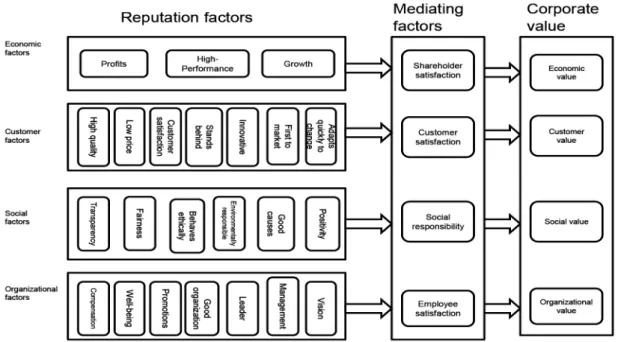
The basic model to express the proposed relationship between corporate reputation and corporate value may be seen in Figure 3. This basic model was created by applying the basic conceptual model of the strategy map proposed by Kaplan and Norton[2001]. How should we understand the relation-ships between organizational value, social value, customer value, and economic value in Figure 3? Under our hypothesis, when or-ganizational value improves(e.g., the incen-tive to work of the employees improves due to high compensation and well−being)social value improves(e.g., social status as well as orders, sales and profits improve when an employee at Shimadzu Corporation won a Nobel Prize). When social value improves, customer value(e.g., products and services that have outstanding high quality)improves. When customer value improves economic value improves. We assumed that if eco-nomic value improves financial performance will improve. In other words, we propose that
the impact of relationships start from organ-izational value to social value, then to cus-tomer value and, finally, from cuscus-tomer value to economic value. Figure 4 is a diagram-matic representation of these relationships.
3-3 Hypotheses and their Analysis
We use the basic model in Figure 3 and the relationships in Figure 4 to examine the following hypotheses :
Hypothesis 1: The constituent elements of corporate reputation are comprised of organizational value, social value, cus-tomer value, and economic value. Hypothesis 2: Organizational value has an
effect on social value, social value has an effect on customer value, and cus-tomer value has an effect on economic value.
Hypothesis 3: Improving corporate reputa-tion is effective for improvement of fi-nancial performance.
A)Verification of hypotheses 1 and 2 We used RepTrakTM
to examine hypothe-ses 1 and 2. We performed a factor analysis and a covariance structure analysis. First, we performed a factor analysis of the 26 attrib-utes related to reputation. However, we were not able to identify the factors with this analysis. Therefore, we performed another factor analysis of 23 attributes. Based on the results of this second factor analysis, we ex-amined the hypotheses about the causal rela-tionships among the factors using a covari-ance structure analysis.
Step 1 : Analysis using a factor analysis
We carried out a factor analysis based on the results of a survey of the 23attributes us-ing a five−point Likert scale. When we car-ried out an exploratory factor analysis to en-sure that the factor loadings would reach 0.4 or more, we were able to identify five factors as shown in Table4.
The first factor is comprised of five attrib-utes including two attribattrib-utes related to the citizenship dimension and three attributes re-lated to the workplace dimension. Therefore, we attached the label “workplace and citizen-ship” to the first factor.
The second factor is comprised of four at-tributes related to the leadership dimension. Therefore, we attach the label “leadership” to the second factor.
The third factor is comprised of six attrib-utes including two attribattrib-utes related to the compliance dimension and four attributes re-lated to the products/services dimension. Therefore, we attach the label “products/ services and compliance” to the third factor.
The fourth factor is comprised of two at-tributes arising from the performance dimen-sion. Therefore, we attach the label “perform-ance” to the fourth factor. Performance, in this paper, means the perception of financial performance.
The fifth factor is comprised of three at-tributes related to the innovation dimension in RepTrakTM
.
As a result of factor analysis, three vari-ables, S910(future growth)can be expected, S915(engaged in open and transparent cor-porate activities), and S918(strong environ-mental responsibility) did not load on any identified factors.
Note that with “products/services and compliance,” the third factor, there is a
ing effect, so statistically speaking this factor should not be used in the factor analysis we perform next. However, “products/services and compliance” is a factor closely involved in customer value so it is an important factor for examination of the hypotheses, which is the objective of this study. Therefore, we continue the analysis including this factor too. Step 2 Verification of the hypotheses using a covariance structure analysis
We performed a covariance structure analysis on the five factors we identified from the factor analysis to explore the causal rela-tionships. The results showed that the fifth factor, innovation, was not statistically
signifi-cant. For this reason, we excluded the three attributes related to innovation ― innovative, first to market, adapts quickly to change ― from the analysis and performed the covari-ance structure analysis of the four factors us-ing AMOS. This reduced the number of at-tributes to 20rather than23. There are three possible reasons why the three attributes re-lated to innovation were excluded. The first is that we asked the questions to controllers who are in charge of work that is mainly separate from innovation. If we had asked the questions to executives in charge of tech-nology we may have obtained different an-swers. Second, typical Japanese could not af-ford to invest vast amount of money into in-novative product and services because of
pressive economy over twenty years. The third reason is that we can interpret the re-sults as reflecting the reality that in Western countries importance is placed on innovation by companies whereas Japanese companies pay a lot of lip service to the importance of innovation without placing so much impor-tance on it in practice.
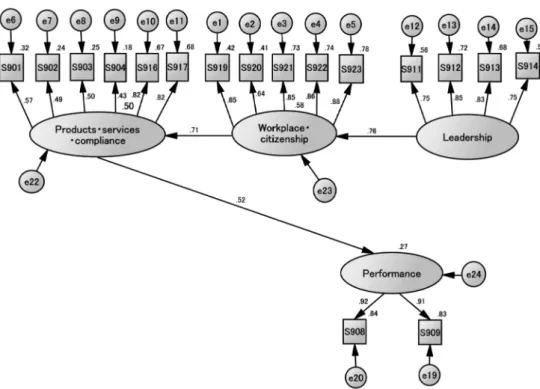
In order to perform the covariance struc-ture analysis we established a hypothetical model stating that “leadership” has an effect on “workplace and citizenship,” “workplace and citizenship” has an effect on “products/ services and compliance,” and “products/ services and compliance” has an effect on “performance.” The results of the analysis we performed based on these relationships are shown in diagrammatical form in Figure 5. The figures in Figure 5 are standardized es-timates. The goodness of fit of this model is CFI =0.891and RMSEA = 0.091. The model is said to fit when the CFI is 0.9 or higher
and the RMSEA is0.1or lower so the CFI is a little low by this standard but it can be con-cluded that the model fits.
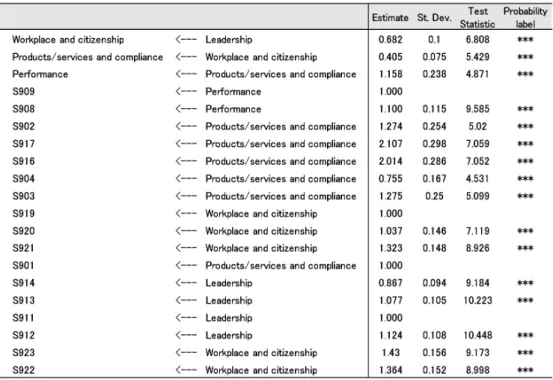
The standardized estimates are shown in Table5. From Table 5 we can see that all of the variables are significant. Therefore next we calculated the standardized coefficient in Table 6. From Table 6 we can see that “leadership” has an effect of 0.763 on “work-place and citizenship,” “work“work-place and citi-zenship” has an effect of0.707 on “products/ services and compliance,” and “products/ services and compliance” has an effect of 0.515on “performance.”
Incidentally, leadership and workplace are closely related with organizational value. Citi-zenship and compliance are related with so-cial value. Products/services express cus-tomer value. Performance, which is formed from the attributes of being profitable and high−performance and having strong growth prospects, can safely be replaced with
Table 5 Standardized Estimates of the Causal Model
nomic value.
After making this replacement and consid-ering our initial Hypothesis 1, we obtained the result that “the constituent elements of corporate reputation are formed from organ-izational value, social value, customer value, and economic value.” These results verify the hypothesis that the corporate value of corpo-rate reputation is formed from organizational value, social value, customer value, and eco-nomic value.
Furthermore, the hypothesis in Hypothesis 2 that “organizational value has an effect on social value, social value has an effect on cus-tomer value, and cuscus-tomer value has an ef-fect on economic value” was also verified at the same time.
B)Examination of Hypothesis 3
Regarding Hypothesis 3, we limited the companies to those which responded to all of the questions in Question Form 9 of the questionnaire survey created based on Rep-TrakTM
, and we excluded financial institutions and those companies that did not disclose their company names. This left 139 compa-nies in the analysis. We calculated the ROA (net profit divided by total assets)of the 139
companies based on their securities reports. This approach enabled us to evaluate
per-formance regardless of the size of the com-pany. Furthermore, we excluded financial in-stitutions because we could not calculate their ROA in Japan.
When examining hypothesis 3, in the re-sponses to the corporate reputation indica-tors we used mean ROA to rank the top ten companies and bottom ten companies. Then, we randomly extracted ten companies in the same industry from a different data set and with a similar business description to the ten top−ranked companies. After this we per-formed a comparative study of the ROA of ten randomly−extracted companies in the same industry against the ten top−ranked surveyed companies ranked by reputation in-dicators. The results are as shown in Table 7.
The mean ROA of the top−ranked compa-nies was 3.42% and the corresponding mean ROA of the other companies in the same in-dustry was2.33%.
Similarly, we randomly extracted ten com-panies in the same industry and with a busi-ness description similar to the ten bottom− ranked companies. After this we performed a similar comparative study of the ROAs. The results are as shown in Table8.
The mean ROA of the bottom−ranked com-panies was 2.52% and the corresponding
Table 7 ROA of the Top−Ranked companies and other companies in the Same Industry
mean ROA of the other companies in the same industry was2.92%.
From the above results, the top−ranked companies had a higher mean than the other randomly−extracted companies in the same industry and the bottom−ranked companies had a lower mean than the companies in the same industry. We compared the differences with t−tests of the following hypotheses :
Hypothesis 3−1: There is no difference between the mean ROA of the top− ranked companies and the mean ROA of the other companies in the same in-dustry.
Hypothesis 3−2: There is no difference between the mean ROA of the bottom −ranked companies and the mean ROA of the other companies in the same industry.
Neither hypothesis was rejected. So we reached the result that “there is a possibility that if importance is placed on reputation in-dicators then ROA shows a tendency to be higher compared to general companies and if reputation indicators are viewed as unimpor-tant then ROA shows a tendency to be lower compared to general companies.”
4 Conclusions and Limitations The purpose of this study is to empirically examine the impact corporate reputation has on performance and what kinds of mecha-nisms change performance. In order to achieve this purpose we carried out a ques-tionnaire survey mainly targeted at the con-trollers or CFO of companies listed on the First Section of the Tokyo Stock Exchange. Based on that questionnaire survey, we first used a factor analysis to identify the common factors hidden in the multivariate data. Then we performed a covariance structure analysis based on the obtained factors to reveal the mechanisms by which corporate reputation
creates corporate value. However, we did not obtain a statistically significant result show-ing that improvement(or damage)of corpo-rate reputation enhances(or reduces)per-formance.
4-1 Findings discovered by this research
Typically there are three views regarding how to think of corporate value. The first is the view centered on economic value that is primarily endorsed by business managers in the United States, the second is the view of shared value that was proposed by Porter and Kramer[2011, pp.62−77]and now is the basic concept behind Integrated Reporting, and the third is the view one of us have been advocating since 2005 ― corporate value is composed of economic value, social value, and organizational value [Sakurai, 2005, p.105; Sakurai, 2008, pp.92−93; Sakurai, 2011, pp.60−69]. In our view, the importance of customer value has been sufficiently rec-ognized previously, but customer value was included in a part of social value. We exam-ined the validity of this concept using the re-sults from the covariance structure analysis implemented in 2011. Therefore, before start-ing the 2013 research, we had previously ex-amined the hypotheses that the mechanisms by which corporate reputation creates corpo-rate value are comprised of the relationships among organizational value, social value, and economic value, and those relationships are that organizational value has an effect on so-cial value and soso-cial value has an effect on economic value.
value in terms of the relationships between organizational value, social value, customer value, and economic value was so clearly shown by the present factor analysis made us decide to change our basic assumptions.
In this survey, when evaluating corporate reputation, we basically used RepTrakTM
in order to improve international comparability. However, in addition to the 23 items which are the RepTrakTM
attributes, we added the three attributes, i.e., “the corporate philoso-phy is well established,” “the company is highly trusted by customers,” and “the com-pany is highly favored by consumers” when performing the factor analysis, in order to in-corporate the characteristics of Japanese companies in the analysis.
The first finding discovered by this study is given by verifying hypothesis1. As a result of factor analysis we found five factors ; lead-ership(organizational value), workplace and citizenship (organizational value and social value), products/services and compliance (customer value and social value)and per-formance (economic value). These factors comprise the constituent factors of corporate value and this finding led to assumption1.
The second finding is given by verifying hypothesis 2. As a result of covariance struc-ture analysis we found that organizational value has an effect on social value, social value has an effect on customer value and customer value has an effect on economic value. Thus, we verified hypothesis 2 on a causal model of corporate reputation. How-ever, innovation could not be verified as sta-tistically significant in our covariance struc-ture analysis.
In the analysis of whether improvement (or damage) of corporate reputation en-hances(or reduces)performance, an impor-tant point is what performance indicators to select. Sakurai and others(2012)has suc-ceeded in verified to find statistically signifi-cant relationship between reputation drivers and such multiple financial performances as
sales, operating income, cash flow and ROI in their empirical research. With comparabil-ity in mind we selected ROA this time. We did not select ROE because we thought that in this case it was important to consider prof-itability for all of the stakeholders. However, when selecting ROA, the problem related to international comparisons is that the ROA of Japan in recent years was extremely low. The mean of the ten top−ranked companies in terms of managing their businesses with respect for corporate reputation was 3.42% whereas the mean for the ten bottom−ranked companies was 2.52%. Next, we measured ROA of top−ranked10companies and bottom −ranked10companies and compute mean for each. Then, the t−tests were not significantly different.
From the above results, we could not sup-port hypothesis 3, i.e., “Improving corporate reputation is effective for improvement of performance.” However, we found that if im-portance is placed on reputation indicators then ROA is slightly higher compared to gen-eral companies and if reputation indicators are viewed as unimportant then ROA is slightly lower compared to general compa-nies.”
4-2 Limitations of this study
Firstly, in the results obtained from the questionnaire survey a ceiling effect was rec-ognized with the “products/services and compliance” factor mainly related to custom-ers. However, we think that this factor relat-ing to customer value is an important vari-able for this study, so we ignored the ceiling effect and treated it as one of the factors in the analysis.
sig-nificant statistically.
Thirdly, we excluded innovation, one of the factors, from the covariance structure analysis because innovation was not statisti-cally significant in our analysis. However, we found that innovation is one of the most im-portant factors from our factor analysis. We will continue to do research on the relation-ship between innovation and financial per-formance, importance of innovation in the mechanism of creating corporate reputation in our next survey.
References
Aoki, A., H. Iwata and M. Sakurai.(2010)‘Man-agement Perception of Reputation Manage-ment : analysis of questionnaire research from the viewpoint of management accounting’, in Final Report of the Japan Accounting Associa-tion Study Group(eds.), Management Account-ing of the Intangibles : With a Focus on Corpo-rate Reputation, Proceeding of 69th Annual Meeting of Japan Accounting Association. Belkaoui, A.R.(2001)The Role of Corporate
Repu-tation for Multinational Firms : Accounting, Organizational, and Market Considerations. Quorum Books.
Carmeli, A. and A. Tishler.(2005)‘Perceived Or-ganizational Reputation and OrOr-ganizational Per-formance : An Empirical Investigation of In-dustrial Enterprises’, Corporate Reputation Re-view, 8(1),pp.13−30.
Fombrun, C.J. and M. Shanley.(1990)‘What’s in a Name? Reputation Building and Corporate Strategy’, Academy of Management Journal, 33 (2), pp.233−258.
Fombrun, C.J. and C.B.M. van Riel.(2004)Fame & Fortune : How Successful Companies Build Winning Reputations. Financial Times.
Fujii, M. (2012) ‘Management Accounting of Brother Industries, LTD.’, Melco Journal of Management Accounting Research, 5(2), pp.9− 13.
Graham, M. and P. Bansal.(2007)‘Consumers’ Willingness to Pay for Corporate Reputation : The Context of Airline Companies’, Corporate Reputation Review,10(3), pp.189−200.
Hammond, S.A. and J.W. Slocum.(1996)‘The Im-pact of Prior Firm Financial Performance on Subsequent Corporate Reputation’, Journal of
Business Ethics,15(2), pp.159−165.
Ito, K.(2000)Corporate Brand Management, Ni-hon Keizai Shinbun−sha, Inc.
Ito, K, K. Ito, S. Shinmura, and M. Sakurai. (2011)‘Analysis of Research Result on Reputa-tion Management Based on Empirical Studies’, Senshu Shogaku Ronshu,93, pp.15−40.
Iwata, H., A. Aoki and M. Sakurai.(2009)‘From Measurement of Corporate Reputation to Man-agement’, Accounting,61(7), pp.151−159. Iwata, H.(2012)‘The Relationship between
Cor-porate Reputation and Financial Performance : The Japanese Perspective’, Senshu manage-ment journal,2(2), pp.13−22.
Kaplan, R.S. and D.P. Norton.(2001)The Strategy −Focused Organization : How Balanced Score-card Companies Thrive in the New Business En-vironment. Harvard Business School Press. Martin, R.(2010)‘The Age of Customer
Capital-ism’, Harvard Business Review, 88(1/2), pp.58− 65.
Porter, M. E. and M.R. Kramer.(2011)‘Creating Shared Value’, Harvard Business Review, 89 (1/2), pp.62−77.
Roberts, P.W. and G.R. Dowling.(2002)‘Corpo-rate Reputation and Sustained Superior Finan-cial Performance’, Strategic Management Jour-nal,23(12), pp.1077−1093.
Rose, C. and S. Thomsen.(2004)‘The Impact of Corporate Reputation on Performance : Some Danish Evidence’, European Management Jour-nal,22(2), pp.201−210.
Sakurai, M.(2005)Corporate Reputation : Manag-ing Corporate Reputation, Chuokeizai−sha, Inc. Sakurai, M. (2008) Reputation Management :
Management of Corporation through Internal Control, Management Accounting and Auditing. Chuokeizai−sha, Inc.
Sakurai, M.(2011)Measuring and Managing Cor-porate Reputation : Theory and Case Studies of Corporate Reputation. Dobunkan Shuppan. Co., Ltd.
Sakurai, M, K. Ito, K. Ito and S. Shinmura.(2012) ‘The Influence of Corporate Reputation on Cor-porate Value : Based on Empirical Research Results’, Senshu Management Journal, 2(2), pp.31−43.
1 In our questionnaire we used five points Likert scale method and ceiling effect can be seen in customer, shareholder and employee. For ex-ample, SD(4.804)+SD(0.444)>5 in cus-tomer.
2 Japanese companies currently place the most importance on customers, employees, and shareholders. Ito[2000, pp.65−66]claims that these three should be respected as the Golden Triangle from the standpoint of corporate brand management.